Ethnic groups, social classes, peoples, civilizations, religions, and nations do not engage in conflict or strategic interaction – organizations do. When Samuel Huntington tells us that civilizations clash, he is merely informing us that there are organizations (states and non-states alike) that are engaged in conflict across what he believes to be borders of civilizations.Footnote 1 When Marxists talk of class revolt, they envision it as instigated by a dedicated organization that mobilizes the toiling masses. As any close observer of civil war will tell you, ethnic groups rarely fight each other en masse – organizations, which are either ad hoc or extensions of existing social structures, use an ethnic agenda to attract some members and wage conflict in their name.
Engaging in armed conflict consists of performing a number of essential operations, such as co-ordination, mobilization, and the manipulation of information, to undermine rivals within a contested territory. Amorphous entities such as civilizations, ethnic groups, or the masses cannot perform such operations – only organizations can do so. To say that a certain conflict pits a politicized group against another is to use shorthand to indicate that organizations that recruit from among those groups, and that claim to represent the interests of members of the group, are engaged in conflict. It is perfectly reasonable to use shorthand, but its use distracts the analyst from focusing on the mechanisms that best explain how conflicts begin, evolve, and conclude. It may also mislead humanitarian workers in the field.
When masses of people take to the street to protest the rule of tyrants, they are either organized or motivated by a combination of social, religious, and political organizations (for example, the Iranian Revolution of 1979) or self-organized through technologies that allow for co-ordination and the processing of information, or both (as with some of the recent revolutions in the Arab world). These revolts have a dynamic that is different from those of armed organizations that I focus on in this article. Non-violent mass revolts aim to bring fissures in the institutions of the state or occupier that would lead to their collapse or withdrawal. Their core strategy fails when those participating in the uprising use arms. When they do use violence, they fall under the category of groups I consider here. Such is the case, for example, of the 2011 popular revolt against the rule of Muammar al-Gaddafi in Libya, where non-violent protests transmuted into a civil war after the government mercilessly clamped down on the opposition.
One way to understand the strategies of armed groups, including their desire and ability to engage in peace negotiations, is to look at what the distribution of power (organizational structure) within them allows them to do. The organizational structures of armed groups, whether they develop by accident or by design, affect their strategic choices and performance during the conflict, as well as their ability to enter peace agreements. Only centralized organizations can make use of sophisticated strategies such as ‘divide and conquer’, ‘co-option’, and ‘hearts and minds’, and can engage in successful peace agreements, if they have a safe haven. Centralized armed organizations that do not have a safe haven within the contested territory tend to be very vulnerable, however, which makes peace less attractive to their opponents and explains in part why long-lasting peace agreements are rare. Decentralized organizations are more resilient than centralized ones in the absence of a safe haven but are incapable of making use of sophisticated strategies or engaging in peace because of the inability of the leadership to enforce the necessary discipline on the rank and file and because of other structural limitations that I explain below.
How organizational structures develop
Some organizations are shaped by pre-existing societal ties while others are developed by political entrepreneurs to maximize their organization's probability of success or to achieve personal gains in areas where societal structures are weak. The two patterns generally develop simultaneously in recently politicized societies. Political mobilization takes place along traditional socio-structural lines, where those exist, because they minimize the cost of convincing people to develop new loyalties and patterns of accountability and reduce resistance from those who would lose influence from their development.Footnote 2
Traditional patterns of authority, such as those typical of tribe and clan, often do not reach into urbanized areas and refugee camps, which provides an opening for entrepreneurial militants to forge new ones based on loyalty to their organizations.Footnote 3 If society is atomized (lacking well-developed social structures that the government needs to deal with one way or another), as in many previously communist countries, entrepreneurs become essential for the formation of any political organization.Footnote 4 Traditional and entrepreneurial political organizations have major structural differences that give them distinct advantages and disadvantages in different circumstances. Entrepreneurial political organizations are likely to be more centralized, aggressive, and integrated than traditional ones, which often rely on loose patron–client relations and are more reactive to local infringements on their authority but lack a coherent overall strategy. Traditional and ad hoc types of organizations often coexist, but organizations whose structural features best suit the conditions of the conflict ultimately prevail.
The structure of traditional organizations is grounded in the existing social structure and often emulates it, with minor variations that might become amplified with the passage of time. One observer of a meeting of the men in charge of defending a Kosovar village (part of the loose structure of the Kosovo Liberation Army) found them seated in the traditional way: the village elder was flanked by two distinguished figures, the most educated among the villagers (a tradition) and the commander of the armed villagers (the innovation in this case).Footnote 5 The longer the war, the more important the role of the fighters becomes (as opposed to the traditional elders), but the new allegiances are likely to mimic old ones – a phenomenon that is also illustrated by the Afghan shift from clans to clan-like fighting units centred around field commanders during the jihad.Footnote 6
Those who engineer ad hoc organizations have a greater ability to structure them to maximize their own power within them, while still giving the organization a chance to succeed. This universal trade-off between the power of the organizational entrepreneur and the potential of the organization to succeed explains why so many entrepreneurial revolutionary organizations are similarly structured, even if they differ in every other respect. It is indeed no coincidence that the Islamist Hekmatyar's party in Afghanistan was structured similarly to many Marxist organizations, or that European parties in the first half of the last century engaged in what Maurice Duverger calls ‘contagious organization’.Footnote 7
Sometimes organizations in a colonized society try to imitate the structure of their occupiers despite lacking the necessary skills, numbers, and resources. Societal leaders who believe that they can acquire the strength of their occupiers by mimicking their organizational structure generally discover the flaw in their reasoning at great cost, as Charles Callwell, the seasoned British colonial officer and small-war theorist, observed in his discussion of the Russian route of Central Asian resistance during the insurgencies of the early twentieth century.Footnote 8 More extreme examples are provided by armies established by weak non-European leaders in awe of European colonizers at the end of the nineteenth century. The British easily defeated the forces of Urabi Pasha in 1882 in Egypt, and the French did the same to Chinese troops they confronted in 1884–1885. Both forces were ironically organized by their leaders in imitation of how European powers organized their militaries in hopes of providing a deterrent for colonizers and other foes. Their performance pales when compared with that of the traditionally organized Algerians and Afghans in reaction to the same colonizers. Once again, Callwell's extensive experience proves pertinent: ‘It is an undoubted fact indeed that the more nearly the enemy approximates in system to the European model, the less marked is the strategical advantage he enjoys’.Footnote 9
Shifting circumstances during conflict impose new trade-offs on members of rival organizations. Sometimes the growing influence of new ideas influences organizational change. For example, Ibn Saud formed the Ikhwan (brotherhood) after embracing the purist understanding of Islam of the Wahhabis and there were many ill-fated imitations of Che Guevara's and Fidel Castro's organizational models by other South American revolutionaries.Footnote 10 More often, however, change happens because those at the helm of an organization and their rivals within and outside the organization attempt to affect the organization's structure to increase their power within or over it.
Resources are important for individuals wishing to restructure organizations. Duverger tells us that organizations financed by their rank and file are much more decentralized than those that feature a leadership with a monopoly on financial or other essential resources.Footnote 11 Although this is not always true, those who control the flow of money gain some leverage in modifying organizational structure to increase their influence or to achieve other goals. Sometimes they can completely reshape the organization to maximize their power. And foreign sponsors encourage centralization of structure by giving their aid to the leaders they favour because they recognize that this facilitates their control over the organization. This happened, for example, when Israel decided to channel all aid to southern Sudanese rebels through Joseph Lagu, the Anya Nya leader, who then eliminated all competition in the movement with the help of his newly mustered resources, starting in 1969.Footnote 12 Another example is the failed British effort to unify Albanian resistance leaders who detested one another during World War II.Footnote 13 Shifts in power among relevant actors motivate the continuous deal-making and compromises that cause the generally slow, but sometimes brutal, metamorphosis of organizational structures.
Types and performance of organizational structure
In this section I consider six basic organizational structures (ways that power can be distributed within and among organizations): centralized, decentralized, networked, patron–client, multiple, and fragmented. Centralization is the measure of distribution of power over decision-making among the top-tier leadership and second-level or subsequent cadres within the organization. Decision-making deals with formulation of strategy, making appointments, distribution of resources, control of communication, and enforcing discipline. Second-level cadres (e.g. field commanders, village leaders, imams of mosques, heads of associations) can only make such decisions for local matters, while the top leadership can be decisive on both the local and organizational levels. The more control that second-level or subsequent cadres wield over the formulation of local strategy and other decisions, the more decentralized the organization.
The idea of ‘networked’ organizations (autonomous fluid units without a hierarchical structure) has gained traction as analysts have scrambled to find tools to study transnational militant organizations such as Al Qaeda. In the context of territorial conflicts, however, the concept makes little sense because the ubiquitous existence of a leadership, even when the units are very autonomous, makes the organization similar to other decentralized ones. If the mostly autonomous units have a low exit cost (leaving the organization is not too difficult or costly), then the organization can be modelled as one based on patronage.Footnote 14
A patron–client relationship is one of exchange, in which a party (the patron) allocates a resource or is capable of providing a service to another party (the client) who needs it and is ready to exchange temporary loyalty, general support, and assistance for it. It is considerably easier for a client to exit a relationship with a patron than for a regular agent to do the same with his principal. To illustrate this with familiar terms from the corporate world, a client is analogous to a contractor and an agent to an employee. Although some consider patron–client relations to be attributes of some cultures, I consider them to be structural links that can exist within any organization. We encounter them in traditional societies such as Afghanistan and Yemen as well as in the modern American military's heavy reliance on contractors.
The two other dimensions of organization are movement-specific and only applicable to challengers to the powers that be. Some conflicts feature one independent challenger, some multiple independent challengers (two to four organizations), and others a fragmented opposition (five or more organizations). I decided on the cut-off between multiplicity and fragmentation after noticing a different dynamic in qualitative case studies once the number of organizations exceeds four – this is the empirical point of transition from competition with specific rivals to positioning the organization within a nearly atomized movement.Footnote 15 What makes an organization independent is that its rank and file is bound to its leadership, and no other leadership, as agents or clients. If the incumbent (the government or occupier) has no organized challengers, then opposition is atomized for our purposes. Atomized opposition movements do not produce sustained militant opposition, though they may very well topple regimes through non-violent means.
The safe haven contingency
The contingency that decisively influences how structure affects performance is the organization's control of a territorial safe haven – a portion of the contested territory where an organization's rivals cannot intervene with enough force to disturb its operations. A safe haven is important because each organization in conflict must perform critical operations well, and perform most of them better than the competition, to have a good chance of winning. The way that power is distributed within the organization (i.e. structure) creates incentives that affect how organizational members perform such operations, and the availability of a safe haven (the contingency) affects whether they can achieve the levels of performance their organizational structure permits. The safe haven should be within the contested territory. Havens across the border are rarely safe for long because finicky sponsors may interrupt operations at will or distract the organization from its original goals by making it a tool to project influence in the neighbouring country. Insurgents have a safe haven when the incumbent lacks the ability to fight them effectively in some regions of the country for any number of reasons – for example, loss of foreign aid, divisions within the military, or an underdeveloped state apparatus. Insurgents do not necessarily need a safe haven to win because regimes may collapse and occupiers may withdraw (for example, the Algerian War of Liberation) before they acquire one.
Organizations without a safe haven
The most important goal for organizations that are subject to the constant harassment of rivals is to survive long enough to take advantage of opportunities that may come up in the future.
Centralized organizations without a safe haven
Centralized organizations are very vulnerable in the absence of a safe haven because they rely on close co-ordination among their specialized branches and depend heavily on a few key leaders. Co-ordination can be frequently interrupted by stronger rivals, which makes the non-autonomous organizational components ineffective. The organization can also be incapacitated if decapitated, witness the way in which the Kurdistan Workers Party (PKK) was weakened by the capture of Abdullah Ocalan or the Shining Path (Sendero Luminoso, the Communist Party of Peru) by the capture of Abimael Guzmán. Centralized organizations without a territorial safe haven can also be routed through the use of sophisticated strategies that aim to isolate them from potential supporters. This is how the Omani Zhofaris, the Kenyan Mau Mau, and the Malayan Communists, among others, were defeated.Footnote 16 Furthermore, centralized organizations are much less capable of mobilizing support than non-centralized ones in the absence of a safe haven because they are less rooted in the social structure and their non-autonomous branches are not as responsive and adaptable to local needs. Centralized organizations are also vulnerable to becoming tools for the projection of the power of their foreign sponsors instead of pursuing their independent goals because their leaders are able to bring the rank and file along with their shifts in strategy. Many Palestinian organizations shrank their way to near oblivion by becoming surrogates of Syria or Iraq in internecine Palestinian conflicts rather than pursuing a sensible agenda and popular policies so that they could grow at the expense of rivals. A foreign sponsor often requests exclusive sponsorship of a centralized organization and consequently manages to have strong leverage over its leader. Even more damaging can be the withdrawal of support by this one sponsor. Many organizations, such as the Sahrawi Polisario in the Western Sahara region of Morocco after the withdrawal of Algerian support, have faltered in this way. A centralized organization without a safe haven will also not be able to use effectively mechanisms otherwise available to it to enforce discipline, such as redundant structures and specialized branches, because they cannot easily be developed under duress and they require co-ordination and intensive communication. Finally, centralized organizations cannot manipulate and move information and knowledge effectively without a safe haven: information needs to travel a long way from where it is produced to where it is needed in such organizations, and its flow can easily be interrupted or intercepted by rivals.
Non-centralized organizations without a safe haven
Non-centralized (decentralized/networked, patronage, multiple) organizations are more resilient than centralized ones in hostile environments because their different components are more autonomous and less dependent on co-ordination. They are not as vulnerable as centralized organizations are to short-cuts such as decapitation or sophisticated strategies that aim to isolate the organization because the rank and file are both fairly independent and well ensconced within the social structure. The leader of a non-centralized organization will risk the noncompliance of its more autonomous rank and file if he tries to transform the organization into the surrogate of a foreign sponsor; the non-centralized organization is therefore less likely to squander its credibility and support. Some decentralized organizational set-ups (multiple patronage-based organizations) can even result in a strategic lock-up when the insurgent organizational leaders cannot compromise with the powers that be regardless of their desire to do so or pressure from sponsors, because they would lose their rank and file.Footnote 17 Multiple organizations might even attract multiple sponsors, thus producing the kind of redundancy that would shield them in the aggregate from an abrupt cessation of support by any one sponsor. Non-centralized organizations are also advantaged in mobilizing support in a hostile environment because their more autonomous cadres are more responsive to local needs and are better able to mete out positive and negative sanctions than the officers of centralized ones. Control and discipline are easier to maintain within smaller and autonomous groups in hostile environments, which gives an advantage to non-centralized organizations enmeshed in intricate social structures. Lastly, information does not need to move far in non-centralized organizations: it is mostly produced and used locally, with little input from the leadership and with little probability of interception by rivals.
Sophisticated incumbents can, however, easily defeat a fragmented insurgent landscape because its different components are the equivalent of tiny vulnerable independent centralized organizations.
Organizations with a safe haven
An organization that can operate in a portion of the contested territory without much interference from rivals needs to take co-ordinated strategic action decisively to eliminate such rivals beyond its safe haven. If it does not, it will allow its rivals to attack it repeatedly and perhaps ultimately to defeat it. It might also lose supporters to organizations that make faster progress and lose aid from sponsors that lose interest.
Centralized organizations with a safe haven
Centralized organizations are much more capable than non-centralized ones of taking the strategic initiative, and they have other advantages once they can operate without the intrusive intervention of rivals. Only centralized organizations can implement complex multi-step strategies that require careful co-ordination, strict discipline, and concentrated decision-making as will be explained below. They become less vulnerable to strategies that aim to isolate them from potential supporters if they acquire a safe haven because they have exclusive control over a portion of the territory, where they can methodically mobilize the population through overlapping structures that police them and provide specialized services. Territorial control also allows taxation of the population and the extraction of resources, both of which reduce the centralized organization's reliance on sponsors who might distract it from its original goals. Redundant structures and specialized branches (e.g. political field officers) also enforce discipline within the ranks. Leaders of the organization can be well protected in a safe haven, thus reducing the likelihood of its decapitation. A centralized organization with a safe haven can also transmit information from where it is produced to where it is needed, can accumulate knowledge, and can centralize training with less fear of serious interruption.
Non-centralized organizations with a safe haven
Non-centralized organizations are incapable of taking the strategic initiative beyond locales abandoned by weakened rivals. They lack the ability effectively to co-ordinate large-scale actions, manipulate information, and enforce discipline among organizational components to do so (in contrast to within those components, at which they excel). Their inability to take the strategic initiative decisively to defeat rivals can give their enemies time to re-establish themselves and further attempt to undermine them. It may also allow new organizations that are more capable of co-ordinated action to form in their areas and recruit their own followers (for example, the Taliban's expansion at the expense of other mujahideen in 1994–1996). They may also lose the financial backing of impatient foreign sponsors with new priorities (e.g. the reduction of US support for the mujahideen after they failed to take Kabul after 1989). Foreign backers might even cease to exist (as with the collapse of the Soviet Union). Resilience, the major advantage of decentralization, is irrelevant for organizations that do not need to worry about constant harassment. The longer they take to centralize, the more likely they are to be defeated by rival organizations that can take the initiative or to fall apart on their own because of changing circumstances.
A highly fragmented insurgent landscape is even less capable than non-centralized organizations of engaging in decisive collective action. Fragmentation has no military advantages, unless it draws sympathetic foreign intervention, as recently happened in Libya.
Survival of the Fittest
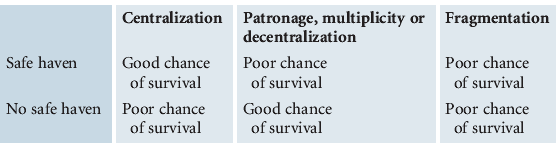
Table 1 summarizes the discussion so far. Centralized organizations are generally more effective than non-centralized ones, but they are more vulnerable to the attempts of rivals to disturb their operations because of their dependence on co-ordination among their different specialized branches. An organization (such as the state, an occupier, or a strong insurgent group) that controls a safe haven that protects it from the easy disturbance of its operations by rivals therefore needs to adopt a highly centralized and specialized structure. Organizations that do not have such a space should adopt a non-centralized structure to increase their odds of outlasting their rivals. A safe haven is not essential to win a conflict, but it is essential that an organization organize properly depending on whether it has such a haven. An organization that suddenly gains control of a safe haven needs to transform itself into a more centralized structure or risk dissipating its resources.
How structure and the availability of a safe haven affect organizational survival.
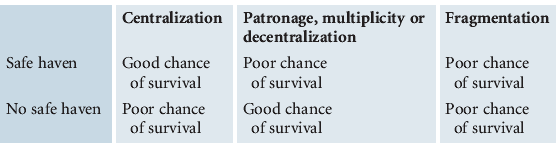
Source: modified from A. H. Sinno, above Footnote note 15, p. 88.
The impact of organizational structure on strategic choices
Organizational structure and strategy are closely intertwined. A certain structure can limit the strategic options available to a movement; make the adoption of a certain strategy more or less credible to the organization's opponents, sponsors, and supporters; limit the ability of the organization to resist its rivals' strategies; and provide additional incentives to adopt some strategies.
When I say that organizational structure can limit both strategic and tactical options I do not intend to be as stringent as the determinism of social structuralists. I do not mean that there is only one winning strategy and that this strategy is always adopted, as Theda Skocpol saw matters evolving during the Chinese Revolution.Footnote 18 I simply mean that the range of strategies that can be initiated and the range of those that can be countered are limited by the structure of the organization. If the top-tier leadership decides to pursue a strategy outside the range that the structure of the organization allows, then one of four things can happen: the leadership is replaced or readjusts its strategy; the rank and file leave in droves; the organization is thoroughly defeated; or a difficult organizational restructuring process takes place. I draw on the metaphor that James DeNardo uses to criticize Skocpol's strategic determinism to illustrate the different ways in which Skocpol, DeNardo, and I see strategic options.Footnote 19 Consider a game of chess, DeNardo tells us, and you soon realize that the structure of the board and the configuration of pieces constrain the players' choices. Those restrictions do not determine the subsequent course of the game and its outcome, as Skocpol believes social structure determines the outcome of revolutionary action. The metaphor of the chessboard, like all others, has its limitations, but it suffices to illustrate my understanding of restrictions on strategy. Although Skocpol might not consider a chessboard a good metaphor for revolutionary interaction and DeNardo finds it a fine one to illustrate the availability of many alternative strategies, I believe the chessboard could provide a good metaphor if the pieces were tied to one another with threads. The threads represent organizational restrictions that might limit the availability of complex strategies, and each structure can be represented by a different assortment of threads tying different pieces. If the rooks were attached to the queen with threads the length of two squares, then the player would be deprived of a number of strategies that depend on those pieces. The same player would also be limited in evading any of his or her opponent's strategies that aim to eliminate those pieces or that would be inconvenienced by a defence that requires their habitual movement. This is how I envision organizational structure to reduce the range of strategies available to the state and its challengers. In what follows, I discuss the effect of structure on simple strategies (confrontation and accommodation), as well as on three more complex strategies – divide and conquer (rule), ‘hearts and minds’, and co-option.
Confrontation and accommodation
Strategies of confrontation and accommodation are available for both incumbent organizations (the regime or occupying power) and their challengers. The organizational structures of the parties in conflict can both encourage them to adopt an accommodationist (attempting to reach a settlement) or a conflictual strategy (through attrition or a direct attack to dismantle rival organizations) and also lock them into those tactics.
Centralized organizations with strong hierarchical control are capable of rapidly adjusting their strategies in response to changes in the environment or the strategies of rivals. The ability to switch could be either to the advantage or to the detriment of the organization, because both resilience and flexibility have their distinct virtues. The ability of a centralized organization to adopt an accommodation strategy toward the incumbent (the regime or occupying power) can, however, be impaired by the existence of rival organizations. A multiplicity of organizations encourages the consistent adoption of a confrontational strategy by the challengers because a dissatisfied population is likely to shift its support to the organization that shuns the conciliatory route.Footnote 20 The resistance organization that fails to understand this dynamic and appeases the incumbent is likely to see its rivals grow at its expense.Footnote 21 Such was the destiny, for example, of Draža Mihailovič's Chetnik, as Chalmers Johnson and participants in the conflict tell us.Footnote 22According to Vladimir Dedijer, one of Tito companions and the official Yugoslav Communist Party historian, entire Chetnik units joined the partisans when they became disgusted with the policy of waiting or refused to accept their leadership's orders to stop attacking the Germans.Footnote 23 Another example is the radicalizing effect of ETA (Basque Homeland and Freedom) on other Basque organizations such as the PNV (Partido Nacionalista Vasco, or Basque National Party) and many Basque politicians.Footnote 24 The Chinese Kuomintang, which accommodated the Japanese, was also defeated as its support weakened while Mao's Communists engaged in active resistance.Footnote 25
Some structures go beyond influencing the adoption of a certain strategy; they lock the organization into this strategy. This occurs when structure creates a set of incentives that make it a dominant personal strategy for each organizational member to persist in the role he plays as part of the overall organizational conflictual strategy. Multiple organizations featuring ties of patronage are particularly prone to create such strategy lock-ups. A prominent example of such a lock-up is the Afghan mujahideen's tenacious resistance to the Soviets in the 1980s.
Afghan mujahideen leaders remained firm in their commitment to fight the Soviets even when the United States and Pakistan, their key suppliers and sponsors, pressured them to accept and abide by the Geneva Accords after their ratification. Afghan commanders continued to attack Soviet troops until the last day of their occupation of Afghan soil, in spite of Soviet threats to halt the withdrawal if attacks did not stop and of US and Pakistani pressure on resistance leaders. They also refused to enter into a coalition government with the Kabul regime despite more such pressure. This puzzling inflexibility, which meant that the Afghan resistance parties could not be co-opted or deterred by their enemies nor be manipulated by their powerful sponsors, was a direct consequence of the structure of the resistance.Footnote 26
Each of the seven Peshawar-based resistance party leaders who considered compromising with the Soviets or their client regime in Kabul had to consider how such a compromise would be received by his field commanders (his clients). The reason for this was that a party leader's prestige and influence was proportional to the number and strength of commanders whose allegiance he was able to claim. Field commanders had an inherent interest in the continuation of the jihad because their stature, economic interests, and raison d'être depended on being needed field commanders. More important, field commanders wanted to preserve local autonomy from the intrusive Kabul regime and its Soviet sponsors, and the perpetuation of the resistance was essential to maintaining it. If a Peshawar-based leader opted for compromise, he was likely to lose the support of field commanders who staunchly disagreed with his policy and would therefore defect to uncompromising parties who were more than happy to welcome them. Agreement among all party leaders jointly to compromise with the Soviets or their client regime in Kabul was virtually impossible because field commanders could choose to become unaffiliated with any party, and even to form their own, if all party leaders simultaneously chose to compromise with the Soviets. This is why no party leader ever compromised with the Soviets, regardless of the cost of the confrontation to the Afghans.Footnote 27
Decentralization puts more decision-making power in the hands of second-tier cadres, making them more flexible on the local level, unlike their peers in centralized organizations. This local flexibility – the ability to switch strategies – comes at the expense of overall organizational flexibility. Decentralized organizations are held hostage by their most extreme cadres, because the execution of a conflictual act by one segment of the organization is generally viewed by rivals as representing the intentions of the entire organization. The top-tier leadership of the organization will find itself in the awkward position of having to choose between denouncing part of the rank and file or pretending that it supported them all along while hoping that the confrontational strategy will succeed. Unfortunately for them, the same lack of control that dragged them into adopting an overall organizational conflictual strategy is likely to weaken their ability to motivate the nonaggressive segments. The Palestinian Authority under Yasir Arafat was no stranger to this situation as it tried to establish itself in the West Bank and Gaza after the Oslo Agreements.
Divide and conquer
‘Divide and conquer’ (rule) is a strategy for territorial control initiated by the occupying power or regime in place that consists of dividing the population into interest groups (either horizontal or vertical) with a low probability of achieving their most preferred political outcome (to assume power) but that can achieve an outcome that is better than their worst one (having rival groups in power) by having the occupation apparatus (regime) in power. For example, let us assume that a number of solidarity groups (e.g. ethnic groups) have the following preferences because of a history of enmity:
1. Direct control of the centre and the resources it confers (be in power)
2. Colonial power (regime) controls government
3. Anarchy/secession (no government)
4. Rival group(s) control(s) government
If P(1) – the probability of outcome number one being achieved – is negligible or its cost is too high, then supporting the colonial power (regime) becomes the dominant strategy for the group. P(1) becomes smaller as the size of the group gets smaller and its distance from the centre of power increases.Footnote 28
Few writers describe the conditions under which a policy of divide and rule is likely to be successful as eloquently as Alexis de Tocqueville did when he explained why the rule of the Corsican Napoleon was easily accepted:
All parties, indeed, reduced, cold, and weary, longed to rest for a time in a despotism of any kind, provided that it were exercised by a stranger, and weighed upon their rivals as heavily as on themselves. When great political parties begin to cool in their attachments, without softening their antipathies, and at last reach the point of wishing less to succeed than to prevent the success of their adversaries, one must prepare for slavery – the master is near.Footnote 29
If, however, the occupying power or regime is perceived as wanting to use the resources of government to subvert the group, instead of keeping other groups from doing so at a cost, then the group has no incentive to support it. Anarchy and secession are often too costly and only become appealing alternatives if the rival group controls the centre and uses its resources (such as legitimacy, institutions, financial power) to subvert the group with the above preferences. Secession (de facto self rule) can be a more appealing alternative to occupation (regime) control if it is easy to achieve because of competition among rival groups and the occupying power/regime.
If we relax the assumption of animosity or competition (either historical or stoked by the occupying power or regime) among societal groups, we can expect the different groups to coalesce in an effort to get rid of the occupying power or regime that is in control of resources that could otherwise be shared among them in their entirety.
In brief, ‘divide and conquer’ is more likely to succeed (1) the greater the animosity and fear among societal groups, (2) the smaller the size and greater the distance of groups from the centre of power, (3) the more costly secession is for the concerned groups, and (4) the greater the ability of the occupying power/regime to be (or to appear) neutral in the conflict among rival groups.
King Hussein of Jordan skilfully shaped conditions during his reign so that these four factors would allow him to keep his precarious throne through the use of such a strategy. He allowed resentment between Transjordanians and Jordanians of Palestinian descent to fester by giving Transjordanians a monopoly over state employment and allowing – some claim encouraging – the development of Transjordanian nationalist parties that excluded Palestinians from their conceptual construction of Jordan as a nation (factor 1). Transjordanians and Palestinian Jordanians coexist in the larger cities, and secession by any one group would be very difficult and costly, as demonstrated by the civil war of the early 1970s (factors 2 and 3). Finally, Hussein was an outsider (a descendant of the sharif of Mecca, with no family roots in Jordan). Although previously both Transjordanians and Palestinians could have envisioned a better Jordan without him, they ultimately preferred enduring his mild despotism to the rule of extremists from the opposing side after he managed to fan ethnic distrust (factor 4).
Only a centralized organization can execute a divide-and-conquer strategy because of the dexterity and co-ordination required to fan intergroup hatreds (factor 1) and the necessity of projecting a consistent finely tuned image as a neutral party above those hatreds (factor 4). ‘Divide and conquer’ is not meant to be applied to atomized societies or against a single centralized rival organization for obvious reasons – the latter situation generally invites a hearts-and-minds strategy. The ability of other structures to resist ‘divide and conquer’ hinges on their ability to affect the four factors that govern its success. Factors 1, 3, and 4 are not clearly affected by structural matters, but factor 2 (the lesser the size and greater the distance of groups from the centre) can be. Multiplicity and decentralization increase the role of this factor. Patronage, on the other hand, could either encourage or discourage it, depending on whether the strategy ‘lock-up’ is already in place.
Hearts and minds
The British refined and successfully applied the ‘hearts-and-minds’ strategy in a number of colonial conflicts, particularly in Malaya and in the Mau Mau and the Dhofar revolts.Footnote 30 This strategy is, in principle, available to government rivals, but it requires extreme centralization and considerable resources, more often attributes of the government or occupier than of its rivals. The strategy consists of:
1. Differentiating among active fighters, passive supporters, genuine neutrals, and government loyalists. This, of course, requires a centralization of the flow of information.
2. Geographically, physically, or psychologically isolating those identified as the active challengers from others. This requires a highly co-ordinated and thus centralized military and intelligence operation.Footnote 31
3. Providing positive sanctions (inducements) to potential supporters of rival organizations and protecting them from abuse by undisciplined troops to discourage them from supporting rivals.Footnote 32
When those steps are well executed, it becomes much easier to subdue the isolated rebels, who cannot replenish their ranks or rely on external material support. To execute them well can be a considerable challenge, however, particularly if the revolutionaries avoid the fatal mistake of centralizing their structure in response to the regime's efforts. The best structures to counter a hearts-and-minds strategy are traditional ones, preferably based on patron–client ties and featuring an abundance of redundant structures. The density of ties in traditional structures makes it easier to conceal fighters within their own communities and prevent their isolation. Patron–client ties, if both patrons and clients are on the same side, maintain cohesion in the face of a hearts-and-minds strategy. Such ties also make it more costly for the regime to woo either patrons or clients to its side, because the more dependent a member is on a relationship (that is, the more costly it is to leave it in terms of opportunities foregone), the higher the cost will be to sever him from it. Such was the case during the Soviet occupation of Afghanistan, but not during the Huk rebellion, where previous patrons (landlords) and clients (farmers) were on opposite sides after a serious dislocation of their traditional ties. The Philippine government of Ramon Magsaysay followed the hearts-and-minds strategy to the letter under the guidance of Western advisers and was assisted by the clumsy attempt of the Communist Party of the Philippines (PKP) to control and centralize the peasant rebels.Footnote 33 The Chinese Communist rebels in Malaya, as many observers have noted, suffered tremendously from their stubborn adoption of a centralized organizational structure inspired by their dogmatic beliefs when faced with the British hearts-and-minds strategy.Footnote 34 Redundancy, decentralization, and multiplicity are useful because they hinder the collection of information on active militants by the regime: it is easier to fill the name slots in a single rigid organizational chart than in numerous ones in flux.
It is worth noting that what American politicians and generals call ‘hearts-and-minds’ in the context of US wars in Vietnam, Iraq, and Afghanistan is something completely different – a largely ineffectual massive propaganda campaign or effort to gain a population's goodwill by doling out services and resources. The US approach often fails to distinguish effectively between ally and foe while doling out resources and does not methodically isolate US opponents. It is often applied against opponents that are practically impossible to isolate.
Co-option
Selznick defines co-option (or co-optation) as ‘the process of absorbing new elements into the leadership or policy-determining structure of an organization as a means of averting threats to its stability or existence’.Footnote 35 I generalize this definition as follows: co-option is a strategy initiated by a dominant organization or coalition of organizations that consists of offering positive sanctions to other threatening organizations or key individuals within them in return for accepting the norms of interaction desired by the dominant organization or coalition.Footnote 36
Co-option is a co-operative strategy that can result in a co-optive arrangement that is not self-enforcing: both parties, the co-opter and the co-optee, have to offer something in return for what the other offers for a co-optive arrangement to succeed. The co-opter hopes to reduce risk by co-opting some rival organizations or their leaders. The co-optees could obtain substantial gains from a co-optive arrangement but forfeit their ability to challenge the co-opter outside its institutions. The co-optee's acceptance of the co-optive arrangement might be valuable to the co-opter if it is one of many challengers and can therefore provide a precedent for more important attempts at co-option. A co-optee can also be valuable if it provides two-step leverage over other organizations or groups.Footnote 37 Co-opting for two-step leverage is a common strategy in colonial situations where the occupying power co-opts a small, highly militarized minority to police the rest of the population. Frisch provides us with a vivid illustration of the use of this strategy by the Israeli government.Footnote 38 The co-optees in this case are the highly martial Druze citizens of the state of Israel, whose units in the Israeli army are often assigned the task of suppressing Palestinian resistance in the Israeli-occupied territories in return for favourable treatment for their tiny community. Another form of two-step leverage consists of co-opting the leaders of an organization rather than the entire organization. This kind of co-option is highly cost effective because it is much cheaper to co-opt one or a few individuals than an entire organization. Tribal politics sometimes facilitate personal co-optation because of the loyalty that tribal leaders generally, but not always, command among members of the tribe, whom they can restrain or unleash at will.
Two factors differentiate co-option from alliance (the short-term aggregation of capabilities against a common enemy). First, the co-opter generally offers positive sanctions in the hope of producing a co-optive agreement because the acceptance by a lesser organization of the norms of the hegemonic organization without concessions would be tantamount to defeat. Second, the co-opter must be more powerful than the co-optee, which must necessarily accept the hegemonic stature of the co-opter and the applicability of its norms to their future interaction (for example, that all differences are solved in the parliamentary arena, or the acceptance of the monarch's authority). Either party could defect (not continue to co-opt or be co-opted), sometimes even after a co-optive arrangement is reached or even institutionalized, if incentives change. Institutionalization, however, generally makes the cost of defection higher.
Co-option is costly to the co-opting organization and its leaders. It is costly because positive sanctions need to be offered to the co-opted individual or organization and because power and information need to be shared with them.Footnote 39 The powers therefore need to assess candidates for co-optive arrangements carefully. An organization makes a good candidate for co-option if it is powerful enough substantially to disturb the operations of the co-opting organization, or is likely to do so in the future, and not powerful enough to take over the organization from within, or capable of eliminating it, and if the cost of co-opting it is less than the cost of fighting it.Footnote 40
Whether it is advantageous or detrimental for an organization to be co-opted depends on the terms of the co-optive agreement (the positive sanctions and the norms adopted), as well as the opportunity cost of forfeiting confrontation. The only kind of co-option that could safely be assumed to have negative consequences for an organization is the co-option of its leaders, not the organization itself – if the leaders are awarded positive sanctions instead of the organization. In addition, early co-optees tend to benefit more than subsequent ones because the regime wants to co-opt the minimum number of rivals necessary to remain in power while lowering the cost of co-option, and it therefore may pay a premium to form a minimum organizational quorum.
Only centralized organizations are likely to adopt and implement co-optive strategies because of the necessity of bringing along the rank and file in support of the arrangement, which represents a strategy shift. Vulnerable societal leaders in fragmented societies are easy targets for co-option. It is easier to co-opt a centralized organization whose leadership has more control over organizational strategy than a decentralized one. Decentralized structures are also less likely to be able to enforce the respect of the co-opter's norms on their rank and file, an essential condition for the success of the co-optive arrangement.
A multiplicity of organizations eases the implementation of co-option by the powers that be because of the incentive for each organization to be the first co-optee with the most favourable co-optive arrangement, but it also makes defection more likely if the rank and file defect to non-co-opted challengers. Patronage-based organizations are likely to be immune to co-optive efforts once a lock-up is triggered and to be vulnerable if the co-optive arrangement is concluded before the dynamics for a lock-up are set in motion. Since we are dealing with well-developed conflicts, I assume that patronage-based organizations are likely to resist co-optive offers.
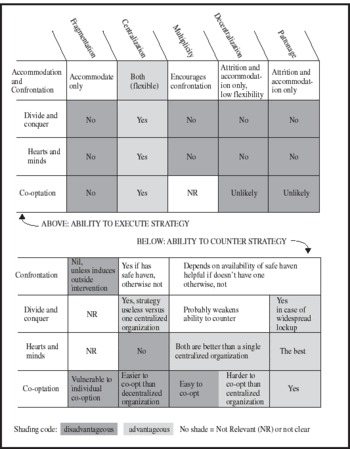
I summarize this discussion of the effect of organizational structure on the ability to both pursue (top half) and resist (bottom half) different strategies in Table 2. A dark square indicates that a structure hinders executing or resisting a strategy while a lightly shaded one indicates that the structure facilitates execution or resistance. Decentralized structures are generally incapable of taking the strategic initiative but can effectively resist complex strategies. Centralized structures generally can take the strategic initiative and execute complex strategies but are less able to counter them. Organizations without a safe haven would benefit from adopting a non-centralized structure, because centralized organizations are not capable of co-ordinating their operations well enough to implement complex strategies effectively in the absence of a safe haven. The non-centralized organization without a safe haven will at least be more capable of fending off its rivals. Once an organization acquires a safe haven, it makes sense for it to centralize to be able to take the strategic initiative in a co-ordinated way beyond its safe haven.
How structure affects the ability of an organization to perform and counter strategies.

Source: modified from A. H. Sinno, above Footnote note 15, p. 58.
Conclusion: The tragedy of peace-making
Durable compromise settlements are rare. In a statistical study I conducted, I found that of the forty-one conflicts that took place between 1945 and 2001, and that lasted longer than three years, in the Americas, the Middle East, and North Africa, only two experienced a durable settlement (longer than ten years).Footnote 41 Perhaps one reason is that durable settlements can only be achieved between (not among) centralized organizational rivals that strongly control their members and are capable of pre-empting the rise of alternative organizations to represent the interests of those who do not favour an agreement. This was the case for the only negotiated settlement from North Africa and the Middle East in the sample. Joseph Lagu had to centralize Anya Nya and consolidate his control over its rank and file before negotiating with the government in Khartoum in 1972.Footnote 42
Centralization, and the ability that it generally confers to control the rank and file, is an important prerequisite for effective negotiation because of the frequent need to rein in spoilers (to use Stephen Stedman's terminology) who disagree with the leadership's conciliatory goals. Spoilers can sabotage negotiations by committing confrontational acts that undermine the perceived sincerity of organizational leaders, who will be blamed for them.Footnote 43 Centralization also helps in effectively pre-empting the emergence of new rival organizations that are likely to adopt, as their strategy for rapid growth at the expense of the conciliatory organization, an uncompromising line that appeals to those conditioned during years of conflict to believe that negotiation is tantamount to betrayal.Footnote 44
Unfortunately, as I argue above, centralized organizations are only serious contenders in a conflict if they have a safe haven within the contested territory, and most of them do not. Their opponents may therefore not feel the urge to negotiate with them or to make concessions because they may sense that victory would ultimately be theirs. This is the unfortunate reality of peace-making in civil wars: most of the insurgent organizations that can be serious parties to negotiated settlements are precisely the ones that incumbents think are not worth negotiating with.