On his return to New York in September 1965 after a sojourn on the West Coast, Steve Reich found himself in a creative disjuncture with the city's polarized cultural landscape. ‘Downtown’, he later recalled, ‘it was basically works by or in imitation of John Cage, Morton Feldman, Christian Wolff, and Earle Brown. Uptown it was pieces in imitation of Stockhausen, Boulez, and Berio.’Footnote 1 Likewise, Reich played no part in La Monte Young's Theatre of Eternal Music – a New York-based ensemble that was exploring sustained tones and extended durations, in which Terry Riley was also involved.Footnote 2 Feeling ‘equidistant’ from the established avant-garde enclaves, he instead found himself ‘at home with [his] painter friends, mostly listening to jazz’.Footnote 3 The importance of visual culture to Reich's development was manifest earlier in the loose funk art milieu he had become involved with in California, revolving around underground filmmaker Robert Nelson and the radical San Francisco Mime Troupe. As he has established, such contacts provided a creative platform for his own work throughout the later 1960s: ‘I was involved with a lot of visual artists and the context for my work was art galleries and museums.’Footnote 4 In New York, Reich shared in the unique aesthetics of the Park Place gallery and later participated in a moment of what Lucy R. Lippard has described as ‘dematerialization’, through which artists sought new modes of manufacture and perception.Footnote 5 The existence of such connections underscores the necessity of situating Reich's early work away from musical institutions in order to understand how it made sense to listeners and why he came to adopt shifting aesthetic alignments. This perspective calls for a more nuanced view of minimal art and its relationship to music.
In a 1986 lecture, H. Wiley Hitchcock noted that ‘minimalist music had arisen at about the same time as minimal art, and … was in many ways aesthetically and stylistically similar’; he then set out to ‘explore some analogies’ between the two media.Footnote 6 Scholars such as Jonathan W. Bernard and Edward Strickland have since followed this path, correlating the proclivities of composers and visual artists. Proposing that the term ‘minimal’ ‘is not at all inappropriate to the music of certain composers when construed according to its meaning in the plastic arts’, Bernard focuses attention on what he sees as three traits defining this aesthetic: 1) ‘minimization of chance or accident’, 2) impersonal ‘emphasis upon the surface of the work’, and 3) concentration ‘upon arrangement rather than composition’.Footnote 7 Bernard's claim that ‘accidentally produced effects’ are not intended to have ‘any substantial bearing upon the way a work is perceived’ is, however, difficult to square with Reich's interest in the ‘unintended psycho-acoustic bi-products’ of a process.Footnote 8 Moreover, Bernard's monolithic scheme cannot account for the historical flux of art in the 1960s, and it fails to do justice either to the specific social connections between composers and artists or to the diversity of material under consideration. Strickland's broad categorization – ‘a style distinguished by severity of means, clarity of form, and simplicity of structure and texture’ – is even less helpful, particularly as he stresses minimalism's supposedly ‘transhistorical’ scope.Footnote 9 Recognizing Foucault's vital insight that such discourses ‘systematically form the objects of which they speak’, repeated attempts at a delineation of minimalism across artistic media have reified a complex and dynamic field into a concise rubric by generating the very classifications they claim to deduce.Footnote 10
An interdisciplinary discourse linking these practices under a shared heading stems from a 1965 article by Barbara Rose entitled ‘A B C Art’. Drawing on Richard Wollheim's seminal essay ‘Minimal Art’ published earlier that year, she extended the term's initial parameters to include ‘the empty, repetitious, uninflected art of many young painters, sculptors, dancers, and composers working now’.Footnote 11 These composers, she argued, were ‘all, to a greater or lesser degree, indebted to John Cage’, whom she saw as following a trajectory deriving from Marcel Duchamp.Footnote 12 Adding Kazimir Malevich and Ad Reinhardt as progenitors, she traced the appearance of a sensibility that was ‘critical of Abstract-Expressionist paint-handling’ and a reaction against ‘the self-indulgence of an unbridled subjectivity’.Footnote 13 The result of this specious connection between the visual arts and musical aesthetics is the restricted pantheon of Young, Riley, Reich, and Glass, a grouping that – as Benjamin Piekut has shown in relation to experimentalism – is not self-evident, but itself a performative act requiring intellectual labour.Footnote 14 Such gestures of historiographical enclosure have placed unhelpful limitations on understanding the complexity of what Sally Banes describes as ‘numerous small, overlapping, sometimes rival networks of artists … forming the base of an alternative culture’.Footnote 15
Contemporary art-historical scholarship has generally been more careful to avoid positing a uniform stylistic tendency by tracing individuals through a mercurial field of diversity and discord. James Meyer points out that, like the composers, ‘all of the artists associated with minimalism rejected the idea that theirs was a coherent movement’.Footnote 16 He argues instead that the term functioned as a ‘shifting signifier whose meanings altered depending on the moment or context of its use’; the classification of artists under a neat appellation has thus resulted from repeated citation, criticism, and retroactive canonization.Footnote 17 A more accurate appraisal, he proposes, would view minimalism ‘not as a movement with a coherent platform, but as a field of contiguity and conflict, of proximity and difference … a dynamic field of specific practices’ – in short, as a debate.Footnote 18 Meyer is not alone in advocating this position: Anna C. Chave also argues that where the identity of minimalism is concerned ‘there can be no indelible ink and no orthodoxy’, simply ‘different discursive configurations describing differing movements’.Footnote 19 Musicology has been slow in acknowledging the correlative to Meyer's central tenet that viewing minimalism as a stable or collective trait ‘could not be more mistaken’.Footnote 20
A diachronic exploration of Reich's compositions and theoretical writings from this period reveals the shortcomings of an undifferentiated minimalist rubric and brings to light significant yet overshadowed trends such as process art. Taking into account Reich's own revisionism and what Sumanth Gopinath refers to as his ‘frequent efforts to police the boundaries’ of an authorized oeuvre, I follow Reich's output from the stark modularity of Melodica (1966) to the entropic process of Pendulum Music (1968) in order to demonstrate the contingency of his developing aesthetic.Footnote 21 Reich used opportunities such as the 1968 treatise ‘Music as a Gradual Process’ to rethink previous works, selecting and emphasizing a particular strand of his aesthetic that correlated with nascent tropes in the visual arts and his position in Manhattan's artworld. His compositional voice, however, encompassed a variety of techniques, causing him to retreat from this austere position in the 1970s and foreground aspects that endorsed the direction of his later style. Situating Reich within the networks of events, institutions, and discourses that supported him allows radical early works and theories to signify through what Derrida calls an ‘economy of traces’.Footnote 22 To Reich, many of these pieces – like his earlier minstrel soundtrack for Oh Dem Watermelons (1965) – perhaps seem too much of their time and have since been redacted, downplayed, or discarded. Shadowing his conservative political drift, the more overtly authored pieces now canonized are those that affirm his desired status as a composer in the conventional Western sense.Footnote 23
This status was by no means assured when Reich arrived back in New York, moved into a loft on Duane Street and, as he puts it, ‘once again took a series of menial jobs’ (along with teaching at the New School and School for Visual Arts) in order to survive.Footnote 24 As Keith Potter notes, the connections made during this period opened ‘access to art galleries as performance spaces long before [Reich] became accepted in Western classical music circles’.Footnote 25 Newspaper reviews show that reception of his music in such spaces manifested (in the words of Village Voice critic Carman Moore) ‘a new listening style’ distinct from that of the concert hall.Footnote 26 Literary theorist Hans Robert Jauss has argued that as new texts are ‘received and judged against the background of other works of art as well as against the background of the everyday experience of life’, audiences are predisposed to interpretations based on the mediating coordinates of genre.Footnote 27 The fact that Reich's friends in the art scene ‘liked and understood’ what he was doing derived from their immersion in this form of shared socio-cultural space.Footnote 28 Through (re)constructing these horizons of expectation, hermeneutic differences ‘between the former and the current understanding of a work’ are brought to the fore – here, exposing the inconsistent relationship Reich has had with his output.Footnote 29 Employing reception theory in this manner answers Georgina Born's recent call for a ‘non-reductive account of the aesthetic and of the temporalities immanent in cultural production’.Footnote 30
The Park Place Gallery: ‘Just as Modular as the Art’
After the premiere of Come Out in April 1966 for the Harlem Six benefit at Town Hall, Reich was asked to put on a concert by ‘a group of painters and sculptors who had a gallery that everybody liked to go to’.Footnote 31 Reflecting its factional position, critic Grace Glueck described the Park Place as that ‘lively young … off-off-Madison-Avenue out-post of “minimal,” “pure” or “systemic” art’.Footnote 32 Founded during the early 1960s in a low-rent building at 79 Park Place, this experimental cooperative consisted of a particular group of painters and sculptors – Mark di Suvero, Peter Forakis, Robert Grosvenor, Tony Magar, Forrest Myers, Edwin Ruda, Leo Valledor, Dean Fleming, Tamara Melcher, and David Novoros – many of whom had come to New York via California, having been involved in assemblage and San Francisco's mixed-media Six Gallery. The collective moved to a much larger space at 542 West Broadway in autumn 1965 under the name ‘Park Place, The Gallery of Art Research, Inc.’; Paula Cooper took over as director before the gallery closed in summer 1967.Footnote 33 Claudine Humblet proposes that this group ‘distinguished themselves from their peers’, coalescing through ‘shared ideals and vision … enriched by their mutual interactions’.Footnote 34 Manifesting what Ressa Greenberg terms the dialectical ‘interplay of architectural differentiation and … socio-economic signification’ associated with downtown spaces that fostered new ways of viewing art, the gallery required ‘a mind set and, often, a set of clothes, different from that required to “see” art uptown’.Footnote 35 Linda D. Henderson even claims that Park Place ‘was the prototype for all subsequent SoHo gallery spaces’.Footnote 36 For a brief but crucial period, it would provide a uniquely sympathetic context for Reich's early phase-shifting compositions.
Bearing in mind what Meyer terms ‘the essential heterogeneity of the minimal field’, a distinctive style associated with Park Place should be differentiated from other New York galleries of the period.Footnote 37 Quoting critic David Bourbon, Meyer notes that the group resisted the austerity exemplified at the time by Robert Morris, Donald Judd, and Carl Andre: ‘where the “minimal” artists hid subject matter “behind impassive surfaces” and “stationary” forms, the Park Placers used allusive shapes that pointed beyond the material object’.Footnote 38 Despite their hard-edged style, Humblet asserts, this historically peripheral group ‘did not take part directly in the “reductive tendencies” of the 1960s’: as Irving Sandler noted, ‘only work that partook of the changed sensibility commanded attention, and the cooler it looked, the more recognition it received’.Footnote 39 Henderson argues that figures now associated with canonical minimalism ‘had no place for spatial complexity or higher dimensions’ in their work, whereas Park Place artists were fascinated by colourful visual play, four-dimensional geometry, and ambiguous spatial illusions that paralleled the ‘retinal kicks’ and perceptualism of Op art.Footnote 40 The group's concern for ‘urban abstraction filled with dynamism and energy’ and belief ‘in the expressive possibilities of their art’ were patently at odds with prominent reductivist polemics.Footnote 41 The gallery was nevertheless intended as a space for intellectual exchange and political discussion, extending invitations to artists including Robert Smithson and Sol LeWitt as well as accommodating free jazz and other avant-garde events. Moore recalls that Reich ‘seemed right at home’ in what Humblet describes as the ‘characteristic freedom and anti-conformist spirit’ of Park Place: ‘the right guy at the right place with the right goods at the right time’.Footnote 42
Conversely, Reich later described 1966 as ‘a very depressing year’ when he felt ‘like a mad scientist trapped in a lab’, surrounded by mechanical tape loops.Footnote 43 He has routinely distanced himself from the music composed during this short period, branding it ‘repetitious and boring’.Footnote 44 However, two pieces dating from that year – Melodica and Reed Phase (initially entitled Saxophone Phase) – are pivotal in Reich's development and were well received in the context of Park Place; they also formed the core of his incipient ensemble's repertoire until the early 1970s and have been unjustly neglected, given their role in establishing his identity as a young composer.Footnote 45 Reich appears to have retrospectively distanced himself from these two pieces for the very same reason they were originally successful, namely reduction of compositional input and the emphatic repetition of short phrases containing no more than four pitch classes – in other words, their radical simplicity. Although received as creating an innovative experience from elementary means, within such parameters there was only limited room to find the ‘mysteries’, including ‘sub-melodies heard within repeated melodic patterns’, that he would later value.Footnote 46
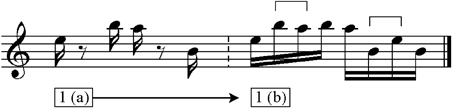
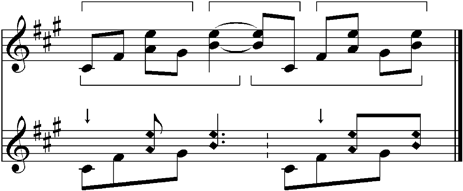
Melodica exists as a tape composition of around ten minutes. As shown by Example 1, an initial canon employing 1(a) is set up and spliced into a fixed combination with itself to form 1(b), which then acts as the basic unit for a progression through four phased relationships, the last held ‘for more than 2½ minutes to permit the listener to examine the sound in detail’.Footnote 47 Reich describes having ‘dreamed the melodic pattern’, and realized the piece in one day: ‘it proved to be both a transition phase shifting process, and the last tape piece I ever made’.Footnote 48 Alongside concert appearances – in May 1966, January 1967, and as part of the series ‘Four Pianos: Three Evenings of Music by Steve Reich’ – Melodica functioned as a sound installation for an invitational group exhibition at Park Place. The show, advertised as ‘Dean Fleming – Primal Panels / Charles Ross – Prisms & Lenses / Jerry Foyster – Mirrors / Steve Reich – Continuous Tape Music’, ran from 5 to 30 March 1967.Footnote 49 Grace Glueck remarked in the New York Times that the artwork had been ‘ingeniously deployed’ and ‘set to sound effects (O.K., music) by Steve Reich’:
Fleming, a painter, has adorned the gallery's white brick walls with panels whose geometric module[s] create the effect of volume on a flat surface … The bright colors of his panels are echoed in the clear, water-filled plastic prisms and tenses that are made by Ross, a young Californian sculptor … as an abstract never-never architectural environment hardly likely to come together outside of a gallery, this show is a stunner.Footnote 50
Steve Reich, Melodica (1966).
Differentiating himself from a predominant focus on surface, Ross has characterized his repeated prisms as ‘minimal structures with maximal effect’ – optical devices that created indeterminate and temporal interplay with their surroundings.Footnote 51 Despite her ostensibly dismissive slur, Glueck concluded that Reich's ‘repetitive figures performed on the melodica … appear to be just as modular as the art. And somehow everything hangs together very well … [as] the pieces lend one another a weight and presence that they could not achieve separately’.Footnote 52
The ‘Four Pianos’ concerts of March 1967 – featuring what the programme leaflet described as ‘single repeated figures going out of phase with themselves’ – also took place in this setting, amid Ross's prisms and what Humblet calls Fleming's ‘response to the environment of New York City’.Footnote 53 An ensemble comprising Reich, Art Murphy, James Tenney, Philip Corner, and Jon Gibson presented Improvisations on a Watermelon, Come Out, Saxophone Phase, Melodica, and a Hohner Cembalet quartet billed as Four Pianos.Footnote 54 Carman Moore wrote a particularly favourable review in the Village Voice:
Reich's unifying element – in an age where materials of a piece are usually in constant asymmetry and contrast – is repetition. The great variety and fleshiness of his successful works comes about because he has discovered that a small piece of musical goods, when manipulated against itself with imagination, will yield, seed-like, an entire field of fresh sound and rhythm.Footnote 55
Moore was ‘surprised by the yield of one simple phrase’ and impressed by ‘interesting developments’ following from Reich's earlier use of tape.Footnote 56 His review was accompanied by a vertically refracted photograph of the concert seen through Ross's transparent acrylic structures, providing a literal illustration of the way in which artwork occasioned horizons of expectation for Reich's music. Moore noted that the Friday event was ‘a well attended and glittering affair, with prism sculpture all around the white room’ and an audience ‘sprawled on the floor’.Footnote 57 He recalls that this crowd ‘was of the young artistically-experimental sort … and white basically – they seemed authentically downtown and blue-jeaned’.Footnote 58 Providing a supportive audience and scenario that explicitly allied him to a contemporary aesthetic, Reich considers these concerts to have been ‘pivotal’ in the dissemination of his music in New York: ‘that did make an impression … everybody downtown ended up coming. Rauschenberg was there, and all the [Judson] dancers.’Footnote 59
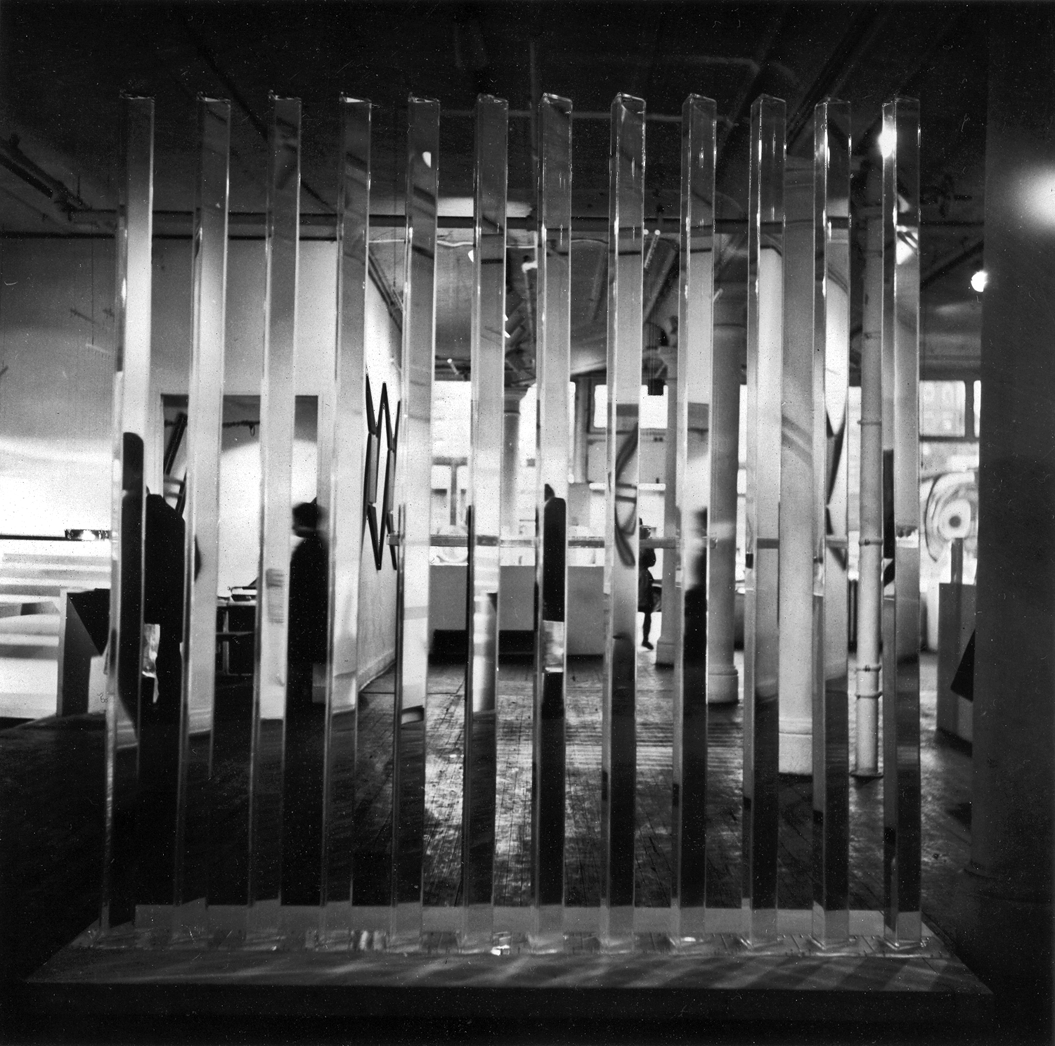
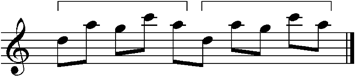
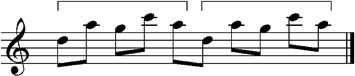
Perhaps the most striking and systematic omission from the accepted canon of Reich's output from this period is Reed Phase; the piece only receives a single passing mention in Writings on Music as ‘later discarded’.Footnote 60 In his ‘Four Pianos’ review, however, Moore described it as ‘shrill, exact, and rich’ and his ‘favorite experience … done with a phenomenal breathing trick and first rate musicianship by Jon Gibson’ on soprano saxophone; he added that ‘when tape is put aside and emulated by humans with human limitations … an element of real excitement occurs’.Footnote 61 Gibson performed Reed Phase behind Ross's 1966 work Prism Wall (Figure 1), staging, as David Chapman argues, ‘an interweaving of artistic media that paired well with the aesthetics of Park Place’.Footnote 62 Potter notes that it was Reich's first attempt at live phasing: its simple unit (see Example 2) and the use of soloist alongside tape imply a preliminary study in the application of the technique to ensemble performance.Footnote 63 Gibson himself sees the piece as ‘the link between a strictly prerecorded phase piece and one with all live performers’ and is surprised that Reich has downplayed its importance: ‘it was part of his development … [and] it's not a bad little piece’.Footnote 64 Reich was evidently satisfied with Reed Phase at the time, as it appeared in Source: Music of the Avant Garde in January 1968.Footnote 65 Dedicated to the advancement of new music through innovation, the periodical described itself as ‘a chronicle of the most recent and often the most controversial scores’; it was the first phasing manuscript Reich decided to publish.Footnote 66
Charles Ross, Prism Wall (1966). Fleming/Ross/Foyster/Reich, Park Place Gallery, New York, 1967.

Steve Reich, Reed Phase (1966).
Reed Phase seems to have been discarded for two reasons. First, despite his view that the piece came across ‘very effectively’ at the time, Gibson felt that he could have been more precise in his execution: ‘I don't think I played it very accurately, or as accurately as Steve would have liked; I found it very difficult to achieve a gradual phase across the taped melody’, as instructed.Footnote 67 More significantly, Reich now finds the piece ‘repetitious and boring’ on exactly the same grounds it was radical at the time: the form (a long tripartite palindrome building to three voices in the central section) and basic unit are rudimentary. Over its fifteen-minute duration, articulation of structure is somewhat blurred and, as in Melodica, contrast and perceptual freedom to locate idiosyncrasies within the process are limited.Footnote 68 However, received within what Henderson describes as a show emphasizing ‘spatial ambiguity and the goal of altering a viewer's consciousness’ – manifest in the optical illusions created by block colour panels and the effects of mirrors, lenses, and serialized prisms – the work's repetitious modularity and the unexpected richness it achieved through manipulation of a radically simple premise meshed with aesthetic elements of the downtown art scene and afforded opportune modes of reception.Footnote 69 Reich's early instrumental pieces made sense to listeners by demonstrating an interactive affinity with the artwork on display at Park Place.
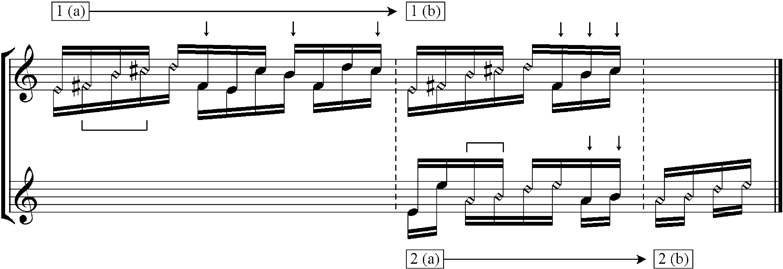
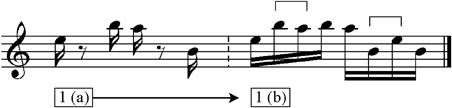
The title of Reich's concert series (‘Four Pianos’) and Moore's Village Voice review (‘Park Place Pianos’) alluded to a central spectacle: a quartet version of Piano Phase performed on amplified electromechanical keyboards. Piano Phase had a particularly convoluted genesis, beginning ‘late in 1966’ after Reich decided to extrapolate live music from his use of simultaneous tape loops: ‘I recorded a short repeating melodic pattern played on the piano, made a tape loop of that pattern, and then tried to play against the loop myself … In the next few months, Arthur Murphy and I, both working in our homes, experimented with the performance of this phase shifting process.’Footnote 70Reed Phase and any collaboration with Gibson are omitted from this narrative, even though the two pieces came into existence concurrently: on a January 1967 programme at Fairleigh Dickinson University Art Gallery Saxophone Phase and Piano Phase are both dated ‘12/66’.Footnote 71 As Chapman argues, Gibson and Murphy played similarly crucial roles at the time ‘in bringing Reich's phasing techniques to a live-performance context’.Footnote 72Piano Phase appears to have sprung fully formed from these experiments, given the date of 1967 on the score published by Universal Edition in 1980 from which the analysis in Example 3 is drawn.Footnote 73 In Reich's own words, however, the piece existed as a ‘work in progress’ until at least 1969: a version dated ‘12/66’ was published in the catalogue to the landmark Whitney Museum show Anti-Illusion: Procedures/Materials, consisting only of unit 2(a) phased against itself; another duet version, dated ‘1/67’, was published in John Cage and Alison Knowles's 1969 collection Notations, consisting only of unit 1(a).Footnote 74 Under both versions Reich asserted that ‘the entire process may be repeated as many times as desired’. Scores to (presumably these) two versions of Piano Phase were displayed on a wall during the Fleming/Ross/Foyster/Reich exhibition.Footnote 75
Steve Reich, Piano Phase (1967).
Reich's programme note outlined how the process translated into a quartet, with pianists moving ‘in gradually shifting phase relations with themselves’ while wearing earphones ‘to facilitate playing in an ordered relationship’ to a guide performer.Footnote 76 A practical explanation of why the piece existed in such a state of flux relates to this method of performance: in order to execute phase shifting, he suggests, ‘one learns the musical material and puts the score aside’.Footnote 77 Once the basic units are internalized, total number of repetitions and length of individual transitions are the only aspects left open to variation. Reich ventures that what he gained from this experience was not the pleasure of self-expression, ‘but of subjugating [himself] to the music’ through participation in ‘a particularly liberating and impersonal kind of ritual’.Footnote 78 Echoing Stravinsky's aesthetic of ‘execution’ and his paradoxical assertion that freedom resides in ‘strict submission to the object’, Reich assigned different roles for composition and performance – the former being a domain of individual creativity whereas the latter was simply the realization of an authored mechanism.Footnote 79 Indeed, Moore noted that ‘in these works, the equipment of the live performer has to be similar to that of a machine’.Footnote 80 Reich nevertheless equates this trope with ‘simply controlling your mind and body very carefully as in yoga breathing exercises’ – a practice he advocated and passed on to friends such as Ramon Sender.Footnote 81
Early versions of Piano Phase were thus constructed from single modal units resembling pieces such as Reed Phase; at a later point, however, Reich consciously intervened to create a more carefully crafted and dynamic linear form. From Example 3, it is possible to see how analogous subunits were distilled from patterns 1(a) and 2(a), fusing two separate phasing cycles into a cohesive whole: 1(b) represents a motivic curtailment of its original to fit against 2(a), which itself undergoes a similar reduction to produce 2(b). The use of four distinct basic units – demonstrating concurrent phasing of different modes and the systematic distillation of a linear ascent – is unprecedented, revealing what Robert Fink has characterized as ‘recombinant’ teleology.Footnote 82 Fink suggests that minimalist music can ‘maintain a distanced and perhaps even ironic stance toward “traditional” teleological dictates even as it plays with their undeniably pleasurable aspects’.Footnote 83 Notation in Example 3 highlights this cumulative sense of momentum achieved through structural compression, implied acceleration, and the isolation of rising motifs. Despite Potter's caution that the harmonic motion that might be inferred from the score's ‘neat progression of perfect fourths … is heavily qualified by modal ambiguity’, Reich clearly intended a latent tonal impetus: ‘the piece is divided into three sections … the first is twelve beats in B minor, the second eight beats forming an apparent E dominant chord, and the last is four beats in A’.Footnote 84
Reich's next ensemble piece, Violin Phase, returned to the format of soloist alongside multi-track tape. Completed in October 1967, Reich suggests that it was ‘an expansion and refinement’ of earlier work, due to the new idea of doubling the sub-melodies he termed ‘resulting patterns’ within phasing aggregates.Footnote 85 Potter adds that the introduction of differing note values in the basic unit, along with an ‘increase in density of texture and counterpoint’, also marks a significant advance.Footnote 86 Premiered as part of a series of concerts organized by Robert Rauschenberg at the School of Visual Arts late in 1967, Violin Phase was subsequently recorded by Paul Zukofsky as the A-side to It's Gonna Rain on the Columbia Masterworks LP Steve Reich: Live/Electronic Music.Footnote 87 Rather than a transparent system ‘determin[ing] all the note to note (sound to sound) details and the over-all formal morphology simultaneously’, as Reich would suggest in 1968, Violin Phase further demonstrates how he crafted structures out of the phase-shifting process.Footnote 88 Much later, Reich owned up to this form of calculated intervention, stating that he must always engineer perceptual interest:
If you want to write music that is repetitive in any literal sense, you have to work to keep a lightness and constant ambiguity … In this way, one's listening mind can shift back and forth within the musical fabric, because the fabric encourages that. But if you don't build in that flexibility of perspective, then you wind up with something extremely flat-footed and boring.Footnote 89
The most intriguing aspect of Violin Phase is the way in which – unlike earlier pieces – performance latitude is woven into its fabric. Reich employed two separate phasing cycles as means to produce ostinati that are then used as raw material for structured improvisation; focus is thus transferred from the process itself to the soloist's individual path through it. Example 4 shows the basic unit of Violin Phase in Reich's notation, along with an outline of its internal polyphony and brackets showing potential rhythmic divisions; inherent metric uncertainty arising from the use of 12/8 originates from Reich's encounter with West African music via the mediation of A. M. Jones's transcriptions.Footnote 90 The irregular length of its subunits also lends the phrase rhythmic tension and serves to accent C♯ and F♯ alternately: Linda Garton argues that tonality in this context manifests itself as the capacity ‘to center on a pitch class as a point of stability’, noting that ‘a work may have more than one pitch center, and more than one tonality, either chronologically … or simultaneously’.Footnote 91 Although such fluidity can disrupt analytical observations, Richard Cohn has argued that the piece nonetheless creates a form of internal dynamism through accumulation of ‘attack points’, suggesting ‘a traditionally nuanced approach to the shaping of temporal experience’ by the composer.Footnote 92 Yet despite experimenting with structure, perceptual ambiguity, and the role of the performer, the way Reich initially theorized his output from this period reveals a selective reconceptualization of his aesthetic – directing focus away from authorial decision-making towards the seemingly autonomous aspects of phase shifting. In what follows, I trace the burgeoning influence of process and conceptual art in order to explore why Reich made this move.
Steve Reich, Violin Phase (1967).
Anti-Illusion: ‘Raw Substance and Repetitive Process’
Conceptualized at the instigation of artist Nancy Graves while visiting New Mexico during summer 1968, Reich's aphoristic theoretical treatise ‘Music as a Gradual Process’ represents a significant juncture in his aesthetic development.Footnote 93 Although Reich considers it an ‘accurate reflection’ of his music up to 1968, the essay is misleading: like the ‘minimalist’ epithet, it has projected the illusion of consistency across this period, leaving a progression of competing affiliations unexplored.Footnote 94 As Reich himself later noted, ‘there was a two or three-year period between the emergence of Pop art as a dominant form and the emergence of Minimal art as a dominant form; and then after that you have the process art that I was tied in with. Things moved very rapidly’.Footnote 95 Lee validates this chronology, arguing that through a foregrounding of ‘material facticity’ and rejection of ‘gestalt readings’, process art ‘signaled a certain exhaustion with the formal procedures and properties of art of the time, notably the reductivist tendencies assigned … to the Minimalist practices that historically prefigured it’.Footnote 96 Noting that the style was essentially ‘an extension of the work in the studio’, Cornelia H. Butler proposes that static geometries were deliberately opposed by process art's ‘low lying, floor hugging, non-hierarchical accretions bound in an anti-illusionistic, nonpictorial way by the contingencies of the materials’.Footnote 97 Like Lee, however, she is keen to avoid fetishizing the difference between minimalism and process art by recognizing theoretical and historiographic convergences: within this ‘knotty and incestuous’ proliferation of activities, she continues, ‘one artist's body of work could contain multiple stylistic readings and vacillate between conceptual positions’.Footnote 98 In order to decentre Reich's essay – routinely employed in the literature to initiate discussions of phase shifting – and contextualize the early reception of his work, it is necessary to confront the vicissitudes of 1960s art discourse.
Dated October 1968, Reich's treatise first appeared in the artist index of the catalogue to a landmark 1969 exhibition of process art at the Whitney Museum in New York.Footnote 99 This show – entitled Anti-Illusion: Procedures/Materials – marked the institutionalization of what Butler describes as ‘extremely ephemeral work’ produced by downtown artists enjoying unexpected inclusion in the ‘hallowed halls’ of Marcel Breuer's building on Manhattan's Upper East Side.Footnote 100 As Sandler notes, ‘museums were the most important agencies in the validation of art, because they were (or were commonly thought to be) shrines elevated above commercial interests’.Footnote 101 In her New York Times review, Glueck described the exhibition as follows:
Barry Le Va has dusted the floor with flour. Rafael Ferrer has piled up hay against a wall … [Elsewhere, you find] a rope dangled from the ceiling, lead splashed on the floor, microphone feedback played as music, or a simple, repeated gesture like the bouncing of a ball … Most of the art – done right on the spot – will only last the length of the show.Footnote 102
One critic linked the artists to student radicals of 1968, proclaiming that the uptown exhibition was symptomatic of museum art's ‘final death throes’ and a demonstration of ‘alienation, outrage, and misery towards a materialistic world that has transformed the artist into a court jester’ through demand for perpetual novelty.Footnote 103 Glueck advised her readers that in order to comprehend the movement, ‘you must discard your fuddy ideas about art as object, as form, or even as ordered experience’.Footnote 104
This deliberately ‘investigative’ exhibition was initially conceived under the title ‘Anti-Form’, referencing Robert Morris's 1968 essay of the same name in which he claimed that ‘the process of “making itself” has hardly been examined’.Footnote 105 Outlining a new proclivity towards the reconsideration of artistic tools and materials, Morris had proposed that ‘focus on matter and gravity as means results in forms that were not projected in advance’.Footnote 106 Indeed, he argued, such art recalled the Abstract Expressionist work of Jackson Pollock where successive layers of paint revealed the artist's gestural movements along with the physical materiality of the medium itself, making process ‘part of the end form of the work’.Footnote 107 Butler notes that this aesthetic concerned a transfer of attention ‘away from the contained sculptural object, to the making of the object as the end in and of itself’.Footnote 108 The resultant work's unstable, evanescent, contingent, or perishable qualities thus openly challenged art's autonomy and commercial viability by foregrounding its dependence on context; akin to Lippard's view of conceptualism, process art ‘focused on the de-mythologization and de-commodification of art’ in defiance of a prevailing ‘gallery-money-power structure’.Footnote 109
Co-curator James Monte argued that the exhibition's radical nature revolved around the fact that ‘acts of conceiving and placing the pieces take precedence over the object quality of the works’.Footnote 110 In this ‘climate of open possibilities’, sculptures such as Richard Serra's works made from thrown or splashed lead were essentially displayed somatic acts; such direct, deliberately anti-illusionistic procedures, Monte concluded, would ‘seriously call into question how art should be seen, what should be done with it and finally, what is an art experience’.Footnote 111 Displaying the impact of Merleau-Ponty's ideas on embodied consciousness, co-curator Marcia Tucker added that ‘by divorcing art from an established value system in which order is inherent, new concerns with time, gesture, materials and attitudes take precedence’, leading sculpture towards the impermanent condition of music, dance, or theatre.Footnote 112 Within this framework, creative intervention in materials was minimized by allowing innate qualities to determine a work's form, flux and duration in an indeterminate fashion.
As noted in its catalogue, Anti-Illusion: Procedures/Materials encompassed ‘film, music and extended-time pieces as well as sculpture and painting’ in ‘a series of evening events as part of the exhibition’.Footnote 113 Performances included the shared ensemble of Reich and Philip Glass, filmmaker Michael Snow, and Bruce Nauman (who apparently, along with his wife Judy and Meredith Monk, ‘bounced backward into a corner for over an hour’).Footnote 114 Tucker argued that Reich's music ‘offer[ed] no illusion of temporality … only the sense of an isolated present’, resulting from ‘a deliberate and unrelenting use of repetition’ that focused defamiliarized attention ‘on the material of the sounds and on their performance’, highlighting what Pamela M. Lee has identified as ‘chronophobic’ tendencies in art of the 1960s.Footnote 115 In his review of Reich's concert – which included Violin Phase, Pendulum Music, Four Log Drums, and Pulse Music (the last two compositions employing his electronic Phase Shifting Pulse Gate) – Alan M. Kriegsman proposed that Reich, Riley, and Glass were ‘exploring a new direction’ in musical aesthetics:
Reich, a leading exponent of the new ideas, concerns himself mainly with very simple note patterns, repeated over and over. As the repetitions proceed, rhythmic variations are introduced at an exceedingly slow rate, resulting in a kaleidoscopic compression and dilation of time. If it gets to you at all, the effect is hypnotic. At its best, Reich's music seems to open vast untapped vistas of musical experience.Footnote 116
Kriegsman also provided a valuable sketch of the audience, mostly consisting of ‘young people in hip attire’ who ‘sat transfixed on the gallery floor like a circle of communing Druids’.Footnote 117 Even though the review demonstrated an early instantiation of the ‘hypnotic’ and ‘compression/expansion’ reception tropes, the term ‘minimalism’ did not appear. Instead, Kriegsman made a revealing comparison between media via different tendencies: ‘the show's preoccupation with raw substance and repetitive process echoes Reich's musical concepts’ – a conclusion that paralleled Moore's contention that Violin Phase ‘seem[ed] to involve the transporting of the compositional laboratory process to the stage’.Footnote 118
Conceived alongside ‘Music as a Gradual Process’, Pendulum Music functioned as a sonic distillation of concepts outlined in the essay.Footnote 119 On a trip to Boulder, Colorado to collaborate on an avant-garde ‘theatre event’, Reich found himself in a studio with Nauman and William T. Wiley (an associate and collaborator from his time in the San Francisco Bay Area):
I had one of these Wollensak tape recorders … I [was] holding the microphone, which was plugged into the back of the machine so it could record. The speaker was turned up. Being out West, I let it swing back and forth like a lasso. As it passed by the speaker of the machine it went ‘whoop!’ and then it went away. We were all laughing at this and the idea popped into my mind that if you had two or three of these machines, you would have this audible sculpture phase piece.Footnote 120
By rationalizing the parameters of this event, Reich created the possibility for what he has described as ‘the ultimate process piece’.Footnote 121 He credits Wiley's personality and ‘air of freedom and looseness’ with early realizations of the concept, but sees the ‘deadpan working out of a process’ arising from his relationship with Serra; for Reich, the piece is ‘strictly physical’ rather than musical and ‘the most impersonal … and the most didactic in terms of the process idea’.Footnote 122
Pendulum Music functions as a limit case for Reich's theoretical posturing and is unique among his oeuvre up to this point – with the possible exception of the haphazard tape phasing in Buy Art, Buy Art (1967) – in that the process it sets in motion is neither logically controlled nor reliant on direct authorial intervention; it therefore seems to integrate well with an anti-illusionistic outlook.Footnote 123 This view is corroborated by the fact that Reich intended the apparatus to be a focal entity: ‘in many ways you could describe Pendulum Music as audible sculpture … I always set [it] up quite clearly as sculpture. It was very important that the speakers be laid flat on the floor, which is obviously not usual in concerts’.Footnote 124 In its unabashed embrace of indeterminate feedback pulses, it also bears conceptual resemblance to John Cage: Reich has come to acknowledge this affinity, proposing that the outcome involved ‘making [his] peace’.Footnote 125 Although Cage's processes had been a point of reference in Reich's 1968 essay, they were presented negatively as being merely compositional: ‘using the I Ching or imperfections in a sheet of paper to determine musical parameters can't be heard’.Footnote 126 Instead, Reich preferred ‘to be able to hear the process happening throughout the sounding music’.Footnote 127
The desire to expose aspects of a work's generative apparatus whether audible or not, and to create systems that delimit note-to-note decisions, however, reflects a fundamental similarity between the rhetoric of the two composers: Reich, for example, later stated that what he was attempting in the early pieces ‘was, to some extent, [to] eliminate personal choices’.Footnote 128 During an interview for Artforum, Reich expanded on this point: ‘where [Cage] was willing to keep his musical sensibility out of his own music, I was not. What I wanted to do was to come up with a piece of music that I loved intensely, that was completely personal, exactly what I wanted in every detail, but that was arrived at by an impersonal means’.Footnote 129 Nevertheless, Lee makes the point that chance, indeterminacy, and process are all fundamentally ‘guaranteed only by conditions established in advance by the artist’.Footnote 130 Scholars have consistently drawn attention to the covert presence of choice in Cage's work: James Pritchett, for example, notes that ‘the frameworks for Cage's chance systems were crafted with an ear toward what sorts of results they would produce’; Piekut puts it more bluntly, suggesting that Cage ‘fiddled with the parameters he set’.Footnote 131 A rapprochement between the two composers may perhaps be reached via Cage's confession that ‘expression of two kinds, that arising from the personality of the composer and that arising from the nature and context of the materials, was inevitable, but I felt its emanation was stronger and more sensible when not consciously striven for’.Footnote 132
After a performance for two microphones in ultraviolet light amid a shower of fluorescing soap flakes at the University of Colorado event Over Evident Falls, Pendulum Music was presented at the Whitney Museum as part of the Anti-Illusion: Procedures/Materials concert.Footnote 133 This ten-minute performance involved four microphones released by Nauman, Serra, Snow, and Tenney. In retrospect, Reich – who acted as sound engineer – described the duration as being ‘a little too long’.Footnote 134New York Times critic Donal Henahan seemed to agree, claiming that the piece produced ‘interesting variations of tone and pulse’ but ‘was, if you will, as much fun as watching a pendulum’.Footnote 135 Kriegsman was more enthusiastic in his review: ‘the resultant feedback generated a giddy blare of whistles, wows and ondulations [sic], all varying in accordance with the decaying swing of the mikes’.Footnote 136 For Serra, the Whitney exhibition was decisive, as it ‘summed up the activities of the moment and confirmed this group as a movement’: writing in 2005, he even proposed that ‘one could call Pendulum Music a paradigm for process art’.Footnote 137 Serra's conclusion indicates the necessity of linking Pendulum Music to ‘Music as a Gradual Process’ and situating both pragmatically in relation to the visual arts and the distinctive anti-illusionistic aesthetics they embodied.
Richard J. Williams argues that although process works were manifest in one way or another as gallery objects, they ‘contrived to make their materiality less of an issue than the ideas behind them’.Footnote 138 Process art was therefore intertwined with conceptual art – exemplified by Serra's idea for a sculpture that involved dropping molten lead from an aircraft. Suggesting that Serra's attitude was typical, Williams notes that the piece existed on the one hand as ‘an example of straightforwardly dematerialized art’ and on the other as part of a continuum of realized and unrealized works.Footnote 139 Reich produced a conceptual score entitled Slow Motion Sound in September 1967 that reveals the influence of this aesthetic. According to Reich, the piece ‘has remained a concept on paper because it was technologically impossible to realize’ at the time.Footnote 140 The handwritten instruction reads as follows: ‘very gradually slow down a recorded sound to many times its original length without changing its frequency or spectrum at all.’Footnote 141 Its form echoes earlier text scores by La Monte Young and George Brecht that existed, as Liz Kotz has argued, in a tripartite form allowing them ‘to be “realized” as language, object, and performance’.Footnote 142 Reich sees it originating from an interest in ‘film as analog to tape’ and coming to fruition in the slow augmentation of Four Organs (1970).Footnote 143 The conceptual aspect, however, is indebted to an environment condoning such unattainable projects as legitimate forms of art.
The stance Reich decided to take in ‘Music as a Gradual Process’, and the language used to crystallize his compositional approach, also reveal conspicuous parallels with Sol LeWitt's theoretical output from this period – an artist Reich may have initially encountered at Park Place during 1966.Footnote 144 As Charles Ross recalls, ‘everything was a big mixture, a big soup, and it was pretty easy to move around between the different circles of artists’.Footnote 145 Published in a special issue of Artforum in summer 1967, LeWitt's ‘Paragraphs on Conceptual Art’ prefigure how Reich would choose to portray the phasing technique a year later:
When an artist uses a conceptual form of art, it means that all of the planning and decisions are made beforehand and the execution is a perfunctory affair. The idea becomes a machine that makes the art … the fewer decisions made in the course of completing the work, the better. This eliminates the arbitrary, the capricious, and the subjective as much as possible … This kind of art, then, should be stated with the most economy of means.Footnote 146
Published early in 1969, LeWitt's similarly terse ‘Sentences on Conceptual Art’ also contain strong echoes of Reich's theoretical position:
7–– The artist's will is secondary to the process he initiates from idea to completion.… 27–– The concept of a work of art may involve … the process in which it is made. 28–– Once the idea of the piece is established in the artist's mind and the final form is decided, the process is carried out blindly. There are many side effects that the artist cannot imagine. 29–– The process is mechanical and should not be tampered with. It should run its course.Footnote 147
Compare these excerpts, for example, with the following from Reich's essay:
Though I may have the pleasure of discovering musical processes and composing the musical material to run through them, once the process is set up and loaded it runs by itself … I mean that by running this material through this process I completely control all that results, but also that I accept all that results without changes … What I'm interested in is a compositional process and a sounding music that are one and the same.Footnote 148
Lippard argues that for artists wishing to ‘restructure perception’ and the ‘process/product’ relationship, ‘information and systems replaced traditional formal concerns of composition, color, technique, and physical presence’ at this time; ideas became paramount, offering ‘a bridge between the verbal and the visual’.Footnote 149 Anna Lovatt has similarly shown that the context for Reich and LeWitt's discursively interlaced pronouncements was increased activity in the field of artists’ writings and a general linguistic turn evident in conceptual art of the late 1960s.Footnote 150 Reich has since stated that ‘what I found in Sol LeWitt and later in Richard Serra … were kindred spirits whose work all related to mine and to each other. There were things “in the air” as there always are in any given historical period and that was what we shared’.Footnote 151 Serra concurs, recalling that this downtown group ‘were each other's audience and critics’, enabling ‘the interchange of ideas’ that ‘nourished new approaches to materials, to time, to content, to process. We were all involved in process.’Footnote 152
These similarities with LeWitt's writings were recognized by Michael Nyman, who questioned Reich on the subject during a 1976 interview; Reich, however, asserted that he was not aware of LeWitt's paragraphs while writing ‘Music as a Gradual Process’.Footnote 153 Even if he did not have direct access to LeWitt's work (which seems unlikely given his comments on his creative environment at the time) it would be naïve to assume that he wrote ‘in complete isolation’, as he proposed.Footnote 154 The responses given to questions regarding a shared foundation with conceptual art, however, served to reveal dissimilarities between Reich's compositional practice and what he had affirmed in writing. In the interview, Reich emphatically stated that ‘execution is hardly a perfunctory affair and never has been in my music’:
So I would completely disagree with what Sol says here … my decisions weren't all made beforehand. The only times that I composed a phase piece that goes from unison to unison was in the first section of It's Gonna Rain and the individual sections of Piano Phase. Every other piece of mine has some aesthetic decision in it as to exactly how many beats out of phase a pattern will shift against itself and when the two voices become four, and when the four voices will become eight voices, and when the melodic resulting patterns will be doubled.Footnote 155
Admitting that his ‘tone and purpose’ were nevertheless close to LeWitt, Reich recalled that what he had desired was a ‘blend of individual choice and impersonality’.Footnote 156 He was thus privy to the same contradictions registered in the visual arts by attempts to expel illusion: as Williams has shown, aesthetic decisions, authorship, and creative intervention were not entirely abandoned in process art and the notion of a coherent art product often remained intact.Footnote 157
Lovatt notes that theoretical writings may ‘seem to offer privileged access to the thoughts’ of artists, but in practice are sites of ‘communication breakdown’ and misreadings that generally ‘function to obscure rather than reveal’, undoing their own apparent logic in the process.Footnote 158 Reich's essay functions in precisely this manner – proving unintentionally obfuscating where it promises to clarify. Reich evidently smoothed over the more involved aspects of his methodology in an attempt to portray an impersonal, transparent ideal conveying greater affinity with corresponding themes in the visual arts and the aesthetics of a particular milieu. Rather than autonomous, uninflected ideas to be grasped on their own terms, his processes were most often only a means to an end – that end being the creation of works bearing the stamp of authorial subjectivity; as Martin Scherzinger notes, Reich's processes were ‘not as pure as [his] hindsight assessment would have us believe’.Footnote 159 Indeed, the naturalistic paradigms of gradual process Reich offered in his essay – ‘turning over an hour glass … pulling back a swing, releasing it … placing your feet in the sand by the ocean's edge’ – were only ever realized in Pendulum Music.Footnote 160 Phase shifting itself did not constitute a self-governing system, but at a particular moment in 1968, as he candidly recounted to Artforum four years later, he ‘began to see [the early phasing pieces] as processes, as opposed to compositions’ – in other words, through an ontological lens conditioned by process and conceptual art.Footnote 161
Conclusion
When Reich came to theorize his aesthetic in 1968 – driven by the linguistic turn in contemporary art and a proliferation of manifestos and polemics – he was drawing on a dynamic exchange of ideas characteristic of his downtown social milieu. Reich dwelt on facets of his methodology that corresponded with proximate conceptual tropes. As his career progressed, however, he began emphasizing elements that suited a more composerly stance, rejecting or redacting earlier compositions to fit. In spite of the mismatch between theory and praxis, process art nevertheless provided a heuristic framework within which he could situate himself, echoing his earlier relationship to the aesthetics of Park Place. Such confluences disrupt the essentializing view of Reich as a ‘minimalist’ composer: his alignments, like his self-representation, shifted pragmatically from one environment to another as circumstances dictated, shadowing what Howard Brick terms the ‘rapid-fire emergence of new styles’ during this period.Footnote 162 Bernard's portrayal of minimalist music as ‘a direct offshoot of minimalism in the plastic arts’ should therefore be countered with the fact that even before process art, Reich was associated with a faction of artists who resisted dominant definitions of the style.Footnote 163 Reich's work, like that of other artists during the turbulent 1960s, held the potential for conflicting readings and fluctuation between conceptual bearings.
Through the various avant-garde scenes he encountered, Reich was able to gain performing opportunities and cultivate advantageous horizons of expectation, recruiting a sympathetic audience and accruing significant cultural capital for a type of music that might not have survived outside the informal yet legitimizing context of a museum or gallery. His radically new pieces achieved institutional and aesthetic credibility through being read interactively with painting and sculpture on display at their early performances. In 1964, Arthur Danto proposed that art theories, criticism, and institutions confer a privileged status on artefacts within their remit – a network he termed the ‘artworld’.Footnote 164 The conventions of New York's downtown artworld enabled Reich's phase shifting compositions to be recognized and validated (albeit reluctantly at times) as music: as Howard S. Becker argues, artworlds allow artists to ‘earn the material support and serious response of others’ by ‘connect[ing] work to a tradition in which it makes sense’.Footnote 165 Viewing Reich's output from the latter half of the 1960s within New York's artworld is thus crucial to an understanding of its protean aesthetic: rather than merely reflecting contiguous trends, Reich's work developed in an intertextual, dialogic relationship with its surroundings.