1 Introduction
A peculiar characteristic of the interface between phonetics and phonology is that processes on either side of the divide often resemble one another. The resemblances, pointed out most explicitly by Flemming (Reference Flemming2001), can be seen by examining, for example, the effects of a nasal consonant on a neighboring vowel. In some languages, such as English, the vowel becomes partially nasalized; in other languages, such as Bengali and Nupe, the vowel becomes fully nasalized and undergoes neutralization with respect to phonemic nasalized vowels (Cohn Reference Cohn1993). We call the first process coarticulation and refer to it as phonetic, while we call the second process assimilation and refer to it as phonological. Yet insofar as both these processes involve the contextual influence of one sound upon another, there is undeniably some sense in which they are ‘the same’. Flemming (Reference Flemming2001) lists many other processes that look ‘the same’; whether we agree with his particular approach to these processes or not, we must acknowledge that the phonetics–phonology interface does indeed raise pressing problems of redundancy, and that it does so to a degree that is not found in other interfaces, such as those between phonology and morphology or syntax and semantics (for further perspectives on this redundancy issue see J. Ohala Reference Ohala, Kingston and Beckman1990; Steriade Reference Steriade1997, Reference Steriade, Hume and Johnson2001; Blevins & Garrett Reference Blevins and Garrett1998; Barnes Reference Barnes2002; Blevins Reference Blevins2004; and many others).
Consonant lengthening is a phenomenon that has received much attention as a phonetic process, and also separately as a phonological process, but to date little or no research has considered the relationship between the two. Are these two processes the same? Consider phonetic lengthening. A large body of work has established that consonants can lengthen due to their position in a syllable, word, or phase (e.g. Klatt Reference Klatt1976, Fougeron & Keating Reference Fougeron and Keating1997, Cho & Keating Reference Cho and Keating2001, Lavoie Reference Lavoie2001, Keating et al. Reference Keating, Cho, Fougeron and Hsu2003, Byrd et al. Reference Byrd, Kaun, Narayanan, Saltzman, Broe and Pierrehumbert2000, Reference Byrd, Lee, Riggs and Adams2005). The changes effected by this type of lengthening vary, but are usually limited: in English, for example, consonants in phrase-final position exhibit durations approximately 30% greater than their medial counterparts (Klatt Reference Klatt1976: 1217). Because such a limited increase in duration does not change the phonemic status of the consonant, we refer to this type of lengthening as phonetic (for further discussion on distinguishing between phonetic and phonological processes, see Keating Reference Keating1984, Pierrehumbert & Beckman Reference Pierrehumbert and Beckman1988, and Cohn Reference Cohn1993).
Of course, phonological lengthening of consonants has also received a great deal of attention (see e.g. Kenstowicz Reference Kenstowicz1982; Hyman Reference Hyman1985; Hayes Reference Hayes1986a, Reference Hayesb; McCarthy Reference McCarthy1986; Schein & Steriade Reference Schein and Steriade1986; Inkelas & Cho Reference Inkelas and Yu Cho1993; Rose Reference Rose2000; Ham Reference Ham2001; Muller Reference Muller2001). This process, usually referred to as gemination, typically effects rather large changes: in Hungarian, for example, underlying geminates exhibit durations that are 180% to 300% greater than their singleton counterparts (Ham Reference Ham2001; see also Magdics Reference Magdics1969: 80, Szende Reference Szende1974, Kassai Reference Kassai1980, Tarnóczy Reference Tarnóczy, Channon and Shockey1987: 267). These duration increases change the phonemic status of the consonant from singleton to geminate, and can therefore be considered phonological.
Phonetic lengthening and phonological lengthening seem to perform the same basic operation (increasing duration) on the same representation (a consonant), so it seems reasonable to ask if there are some unnoticed differences between the two. The current study addresses this question, and it does so in a particular way: by examining the behavior of affricates. Affricates are complex segments which, on the surface, consist of a stop closure followed by frication (e.g. Clements & Keyser Reference Clements and Keyser1983; Lombardi Reference Lombardi1990; Sagey Reference Sagey1990; Steriade Reference Steriade, Huffman and Krakow1993, Reference Steriade, Cole and Kisseberth1994; Clements Reference Clements, George, Fujimura, Joseph and Palek1999). This means that any given process which affects an affricate actually has not one, but two potential targets. Different lengthening processes can, in theory, treat these targets differently. The null hypothesis is that both processes treat the complex structure of the affricate in the same manner, e.g. by increasing the duration of each portion to a certain degree. This would provide evidence that phonetic and phonological lengthening are basically the same. The alternative hypothesis, however, is that different lengthening processes treat affricates differently, e.g. phonetic lengthening increases the duration of frication only while phonological lengthening increases duration of closure only. Such a result would provide evidence that the two processes are actually rather different.
I investigate these hypotheses in a speech production study that uses near-minimal pairs for phonetic and phonological lengthening. For example, to characterize phonetic lengthening, I compare the durations of closure and frication in a target affricate that is phrase-medial with those of a target affricate that is phrase-final, as schematized in (1).
(1)

Based on the research on phonetic lengthening cited above, we expect the target consonant in phrase-final position to exhibit an increased overall duration relative to its phrase-medial counterpart. In the current study, I seek to elaborate this expectation by asking which portion of the target affricate, if any, increases its duration the most.
Similarly, to characterize phonological lengthening, I compare the durations of closure and frication for a singleton affricate with those for a geminate affricate, (2).
(2)
Based on previous research examining the correlates of gemination, we expect geminate consonants to exhibit longer duration than singleton counterparts, even if duration is not the sole cue distinguishing the two (see Lahiri & Hankamer Reference Lahiri and Hankamer1988 on Turkish and Bengali; Local & Simpson Reference Local, Simpson, Bradley, Henderson and Mazaudon1988, Reference Local and Simpson1999 on Malayalam; Ladd & Scobbie Reference Ladd and Scobbie2003 on Sardinian; Payne Reference Payne2005 on Italian; Arvaniti & Tserdanelis Reference Arvaniti and Tserdanelis2000 and Payne & Eftychiou Reference Payne and Eftychiou2006 on Cypriot Greek; Ridouane Reference Ridouane2007 on Tashlhiyt Berber). But again I seek to elaborate this expectation, by asking which portion of the affricate increases its duration the most.
The conceptual questions that motivate the current study could conceivably be pursued with speech production data from any number of different languages. Here, I pursue them with data from Hungarian, for three reasons. First, Hungarian has strident affricates at two different places of articulation, alveolar ([ts], [dz]) and postalveolar ([tʃ], [dʒ]). This fact obliges us not to over-simplify the representation of the affricate, a point to which I will return in section 5 below. Second, in addition to affricates, Hungarian has a series of palatalized consonants [tj dj nj]. These consonants also have a complex structure (stop closure plus glide articulation), and therefore serve as a useful point of comparison with the strident affricates. Third and finally, Hungarian possesses an unusually rich inventory of phonological processes that create geminate affricates. Only one such process will be directly investigated here, but the other processes give us important supporting evidence about the nature of lengthening.
Section 2 describes the methods of the current study. Section 3 reports the results of experiments examining phonetic lengthening, while section 4 examines phonological lengthening. Section 5 considers how linguistic theory should capture the difference between these lengthening processes, and concludes that the difference is not one of representations, but of basic operations.
2 Methods
2.1 Stimuli
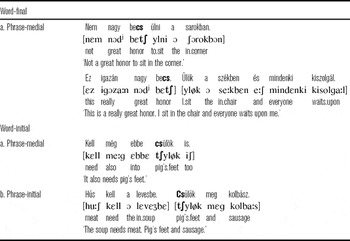
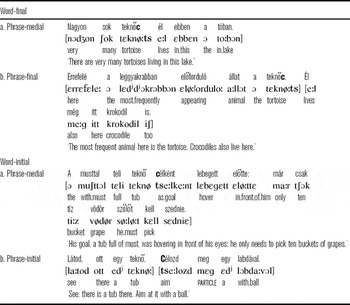
To investigate phonetic lengthening, two target affricates, alveolar [ts] and postalveolar [tʃ] (Hungarian orthographic 〈c〉 and 〈cs〉, respectively, see Szende Reference Szende1994), were embedded in carrier sentences modeled after those found in Beckman, Edwards & Fletcher (Reference Beckman, Edwards, Fletcher, Docherty and Ladd1992) and Byrd et al. (Reference Byrd, Kaun, Narayanan, Saltzman, Broe and Pierrehumbert2000). Two word positions (initial versus final) were cross-cut with two phrasal positions (final or initial versus medial) such that each affricate appeared in a total of four positions. The target affricate was always intervocalic. Stimuli for phonetic lengthening are shown in tables 1 and 2.
Stimuli for target affricate 〈cs〉 [tʃ] in intervocalic position.

Stimuli for target affricate 〈c〉 [ts] in intervocalic position.

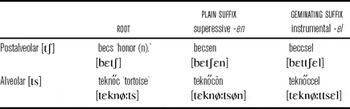
To investigate phonological lengthening, stimuli were constructed from the same Hungarian noun roots, becs ‘honor’ and teknőc ‘tortoise’. Each root was combined with two different suffixes, to create two different experimental conditions. Stimuli are shown in table 3.
Stimuli for phonological lengthening.

The singleton condition consisted of the root plus the superessive case suffix -en ~ -ön ~ -on ~ -n, which adds a meaning ‘on’ or ‘on top of’ (Kenesei, Vago & Fenyvesi Reference Kenesei, Vago and Fenyvesi1998: 235ff.; see also Vago Reference Vago1980).Footnote 1 This suffix, like most suffixes of the Hungarian nominal paradigm, combines with the root without triggering lengthening. The lengthened condition consisted of the root plus the instrumental case suffix -el ~ -al ~ -vel ~ -val, which adds a meaning ‘with’ (Kenesei et al. Reference Kenesei, Vago and Fenyvesi1998: 210). This suffix conditions phonological lengthening of the root-final consonant; cf. vassal ‘iron-instr’, bajjal ‘trouble-instr’, ketreccel ‘cage-instr’ (Kenesei et al. Reference Kenesei, Vago and Fenyvesi1998: 437). Gemination is represented in the Hungarian orthography by 〈ccs〉 for the postalveolar affricate and 〈cc〉 for the alveolar affricate. For phonological lengthening, then, the comparison of interest is between two affricates in word-medial, intervocalic position, one singleton and the other geminate.
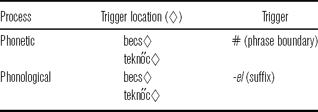
As shown in table 4, the gemination process is as similar as possible to that of the phonetic lengthening processes (specifically, of phrase-final lengthening). The input is a singleton consonant. The output is a lengthened version of that consonant. And crucially, the conditioning environment (i.e. the suffix itself) lies to one side of the target consonant. We can see this if we schematically compare phonetic and phonological lengthening processes for Hungarian words such as becs ‘honor’ and teknőc ‘tortoise’. In one case the trigger location is a phrase boundary, while in the other it is a suffix, but in both cases the environment lies in the same place – to the right of the affricate.
Comparison of lengthening types.

Suffix-conditioned geminates present an advantage over geminates from other sources, such as those created by the juxtaposition of two singletons, those created by assimilation, or those which exist underlyingly. These types of geminates, all of which are also found in Hungarian, have dominated the literature on the formal representation of consonant length in phonology (see e.g. Kenstowicz Reference Kenstowicz1982; Hyman Reference Hyman1985; Hayes Reference Hayes1986a, Reference Hayesb; McCarthy Reference McCarthy1986; Schein & Steriade Reference Schein and Steriade1986) and certainly warrant instrumental investigation in their own right (for explicit comparison of geminates arising from different sources, see Lahiri & Hankamer Reference Lahiri and Hankamer1988 on Turkish and Bengali; Local & Simpson Reference Local, Simpson, Bradley, Henderson and Mazaudon1988, Reference Local and Simpson1999 on Malayalam; Ladd & Scobbie Reference Ladd and Scobbie2003 on Sardinian; Payne Reference Payne2005 on Italian; Payne & Eftychiou Reference Payne and Eftychiou2006 on Cypriot Greek). But these other geminates make for a less direct comparison with the process of phonetic lengthening and therefore fall outside the realm of the current study.
Suffix-conditioned geminates also present an advantage over geminates created by phrasal conditioning, as in the Italian process of Raddoppiamento Sintattico (RS). At first blush, this kind of phonological lengthening might seem to make a good comparison with phonetic lengthening because the conditioning environment for both processes relates to position in the phrase. In reality, however, the conditioning environment for RS is quite complex, depending partly on the stress and length of the preceding vowel (Saltarelli Reference Saltarelli1970), partly on a phrasal constituent that is initially derived from syntactic structure but then deviates from it (Nespor & Vogel Reference Nespor and Vogel1986) and partly on the presence of specific lexical items, at least for some dialects (e.g. Bullock Reference Bullock and Repetti2000). By contrast, the conditioning environment for suffix-triggered geminates is simple, and its linear structure is analogous to that of phonetic lengthening. The current study therefore focuses on suffix-triggered geminates in Hungarian.
2.2 Procedure
A list of sentences was prepared, containing five repetitions of each target sentence (5 × 8 = 40), additional target sentences which were analyzed for a separate study (=40), and filler sentences (=28). Following the sentences was a list of words, which contained four repetitions of each of the four target words (becsen, beccsel, teknőcön, teknőccel; 4 × 4 = 16), additional target words which were analyzed for a separate study (= 16), and fillers (= 17). The order of the 108 total sentences was randomized, although adjustments were then made to ensure that filler sentences, and not stimulus sentences, occupied the first and last item of every printed page. The order of the 49 total words was similarly randomized.
Subjects were asked to familiarize themselves with the sentences and words, and to read each one aloud for practice before recording began. During recording, which used a Marantz digital recorder and a head-mounted microphone, subjects were asked to read the sentences and words at a natural pace. When they mispronounced a word or a sentence, they were asked to repeat the stimulus item from the beginning. Ten subjects were recorded in a sound-proof booth, the remaining four were recorded in a quiet room in their homes.
2.3 Subjects
Subjects were adult native speakers of Hungarian (n = 14), all but two of whom live in the Bay Area of California. The remaining two live in Hungary, but visited California during the study. All were paid for their participation. Eight were female, and six were male. Their ages ranged from 18 years to approximately 50 years. Of those who lived in the U.S., their length of residence ranged from two months to eleven years. They came from various locations in Hungary and Romania. In interpreting the results that follow, the varied backgrounds of the subjects as well as their (sometimes prolonged) contact with American English should be borne in mind.
2.4 Measurements
For phonetic lengthening, a total of 560 tokens were analyzed (2 affricate types × 2 word positions × 2 phrase positions × 5 repetitions × 14 speakers = 560). One subject accidentally skipped one token during the session; the missing data were replaced with the means for that cell. For phonological lengthening, a total of 220 tokens were analyzed (2 affricate types × 2 suffix types × 4 repetitions × 14 speakers = 224, minus four tokens which were discarded). One subject mispronounced three tokens during the session. These tokens were excluded from the data set; in order to maintain balanced numbers across all conditions for statistical analyses, a fourth additional token for this subject was removed.
The duration of each portion of each target affricate was measured using waveforms and spectrograms produced by Praat software (Boersma & Weenink Reference Boersma and Weenink2007). Segmentation procedures were as follows. The closure portion began when the preceding vowel displayed no more periodicity, and ended just before the release burst, if any. The frication portion began at the onset of aperiodic energy, and ended at the cessation of aperiodic energy. In those cases where the stop portion of an affricate displayed a release burst, the burst was included in the following fricative portion.
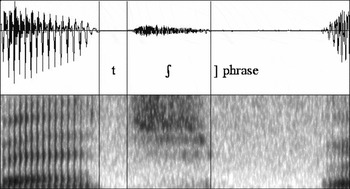
Figures 1 and 2 show waveforms and spectrograms of sample tokens that occurred in phrase-final position. In this position, the target affricate was almost always followed by pause, as in figure 1. In such cases, the frication portion ended when the waveform exhibited no further evidence of aperiodic energy, and declined to a silent state. The cessation of high frequency energy in the spectrogram also provided a segmentation cue to the end of the fricative, particularly for the postalveolar [tʃ]. In a few phrase-final cases, the target affricate was followed by cues associated with the following phrase, as in figure 2, where there is evidence of creaky voice following [ts]. In these cases, segmentation was aided by the cues associated with the following phrase, but the criteria for segmentation were the same – that is, the frication portion ended when the waveform exhibited no further evidence of aperiodic energy.
Segmentation of the postalveolar affricate [tʃ] in becs ‘honor’ in phrase-final position.

Segmentation of the alveolar affricate [ts] in teknőc ‘tortoise’ in phrase-final position.

2.5 Limitations
In this study, ‘phonetic lengthening’ will usually mean phrase-final lengthening – that is, we will be concerned with a comparison between the phrase-medial and phrase-final near-minimal pairs. This is for two reasons. First, the companion phonological lengthening process is triggered by a suffix – in other words, the triggering environment lies to the right side of the affricate. In phrase-final lengthening, the triggering environment (i.e. the phrase boundary) also lies to the right side of the affricate, making for a reasonably direct comparison between the two processes, which is the primary goal of this study. Second, the closure portion of a voiceless affricate cannot be measured accurately in phrase-initial position because it is preceded by silence. Therefore, we cannot paint a complete picture of phrase-initial lengthening. The frication portion can, however, be measured in phrase-initial position, and both portions can be measured in word-initial, phrase-medial positions. These latter measurements will therefore afford us a partial, but still valuable, characterization of lengthening in initial positions.
Hungarian also has voiced affricates, [dz] and [dʒ], at corresponding places of articulation. These are not included in the current study because their distributions are not regular. Siptár & Törkenczy (Reference Siptár and Törkenczy2000: 88–89) summarize the distributional evidence concerning /dz/ and conclude that ‘[t]he existence of /dz/ as an underlying segment . . . is not supported by any valid argument at all’. As for [dʒ], Siptár & Törkenczy conclude that it probably is an underlying segment. But its intervocalic and final occurrences tend to be exclusively long (geminate), with just a few exceptions. Without a robust singleton counterpart, [dʒ] is a poor candidate for analysis in the current study.
For these reasons, this study examines voiceless affricates only. One consequence of this decision is that our results can be more profitably compared with previous production and perception studies of affricates, which have overwhelmingly focused on voiceless affricates (Cutting & Rosner Reference Cutting and Rosner1974; Repp et al. Reference Repp, Liberman, Eccardt and Pesetsky1978; Dorman, Raphael & Isenberg Reference Dorman, Raphael and Isenberg1980; Howell & Rosen Reference Howell and Rosen1983; Miller-Ockhuisen & Zec Reference Miller-Ockhuisen and Zec2002; Thurgood & Demenko Reference Thurgood and Demenko2003; Hölterhoff Reference Hölterhoff2006; Mitani, Kitama & Sato Reference Mitani, Kitama and Sato2006; but see Faluschi & Di Benedetto Reference Faluschi and Di Benedetto2001, which includes both voiceless and voiced Italian affricates).
Note that in the word-final condition, the word containing the target postalveolar affricate, becs ‘honor’, is monosyllabic with a short vowel preceding the target, while the word containing the target alveolar affricate, teknőc ‘tortoise’, is disyllabic with a long vowel preceding the target. Ideally, these words would contain the same number of syllables and the same vowel length, but this was not possible. The difficulty lies in matching an affricate-final word with a minimally different word that lacks the affricate, as in teknőc ‘tortoise’ versus teknő ‘tub’. The frequency of Hungarian words containing any affricate is low to begin with. The relative frequency of words containing either a singleton or geminate 〈cs〉, in any position, is 0.62%. For 〈c〉, the figure is 0.23% (Tarnóczy Reference Tarnóczy, Channon and Shockey1987: 256). For final position, Reverse-Alphabetized Dictionary of the Hungarian Language (Papp Reference Papp1969) lists only 279 words ending in singleton 〈cs〉 [tʃ], of which 244 are polysyllabic. It lists only 301 words ending in singleton 〈c〉 [ts], of which 254 are polysyllabic. Of these, only a small handful have minimally different counterparts lacking an affricate, and an even smaller handful can be embedded in a meaningful, minimally-different phrasal pair. The stimuli used in this experiment therefore represent the best compromise possible, given the natural restrictions of the Hungarian lexicon.
In the discussion that follows, then, it should be borne in mind that a difference in the lengthening behavior of postalveolar and alveolar affricates could be attributable to place, number of syllables, vowel length, or position relative to stress (which is always initial in Hungarian) or some combination of these factors. Given previous work on these issues, however, we do not expect such differences to be large. For place, Tarnóczy (Reference Tarnóczy, Channon and Shockey1987: 267) reports nearly identical durations for both the stop and frication portions of 〈cs〉 and 〈c〉 (postalveolar closure: 0.104 sec, postalveolar frication: 0.106 sec, alveolar closure: 0.104 sec, alveloar frication: 0.113 sec), suggesting that the internal timing of these two affricates is the same (although see Magdics Reference Magdics1969, who reports bigger differences). For position relative to stress, it is usually the consonant in pre-stressed position that undergoes the most change in duration (Klatt Reference Klatt1976, Lavoie Reference Lavoie2001). Consonants in post-stressed position, such as the 〈cs〉 in becs ‘honor’ are not known to change markedly, suggesting they may be reasonably compared with consonants in non-post-stressed position, such as the 〈c〉 in teknőc. It should also be noted that in most instances, Hungarian permits sequences of long vowels followed by a geminate consonant (see Kenesei et al. Reference Kenesei, Vago and Fenyvesi1998: 419), so there should be no vowel-based restriction on the lengthening of 〈c〉 in teknőc.
3 Results: phonetic lengthening
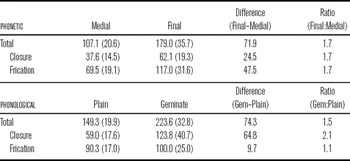
The overall results, including both phonetic and phonological lengthening conditions, are summarized in table 5. The effect of lengthening on the total duration of the affricate appears to be roughly similar in both phonetic and phonological conditions, which exhibit increases of 71.9 ms and 74.3 ms, respectively. However, the effect of lengthening on the closure and frication portions of the affricate appears to differ greatly across the conditions. In phonetic lengthening, both closure and frication show increases in duration; for phonological lengthening, only closure seems to show a substantial increase.
Mean duration measurements, mean differences, and ratios for affricates in phonetic and phonological lengthening contexts.

The following sections discuss these results in more detail. All results use repeated-measures Analysis of Variance (ANOVA), with subject as the error term. This means that each subject serves as his or her own control, and the significance results may therefore be considered normalized across subjects (see e.g. Anderson Reference Anderson2001: chapter 6; Johnson Reference Johnson2008: chapter 4).
3.1 Phrase-final lengthening
3.1.1 Overall duration
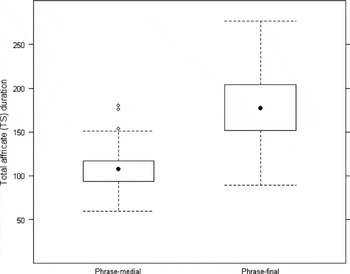
Our first concern is to establish that phonetic lengthening does, in fact, occur in phrase-final positions. Therefore, we will focus initially on measurements for the total duration of the affricate. Recall our expectation, which is that affricates in phrase-final position should exhibit longer durations than those in phrase-medial position. This expectation was met, as can be seen in figure 3.
Distributions of total affricate durations in different phrasal positions, in milliseconds.

Affricates in phrase-medial position show a mean duration of 107.1 (20.6) ms, while those in phrase-final position show a mean duration of 179.0 (35.7) ms. This difference is significant: a repeated-measures ANOVA shows a main effect of phrasal position (F(1, 13) = 131.25, p < .001) on the total duration of the affricate. There is no effect of place of articulation and no interaction between phrasal position and place of articulation. The boxes in figure 3 (and subsequent box-and-whisker figures) enclose 50% of the durations; note that the distribution of durations in phrase-final position is relatively wide by comparison with the distribution in phrase-medial position.
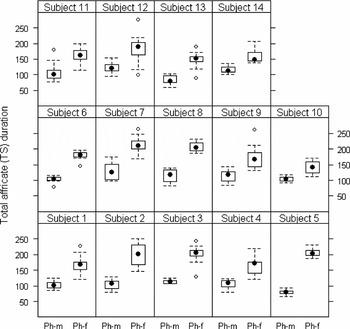
We can conclude that phonetic lengthening occurs in our data set. Furthermore, each individual subject exhibits a pattern of increased durations in final position, as can be seen from consideration of figure 4. The mean ratio of durations in final versus medial position is 1.7, and individual subject ratios range from 1.4 to 1.9, except for Subject 5 who exhibited a ratio of 2.5. Thus, despite their variation in age, place of origin, and degree of contact with English, subjects exhibited remarkably consistent patterns of phonetic lengthening.
Distributions of total affricate durations in different phrasal positions (Ph-m = phrase-medial, Ph-f = phrase-final), for each individual subject (n = 14).

3.1.2 Component durations
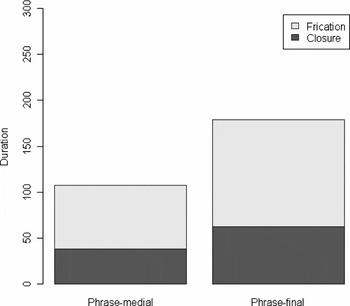
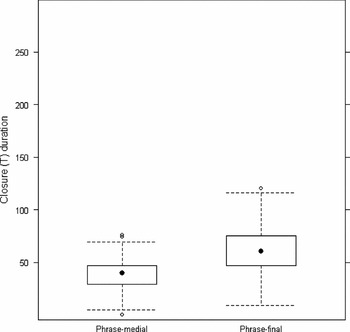
Given that phonetic lengthening does occur, we can now ask how it occurs. We do this by individually examining the durations of the affricate components, closure and frication. Figure 5 shows the relative contribution of each component to the mean duration in each phrasal position. Figures 6 and 7 show the duration distributions of each component in each phrasal position.
Mean values for closure (dark gray) and frication (light gray) durations in different phrasal positions, ms.

Distributions of closure durations in different phrasal positions, ms.

Distributions of frication durations in different phrasal positions, ms.

In absolute terms, we see a modest difference in closure duration across the two phrase positions. Phrase-medial affricates have a mean closure of 37.6 (14.5) ms, while phrase-final affricates have a mean closure of 62.1 (19.3) ms. This difference is significant: a repeated-measures ANOVA shows a main effect of phrasal position on the closure duration (F(1, 13) = 72.45, p < .001). There is no effect of place of articulation, and no interaction between place of articulation and phrasal position. In relative terms, the mean ratio of durations in final versus medial positions is 1.7, and individual subject ratios range from 1.3 to 2.0 (except for Subject 6, whose ratio is 2.7).
Again in absolute terms, we see a much greater difference in frication duration. Medial affricates have a mean frication of 69.5 (19.1) ms, while final affricates have a mean frication of 117.0 (31.6) ms. This difference is significant: a repeated-measures ANOVA shows a main effect of phrasal position on frication duration (F(1, 13) = 80.75, p < .001). Again, there is no effect of place of articulation, and no interaction between place of articulation and phrasal position. In relative terms, the mean ratio of durations in final versus medial position is 1.7, and individual subject ratios range from 1.3 to 2.1 (except for Subject 5, whose ratio is 3.0).
There are two ways in which we might interpret these results. In relative terms, it seems that the relationship between the closure and frication portions of the affricate remains nearly constant; phrase-final lengthening increases the duration of both closures and frications by a factor of about 1.7. This suggests a ‘constancy’ hypothesis: when affricates lengthen phonetically, the internal organization of the affricate remains essentially untouched. In absolute terms, however, the results indicate that it is the frication portion of the affricate which increases its duration the most. This suggests a ‘locality’ hypothesis: when affricates lengthen phonetically, the prime target is that portion of the affricate which lies closest to the phrase boundary.
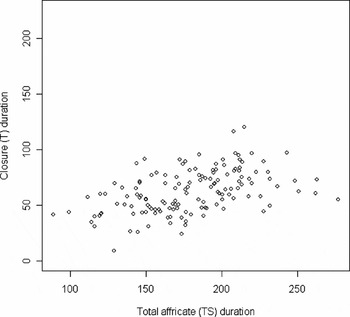
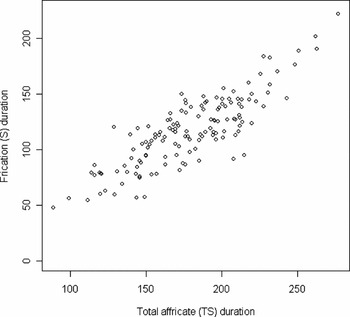
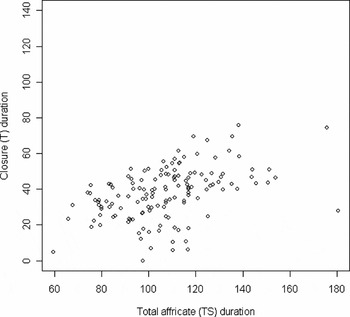
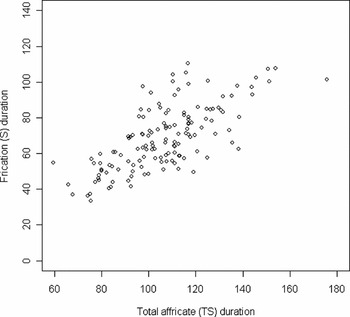
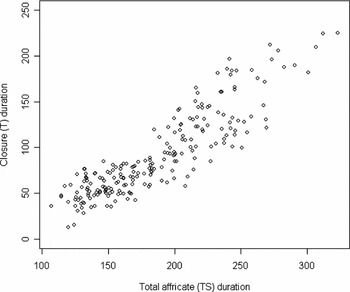
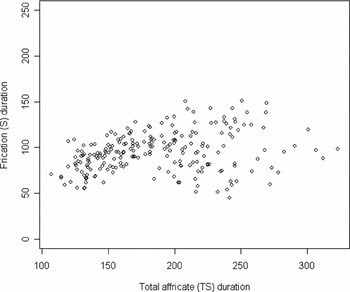
Correlations between component and total durations offer one way to evaluate these competing hypotheses. Figure 8 shows closure durations as a function of the total affricate duration, and figure 9 shows frication durations as a function of total affricate duration, both for phrase-final positions only. The constancy hypothesis would predict that both closure and frication duration should correlate equally tightly with total affricate duration. But this is not the case. Closure shows only a modest correlation with total affricate duration (Pearson's r = 0.47), while frication duration shows a much closer correlation (Pearson's r = 0.84). This result supports the locality hypothesis because it suggests that when an affricate lengthens in phrase-final position, the frication portion must be the primary target while the closure portion is only a secondary target.
Phrase-final positions: relationship between total duration of the affricate and the closure portion (Pearson's r = 0.47).

Phrase-final positions: relationship between total duration of the affricate and the frication portion (Pearson's r = 0.84).

3.2 Results: word- and phrase-initial lengthening
If the locality hypothesis for phonetic lengthening generalizes, then we expect that, for any phrase position, it is the affricate component closest to the phrase boundary which should undergo the biggest increase in duration. For affricates in word-initial and phrase-initial positions, then, the hypothesis predicts that closure should exhibit the biggest increases.
Our data allow us to investigate this prediction in two ways, even though we cannot measure closure durations in absolute phrase-initial position. The first way involves examining word boundaries, which also serve as a trigger for phonetic lengthening (cf. Klatt Reference Klatt1976: 1213). For our purposes, we want to know if the internal organization of the affricate changes as it lengthens in word-initial position (e.g. csülök ‘pig's feet’), and whether this reorganization is the same as what we see in word-final position (e.g. becs ‘honor’). To do this, we examine correlations between measurements taken in both word-initial and word-final position, but we factor out the phrasal effect by examining only those tokens which occur in phrase-medial position (i.e. the first and third sentences from tables 1 and 2).
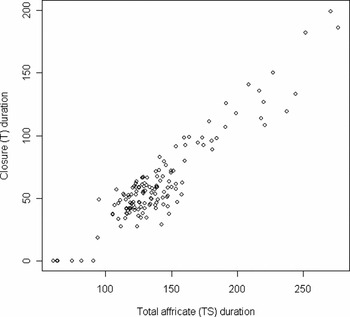
Figures 10 and 11 show measurements from word-initial position. Figure 10 shows closure durations as a function of the total affricate duration, and figure 11 shows frication durations as a function of total affricate duration. Closure shows a very close correlation with total affricate duration (Pearson's r = 0.93), while frication duration shows a modest correlation (Pearson's r = 0.38). This result supports the locality hypothesis because it suggests that when an affricate lengthens in phrase-initial position, the closure portion must be the primary target while the frication portion is only a secondary target. In other words, phonetic lengthening targets the component closest to the boundary, which here lies to the left of the affricate.Footnote 2
Word-initial positions: Relationship between total duration of the affricate and the closure portion (Pearson's r = 0.93).

Word-initial positions: relationship between total duration of the affricate and the frication portion (Pearson's r = 0.38).

Figures 12 and 13 show measurements from word-final position. Here, closure shows a modest correlation with total affricate duration (figure 12, Pearson's r = 0.45), while frication duration shows a closer correlation (figure 13, Pearson's r = 0.74). This pattern is reversed from what we saw in figures 10 and 11. Under the locality hypothesis, this is what we expect, because lengthening targets the component closest to the boundary, which now lies to the right of the affricate.
Word-final positions: relationship between total duration of the affricate and the closure portion (Pearson's r = 0.45).

Word-final positions: relationship between total duration of the affricate and the frication portion (Pearson's r = 0.74).

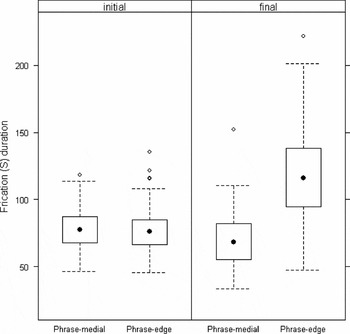
In addition to word boundaries, the second way in which we can examine our locality hypothesis is by comparing the behavior of frication durations across all four word and phrase positions.Footnote 3 We expect that the effect of phrase-final lengthening should be accomplished by increasing frication durations – this result holds true, as we have already seen in the previous section. But we also expect that the effect of phrase-initial lengthening should not be accomplished in this manner. This expectation appears to be borne out. A repeated-measures ANOVA shows main effects of both word position (F(1,13) = 22.43, p < .001) and phrasal position (F(1,13) = 64.25, p < .001) on frication duration, and an interaction between word and phrasal position (F(1,13) = 77.89, p < .001). There is no effect of place of articulation, and no interaction between place and either word or phrasal position. A post-hoc Tukey's test reveals significant differences for every comparison except two: there is no significant difference between frication durations in phrase-initial and phrase-medial, word-initial conditions, or between frication durations in phrase-initial and phrase-medial, word-final conditions.
These results can be visualized by examining the left panel of figure 14, which shows essentially no difference in frication duration between affricates in phrase-medial and phrase-initial positions. Of course, this contrasts markedly with the results for phrase-final position (right panel), where phonetic lengthening targets frication durations almost exclusively.
Distributions of frication durations in different word positions (initial versus final) and different phrasal positions (medial versus edge).

3.3 Summary
The results of the phonetic lengthening experiment allow us to draw several conclusions. Lengthening in phrase-final positions is a robust effect in Hungarian. It also appears to be a gradient one, because the durations of lengthened consonants occupy a relatively wide distribution. Lengthening in phrase-final positions affects both alveolar and postalveolar affricates in similar fashion. Most importantly, phonetic lengthening targets the portion of the affricate that is closest to the word or phrase boundary. That is, initial lengthening processes target the stop closure while final lengthening processes target the frication.
The current results are consistent with previous work on phonetic lengthening in Hungarian. Olaszy (Reference Olaszy1994: 55) reports greater overall durations for words in phrase-final position, compared to phrase-medial position. Kassai (Reference Kassai1979, Reference Kassai and Bolla1982, cited in Hockey & Fagyal Reference Hockey and Fagyal1999) reports greater durations for both vowels and consonants in phrase-final position. Finally, Hockey & Fagyal (Reference Hockey and Fagyal1999), in a corpus study of restricted spontaneous speech, found that the final CVC syllables of polysyllabic words in phrase-final position exhibited significantly longer durations than their phrase-medial counterparts. Crucially, the duration increases were not distributed equally throughout the syllable: onset consonants did not differ significantly across phrasal positions, but rhymes were somewhat longer when phrase-final, and coda consonants were significantly longer when phrase-final. The authors conclude that while some phrase-final lengthening occurs on the rhyme, most of it occurs on the final consonant, a finding that is entirely consistent with our characterization of phonetic lengthening as a strictly local process (for related work on Hungarian segmental durations, see Gósy Reference Gósy2001; Olaszy Reference Olaszy2000, Reference Olaszy2002; and the papers in Gósy Reference Gósy1991).
The current results are also consistent with those predicted by the prosodic boundary (π) gesture model, which Byrd and colleagues have proposed for phonetic lengthening and strengthening effects (Byrd et al. Reference Byrd, Kaun, Narayanan, Saltzman, Broe and Pierrehumbert2000, Reference Byrd, Lee, Riggs and Adams2005). The π-gesture model predicts that those portions of the speech stream that lie closest to a prosodic boundary should undergo the most change, while those that lie farther away should undergo less. This is the effect that we see here. In phrase-final lengthening, for example, the frication portion of the affricate lies closest to the phrase boundary, and it exhibits larger increases in duration. The closure portion lies somewhat farther from the phrase boundary, and it exhibits smaller increases in duration.
Of course, the notion of locality – by which linguistic units tend overwhelmingly to be affected by those units which lie adjacent to them – is also known to be operative in phonology, the domain to which we turn next.
4 Results: phonological lengthening
We turn now to the results for phonological lengthening. Recall that we are comparing word-medial affricates followed by plain versus geminating suffixes: becsen ‘honor-superess’ versus beccsel ‘honor-instr’, and teknőcőn ‘tortoise-superess’ versus teknöccel ‘tortoise-instr’.
4.1 Overall duration
We will first establish that phonological lengthening occurs by focusing on total duration measurements. We expected that affricates which are lengthened by a geminating suffix should exhibit longer durations than affricates which are adjacent to a plain suffix. This expectation was met.
Affricates adjacent to the plain suffix show a mean duration of 149.3 (19.9) ms, while adjacent to a geminating suffix show a mean duration of 223.6 (32.8) ms. This difference is significant: a repeated-measures ANOVA shows a main effect of suffix type on the total duration of the affricate (F(1, 13) = 235.1, p < .001). The mean ratio of durations in geminating versus plain position is 1.5, and individual subject ratios range from 1.4 to 1.8. The ANOVA also indicates a main effect of place of articulation (F(1, 13) = 7.4, p < .05), and an interaction between suffix type and place of articulation (F(1, 13) = 74.3, p < .001). As can be seen in figure 15, the postalveolar affricates exhibit duration increases that are rather large (+92.5 ms) compared to those that the alveolar affricates exhibit (+56.0 ms). (Recall that the postalveolar stimuli becsen, beccsel and the alveolar stimuli teknőcön, teknőccel are further differentiated by number of syllables and vowel length preceding the target consonant.) Note that within each place of articulation, the distribution of durations in the geminating conditions is not much wider than the distribution of durations in the plain conditions.
Distributions of total duration for different affricate places of articulation (alveolar versus postalveolar) and different suffix conditions (plain versus geminating), ms.

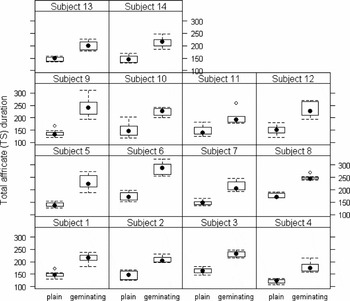
We may conclude that phonological lengthening occurs in our data set. Furthermore, each individual speaker exhibited a robust contrast between plain and geminating durations, as shown in figure 16. Again, despite their variation in age, place of origin, and degree of contact with English, the subjects exhibited remarkably consistent behavior. This point is important because studies of immigrant communities in the United States have shown that second-generation Hungarian speakers often lose the contrast between singleton and geminate consonants, and fail to produce geminates with the instrumental (and translative) suffixes (Fenyvesi Reference Fenyvesi and Fenyvesi2005: 285–286). However, these studies also show that first-generation immigrants, unlike their younger counterparts, continue to maintain these contrasts, a conclusion that is confirmed by the current study, which included first-generation immigrants only.
Distributions of total affricate durations in plain and geminating positions, for each individual subject (n = 14).

4.2 Component durations
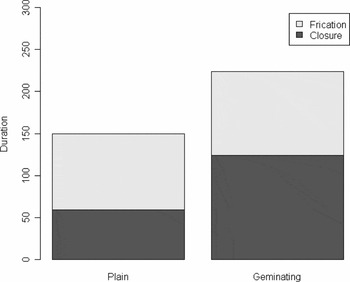
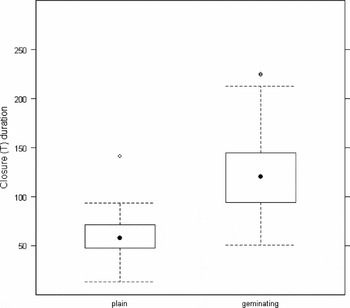
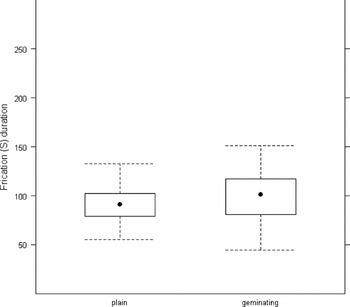
We can now ask how phonological lengthening occurs, and as before, we do this by examining the durations of closure and frication individually. Figure 17 shows the relative contribution of each component to the mean duration for each suffix type, and figures 18 and 19 show the duration distributions.
Mean values for closure (dark gray) and frication (light gray) durations in different suffix conditions, ms.

Distributions of closure duration in different suffix conditions, ms.

Distributions of frication duration in different suffix conditions, ms.

We see a very large difference in closure duration across the two suffix types. Affricates next to a plain suffix have a mean closure of 59.0 (17.6) ms, while those next to a geminating suffix have a mean closure of 123.8 (40.7) ms. This difference is significant: a repeated-measures ANOVA shows a main effect of suffix type on the closure duration (F(1, 13) = 99.8, p < .001). The mean ratio of durations in geminating versus plain position is 2.1, and individual subject ratios range from 1.7 to 3.0.
There is also a main effect of place of articulation (F(1, 13) = 36.8, p < .001), and an interaction between place of articulation and suffix type (F(1, 13) = 71.0, p < .001). This is not surprising given that the ANOVA for total duration also showed this effect and this interaction. If the bulk of affricate duration is actually due to changes in closure duration, then we expect closure duration to pattern closely with total duration.
We see just a small difference in frication duration. Affricates next to a plain suffix have a mean frication of 90.3 (17.0) ms, while those next to a geminating suffix have a mean frication of 100.0 (25.0) ms. Such a small difference may not play any linguistically meaningful role, although it is statistically significant: a repeated-measures ANOVA shows a main effect of suffix type on frication duration (F(1, 13) = 9.3, p < .01). The mean ratio of durations in geminating versus plain position is 1.1, and individual subject ratios range from 0.9 to 1.4. There is also a main effect of place of articulation (F(1, 13) = 25.3, p < .001), but no interaction between place of articulation and phrasal position.
The relative contribution of each affricate component can be seen in figures 20 and 21. These figures, which include both singleton and geminate measurements, show the closure durations and frication durations, respectively, as a function of the total affricate duration. As total duration increases, so does closure duration, and the correlation between them is strong (Pearson's r = 0.89). Frication duration, however, has a much looser relationship with total duration, and the correlation between them is quite modest (Pearson's r = 0.28).
Singleton and geminate positions: Relationship between total duration of the affricate and the closure portion (Pearson's r = 0.89).

Singleton and geminate positions: Relationship between total duration of the affricate and the frication portion (Pearson's r = 0.28).

4.3 Summary
The results from phonological lengthening allow us to draw several conclusions. Suffix-triggered gemination effects duration increases on consonants. These increases appear to be categorical, in the sense that the durations of geminate consonants occupy a distribution that is just as narrow as that occupied by singletons. Most importantly, phonological lengthening overwhelmingly affects the closure portion of the affricate.
The scope of these conclusions is of course circumscribed by the fact that only two noun roots, becs ‘honor’ and teknőc ‘tortoise’, were examined. However, previous work that encompassed a larger number of Hungarian noun roots shows very similar results. Pycha (Reference Pycha2007) reports duration measurements for thirty-two affricate-final roots with the superessive (plain) and instrumental (geminating) suffixes, exactly the same environments used here. Stimuli included monosyllabic and disyllabic roots, with final syllable shapes drawn from the set CVC, CVNC, CVːC, and CVːNC, giving rise to a total of eight root shapes. The results, from three Hungarian speakers living in the United States (none of whom participated in the current study), are consistent with those presented here. The mean total duration ratios for geminating versus plain contexts was 1.3. This ratio is somewhat smaller than that reported here, most likely due to the use of a carrier sentence. For closure duration, the ratio was 1.8 and for frication duration, it was 1.1. Thus, the significant difference in duration between plain and geminating contexts occurred almost entirely in the closure portion of the affricate. Previous data on underlying singleton and geminate affricates in Hungarian also show this pattern: Kassai (Reference Kassai1980) and Tarnóczy (Reference Tarnóczy, Channon and Shockey1987) report measurements showing that the bulk of the duration difference occurs in the closure portion, not in the frication portion.
The current results from phonological lengthening also revealed that noun roots ending in postalveolar consonants (becs ‘honor’) are affected by phonological lengthening to a greater degree than those ending in alveolar consonants (teknőc ‘tortoise’). Recall, however, that the two roots in question are distinguished not just by the place of articulation of the final affricate, but also by number of syllables (one for becs, two for teknőc), length of preceding vowel (short for becs, long for teknőc), and placement of the stressed syllable (always initial) relative to the target. Isolating the relevant factor is a question for future research. For now, the important point is that, in contrast to phonological lengthening, phonetic lengthening did not exhibit sensitivity to any of these factors. Thus, the behavior of phonetic and phonological lengthening clearly diverges along these lines.
Finally, recall our initial observation that the effect of lengthening on the total duration of the affricate appears to be roughly similar in both phonetic and phonological conditions. Indeed, the absolute duration increases in each condition closely parallel one another, with a mean increase of 71.9 ms for phonetic lengthening and 74.3 ms for phonological lengthening, respectively. This finding is in line with results reported in Pycha (Reference Pycha2007) for Hungarian affricates and Hockey & Fagyal (Reference Hockey and Fagyal1999) for Hungarian vowels; both studies show that phonetically lengthened segments can exhibit duration increases on a par with phonologically lengthened ones. Despite this confluence of results, the fact that phonetic and phonological lengthening should trigger similar changes in total duration is somewhat surprising, given the notion that phonetic processes should not neutralize phonological contrasts. Our focus on affricates allows us to resolve this issue. We have seen that phonetic lengthening targets the adjacent portion of an affricate, while phonological lengthening targets the closure only. Thus, a trade-off exists between the degree of lengthening, which is comparable in both conditions, and the type of lengthening, which is not (see also Pycha Reference Pycha2007). Given that phonetic lengthening has such a radically different impact on the complex structure of the affricate, then, it seems doubtful that it would really threaten to neutralize the phonological length contrast. Future research would determine whether the phonetic lengthening of simple segments, such as vowels, could be characterized in a similar vein.
5 Discussion
The use of affricates in target position reveals a difference between phonetic and phonological lengthening that would not otherwise be evident. Although both lengthening processes are triggered by an element to the right of the affricate, and both increase the duration of the target segment, they do so in very different ways. Phonetic lengthening can increase the duration of either affricate component and does so in a strictly local fashion. But phonological lengthening exclusively increases closure duration, in a noticeably non-local fashion.
We therefore reject the hypothesis that phonetic and phonological lengthening are ‘the same’: that is, we reject the idea that they perform the same basic operation (increasing duration) on the same representation (a consonant). But how should we account for this lack of sameness? We could claim that the difference lies in the operation of the lengthening itself, and that the affected representations are equivalent. Alternatively, we could claim that the difference lies in underlying versus surface representations of affricates, and that the operations themselves work in an equivalent manner.
I will argue for the former claim. Phonetic lengthening, as we have seen, obeys strict locality. It always targets the nearest material in the speech stream. Phonological lengthening, on the other hand, is a more complex beast. While it generally operates according to locality, it may sometimes disregard this principle. In particular, the claim I will make here is that phonological lengthening can disregard locality (or other principles, such as input faithfulness) in order to produce outputs with long areas of maximum stricture. In other words, long consonants are preferentially long stop consonants, not long fricatives (Elmedlaoui Reference Elmedlaoui1993, Kirchner Reference Kirchner2000, Podesva Reference Podesva2002). As we will see, this account finds support far beyond Hungarian, in cross-linguistic patterns of gemination. Yet it also finds support within Hungarian, in patterns of geminate formation that require an underlying affricate with two ordered portions.
Let us begin by examining how this idea would apply to the Hungarian cases that have been under consideration. If there are no substantive differences between the underlying and surface forms of affricates, then the underlying form must have a two-part structure in which the stop closure and frication are ordered one after the other. This is because the surface form clearly has such a structure, visible for example in the spectrograms presented earlier in figures 1 and 2. A simple way (although certainly not the only way) to represent this ordered relationship is as in (3), which shows an alveolar affricate [ts].
(3)
Here a single timing unit, C, is linked to two segmental units, [t] and [s] (Clements & Keyser Reference Clements and Keyser1983, among many others).
Phonetic lengthening can affect either edge of this two-part structure. When the trigger for lengthening is on the right (i.e. when the affricate is word-final or phrase-final), it is the frication which is affected, as shown by the bolding of [s] in (4a). When the trigger is on the left (i.e. affricate is word-initial or phrase-initial), it is the closure which is affected, as shown by the bolding of [t] in (4b).
(4)
Phonological lengthening, on the other hand, does not have access to both edges. Even when the trigger for lengthening is on the right (i.e. when the affricate is next to a geminating suffix), it is the closure which is affected. This is because phonological lengthening is constrained by a preference to lengthen the closure rather than the frication. The representation of this constrained lengthening could take several possible forms, the choice of which is not crucial for my more general point. In (5), I show it as the non-local insertion of an empty C slot accompanied by subsequent feature spreading from [t].
(5)
There are two sources of evidence for the account that I propose. The first source comes from cross-linguistic patterns, in which a preference for geminate stop closures (versus long frications or approximant articulations) shows up in many different guises. The second source of evidence comes from independent patterns of geminate affrication within Hungarian, which show that underlying affricates must consist of two ordered portions, just like their surface counterparts.
Let us consider cross-linguistic patterns first. In Hungarian, a preference for long stop closures trumps locality. That is, phonological lengthening produces a lengthened stop closure where locality would predict a lengthened frication. In other languages, the preference for long stop closures trumps faithfulness to the input. Wolof (Ka Reference Ka1994) provides a good example (see also the related language Pulaar (Niang Reference Niang1997), as well as the examples from Berber cited in Elmedlaoui Reference Elmedlaoui1993). Wolof has a reversive suffix -i that triggers phonological lengthening. When the final consonant of a root is a stop, the output is a lengthened stop, as in (6).
(6)
When the final consonant of a root is a fricative, however, the output is also a lengthened stop, as in (7).
(7)
That is, phonological lengthening produces a lengthened stop closure even where input faithfulness would predict a lengthened frication.
Interestingly, in just those cases where the language can satisfy the constraint on phonological lengthening while also remaining somewhat more faithful to the input, it does so. For an input singleton /s/, the phonological lengthening produces a geminate affricate /tːs/, as in (8).
(8)
In other words, one portion of the fricative /s/ alternates to [t] in order to satisfy the preference for long stop closures, but the other portion surfaces as [s] in order to satisfy faithfulness to the input.
Tamil (Christdas Reference Christdas1988) provides additional support for this idea. In Tamil, phonological lengthening serves as a morphological marker for the derivation of nouns from verbs and of transitives from intransitives. For singleton fricatives, the output of lengthening is a geminate stop, similar to what we saw in Wolof: [perɯxɯ] ‘increase’, [perɯkkɯ] ‘multiply’; [peesɯ] ‘speak’, [peeccɯ] ‘speech’. In fact, Tamil extends this alternation to singletons that have even less stricture than fricatives. Thus, approximant singletons also alternate with geminate stops: [ciiʋɯ] ‘comb (v)’, [ciippɯ] ‘comb (n)’; [uurɯ] ‘ooze’, [uuttu] ‘spring (n)’ (examples from Christdas Reference Christdas1988: 190, 386).
The related language Malayalam (Mohanan & Mohanan Reference Mohanan and Mohanan1984, Asher & Kumari Reference Asher and Kumari1997) exhibits a similar pattern, and furthermore illustrates that the preference for long stop consonants seems to act specifically as a constraint on active phonological lengthening. For example, the locative suffix -il triggers lengthening: [kaaʈə] ‘forest’, [kaaʈʈil] ‘in the forest’. When the target is a singleton approximant /r/, lengthening favors a long stop closure and produces a geminate /tt/: [aarə] ‘river’, [aattil] ‘in the river’. When two /r/ segments happen to join across a morpheme boundary, however, the preference for maximum stricture plays no role and the output is a geminate approximant /rr/: /dur-raaɳi/ → [durraaɳi] ‘bad queen’ (examples from Mohanan & Mohanan Reference Mohanan and Mohanan1984: 582).
The idea that long consonants are preferably long stops also finds support in Podesva (Reference Podesva2002), whose survey of 52 languages found that languages which have a geminate fricative in their phonemic inventories also have geminate stops, but not vice-versa (see also Kirchner Reference Kirchner2000). It is also interesting to note that in some languages, an increase in stricture seems to substitute for phonological lengthening. In Cuna, for example, the geminate counterpart to singleton /s/ is not a geminate, but a singleton affricate /tʃ/ (Adelaar with Muysken Reference Adelaar and Muysken2004, Lindsey Newbold p.c.). And in Boraana Oromo, singleton affricates pattern along with geminates and consonant clusters, as evidenced by the fact that word-final affricates trigger vowel epenthesis when adjacent to another consonant (Stroomer Reference Stroomer1995).
Many of the individual examples cited above exhibit active processes of phonological lengthening, triggered by suffixes that are similar to the Hungarian instrumental. They demonstrate that at least some phonological lengthening processes are sensitive to stricture type. But it is possible, and in fact quite likely, that more than one type of phonological lengthening exists. Some evidence for this can be found in other descriptions of geminate affricates arising from various sources. Geminate affricates that are realized with long closure portions, similar to what we have documented here for Hungarian, have also been documented for the languages Anejom (Malayo-Polynesian, Vanuatu; Lynch Reference Lynch2000: 24), Hindi (Indo-Iranian, India; M. Ohala Reference Ohala1983: 6), and Shilluk (Eastern Sudanic, Sudan; Gilley Reference Gilley1992: 27), to name a few. But Arvaniti & Tserdanelis (Reference Arvaniti and Tserdanelis2000) report that in Cypriot Greek minimal pairs such as [Ⲉfitʃɐ] ‘seaweed’ versus [Ⲉfitʃːɐ] ‘show off’ it is the frication portion, and not the stop portion, which exhibits significantly longer durations in the geminate environment. Faluschi & Di Benedetto (Reference Faluschi and Di Benedetto2001) report that in nonsense syllables pronounced by Italian speakers, both the stop and frication portions of a geminate affricate lengthen significantly, albeit by different amounts (closure increases by 62%, frication by 28%). Finally, Thurgood & Demenko (Reference Thurgood and Demenko2003) report that Polish speakers most often produce geminate affricates not with increased durations, but by double articulation. Of those geminates that were singly articulated, 44% exhibited increased duration in the frication portion. If geminate affricates take on all of these different guises, it is more likely due to a proliferation of lengthening types than to a proliferation of affricate representations.
Let us now turn to the idea that underlying affricates in Hungarian must consist of two ordered portions, just like their surface counterparts. This conception of affricates has, of course, been subject to critique. Lombardi (Reference Lombardi1990), Steriade (Reference Steriade, Cole and Kisseberth1994), and Clements (Reference Clements, George, Fujimura, Joseph and Palek1999) have all claimed that the representation of affricates must differ underlyingly and on the surface (see also Hualde Reference Hualde1988, Rubach Reference Rubach1994). In particular, Clements (Reference Clements, George, Fujimura, Joseph and Palek1999) explicitly rejects the idea that affricates consist of two ordered portions. He argues instead that affricates are underlyingly simple stops, distinguished from other simple stops in terms of independently-motivated features such as [strident], [distributed], and [anterior]. Therefore, an affricate such as [ts] might have the underlying representation shown in (9a), which is distinguished from the simple stop [t] shown in (9b).
(9)
According to Clements's proposal, the feature [strident] and the features for [t] are unordered in the underlying representation. A (presumably universal) process of phonetic spell-out determines that in the surface representation, the stop closure representing [t] occurs first followed by the frication representing [strident], creating the representation shown in (10).
(10)
One advantage of Clements's proposal is that it restricts the inventory of possible segment representations. Furthermore, many, and possibly all, cases in which affricates pattern like full-blown fricatives can be analyzed as patterns that are sensitive to the feature [strident]. One such case is found in Hungarian, where regressive place assimilation among stridents encompasses not only the fricatives /s/ and /ʃ/, but also the affricates /ts/ and /tʃ/ (Siptár & Törkenczy Reference Siptár and Törkenczy2000: 188–194; see also Vago Reference Vago1980).
Another advantage of his proposal is that it could provide a reasonably straightforward explanation for the findings of the current study. Phonological lengthening would apply to the representation in (9a) where the closure for [t] is the only linguistic unit available for gemination. Phonetic lengthening would apply to the representation in (10), after the closure for [t] and the frication for [strident] are ordered as a sequence of events in time.
But other evidence from Hungarian suggests that an ordered, two-part structure for underlying affricates is crucial, and that an analysis which denies this ordering cannot be correct. As I mentioned briefly in the introduction, Hungarian possesses a number of processes that create geminates, and geminate affricates in particular (Kenesei et al. Reference Kenesei, Vago and Fenyvesi1998: 442–444). For example, when an alveolar stop and a fricative come together across a morpheme boundary, a geminate affricate results, as shown in (11). (Subsequent examples, some of which show the independent effect of regressive voicing assimilation, are from Siptár & Törkenczy Reference Siptár and Törkenczy2000: 193 and Kenesei et al. Reference Kenesei, Vago and Fenyvesi1998: 442–444).
(11)
In each of these cases, two previously independent short segments, such as /t/ and /s/, rearrange their timing relationships to become a single long segment.
If, as I claim, affricates have a two-part structure, this process can be represented straightforwardly as auto-segmental spreading, in which a one-to-one relationship between segments and timing units is replaced by a many-to-one relationship, as in (12).
(12)
This analysis captures the compensatory lengthening process that occurs (Clements Reference Clements, Wetzels and Sezer1986). As the stop /t/ gets longer by virtue of association to multiple timing units, the fricative /s/ gets shorter because it no longer has a timing unit to itself.
If, on the other hand, affricates have a Clements-style simple structure, this process might be represented as the de-linking of the segment /s/ from its timing unit. This is followed by the spreading of /t/ features, and re-association of the [strident] feature that had previously been associated with /s/. A rough illustration of what this process would look like is in (13).
(13)
There are two problems here. First, the affricate geminate that results from this process can be either alveolar [ts] or postalveolar [tʃ], depending upon the place of articulation of the original fricative, i.e. alveolar /s/ or postalveolar /ʃ/. But the affricate representation in (13) does not capture differences in place. We could potentially remedy this by claiming that regressive place assimilation occurs before the delinking of /s/ or /ʃ/ from its timing unit, such that the simple stop /t/ could be rendered postalveolar, but it is much simpler to say that the underlying /s/ or /ʃ/ simply remains intact – with its stridency, place of articulation, and other features – in its original linear position within the string. Second, under a Clements-style analysis, the stridency feature of an underlying affricate is not in any linear order relative to the stop. Crucially, this predicts that geminate affricates in Hungarian should be just as likely to arise from /s-t/ and /ʃ-t/ combinations. The fact that geminate affricates do not arise at such junctures suggests that linear ordering of stop and frication does, in fact, play a role in affricate structure underlyingly.
Two other processes in Hungarian are also relevant to my argument. Stop and affricate combinations that occur across morpheme boundaries produce geminate affricates, as in (14). Furthermore, affricate and fricative combinations also produce geminate affricates in fast, carefree speech, as in (15) (some of the examples below also show the effect of regressive place assimilation in stridents).
(14)
(15)
The attested patterns show a strict sensitivity to the different sides of an affricate (‘edge effects’, in the terms of Lombardi Reference Lombardi1990). Just when a stop lies to the left side of an affricate, or when a fricative lies to the right side, a geminate affricate results. If affricates have an ordered, two-part structure underlyingly, this pattern is entirely expected, and we can analyze it as the fusion of identical, adjacent material (cf. Siptár & Törkenczy Reference Siptár and Törkenczy2000: 190–193) followed by restructuring of timing relationships, as shown in (16).
(16)
As the examples show, alveolar affricates can fuse with postalveolar fricatives (arc seb ‘facial wound’), and postalveolar affricates can fuse with alveolar fricatives (kulcs szam ‘key number’). We can analyze these cases as having undergone regressive place assimilation, an independently-motivated alternation, prior to fusion.
If affricates have a simple structure underlyingly, however, sensitivity to the different sides of an affricate is not predicted. That is, if stop closure and stridency are unordered as Clements (Reference Clements, George, Fujimura, Joseph and Palek1999) claims, geminate affricates should be just as likely to arise from the combinations /s-ts/, /ʃ-tʃ/, /ts-t/ and /tʃ-t/. But this does not occur in Hungarian.
A final piece of evidence also argues in favor of the two-part structure for underlying affricates. Hungarian has a series of palatalized consonants [tj dj nj]. In precisely the same environments where geminate affricates are created, so are geminate palatalized consonants. Thus, when an alveolar stop and a glide /j/ come together, a geminate results.
(17)
Likewise, combinations of stop and palatalized consonants produce geminate palatalized consonants, as do combinations of palatalized consonants and glides.
(18)
(18)
The data for palatalized consonants pattern perfectly with the data for affricates. If the distinguishing feature of affricates resides in a feature such as [strident], however, we would be forced to offer one analysis for strident consonants and a separate analysis for palatalized consonants. Such a solution obviously fails to capture the generalizations holding over both. If, on the other hand, affricates and palatalized segments both have ordered, two-part structures underlyingly, as I argue, then the same analysis that we have offered for geminate affricates can handle palatalized affricates too. Thus, the proper generalization for Hungarian must be one which recognizes, rather than ignores, the underlying complexity of some segments versus the simplicity of others.
In sum, underlying affricates in Hungarian have a two-part, ordered structure. Of course, surface affricates also have a two-part, ordered structure. This strongly suggests that the correct characterization of phonetic and phonological lengthening cannot rely on the representational differences, if any, between underlying and surface segments. Instead, the correct characterization must rely on differences between the lengthening operations themselves. I have argued that this difference has to do with a phonological preference for lengthened stop closures, an idea for which there is abundant cross-linguistic evidence.
5 Conclusion
There are two major conclusions from this study. The first is that the difference between phonetic and phonological processes can run very deep indeed, despite their apparent similarities. We cannot necessarily distinguish between them simply by saying that one produces a small degree of change while the other produces a large degree of change. In fact, the lengthening processes in this study exhibit roughly equivalent degrees of overall change; thus, it is not degree, but type of change that distinguishes them. It is possible that upon closer scrutiny, other supposedly similar processes – such as coarticulation and assimilation – may turn out to be quite different, too.
The second major conclusion is that complex units still have much to tell us about the nature of linguistic processes. Affricates are just one kind of complex unit. Doubly-articulated consonants, pre- and post-nasalized consonants, palatalized and aspirated consonants, diphthongs, and contour tones all possess elaborated structures. Future work could show that their components participate in phonetic and phonological processes in different ways, revealing the nature of these processes in ways that remain hidden with simpler units.
Acknowledgements
Peter Dienes wrote the stimulus sentences, for which I am deeply grateful. Keith Johnson provided guidance at all stages. Ashlyn Moehle provided expert research assistance. The Hungarian participants gave generously of their language expertise. Diana Archangeli, Larry Hyman, Sharon Inkelas, Robert Vago, JIPA editor Adrian Simpson, and two anonymous reviewers provided valuable critique. Portions of this work were presented at UC Berkeley, City University of New York, the University of Georgia, the 16th International Congress of Phonetic Sciences at Saarbrücken, Stanford University, and the Linguistic Society of America annual meeting, where audiences offered useful feedback. The contributors to Praat, R, and Gimp provided not-for-profit software tools. This paper was researched and written while the author was at the University of California, Berkeley. The Linguistics Department of UC Berkeley, the UC Berkeley chapter of Phi Beta Kappa, and the Abigail Hodgen Publication Award provided crucial financial support.