




No CrossRef data available.
Article contents
Development and application of Model of Resource Utilization, Costs, and Outcomes for Stroke (MORUCOS): An Australian economic model for stroke
Published online by Cambridge University Press: 25 October 2005
Abstract
Objectives: To outline the development, structure, data assumptions, and application of an Australian economic model for stroke (Model of Resource Utilization, Costs, and Outcomes for Stroke [MORUCOS]).
Methods: The model has a linked spreadsheet format with four modules to describe the disease burden and treatment pathways, estimate prevalence-based and incidence-based costs, and derive life expectancy and quality of life consequences. The model uses patient-level, community-based, stroke cohort data and macro-level simulations. An interventions module allows options for change to be consistently evaluated by modifying aspects of the other modules. To date, model validation has included sensitivity testing, face validity, and peer review. Further validation of technical and predictive accuracy is needed. The generic pathway model was assessed by comparison with a stroke subtypes (ischemic, hemorrhagic, or undetermined) approach and used to determine the relative cost-effectiveness of four interventions.
Results: The generic pathway model produced lower costs compared with a subtypes version (total average first-year costs/case AUD$15,117 versus AUD$17,786, respectively). Optimal evidence-based uptake of anticoagulation therapy for primary and secondary stroke prevention and intravenous thrombolytic therapy within 3 hours of stroke were more cost-effective than current practice (base year, 1997).
Conclusions: MORUCOS is transparent and flexible in describing Australian stroke care and can effectively be used to systematically evaluate a range of different interventions. Adjusting results to account for stroke subtypes, as they influence cost estimates, could enhance the generic model.
Information
- Type
- RESEARCH REPORTS
- Information
- International Journal of Technology Assessment in Health Care , Volume 21 , Issue 4 , October 2005 , pp. 499 - 505
- Copyright
- © 2005 Cambridge University Press
Stroke is a leading cause of mortality and morbidity in the developed world. Currently, approximately 48,000 Australians suffer a stroke each year (25). This number is predicted to increase to around 65,000 by 2015, due to an ageing population. Stroke places a large burden on government, as well as individuals/families. Given inevitable healthcare budget constraints, policy-makers and clinicians need to find ways of meaningfully comparing current practice and options for change. Formal economic appraisal provides an important input to rational planning.
Economic models are useful because they provide the capability to synthesize information from trials and other sources (such as claims data or epidemiological studies) to estimate the impacts of a disease over the lifetime of a patient population. They can be tailored to a variety of policy questions, incorporating longer-term outcomes for economic analysis. Particularly appealing, is the capacity to undertake detailed sensitivity analysis to assess the extent of uncertainty in results, given the assumptions made and limitations of the data sources. For example, clinical trials data are limited by their short duration, strict inclusion/exclusion criteria, and restricted outcome measures.
In this study, we describe an economic model (Model of Resource Utilization, Costs, and Outcomes for Stroke [MORUCOS]) that was originally commissioned by the National Stroke Foundation (NSF) in Australia to aid its government policy advocacy role. The required attributes of the model included (i) comprehensive description of the incidence and prevalence of stroke in specified populations and the associated resource utilization and care costs; (ii) the capacity to predict the disease burden and associated health services implications through time, based on a set of explicit but modifiable assumptions; and (iii) the capacity to evaluate stroke interventions from primary prevention through to palliation. Two versions of the model were created—version~1 (V1), a generic model specified by treatment pathway as commissioned by the NSF; and version 2 (V2), specified by stroke subtypes and developed for a cost-of-illness study.
The results of the first two basic functions of MORUCOS (V2) are reported in detail elsewhere (14–17). A trial cost-effectiveness study using V1 demonstrated the application of a standardized protocol to simulate two interventions: (i) aspirin within 48 hours of stroke; and (ii) intravenous thrombolytic therapy (tPA) within 3 hours of stroke (22).
Economic models are often criticized for their lack of transparency (18). Despite the publications of results from MORUCOS, its development and assumptions have not been fully outlined, nor have the results of the two versions been compared for validation purposes. Use of V1 for describing the national burden of stroke will be reported and compared with V2 results. Additional comparative evaluations of acute and preventative interventions will also be reported using V1.
METHODS
Model Development and Overview
MORUCOS was developed in a series of linked spreadsheets (Excel 97) to maintain “user-friendliness” and transparency, while facilitating use of decision-analytic (DATA Treeage Version 3.5, 1998) and risk analysis software (@Risk Version 3.2, Palisade Corporation, 1997). The two versions were created to describe different factors that drive resource utilization. V1 was developed for stroke classified simply as “first-ever” or “recurrent” (subarachnoid hemorrhages [SAH] excluded) by treatment pathway (“hospitalized”, “not hospitalized and residing in institutional care”, and “not hospitalized and residing in private residence” at time of stroke). The V1 “base-case” is self-contained, in that each treatment pathway is specified within the one workbook. In contrast, V2 comprises the same linked spreadsheet framework in six workbooks: one each for intracerebral hemorrhage (ICH), the four ischemic subtypes based on the Oxfordshire stroke classification (8), and unclassified strokes (those cases not undergoing brain imaging or autopsy; UND). V2 is more labor intensive, depending on which populations (workbooks) are used. The subtypes models were developed with the recognition that different stroke subtypes are associated with different risk factors and outcomes.
A strength of MORUCOS is the incorporation of incidence and outcome data from two studies (North East Melbourne Stroke Incidence Study [NEMESIS] and Perth Community Stroke Study [PCSS]) both recognized as meeting “ideal” criteria for stroke incidence studies (1;25). In addition, the NEMESIS investigators collected detailed patient-level resource utilization data making it the only comprehensive, Australian stroke cost-of-illness study (15). Hence, MORUCOS incorporates detailed patient-level demographic, resource utilization, and outcome data. Long-term (10 years) follow-up of patients recruited to NEMESIS is ongoing and will continue to inform the model.
Given the chronic nature of stroke, MORUCOS comprises a “societal” viewpoint. Because the Australian health-care system is a mixed public/private arrangement, with the majority of service utilization occurring by means of the public (Medicare) system, the focus has been on the impact of stroke on government. Private sector provision, where applicable, together with the costs of stroke impacting outside the health-care sector (e.g., on patients and informal carers and production effects on the general economy) are also available.
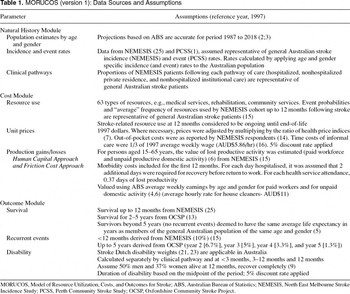
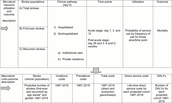
Table 1 summarizes the data sources and assumptions made in the “base case” modules, and Figure 1 provides a conceptual overview of V1. The “base case” reflects “current practice” and consists of three modules. The natural history module provides the platform on which the other modules depend. It is calibrated to the Australian population by gender and five age bands, simulating cohorts between 1987 and 2018. Epidemiology spreadsheets include risk factor, incidence, prevalence, and survival data. The stroke incidence and survival spreadsheets include categorization by both “first-ever” and “recurrent stroke” rates for the three treatment pathways.


Conceptual overview of Model of Resource Utilization, Costs, and Outcomes for Stroke (MORUCOS, version 1). *Age bands are <55,55–64, 65–74, 75–84, 85+ years. DALYs, disability-adjusted life years.
The costs module involves a microcosting approach (18), based on individual patient-level data with spreadsheets that includes description of health services utilization for each disease stage and treatment pathway; national unit prices; indirect cost consequences for production effects on the general economy; and cost results presented as aggregated estimates. Resource utilization data for each treatment pathway up to 12 months after stroke was determined in detail from NEMESIS. Rest-of-life (ROL) service use was based on 12-month utilization and adjusted by experts to exclude services considered unlikely to continue beyond 12 months. Patient “out-of-pocket” expenses, such as home modifications or special equipment/aids, were obtained directly from NEMESIS participants (14). Carer costs were valued using the “opportunity cost method” for valuing leisure time, because, in NEMESIS, the majority of informal care was provided during “family” or “leisure” time (16). As inclusion of production gains or losses is routine in “cost-of-illness” studies, but controversial in economic evaluations, two approaches to valuing production effects were used: the “human capital approach” and the “frictional cost approach” (19).
Cost Results
Prevalence-based costs (the cost of all first-ever and recurrent strokes in the reference year, plus the ongoing costs in that year associated with strokes occurring in previous years) and incidence-based costs (the present value of lifetime costs associated with a cohort of first-ever strokes) can be derived. Cost forecasts can be made for future years up until 2018.
Outcome Results
The outcomes module summarizes mortality and morbidity data. Disability-adjusted life years (DALYs) are also calculated by combining years of life lost (YLL) and years of life lived with disability (YLD) due to stroke. The YLD component uses explicit preference weights for health states using a deliberative “person trade-off” method (21). The DALY burden is estimated separately at three time points within the first 12 months for both those fully recovered and those permanently disabled.
An interventions module that replicates the “base case” allows parameters to be changed for economic evaluations. Alternate options for clinical practice can then be compared with this base case. Such options could include changes to incidence brought about by risk factor modification, the cost of a new intervention, or a change to an existing intervention, and so on. The incremental cost-effectiveness can then be calculated.
Model Validation
Face Validity and Peer Review
The development of MORUCOS included appraisal from various stakeholders, the main sources of expert opinion being the NSF and National Stroke Research Institute. Appraisal in terms of “face validity” and “peer review” was obtained at various local and international scientific conferences, including a national Stroke Consumer Forum held in 2000, as well as the previously cited publications.
Technical Accuracy and Predictive Validity
The different users using the model for various projects have assessed its technical accuracy, such as logical errors, programming formulas, and data inputs and predictive validity. There have also been detailed sensitivity analyses (15;22). A further validation step entails undertaking a direct comparison, between V1 and V2, of cost description and prediction.
Economic Evaluation
We used a standard protocol to ensure that interventions were uniformly assessed. This approach entailed using the best evidence available to clearly specify (i) a description of the intervention, including applicable setting and treatment parameters such as dosage, eligibility criteria, commencement and duration; (ii) effectiveness information, including strength of evidence, effect size, and relevance of effect; (iii) resource use; and (iv) applicable unit costs (22). In this analysis, the following treatments were assessed in first-ever stroke: warfarin therapy for atrial fibrillation (for both primary prevention and secondary prevention [commencing 1 week after stroke]); aspirin within 48 hours of ischemic stroke and continuing for 2–4 weeks; stroke unit management (geo- graphically localized, specialist acute care for 7–10 days); and tPA within 3 hours of ischemic stroke in hospitals with stroke units.
RESULTS
Model Validation
Treatment Pathways Versus Stroke Subtypes
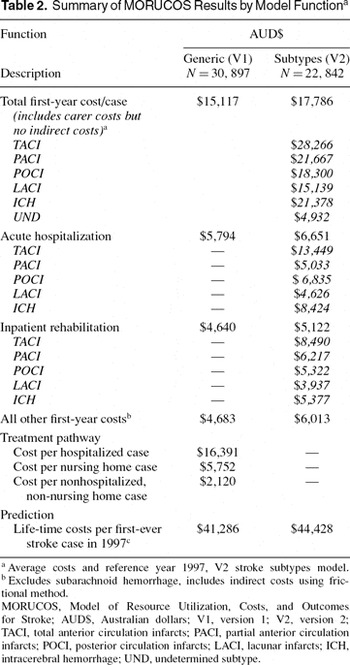
Table 2 illustrates the results derived from V1 and V2. The costs calculated by each version are different, with average (weighted) total costs in V2 resulting in higher costs.

Comparative Assessment of Stroke Interventions Using V1
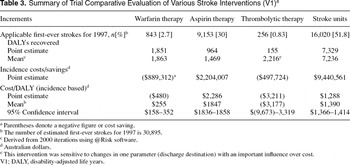
Compared with current practice, warfarin therapy and tPA were cost-effective (“dominant”), in that they each offered a more effective and less costly option (Table 3). Warfarin therapy ranked higher than tPA as it resulted in both larger net savings (AUD$890,000 compared with AUD$500,000) and health benefits (1,851 DALYs saved compared with 155). However, the tPA results were impressive given the small number of persons eligible to be treated (n = 256). Although not “dominant,” the stroke unit intervention was the most attractive option in terms of health gains (7,329 DALYs saved).

DISCUSSION
MORUCOS enables a comprehensive assessment of the current and future disease burden and costs of stroke in Australia. Important insights into the key cost drivers for the disease, such as cost of hospitalization, by stroke subtype, and treatment pathways, were gained. As an evaluation tool, it has tremendous capacity to inform rational health-care planning by enabling the measurement of the opportunity costs associated with intervention choices.
The different units of analysis can explain the differences in costs obtained between V1 and V2. Discrimination by treatment pathway is less “fine-grained,” as it does not pick up the differences between stroke subtypes. The subtypes model tends to have higher total average costs, despite the same NEMESIS cohort data driving the calculations. Therefore, it is the proportion of cases for each relevant population with their associated linked resource use that accounts for the difference. This finding is an important feature of the model, and one of its strengths is its ability to discriminate between types of stroke cases. V2 is more suited to cost-of-illness work and disease prevention evaluations for specific risk factors that influence different stroke subtypes. In contrast, V1 is suited to evaluations where treatment pathway analysis is required. Such pathway analysis is not practical in the subtypes model because of the small numbers of strokes allocated to each pathway (particularly for ICH and UND). The cost estimation capacity of V1 could be improved by adjusting the cost results to account for underlying differences in the incidence and prevalence of various stroke subtypes. Both models clearly facilitate the ability to investigate different policy questions providing flexibility for various applications and decision-making contexts.
The usefulness of MORUCOS is heavily dependent on the validity of the model structure and the quality of the data input. In contrast to other published economic models for stroke (11;12;20;24), the clinical treatment pathways are not conceptual maps of patient flows through discrete health states using a Markov approach (whereby patients move from one health state to another according to transition probabilities dependent on the current state). Rather, they provide a comprehensive description of current patient care in Australia. Furthermore, it is the only economic model to contain detailed patient-level resource utilization and outcome data derived from a community-based incidence study. Another advantage of MORUCOS is that data parameters can be manipulated easily to match the decision context and can incorporate new data sources as they become available.
MORUCOS has several limitations. First, stroke incidence rates, mortality, resource utilization probabilities, and treatment patterns are held constant through time, unless specifically altered as part of an evaluation. Hence, predictions for future years may be inaccurate. There is an implicit assumption that current services are acceptable and can be maintained through time within available budgets. Second, although MORUCOS incorporates many data sources, it is closely aligned with NEMESIS results. NEMESIS constitutes “best available data”, however, we cannot be certain of its representativeness for Australia as a whole. Similarly, we assume standard unit costs for services but, in reality, there will be variations. Such data assumptions clearly have implications for the model's external validity. Finally, care should be taken in interpreting direct costs associated with disease treatment as an estimate of financial savings that would result from prevention of disease. Such “cost offsets” are not usually estimates of immediately realizable savings, but rather “opportunity cost” estimates measuring resources devoted to the treatment of preventable disease that could be available for other purposes.
Further internal validation will include use of cross-sectional resource utilization data obtained from 5-year follow-up of NEMESIS patients to verify the accuracy of long-term assumptions regarding resource use. This aspect has been identified as an important formal validation step that is rarely undertaken (10). Units costs, demographic, and other population statistics will also be updated to reflect a 2004 reference year. Long-term NEMESIS and PCSS Australian estimates will be substituted for Oxfordshire data (13), regarding outcomes and recurrent stroke rates.
The trial evaluation of four interventions demonstrated the evaluation capacity of the model. Each of the interventions forms part of routine practice in Australia. It could be argued that the simulations are limited as they only consider first-ever stroke cases in the reference year and some intervention parameters required extrapolation from international literature. Our cost-effectiveness results are consistent with other published data. However, there has been no previous direct comparison between these or other common stroke interventions using a consistent evaluation methodology. These findings provide the only systematic evidence of cost-effectiveness for these stroke interventions in Australia that is underpinned by local data.
In conclusion, MORUCOS is a transparent, relevant, and flexible decision-analytic tool for stroke in Australia. Further work to enhance the model will strengthen its predictive and evaluative capabilities.
CONTACT INFORMATION
Cathrine Mihalopoulos, PGDHthEc (c.mihalopoulos@unimelb.edu.au), Senior Research Fellow, The University of Melbourne, 4/207 Bouverie Street, Melbourne, 3010 Victoria, Australia
Dominique A. Cadilhac, MPubHlth (dcadilhac@nsri.org.au), Postgraduate Student–PhD, Health Economics Group, School of Population Health, The University of Melbourne, 4/207 Bouverie Street, Melbourne, 3010 Victoria; Manager/Research Fellow, Public Health Division, National Stroke Research Institute, Level 1 Neuroscience Building, 300 Waterdale Road, Heidelberg Heights, 3081 Victoria, Australia
Marjory L. Moodie, DrPH (mmoodie@unimelb.edu.au), Research Fellow, Health Economics Group, School of Population Health, The University of Melbourne, 4/207 Bouverie Street, Melbourne, 3010 Victoria, Australia
Helen M. Dewey, PhD (deweyhm@unimelb.edu.au), Senior Lecturer, Department of Medicine–Austin Health, The University of Melbourne, Level 7, Lance Townsend Building, 145 Studley Road, Heidelberg, 3084 Victoria; Senior Research Fellow, Epidemiology Division, National Stroke Research Institute, Level 1 Neuroscience Building, 300 Waterdale Road, Heidelberg Heights, 3081 Victoria, Australia
Amanda G. Thrift, PhD (thrift@unimelb.edu.au), Honorary Senior Fellow, Department of Medicine–Austin Health, The University of Melbourne, Level 7, Lance Townsend Building, 145 Studley Road, Heidelberg, 3084 Victoria; Head, Epidemiology Division, National Stroke Research Institute, Level 1 Neuroscience Building, 300 Waterdale Road, Heidelberg Heights, 3081 Victoria, Australia
Geoffrey A. Donnan, MD (gdonnan@unimelb.edu.au), Professor, Department of Medicine–Austin Health, The University of Melbourne, Level 7, Lance Townsend Building, 145 Studley Road, Heidelberg, 3084 Victoria; Director, Epidemiology Division, National Stroke Research Institute, Level 1 Neuroscience Building, 300 Waterdale Road, Heidelberg Heights, 3081 Victoria, Australia
Robert C. Carter, PhD (r.carter@unimelb.edu.au), Associate Professor, Health Economics Group, School of Population Health, The University of Melbourne, 4/207 Bouverie Street, Melbourne, 3010 Victoria, Australia
MORUCOS Version 1 was paid for and is owned by the National Stroke Foundation (NSF). It was developed collaboratively by the Program Evaluation Unit of The University of Melbourne and the investigators of the North East Melbourne Stroke Incidence Study at the National Stroke Research Institute.
References
Anderson CS,
Jamrozik KD,
Burvil PV, et al.
1993
Ascertaining the true incidence of stroke: Experience from the Perth Community Stroke Study, 1989–1990.
Med J Aust.
158:
80–
84.Google Scholar
Australian Bureau of Statistics.
1998.
Australian Historical Population Statistics.
Catalogue No. 3105.0.65.001. Canberra:
Australian Government Publishers;
Australian Bureau of Statistics.
1998
Australian population projections statistics (base year 1996),
series B. Catalogue No 3222.0.
Canberra:
Australian Government Publishers;
Australian Bureau of Statistics.
1997.
Average weekly earnings, states and Australia.
ABS Catalogue 6302.00.
Canberra:
Australian Government Publishers;
Australian Bureau of Statistics.
1997.
Deaths Australia 1996.
Catalogue No. 3302.0.
Canberra:
Australian Government Publishers;
Australian Bureau of Statistics.
1997.
Labour force.
ABS Catalogue 6203.00.
Canberra:
Australian Government Publishers;
Australian Institute of Health and Welfare.
1997
Health Expenditure Bulletin,
No13. AIHW cat no. HWE 4.
Canberra:
Australian Government Publishers;
Bamford J,
Sandercock P,
Dennis M, et al.
1991
Classification and natural history of clinically identifiable subtypes of cerebral infarction.
Lancet.
337:
1521–
1526.Google Scholar
Bonita R.
1993
Stroke trends in Australia and New Zealand: Mortality, morbidity and risk factors.
Ann Epidemiol.
3:
529–
533.Google Scholar
Buxton JM,
Drummond MF,
Van Hout BA, et al.
1997
Modelling in economic evaluation: An unavoidable fact of life.
Health Econ.
6:
217–
227.Google Scholar
Caro JJ,
Huybrechts KF.
1999
Stroke treatment economic model (STEM): Predicting long-term costs from functional status.
Stroke.
30:
2574–
2579.Google Scholar
Chambers MG,
Koch P,
Hutton J.
2002
Development of a decision-analytic model of stroke care in the United States and Europe.
Value Health.
5:
82–
97.Google Scholar
Dennis MS,
Burn JP,
Sandercock PA, et al.
1993
Long-term survival after first-ever stroke: The Oxfordshire Community Stroke Project.
Stroke.
24:
796–
800.Google Scholar
Dewey HM,
Thrift AG,
Mihalopoulos C, et al.
2004
‘Out of pocket’ costs to stroke patients during the first year after stroke—results from the North East Melbourne Stroke Incidence Study (NEMESIS).
J Clin Neurosci.
11:
134–
137.Google Scholar
Dewey HM,
Thrift AG,
Mihalopoulos C, et al.
2001
Cost of stroke in Australia from a societal perspective: Results from the North East Melbourne Stroke Incidence Study (NEMESIS).
Stroke.
32:
2409–
2416.Google Scholar
Dewey HM,
Thrift AG,
Mihalopoulos C, et al.
2002
Informal care for stroke survivors: Results from the North East Melbourne Stroke Incidence Study (NEMESIS).
Stroke.
33:
1028–
1033.Google Scholar
Dewey HM,
Thrift AG,
Mihalopoulos C, et al.
2003
Lifetime cost of stroke subtypes in Australia. Findings from the North East Melbourne Stroke Incidence Study (NEMESIS).
Stroke.
34:
2502–
2507.Google Scholar
Drummond M,
McGuire A.
2001.
Economic evaluation in health care: Merging theory with practice.
New York:
Oxford University Press;
Drummond MF,
Stoddart GL,
Torrance GW.
1997.
Methods for the economic evaluation of health care programmes: Second edition.
Oxford:
Oxford Medical Publications;
Matcher DB,
Samsa GP,
Matthews JR, et al.
1997
The stroke policy model: Linking evidence and clinical decisions.
Ann Intern Med.
127:
704–
711.Google Scholar
Mathers C,
Stevenson C,
Carter R, et al.
1998
Disease costing methodology used in the Disease Costs and Impact Study 1993–94.
AIHW cat. No. HWE 7.
Canberra:
Australian Institute of Health and Welfare
(Health and Welfare Expenditure Series no. 3),
Moodie ML,
Carter R,
Mihalopoulos C, et al.
2004
Trial application of a Model of Resource Utilization, Costs and Outcomes for Stroke (MORUCOS) to assist priority setting in stroke.
Stroke.
35:
1041–
1046.Google Scholar
Stouthard MEA,
Essink-Bot M,
Bonsel GJ, et al.
1997.
Disability weights for diseases in the Netherlands.
Rotterdam:
Department of Public Health, Erasmus University;
Sunberg G,
Bagust A,
Terent A.
2003
A model for costs of stroke services.
Health Policy.
63:
81–
94.Google Scholar
Thrift AG,
Dewey HM,
MacDonnell RA, et al.
2000
Stroke incidence on the east coast of Australia: The North East Melbourne Stroke Incidence Study (NEMESIS).
Stroke.
31:
2087–
2092.Google Scholar
MORUCOS (version 1): Data Sources and Assumptions
Conceptual overview of Model of Resource Utilization, Costs, and Outcomes for Stroke (MORUCOS, version 1). *Age bands are <55,55–64, 65–74, 75–84, 85+ years. DALYs, disability-adjusted life years.
Summary of MORUCOS Results by Model Functiona
Summary of Trial Comparative Evaluation of Various Stroke Interventions (V1)a
 You have
Access
- 19
- Cited by