Introduction
Given its complex institutional structure and its intertwined layers of (territorial) regions and (linguistic) communities, Belgium is often considered as a textbook case for analyzing multi-level political elite dynamics. Indeed, much attention has been spent on the study of regionalist or secessionist discourse of Flemish political leaders or on the career patterns of regional and federal politicians (Stefanova Reference Stefanova2014). However, all these studies take the region or the community as unit of analysis and political elites are often considered as homogenous actors in each respective entity. Consequently, little has been said about intra-regional or intra-community elite differences.
The concept of peripheral elites in Belgium has traditionally relied on language distinctiveness. The linguistic divide between French- and Dutch-speakers structured political relations since the creation of the country in 1830. During the first decades, Dutch-speakers were considered as peripheral elites. Later on, the focus of the analyses of peripheral elites moved to (enclaved) linguistic minorities such as the Dutch-speakers in Brussels, the French-speakers in Flanders, or the German-speakers in Wallonia. Yet, the common trait was – again – language, and the concept of peripheral elites was associated to linguistic discrimination and to a poorer access to political representation and resources by linguistic minorities in political and territorial enclaves. The main constitutional and institutional arrangements also recognized the importance of language: it is crucial for the participation in elections, for the legislative process in the federal parliament, or for the management of the Brussels regional institutions. Depending on their language, citizens and representatives of the political elites have differentiated access to existing institutions.
Speaking a different language than the majority of the population of a certain territory does not de facto mean belonging to the periphery. German-speakers in Wallonia have their own institutions (as government, parliament, or public services) and are considered as the best-protected minority of Europe (Beheydt Reference Beheydt1994). In contrast, Dutch-speakers in Brussels are very close (in terms of distance and thus access) to the central government, but they are overrepresented in the regional cabinet and parliaments. The situation and political representation of the French-speakers in Flanders (actually living in the very close periphery of Brussels) makes them maybe less protected, but the fact that former Prime Minister Sophie Wilmès belongs to this French-speaking minority in Flanders confirms that these elites do have access to the federal decision-making process. In these cases of linguistic minorities, one can barely speak of peripheral elites.
Rather than looking at language, factors of geography and territory can instead be mobilized in order to grasp the concept of peripheral elites in the Belgian context. There are important sub-regional or sub-community variations, and not all political elites have a similar access to the core institutions. Even if physical distance is not a relevant factor in Belgium (there are only 172 kms between Brussels and Arlon, one of the most peripheral cities of the kingdom), it does not mean that some territories are found to be less represented within federal institutions. Belgium is territorially and historically sub-divided into ten provinces plus Brussels, and the provincial level of government appears as a relevant unit of analysis in order to investigate peripheral elites in this country.
This article centers on the ministerial elites in the federal cabinet and more specifically on their geographical origin. Ministerial selection in Belgium has often been overshadowed by the length and the complexity of the government formation process in scholarly works. The focus has also been put on the coalition formula or the content of the coalition agreement, but not so much on the profile of the selected ministers. In particular, an in-depth study of the provincial origin of federal ministers is still lacking. Based on an empirical analysis of the appointments of all 402 ministers in the federal cabinet over the period 1981–2020, I investigate whether provinces are proportionally represented or whether some provinces may suffer an underrepresentation in the government. In a parliamentary regime such as Belgium, executives are key political institutions, and being in charge of a ministerial portfolio in the federal cabinet may be one of the most looked upon and rewarding position. In that sense, the strength of peripheral elites can be measured by their capacity to be appointed in the federal cabinet.
This article is structured as follows. The first section reviews academic knowledge about the location of the provincial institutions in today’s Belgian political landscape and their importance for the process of selection of federal ministers. A series of hypotheses will be formulated, and a second section presents the data collection process and methodological considerations. Analyses will be based on descriptive statistics at the province and party levels, illustrated by some examples. Before the conclusion, a last section tests the main hypotheses and develops alternative explanations for the observed provincial disproportionality. This article confirms that, even if provinces remain a relevant geographical unit of analysis of the composition of the Belgian federal cabinet, the observed provincial imbalance could also indicate a weakening of the importance of provinces in the national political institutions. Indeed, the article demonstrates that Belgian provinces are not perfectly present in a balanced manner in the federal government. Large provinces are underrepresented in the federal cabinet, and they tend to occupy more junior positions, while the capital Brussels managed to have proportionally more ministers in the federal cabinet than any other (larger) province. Even if these findings are stable over time and across different types cabinets, the article also indicates that this provincial imbalance may be explained by party strategies and vote-seeking considerations.
Provinces and Ministerial Appointment in Belgium
Provinces in the Belgian Federal System
Provinces are as old as the Belgian state. These institutions, intertwined between the local and the national levels, were already recognized by the first Constitution in 1831, and the provincial organization was regulated by the law as soon as 1836 (Dupriez Reference Dupriez1920). Originally, there were nine provinces in Belgium: four dominantly Dutch-speaking, four dominantly French-speaking, and one bilingual centered around the capital city of Brussels. The German-speaking municipalities are part of the province of Liège. Based on the Dutch model, provinces were of prime importance in the Belgian institutional design before the regionalization and – later – federalization of the country. Up to the nineties, provincial elections and national elections for the House and the Senate took place on the same day. In addition, 52 (out of 184) so-called provincial senators were designated by provincial councils, next to the directly elected senators and the co-opted senators. From this perspective, the provincial and national political dynamics were rather intertwined, and provinces were considered as relevant actors in the Belgian political system.
The end of the 20th century witnessed important political reforms that put progressively provincial institutions in the shadows. Provincial elections were decoupled from national elections and were, since 1994, organized on the same day as local elections. In 1995, the largest province – the province of Brabant – was split into three different entities. The Flemish Brabant was based on predominantly Dutch-speaking municipalities while the Walloon Brabant gathered mainly French-speaking municipalities. As a result, the number of provinces increased from nine to ten: five Flemish provinces and five Walloon provinces. Given its specific status and its bilingualism, the newly created Brussels-Capital region was considered as extra-provincial. The Brussels region therefore does not belong to any province, and there are, since 1995, no longer provincial institutions in Brussels, even though the function of governor subsists in the region.
Another important set of reforms took place at the occasion of the 1993 state reform. Belgium became officially a federal state on that year and thus hitherto relied on unequal bicameralism. The Senate was reformed and provincial senators disappeared, replaced by the so-called community senators designated by the community parliaments. Tutelage on the provinces moved from the federal to the regional level in 1995. More recently, the Flemish provinces have lost competences regarding sports, youth, welfare, or culture and are no longer allowed to collect property tax while the number of provincial councilors has been reduced after the 2012 provincial elections in Wallonia and the 2018 provincial elections in Flanders (Dandoy et al. Reference Dandoy, Matagne, Reynaert, Valcke and Dandoy2013; Valcke and Verhelst Reference Valcke, Verhelst and Reynaert2017). In both regions, there is currently a political debate about the core competences, and even the mere existence of provinces as some political parties are demanding their further weakening or even their disappearance (Valcke et al. Reference Valcke, Reynaert, Steyvers, Heinelt and Bertrana2011).
Yet, provinces remain nowadays significant territorial units and relevant political actors in the Belgian institutional landscape. First, provincial institutions have large competences and implement autonomous policies in domains such as education, agriculture, spatial planning, social policy, economic development, environment, mobility, cultural heritage, tourism, and recreation. However, provinces have very limited financial instruments and are seen by the citizens as a purely administrative level or even simply as politically non-relevant (Coninckx and Valcke Reference Coninckx, Valcke, Fiers and Reynaert2006; Valcke et al. Reference Valcke, De Ceuninck, Reynaert and Steyvers2008). Provincial assemblies are directly elected, on the same day as local elections. Therefore, provincial elections are often considered as the best proxy for predicting national and regional electoral trends, and they provide an interesting electoral barometer of the upcoming federal elections (Dandoy Reference Dandoy2013).
Second, provinces constitute a meaningful geographical unit for formal subdivisions of political parties and are a relevant variable for predicting their behavior (Wauters Reference Wauters2005). But the importance of provinces increased after the 2003 electoral reform. Before that year, the number of constituencies in federal elections varied between 30 (1980–1993) and 20 (1993–2003), and sub-national and local party units were quite autonomous in selecting their representatives to Parliament. Since 2003, electoral districts coincide with the borders of the ten provinces and the special bilingual area of the capital Brussels. This provincialization of the electoral districts drastically affected the candidate selection process and, to some degree, intra-party politics (De Winter Reference De Winter, Gallagher and Mitchell2005; Pilet Reference Pilet2007). Due to the reduction of the number of constituencies, the central party offices and their provincial branches acquired a stronger say in the composition of the lists for the chamber, even if local branches remain powerful in some parties (Pilet and Wauters Reference Pilet, Wauters, Pilet and Cross2014). In order words, provincial party committees were empowered after 2003 even if national party interference occurs. It also affected party organization in some cases, as sub-provincial party units have merged into a provincial structure capable of drafting electoral lists and coordinating the campaign.
Ministerial Appointment in Belgium: Where are the Provinces?
The seminal works of Thiébault (Reference Jean-Louis, Blondel and Thiebault1991) paved the way of studies on socio-demographic profile of ministers in Western Europe – and many authors have stressed the importance of the representative requirements of the geographic origin of ministers (see for instance Dowding and Dumont Reference Dowding, Dumont, Dowding and Dumont2009). The geographical spread of cabinet ministers refers to the importance of the symbolic proximity of the national executive with its citizens. In that sense, the territorial dimension of the descriptive representation (Pitkin Reference Pitkin1967) is not limited to the legislative but could also be found in the executive.
While the diversity of the geographic origin of ministers has proven to be important for several West-European countries such as Germany, Ireland, Italy, or Spain, the same findings have been observed for India, New Zealand, or Pakistan (Dowding and Dumont Reference Dowding and Dumont2015). For instance, Turkish ministers tend to come from more economically developed provinces and from the largest cities (Mutlu-Eren Reference Mutlu-Eren, Dowding and Dumont2015) while ministers from St Petersburg are overrepresented in the Russian national government (Semenova Reference Semenova, Dowding and Dumont2015). Several explanations have been put forward such as constitutional convention in Canada, even if the ability to satisfy convention is highly dependent on the number of government party MPs elected in any given province (Kerby Reference Kerby, Dowding and Dumont2015), unwritten rules that all the regions need to be present in the Italian Christian-democrat governments (Dogan Reference Dogan and Dogan1989), that at least one Catalan minister is traditionally present in Spanish cabinets (Cuenca Toribio and Miranda García Reference Toribio, Manuel and García1987), or simply to preserve the factional balance of powers within the party in India (Nikolenyi Reference Nikolenyi, Dowding and Dumont2015).
In contrast, the main characteristics of ministers regarding gender, age, occupation, educational background, or parliamentary experience have often been investigated in the Belgian case (Blondel Reference Blondel1988; Frognier Reference Frognier, Blondel and Müller-Rommel1997; Dumont et al. Reference Dumont, Fiers, Dandoy, Dowding and Dumont2009), but the territorial aspects of the ministerial recruitment have been found lacking. When sub-national levels of government are included in the analyses of the Belgian case, it is mostly limited to regional parliaments, multi-level career patterns, or political experience at these levels (Fiers Reference Fiers2001; Pilet and Fiers Reference Pilet, Fiers, Dandoy, Van Wynsberghe and Matagne2013; Dodeigne Reference Dodeigne2018).
The appointment of federal ministers in Belgium is regulated by the constitution. Even if ministers are formally appointed by the King, party leaders are in fact responsible for the ministerial selection. Since all cabinets in modern Belgian politics are coalition cabinets, each party leader has the opportunity to select his or her ministers in order to fill the portfolios that were attributed to his or her party. The prime minister has only a say on the appointment of the ministers from his or her party, and there are very few episodes of veto put on the appointment of ministers from another party. In order to guide the selection of “their” ministers, a large variety of criteria can be used: language, age, gender, cabinet experience, popularity, and internal party factions or proximity to interest groups (Dandoy and Lebrun Reference Dandoy, Lebrun, Delwit and van Haute2021).
As indicated above, the geographical origin of Belgian ministers has poorly been studied in previous studies. Yet, scholarly works discussing government formation state that party leaders often search for a balance between provinces or subnational party branches when they are appointing their ministers (De Winter et al. Reference De Winter, Frognier, Rihoux, Blondel and Cotta1996; Dumont et al. Reference Dumont, Fiers, Dandoy, Dowding and Dumont2009). It is thus expected that the appointment of ministers proportionally reflects the relative weight of individual provinces. This imbalance can be ensured by appointing more ministers coming from larger provinces and a contrario less ministers coming from smaller provinces. In Germany, federal ministers often come from more densely populated states (Kempf Reference Kempf, Kempf and Merz2001; Fischer and Kaiser Reference Fischer, Kaiser, Dowding and Dumont2009). According to this hypothesis (Hypothesis 1a), the share of ministers per province should be proportional to the size of the province. This article uses the percentage of registered voters per province for the federal elections in order to assess the relative size of each province.
De Winter and Dumont (Reference De Winter, Dumont, Witte and Meynen2006) have a different view on the geographical origin of Belgian ministers as they stress the importance of provincial quotas rather than inter-provincial imbalance. These authors affirm that “the party leader takes care that each province receives a minister” (Reference De Winter, Dumont, Witte and Meynen2006, 308), meaning that the cabinet is composed of at least one minister coming from each province of the country. Following De Winter and Dumont, it is expected that the party leader selects at least one minister from each province in his or her community: a Dutch-speaking party leader would select at least one minister from each Flemish province and Brussels while a French-speaking party leader would select at least one minister from each Walloon province and Brussels. As a result, I will test the alternative hypothesis (Hypothesis 1b) according to which ministers from the same party originate from different provinces. Hypothesis 1a and 1b could be combined when one considers cases where a party leader may appoint more than six ministers: six of them would originate from five different provinces and Brussels while the additional ministers would come from the larger provinces in order to ensure a better balance between provinces.
Since 1993, the number of ministers in the federal cabinet is regulated by the constitution (art. 99). The number of ministers has been limited to 15, but it only concerns the prime minister, senior ministers, and ministers. Junior ministers are not included in this upper limit of the size of the cabinet. Though this constitutional change aimed to avoid oversized cabinets, it constrains heavily the margin of maneuver of party leaders in their selection of the ministers. When one remembers that Belgian coalition governments gather between four and six parties, it means that each party receives – on average – between two and four cabinet positions. As a result, and particularly after 1993, I expect that party leaders will strategically select their few allocated ministers from the largest provinces. When the party leader may appoint only two cabinet members, it makes sense that these two ministers come from important provinces rather than small ones. According to this hypothesis (Hypothesis 2), largest provinces should be overrepresented in the federal cabinet.
Not all ministers in the federal cabinet are equal, and there is in fact a rigid hierarchy at place (Brans et al. Reference Brans, Brans and Aubin2017). At the top of the cabinet, one finds the prime minister, followed by the deputy prime ministers (senior ministers), the ministers, and finally the state secretaries (junior ministers). Senior ministers are key figures in the life of a Belgian cabinet and are often experienced politicians and/or former party leaders (De Winter Reference De Winter, Blondel and Thiebault1991). Since 1981 and with very few exceptions, each party in the coalition obtains one position as senior minister.Footnote 1 Besides the fact that those parties often occupy the most important departments, they compose with the prime minister the so-called core cabinet (kernkabinet in Dutch) (Frognier Reference Frognier, Blondel and Müller-Rommel1997). This inner circle of ministers takes the most important decisions regarding the management of the government, and it constitutes the ultimate arena for intra-party agreements. Given their importance in the structure of the cabinet, one can expect that the prime minister as well as senior ministers come from the most important provinces (see also Fischer and Kaiser Reference Fischer, Kaiser, Dowding and Dumont2009 for the importance of the geographic origin of German senior ministers).
Even if they are not officially members of the council of ministers, junior ministers enjoy the same constitutional status as other types of ministers (art. 104). Yet, the two main rules that govern ministerial appointments are not applicable to junior ministers: their linguistic regime is not regulated (see below), and their number is not limited. As a result, party leaders may use the positions of junior ministers as a way to counterbalance disproportionalities in the composition of the cabinet. Due to the limited number of ministers, a party leader that receives only a small number of portfolio(s) may be tempted to appoint junior ministers from (smaller) provinces that were not represented by other ministers. As a result, I expect to observe a difference depending on the status of the minsters: the prime minister and the senior ministers should originate from the largest provinces while the junior ministers should originate from smaller provinces (Hypothesis 3), as evidenced by the Irish case (O’Malley Reference O’Malley, Dowding and Dumont2009).
These hypotheses seem to be contradicted by empirical analyses of ministerial appointments between 1918 and 1940. Matheve (Reference Matheve2014) observed that 44% of ministers appointed during this period originate from three provinces (provinces of Antwerp, Liège and Brabant). More precisely, out of 329 ministers, no less than 75 (22.8%) came from the capital-city Brussels. On the other side, he observed that only one minister comes from the province of Limburg. Based on more recent analyses of the federal government, De Winter and his colleagues (Reference De Winter, Frognier, Rihoux, Blondel and Cotta1996) and Reuchamps (Reference Reuchamps, Dandoy, Van Wynsberghe and Matagne2013) also outlined the importance of the geographical factor in the appointment of ministers and stressed in particular the specific balance long maintained in executive personnel appointments between ministers from Walloon provinces and Brussels and between the provinces of Hainaut and Liège.
Provinces and Language in the Federal Cabinet
Yet, the Belgian federal system does not rely on provinces. Belgian federalism is often considered as a textbook case of dualist, dyadic, or bipolar federalism. Its dynamic relies basically on the opposition between the two largest communities of the country (Beaufays Reference Beaufays1988; Reuchamps Reference Reuchamps, Dandoy, Van Wynsberghe and Matagne2013). Each community has a veto power at the national level, and all federal decisions need to rely on the agreement of both communities. The Belgian federation is rather complex and is composed of regions and communities that co-exist at the subnational level and somehow overlap. Broadly speaking, regions rely on territory while communities rely on language.
Following this main characteristic of the Belgian federation, one could have expected that the federal government would be similarly organized. Two criteria (territory and language) should logically be used for the appointment of ministers. But lawmakers decided that the most relevant criteria for selecting ministers would not be of a geographical nature (regions or provinces) but rather a linguistic one. Since 1970, the Belgian constitution imposes the linguistic balance to the executive, with an equal number of French- and Dutch-speaking ministers (art. 99). Given that there are more Dutch-speakers than French-speakers in Belgium, it creates a distortion between the share of ministers and the relative importance of their linguistic community. Dutch- and French-speakers account for respectively about 60% and 40% of the Belgian population, but they are represented by the same number of ministers in the federal cabinet.
In order to compensate for the overrepresentation of French-speaking ministers, the constitutional rule of the parity suffers two exceptions.Footnote 2 First, the position of prime minister may be excluded from the calculation of the parity in the cabinet. This explains why most of the prime ministers over the last decades are Dutch-speakers. In addition, the rule of the parity between the number of French- and Dutch-speaking ministers does not apply to junior ministers. When composing the cabinet, junior ministers may be appointed in order to balance the cabinet and to compensate for the underrepresentation of Dutch-speakers (Reuchamps Reference Reuchamps2007; Dumont et al. Reference Dumont, Fiers, Dandoy, Dowding and Dumont2009).
While the German-speakers officially constitute the third linguistic community in Belgium, the rule of the linguistic parity in the federal cabinet does not concern German-speaking ministers. Similar to other linguistic groups, there are no linguistic limitations for the positions of prime minister and junior ministers that could be occupied by German-speakers. After 1993 and the limitation of the size of federal cabinet to 15 members, one could expect to observe one German-speaking minister besides the seven Dutch-speaking ministers and the seven French-speaking ministers as this minister could play a role of broker between French- and Dutch-speaking ministers. Yet, that would mean an end to the possibility of the prime minister being excluded from the parity calculation, i.e. a way to compensate for the underrepresentation of the Dutch-speakers (Reuchamps Reference Reuchamps, Dandoy, Van Wynsberghe and Matagne2013). In practice, there has been no German-speaking minister appointed in the federal cabinet for the period 1980–2020.Footnote 3 The reason is quite simple: the German-speaking community constitutes a small and peripheral polity and this small size greatly limits its place on the nation’s political chessboard (Beaufays Reference Beaufays1988; Niessen Reference Niessen2021).
The same consideration does not apply for Brussels. Brussels is Belgium’s capital city, its largest metropolitan area, its wealthiest territory and the seat of several international organizations (for instance, the European Union and the North Atlantic Treaty Organization). Brussels was also recognized as a bilingual territory and the country’s third region since 1989. Unlike in the Flemish regional cabinet, there are no constitutional rules guaranteeing the presence of ministers from Brussels in the federal cabinet. But the Brussels region is important for the two largest communities: it constitutes the capital of the Flemish and French communities; it is politically and demographically important for the French-speaking parties and it is symbolically and ideologically important for the Dutch-speaking parties (Van Wynsberghe Reference Van Wynsberghe, Dandoy, Van Wynsberghe and Matagne2013). In addition, the Brussels regional institutions discriminate citizens, voters, and politicians based on their language. For instance, the Brussels’ regional cabinet must legally be composed of five French-speaking and three Dutch-speaking ministers (Dandoy Reference Dandoy, Bouhon and Reuchamps2018). By being at the intersection of the interests of the two largest communities, one could therefore expect that both Dutch- and French-speaking parties would appoint a larger share of ministers from this region in the cabinet. In particular, I expect that Dutch-speaking ministers coming from Brussels would be overrepresented in the federal cabinet.
Analyzing the Geographic Origin of Cabinet Ministers
Data and Variables
In this article, I investigate all Belgian federal cabinet ministers from 1981 to 2020 following this definition of cabinet: created after federal elections, after a change of the Prime Minister, or after a change of the parties in the coalition.Footnote 4 There have been no less than 20 different executives since the Martens V cabinet in 1981. This year has been chosen as the starting date for the data collection for two reasons. First, the ministers responsible for regional and community matters were formally part of the national executive and therefore were selected during the formation of the federal government until 1981. This has led to an important geographical bias of the selection of ministers as certain regions were artificially overrepresented. Moreover, almost each party in a coalition receives since 1981 a position of senior minister. As indicated above, senior ministers are key actors in the defense of the interests and in the representation of their respective parties within the cabinet.
I considered as cabinet members all ministers, including senior and junior ones (with the exception of the state commissioners) that entered the cabinet on its first day in office. As a result, I do not include reshuffles and ministerial changes in the composition of the cabinet that occurred in-between cabinets. I believe that the initial composition of the cabinet displays a better picture of the geographical balance in government as this equilibrium might be artificially challenged by external events (such as the resignation of a minister because of a health issue or a corruption scandal). I also do not discriminate cabinets based on their characteristics (coalition formula or number of parties in government, minority vs. majority cabinet, caretaker vs. cabinet with full or special power).
There are four types of cabinet members in Belgium: prime ministers, deputy-prime ministers (senior ministers), ministers, and state secretaries (junior ministers). I included those four types of positions in the database and coded each individual minister according to this typology. Even if there has been an average of 20 ministers per cabinet, the number of members composing the cabinet varies over time. The cabinets appointed in the 1980s witnessed a large number of ministers. But in 1995, the size of the federal cabinet has been limited to 15 members even if junior ministers were excluded from this calculation. This led to a clear decrease of the size of the federal cabinet and the Michel II and the two Wilmès cabinets (2018–2020) accounted for only 13 ministers.
Since there has been some changes in the provincial division of the country, the coding has been adapted accordingly. In 1995, the province of Brabant has been split into 2 provinces plus Brussels, and Belgium therefore moved from 9 to 11 sub-national entities. For the period before this date, I identified the province of origin of the ministers based on the eight remaining provinces with the exception of the ministers originating from the province of Brabant. For these ministers, I coded the municipality of origin of the minister in order to differentiate ministers coming from one of the three future entities. Each individual municipality has been attached to one of the three entities: Brussels, Flemish Brabant, or Walloon Brabant. This coding may seem artificial (ministers are attached to an entity that has not yet been created), but it actually allows the comparison with all cabinets in the selected period. For all other cases, each minister has been directly attached to Brussels or to one of the ten provinces.
The main criteria for identifying the province of origin of a federal minister is the geographical location of the electoral district for his/her participation in federal elections. For the province of Brabant before 1995, I also looked at participation in local elections in order to replicate this coding at the municipal level. Even if ministers often participate in elections in the district or municipality where they reside (many of them even become mayor of their municipality), it may be the case that they participate in elections in another province. An exception concerns ministers from Brussels after the 2011 electoral reform and the split of the Brussels-Halle-Vilvoorde constituency (Goossens Reference Goossens2017): candidates living in the periphery around Brussels may participate in elections in Brussels. For these ministers, I also looked at their participation in local (and provincial) elections in order to identify whether they come from Brussels or the Flemish Brabant. Some ministers have also moved from one province to another over time. I adapted the coding according to the province where the minister was attached at the time of the installation of the new cabinet. In the case of ministers that have never participated in any elections, I used their province or municipality of residence as a proxy for their provincial affiliation.
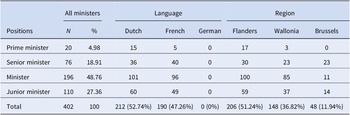
Another challenge was the party affiliation of the ministers. The Belgian party system is rather unstable in terms of party names or party alliances. I adapted the coding of the party affiliation of ministers in order to take these changes into account. Overall, the database contains 402 positions of federal ministers. This does not mean 402 distinct individuals as some individuals occupied ministerial positions in different federal cabinets (sometimes with completely different ministerial portfolios). Table 1 presents the number of ministers for the period 1981–2020 per language and per region.
Type of Ministerial Position per Language and per Region (1981–2020)

Source: The author’s own elaboration.
Regarding language, there are unsurprisingly few differences in the number of Dutch- and French-speaking ministers due to the cabinet’s linguistic parity. Even if they represent 61.74% of voters, Dutch-speakers account for only 52.74% of cabinet positions. In turn, French-speaking voters only represent 37.65% of the total number of voters, but they occupy 47.26% of cabinet positions. There are no German-speaking ministers (German-speaking voters represent 0.62% of the voting population). As expected, Dutch-speakers are overrepresented among prime ministers and among junior ministers. As indicated earlier, this larger number of Dutch-speaking prime ministers and junior ministers is a direct consequence of the linguistic parity of ministers (prime ministers and junior ministers are not included in obligation of the parity).
The analysis of cabinet positions per region presents a quite similar story even if there are no constitutional rules regulating the geographical origin of ministers. Indeed, most of Flemish ministers are Dutch-speakers while all Walloon ministers are French-speakers. There have been nine Dutch-speakers and 39 French-speakers among the 48 federal ministers coming from Brussels. Flemish voters represent 60.56% of the total number of voters while there are only 51.24% of Flemish ministers in the cabinet. On the contrary, Walloon and Brussels ministers are overrepresented in the federal cabinets. There are 32.08% of Walloon voters while Walloon ministers occupy 36.83% of the cabinet positions. Only 7.36% of the total voting population originates from Brussels, but ministers from this region occupy 11.94% of the seats. Once again, this proportional underrepresentation of Flemish ministers is compensated by its quasi-monopoly of the position of prime minister and a larger number of junior ministers. There have been only three Walloon and no Brussels prime ministers for the period 1981–2020. Surprisingly, there is a very large overrepresentation of the number of senior ministers coming from Brussels (23 in total, the same number as the Walloon senior ministers) and – to a lesser extent – an overrepresentation of the number of junior ministers from Brussels.
The Provincial Origins of Ministers
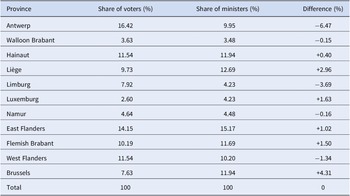
I now turn to the geographical origin of ministers based on their provinces of affiliation. We observe in Table 2 that there are large variations in the share of ministers per provinces. More than 15% of federal ministers come from the province of East Flanders while only 3.48% come from the small province of Walloon Brabant. Similar to region and language, I used the number of registered voters for the federal elections as a variable for identifying the demographic size of the provinces. I can therefore observe provincial variations in the differences between this share of voters and the share of ministers. Overall, it indicates that some provinces are overrepresented in the federal cabinet compared to their demographic importance while others are underrepresented. Interestingly, the provinces that are under- and overrepresented in the federal cabinet come from different regions.
Share of Voters and Ministers per Province (1981–2020)

Source: The author’s own elaboration.
Five provinces are underrepresented in the federal cabinet. The province of Antwerp accounts for 16.42% of the Belgian voters but for less than 10% of the number of federal ministers. This province alone gathers more than half of the ministerial underrepresentation (-6.47%), i.e., more than the other four provinces combined. Antwerp is the largest province of Belgium in terms of population, and its capital (Antwerp) is the largest Belgian municipality. It is also the richest province (in gross domestic product per capita in purchasing power standards), partly thanks to its industries and Europe’s second-largest seaport. Given its economic and demographic importance, the surprising underrepresentation of ministers from the province of Antwerp is also illustrated by the share of ministers per cabinet. In the Dehaene I cabinet (1992–1995) and out of a total of 16 ministers, not a single one was originating from the province of Antwerp. In the Martens V cabinet (1981–1985), only one minister came from the province of Antwerp in a cabinet composed of no less than 25 members. This province did not deliver any prime minister over the last 40 years.
This underrepresentation is even proportionally larger in the case of the province of Limburg. This province accounts for about 8% of the total amount of voters but for only 4.23% of federal ministers, i.e., almost half of its demographic weight. In the case of this province, this underrepresentation is a more recent phenomenon. Out of the 17 federal ministers originating from the province of Limburg, no less than 16 of them can be located in the 11 first cabinets under study (1981–2008), while one single minister from this province entered in the following nine federal cabinets (2008–2020): Steven Vandeput in the Michel I cabinet. Since 1980, no prime minister originated from this province. To a lesser extent, the province of West Flanders is also underrepresented in the federal cabinet (-1.34%), making the three most underrepresented provinces all Flemish. Finally, two Walloon provinces are slightly underrepresented in the federal cabinet: the provinces of Namur (-0.16%) and Walloon Brabant (-0.15%).
Among the provinces that display the largest overrepresentation in the federal cabinet, I find two Walloon provinces. First, the province of Liège accounts for almost 10% of the voting population but no less than 12.69% of the number of ministers. The overrepresentation of the province of Liège is even larger when one takes into account the fact that the German-speaking community is located in this province. Given that there has been no German-speaking federal minister since 1973, it increases the overrepresentation of the province of Liège to +3.57% if only the French-speaking voters are taken into account. Second, the overrepresentation of the province of Luxemburg is even proportionally larger. The smallest Belgian province in terms of population gathers 2.6% of voters but delivered 4.23% of the total number of federal ministers – that is almost the double amount of its size. This overrepresentation was particularly strong in the 1980s as Charles-Ferdinand Nothomb became senior minister in the Martens V and Martens VI cabinets. On the contrary, there have been no Luxemburgish minister in the Dehaene cabinets (1992–1999) nor in the more recent federal cabinets. The province of Hainaut also benefits from a slight overrepresentation in the cabinet (+0.4%).
Even if I observed that the Flemish region was globally underrepresented in the federal cabinet due to the rule of the linguistic parity, this phenomenon is not homogeneous across provinces in this region. As a matter of fact, two Flemish provinces are overrepresented in the federal cabinet. The provinces of East Flanders and Flemish Brabant display a larger share of ministers than of voters (+1.02% and +1.5% respectively). The province of East Flanders even delivered the prime minister in no less than 9 instances (out of 20) while the province of Flemish Brabant provided 5 prime ministers. In other words, only 6 prime ministers did not originate from these two provinces over the last 40 years.
But the entity that benefits the most from this asymmetry between demography and presence in the federal cabinet is Brussels. This extra-provincial territory accounts for 7.63% of the voting population but for almost 12% of the total number of cabinet positions. In this case, I can talk of a clear capital city bonus for this bilingual region where the federal entities are located. I duplicated the analysis of the presence of Brussels ministers in the federal cabinet per language group. It appears that both groups are overrepresented in the federal cabinet: the overrepresentation of the Brussels French-speakers in the federal cabinet increases by 3.52% while those of the Dutch-speakers almost double. Dutch-speakers in Brussels account for 1.18% of the voting population while they occupy 2.24% of the seats in the federal cabinet.
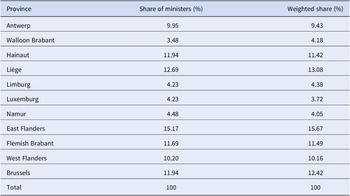
Finally, I tested an alternative measurement of the share of ministers per province in the federal cabinet. The portfolio allocation during the process of coalition formation relies since the 1980s on a “point system” (De Winter and Dumont Reference De Winter, Dumont, Witte and Meynen2006; Reuchamps Reference Reuchamps2007): each party obtains a number of points, based on its number of seats in the federal parliament, that is being used to evaluate the number and the type of positions this party gets in the cabinet. I used a similar system for weighting the different types of cabinet positions: the position of prime minister equals to three points, two points for a minister while a junior minister equals to only one point.Footnote 5 In the portfolio allocation system, senior ministers are considered equivalent to ministers but, given both their symbolic and political importance (only senior ministers can seat in the core council of ministers), I allocate them 2.5 points. Table 3 compares the share of ministers (based on absolute numbers) per province with the weighted share of ministers according to the type of positions.
(Weighted) Share of Federal Ministers per Province (1981–2020)

Source: The author’s own elaboration.
Overall, when the hierarchy of the different cabinet positions are taken into account, the disproportionality between share of voters and share of ministers increases for most of the provinces and for Brussels. In the case of underrepresented provinces, the province of Antwerp witnesses an even smaller weighted share of cabinet positions. Out of the 40 cabinet positions attached to this province, none concerns the prime minister and only four concern positions of senior minister (and three of them are only in recent cabinets with the exception of Hugo Schiltz in the Martens VIII cabinet). There are proportionally fewer ministers from the province of Antwerp and these ministers seldom occupy senior positions. The same logic occurs – but to a lesser extent – for the provinces of West Flanders and of Namur. Only 18 ministers can be attached to this later province, among which only one was appointed as senior minister (David Clarinval in the Wilmès II cabinet).
On the contrary, the importance of the cabinet positions seems to reinforce the overrepresentation of a few other provinces. Brussels and the provinces of Liège and of East Flanders observe an increase of their overrepresentation in the federal cabinet once the type of positions is taken into account. Besides the fact that no less than nine prime ministers come from the province of East Flanders, this province also account for eight senior ministers and a relatively small number of junior ministers. The same applies to Brussels and the province of Liège that saw the appointment of respectively 23 and 15 senior ministers over the 40 years under scrutiny. In the Leterme II cabinet (2009–2011), four out of the five senior ministers came from Brussels (Joëlle Milquet, Laurette Onkelinx, Guy Vanhengel and Steven Vanackere). The fifth senior minister (Didier Reynders from the province of Liège) moved to Brussels a few years later.
Understanding Provincial Disproportionality
Testing the Main Hypotheses
I not only observe important sub-national variations in the origin of federal ministers but also a significative degree of disproportionality: some territorial entities seem to have a larger access to the federal government than others. This section investigates these variations more in-depth and reflects upon the hypotheses presented above. Broadly speaking, the first hypothesis (Hypothesis 1a) seems to be confirmed: the share of ministers per province is somehow proportional to the size of the province (estimated in number of registered voters). There are more ministers coming from larger provinces than smaller ones in the federal cabinet. However, a certain degree of disproportionality remains as some provinces are found to be deeply underrepresented in the federal cabinet. For instance, the province of Antwerp obtained less ministers than Brussels while the population in this province is more than the double of that of Brussels.
Is this provincial balance more likely to occur at the party level rather than at the cabinet? In order to test this hypothesis (Hypothesis 1b), I looked at ministerial appointments for parties that obtained at least six portfolios. The results are quite clear. Out of 26 cases of federal cabinet formation, not a single party obtaining at least 6 portfolios has ever appointed ministers from each of the 5 Flemish provinces and Brussels or from each of the 5 Walloon provinces and Brussels. If I exclude Brussels from the analysis, only 2 parties obtaining at least 6 portfolios appointed ministers from the 5 Flemish provinces: the Christian Social Party in the Martens VI cabinet and the Socialist Party in the Martens VIII cabinet.
These findings also lead to the rejection of the second hypothesis (Hypothesis 2) according to which we should observe an overrepresentation of the largest provinces in the federal cabinet. The four largest provinces account for almost 54% of the number of voters, while they managed to see 47.26% of the federal cabinet seats occupied by ministers coming from these provinces. On the contrary, we observe an overrepresentation of the smallest provinces: the four smallest provinces gather more than 18% of the voting population but no less than 24.13% of the total number of federal ministers come from these provinces.
This disproportionality also concerns the different types of ministerial positions. The third hypothesis (Hypothesis 3) can be completely rejected: the prime minister and the senior ministers do not originate from the largest provinces, and the junior ministers do not originate from the smallest provinces. The exact opposite is actually observed. For instance, the largest Flemish province (Antwerp) and the largest Walloon province (Hainaut) obtain respectively 4 and 3 senior positions (out of a total 96 prime ministers and senior ministers) – that is less than the smallest Flemish province (Limburg) and just one unit above the smallest Belgian province (Luxemburg). Similarly, the largest number of junior ministers is not observed in the smallest provinces but in the largest ones. The small province of Limburg accounts for only 4 junior ministers compared to the large province of East Flanders (17 junior ministers). Among the Walloon provinces, the small province of Walloon Brabant does not obtain a single junior minister, while the largest Walloon province gets no less than 13 junior ministers. Altogether, large provinces are twice sanctioned during the process of government formation: they are underrepresented in the federal cabinet, and they tend to occupy junior positions.
Alternative Explanations
In this last section, I test several alternative explanations. In order to take into account the different institutional, political, and electoral reforms at the provincial level, I distinguish between three periods in the analysis: a first period where provinces were still a relevant subnational level of government (1980–1992), a second after the federalization of Belgium but before the electoral reform (1993–2002) and a third period after the provincialization of the electoral districts in federal elections (2003–2020). I do not observe significant differences over these three periods: the provincial disproportionality in ministerial appointment remains large, independently on the political and symbolic importance of provinces. I also do not observe differences following the recent institutional reforms at the provincial level and the political debate on the structure of subnational government in Belgium.
I discussed above the importance of several electoral reforms and constitutional requirements concerning the government formation process and the ministerial selection. The most relevant reform probably concerned the limit of the size of the federal cabinet (15 ministers). Surprisingly, our data indicate that the provincial disproportionality does not increase when there are a smaller number of positions to be attributed. There are very few changes over time and the same provinces seem to benefit from the portfolio allocation: Brussels and the province of Liège are overrepresented while the provinces of Antwerp and Limburg are underrepresented in the federal cabinet.
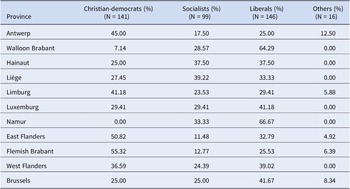
A last set of explanations may be related to party politics. Based on their ideology and/or their political strategies, I tested whether some parties make more efforts in balancing the geographical origin of their ministers while other parties focus their ministerial appointments on individuals coming from a limited number of provinces. Similarly, it is expected that the provincial origin of the party leader has an impact on the selection of his or her ministers, in an effort to better balance the party leadership between provinces. Since there were too few ministers from the green and regionalist parties (respectively six and ten ministers), I focused on the three main party families (Christian-democrat, socialist, and liberal). The results presented in Table 4 display interesting trends.
Share of Ministers per Party Family and Province of Origin

Source: The author’s own elaboration.
Christian-democrat parties tend to appoint ministers from the provinces of East Flanders and Flemish Brabant: more than half of the ministers coming from these two provinces are Christian-democrats. Christian-democrats also provide the largest share of federal ministers coming from the provinces of Antwerp and Limburg. On the opposite, the Christian-democrat parties depreciate the provinces of Walloon Brabant and Namur. They only provide a bit more than 7% of the number of ministers coming from the former province while not a single Christian-democrat minister from the province of Namur has ever been appointed in the federal cabinet over the last 40 years. These results are also quite surprising when one remembers that the party’s traditional electoral strongholds are located in the more rural provinces of Luxemburg and West-Flanders. The liberals are the ones providing the largest cohort of ministers coming from these two provinces.
Socialist parties obtained fewer cabinet positions than the two other party families over the last four decades, but there are nonetheless interesting elements to be learned from these analyses. The Socialists provide the largest share of ministers coming from the province of Liège and – equal to the liberals – of Hainaut. This somehow reflects the importance of the traditional Socialist strongholds that are located in the (post-)industrial provinces of Hainaut, Liège, and Limburg. In this latter province, however, the Socialist Party provides the smallest share of ministers. Similarly, the Socialist Party does not dedicate much efforts to appoint ministers originating from East Flanders and Flemish Brabant.
The Liberal Party also concentrates its ministerial appointments on some provinces: more than half of the ministers coming from the provinces of Namur and Walloon Brabant are liberals. This latter province is the liberal electoral stronghold in Wallonia, while the party presents the largest share of ministers in its Brussels stronghold. Among the provinces that are favored by the liberals, I also find the provinces of Luxemburg and West Flanders. Overall, the Liberal Party constitutes the party family that displays a more balanced geographical origin of its ministers.
These party priorities in the geographical origin of the appointed ministers demands a broader discussion regarding party strategies. We have seen that some parties focus on their actual electoral fiefs (the Socialists in the provinces of Hainaut and Liège and the liberals in Brussels and in the province Walloon Brabant) while others do not particularly favor their strongholds when participating in the federal cabinet. This reasoning seems more driven by vote-seeking considerations than by ideological ones. Almost all federal ministers are mobilized by their parties during electoral campaigns and appear on the lists (Pilet and Fiers Reference Pilet, Fiers, Dandoy, Van Wynsberghe and Matagne2013), and we know from previous empirical studies that incumbent ministers perform electorally better than other candidates (see for instance Klein and Umit Reference Klein and Umit2016; Ladwig III Reference Ladwig2019). This element may explain the party focus on some provinces rather than others: parties tend to appoint ministers that will deliver them an electoral advantage in the future election or that will help protecting the party’s electoral base in particular regions (see for instance Nikolenyi Reference Nikolenyi, Dowding and Dumont2015 for the Indian case). In that sense, parties would not appoint ministers coming from their strongholds, but rather from electoral battlegrounds or disputed electoral districts.
Conclusion
This article aimed at investigating the representation of peripheral elites in Belgian national political institutions. Given the importance of the executives in this country, I analyzed cabinet and ministerial appointment at the federal level over a period of exactly 40 years. More precisely, the geographical origin of 402 ministers has been assessed based on their electoral attachment to the provinces, an understudied sub-regional level of government that still constitute a relevant geographical unit of analysis of the composition of the Belgian federal cabinets. Empirical analyses demonstrated that provinces are somehow represented in a proportional manner in the federal government, but also that some provinces are overrepresented while others are underrepresented. In addition, not a single party has ever appointed ministers from more than five different territorial entities in the same cabinet. By stressing out provincial imbalance, these findings could also be seen a proof of the reduced impact of provinces on national politics, partly caused by the recent institutional reforms at the provincial level and the political debate on the structure of subnational government in Belgium.
The ministerial prospects of the elites representing the center(s) of the decision-making process vary geographically. Unsurprisingly, Brussels is the territory that managed to have proportionally more ministers in the federal cabinet than any other province. One can really talk about a Brussels capital city bonus. This does not only concern French-speakers in the capital city but also the Dutch-speaking minority. Dutch-speakers in Brussels account for about 1% of the voting population while they occupy twice this proportion of seats in the federal cabinet. On the contrary, Belgium’s largest province and economic hub (the province of Antwerp) arrives in sixth position in terms of importance in the federal cabinet, sometimes after territories that are half its size in terms of population. Large provinces are twice sanctioned during the process of government formation: they are underrepresented in the federal cabinet, and, when appointed, their representatives tend to occupy junior positions.
Representatives from the German-speaking minority in the province of Liège could be considered as peripheral elites and may appear as the losers of the ministerial selection in the federal cabinet: not a single German-speaking minister has been appointed since 1973. Yet, this obvious underrepresentation is explained by the linguistic parity rule in the composition of the federal cabinet. By focusing on the subtle balance between the two largest communities, the federal institutions do not leave space for representatives of the German-speakers. But the impact of the parity rule that was supposed to penalize Dutch-speaking ministers does not prevent certain Flemish provinces to remain overrepresented in the federal cabinet, such as the provinces of East Flanders and Flemish Brabant that provided more than two third of the prime ministers over the last 40 years.
Finally, party strategies have been included in this study. As party leaders are ultimately responsible for the selection of “their” ministers, cabinet appointments may be part of a larger ideological or electoral strategy of some parties, not to mention the impact of the party leader’s own provincial origin. If I found empirical evidence of appointments of ministers coming from party strongholds, parties also sometimes depreciate provinces where they obtained their largest vote shares. In that sense, ministerial appointments can be seen as investments in future electoral campaigns. Rather than focusing on their electoral strongholds or on the largest provinces, parties may want to promote ministers from battleground territories where the party could perform well electorally and politically. Future research will indicate whether these electoral prospects may explain these party strategies rather than clientelist behavior in the territories dominated by the party.
Future empirical efforts could also enlarge the types of investigated elites and also consider provinces as geographic units of analysis of the origin of party leaders, chiefs of staff, parliamentary committee chairs, and appointed heads of public administration and public companies. Another obvious step concerns the replication of these analyses at the level of ministerial appointments in regional and community cabinets. Given the multi-level nature of the Belgian political system, it is not unwise to think that party leaders may want to balance out the underrepresentation of certain provinces in the federal cabinet by appointing more ministers from these provinces in subnational cabinets, or to reward party’s regional branches that managed to enter regional cabinets (see the Spanish example in Real-Dato and Jerez-Mir Reference Real-Dato, Jerez-Mir, Dowding and Dumont2009). Obviously, the existence of asymmetric coalitions – i.e., some parties are in government at the federal level while in the opposition at the subnational level, and vice versa – and the dissociated government formation calendars at different levels of government often prevents party leaders to implement such multi-level ministerial appointment strategy.
The consequences of the analysis of the territoriality of the political elites in the federal institutions and more precisely in the federal cabinet seem to indicate an ongoing relevance of the concept of consociationalism in the Belgian context. Consociationalism is based on a complex combination of grand coalition, proportionality, segmental autonomy, and mutual veto as the four characteristics of consociationalism (Lijphart Reference Lijphart1977; Agarin Reference Agarin2020). While there is no segmental autonomy in the case of the federal cabinet, the grand coalition is expressed by the linguistic parity rule, and the mutual vote emerges from the consensual mode of decision-making in the federal cabinet and the key role of senior ministers (Frognier Reference Frognier1988). Proportionality was viewed the least important of the four consociational characteristics in the current version of consociationalism in Belgium (Andeweg Reference Andeweg2019). However, this article brings back this neglected characteristic of proportionality at the federal level by investigating the provincial origin of ministers and demonstrates that proportionality is found to be missing in the composition of the federal cabinet. This presence of a clear disproportionality will probably not evacuate the doubts regarding the capacity of consociationalism to solve Belgium’s problems (see for instance Bouveroux and Huyse Reference Bouveroux and Huyse2009; Caluwaerts and Reuchamps Reference Caluwaerts and Reuchamps2015).
Acknowledgements
The author wants to thank all the participants to the ECPR Workshop on peripheral elites held in Wroclaw along with the editor and reviewers of Nationalities Papers for their suggestions.
Disclosure
None.