1. Introduction
The Standard Model (SM) of particle and fields describes the properties and the interactions of the fundamental constituents of all visible matter in the Universe. It reproduces successfully the data observed in a myriad of experiments, performed mainly in particle accelerator facilities. At the start-up of the Large Hadron Collider (LHC) operations at CERN in 2009, the fundamental particles predicted by this theory were all found in nature, except the Higgs boson, the quantum of the Higgs field, whose interaction with elementary bosons determines the appearance of their mass. Without this field, particles such as electrons and quarks would be massless, in strong contrast with the experimental observations. The consequences for a Universe with elementary particles with no mass would be dramatic: for example, atoms with massless electrons, would not exist, as the binding energy would be vanishing. In the SM, there is one isodoublet complex scalar field, described by four real scalar fields. After spontaneous electroweak symmetry breaking, one physical degree of freedom is left, the spin-0 Higgs boson, while the other three degrees of freedom are ‘absorbed’ to build the longitudinal components of the W± Z0 vector bosons and generate their masses. Yukawa interactions of this field with fermion fields generate masses of leptons and quarks. In this model, the Higgs boson mass is not predicted. Once assigned, all physics properties of this scalar, with CP=+1 quantum number, are defined. An overview of the Standard Model is available in this issue.Reference Kibble1
2. The Formulation of the Higgs Mechanism
The idea of introducing spontaneous symmetry breaking in particle physics is due to NambuReference Nambu2, Reference Nambu3 and Jona-Lasinio.Reference Nambu and Jona-Lasinio4 The proposal was based on theory developments in condensed-matter, and was applied to particle physics by several authors. In 1962 AndersonReference Anderson5 discussed the consequences of the proposed mechanism, but did not develop a relativistic model. The first formulation of the Higgs boson dates back to 1964, and is mainly due to Brout, Englert, Higgs, Guralnik and Kibble.Reference Englert and Brout6–Reference Guralnik9 Later, it was included in the Standard Model, thanks in particular to the work of Weinberg and Salam.Reference Weinberg10, Reference Salam11 A few years later, in 1971, ’t HooftReference Hooft12, Reference Hooft and Veltman13 demonstrated that this model allows calculable predictions of elementary particle processes, such us cross-sections and decay branching fractions; this was a major step for the consolidation of the Standard Model. From 1973 onwards, an impressive series of experimental observations produced strong support in favour of this model: from the discovery of neutral currents to the discovery of the vector bosons W± and Z0 (1983). More details on the historical profile of the Higgs boson can be found in Ref. Reference Ellis, Gaillard and Nanopoulos14.
3. Higgs Boson Searches from LEP to LHC
As already discussed, the SM does not predict the Higgs boson mass. However, the mass can be constrained by a huge volume of electroweak measurements made by a large number of past experiments. The combination of these measurements limits the mass of this particle to an upper limit of m H<158 GeV at 95% confidence level.15 Direct searches were made by the experiments ALEPH, DELPHI, L3 and OPAL at LEP2 at CERN, studying electron-positron collisions up to √s=209 GeV. No evidence of the production of this particles was found, and a lower bound of m H>114 GeV at 95% confidence level (CL) was placed by the combination of the results from the four above-mentioned experiments.16
Direct searches were also made by the experiments CDF and D0 at the Tevatron collider (Fermilab, Chicago) where protons and anti-protons were collided at energies up to √s=1.96 TeV. Searches have been conducted for a Higgs boson mass in the range 100–150 GeV since early 1990s, with no evidence of the production of this particle, up to the end of 2011. In a seminar held at CERN on 13 December 2011, the ATLAS and CMS collaborations at the Large Hadron Collider (LHC; see next section) at CERN, announced the observation of an excess of events in proton-proton (pp) collisions at √s=7 TeV, consistent with the production of the SM Higgs boson, based on the analysis of 4.9 fb−1 data. The local significance of this excess was about three standard deviations per experiment.19, 20
In summer 2012, ATLAS and CMS confirmed the early observation announced in December 2011 using the first ~6 fb−1 of data taken at √s=8 TeV in combination with the 7 TeV full data sample.21, 22 It was shown that the excess increased to about five standard deviations per experiment, and hence the discovery of a new particle at about 125 GeV mass was announced. At the same time, CDF and D0 announced an excess of events (mostly located in the mass region 120–135 GeV) by combining the findings of the two experiments in the search for the SM Higgs boson produced in association with a W or Z and decaying to bottom-antibottom final states.23 The significance of the excess was evaluated to be about three standard deviations.
4. The Large Hadron Collider
The Large Hadron Collider is, to date, the largest and highest-energy particle accelerator ever built. Approved by the CERN Council of December 1996, the construction of this accelerator started in 1998, in the LEP tunnel.Reference Brunning, Collier, Lebrun, Myers, Poole and Proudlock24 A nice recollection is available in Ref. Reference Evans25. This machine has been designed primarily to collide protons at a centre-of-mass energy √s=14 TeV with a nominal luminosity of L=1034 cm–2 s–1 and a bunch spacing of 25 ns. The LHC has also been designed to accelerate heavy ions. Four main experiments have been installed around the ring: two general purpose detectors, ATLAS and CMS, a detector to study heavy flavour physics, LHCb, and a detector optimized for the heavy ion collisions studies, ALICE. LHC operations started in December 2009.
Figure 1 shows an aerial view of the LHC layout and the CERN site.
Aerial view of the Large Hadron Collider layout. The position of the main four experiments is also shown. The CERN site is in correspondence of the ATLAS experimental area. The insert on the right hand side shows a view of the LHC tunnel.

In 2011 this accelerator collided protons at √s=7 TeV, delivering about 6 fb−1 of integrated luminosity; in 2012 the centre-of-mass energy was increased to √s=8 TeV and an integrated luminosity of more than 23 fb−1 was delivered. In both cases the bunch spacing was set to 50 ns.
The results reported in this paper are based on the full 2011 and 2012 data set.
5. The ATLAS and CMS Detectors
ATLAS (A Toroidal Lhc ApparatuS) and CMS (Compact Muon Solenoid) are the two general-purpose detectors at LHC. Their basic structure is very similar, although they are complementary on many technological choices.
The three major sub-systems of ATLAS,17 see Figure 2, are the tracking detector, the calorimeter and the muon spectrometer. At the core of the ATLAS detector is the inner tracking detector, of about 2 m in diameter, which is immersed in a 2 T axial field produced by a superconducting solenoidal magnet. Silicon and micro-strip detectors, as well as a straw tube tracker, provide measurements of charged particle trajectories produced in the p-p collision. The central solenoid is surrounded by the calorimeter system. The electromagnetic calorimeter is based on a sampling lead/liquid-argon device. An iron-scintillator calorimeter placed around the electromagnetic calorimeter provides detection and measurements of hadrons, and it also acts as filter for muons produced in the collision. The muon spectrometer is based on three air-core superconducting toroidal magnets instrumented with precision drift tubes, as well as fast cathode readout detectors used for trigger and offline measurements. The dimensions of ATLAS are 25 m diameter, 44 m in length; the overall mass is of 7000 tonnes.
Schematic of the ATLAS detector. The main components of this apparatus are shown.
The central feature of the CMS detector18 is a superconducting solenoid 13 m long and 6 m diameter, which provide an axial field of about 3.8 T. The bore of the solenoid is instrumented with particle detection systems. The steel return yoke outside the solenoid is instrumented with gas detectors used to identify and measure muons. Charged particles are measured by silicon and pixel detectors; no use of gaseous detectors is made. A lead-tungestate crystal electromagnetic calorimeter and a brass/scintillator hadron calorimeter surround the tracking volume. Both calorimeters are contained in the solenoid cavity. As in ATLAS, the outermost component of the CMS detector is the muon system, consisting of gaseous detectors interleaved in the iron plates belonging to the magnet return yoke.
Photons, electrons, muons of 100 GeV transverse momentum emitted in the central pseudorapidity region (the pseudorapidity η is defined as η=ln tanθ/2, where θ is the polar angle of the emitted particle) are measured by these detectors with an energy resolutions of O(1%) or less. Hadrons, jets and taus with that energy are measured with resolutions better than 10%. This performance places the ATLAS and CMS detectors in an ideal position for the search for Higgs boson(s).
6. The Standard Model at LHC
Many Standard Model physics processes have been studied with great care by the four LHC experiments, in particular by ATLAS and CMS. Precision measurements have been made of the production of the vector bosons W± and Z, of photons and jets, as well as of top and bottom quark production, and boson pair production.
The physics properties of these objects have also been analysed. These studies are important not only to understand in detail the response of the experimental apparatuses, but also to measure with the best possible accuracy the physics processes that represent the main backgrounds to the searches for new physics beyond Standard Model predictions, and for the Higgs boson(s) predicted by this theory, or by alternative models. As an example, Figure 3 shows the measured W± boson production cross-section times the decay branching ratio in e±ν and μ±ν final states, versus the Z boson production cross-section times the decay branching ratio in ee and μμ final states, for data and Monte Carlo predictions assuming different proton parton distribution functions (PDFs).26
Measured and predicted total cross-sections times leptonic branching ratios, σ Wtot×BR(W→lν) versus σ Ztot × BR(Z→ll), with l=e,μ. The ellipses illustrate the 68% confidence level (CL) coverage for total uncertainties, excluding the luminosity uncertainty (open black). The uncertainties of the theoretical predictions correspond to the parton distribution functions’ uncertainties only.
In general, data and Standard Model predictions agree to an order of a few percent over the full kinematical range accessible with the analysed data.
7. Production of the Standard Model Higgs Boson at LHC
The dominant production mechanism at hadron colliders for the SM Higgs boson is the gluon-gluon process (ggF); other important processes are the Vector Boson Fusion (VBF) and the production in association with vector bosons W or Z (VH). SM Higgs boson searches at the LHC take advantage of the large production cross-sections, about a factor 10 more than the values at the Tevatron collider. Large centre-of-mass energy and high luminosity are both crucial to the production of this particle with significant rates.
In the region of mH ~ 120 GeV, the rare decay mode H→γγ is a crucial channel, thanks to the high experimental mass-resolution that ATLAS and CMS detectors have on the reconstruction of diphoton final states. High-mass resolution is also available in the H→ZZ*→lll’l’ decay mode (with l,l’=e,μ); this final state is characterized by low rates and by a high signal/background ratio, and represents another crucial decay mode for the search for this boson with mass down to m H ~ 120 GeV. In the region of low mass (m H<2 m Z, where m Z is the Z-boson mass), decay modes such as H→ $${\rm b}\overline{{\rm b}} $$
and H→τ+τ− are also important, in particular for production associated with vector bosons or for VBF processes.
For Higgs boson masses in the region 150 GeV≤m H≤2 m Z the most important decay modes are H→ZZ*→lll’l’ and H→WW(*)→lνlν. For larger mass values, in addition to the gold-channel H→ZZ→lll’l’ and H→WW→lνlν, decay modes H→ZZ→llνν, llqq and H→WW(*)→lνqq are also important. A useful review of the Standard Model Higgs boson phenomenology is given in Ref. Reference Djouadi27. Recent and detailed calculations of the SM Higgs boson production rate and physics properties at LHC are discussed in Refs 28–30. Figure 4 shows the cross-section time and the branching fraction for different production processes at √s=8 TeV and several decay final states.
Measured Standard Model Higgs boson production cross-section times branching ratio at √s=8 TeV. For H→ττ both inclusive (solid line) and VBF (dashed line) mode are plotted.
8. Discovery of a Higgs Boson by ATLAS and CMS at the LHC
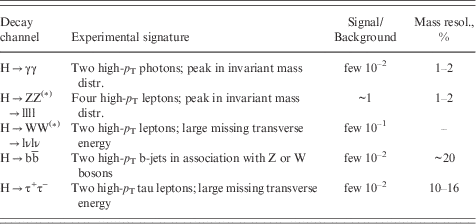
Table 1 is a summary of the main channels investigated by ATLAS and CMS in searches for the Standard Model Higgs boson. In this table, representative figures for the mass resolution and signal purity are given.
The most important Higgs boson channels in the low mass region (100 GeV≤m H<2m Z) studied by ATLAS and CMS. The ‘Signal/Background’ column reports the ratio between the signal yield expected for a Standard Model Higgs boson and the observed background after full event selection. The column ‘Mass resol.’ reports the expected mass resolution of the system made by the observed physics objects belonging to the Higgs boson decay.

On 4 July 2012, ATLAS and CMS announced the discovery of a new resonance with mass about 125 GeV, with analyses dedicated to the search for the SM Higgs boson in the H→γγ, H→ZZ(*)→llll and H→WW(*)→lνlν final states.21, 22 The datasets used by ATLAS (CMS) corresponded to integrated luminosities of approximately 4.8 (up to 5.1) fb−1 collected at √s=7 TeV in 2011 and 5.8 (up to 5.3) fb−1 at √s=8 TeV in 2012. The results for the three Higgs boson decay modes mentioned above (plus also H→ τ+τ− H→ $${\rm b}\overline{{\rm b}} $$
in the case of CMS) showed a local significance of 5.9 (5.0 in CMS) standard deviations, corresponding to a probability that the background produces a fluctuation greater than or equal to the excess observed in data of 1.7×10⁻⁹ (ATLAS). This is compatible, within their uncertainties, with the Standard Model Higgs boson expectations.
Subsequently, the full data set collected in 2012 was analysed by ATLAS and CMS for many Higgs boson final states, and in particular for the final decay modes H→γγ, H→ZZ(*)→llll and H→WW(*)→lνlν.31–35
In this section, the results found by ATLAS and CMS experiments, based on the studies of the diphoton and the ZZ*→lll’l’ (l=e,μ) final states are presented.
Figure 5 shows the invariant mass m γγ distribution of a γγ pair reconstructed in the 100<m γγ<160 GeV mass-window obtained with the diphoton analysis of the ATLAS data. The study is based on the analysis of isolated, high transverse momentum (p T) photons that selects a total of 142,681 events.
Invariant mass distribution of diphoton candidates after all selections of the inclusive analysis for the combined ATLAS 7 TeV and 8 TeV data. The result of a fit to the data with the sum of a SM Higgs boson signal (with m H=126.8 GeV, width set at the MC prediction for a SM Higgs boson, and free signal strength) and background is superimposed. The residuals of the data with respect to the fitted background are displayed in the lower panel.
This spectrum is well explained by the Standard Model γγ-continuum (irreducible background), plus contributions from -jet and jet-jet processes, where the jet is misidentified as a prompt photon (reducible background). The background composition has been measured and compared with Monte Carlo predictions. About 76% of the events are from γγ processes, the remainder are from the reducible background. This shows an excellent purity of genuine photon selected after analysis cuts. The single photon reconstruction and identification efficiency depends on the photon p T; it is 65%(95%) for p T=25(80) GeV. The diphoton mass resolution is predicted to range in the interval 1.4–2.5 GeV, depending on the event topology. The invariant mass distribution can be fitted with quite a few empirical analytical functions that have been carefully studied using Monte Carlo samples. The chosen function (a fourth-order Bernstein polynomial) describes satisfactorily the data except in a narrow mass interval around 126 GeV: an excess of events is visible on top of the expected background. The local probability that this excess is due to background fluctuations has been evaluated to have a maximum of 7.4 standard deviations at m H=126.5 GeV (while a significance of 4.3 standard deviations is expected by a SM Higgs boson with that mass).
The 4-lepton channel offers an excellent mass resolution (O(1%)) at m 4l ~120 GeV, associated with an excellent signal-to-background ratio (O(1)), thanks to the precise reconstruction of this final state which is possible in ATLAS and CMS. Also in this case, the analysis proceeds with the selection of two pairs of isolated, high-p T, opposite charged, same-flavour leptons (electron or muon) with one pair having the reconstructed invariant mass consistent with the Z-mass. Leptons are also required to be well associated with the proton-proton collision vertex. Figure 6 shows the invariant mass m 4l of the 4-lepton system after full event selection, as measured by CMS, in the mass range from 70 to 180 GeV.
Distribution of the 4-lepton reconstructed invariant mass in the full mass range for the sum of the 4e, 4μ and the 2e2μ channels in CMS. Points represent the data, shaded histograms represent the background, and the unshaded histogram the signal expectation. The expected distributions are presented as stacked histograms. The measurements are presented for the sum of the data collected at √s=7 TeV and √s=8 TeV. No events is observed for m 4l>800 GeV.
The resonance reconstructed around m 4l ~ 90 GeV is explained by Z-boson decays in 4-lepton final states (where the pair of additional leptons is produced by virtual bremsstrahlung photons from initial or final state radiation). In a SM without Higgs boson, the events excepted above m 4l=90 GeV, visible in the coloured histogram, are due to the ZZ* irreducible background, and to Z+jets reducible background, where a lepton pair is produced by heavy flavour decays, and/or by jets mis-identified as electrons or muons.
These predictions reproduce the observed data, except in a tight region around m 4l ~ 125 GeV where, also for this final state, an excess of events is observed. In the mass window 100–160 GeV, 71 events are observed while 46.5±2.7 events are expected assuming no SM Higgs contributions. The local probability that this excess is due to background fluctuation has been evaluated to be 6.7 standard deviations (expected 7.2 standard deviations). The 4-lepton mass resolution for mass values around 125 GeV is expected to be about 1.2 GeV. Similar results have been found independently by ATLAS.
The results obtained in these two individual channels have been combined to get the overall significance of the observed excess. Both ATLAS and CMS have also included the results of the analysis of the channel H→WW*→lνlν, given the sensitivity of this decay mode in the mass region in discussion with the analysed data. In addition, CMS has also included the findings of the searches for H→τ+τ− and H→ $${\rm b}\overline{{\rm b}} $$
(produced in association with vector bosons) final states.
The combined local probability (called p 0), as a function of the hypothesized Higgs boson mass, for the background to fluctuate and produce the excess observed by ATLAS is shown in Figure 7. As can be seen, this probability reaches the value of larger than seven standard deviations for m H ~ 126 GeV. Similar results are obtained by CMS (for m H ~ 125 GeV, which is fully compatible within statistical and systematic uncertainties with the mass where ATLAS gets its maximum significance). We are in the presence of the production of a new neutral particle, with a mass value of about 125 GeV, a candidate to be the Higgs boson predicted by the Standard Model.
Observed local p 0 as a function of the Higgs boson mass m H for the √s=7 TeV data, the √s=8 TeV data and their combination. The dashed curves show the expected median local p 0 for the SM Higgs boson hypothesis when tested at a given m H.
In 2013 the Royal Swedish Academy of Sciences decided to award the Nobel Prize in Physics for 2013 to François Englert and Peter W. Higgs (see Figure 8) ‘for the theoretical discovery of a mechanism that contributes to our understanding of the origin of mass of subatomic particles, and which recently was confirmed through the discovery of the predicted fundamental particle, by the ATLAS and CMS experiments at CERN’s Large Hadron Collider’.
François Englert (left) and Peter W. Higgs (right) during the seminar held at CERN on 4 July 2012.
9. Future Plans and Perspectives
The discovery of this new particle opens a new research field in high-energy physics. It is important now to determine the particle’s physics properties and compare them with those predicted by Standard Model for the Higgs boson: mass, natural width, spin and parity, couplings to elementary fermions and bosons. The LHC can do all these measurements, except the intrinsic width (expected for the SM Higgs boson to be about 4 MeV) for which most likely only limits can be put, because of the experimental mass resolution. A high-luminosity upgrade of the LHC (HL-LHC), if approved by CERN Council, will allow us to reach the ultimate accuracy on the determination of the nature of this particle that it is possible to achieve by this collider.
In parallel, the search for possible partners of this new particle will continue: the discovery of an additional Higgs-like boson would unambiguously indicate that this object is not the Higgs boson predicted by Standard Model, and that New Physics is at the energy scale accessible with the Large Hadron Collider.
Aleandro Nisati is a Research Physicist at the Istituto Nazionale di Fisica Nucleare (INFN), Sezione di Roma. He has a PhD in physics from the Rome University ‘La Sapienza’ with a thesis on strange particle production in proton–antiproton collisions at √s=630 GeV. With the UA1 experiment at CERN, he has contributed since 1988 to the studies of the physics programme of the Large Hadron Collider. Among the founders of the ATLAS experiment, he gave a major contribution to the design of the muon spectrometer, as well as to the design of the first-level and the high-level muon trigger systems. He was nominated co-convener of the Higgs Group in 2007 (for two years) and elected Physics Coordinator from 2009 to 2011. In 2012 he was appointed to be responsible for ATLAS for the Update of the European Strategy for Particle Physics. In 2013 he was co-chair of the Physics Group of the ECFA (European Committee for Future Accelerators) High-Luminosity LHC Workshop (Aix-les-Bains, 1-3 October 2013).