Introduction
Many animal species have been spread by international trade in the last few centuries. An increasing exchange of soil and plant material over large distances has led to the introduction of alien species into areas where they have become pests (Keller et al., Reference Keller, Kollmann and Edwards1999). In particular, alien slugs (Gastropoda) cause increasing problems in horticulture and agriculture (South, Reference South1992). Slugs become pest species mainly in areas where precipitation in spring is high (Keller et al., Reference Keller, Kollmann and Edwards1999; Hommay, Reference Hommay and Barker2002), rarely causing any problems in areas with dry spring weather. Gastropods may affect the species composition of natural plant communities as well as seriously reducing the yields and devaluing a wide range of crops by feeding damage (Port & Port, Reference Port and Port1986; South, Reference South1992; Barker, Reference Barker2002). Another reason for concern is that introduced gastropods may endanger native species (Essl & Rabitsch, Reference Essl and Rabitsch2002).
The invasive form of the slug Arion lusitanicus Mabille 1868 (also regarded as A. vulgaris Moquin-Tandon 1855: Anderson, Reference Anderson2005) (Pulmonata: Arionidae) originates from the Iberian Peninsula and southern France but has been introduced into central and northern Europe, where it has become a major pest in the last 30 years (von Proschwitz, Reference von Proschwitz1996; Dolmen & Winge, Reference Dolmen and Winge1997; Grimm et al., Reference Grimm, Paill and Kaiser2000). The slug was first recorded in Norway in 1988 (von Proschwitz & Winge, Reference von Proschwitz and Winge1994) and has subsequently spread along much of the coast, reaching high densities locally (Dirks, I., Tomasgård, T.E.H., do Amaral, M.J.A., Solhøy, T., Skartveit, J. & Mong, C., unpublished data) and causing considerable damage to garden plants and strawberry cultivation.
Slug control in agriculture and horticulture is mainly through the application of pesticides (South, Reference South1992; Barker, Reference Barker2002; Iglesias et al., Reference Iglesias, Castillejo, Ester, Castro and Lombardia2002), but the effect of molluscicides is often variable and short-lived, and they may affect non-target organisms negatively, including natural enemies of slugs and other pests (Langan et al., Reference Langan, Taylor and Wheater2004). Integrated management of slugs, therefore, is highly desirable, including maximising regulation by natural enemies.
Promising candidates for natural biological control of the Iberian slug include carabid beetles (Symondson, Reference Symondson and Barker2004). However, adult specimens of the Iberian slug secrete a thick covering of sticky mucus when irritated, which may render them immune to attack from many predators. Further, the Iberian slug has been shown to produce a defensive compound (Schroeder et al., Reference Schroeder, Gonzalez, Eisner and Meinwald1999), which may deter some predators. However, it is probable that eggs and newly hatched slugs are more susceptible to predation (Paill, Reference Paill, Brandmayr, Lövei, Brandmayr, Casale and Vigna Taglianti2000) and, thus, to biological control.
Ground beetles (Coleoptera, Carabidae) are common predators that feed on a number of invertebrate groups (Sunderland, Reference Sunderland and Holland2002; Symondson, Reference Symondson and Holland2002; Toft & Bilde, Reference Toft, Bilde and Holland2002). Within carabids, there are a few mollusc specialists (notably Cychrus caraboides (L.)) and also species (e.g. Carabus spp.) which are predominantly mollusc feeders (Toft & Bilde, Reference Toft, Bilde and Holland2002). In addition, many generalist species also include molluscs as part of their diet (Thiele, Reference Thiele1977; Sunderland, Reference Sunderland and Holland2002). Field studies have demonstrated that ground beetles, notably Pterostichus melanarius (Illiger, 1798), can effectively reduce gastropod populations and damage to crops (Asteraki, Reference Asteraki1993; Bohan et al., Reference Bohan, Bohan, Glen, Symondson, Wiltshire and Hughes2000; Symondson et al., Reference Symondson, Glen, Ives, Langdon and Wiltshire2002; McKemey et al., Reference McKemey, Symondson and Glen2003; Oberholzer et al., Reference Oberholzer, Escher and Frank2003; Symondson, Reference Symondson and Barker2004). The present study investigated whether some of the common beetle species would eat eggs, hatchlings and juveniles of A. lusitanicus under laboratory conditions. It is necessary to know which species are able to kill and consume slugs of the different size classes found in the field before doing larger experiments (Kaiser et al., Reference Kaiser, Geiersberger, Grimm and Paill1993), as well as developing molecular methods for detection of predation in the field (Harper et al., Reference Harper, King, Dodd, Harwood, Glen, Bruford and Symondson2005; Thomas et al., Reference Thomas, Harwood, Glen and Symondson2009).
Four widespread predatory carabid species were tested and compared: Carabus nemoralis, Nebria brevicollis, Pterostichus niger and P. melanarius, as well as the ubiquitous staphylinid Staphylinus erythropterus. The beetles were selected on the basis of being relatively large and common predators in gardens and arable fields. The Carabus species are generally thought to feed on soft-bodied prey, such as earthworms and gastropods (Hengeveld, Reference Hengeveld1980a,Reference Hengeveldb; Luff, Reference Luff2007), preventing the latter from producing large amounts of mucus by killing the slugs efficiently (Pakarinen, Reference Pakarinen1994). Carabus violaceus has been found to prey mainly on A. lusitanicus when juvenile slugs were available (Paill, Reference Paill, Brandmayr, Lövei, Brandmayr, Casale and Vigna Taglianti2000), but this species mostly occurs in forests in Scandinavia rather than open fields (Lindroth, Reference Lindroth1985). By contrast, C. nemoralis is common in anthropogenically altered habitats (e.g. parks, gardens) and has been found to prey on molluscs (Tod, Reference Tod1973), including the slug Arion ater (Poulin & O'Neil, Reference Poulin and O'Neil1969). Nebria brevicollis, on the other hand, is regarded as mainly a springtail predator (Thiele, Reference Thiele1977), but it has also been shown to prey on molluscs (Tod, Reference Tod1973), including juvenile Deroceras reticulatum (Ayre, Reference Ayre2001). Pterostichus melanarius has, in particular, been found to be an effective slug predator both in laboratory experiments (McKemey et al., Reference McKemey, Symondson, Glen and Brain2001; Oberholzer & Frank, Reference Oberholzer and Frank2003) and under field conditions (Symondson, Reference Symondson1993, Reference Symondson and Barker2004; Symondson et al., Reference Symondson, Glen, Whiltshire, Langdon and Liddell1996, Reference Symondson, Glen, Ives, Langdon and Wiltshire2002; McKemey et al., Reference McKemey, Symondson and Glen2003) and has been found to feed on A. lusitanicus in the field (Paill, Reference Paill2004). In addition, P. niger has been found to prey on gastropods (Tod, Reference Tod1973; Pakarinen, Reference Pakarinen1994). The food preferences of the large staphylinid beetle S. erythropterus are less known, but it is regarded as a generalist predator (V. Gusarov, Natural History Museum in Oslo, personal communication).
In the present work, we wanted to test the hypothesis that all the selected beetles, C. nemoralis, P. niger, P. melanarius and S. erythropterus, consume eggs and newly hatched slugs. Further, we aimed to test the hypothesis that C. nemoralis prefer D. reticulatum over A. lusitanicus, based on the much more sticky mucus of arionid slugs compared to D. reticulatum (Pakarinen, Reference Pakarinen1994). In addition, we wanted to test the hypothesis that beetles prefer smaller slugs over larger ones also due to less mucus production. The terminology for biological control we use follows Eilenberg et al. (Reference Eilenberg, Hajek and Lomer2001).
Materials and methods
Study sites
All slugs and beetles studied were collected in the vicinity of Bergen, western Norway. Beetles and slugs were sampled separately for the different experiments in 2003, 2004, 2006 and 2007. Thus, the beetles used had different ages and feeding histories, but we attempted to mitigate any problem that this could cause by using beetles and slugs from the same sampling site and time period, and made sufficient replicates to control for these factors when testing their ability to consume slugs. The area has an oceanic climate with high precipitation throughout the year, mild winters and relatively cool summers. Average annual precipitation in Bergen is 2250 mm, and monthly mean temperatures are 1.3°C in January (coldest month) and 14.6°C in July (warmest month) (data from Norwegian Meteorological Institute, 2002).
Feeding trials
The beetles, C. nemoralis, N. brevicollis, P. niger, P. melanarius and S. erythropterus, were kept at 4°C in plastic boxes with mosses, which gave cover as well as helping to prevent desiccation. The beetles were fed earthworms (Lumbricidae) once a week. Prior to each experiment, the beetles were starved. In 2003, they were starved for nine days at 4°C following McKemey et al. (Reference McKemey, Symondson and Glen2003); while, in 2004 and in the size choice experiment in 2006, they were starved for two days at room temperature (19°C) following Oberholzer & Frank (Reference Oberholzer and Frank2003). In the prey choice experiment in 2007, different starvation periods were used to test for the effect of starving. Slug eggs were kept in plastic boxes with moss and grass to avoid desiccation and stored at 4°C until needed. The feeding trials were carried out in Petri dishes, 9 cm diameter by 6 cm tall. The bottom of each dish was lined with wet filter paper to maintain high humidity. In each experiment, one beetle specimen was added to half of the Petri dishes while the remained contained no beetles and served as controls.
Predation on eggs and newly hatched slugs in Petri dishes
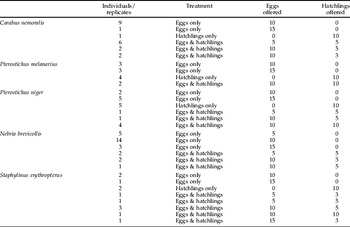
Eggs were placed on a thin layer of soil, covered by moss, placed at room temperature and inspected daily for hatching. Hatchlings were fed with carrot and stored at 4°C until the start of the experiments when they were 1–4 days old. The mean total biomass of eggs and hatchlings provided for each beetle was 31±4 mg and 19±2 fresh weight, respectively. The walls of the Petri dishes were smeared with FLUON® (polytetrafluoroethylene) to prevent the slugs from escaping out of reach of the beetles (Symondson, Reference Symondson1993). The number of eggs and hatchlings offered to the beetles varied between experiments (table 1), which had to be taken into account in the numerical analyses. The number of beetles (replicates) used in the different experiments also varied (table 1), but the total for each species was thought to be sufficient to analyse the capability for handling eggs and newly hatched slugs. Furthermore, a predation index (PI) was defined, as

This gives higher scores to beetles which consumed a given percentage of the eggs or hatchlings offered, if higher numbers were offered. Thus, a higher index score is given for a beetle consuming ten out of 20 slug eggs compared to a beetle consuming five out of ten, even though proportionally both fed the same. In this way, we can score predation by a beetle more accurately. To provide a scale for the predation indices, to make them comparable to the other indices which are fractions, they were standardised by dividing all indices by the largest PI, so that the final index would range between 0–1.
Number of predator-prey combinations in the Petri-dish experiments with eggs and newly hatched slugs. Each Petri dish contained one beetle and the number of prey offered to each beetle are presented in the columns ‘eggs offered’ and ‘hatchlings offered’.

After 24 h in darkness at 19°C, the beetles were removed and the state of damage to eggs and hatchlings assessed. The beetles were used in 1–3 experiments due to the limited availability of beetles. The same starving period and storing conditions were used between experiments when the same beetle was used on multiple occasions. In order to estimate the biomass of slug eggs or hatchlings consumed, each egg or hatchling was given a consumption index (CI) ranging between 0–4 (Oberholzer & Frank, Reference Oberholzer and Frank2003) as follows: 0, not consumed or destroyed; 1, up to 25% of content consumed; 2, 26–50% of contents consumed; 3, 51–75% of content consumed; and 4, 76–100% of content consumed. Biomass of eggs and hatchlings consumed was calculated by multiplying the number of eggs or hatchlings in each consumption category by the mass for each category and added together (table 2). This sum was divided by the total biomass offered to give the fraction consumed. The number of replicates differed due to the limited availability of beetles, eggs and newly hatched slugs (table 1).
Calculation of biomass (mg) of consumed eggs and newly hatched slugs within the different consumption indices (CI): 0, no eggs or slugs; 1, 1–25% consumed; 2, 26–50% consumed; 3, 51–75% consumed; and 4, 76–100% consumed.

Predation on eggs and newly hatched slugs in mini-plots
These experiments were carried out in two Styrofoam boxes measuring 46×75×20 cm (base area 0.345 m2). The boxes were filled with ∼10 cm of substrate, consisting of vegetation with attached soil. The substrate was collected randomly from the same site where beetles and slugs were collected in 2003. The vegetation consisted mainly of grasses (Poaceae) and the moss Rhytidadelphus squarrosus and was cut down to 8–10 cm. No effort was made to extract alternative prey from the vegetation in order to make the experimental design as natural as possible. Each box was divided by aluminium sheets into five experimental arenas, each 0.069 m2 (15×46 cm). The dividing walls, as well as the walls of the Styrofoam boxes, were smeared with a 2 cm wide strip of FLUON® to prevent the slugs from escaping (Symondson, Reference Symondson1993). Twenty eggs of A. lusitanicus were transferred to each experimental arena. The eggs were divided into two groups of ten eggs each and covered with vegetation to mimic, as closely as possible, the way that eggs can be found in clusters in the field. In addition, 20 newly hatched slugs were distributed throughout each experimental arena. The boxes were covered by transparent plastic sheets to maintain humidity. Since the beetles used in this experiment are nocturnal, the experiment was carried out in a darkened room. The beetles were kept in the arenas for 72 h at 12–14°C. They were then removed, the remaining eggs and hatchlings were collected and the numbers lost were scored. A total of six P. melanarius and six P. niger were tested.
Prey size choice by carabids feeding on A. lusitanicus
Each beetle (26 specimens of C. nemoralis, 9 P. niger and 11 S. erythropterus) were offered three relatively different sized A. lusitanicus: one small (0.1–0.3 g), one medium (0.3–0.9 g) and one large-sized slug (0.6–2.4 g). The Petri dishes were covered by lids to avoid slugs or beetles escaping. The experiment progressed for 2 h under low light at 19°C, and choice of slugs was detected during the experiment. The first slug that was killed and partly or completely consumed was recorded for further analyses.
Prey choice experiment with C. nemoralis feeding on A. lusitanicus and D. reticulatum
Each C. nemoralis was offered two slugs of the same size, one A. lusitanicus and one D. reticulatum. The weight of the slugs ranged from 0.1 to 0.6 g fresh weight. The experiment progressed under the same conditions as the size choice experiment and the results were also obtained in the same way, except that different starving periods (0, 3, 6, 9, 13, 14 and 17 days) were used to look for any effects of starving on prey choice.
Statistical analyses
All statistical analyses were performed utilizing the free software R (version 2.8.0) (R Development Core Team, 2008). There was no reason to anticipate a parametric distribution of the predation index (PI) since the data consisted of counts, and the data did not follow a normal distribution according to the Kolmogorov-Smirnov test. Thus, the non-parametric Kruskal-Wallis test was employed to indicate significant differences in PI between the pooled data for the carabids as well as differences between the experiments conducted with different starving regimes in 2003 and 2004. When several groups are compared in statistical tests, multiple comparison tests will avoid the increased probability of a type I error that occurs if more than two groups are incorporated in the same test. To identify the species of carabids that most efficiently preyed on or killed eggs or newly hatched slugs, we employed the non-parametric multiple comparisons for unequal sample sizes test described in Zar (Reference Zar1999). This procedure is based on the Nemenyi test but arranges the mean ranks, rather than the rank sums, in order of magnitude. Our comparisons of predation indices (PI) between different species in the feeding trials, therefore, were based on pooled data.
A generalised linear mixed-effect model (GLMM) was applied for the size-choice experiment by using the function glmmPQL, which is available in the MASS package for R. The observed first choice that led to consuming a slug by a given beetle was used as the response variable, and the three different size categories (small, medium, large) were used as the explanatory variable. A mixed model, using the beetles as a random factor, was included since the choice of slug was dependent on the other two slugs available for each beetle.
Results
Predation on eggs and newly hatched slugs
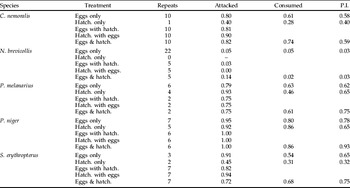
A Kruskal-Wallis test found, despite the difference in starvation periods, no difference in predation index between the experiments of 2003 and 2004 (χ=2.6461, df=1, P>0.05); and, consequently, they were analysed together. No loss of, or damage to, eggs or newly hatched slugs was observed in the control dishes. The maximum biomasses of eggs and newly hatched slugs consumed were 31 mg and 19 mg, respectively (table 2). The results of the feeding trials are summarised in table 3. A Kruskal-Wallis test revealed significant differences in predation indices between the species tested (χ=61.008, df=4, P<0.001). Pairwise comparisons revealed that N. brevicollis killed and consumed significantly less prey than the other species; thus, this species was excluded from the non-parametric multiple comparison models. The multiple comparison models revealed a significantly higher predation index (P<0.05) for P. niger compared to P. melanarius, S. erythropterus and C. nemoralis. The results were qualitatively similar when comparing the proportions attacked and consumed (data not shown), expect that the differences between C. nemoralis and P. niger were not significant. Comparisons between P. melanarius, S. erythropterus and C. nemoralis were not significantly different in terms of attacks and consumptions.
Mean fraction of eggs and newly hatched slugs attacked and consumed during the feeding trials for eggs and hatchlings offered alone, predation on eggs when offered with hatchlings, predation on hatchlings when offered with eggs and hatchlings together. PI, predation index.

Predation on eggs and hatchlings under semi-natural conditions
No significant difference was found between P. melanarius and P. niger (table 4; Kruskal-Wallis test, χ=0.1961, df=1, P>0.05). Overall, the numbers preyed upon were lower than in the Petri-dish experiments. On average for all beetles, 15% of hatchlings and 55% of eggs were attacked during the 72 h experiment.
Predation on eggs and hatchlings under semi-natural conditions. Results are given as proportion of available prey consumed.

Prey-size-choice experiments using A. lusitanicus
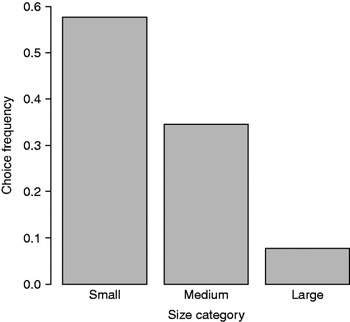
Carabus nemoralis showed size preferences when feeding on A. lusitanicus, preferring slugs smaller than 1 g (fig. 1). Predation on slugs termed ‘large’ was significantly lower compared with the ones termed ‘small’ (GLMM, P-value=0.0019) and the ones termed ‘medium’ (P-value=0.0365). However, predation on these two latter groups was not significantly different from each other (P-value=0.1113). P. niger seems to have less appetite for juvenile slugs than the larger beetle C. nemoralis. Only half of the former beetles consumed slugs while more than 80% of the latter beetles consumed slugs, of which 40% consumed more than one slug during the 2 h long experiment and 20% ate all three slugs. Staphylinus erythropterus did not kill any of the juvenile slugs weighing 0.1 g or more, suggesting that the slugs were too large for this beetle to handle.
Beetles choice in size categories of Arion lusitanicus. Results are given as proportions of beetles choosing the different sizes of slugs. Small, 0.1–0.3 g; medium, 0.3–0.9 g; and large, 0.6–2.4 g.

Prey choice experiments using A. lusitanicus and D. reticulatum
A Kruskal-Wallis test suggested no significant difference in prey choice by C. nemoralis (χ=3.4893, df=2, P-value=0.1747) when choosing between A. lusitanicus and D. reticulatum. A total of 30 beetles chose A. lusitanicus, while 24 beetles fed on D. reticulatum and 12 did not feed. No prey preference between the two slugs was persistent for all the different starvation periods.
Behaviour of beetles and slugs
Carabus nemoralis showed an extraordinary variety of behaviours in the Petri-dish experiments. Some individuals attacked the first encountered slug or egg when put into the experimental arena, while others did not attack any prey the first 20–60 minutes. They attacked the slugs at the posterior end and often killed their prey during the first attack. The other carabid species, as well as the staphylinid, were in most cases stressed during the first minutes of the experiments. These species did not direct their attacks to any specific part of the slug and normally attacked repeatedly the larger juveniles at intervals, with frequent cleaning of their mandibles to remove mucus. Pterostichus niger attacked juveniles larger than 0.1 g, but often gave up after several failed attempts.
Discussion
Capacity to eat A. lusitanicus eggs and hatchlings
We have demonstrated that the common beetles, C. nemoralis, P. melanarius, P. niger and S. erythropterus, will all eat eggs and newly hatched A. lusitanicus when offered them in the laboratory. Nebria brevicollis did not eat A. lusitanicus eggs and hatchlings under our experimental conditions. While N. brevicollis did destroy some eggs, a closer examination revealed that the eggs were just bitten into and hardly anything consumed. The hungry beetles seem to have tasted the eggs but then rejected them. As N. brevicollis is regarded to feed mainly on springtails (Thiele, Reference Thiele1977), it is possible that eggs and juveniles of the Iberian slug are outside the size range of suitable prey and/or are unpalatable to this species. Tod (Reference Tod1973) found a correlation between size of beetle and slug predation in the field, where N. brevicollis crops rarely contained slugs, while the larger species, like C. nemoralis, fed on slugs frequently. Ayre (Reference Ayre2001) found that N. brevicollis preyed upon D. reticulatum juveniles, but these were considerably smaller (ca. 4 mm) than those of A. lusitanicus used in our study (8–10 mm).
In the Petri-dish experiments, the fraction of prey consumed was lower than the fraction attacked for all beetle species; however, the differences were small and the two measures highly correlated. This suggests that eggs and juveniles of A. lusitanicus were edible to all these beetle species, except N. brevicollis. However, slugs like A. lusitanicus may be less palatable than other prey (e.g. earthworms), and more palatable prey may be preferred under field conditions where a range of prey are on offer.
The mini-plot experiment, under semi-natural conditions, addressed one of the shortcomings of the Petri-dish experiments by introducing search time; the eggs and newly hatched slugs were presented in conditions emulating those in the field. The setting was not entirely realistic since the area over which the beetles could roam was limited. The mini-plot experiments showed that a substantially lower fraction of eggs and hatchlings were preyed upon under such conditions than in the highly unnatural conditions of the Petri dishes. However, over 50% of eggs and 15% of hatchlings were preyed upon during 72 h, demonstrating that the beetles were able to find and eat slug eggs and newly hatched slugs under these conditions. In the laboratory, hatching of A. lusitanicus eggs took 20 days in room temperature (19–21°C) and 150 days at low temperatures (4–6°C), with large variations between egg clutches held at the same temperature (Tomasgård, Reference Tomasgård2005). The eggs are thus exposed in the field to potential predation for periods 7–50 times longer than the duration of the mini-plot experiments, giving ample time for predation.
Predation on juvenile A. lusitanicus and D. reticulatum
Carabus nemoralis consumed juveniles of up to 1.3 g, although a significant preference for slugs less than 1 g was found. Pterostichus niger, on the other hand, appeared to have difficulties handling the mucus of juvenile slugs and seems to be restricted to eggs and newly hatched A. lusitanicus. This is partly in accordance with a previous study by Kaiser et al. (Reference Kaiser, Geiersberger, Grimm and Paill1993), who found a preference for juvenile slugs of A. lusitanicus less than 0.1 g in Carabus cancellatus, while P. melanarius preferred eggs and C. granulatus showed no particular preference. Furthermore, Paill (Reference Paill, Brandmayr, Lövei, Brandmayr, Casale and Vigna Taglianti2000) found that C. violaceus preferred smaller A. lusitanicus in the field. However, a preference for smaller slugs may be counterbalanced in the field since larger juveniles might be easier to find, which has been shown by McKemey et al. (Reference McKemey, Symondson and Glen2003) for P. melanarius feeding on D. reticulatum.
A number of studies have shown that ground beetles will prey upon gastropods irrespective of the length of the starving period prior to the experiment (Ayre, Reference Ayre2001; Mair & Port, Reference Mair and Port2001; McKemey et al., Reference McKemey, Symondson, Glen and Brain2001, Reference McKemey, Symondson and Glen2003; Oberholzer & Frank, Reference Oberholzer and Frank2003; Oberholzer et al., Reference Oberholzer, Escher and Frank2003), so eating slugs seems not to depend upon duration of starvation. Further, starving seems to have no effect on choice of slug species by C. nemoralis, and no preference existed for D. reticulatum vs. A. lusitanicus. The same lack of preference of slug species has been found for Carabus problematicus and Abax parallelepipedus when given Arion subfuscus, A. intermedius, A. circumscriptus, A. ater and Malacolimax tenellus (Bless, Reference Bless1977).
Predation in the field on A. lusitanicus
We have demonstrated that several beetle species will eat eggs and juveniles of A. lusitanicus under experimental laboratory conditions, but more research is needed to determine to what extent beetles actually eat slugs in the field. Many small-sized slugs are found up in the vegetation, where they may be out of reach of some beetles, particularly large species like C. nemoralis. Except for S. erythropterus, the beetles we studied are all primarily nocturnal, and slugs might thus escape predation by climbing up into the vegetation at night. It is also questionable how palatable the eggs and juveniles of A. lusitanicus are to beetles, in particular, when alternative prey is available. In a rather questionable experiment, Schroeder et al. (Reference Schroeder, Gonzalez, Eisner and Meinwald1999) isolated the defensive diterpene miriamin from A. lusitanicus eggs and showed that the substance deterred the coccinellid Harmonia axyridis from feeding on moth eggs coated with this extract. As these coccinellids do not eat mollusc eggs (and no comparison was made with extracts from the eggs of other mollusc species), this tells us nothing about the potential deterrence of slug predators, such as Carabus species. Oberholzer & Frank (Reference Oberholzer and Frank2003) found that P. melanarius fed on A. lusitanicus eggs with no harm to the beetles. Similarly, P. melanarius fed exclusively on A. lusitanicus eggs over several weeks and showed no mortality (W.O.C. Symondson, unpublished data). We did not observe anything indicating that the beetles suffered any harm from feeding on slug eggs and juveniles, suggesting that these carabids and staphylinids are insensitive to diterpene miriamin.
Direct observation of predation in the field is difficult since both the beetles and the slugs are nocturnal and spend much time in dense vegetation. Molecular markers to identify A. lusitanicus DNA in beetle guts will be useful in revealing food preferences together with DNA-based markers and methods already developed by Harper et al. (Reference Harper, King, Dodd, Harwood, Glen, Bruford and Symondson2005), Dodd (Reference Dodd2004) and Hatteland, B.A., Noble, L.R., Schander, C., Skage, T. & Solhøy, T. (in prep.). Appropriate markers for A. lusitanicus DNA have been optimised for foregut analyses (Hatteland, B.A., King, R.A., Symondson, W.O.C. & Solhøy, T., in prep.); thus, it will be possible for a range of beetle species to be screened for evidence of feeding on A. lusitanicus as well as other slugs. DNA-based markers will not be able to distinguish between predation on slugs and their eggs, however, although this has been shown to be possible using monoclonal antibodies (Symondson et al., Reference Symondson, Mendis and Liddell1995; Mendis et al., Reference Mendis, Bowen, Liddell, Symondson and Henderson1996).
The activity peak of a potentially useful predator should coincide with the egg and juvenile phases of A. lusitanicus; the egg phase takes place from September to November and the juvenile phase is mainly from October to June in Norway (Dirks et al., in prep.). The potential of the predator species tested in this study only partly fulfil this criterion. Carabus nemoralis is mainly active as adults during spring and early summer with a smaller activity peak in early autumn (Lindroth, Reference Lindroth1985; Turin et al., Reference Turin, Penev, Casale, Arndt, Assman, Makarov, Mossakowski, Szél, Weber, Turin, Penev and Casale2003), when the abundance of juvenile slugs is highest. This is unlike other Carabus species, as well as P. melanarius, P. niger, N. brevicollis and S. erythropterus, that all have an activity peak in the latter half of the summer (July–August) when the juvenile slugs are less abundant (Hatteland et al., in prep.). Pterostichus melanarius has been found to feed mainly on A. lusitanicus in spring and autumn when juvenile slugs of <200 mg are abundant (Paill, Reference Paill2004). However, the larvae of the two Pterostichus species are active in autumn (Kaiser et al., Reference Kaiser, Geiersberger, Grimm and Paill1993; Thomas, Reference Thomas2002) and N. brevicollis larvae are active in spring (Traugott, Reference Traugott1998). Pterostichus melanarius larvae have been shown to feed on both D. reticulatum and Arion intermedius under semi-field conditions (Thomas et al., Reference Thomas, Harwood, Glen and Symondson2009), and orientation towards slugs in the soil is possible by olfaction (Thomas et al., Reference Thomas, Glen and Symondson2008).
The potential of beetle predators for biological control of A. lusitanicus
Since we found that several carabid species ate eggs and juveniles of A. lusitanicus, any measures which promote abundance of these beetles (and possibly also staphylinids) are likely to be beneficial in terms of slug population reduction. The most realistic biological control of slugs by beetles is often not classical nor inundative biological control but conservation biological control (Symondson, Reference Symondson and Barker2004). Introducing alien beetles is too risky and culturing these beetles is very expensive due to cannibalism among larvae. The only species that has so far been found possible to mass culture economically is the woodland-edge species Abax parallelepipedus (Symondson, Reference Symondson1994), which is common in many parts of Europe but not present in western Norway (Lindroth, Reference Lindroth1986). Crop management practices should rather take into account the beetle fauna by reducing use of insecticides and those molluscicides that are toxic to carabids, especially in spring when C. nemoralis is active. Provision of refugia may also increase the number of beetles (Altieri et al., Reference Altieri, Hagen, Trujillo and Caltagirone1982). Alternatively, or additionally, hedges may be planted to connect surrounding woodlands to arable fields since C. nemoralis has been found to disperse along such habitat strips (Glück & Kreisel, Reference Glück and Kreisel1986; Gruttke, Reference Gruttke, Desender, Dufrêne, Loreau, Luff and Maelfait1994). Future studies should address the numbers of beetles needed to control slugs like A. lusitanicus, and whether these numbers are present in arable fields and surrounding habitats, or if they need to be increased. Arion lusitanicus has been found to be numerous and causes problems for strawberry cultivation even though beetles like C. nemoralis were present (Hatteland et al., in prep.), which suggests that some sort of manipulation is necessary. On the other hand, we do not know how the exclusion of such predators will affect the slug populations. Clearly, manipulative studies under field conditions are needed to explore how the beetles are affecting pest species like A. lusitanicus. However, studies of predation in the field (as mentioned above) should first be carried out to determine to what extent these beetles are feeding on A. lusitanicus.
Acknowledgements
Sincere thanks to Stine Beate Balevik for help with sampling of beetles and many thanks to Kathrin Bochmühl for help during the prey choice experiment. We are also grateful to Steffen Roth and Cathy Jenks for giving valuable comments on the manuscript and to Knut Helge Jensen for help with the statistics. Thanks also to Vladimir Gusarov for information on food preferences of Staphylinus erythropterus. We also thank Myrdyrkingsfondet and the University of Bergen for financial support.