Effortful control is a key concept in developmental psychology and psychopathology (Fonagy & Target, Reference Fonagy and Target2002; Posner, Rothbart, Sheese, & Tang, Reference Posner, Rothbart, Sheese and Tang2007), and it has been increasingly recognized as a major contributor to successful social development (Calkins & Fox, Reference Calkins and Fox2002; Eisenberg, Champion, & Ma, Reference Eisenberg, Champion and Ma2004; Eisenberg, Fabes, Guthrie, & Reiser, Reference Eisenberg, Fabes, Guthrie and Reiser2000; Kochanska, Murray, & Harlan, Reference Kochanska, Murray and Harlan2000; Posner & Rothbart, Reference Posner and Rothbart1998). In the temperament framework proposed by Rothbart and coworkers, effortful control is defined as the ability to voluntarily regulate behavior and attention, including the inhibition of a dominant response and activation of a subdominant one (Rothbart, Reference Rothbart2007; Rothbart, Ellis, Rueda, & Posner, Reference Rothbart, Ellis, Rueda and Posner2003). Effortful control as measured by questionnaire has been linked to Posner's executive attention system, which includes the anterior cingulate and lateral prefrontal cortex (Posner & Rothbart, Reference Posner and Rothbart1998, Reference Posner and Rothbart2007; Rothbart & Rueda, Reference Rothbart, Rueda, Mayr, Awh and Keele2005; Rueda, Posner, & Rothbart, Reference Rueda, Posner and Rothbart2005).
A growing body of evidence has linked inadequate effortful control to externalizing (e.g., Brunnekreef et al., Reference Brunnekreef, De Sonneville, Althaus, Minderaa, Oldehinkel and Verhulst2007; Olson, Schilling, & Bates, Reference Olson, Schilling and Bates1999; Oosterlaan & Sergeant, Reference Oosterlaan and Sergeant1996; Ormel et al., Reference Ormel, Oldehinkel, Ferdinand, Hartman, De Winter and Veenstra2005) and internalizing problems (e.g., Eisenberg et al., Reference Eisenberg, Cumberland, Spinrad, Fabes, Shepard and Reiser2001; Oldehinkel, Hartman, Ferdinand, Verhulst, & Ormel, Reference Oldehinkel, Hartman, Ferdinand, Verhulst and Ormel2007; Vasey, El-Hag, & Daleiden, Reference Vasey, El-Hag and Daleiden1996). Besides having an effect of its own, effortful control has also been found to moderate effects of negative emotionality (Eisenberg, Spinrad, et al., Reference Eisenberg, Spinrad, Fabes, Reiser, Cumberland and Shepard2004; Oldehinkel et al., Reference Oldehinkel, Hartman, Ferdinand, Verhulst and Ormel2007; Valiente et al., Reference Valiente, Eisenberg, Smith, Reiser, Fabes and Losoya2003) and social risk factors (Stice & Gonzales, Reference Stice and Gonzales1998; Veenstra, Lindenberg, Oldehinkel, De Winter, & Ormel, Reference Veenstra, Lindenberg, Oldehinkel, De Winter and Ormel2006; Wills, Sandy, Jaeger, & Shinar, Reference Wills, Sandy, Jaeger and Shinar2001) on mental health outcomes. This suggests that high effortful control reduces the impact of negative (internal or external) experiences on emotions and behavior. Derryberry and Rothbart (1977) postulated that “effortful control may be crucial in coordinating the various sources of threatening and relieving information required in defensive contexts, and in allowing for adaptive action in situations where children would otherwise be subject to inhibition and a focus on their own distress” (p. 647).
Thus, effortful control is thought to be crucially involved in the management of emotions, thoughts, and actions in coping with stress (Derryberry, Reed, & Pilkenton-Taylor, Reference Derryberry, Reed and Pilkenton-Taylor2003; Rueda & Rothbart, Reference Rueda and Rothbart2009). Developmental researchers have converged on a conceptualization of coping as “regulation under stress” (Skinner & Zimmer-Gembeck, Reference Skinner and Zimmer-Gembeck2007). Several studies have addressed the link between effortful control and behavioral coping styles such as active problem solving (e.g., Fabes & Eisenberg, Reference Fabes and Eisenberg1997; Lengua & Long, Reference Lengua and Long2002). However, studies on how effortful control relates to immediate emotional, cognitive, and physiological reactions to stressful challenges are scarce. Chapman, Woltering, Lamm, and Lewis (Reference Chapman, Woltering, Lamm and Lewis2010) investigated the relationship between various aspects of emotion regulation and respiratory sinus arrhythmia (RSA) in 99 children and adolescents. They found that resting RSA was associated with effortful control as measured by questionnaire, whereas RSA during a go/no go task with induction of negative emotions was associated with the no go N2 event-related potential, a neural correlate of response inhibition. Limitations of the Chapman et al. study are that resting RSA and RSA during the task were assessed at different locations, which precluded the use of difference scores, and that it did not include other physiological measures and indices of perceived stress. The present study extended Chapman's findings by examining if various aspects of effortful control predicted perceived arousal, unpleasantness, and control as well as autonomic (heart rate [HR]) and hypothalamic–pituitary–adrenal (HPA) axis (cortisol) responses during a laboratory social stress task in a large population sample of adolescents. Effortful control was assessed using both parent- and self-report questionnaires. In addition, we included a response inhibition task as a reaction time (RT) measure of effortful control. Response inhibition tasks are a well-established, often-used way to assess an essential part of effortful control: the inhibition of prompted, but inappropriate responses (e.g., Blair & Razza, Reference Blair and Razza2007; Chapman et al., Reference Chapman, Woltering, Lamm and Lewis2010; Rothbart & Rueda, Reference Rothbart, Rueda, Mayr, Awh and Keele2005).
Investigating how individual differences in effortful control relate to stress responses under controlled laboratory conditions may extend our insights in vulnerability and resilience in real-world stressful encounters. Although effortful control is assumed to play a key role in successful social development and mental health, the mechanisms through which it can protect youth during stressful encounters are still largely unknown. Knowing which aspects of effortful control are associated with which aspects of stress reactivity may provide tools for further examining what can be done to prevent psychopathology in adolescents at risk.
Methods
Participants
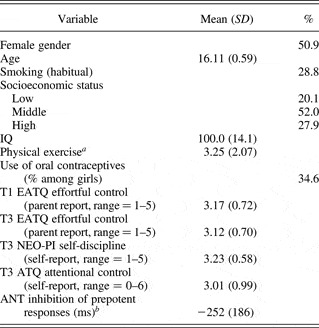
The data were collected in a focus sample of the Tracking Adolescents' Individual Lives Survey (TRAILS), a large prospective population study of Dutch adolescents with bi- or triennial measurements from age 11 to at least age 25. The three assessments waves finished so far ran from March 2001 to July 2002 (Time 1 [T1]), September 2003 to December 2004 (T2), and September 2005 to December 2007 (T3). At T1, 2,230 children were enrolled in the study (response rate 76.0%, mean age = 11.09, SD = 0.55, 50.8% girls; De Winter et al., Reference De Winter, Oldehinkel, Veenstra, Brunnekreef, Verhulst and Ormel2005), of whom 1,816 (81.4%) participated at T3. During T3, 744 adolescents were invited to perform a series of laboratory tasks (hereafter referred to as the experimental session) on top of the usual assessments, of whom 715 (96.1%) agreed to do so. Adolescents with a high risk of mental health problems had a greater chance of being selected for the experimental session. High risk was defined based on T1 temperament (high frustration and fearfulness, low effortful control), lifetime parental psychopathology, and environmental risk (living in a single-parent family). In total, 66.0% of the sample had at least one of the above-described risk factors; the remaining 34.0% were selected randomly from the total TRAILS sample. For descriptive statistics see Table 1.
Sample characteristics and measures of effortful control (N = 715)

Note: T1 and T3, Time 1 and Time 3; EATQ-R, Early Adolescent Temperament Questionnaire—Revised; NEO-PI-R, Revised NEO Personality Inventory; ATQ, Adult Temperament Questionnaire.
aNumber of days per week with at least 1 hr of physical exercise.
bDifference in mean reaction times between compatible and incompatible responses of the ANT Shifting Set task. High scores represent a high ability to inhibit inappropriate responses.
Procedure
Regular TRAILS assessments
Both at T1 and T3, TRAILS participants filled out questionnaires at school, in the classroom, supervised by one or more test assistants. In addition, the T1 school assessments included individual sessions with the children for the measurement of intelligence and a number of biological and neurocognitive variables, among which inhibition of prepotent responses (see below). Parents filled out questionnaires at home at both assessment waves.
Experimental session
As described above, a subsample of adolescents were invited to participate in an experimental session on top of the regular assessments at T3. The experimental session consisted of a number of different challenges, that is, orthostatic stress (from supine to standing), a spatial orienting task, a gambling task, a startle reflex task, and a social stress test; preceded and followed by a 40-min period of rest. Before, during, and after the experimental challenges we assessed cardiovascular measures, cortisol, and subjective experiences. Measures that were used in the present study are described more extensively below. The experimental sessions took place in sound-proof rooms with blinded windows at selected locations in the participants' residence towns. The total session lasted about 3.5 hr and started between 8:00 and 9:30 a.m. (morning sessions, 50%) or between 1:00 and 2:30 p.m. (afternoon sessions, 50%). The protocol was approved by the Central Committee on Research Involving Human Subjects.
The Groningen Social Stress Test
This test was the last challenge of the experimental session. It involves a standardized protocol including public speaking and mental arithmetic, inspired by the Trier Social Stress Task (Kirschbaum, Pirke, & Hellhammer, Reference Kirschbaum, Pirke and Hellhammer1993), for the induction of moderate performance-related social stress. Socioevaluative threats are highly salient challenges for adolescents and known to be effective activators of various physiological stress systems, particularly in combination with uncontrollability (Dickerson & Kemeny, Reference Dickerson and Kemeny2004). The participants were instructed to prepare a 6-min speech about themselves and their lives and deliver this speech in front of a video camera. They were told that their videotaped performance would be judged on content of speech as well as on use of voice and posture, and rank-ordered by a panel of peers after the experiment. The participants had to speak continuously for the whole period of 6 min. The test assistant watched the performance critically, and showed no empathy or encouragement. The speech was followed by a 3-min interlude in which the participants were not allowed to speak. Subsequently, they were instructed to subtract 17 repeatedly, starting with 13,278. A sense of uncontrollability was induced by repeated negative feedback by the test assistant (e.g., “No, wrong again, begin at 13,278,” “Stop wiggling your hands,” “You are too slow, we are running out of schedule”). The mental arithmetic part lasted for 6 min, again followed by 3-min period of silence, after which the participants were debriefed about the experiment.
Measures
Effortful control
Questionnaire-based effortful control was assessed by subscales of the Early Adolescent Temperament Questionnaire—Revised (EATQ-R, parent report), the Adult Temperament Questionnaire (ATQ, self-report), and the Revised NEO Personality Inventory (NEO-PI-R, self-report), which will be described in more detail hereafter. The EATQ-R was administered at both T1 and T3, whereas the ATQ and NEO-PI-R were administered at T3 only. The T3 self-report measures were part of the regular assessments at school, on average 3.07 months (SD = 5.12) before the experimental session. For all instruments, scale scores were calculated by averaging the individual item scores. In addition to these questionnaires, we used an RT task of the Amsterdam Neuropsychological Task (ANT) program, also to be described hereafter, to assess the ability to inhibit a prepotent response. The ANT was administered at T1.
The EATQ-R (Ellis, Rothbart, & Posner, Reference Ellis, Rothbart and Posner2004; Hartman, Reference Hartman2000) is a 62-item questionnaire, based on the temperament model developed by Rothbart and colleagues (e.g., Rothbart, Ahadi, & Evans, Reference Rothbart, Ahadi and Evans2000). In this study, we used the parent-report version of the EATQ-R. Each item could be rated on a 5-point scale ranging from 1 = hardly ever true to 5 = almost always true. In the original model, the effortful control dimension could be subdivided into activation control (the capacity to perform an action when there is a strong tendency to avoid it), attention control (the capacity to focus attention as well as to shift attention when desired), and inhibitory control (the capacity to plan and to suppress inappropriate responses). Principal component analysis in our sample (T1 data) revealed that these components failed to emerge as separate factors and some of the items did not reflect the concept of effortful control well (for more details, see Oldehinkel, Hartman, De Winter, Veenstra, & Ormel, Reference Oldehinkel, Hartman, De Winter, Veenstra and Ormel2004). Based on this analysis, we constructed a single effortful control scale, which mainly encompassed items reflecting activation control and attention control. This scale contains 11 items and had an internal consistency (Cronbach α) of 0.86 at T1 and 0.85 at T3.
The ATQ (Evans & Rothbart, Reference Evans and Rothbart2007) was also based on the temperament model developed by Rothbart et al. (Reference Rothbart, Ahadi and Evans2000). In total, the ATQ contains 13 scales, of which only the Attentional Control Scale was assessed in our study. The Attentional Control Scale consists of five items, which could be scored on a 7-point scale ranging from 0 = very not true to 6 = very true (Cronbach α = 0.63 in our sample).
The NEO-PI-R (Costa & McCrae, Reference Costa and McCrae1992; Hoekstra, De Fruyt, & Ormel, Reference Hoekstra, De Fruyt and Ormel2003) is a 240-item personality questionnaire which measures 30 personality facets, a selection of which were assessed in our study. For the present analyses we used the facet of self-discipline, which reflects the ability to begin tasks and carry them through to completion, despite boredom or distraction, and hence closely resembles Rothbart's concept of activation control. The scale consists of eight items, which could be scored on a 5-point scale ranging from 1 = totally disagree to 5 = totally agree and had an internal consistency (Cronbach α) of 0.76.
Inhibition of prepotent responses is the ability to inhibit an inappropriate, habitual response tendency, and it was included as an RT measure of effortful control. Inhibition of prepotent responses was assessed by means of RTs derived from the baseline and inhibition condition of the shifting set task of the ANT program (De Sonneville, Reference De Sonneville, Den Brinker, Beek, Brand, Maarse and Mulder1999), administered at T1. In the baseline condition of this task, participants had to copy the direction of the movement of a square (i.e., a left movement requires pressing the left mouse button and a right movement required pressing the right mouse button). In the inhibition condition, this natural and well-practiced response tendency had to be inhibited by reversing the response (i.e., a left movement required pressing the right mouse button and a right movement required pressing the left mouse button). Response inhibition was indexed by the difference in RTs between the responses during the baseline and inhibition conditon. To ease comparison with the questionnaire-based effortful control measures, this difference was calculated in such a way that a high score represent a high ability to inhibit inappropriate responses. RTs and accuracy scores that were more than 4 SD above the mean were defined outliers (Stevens, Reference Stevens2002). These outliers as well as participants performing at chance level of accuracy, that is, making 50% or more errors, were considered missing. The total ANT lasted for about 70 min and consisted of seven tasks. Children were tested individually in a separate room at their school or, if this was not possible, a nearby community center. Tasks were administered by trained undergraduate psychologists. Before each task, children were shown a screenshot of relevant task characteristics and received verbal instructions, emphasizing both speed and accuracy of performance. Furthermore, practice trials were run prior to the administration of the test trials to ensure that the children understood the instructions.
Perceived stress
Perceived stress was assessed by means of the Self-Assessment Manikin (SAM), a nonverbal pictorial assessment technique to measure the perceived arousal, pleasure, and control (originally referred to as dominance) associated with a person's affective reaction to a stimulus (Bradley & Lang, Reference Bradley and Lang1994). For each of the feelings assessed (i.e., arousal, unpleasantness, control), the subjective intensity could be indicated by choosing one out of nine ordered pictures. The pictures were translated into a 9-point scale (range = 1–9) in such a way that high scores represented high levels of arousal, unpleasantness, and control. Perceived stress during the social stress test was assessed directly after the test, with a reference to the test (How did you feel during this test?). Pre- and posttest experiences were measured at the start (after 40 min of rest) and at the end of the experimental session (40 min after the social stress test), respectively. SAM ratings for arousal and unpleasantness have been shown to correlate almost perfectly (r ≥ .95) with corresponding scales of the Semantic Differential Scale (Mehrabian & Russel, Reference Mehrabian and Russel1974), whereas the correlation was moderately high (r = .79) for control (Bradley & Lang, Reference Bradley and Lang1994).
Cortisol
Cortisol levels were assessed just before the start of the social stress test (C1), directly after the end of the test (C2), 20 min after the test (C3), and 40 min after the test (C4). Considering the normal delay (20–25 min) in peak cortisol responses to experimental stressors (Kirschbaum, Read, & Hellhammer, Reference Kirschbaum, Read and Hellhammer1992), all samples reflect stress reactions about 20 min earlier, that is, preceding, during, immediately after, and 20 min after the social stress test.
Cortisol was assessed from saliva by the Salivette sampling device (Sarstedt, Numbrecht). After the experimental session, the samples were placed in a refrigerator at 4°C, and within a few days stored at −20°C until analysis. All samples were analyzed with the same reagent, and all samples from a participant were assayed in the same batch. Cortisol was measured directly in duplicate in 100 µl of saliva using an in-house radioimmunoassay applying a polyclonal rabbit cortisol antibody and 1,2,6,7 3H cortisol (Amersham, Arlington Heights, IL) as the tracer. After incubation for 30 min at 60°C, the bound and free fractions were separated using activated charcoal. The intraassay coefficient of variation was 8.2% for concentrations of 1.5 nM, 4.1% for concentrations of 15 nM, and 5.4% for concentrations of 30 nM. The interassay coefficients of variation were 12.6%, 5.6%, and 6.0%, respectively. The detection border was 0.9 nM. Missing samples (C1: n = 12, C2: n = 8, C3: n = 10, C4: n = 12) were due to detection failures in the lab (60%) or insufficient saliva in the tubes (40%). Cortisol levels above 5 SD of the mean (C1: n = 3, C2: n = 6, C3: n = 3, C4: n = 4) were considered outliers and recoded into missing values.
HR
HR was assessed during and after the social stress test in four blocks: speech preparation (240 s), speech (360 s), mental arithmetic (360 s), and posttest (300 s). A three-lead electrocardiogram was registered using 3M/RedDot silver/silver chloride electrodes (Type 2255, 3M Health Care, Neuss, Germany) while the participant was sitting and breathing spontaneously. A BIOPAC Amplifier-System (MP100) was utilized to amplify and filter the signals before digitization at 250 samples/s. Dedicated software (PreCARSPAN, previously used in, e.g., Dietrich et al., Reference Dietrich, Riese, Sondeijker, Greaves-Lord, Van Roon and Ormel2007) was used to check signal stationarity, to correct for artifacts, to detect R-peaks, and to calculate the interbeat interval (IBI) between two heartbeats. Blocks were considered invalid if they contained artifacts that lasted more than 5 s, if the total artifact duration was more than 10% of the registration, or if the block length was less than 100 s (invalid blocks preparation: n = 28, speech: n = 27, mental arithmetic: n = 29, posttest: n = 32). HR is inversely related to IBI by the equation HR = 60,000/IBI. HR was defined as the number of beats per minute.
Other variables
Smoking, socioeconomic status (SES), intelligence, and physical activity were included as potential confounders of the associations under study. Smoking and physical activity were assessed as part of the regular T3 questionnaire, which was filled out at school, on average 3.07 months (SD = 5.12) before the experimental session. We distinguished between nonsmokers and habitual smokers (i.e., at least one cigarette a day). Physical activity was operationalized as the number of days the respondent was physically active for at least 1 hr. Parental SES was measured at T1, using rankings of maternal and paternal education and occupation, and household income. These rankings were standardized and averaged to derive a composite measure of SES. High SES refers to the highest 25% of the composite score in the population, low SES to the lowest 25%, and intermediate SES to the 50% in between. Intelligence was also assessed at T1, by means of the vocabulary and block design subtests of the Revised Wechsler Intelligence Scales for Children (Van Haassen et al., Reference Van Haassen, De Bruyn, Pijl, Poortinga, Lutje Spelberg and VanderSteene1986), which were used to estimate full-scale IQ for all children (Sattler, Reference Sattler1992). Use of oral contraceptives was assessed by means of a checklist on current medication use administered at the start of the experimental session. In total, oral contraceptives were used by 125 girls.
Analysis
Missing data on any of the variables were handled by multiple imputation, using the Imputation by Chained Equations approach available in the statistical package Stata (StataCorp, 2007). Given other variables in the data set, we created five data sets with imputed missing values, which were joined in subsequent analyses (Royston, Reference Royston2005).
We first calculated descriptive statistics of the (untransformed) variables used in this study, and tested differences between multiple assessments of the same variable by means of repeated measures analysis of variance. In case of significant within-subject changes, pairwise post hoc tests (with Bonferroni correction for multiple testing) were performed to explore the nature of the differences. The analyses of variance were based on a single imputation data set, because Stata's multiple imputation procedures do not support repeated measures analysis of variance. The HR and cortisol variables were log-transformed before analysis. Means and standard deviations are based on untransformed variables.
Subsequently, we tested if various measures of effortful control predicted psychological (perceived stress) and physiological (HR and cortisol) stress measures, by a series of linear regression analyses. To reduce the number of statistical tests, we constructed a combined measure of parent-reported effortful control by averaging the standardized EATQ-R scores of T1 and T3. Likewise, a self-reported effortful control measure was constructed by averaging the standardized scores on the ATQ and the NEO-PI-R. All continuous variables in the models were standardized to mean = 0 and SD = 1. The effects of effortful control were examined with regard to both mean stress levels and the (maximum) stress response. Mean stress levels were calculated as the average level across all assessments, whereas stress responses were defined as the maximum level during the test minus the minimum level before or after the test (for perceived control this was just the other way around). The effects of mean stress levels and stress responses were mutually adjusted for each other in the regression analyses.
Gender, smoking, SES, IQ, and physical exercise were included in all regression analyses as covariates. In addition, the effect of inhibition of prepotent responses (RT) was adjusted for accuracy by including the amount of errors made in the regression models assessing the effects of RT. Because there is ample evidence for gender differences in psychophysiological responses to stressful situations (Biondi & Picardi, Reference Biondi and Picardi1999; Kudielka, Hellhammer, & Wüst, Reference Kudielka, Hellhammer and Wüst2009), also in the present data set (Bouma, Riese, Ormel, Verhulst, & Oldehinkel, Reference Bouma, Riese, Ormel, Verhulst and Oldehinkel2009), all effects under study were tested on gender differences by including interaction terms in the model. In case of (marginally) significant interactions with gender, we inspected gender-specific effects to explore the nature of the differences. A previous study by Bouma et al. (Reference Bouma, Riese, Ormel, Verhulst and Oldehinkel2009) on the effects of gender, menstrual phase, and use of oral contraceptives in the same sample had indicated that oral contraceptive users showed no cortisol response to the social stress test. Therefore, these girls were excluded from all analyses involving cortisol. Bouma's study also revealed that, although the cortisol levels were higher in the morning due to the circadian rhythm of cortisol production, morning and afternoon cortisol responses to social stress were comparable in this sample.
We used three indicators of effortful control and five stress measures, and hence performed multiple statistical tests. Bonferroni or other correction procedures were not applied, nonetheless, because the tests were not independent, but rather meant to explore the robustness of associations (if any) across various measures of effortful control and various stress indicators. In other words, we aimed to explore patterns of associations rather than test specific hypotheses, and p values are therefore used in a descriptive rather than decisive way.
Results
Descriptive statistics
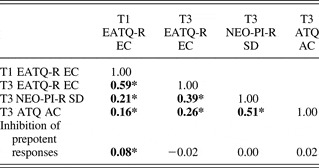
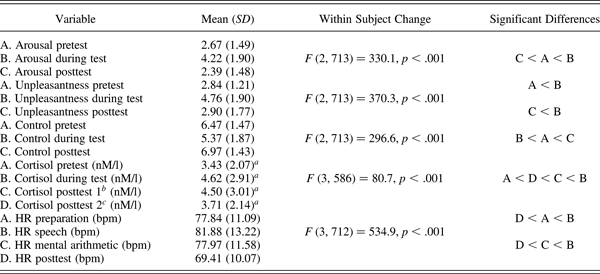
As can be seen in Table 1, the mean questionnaire-based effortful control scores were all slightly above the theoretical mean (i.e., 3), and of the same order of magnitude. Effortful control measures from the same informant correlated fairly high, which justifies the use of combined scores, whereas only modest correlations were found between scores from different informants (Table 2). Inhibition of prepotent responses reflects the RTs of compatible responses minus those of incompatible responses (in ms), and was (weakly) associated with questionnaire-based effortful control at T1, but not at T3. A higher (i.e., less negative) score thus indicates more inhibitory control. Descriptive statistics of the stress measures used are presented in Table 3. All stress measures significantly changed during the social stress test, with both psychological and physiological measures indicating higher stress levels during the stress test than preceding or following it. Please note that HR recordings started during the preparation phase of the stress test, so the first HR measure does not reflect pretest levels. Correlations between subsequent assessment of stress measures were generally moderate to high (perceived arousal: r = .33–.47; perceived unpleasantness: r = .18–.30; perceived control: r = .45–.49; HR: r = .69–.84; cortisol: r = .34–.84). Correlations between perceived arousal, unpleasantness, and control were higher during stress (|r| = .41–.53) than during rest (|r| = .17–.34). HR and cortisol levels were weakly to moderately correlated (r = .14–.25) during the social stress test, but posttest HR and cortisol levels did not correlate (r = −.01). Finally, correlations between the psychological and physiological stress measures ranged between −.11 and .14 and are described in more detail in another paper (Oldehinkel et al., 2011).
Correlations between measures of EC

Note: T1 and T3, Time 1 and Time 3; EATQ-R, Early Adolescent Temperament Questionnaire—Revised; EC, effortful control; NEO-PI-R, Revised NEO Personality Inventory; SD, self-discipline; ATQ, Adult Temperament Questionnaire; AC, attentional control.
*p < .05.
Stress measures used in this study and tests of within-subjects changes
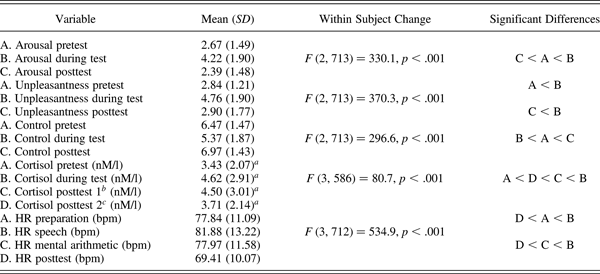
Note: Descriptives for cortisol and heart rate (HR) data reflect untransformed data, while log transformed data were used in the analyses. Analyses were based on single imputation data. Pairwise differences were adjusted for multiple testing (Bonferroni method).
aExclusive of girls using oral contraceptives.
bImmediately after the social stress test.
cTwenty minutes after the social stress test.
Associations of effortful control with perceived and physiological stress measures
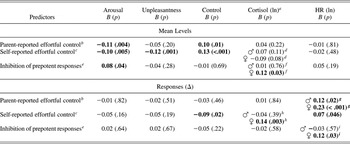
Interrelations between effortful control measures on the one hand and various stress responses in contrast are shown in Table 4. Note that all continuous variables were standardized to a mean of 0 and a standard deviation of 1 so all regression coefficients are internally comparable, and the analyses regarding the mean stress levels were adjusted for the stress responses and vice versa.
Effortful control measures as predictors of psychological and physiological responses to social stress

Note: Heart rate (HR) and cortisol variables were log transformed before analysis. Continuous variables were standardized to 0 mean and 1 SD. Mean stress levels were calculated as the average level across all assessments. Stress responses reflect the maximum level during the test minus the minimum level before or after the test (the opposite for dominance). All effects are adjusted for gender, smoking, Socioeconomic status, IQ, and physical exercise. Furthermore, the effects of mean levels are adjusted for stress responses and vice versa. Responses (Δ), State during the test–pretest state. Bold values are significant at p < .05.
aAnalyses exclusive of girls using oral contraceptives.
bMean value of the Early Adolescent Temperament Questionnaire—Revised (EATQ-R) Effortful Control Scale at Time 1 (age 11) and Time 3 (age 16).
cMean value of Revised NEO Personality Inventory (NEO-PI-R) Self-Discipline Scale and the Adult Temperament Questionnaire (ATQ) Attentional Control Scale, both assessed at Time 3 (age 16).
dSignificant gender difference (B = −0.15, p = .02).
eBased on the difference in reaction time between compatible and incompatible responses of the shifting set task of the Amsterdam Neuropsychological Task program, adjusted for accuracy. A high scores represents a high ability to inhibit inappropriate, habitual response tendencies.
fMarginally significant gender difference (B = 0.10, p = .09).
gSignificant gender difference (B = 0.16, p = .02).
hSignificant gender difference (B = 0.17, p = .005).
iMarginally significant gender difference (B = 0.12, p = .08).
With a few exceptions, the direction of the effects was similar for parent- and self-reported effortful control, but there were considerable differences in the strength of the associations. In general, effortful control was associated with lower mean levels of perceived arousal, unpleasantness, higher control; and with higher HR responses (i.e., the change in HR during the stress test compared to pre- or posttest levels). Self-reported effortful control tended to be more strongly associated with perceived pleasantness, and parent-reported effortful control with HR responses. In addition, we found that self-reported effortful control predicted smaller reductions in perceived control during the test and larger cortisol responses in girls, but these effects were not significant in parent-reported effortful control and might hence be chance findings.
Comparable to questionnaire-based measures of effortful control, the RT measure of response inhibition was also related to stronger HR responses to social stress, at least in girls. As opposed to the questionnaire-based effortful control measures, inhibition of prepotent responses did not predict low perceived stress levels, but rather the opposite: it was associated with higher arousal levels, as well as with higher cortisol levels in girls.
Discussion
The aim of this study was to examine if various aspects of effortful control predicted perceived arousal, unpleasantness, and control as well as autonomic (HR) and HPA axis (cortisol) responses during a laboratory social stress task in a large population sample of adolescents. As it turns out, adolescents with high questionnaire-based effortful control felt, overall, less aroused, less unpleasant, and more in control during the laboratory session than low effortful control adolescents. Effortful control was not consistently associated with perceived stress responses. With regard to HR the pattern was rather opposite: high effortful control was not associated with overall HR levels, but did predict stronger HR responses to social stress test, especially in girls. We found no associations between effortful control and cortisol except for a significant effect of self-reported effortful control on cortisol responses in girls, which may have been a chance finding. The findings on the RT measure of effortful control, that is, inhibition of prepotent responses, partly resembled and partly contradicted those of the questionnaire-based measures: like self- and parent-reported effortful control, the ability to inhibit prepotent responses predicted strong HR responses to social stress, at least in girls; however, it was not associated with low arousal, low unpleasantness, and high perceived control but was instead the opposite.
What do these findings mean? They show that adolescents with high reported effortful control tend to feel more relaxed, pleasant, and in control during challenging situations such as laboratory sessions than adolescents with lower levels of effortful control. With the exception of unpleasantness, these associations were found for both parent-reported and self-reported effortful control, which suggests that the findings are not solely due to shared method variance. However, they do not seem to generate to inhibition of prepotent responses as assessed with an RT task. The RT measure of inhibition of prepotent responses used in our study assessed only one specific aspect of effortful control, which is illustrated by its weak association with concurrent questionnaire-based effortful control. The measure of inhibition of prepotent responses reflected behavioral rather than cognitive/emotional control. It has been postulated that behavioral regulation increases sympathetic nervous system activation but does not dampen unpleasant experiences (Gross, Reference Gross2002; Jackson, Malmstadt, Larson, & Davidson, Reference Jackson, Malmstadt, Larson and Davidson2000; Ochsner and Gross, Reference Ochsner and Gross2005), which is consistent with our findings. Because questionnaire-based effortful control involves regulation of behaviors as well as cognitions and emotions, it may be more likely to neutralize negative experiences than inhibition of prepotent responses. Please note, however, that further study on associations between response inhibition and stress responses, using various measures, is needed before we can draw firm conclusions.
Although we postulated that effortful control would be particularly relevant in stressful situations, the associations with perceived stress measures pertained to the mean levels during the experimental session rather than the responses to the social stress test. Tentatively, adolescents with high effortful control know and have experienced that, if necessary, they can cope adequately with stressful challenges, which reduces negative emotions not only during but also before and after stress (no need to worry about future and past performance). With regard to the self-report measures of effortful control, report bias could be an alternative explanation, but this seems less likely for the parent-report measures.
A second noteworthy finding of this study is that the positive subjective feelings associated with high reported effortful control seem to go hand in hand with stronger HR responses to stress. As proposed by Derryberry and Rothbart (Reference Derryberry and Rothbart1997), effortful control allows adaptive action in defensive contexts and may thereby protect individuals against anxious inhibition and focus on their own distress. Our results suggest that part of that adaptive action may involve a strong HR response to social challenges. Chapman et al. (Reference Chapman, Woltering, Lamm and Lewis2010) found in their study that neurocognitive indices of high inhibitory control during a go/no go task were associated with low RSA during stress. The authors argued that low RSA during behavioral challenges is probably adaptive (Porges, Reference Porges1995), because decreased parasympathetic control may represent mobilization of resources to cope with the situation (e.g., Calkins & Keane, Reference Calkins and Keane2004; Hessler & Katz, Reference Hessler and Katz2007). We did not use RSA in our study because the social stress test involved speech, which is known to interfere with analysis of RSA (e.g., Bernardi et al., Reference Bernardi, Wdowczyk-Szulc, Valenti, Castoldi, Passino and Spadacini2000; Sloan, Korten, & Myers, Reference Sloan, Korten and Myers1991). However, considering that HR is usually inversely related to RSA, the increased HR responses in adolescents high in effortful control seem to be consistent with Chapman's findings and may well be adaptive.
That reported effortful control was associated with both perceived stress levels and HR responses to stress does not necessarily imply associations between perceived and physiological stress indices, but a previous study in the same sample does support the presence of such interrelations. In that study we found evidence for covariation of perceived and physiological stress responses, as well as for a positive association between the strength of the HR response and posttest perceived pleasantness and control (Oldehinkel et al., 2011). Thus, the perceived relaxedness and control in challenging situations may be acquired through the ability to invest much effort at the time needed (but not before or after that; note that mean HR was not associated with effortful control). Cortisol is assumed to be a measure of distress, but HR responses have been suggested to rather reflect the amount of effort invested in a task (e.g., Frankenhauser, Reference Frankenhauser1982; Peters et al., Reference Peters, Godaert, Ballieux, Van Vliet, Willemsen and Sweep1998). In that respect, it is only natural that we found stronger associations of effortful control with HR than with cortisol. It is interesting that the RT measure of effortful control was associated with stronger HR responses as well, at least in girls, even though questionnaire-based and RT measures of effortful control correlated weakly at most. Hence, the association between HR responses to social stress and effortful control seems to be a fairly robust one, which applies to divergent measures.
It is remarkable that none of the associations with perceived stress measures but almost half of those with physiological stress measures tended to be different for boys and girls, and that in all of these cases, the effects were stronger in girls. If anything, this suggests that girls' physiological stress responses are more influenced by aspects of effortful control than those of boys, possibly because girls need to invest more resources to control their impulses in threatening situations.
The findings should be considered in the light of a number of noteworthy strengths and limitations. A significant strength of the study is its very large sample size, compared to most other studies involving laboratory stress tests. This reduces the influence of single outliers and the probability of false-negative results. The subjects were adolescents selected from the general population, whose perceived and physiological stress responses are less likely to be disturbed by (a history of) psychiatric conditions than those of older subjects or clinical patients. Effortful control was assessed by various measures, including both self- and parent-reported questionnaires and an RT measure of response inhibition. Additional strengths are, among other things, that we examined multiple psychological and physiological stress indices, which yields a more comprehensive picture than a single stress measure.
There are also limitations. The social stress test was preceded by a spatial orienting bias, a startle-response, and a gambling task. We did not account for the (perceived) stressfulness of these parts of the experimental session. The stress measures assessed at the social stress test could represent the cumulative effect of the prior experimental tasks rather than responses to social stress. A large systematic bias because of the experimental design is unlikely, however, because the social stress test was by far the most stressful element of the session, both conceptually and in terms of perceived stress as assessed by the SAM. However, it cannot be excluded that the preceding experimental tasks affected the responses to the social stress test. Second, responses to social stress tests as used in laboratory experiments may not reflect responses to potentially pathogenic stressful experiences in real life. The social stress test used in our study lasted for less than half an hour, after which the adolescents were debriefed and could relax again. Real-life stressors and their aftermaths usually persist considerably longer than half an hour and are therefore likely to trigger more pervasive stress reactions.
To conclude, our study emphasizes the role of reported effortful control as a predictor of relatively low perceived stress levels during challenging situations and as a possible regulator of heart responses during acute stress. In other words, effortful control may not only moderate long-term effects of negative experiences on emotions and behavior but also more immediate stress responses, and hence seems to reflect both controlled and automatic processes in responses to stress (Compas, Connor-Smith, Saltzman, Thomsen, Wadsworth, Reference Compas, Connor-Smith, Saltzman, Thomsen and Wadsworth2001). The present study indicates that inhibition of prepotent responses as assessed with an RT task is not a valuable predictor of perceived emotions during challenging situations, but may predict physiological responses, particularly in girls.