Introduction
Schwannomas are tumours of the neurilemma or Schwann nerve sheath cells. They were first established as a pathological entity by Verocay in 1910.Reference Bradley and Bowerman1 Stout introduced the term neurilemmoma in 1935, although they are now commonly referred to as schwannomas.Reference Bradley and Bowerman1 About 25–45 per cent of extracranial schwannomas occur in the head and neck region.Reference Colreavy, Lacy, Hughes, Bouchier-Hayes, Brennan and O'Dwyer2 In the parapharyngeal space of the head and neck, schwannomas most commonly arise from the vagus nerve and cervical sympathetic chain. They constitute around 31 per cent of vagal tumours.Reference Green, Olsen, DeSanto and Scheithauer3 Schwannomas of the sympathetic chain are quite rare, with fewer than 40 cases reported.Reference Souza, Williams, Dalton and Solis4
Schwannomas are usually benign, solitary, encapsulated tumours that are attached to or surrounded by a nerve. They appear to push the nerve axons aside as they grow, and can often be dissected free, with preservation of the nerve of origin.Reference Moore, Yarington and Mangham5 Variable neural function preservation rates have been reported.Reference Valentino, Boggess, Ellis, Hester and Jones6 Although preservation of function following sympathetic chain schwannoma resection has been described, an interruption of the sympathetic pathway may occur, with the secondary development of Horner's syndrome.Reference Kara and Topuz7
In view of the benign nature of these tumours, the surgical resection technique employed should be effective enough to completely remove the disease, with minimal post-operative morbidity and no neurologic sequelae. This paper evaluates the efficacy of the nerve-sparing subcapsular resection technique practiced at our institution for removal of these tumours.
Materials and methods
In terms of medical protocol and ethics, this study was carried out in accordance with the Declaration of Helsinki, and was approved by the institutional ethical review board.
The study entailed a retrospective analysis of 10 consecutive cases of head and neck schwannomas operated on over a period of 7 years (2004–2010) at a tertiary care head and neck referral institute. The electronic medical records of these patients were reviewed, and information regarding clinical features, imaging studies and pathological evaluations were recorded.
Diagnosis on imaging of the probable nerve of involvement, which for parapharyngeal tumours was either the vagus nerve or sympathetic trunk, was made as per the Furukawa et al. Reference Furukawa, Furukawa, Katoh and Tsukuda8 and modified Furukawa (Saito et al. Reference Saito, Glastonbury, El-Sayed and Eisele9) criteria. According to the Furukawa criteria, vagal nerve schwannomas always cause separation of the internal carotid artery (ICA) or common carotid artery (CCA) and the internal jugular vein (IJV), whereas sympathetic chain schwannomas do not produce an observable separation. However, Saito et al. observed that a schwannoma of the vagus nerve may displace the IJV and the CCA or ICA in a posterior direction without splaying them apart.Reference Saito, Glastonbury, El-Sayed and Eisele9 A large schwannoma of the sympathetic chain can similarly result in posterior and slight lateral displacement. Saito et al. therefore proposed a corollary to the paradigm of Furukawa: when the carotid sheath vessels are displaced posteriorly but not splayed apart by the lesion, one should also consider (1) the volume of the lesion and (2) if any distance between the vessels exists.
The operation notes were reviewed for surgical details. Post-operative progress notes were reviewed for both immediate and late neurological sequelae.
Surgical technique
The nerve-sparing subcapsular resection technique for schwannomas is based on the principle that nerve fibres get expanded and stretched out on the tumour rather than getting embedded within it. The technique described herein potentially preserves these nerve fibres without significantly compromising nerve function as nerve continuity is maintained.
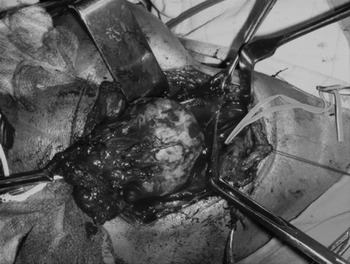
The dissection is preferably carried out using a ×3.5 magnification surgical loupe. After identifying the location of the important blood vessels and nerves in relation to the tumour, the mass is delineated on all sides. The proximal and distal ends of the nerve abutting the tumour are identified and meticulous sharp dissection is carried out, parallel to the axis of the nerve (minimising damage to collateral nerve fibres), until the cleavage plane between the tumour tissue and tumour capsule is reached. Once in the subcapsular plane, the tumour mass is carefully freed proximally, distally and from the sides, and then excised. Care is taken to minimise traction to the surrounding nerve fibres. The tumour is thus resected with preservation of the majority of nerve fibres (Figure 1).
Intra-operative view of the nerve-sparing subcapsular dissection technique showing the tumour being freed on all sides before being resected.

Results and analysis
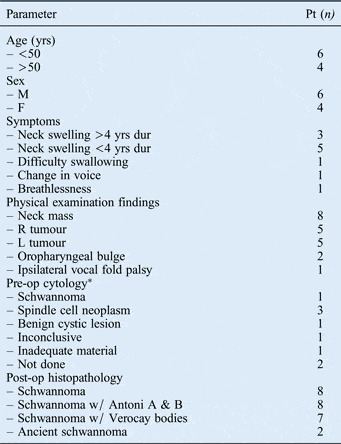
The study comprised 10 patients: 6 male and 4 female. Mean age was 43 years (range 14–73 years). Schwannomas involved the vagus nerve in six cases, the sympathetic chain in one case, the facial nerve in one case and the VIth cervical nerve in one case. Another patient had two lesions, involving both the vagus nerve and the sympathetic chain. The clinical picture at presentation is depicted in Table I.
Clinico-cytohistological schwannoma features

*One case had undergone debulking of tumour 16 years previously and post-operative histology was reported as schwannoma. Pt = patient; yrs = years; M = male; F = female; dur = duration; R = right-sided; L = left-sided; pre-op = pre-operative; post-op = post-operative; w/ = with
Pre-operative cytology was carried out in seven patients, but diagnosis of schwannoma was reported in only one case. For this one case, immunohistochemistry revealed a positive result for the S-100 protein, and negative results for cytokeratin and leukocyte common antigen. One patient had undergone debulking of a tumour 16 years previously and post-operative histology was reported as schwannoma.
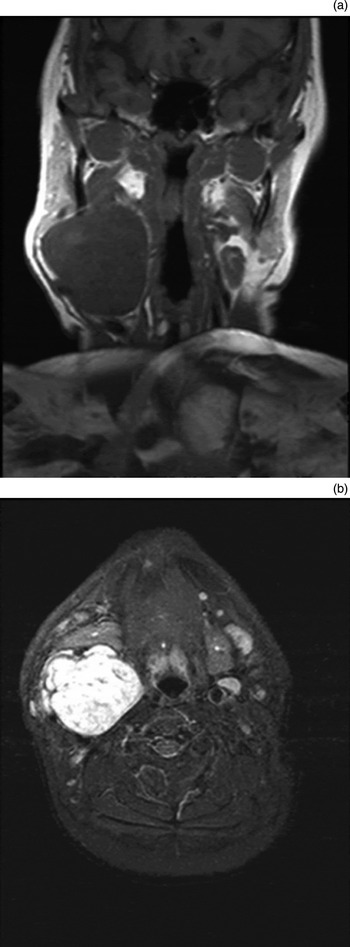
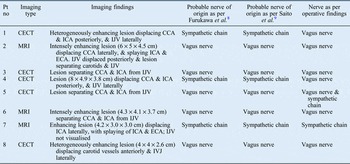
Pre-operative imaging involved contrast-enhanced computed tomography (CT) in five cases and magnetic resonance imaging (MRI) in the other five cases. Contrast-enhanced CT scans showed the lesions to be heterogeneously enhancing. Magnetic resonance imaging revealed the lesions to be hypointense on T1-weighted sequences and hyperintense on T2-weighted sequences (Figure 2). In one of the cases with parotid region swelling, MRI revealed swelling extending from the superficial lobe to the deep lobe of the left parotid, with hypointense signals on the T1-weighted sequence and intermediate signals on the T2-weighted sequence. In the cases of parapharyngeal schwannoma, the probable nerve of involvement was documented to be the vagus nerve in five cases and the sympathetic chain in three cases (as per imaging criteria described in the methods section). No discrepancy was noted between the two imaging criteria (Table II).
(a) Coronal T1-weighted magnetic resonance imaging (MRI) scan showing tumour hypointensity and (b) axial T2-weighted MRI scan showing hyperintensity in a patient with parapharyngeal schwannoma.

Nerve of origin evaluation data for parapharyngeal schwannomas

Pt no = patient number; CECT = contrast-enhanced computed tomography; CCA = common carotid artery; ICA = internal carotid artery; IJV = internal jugular vein; MRI = magnetic resonance imaging; ECA = external carotid artery
All patients underwent surgical resection which, besides cure, offered correct identification of the nerve of origin in the cases of parapharyngeal schwannoma. In two cases, the nerve of origin was different to that suggested by the imaging studies, involving the vagus nerve rather than the sympathetic chain in one case and vice versa in the other case. Surgical access to the tumours was obtained through a cervical approach with the incision placed in one of the upper neck creases. The modified Blair incision was used in one case of parotid schwannoma.
Histopathological analysis led to a diagnosis of schwannoma in eight cases and ancient schwannoma in two cases. All eight cases of schwannoma demonstrated Antoni A and B configurations. Verocay bodies were present in seven cases.
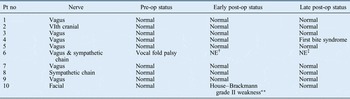
The findings of a post-operative functional evaluation of the VIIth, IXth, Xth and XIIth cranial nerves are depicted in Table III. None of the patients had permanent neural sequelae. The patient with two lesions (involving the vagus nerve and sympathetic chain), who presented with pre-operative vocal fold palsy, had a hypoxic cardiac arrest on the second post-operative day following a bout of vomiting and probable aspiration. In the late post-operative period, one patient diagnosed with vagal schwannoma developed features suggestive of ‘first bite syndrome’, which is characterised by excruciating pain in the parotid region after the first few bites of food. The patient with facial schwannoma had House–Brackmann grade II weakness in the immediate post-operative period, which subsequently resolved.
Neural function outcome*

* Outcome data for VIIth, IXth, Xth and XIIth cranial nerves following tumour excision using the nerve-sparing technique. †Patient had a hypoxic cardiac arrest on second post-operative day following a bout of vomiting and probable aspiration. ‡Patient expired. **Patient had tumour in the parotid region found (pre-operatively) to involve lower division of facial nerve. Pt no = patient number; pre-op = pre-operative; post-op = post-operative; NE = not examined
The median follow-up period was 36 months (range 6–60 months). No recurrence was observed in the follow-up period.
Discussion
Schwannomas are rare tumours, and clinical presentations reported in published series (which often comprise only a small number of patients) vary widely. In our study, there were more male than female patients, although predominance of either sex has been reported variably.Reference Zhang, Cai, Wang, Liu, Ye and Chen10–Reference Torossian, Beziat, Abou Chebel, Devouassoux-Shisheboran and Fischer13 Similarly, a wide age range has been reported in the literature, with the median age range being 30–50 years.Reference Zhang, Cai, Wang, Liu, Ye and Chen10, Reference Leu and Chang11, Reference Gilmer-Hill and Kline14 Vagal schwannomas often originate near the nodose ganglion; 9 out of 11 vagal schwannomas reported by Green et al. affected this region.Reference Green, Olsen, DeSanto and Scheithauer3 The cases described in the present study were generally in line with these features.
The classic schwannoma feature of compact groups of parallel spindle-shaped nuclei (Verocay bodies) were previously found to be present in only 37 per cent of cases.Reference Colreavy, Lacy, Hughes, Bouchier-Hayes, Brennan and O'Dwyer2 In our series, only one case with classic schwannoma demonstrated an absence of Verocay bodies on histopathology. Immunochemistry has been used to aid the diagnosis of these tumours where doubt exists in terms of the classic morphological features. The S-100 protein, which is a neural crest marker antigen present in the supporting cells of the nervous system, is an important diagnostic tool, as schwannomas show intense immunostaining for S-100.Reference Donnelly, Al-Sader and Blaney15 However, in cases of malignant tumours it may only be reactive in up to half of the cases.Reference Stefansson, Woolmans and Jerkovic16
In a series of nine patients, Furukawa et al. (1996) reported that pre-operative imaging revealed differences in the vessel displacement patterns caused by vagal and sympathetic chain schwannomas.Reference Furukawa, Furukawa, Katoh and Tsukuda8 These criteria were slightly modified by Saito et al. in terms of the described imaging features of parapharyngeal schwannomas.Reference Saito, Glastonbury, El-Sayed and Eisele9 In the current study, both criteria were equally efficient in diagnosing the nerve of origin. However, in two out of eight cases (involving either the Xth cranial nerve or sympathetic chain), both criteria failed to accurately identify the nerve of origin of the parapharyngeal schwannomas.
As schwannomas are benign, all efforts should be made to preserve nerve function so that quality of life is unaffected. Valentino et al. Reference Valentino, Boggess, Ellis, Hester and Jones6 considered neural deficits to be the result of tumour neuritis, and Russel and RubinsteinReference Russel and Rubinstein17 reported neural fibres within schwannomas to be the cause of such deficits, independent of the employed surgical technique. Various techniques have been described for removal of these tumours, including: tumour excision with neural sacrifice followed by primary anastomosis or neural graft interposition; tumour excision with neural preservation; tumour enucleation between adjacent healthy nerve fibres when possible; tumour emptying (preserving the tumour capsule); and even the ‘shelling out’ of the tumour (leaving gross tumour inside the capsule). The nerve-sparing subcapsular resection technique for schwannomas described in the current study potentially preserves the nerve fibres, without significantly compromising the nerve function as nerve continuity is maintained.
A literature review by Valentino et al. showed that the various surgical techniques offered different function preservation rates.Reference Valentino, Boggess, Ellis, Hester and Jones6 In those who underwent tumour excision without neural sacrifice, 64 per cent had permanent neural deficits, while 29 per cent had temporary deficits. Patients who had their tumours either enucleated or shelled out had a permanent neural deficit rate of 29 per cent and a transient deficit rate of 42 per cent. In those who underwent a shelling out procedure, 29 per cent had no neural deficits at all. In a review of relevant English language literature, de Araujo et al. found that only 31 enucleated schwannoma cases had been reported along with their neurological post-operative outcome.Reference de Araujo, Ramos, Moyses, Durazzo, Cernea and Ferraz18 Of these, 16 patients (51.6 per cent) had partial or complete functional preservation of the affected nerve. In their series of 22 patients, de Araujo et al. reported 10 patients who had undergone enucleation, with a neural function preservation rate of at least 70 per cent. In one of their cases, there was complete recovery of a previously paralysed vagus nerve following the surgical procedure. None of the patients in the current series suffered permanent post-operative neural sequelae. However, one patient with pre-existing vocal fold palsy suffered a cardiac arrest on the second post-operative day due to vomiting and probable aspiration. Another patient developed symptoms of ‘first bite syndrome’ with pain in the preauricular parotid region, which was managed conservatively using medication. A further patient diagnosed with facial schwannoma suffered House–Brackmann grade II weakness in the immediate post-operative period, which subsequently resolved.
• Removal of head and neck schwannomas with the associated nerves can cause significant neurological impairment
• This study reports 10 patients with head and neck schwannomas who underwent nerve-sparing subcapsular resection
• The technique gave excellent post-operative neural function results and tumour control
Incomplete excision may lead to slow local recurrence over a period of months to years.Reference Zbaren and Markwalder19 Torossian et al. reported two recurrences in a series of 15 cases with a median follow up of 4.1 years, which were attributed to the lack of microscopic dissection.Reference Torossian, Beziat, Abou Chebel, Devouassoux-Shisheboran and Fischer13 These recurrences occurred within one and two years following surgery. The affected patients were submitted to a new surgical procedure under microscopic view to enucleate the tumour, with good results. In their series of 22 patients, de Araujo et al. reported no recurrence in a median follow up of 1 year (range 1–54 months).Reference de Araujo, Ramos, Moyses, Durazzo, Cernea and Ferraz18 The technique described in the current study may be criticised for the possibility that a few tumour cells remain, with a remote chance of recurrence. As schwannoma is a benign, slow-growing tumour, any long-term recurrence can be dealt with by further resection. No recurrences were observed in our series with a median follow up of 36 months (range 6–60 months).
Conclusion
This single institution series reports 10 head and neck schwannoma cases for which a nerve-sparing subcapsular resection technique was utilised. This technique provided excellent post-operative neural function results and effective control of tumour pathology.