Malintzin, Malinche, Marina: indigenous woman, cultural intermediary, contested national symbol.Footnote 1 With her story told through many voices except her own, both imaginations and scholarly investigations have been captured by the question of who, exactly, Malintzin was (and continues to be). Like many Nahua pre-/early teen girls, Malintzin was drawn into the indigenous slave trade during the Mexica's expansion into her home region of Coatzacoalcos, from which she was taken to the trading port of Xicallanco and sold to some Maya.Footnote 2 Years later, Malintzin was one of twenty indigenous women Maya rulers of Potonchan presented to Hernando Cortés in 1519 – along with other gifts of food, gold, and apparel – as part of an indigenous ‘diplomatic strategy’ aimed at ensuring an amicable working relationship with the European strangers.Footnote 3 Malintzin was quickly baptized as ‘Doña Marina’, and – like the other nineteen women – given as a concubine to a Castilian captain, Alonso Hernández Puertocarrero.Footnote 4 Upon Puertocarrero's return to Spain, Malintzin became tied to Cortés, later carrying his child. The Castilians recognized her intelligence and linguistic aptitude, and for the remainder of the conquest of Mexico Malintzin served as one of the Castilian expeditions’ principal interpreters, informants, and cultural advisers.Footnote 5 The profoundness of Cortés and Malintzin's connection becomes increasingly evident when we consider that some indigenous people often called them both by the same name – ‘Malintzin’.Footnote 6
Though often neglected or ignored in European accounts – Cortés merely acknowledges Malintzin as ‘my interpreter, who is an Indian woman’ – this closeness is portrayed throughout sixteenth-century, indigenous-authored pictorial depictions of the first encounters in Mesoamerica.Footnote 7 Fitting with this broader trend, the indigenous tlacuiloque, or painter-scribes, of the Lienzo de Tlaxcala (c. 1552) chose recurrently to place Malintzin in the company of Cortés, as she mediates the unfolding cultural encounters. This source's value for tracing mid-century, indigenous perspectives is significant, especially as the Lienzo presents a second, particularly unique portrayal of Malintzin – one not found in other pictorial records. Here, we find Malintzin not only negotiating between European and indigenous leaders, but amidst battles in the Aztec capital of Tenochtitlan, sometimes even wielding a European-style shield and sword. For the Tlaxcalan authors of this Lienzo, Malintzin's identity was intricately connected to conflict and violence: she was not only a peaceful intermediary operating in non-violent spaces, as we see in so many other pictorials, but a warrior.Footnote 8
Unique to the Lienzo, Malintzin-as-warrior offers a window into a more nuanced, complex understanding of Malintzin's perceived identity, as well as the Tlaxcalteca's vision of the events of conquest more broadly. In the effort to foreground ‘lost’ indigenous accounts and stories, the growing movement of New Conquest History is successfully returning agency to Native Americans, and reflecting the intricacy of the multiple and diverse narratives that constitute the history of the conquest.Footnote 9 Understanding why the Tlaxcalan tlacuiloque may have chosen to present Malintzin as a warrior contributes to this wider scholarly pursuit: as a warrior, what does this version of Malintzin symbolize or embody? What did Malintzin mean to the city of Tlaxcala and the indigenous individuals – the real people – who authored the Lienzo?Footnote 10
In this article, I argue that combative representations of Malintzin demonstrate that her role as a mediator was not always a peaceful role separated from scenes of warfare, and one not mutually exclusive with violence – at least for the indigenous authors of the Lienzo. Depicted holding shields and/or swords, portrayals of Malintzin as a warrior woman strongly challenge the reductive dichotomy of ‘peacefulness, mediation, female: violence, warfare, male’ as a framework of analysis, and give fresh insights into mid-century perceptions of her role and identity. Importantly, this article contextualizes the authors of the Lienzo's depictions of Malintzin as a warrior within the wider entanglement of female figures with violence and warfare, who reflect the possibility that one could be both a woman and a warrior. To understand these representations of her persons in the Lienzo, I explore their connections to the Hispanic and Mesoamerican pasts, considering what precedents may have influenced such portrayals of Malintzin as a warrior. In this way, I examine the tlacuiloque's possible conceptualizations of Malintzin in both Christian and indigenous terms.Footnote 11 Before exploring Malintzin's connection to warrior women found in Mesoamerican mythohistory, we will turn first to the parallels drawn between Malintzin and the Virgin Mary. Whilst Malintzin's connection to the Virgin Mary has been well established in scholarship in terms of their dominant, shared identities as powerful female intercessors, I argue that their connection can be strengthened by recognizing how Malintzin may have also shared in Mary's role as a conquistadora or conqueror in the minds of the Lienzo's tlacuiloque.
The article will therefore reflect on the Tlaxcalan portrayal of Malintzin-as-warrior as a significant chapter of Malintzin's story, which – like for so many indigenous women – we can only learn about through voices other than her own.Footnote 12 Although we will never know if Malintzin really held a sword and shield amidst the battle fray, or if, indeed, this is one of many mid-century inventions of the Tlaxcalan tlacuiloque, the existence of this unusual representation of her person should not be ignored. There are multiple stories intricately intertwined when it comes to Malintzin's identity, which is perceived so differently between tlacuilo to tlacuilo, and from region to region. Through a deconstruction of the Lienzo's Malintzin-as-warrior imagery, this article critically assesses why the Tlaxcalan tlacuiloque may have created such a unique vision of this woman in-between, and highlights the complexity of mid-century perceptions and representations of her role(s) in the conquest. Further, this tale of the conquest presents key insights into indigenous perceptions of the events that unfolded: foregrounding the Tlaxcalan tlacuiloque's narrative, this article contributes to the wider, critical deconstruction of triumphalist, Eurocentric narratives of conquest, as sought by the revisionist New Conquest History, with the Tlaxcalan's Malintzin occupying such a central, formidable position as conquistadora.
I
Like many indigenous-authored records of the conquest, the Lienzo de Tlaxcala was produced decades after the conquest itself; it provides vital insights into mid-century perspectives of the arrival of the European newcomers, and how the events from 1519 to 1521 were perceived by their indigenous authors. Painted in the form of writing and record-keeping used by indigenous groups of Central Mexico before the conquest, post-conquest pictorials are largely seen as the most ‘authentic’ or ‘purest’ sources in terms of indigenous perspectives, though must still be read critically and carefully.Footnote 13 The Lienzo de Tlaxcala details the history of the Tlaxcalteca's encounter with the Castilians, as remembered – or as desired to be remembered – in c. 1552. Measuring 2 metres across by 5 metres tall, this event-oriented painted cloth is composed of eighty-seven scenes of the conquest, chronologically arranged in a grid-like pattern, beginning with the formation of the Tlaxcalan rulers’ relationship with Cortés, and highlighting the significance of their role in the conquest of Mexico.Footnote 14 Perhaps the most famous group of the indios amigos or Indian conquistadors, the Tlaxcalteca produced the Lienzo de Tlaxcala – as well as its much smaller antecedent, the Texas Fragment or Tizatlan Codex (c. 1540) – as evidence of their amity with the Castilians during the conquest.Footnote 15 It is generally understood that the document acted as a pictorial ‘petition’ designed to support their request for rights during the new colonial era, and, accordingly, the indigenous tlacuiloque ‘edited’ the events of the Lienzo at various points in order to strengthen their case.Footnote 16 This is evident from the very beginning of the Lienzo: the tlacuiloque chose to omit completely the Tlaxcalteca's immediate, hostile reception of the Castilians, as this would not support their intended narrative of amity. We learn of the bloody clashes on Tlaxcala's eastern frontier in September 1520 from other indigenous-authored pictorials, such as the Huamantla Roll. Footnote 17
Whilst the earlier Texas Fragment is extant, the Lienzo only survives through tracings and a carefully coloured copy taken from the original cloth(s). These tracings were developed into a facsimile of the Lienzo in 1892 by Alfred Chavero; unfortunately, since the facsimile's publication, the tracings have also been lost. The Chavero edition is usually taken as the ‘best’ source of information on, or representation of, the sixteenth-century Lienzo, in combination with other commentaries; following the careful work of other scholars, it is the Chavero edition I have used in the following analysis.Footnote 18 There have been excellent scholarly efforts to regain distance to the original Lienzo, though, most recently in the ever-growing field of digital humanities: notably, the Mesolore project – created by Liza Bakewell and Byron Hamann – digitally recreates the Lienzo, based on the tracings preserved in the 1892 facsimile.Footnote 19 Travis Barton Kranz is a leading authority on the development of the Tlaxcalan pictorials, and, in line with his efforts to trace how the various Tlaxcalan tlacuiloque present the conquest events in and from the Texas Fragment, to the Lienzo, and to the later Descripción de la ciudad y provincial de Tlaxcala de la Nueva España by Tlaxcalan historian Diego Muñuz Camargo in c. 1580–5, the following analysis identifies points of change between the 1540 and 1552 manuscripts.Footnote 20
Departing from the Texas Fragment, the authors of the Lienzo de Tlaxcala interpreted Malintzin as both a mediator and a warrior, reflecting the fluidity of her representations within a given text and, more widely, across different manuscripts. There are, though, certain visual strategies many different tlacuiloque utilized to reflect Malintzin's significance in their telling of events: indigenous authors usually position her between the two parties, speaking on behalf of Cortés/the Castilians and indigenous nobles, or, alternatively, to the side of or slightly behind Cortés, sometimes mirroring him directly. Numerous tlaquiloque emphasize the centrality of Malintzin's role further by depicting her as equal to or larger than Cortés and the indigenous nobles, and by constantly presenting her in scenes of dialogue and negotiation, often gesturing or pointing.Footnote 21 Moreover, the painter-scribes often adorn Malintzin in both indigenous and Castilian attire, with her outward appearance strongly reflecting her ‘in-between’, intercessory identity. Accordingly, in scenes of the Lienzo de Tlaxcala, as in the Texas Fragment, Malintzin can be quickly identified by her pink huipilli (long blouse or shift), European-style shoes, her proximity to Cortés, and her varying hand gestures (all indicative of an act of conversation/translation).
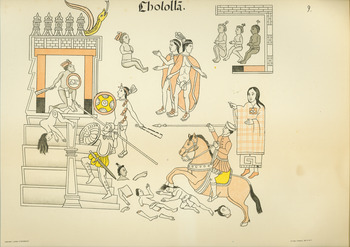
In addition to the dominant presentation of Malintzin as a cultural intermediary, the tlacuiloque of the Lienzo de Tlaxcala depict her amid battle scenes in Tenochtitlan, even bearing arms. These militant portrayals are the focus of the following analysis, which demonstrates the deeply complex nature of indigenous representations of her role and identity. The tlacuiloque's recording of the Cholula massacre (October 1519) is the first violent scene in which Malintzin is present (Figure 1). According to Castilian accounts – principally that of Cortés – Malintzin supposedly uncovered a plot to kill Cortés and his men, and it was her information that led to this bloody episode, where thousands of Cholulteca were slaughtered by Tlaxcalan and Castilian forces. In the years following the massacre, Malintzin has consequently been accused as a traitor and informant – a negative and damaging characterization that gained particular currency around/following the time of Mexican independence in 1821, to which we will later return.Footnote 22 In their portrayal of the massacre, the Tlaxcalan tlacuiloque position Malintzin to the right of the scene, larger than the mounted Castilian conquistador below her, who tramples over dismembered bodies of Cholulan citizens at the foot of the temple of Quetzalcoatl. With her hand outstretched in a pointed gesture, this pictorial scene likewise suggests that the Tlaxcalan authors saw her involvement in the attack as significant.
Scene 9, Lienzo de Tlaxcala. Homenaje á Cristóbal Colón, Lienza 9. Fray Angelico Chavez History Library/New Mexico History Museum, Bourne Collection 972 MexH. Reproduced with permission.

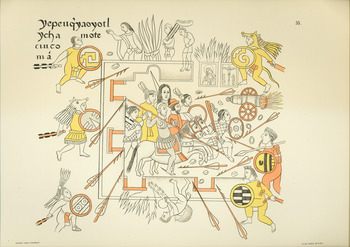
Moving to the fourteenth scene, the tlacuiloque make Malintzin clearly identifiable in the battle fray by way of her brightly coloured huipilli, and again by her large size, which dwarfs that of the Castilians. Positioned to the far left within the palace walls, Malintzin's right hand is held at the centre of her chest in a pointed gesture – perhaps a subtler suggestion of her commanding position than an outstretched arm. Amidst the shooting of arrows, hurling of stones and canon fire, Mexica bodies lie dismembered and gushing blood on the floor. Her presence amongst the allied forces continues in the following scene and scene 21, where the Tlaxcalan authors paint her as the tallest of the figures; in the latter, they again depict Malintzin with her hand raised in an instructive, pointed gesture.
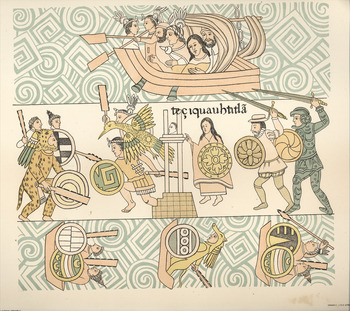
It is in scene 22 of the Lienzo where Malintzin's more militant portrayal becomes particularly remarkable. Like the preceding scenes, Malintzin – in another ornate huipilli – is taller than the allied forces she is accompanying; the tlacuiloque stand her to the far left, behind the forces to the left of and below her. Rather than pointing, however, Malintzin protects herself with and wields a European sword. Her static stance leaves ambiguity with regards to whether she is acting in the physical defence of her person or in an attacking capacity; however, through the possession of weapons, the tlacuiloque's perception of Malintzin's role in battle has recognizably progressed from one limited to guidance and instruction to that of a more active participant. In scene 26, Malintzin is again found amongst the allied forces, and is most likely the carrier of a European shield positioned to her left; in scene 45, Malintzin also carries a European shield (Figure 2). This latter scene records the beginning of the allies’ assault on Tenochtitlan, and it is here where Malintzin's roles as both mediator and warrior collide for the tlacuiloque: whilst placing a shield in her left hand, they present Malintzin's right arm outstretched, her hand in a pointed gesture. Significantly, Malintzin occupies a central position on the causeway, situated between the leading Tlaxcalan warriors (in front of her) and the Castilian forces (behind her). Just as the causeway on which she is stood connects the two places, this militant representation of Malintzin concurrently reflects the tlacuiloque's perception of her as a mediator, as a bridge between cultures.Footnote 23
Scene 45, Lienzo de Tlaxcala. Homenaje á Cristóbal Colón, Lienza 45. Fray Angelico Chavez History Library/New Mexico History Museum, Bourne Collection 972 MexH. Reproduced with permission.

II
A powerful intercessor; highly skilled in dialogue and mediation; and a conduit connecting different peoples, the associated qualities of Malintzin as a woman in-between mirror those of the Virgin Mary. When exploring the wider context for the assimilation of the two female figures of Mary and Malintzin in indigenous worldviews, the presence of the Virgin in moments of early encounter quickly becomes apparent, in both pictorial sources and European accounts. The Huexotzinco Codex contains one of the earliest surviving images of Mary authored by indigenous peoples: appearing on a highly ornate war banner created by the city state or altepetl of Huexotzinco for the conquistador Nuño Beltrán de Guzmán, this image of Mary appears in the record of the excessive tribute demanded from the Huexotzinca by Guzmán in 1531.Footnote 24 Indigenous relationships with Mary were complex, to say the least. Though Cortés records how the indigenous ‘idols’ from the Templo Mayor were ‘taken from their places [by Europeans] and thrown down the steps…[and Cortés] had images of Our Lady and of other saints put there’, the indigenous authors of the Nahuatl text and the pictorial scenes recording the conquest in the Florentine Codex do not mention or include Mary at all.Footnote 25 As Amy Remensnyder, among others, suggests, it is understandable that Bernardino de Sahagún's Nahua informants would not have wanted to associate ‘Our Precious Mother’ with memories of the ruin of their home, Tenochtitlan.Footnote 26 Elsewhere, indigenous communities often utilized images of Mary to build relationships with the Castilians, even in less amicable circumstances, further demonstrating the complexity of indigenous responses to this female figure. As scholars exploring Marian religious syncretism have highlighted, it is no coincidence that Nahua devotions to different Marian cults were often established on the sites of native deities, like that of the Virgin of Guadalupe and the autochthonous goddess Tonantzin, reflecting how indigenous communities integrated Mary into their worldviews.Footnote 27 Perhaps her figure even offered them an anchor in ‘the swirling madness’, to borrow from Rolena Adorno, of indigenous gods and the Christian new.Footnote 28
With both Mary and Malintzin perceived to occupy an in-between space, to act as facilitators of cross-cultural dialogue, indigenous representations of these women follow strikingly similar pathways, and the two intercessors’ identities may have even merged in indigenous understandings. As Townsend highlights, at each place the Castilians paused, a priest would give an introduction to Mary, accompanied by the ceremonious presentation of her image to the community, but it was Malintzin who translated the priest's words.Footnote 29 Indeed, it would be unsurprising if the blurriness of the early contact situation produced confusion between Malintzin, who spoke about Mary, and Mary herself, the subject of Malintzin's addresses.Footnote 30 Furthermore, Townsend suggests that indigenous peoples may have understood the corporeal Malintzin to be a ceremonial god impersonator for the Virgin – clearly a very powerful deity of the Castilians – or perceived her to act as Mary's representative, especially considering the likeness of their reverential names.Footnote 31
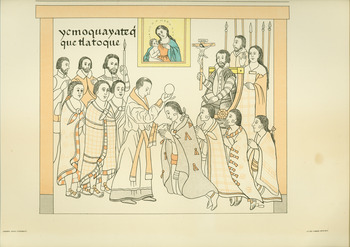
In studying the wider context for the assimilation of Mary and Malintzin, then, their similarities as intercessors have been relatively well established. Returning specially to the Lienzo de Tlaxcala, Federico Navarrete proposes that Malintzin's identity becomes intertwined with that of the Virgin Mary through the ways in which the tlacuiloque connect her with Christian symbols: in the only two scenes in which she features but does not occupy a central position, the Tlaxcalan authors replace Malintzin with a cross, in the first instance, and with an image of the Virgin Mary in the second.Footnote 32 Indeed, in scene 5, a large crucifix is the central focus, with Malintzin – only her face, partially hidden by a banner – found to the left. In front of the crucifix, Cortés holds the wrist of one of the Tlaxcalan nobles, who gestures to him in speech. In scene 8, the tlacuiloque record the conversion of the four Tlaxcalan lords to Christianity (Figure 3). Here, as the lords kneel before a priest, the tlacuiloque give Malintzin's hand a pointed gesture, but displace her to the right of the ceremony, which is instead overseen by a centrally placed image of the Virgin.
Scene 8, Lienzo de Tlaxcala. Homenaje á Cristóbal Colón, Lienza 8. Fray Angelico Chavez History Library/New Mexico History Museum, Bourne Collection 972 MexH. Reproduced with permission.

For the Lienzo's tlacuiloque, the inclusion of these Christian symbols was part of a wider strategy to reflect their allegiance to the European newcomers, similar to their incorporation of European symbols of political power, such as the coat of arms and royal regalia in the main scene of the Lienzo (where the tlacuiloque also place an image of Mary).Footnote 33 Indeed, Kranz examines how the Tlaxcalan pictorials ‘changed over time to emphasize the claim that they had converted to Christianity soon after the first encounter with the Spaniards’: whilst the authors of the Lienzo include the crucifix in scene 5 of the Lienzo, it does not appear in the equivalent scene of the older Texas Fragment, and, significantly, there is no evidence of an early baptism of the four Tlaxcalan lords in pre-mid-century sources.Footnote 34 However, the Christian symbols have an important function in this document, despite their likely mid-century invention. As Navarrete proposes, Malintzin is displaced only by the crucifix and image of Mary because, for the tlacuiloque, these symbols have the capacity to fulfil an intermediary role, too; the devotion to Christianity that is embodied in these images allows for mutual understanding and alliance between the Tlaxcalteca and the Castilians.Footnote 35 For the Tlaxcalan authors, Malintzin – Doña Marina – may have similarly represented an embodiment of their shared faith.
Indigenous associations of Malintzin with symbols of Christianity can be identified in other pictorials produced by indigenous communities more widely, too, perhaps for similar reasons. The authors of the Mapa de San Antonio Tepetlan, for example, position Malintzin next to Christian churches, whilst in the Codex Coyoacán (or Manuscrito del aperreamiento, c. 1560) the tlacuiloque depict her grasping rosary beads, signifying conversion, and – like the Lienzo – adorn her in an indigenous huipilli and European shoes.Footnote 36 In these examples, however, Malintzin still occupies a central position; the authors do not displace her with symbols as they do in the Lienzo. The reason behind this nuance is not clearly identifiable, but her total displacement by the Lienzo's tlacuiloque is perhaps linked to the Tlaxcalteca's particularly vehement devotion to the Virgin: Mary was later made the patron of the province, assuming the intercessory role once occupied by Malintzin.Footnote 37 Speaking on behalf of the Castilian and indigenous groups, Malintzin's role as cultural intermediary is certainly analogous to that of the Virgin as an abogada, a lawyer negotiating with God for her worshippers.Footnote 38 Notably, then, Malintzin's connection to Mary formed an essential aspect of the Tlaxcalteca's negotiations with the Castilians in the post-conquest world. As will now be examined, I argue that this connection is further understood – and strengthened – by the Tlaxcalan tlacuiloque's portrayal of Malintzin as a warrior.
III
In contrast to the trope of Mary as a mediator, there was a different image of Mary in Mesoamerica's religious spaces, too: Mary as a warrior or conquistadora.Footnote 39 This martial Mary was born in medieval Iberia, where, from the eleventh century onwards, she was as much a patron of the Reconquista or Reconquest as St James (Santiago), Isidore of Seville, and other male military saints were.Footnote 40 Mary appeared prominently on battle standards, she was invoked during battlefield prayers, and her presence on the frontier was so strongly felt by those fighting she almost became a military conqueror herself.Footnote 41 Indeed, in 1272 Alonso X even founded a Marian military order, Santa María de España (St Mary of Spain), which fought in Mary's name ‘against the nefarious Saracens…and for the faith’.Footnote 42 Moreover, Mary as military leader was summoned across Europe in efforts to wage war against non-Christians: even in the small English village of Denby, there are stories that crusaders visited the small church of St Mary on their way to the Holy Land, to pray for her aid and protection.Footnote 43 In Iberia, the Virgin's presence on Christian borderlands did not stop at the battlefield; once a region was reconquered, Mary played an important role in the conversion of religious space. As Remensnyder has shown, from the Christian victory at Toledo (1085) to the Fall of Granada (1492), twenty-six mosques were rededicated to the Virgin Mary, reflecting how non-Christian sacred architecture could be usurped by the presence of Mary's image.Footnote 44 Indeed, there was ‘no other holy figure to whom so many mosques were dedicated’ than Mary, the most famous perhaps being the conversion of the main mosque at the Alhambra Palace.Footnote 45 In agreement with Angus MacKay, ‘the late medieval frontier was a Mariological one’.Footnote 46
By the Fall of Granada, Mary's image as la Conquistadora or the Lady Conqueror was secure. As late fifteenth-century art reflects, the Virgin was often depicted as protector of Ferdinand and Isabella, the Catholic monarchs who led the final part of the Reconquista, using her cloak to shield them from onslaught of demonic forces and other evils.Footnote 47 The artistic trope of Mary's cloak of protection was developed over the course of the sixteenth century to shelter the leaders of the imperial enterprise in the Americas, too: as the painting The Virgin of the Navigators by Alejo Fernández (c. 1536) shows, Mary's mantle was perceived to protect conquistadors such as Christopher Columbus and Amerigo Vespucci, as well as Spanish ships of discovery.Footnote 48 Accordingly, Linda Hall identifies how ‘in a real sense, [Columbus's] mission was a continuation, both spiritually and spatially, of the Spanish Reconquest of the Peninsula’ – a notion now well established in Marian scholarship.Footnote 49 Columbus named the second island he reached on his first voyage ‘Santa María de la Concepción’, whilst the ship he later lost on the reef was also named Santa María.Footnote 50 Both Hall and Remensnyder have examined how Cortés continued the Reconquista tradition from Spain by rededicating indigenous temples to Mary on his way to Tenochtitlan – and in those of Tenochtitlan itself – reflecting how the Virgin continued to play an important role in the appropriation of non-Christian religious space.Footnote 51 Certainly, Mary continued to appear on the conquistadors’ battle standards in the Americas, as the indigenous-authored Huexotzinco Codex demonstrates.Footnote 52 Importantly, this idea that a mother could also embody a warrior would not have been an unusual idea for Nahua groups, for, in Mesoamerican thought, mothers in childbirth were transformed into warriors.Footnote 53 The battle of delivering a child highlights how notions of motherhood and warriorhood were certainly not mutually exclusive in indigenous worldviews.
Since Marian scholars have scrutinized Mary's complex role as a mother and mediator and simultaneously established her as a warrior, it is essential to draw this idea of Mary's warriorhood into scholarly considerations of the intertwinement of Mary and Malintzin's figures. Not only does this provide a more nuanced understanding of Malintzin – especially Malintzin as portrayed by the Tlaxcalan tlacuiloque – but of Mary, too. The Lienzo de Tlaxcala's unique images of Malintzin as a warrior only strengthen Malintzin's connection to Mary, in Mary's roles as both abogada and la Conquistadora. Considering the tlacuiloque's portrayal of Malintzin as a warrior in scenes of cross-cultural conflict alongside the understanding of Mary as la Conquistadora allows for a fresh interpretation of the Tlaxcalan's pictorial representations of Malintzin.
Returning to scene 9 of the Lienzo, the tlacuiloque's depiction of Malintzin in the Cholula massacre accordingly takes on additional meaning (Figure 1). By keeping Malintzin's connection to Mary as la Conquistadora in the foreground, this scene can arguably be read as one where Malintzin is overseeing the violent conquest of the religious space of the temple of Quetzalcoatl – just as Mary oversaw the conquest and conversion of non-Christian religious spaces. Arguably, then, this portrayal of Malintzin by the Tlaxcalan tlacuiloque is not necessarily simply fulfilling the Castilian narrative of Malintzin-as-informant, and instead speaks to her identity as a conquistadora. Developing Jeanne Gillespie's argument that the mounted conquistador below Malintzin represents Santiago Matamoros – an embodiment of the Tlaxcalan's ‘true’ Christianity – Malintzin-as-Mary was a further means by which the tlacuiloque could justify the conquest in Christian terms.Footnote 54 The connection the tlacuiloque make between Malintzin, Mary, and the Christian religion here is strengthened by the contrasting nature of this scene to the one preceding it (scene 8): the conversion of the Tlaxcalan lords to Christianity (Figure 3).
Significantly, this reading contributes to the wider deconstruction of Malintzin's supposed role in the massacre. Notably, historians theorize that the massacre was ‘engineered’ by the Tlaxcalteca, both to test their new alliance with the Castilians and to punish the Cholulteca, who had recently abandoned their alliance with Tlaxcala for loyalty to Tenochtitlan.Footnote 55 This theory interlinks with the substantial effort to deconstruct and critique the post-1821 scapegoating of Malintzin as a traitor and whore, as a symbol of domination by outsiders, which sprung from her role in the massacre, and the conquest more broadly. From the 1970s onwards, revisionists have re-envisaged her as a victim, as a survivor, and as a woman with agency.Footnote 56 ‘Blame’ for the events has been examined from different angles (if anyone were to ‘blame’, surely it would be the Tlaxcalan forces?), especially in terms of misogyny, and the term ‘traitor’ interrogated (how could Malintzin be a traitor to the Mexican nation before it even existed?).Footnote 57 Alongside the Tlaxcalan's generally ‘favourable’ portrayal of Malintzin as a converted noblewoman, this reading of Malintzin as a conquistadora complicates the story of the massacre further, highlighting the interplay of multiple narratives.Footnote 58 Though the massacre was likely a result of complex indigenous political affairs, the Lienzo's mid-century telling also reveals religious tensions, or, perhaps more accurately, how the Tlaxcalan tlacuiloque may have used religious tensions to represent a much broader truth.
The tlacuiloque's strategy to emphasize the Tlaxcalan alliance with the Castilians through the differentiation of themselves and their non-Christian neighbours through religion is clear: placing the conversion scene immediately before that of the massacre, which took place on the steps of a non-Christian temple, is a powerful juxtaposition. Similarly, we can look to the contrast the authors draw between the conversion scene and that directly below it. In this scene (15), the tlacuiloque position Malintzin in the battle fray, alongside a second image of the Virgin and child, and a third of a crucifix, in the top right of the scene (Figure 4). Here, the Christian images burn within the walls of Tenochtitlan, representing the Mexica's refusal to welcome Christianity. Considering Malintzin's large size – dwarfing the figures around her – and pointed hand gesture, her figure seems formidable in contrast to the small, damaged image of the Virgin. In development of Navarrete's work, whilst the Lienzo's authors displace Malintzin in favour of Christian symbols in earlier scenes, I argue that scene 15 offers a displacement of Mary's image by Malintzin. Her ongoing presence in scenes of violence after this arguably strengthens the notion that for the Tlaxcalan authors Malintzin came to embody the Virgin, as she watches over the military efforts of the allied forces, offering guidance and instruction. Combined with later scenes in which she bears weapons, her role in combat in scene 15 convincingly reflects her appropriation of the Virgin's identity of la Conquistadora, with Mary herself burnt away.
Scene 15, Lienzo de Tlaxcala. Homenaje á Cristóbal Colón, Lienza 15. Fray Angelico Chavez History Library/New Mexico History Museum, Bourne Collection 972 MexH. Reproduced with permission.

Whilst this understanding of Malintzin as a conquistadora strengthens previous scholarly interpretations of Malintzin's and Mary's connections, it also challenges structural analyses of the Lienzo, which have largely overlooked Malintzin's presence in violent scenes. Byron Hamann has suggested that the Lienzo de Tlaxcala can be divided into two distinct parts, and, significantly, constructs this argument using Malintzin's appearances. According to Hamann, the first half of the Lienzo (up to and including scene 29) reflects a focus on dialogue and intercession, whilst the second half (after scene 29) is dominated by warfare.Footnote 59 All but two of Malinztin's appearances are on or before scene 29, and, accordingly, Hamann argues her (dominant) position as cultural intermediary reflects this corresponding change from peace to violence.Footnote 60 These two halves are reflective of the developing contact situation: the first is characterized by images of Malintzin – who personified Mary – and the second by that of a mounted conquistador leading his fellow Castilians and Tlaxcalteca into battle – an incarnation of Santiago Matamoros.Footnote 61 Taking this spatial analysis of the Lienzo further, Hamann proposes that the structure is thus heavily gendered: the first half of the Lienzo is peaceful, filled with dialogue and negotiation, under the patronage of the Virgin – seemingly presented as the ‘feminine’ half – whilst the second half, under the patronage of Santiago, is dominated by warfare – accordingly, the ‘masculine’ half.Footnote 62
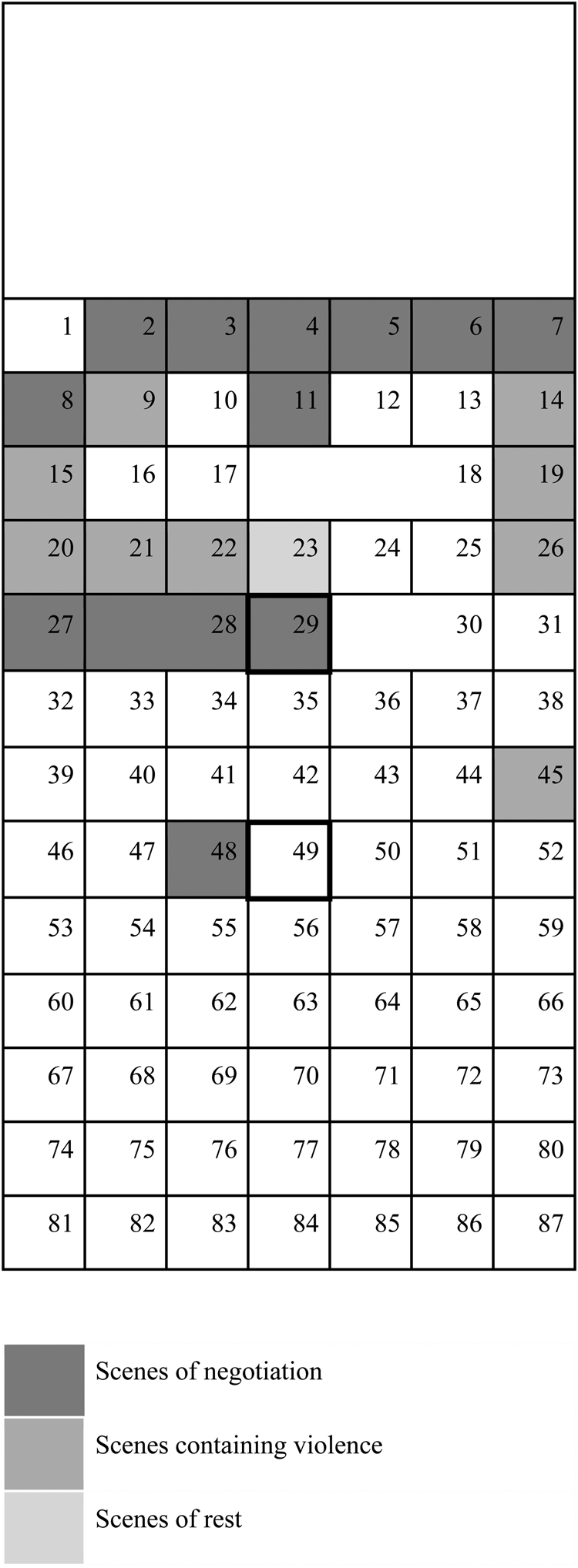
This gendered analysis is unarguably fitting on a visual level; the tlacuiloque do paint Malintzin in twenty of the first twenty-nine scenes and only twice more after scene 29. Despite her continued participation in the following events, scenes 30–87 are contrastingly dominated by the male figure of the mounted conquistador. However, the complexity of the gendered roles of female interpreter and male warrior that such structural analyses present needs to be interrogated, as a closer examination of the Tlaxcalan authors’ representations of Malintzin reveal. Although the tlacuiloque present Malintzin in her main capacity as negotiator in twelve of the twenty-three scenes in which she appears, this article has established that her position as principle interpreter was not always a peaceful role separated from scenes of warfare for the authors of the Lienzo.Footnote 63 The tlacuiloque paint her in violent battles in six of the remaining ten scenes in which she appears, where she can be identified among the allied forces – significantly, on some occasions, holding a European sword and/or shield – and feature her in other scenes containing violent acts, like that of the massacre (see Figure 5).Footnote 64
Malintzin in the Lienzo de Tlaxcala.

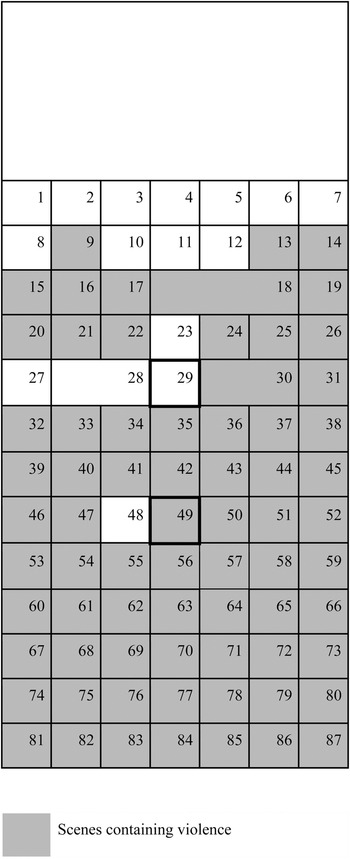
Hamann offers a deep and insightful deconstruction of the Lienzo's spatial layout – much of which I am in agreement with – but the neglect of these more militant representations of Malintzin provides an incomplete story of Malintzin's identity, as perceived by the creators of the Lienzo. Further, the dichotomy of peace and mediation/violence and warfare subsequently assigned to the Lienzo does not reveal the full depth and complexity of this pictorial more widely, even setting aside the accompanying gendered connotations. Though the second part of the Lienzo is essentially dominated by scenes of warfare, depictions of violence (including battles, attacks, killings, and depictions of dead bodies – some in pieces and/or bloodied) are present in thirteen scenes before scene 29, and, moreover, in twenty-seven scenes before scene 48 (Malintzin's last appearance), albeit formatted less schematically (see Figure 6). The tlacuiloque's portrayal of Malintzin as a conquistadora complicates the overall structure of the Lienzo, then, in a way that strengthens readings foregrounding her connection to the Virgin Mary; challenges the reductive dichotomy of ‘peacefulness, mediation, female: violence, warfare, male’ as a framework of analysis; and supports broader deconstructions of the Tlaxcalan tlacuiloque's use of Christian figures and symbols to reflect their amity with the Castilians.
Scenes containing violence in Lienzo de Tlaxcala.

Of course, influences closer to home, not from across the Atlantic, should also be drawn into this new understanding of the Tlaxcalan tlacuiloque's Malintzin. Significantly, whilst portrayals of Malintzin as a warrior are unique to the Lienzo de Tlaxcala, women as warriors are found in the Mesoamerican past and power structures more widely. Examining the duality of Malintzin and Cortés in the Lienzo, Jeanne Gillespie argues that the authors may have conceived of Cortés as the tecuhtli or lord, and Malintzin as cihuacoatl or woman-snake – the ‘prime minister’ who negotiated and advised, but was also a warrior. Usually a position occupied by men, the cihuacoatl would dress as/impersonate a woman; Malintzin, in this interpretation, would wield significant political power, and would also represent the first instance of the cihuacoatl as a woman (rather than a female impersonator).Footnote 65 In agreement with Gillespie, this is one way in which the Tlaxcalan tlacuiloque may have justified the success of the conquest in indigenous terms.Footnote 66
There have been cases of women fighting in battles in the Mesoamerican past, too. Toltec and Tepanec women were said to have fought alongside male warriors in the 1008 civil war and the 1428 battle against the Tenochca army, respectively, for example.Footnote 67 Later, when Tlatelolco was attacked by forces from Tenochtitlan in 1473, the (losing) king of Tlatelolco sent women and young boys into battle. Diego Durán records the incident:
A large number of women were gathered, stripped of their clothing and formed into a squadron. They were made to attack the Aztecs who were fighting furiously. The women, naked, with their private parts revealed and their breasts uncovered, came upon slapping their bellies, showing their breasts and squirting milk at the Aztecs.Footnote 68
There is some ambiguity between accounts recording this curious incident of Aztec mythohistory, even within Durán's work: the accompanying pictorial differs notably from the textual narrative, depicting the women throwing brooms, spindle whorls, and other domestic utensils from a rooftop.Footnote 69 Though such missiles may seem improvised, in Mesoamerican worldview these items – ‘supremely feminine symbols’ – carry notable significance as tools of feminine power.Footnote 70 Importantly, women balanced both creative and disruptive forces: it was women's responsibility to turn unfinished materials (e.g. fibres, foodstuffs, sexual secretions) into finished products in everyday life, yet, as well as this creative capacity, women were ‘imbued…with the inherent potential for disruption’ due to their ‘connection to chaotic energy of the earth’.Footnote 71 Taking up their brooms, women would defend their households against ‘invading’ dirt or other manifestations of disorder, and in doing so maintain the necessary balance of order and disorder – an action especially important at times of war.Footnote 72 With the broom in her hand, a Nahua woman ‘stood at the intersection of chaos and order’, with the broom itself both a transporter of filth or tlazolli and a means for purification, as Louise Burkhart convincingly demonstrates.Footnote 73 That the broom was perceived as a weapon is reflected clearly in the festival of Ochpaniztli, or ‘Sweeping the Roads’, where warriors used brooms in lieu of swords in mock battles performed in the streets.Footnote 74 The festival celebrated Toçi or ‘Our Grandmother’, a benevolent mother goddess, who, with spindle whorls and cotton in her hair, carried both a shield and a broom.Footnote 75
Symbolizing their feminine power, the imagery of the Tlatelolcan warrioresses hurling brooms from the rooftop is demonstrative of women's chaotic potential. Notably, the Tlaxcalan tlacuiloque's portrayal of Malintzin-as-warrior departs from this allegorical representation; rather than wielding the broom or spindle whorl, Malintzin carries a sword and shield. Whilst other descriptions of the events of 1473 record the Tlatelolcan warrioresses as ferociously bearing shields and obsidian-bladed clubs, Malintzin's European-style sword markedly contrasts with indigenous weaponry – symbolic or otherwise.Footnote 76 A woman in-between, Malintzin's adoption of European weaponry strengthens her already liminal, intercessory identity: adorned in beautiful indigenous huipilli and cueitl (wraparound skirt) – often containing designs that mirror the Tlaxcalan nobles’ red and white twisted headbands – as well as European-style shoes, Malintzin's outward appearance is a visual representation of her perceived in-betweenness.Footnote 77 In agreement with Elizabeth Aguilera, Malintzin's dress acts as a ‘visual link’ between the Tlaxcalans and Spaniards; the tlacuiloque offer her as a ‘visual metaphor’ for the alliance, as a symbol of the part they played in the conquest.Footnote 78
At least in the Mexica context, the importance of items to identity has been well established, with Burkhart in particular highlighting how Mexica construction of identity was ‘based not so much on intrinsic qualities as on attributes and accoutrements’.Footnote 79 Indeed, Nahua girls were given spindle whorls at birth whilst boys were given darts, as it was these items that guided the children's growth into their appropriate gender roles.Footnote 80 Wearing European-style shoes and bearing European weapons, these (masculine) accoutrements surely signal a conflict over Malintzin's perceived identity and sense of belonging (and perhaps, even, her gender). Does ‘Europeanizing’ her aid the tlacuiloque's aim to demonstrate their amity with the Castilians? Does it reflect an even stronger connection to the Virgin as both an abogada and a conquistadora?
The Tlaxcalan Malintzin forges a unique representation of a woman warrior in other ways, too. As Klein demonstrates, the mythohistorical tradition typically painted combative women as unsuccessful, as inevitably defeated in battle.Footnote 81 The Lienzo departs from this, however, as Malintzin-as-warrior is on the side of the victors, fighting alongside the Tlaxcalan and Castilian forces. Whilst the Tlatelolcan warrioresses’ aggressiveness was perceived as ‘brazen and unfeminine’, Malintzin's portrayal fits within the alternative – yet concomitant – discourse that reflected ‘ideal femininity itself…characterized as brave, and as manly’.Footnote 82 At the same time, the Lienzo records a period of transition and instability in the conquest of Tenochtitlan: in this sense, Malintzin's femininity subtly reflects that of female figures in the Mesoamerican past – ‘Women of Discord’ – who are often portrayed as ambiguous or transitional, associated with disorder.Footnote 83 Though women's transitional capacity is mirrored in their creative potential, threats to the state were nearly always personified as women.Footnote 84
There is a beautiful parallel to Malintzin's portrayal in the Lienzo, here, in which she represents a threat to Tenochtitlan yet concurrently forges the Tlaxcalan–Castilian relationship. As in the Texas Fragment, Malintzin-as-mediator's most common placement in the Lienzo is a central one, between Cortés and the indigenous nobles; in other scenes, the authors depict her to the side of Cortés, but also behind him, and – on some occasions – alone, without Cortés. In all her mediatory positions in relation to Cortés/the nobles, Malintzin's performance of the act of interpretation is demonstrated through the positioning of her hands. In the Lienzo, the tlacuiloque position Malintzin's hands across her body as well as outwards in one direction, with her right hand pointing upwards towards her left shoulder, and her left hand lying horizontally across her abdomen – a two-way gesture indicative of Malintzin's intermediary role. Her portrayal as intercessor and warrior collide in scene 45, the recounting of the Noche Triste or Night of Sorrows, where the tlacuiloque place Malintzin twice: in one of the brigantines, and also traversing the causeway in her European shoes, carrying her European shield on her left arm and reaching her right hand out, pointed in an act of interpretation or instruction (Figure 2). Walking on a causeway between different groups, Malintzin herself comes to embody a bridge between cultures. Perhaps it is meaningful, too, that, on that causeway, Malintzin is approaching Toçiquauhtitlan, or the temple of the goddess Toçi – a goddess with whom Mary became intricately tied.Footnote 85
Considering her role as mediator and ‘indigenous “collaborator”’, Caroline Pennock argues that Malintzin ‘epitomizes the complexity of women's power: disruptive but also productive’.Footnote 86 In agreement with Pennock, this concept of Malintzin as an exemplar of women's chaotic potential in Mesoamerican thought can be strengthened by drawing upon her portrayal as a warrior in the Lienzo: her intercessory role constructs connections, whilst her brandishing of weapons in the battles of Tenochtitlan speaks to her potential for destruction. With the power to create relationships and simultaneously wield weapons, the Tlaxcalan tlacuiloque's vision of Malintzin can – and should – be recognized as a formidable force.
V
Positioned as a woman warrior and a conquistadora, the Malintzin of the Lienzo de Tlaxcala undoubtedly complicates perceptions of this incredible woman in the early colonial era, and contributes to the wider deconstruction of triumphalist, Eurocentric narratives of conquest. Malintzin remains an ambiguous and contested icon in Mexican consciousness to the present day, taking a place in nationalist history post-1821 as a symbol of domination by outsiders, but also as one of the ‘mothers of mestizaje’; a bridge between cultures, a figure of multiculturalism.Footnote 87 As Clara Kidwell highlights, stereotypes continue to dominate contemporary understandings of Indian women as cultural mediators, such as that of the ‘hot-blooded Indian princess, a la Pocahontas’ or the Squaw.Footnote 88 Following Kidwell, Indian women like Malintzin ‘are not real people’ without the deconstruction of the spectrum of stereotypes that accompany them; moving beyond the pervasive, mythologized Indian woman, the complexity of the intercultural contacts they so importantly mediated can be recognized.Footnote 89 Recognizing Malintzin as a conquistadora is a valuable contribution to this wider deconstruction, especially considering the challenge it poses to damaging identifications of Malintzin as a ‘traitor’.
For the Tlaxcalan tlacuiloque, Malintzin was essential to their history of the conquest: utilized as a means of conveying their position and relationship with the Castilians, the Tlaxcalteca's Malintzin was indispensable as a woman in-between. Most visibly, this in-betweenness is discernible in her outward appearance in scenes of the Lienzo: her huipilli and cueitl mirror the colours and designs of the Tlaxcalan nobles’ headbands, whilst her European-style footwear and weaponry represent both Malintzin's association with the European newcomers and her departure from the allegorical symbols of feminine power of previous warrioresses. Malintzin's in-betweenness is reflected in her intricate fusing with the Virgin Mary, a connection likely drawn as part of the Tlaxcalan tlacuiloque's pictorial strategy to increase their powerholding position in the Tlaxcalan–Castilian relationship – especially considering the importance of Mary to their altepetl after the conquest. Whilst Malintzin's connection to Mary has already been established in terms of their dominant identities as female intercessors, I argue their connection can be irrevocably strengthened by exploring the Tlaxcalan tlacuiloque's vision of Malintzin, in which she shared and appropriated Mary's role as a conquistadora. Though we will never know if Malintzin really carried a sword and shield into sites of conflict and violence, it is only through considering multiple, varying narratives of Malintzin's story that we can reach a more nuanced understanding of indigenous tlacuiloque's perceptions of her identity. Els Maeckelberghe writes that ‘it is a complete illusion to think that you have a clearly defined figure if you just pronounce the name “Mary”’: I would say it is also a complete illusion to think that you have a clearly defined figure if you just pronounce the name ‘Malintzin’ (or Malinche, or Marina).Footnote 90