

1. Introduction
As China continues to increase diplomatic and trade relations with about 53 African countries, the position of China becoming the largest trading partner of Africa cannot be over-emphasized, as numerous academic studies and journalistic reports have documented (e.g. Bodomo & Ma, Reference Bodomo and Ma2010; Laribee, Reference Laribee2008; Mohan & Tan-Mullins, Reference Mohan and Tan-Mullins2008; Mung-Kuang, Reference Mung-Kuang2008; Beijing Xinhua, 2005). By the end of 2008, about 1,600 Chinese companies had invested in African countries with a direct investment stock of US$7.8 billion (Wen Jiabao, November 7, Reference Wen2009, the Opening Ceremony of the China-Africa Business Conference).
This paper seeks to demonstrate that beyond the well-known presence of Chinese traders in Africa, these Chinese traders experience language and communication problems in Africa, as only a few of them are able to speak local languages (for those who have learnt the languages) or rudimentary English, French, or Portuguese in the countries where they reside. Questions could then be raised about what code-switching linguistic structures are employed in the interactions between the Chinese traders and customers (as sellers and buyers), and how Chinese traders use these structures to accomplish effective business relationships with their staff (as employers and employees).
This paper proposes answers to these questions by presenting a brief overview of the position of English as a global language; as a foreign language in China, and as an official language in Botswana. The next section discusses code-switching and adopts a theoretical construct to anchor the idea of using the naturally occurring conversations of Chinese traders, customers, and staff present during the time of recording. Then, using this data, the researcher identifies the different languages being code-switched by participants and the various code-switching linguistic structures employed in their conversations. Based on the findings, this paper argues that by code-switching, Chinese traders build rapport and cordiality with their customers and staff while customers and staff naturally code-switched as a result of their linguistic backgrounds. Thus, the study of the Chinese trading community in Botswana sheds new light on business interactions amongst people who are non-native speakers of English, so as to foster linguistic, cultural, and economic contact and integration between the source and host communities.
2. Chinese traders in Botswana
Botswana, which is landlocked, being surrounded by Namibia, Zimbabwe, Zambia, and South Africa, is located on the Tropic of Capricorn in the Southern Africa region. The land area of Botswana is approximately 216,912 square miles (Johnson, Reference Johnson2008). With an estimated population of two million citizens, most Batswana (plural term for Botswana citizens) live in the capital city of Gaborone. Botswana established diplomatic relations with China in January 1975, and bilateral trade relations and political and social cooperation between both countries have grown positively over the years (Chen, Reference Chen2009). Also, China has made positive contributions to Botswana, in terms of economic and educational development, and ‘is regarded as a reliable friend of African people’ (former president Festus Mogae, cited in Beijing Xinhua Domestic Service, 2005). Chinese companies in Botswana have invested in different sectors of the economy such as mining, textiles, and construction industries. Chinese traders reside not only in Gaborone, but in other parts of the country as well (e.g. Maun, Francistown, and Kasane). The largest Chinese centre (known as Oriental Plaza) is situated in Gaborone and there is a new one in Francistown, in addition to other retail outlets around the country where these Chinese traders sell wholesale and retail items such as household equipment, clothing accessories, bedding, and electronics, amongst others.
3. English: foreign language in China; official language in Botswana
The persistence of English in penetrating other territories of the world has been magnified by the control it has exercised over global commerce, media, aviation, education, and the internet in recent decades (Crystal, Reference Crystal1997; Wilkinson, Reference Wilkinson2006). To this effect, English is learnt in China as a foreign language. Mandarin, the national language, is used as a medium of communication and instruction all over China. The fact that English has grown to be one of the most widely learned global languages in the world makes it important for Chinese traders to improve their knowledge of the English language.
In the case of Botswana, after the country gained independence from Britain on 30 September 1966, English became Botswana's official language while Setswana is the national language, which most people, especially Batswana, are competent in. English, as the official language, is used in the judicial system, government, administration and records, commercial, and educational domains. Setswana is used in informal communication, local traditional gatherings and rallies, local shops and businesses, and transports amongst others (Bagwasi, Reference Bagwasi2003). Bagwasi (Reference Bagwasi2003: 212) further affirms that ‘Setswana is spoken by approximately 80% of the population, while English is spoken by the educated Batswana, whose numbers range from 35% to 40%.’ These speakers of English comprise those who are fluent in it and those with only a basic knowledge. Crystal (Reference Crystal1997: 57) observes that ‘in 1995, the estimated number of Batswana L2 speakers of English was about 620,000 in a population of 1,549,000’. Thus, the recent developments in the world of technology, international business, and the growth of multinational companies have galvanised the global status of English. As Mathangwane (Reference Mathangwane, Bagwasi, Alimi and Ebewo2008: 28) notes, despite the fact that there are roughly twenty-five indigenous languages spoken in Botswana, ‘Setswana is necessary for social mobility and English for economic advancement.’ In essence, Chinese traders ought to learn and speak languages like English or Setswana in order to interact with traders in Botswana.
4. Literature review, theoretical framework, and methodology
4.1 Code-switching
Code-switching is the ability of bilingual or multilingual speakers to use more than one language within a communicative event, which can be in one and the same utterance or discourse (Guowen & Jin, Reference Guowen, Jin and Webster2008; Heller, Reference Heller1998). Scholars have examined the functions of code-switching, depending on the context. For instance, in an ELT classroom, it could be a learning strategy (Mafela, Reference Mafela2009). Pragmatically, it could be used to signal identity and solicit affirmation (Li, Reference Li2002; Poplack, Reference Poplack, Wande, Nordberg, Steensland and Thelander1987). In political discourse, it could be used as a strategy for mobilization and support (Nipel, Reference Nipel2006). Code-switching may occur at different levels of linguistic structure. It may be intra-sentential, which involves the insertion of linguistic elements from one language into another. Sometimes speakers may also code-switch between sentences. This is referred to as inter-sentential code-switching. There is also emblematic switch, which entails the use of exclamations, idiomatic expressions, and tags from one language in another (Myers-Scotton, Reference Myers-Scotton1993; Poplack, Reference Poplack and Preston1993).
4.2 Theoretical framework
The theoretical framework used for this paper is Systemic Functional Linguistics (SFL). SFL as a model was developed by Michael Halliday (Reference Halliday1985). Magocha (Reference Magocha2010) states that SFL examines how language is used to communicate meaningful thoughts via the words that are selected and deployed in the utterances. Eggins and Slade (Reference Eggins and Slade1997) add that SFL provides a detailed and more accurate grammatical instrument for describing casual conversational patterns, and that it investigates the connection between language and social life in conversation by focusing on different strategies used by interlocutors to construct and negotiate social identity and interpersonal relations. SFL recognises three types of meaning, also referred to as metafunctions: ideational, interpersonal, and textual. The ideational metafunction focuses on an individual's ability to use words in expressing his or her real life experiences. The interpersonal metafunction focuses on an individual's ability to enact social relationships and express communication roles. Textual metafunction refers to the internal organisation and communicative nature of a text as deployed by the speaker or writer (see Melrose, Reference Melrose1991; Halliday, Reference Halliday2004; Thompson, Reference Thompson2004).
4.3 Methodology and data
The speakers for the study come from the population of about 2,000 Chinese traders operating in Botswana. The complete data comprised digital recordings of forty Chinese traders, including their employees (as staff) and customers, who were selected through a stratified random sampling procedure within Gaborone. These Chinese traders comprised businessmen and businesswomen (street traders), approximately 21–35 years old. These Chinese traders had shops in different locations widespread across Gaborone. Thus, the participants were drawn from Mogoditshane, Broadhurst Industrial, Kagiso Mall, Railway Station, and Rail Park Mall. In order to comply with ethical standards, the researcher was officially granted access to the Chinese businessmen and women's shops to watch, note, document, and record interactions as a participant observer.
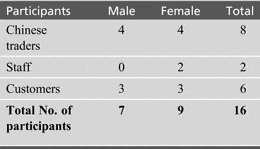
For the purpose of this study, eight recordings were selected. These conversations were recorded between February 2012 and March 2012. The Chinese traders agreed to be digitally recorded during the conversation and were told that the purpose of the recording was for academic research. The total number and the distribution of gender of participants of speakers are indicated in Table 1. All conversations were then transcribed using established transcription conventions (Schiffrin, Reference Schiffrin1994).
Number of participants of the eight selected recordings by gender
5. Data analysis
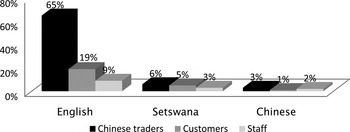
The sequences of conversations examined are taken from the first business encounter between participants. In the conversations of Chinese traders, customers, and staff, the total number of utterances (excluding repeated words) were as follows: English 93, Setswana 14, and Chinese 6. These are presented in Figure 1.
The distribution of utterances spoken in English, Setswana, and Chinese
5.1 Code-switching amongst Chinese traders and customers
Code-switching linguistic structures in the data are predominantly intra-sentential, though there are a few instances of inter-sentential and emblematic switches. ExtractsFootnote 1 1, 2, and 3 show instances in the data where the Chinese traders and the customers greet each other in English, Setswana, and Chinese. The Chinese traders, customers, and staff members are represented in the transcripts as CI1.1, etc, CU1.1, etc, and ST1.1, etc, respectively.
Extract 1
Text 1 (01/03/2012)
1. ##CU1.1##: How are you?
2. ##CI1.1##: I'm fine.
Extract 3
Text 3 (28/02/2012)
1. ##CU3.1##: Nihao! (Hello)
2. ##CI3.1##: Nihao!
It is interesting to note that in each of the extracts above, the Chinese trader's response is in the same language-code as the customer's. This is an indication that both parties are sensitive to one another's need for affirmation and are willing to accommodate this need.
Extracts 4 and 5 show instances in the data where the Chinese traders and the customers code-switch between English and Setswana.
Extract 4
Text 4 (28/02/2012)
3. ##CI4.1##: Sori! (Excuse me!) Tla kwano. (Come here) Sori! Sori! Sori! Monna (Man) tla kwano. Sori, you no pay.
4. ##CU4.1##: A..oh! (Oh!)
Extract 4 depicts inter-sentential code-switching. It is evident that CI4.1 had learnt a bit of Setswana, as demonstrated in his talk ‘Sori’ (Excuse me), ‘monna’ (man), ‘tla kwano’ (come here) and ‘you no pay’ as he spoke to CU4.1 who was leaving his shop with a pair of socks he had not paid for. CU4.1's surprise response ‘A..oh!’ (Oh), which is a Setswana exclamation, is an example of an emblematic switch, which refers to the use of tags, exclamations, pause fillers that are inserted from the vocabulary of one language into another language.
Extract 5
Text 5 (22/02/2012)
10. ##CU5.1##: I miss you.
11. ##CI5.1##: Oh..oh. I don't like for you to miss me too.
12. ##CU5.1##: Me, I miss you!
13. ##CI5.1##: I don't like.
14. ##CU5.1##: Me, I miss you.
15. ##CI5.1##: This, no good.
16. ##CU5.1#: Me, I'm good. I always buy meali (meal made from maize) for you.
17. ##CI5.1##: No, it's fine for what?
18. ##CU5.1##: You only.
19. ##CI5.1##: Comot. I don't have lunch you buying for me!
20. ##CU5.1##: Hey! Problem waitse (you know)…
Extract 5 illustrates emblematic and intra-sentential code-switches. CU5.1 claimed that she usually bought lunch for CI5.1. The latter, however, denied the former's claim. Note that CI5.1 inferred the meaning of meali as ‘lunch’. CU5.1's comment ‘Hey! Problem waitse (you know)…’ contains emblematic and intra-sentential switches. It can be inferred that this type of exchange builds rapport between customers and the Chinese investors. Hence, the two groups of people relate both transactionally and interactionally.
Extract 6 shows instances in the data where the Chinese trader and a customer code-switch between English and Chinese.
Extract 6
Text 6 (22/02/2012)
1. ##CU6.1##: Are you talking in Setswana?
2. ##CI6.1##: No! We're talking, so don't eh…(N)Footnote 3 don't walawala (talk) here. Can we help you?
In Extract 6, there is also an instance of intra-sentential code-switching, in which CI6.1 switches from English to Chinese: ‘No! We're talking, so don't eh…(N) don't walawala (talk) here.’ Walawala is the Chinese word for ‘talk’, hence its use implies that CU6.1 should not intrude into her conversation with the researcher.
5.2 Code-switching amongst Chinese traders and staff
Apart from Chinese traders and customers code-switching to build rapport and effective business relationships, Chinese traders and staff also code-switch in English, Setswana, and/or Chinese, as illustrated in Extracts 7 and 8. In Extract 7, the Chinese trader code-switches in English and Setswana to make a case for a specific request from her staff.
Extract 7
Text 7 (24/02/2012)
1. ##CI7.1##: Tla kwano. (Come here) Where can I go for night school? Where? Night classes?
2. ##ST7.1##: Night! A..a. (No)
3. ##CI7.1##: Night, not day, not in day! Here, no class in night?
4. ##ST7.1##: No class, evening.
5. ##CI7.1##: Evening yes, yes. Where? You mathata! (problem!) 120 eh…(N) No one, one. Too much, bring money…
Extract 7 contains instances of inter-sentential and intra-sentential code-switches. CI7.1 used inter-sentential code-switching as she solicited information from ST7.1, ‘Tla kwano. (Come here)…Night classes?’ ST7.1's response was the inter-sentential/emblematic ‘Night! A..a. (No)’ to signal her surprise over CI7.1's request. CI7.1 also used intra-sentential code-switching when she directed her attention to a customer who entered the shop and conversed with him without waiting for ST7.1 to respond to her question ‘Where?’ It appears that CI7.1's reaction ‘You mathata! (problem)…money’ is an indication that her eagerness to end the interaction with the customer might be borne out of how important she considered the issue (night classes) that she was enquiring about from her staff.
Extract 8 shows instances in the data where the Chinese trader and a staff member code-switch between English, Setswana, and Chinese:
Extract 8
Text 8 (21/02/2102)
1. ##ST8.1##: Tsamaya (Go) in Chinese?
2. ##CI8.1##: Go, go, go, go…
3. ##ST8.1##: Chinese …go, go?
4. ##CI8.1##: Yeah…(N). You going..[ ]
5. ##ST8.1##: Then you say go.
6. ##CI8.1##: You talking Tsamaya. I talking go, go, go, go.
7. ##ST8.1##: Eheee. (Okay)…
13. ##CI8.1##: Coming…(N) lái (come), lái, lái.
14. ##ST8.1##: Nai, nai, nai, nai.
15. ##CI8.1##: Lái! @
16. ##ST8.1##: @. Eheee.
17. ##CI8.1##: You talking coming, coming. I talking…
Extract 8 shows instances of intra-sentential, inter-sentential, and emblematic switches. CI8.1 had been explaining certain Chinese words to ST8.1. In this instance of ‘small talk’, CI8.1 and ST8.1 were discussing some Chinese, Setswana, and English words such as ‘Tsamaya (Go) in Chinese?’ (turn 1) and ‘Coming…lái (come)’ (turn 13), and ‘Eheee (Okay)’ (turn 7). The informal communication exchange of the discussion is probably a means by which CI8.1 could relate to ST8.1 in a cordial manner.
6. Discussion
The findings show that code-switching is one way by which interlocutors (Chinese traders, customers, and staff) collaborate in order to construct meaning in their interaction (Li, Reference Li2002). Whatever their form, code-switching is an indication that all participants are cognisant of the need for affirmation, solidarity, precaution, and acceptance. All of these are achieved as Chinese traders, customers, and staff members interact in one another's language. It can be inferred from the data that these Chinese traders have learnt some Setswana discourse/pragmatic markers such as greetings like ‘dumelang’ (hello). They have also learnt some words such as ‘problem’ (mathata), ‘go’ (tsamaya), ‘man’ (monna) and simple sentences such as ‘come here’ (tla kwano). Similarly, customers have learnt and understood some Chinese discourse/pragmatic markers, including greetings such as ‘nihao’ (hello) and some words such as ‘walawala’ (talk).
For the Chinese traders, code-switching, an indication of some level of proficiency in Setswana, is a means of building a safety valve in their business transactions, so that they do not suffer material loss. For example, in Extract 4, CU4.2, who attempted to shoplift, must have been surprised that CI4.1 could express himself sufficiently in Setswana and English, in order to stop him from carrying out his plan. Also, by code-switching, the Chinese traders build rapport and cordiality with their customers. As Kirkpatrick (Reference Kirkpatrick2007: 29) indicates, people ‘warm’ to others who are able to speak their language. Thus, code-switching enables the Chinese traders to ‘warm’ to their customers.
Although code-switching is a natural consequence of the linguistic background of customers and staff members, it is also used to signal identity (Mafela, Reference Mafela2009). It is also a means of establishing and building rapport with the Chinese traders. The exchange between CU5.1 and CI5.1 in Extract 5 attests to this claim. CU5.1 had started off with the sentence ‘I miss you’ when CI5.1 insisted that she did not miss CU5.1. The latter recalled that she was related to CI5.1 not only as a customer but as a friend for whom she bought lunch some time back. CU5.1's code-switch ‘waitse’ (you know) signals her surprise at CI5.1's seeming denial or rebuff of the friendship.
It can be inferred from the data analysed that despite the fact that the Chinese traders employ the services of their staff to assist the customers, there are instances whereby their employees are unavailable and these Chinese traders are obligated to communicate with the customers in English and/or Setswana. This scenario has resulted in the improvement of the Chinese traders' proficiency in English and/or Setswana. It is also likely that the Chinese traders, who have spent a considerable number of years in Botswana, have become conversant with Setswana as they regularly interrelate with their customers and staff. Likewise, the customers and staff, due to constant business interactions with the Chinese traders, have learnt some Chinese words.
7. Conclusion and recommendations
This paper has sought to provide answers to questions of what code-switching linguistic structures are employed in the interactions between the Chinese traders and their customers, and how Chinese traders use these structures to accomplish desired business goals with their staff. The data identified intra-sentential, inter-sentential, and emblematic switches as strategies used by interactants (Chinese traders, customers, and staff) when code-switching in English and Setswana and/or Chinese. The data has revealed that code-switching helps to establish and build rapport among interlocutors. It is also a means by which interactants relate transactionally and interactionally.
It is evident that language in this type of informal business context shows a lot of linguistic creativity. This paper recommends that the Chinese government, along with other African institutions, should build language and cultural centres (similar to the Confucius Institutes) in China and some parts of Africa, which could enable the Chinese migrants to ‘warm-up’ with their host communities for effective multilingual communication. The code-switching conversations of the Chinese traders operating in other African countries should also be explored in order to establish their similarities to, or differences from, those of the Chinese traders operating in Botswana. ■
 ANTHONIA EBOSEREMEN AKHIDENOR obtained her first degree at The University of Abuja, Nigeria in 2006 and her Master's degree in 2012 at the University of Botswana. Her dissertation was on ‘A Study on the Conversational Strategies Employed by Chinese Investors, their Employees, and Customers in Botswana’. Ms Akhidenor has been sponsored by different international institutions and organizations to participate in research workshops. She has interests in China and other foreign countries' sociolinguistics and labour relations with Africa. Email: tonidenor@yahoo.com



