Introduction
Ménière's disease is a debilitating chronic peripheral vestibular disease of unclear aetiology. The classic pathophysiological mechanism implicated is endolymphatic hydrops,1,Reference Gurkov, Jerin, Flatz and Maxwell2 although many studies shed doubt on this and consider it to be an epiphenomenon.Reference Foster and Breeze3–Reference Megerian5 Ménière's disease can develop at any age, although the peak onset of the disease is between the fourth and sixth decades of life, with an incidence of 15–50 per 100 000.Reference James and Thorp6,Reference Sajjadi and Paparella7 This disease manifests clinically as a tetrad of recurrent symptoms, including spontaneous episodic vertigo, sensorineural hearing loss, tinnitus and aural fullness.
In 2015, the Barany Society consensus document was published, and it simplified the diagnostic criteria into two categories: definitive Ménière's disease and probable Ménière's disease.Reference Lopez-Escamez, Carey, Chung, Goebel, Magnusson and Mandala8 Diagnosing definite Ménière's disease requires: at least two episodes of spontaneous vertigo lasting between 20 minutes and 12 hours, and associated with fluctuating aural fullness, hearing loss or tinnitus; and a documented low- and/or mid-frequency sensorineural hearing loss in the affected ear, before, during or after the vertigo episode. Probable Ménière's disease requires two episodes of spontaneous vertigo lasting between 20 minutes and 24 hours, associated with fluctuating aural symptoms.Reference Lopez-Escamez, Carey, Chung, Goebel, Magnusson and Mandala8
Ménière's disease can have a significant impact on patients’ quality of life (QoL) as measured by patient-reported outcome measures.Reference Söderman, Bagger-Sjöbäck, Bergenius and Langius9–Reference Anderson and Harris11 In a large cohort study, patients with hydropic ear disease, confirmed by inner-ear magnetic resonance imaging, presented with various clinical scenarios of Ménière's disease. Patients reported associated symptoms of nausea, vomiting, sweating, an urge to defecate and urinate, phosphenes, migraines, and transient loss of consciousness with Ménière's disease attacks.Reference Gurkov, Jerin, Flatz and Maxwell2,Reference Ray, Carr, Popli and Gibson12 Ménière's disease has also been associated with psychological distress and clinical depression, which can further worsen QoL.Reference Gurkov, Jerin, Flatz and Maxwell2,Reference Celestino, Rosini, Carucci, Marconi and Vercillo13,Reference Coker, Coker, Jenkins and Vincent14 Unfortunately, depression in these patients has been linked with less successful responses to intervention.Reference Furukawa, Kitahara, Horii, Uno, Imai and Ohta15 It is thus critical to identify psychiatric co-morbidities and treat them accordingly, to improve outcomes.
Although treating depression in Ménière's disease is understandably outside of the scope of practice of an otolaryngologist, we nevertheless are presented with a unique opportunity to identify and properly refer patients for a multidisciplinary team based approach. Therefore, we performed a systematic review and meta-analysis in order to further understand the prevalence and severity of depression in patients with Ménière's disease.
Materials and methods
Data collection and selection
This study was conducted according to the Preferred Reporting Items for Systematic Reviews and Meta-Analyses (‘PRISMA’) guidelines.Reference Moher, Liberati, Tetzlaff and Altman16 Specific search strategies were developed for PubMed (National Library of Medicine – National Institutes of Health), Scopus (Elsevier) and the Cochrane Library (Wiley). A combination of subject headings (e.g. medical subject headings in PubMed) and the following key words were used to conduct the search: Meniere or Ménière's disease, depressive disorders, and depression. The databases were searched from inception through 23 July 2019, and results were limited to those papers in English language only. The reference lists of relevant articles were also searched, as well as citing articles.
References were uploaded to EndNote reference management software (Clarivate Analytics, Philadelphia, Pennsylvania, USA). The identified studies were screened for relevance by authors JJP and DAL.
Selection criteria
Studies with the primary objective of examining depression and psychological illness in patients with Ménière's disease were included. Non-English language papers, studies of non-human subjects and non-journal articles were excluded. Articles were included regardless of study design (retrospective or prospective). Case studies were excluded.
We anticipated a small number of studies in which the participants fulfil the 1995 American Academy of Otolaryngology – Head and Neck Surgery (AAO-HNS) Committee on Hearing and Equilibrium guidelines for the diagnosis of Ménière's disease. In order to increase the number of studies in the final set, alternative criteria for the diagnosis of Ménière's disease were also allowed. Studies that discussed a broad category of ‘vestibular disease’ were also screened and determined for inclusion.
Data extraction
Basic study information (e.g. author, year) were extracted, as well as basic patient information (e.g. gender and age). All outcome measures relevant for healthcare providers were included in the analysis and discussion. These included psychiatric-related (e.g. depression) QoL measures, and any depression scales or questionnaires. No specific depression or psychiatric outcome parameters were used as a basis for inclusion or exclusion for this study. However, outcomes that were reported with statistics which could not be evaluated were excluded. Ultimately, only outcome measures that were reported in more than one study were amenable to meta-analysis and included for statistical analysis. When studies reported two or more measurements at baseline and following intervention, only baseline scores were extracted and used for analysis. The level of evidence for each selected article was evaluated using the Oxford Centre for Evidence-Based Medicine criteria.Reference Howick, Chalmers, Glasziou, Greenalgh, Heneghan and Liberati17
Quality assessment
The risk of bias was assessed according to the Cochrane Handbook for Systematic Reviews of Interventions version 5.1.0.Reference Higgins and Green18 Two authors (JJP and DAL) performed a pilot assessment on three studies to check for consistency of assessment. Both authors then performed an independent risk assessment on the remaining studies. Disagreements were resolved by way of a third author (SAN). Risk of bias items included the following: random sequence generation, allocation concealment, blinding of participants and personnel, blinding of outcome assessment, incomplete outcome data, selective reporting, and other biases.
Statistical analysis
All statistics were calculated with MedCalc software, version 19.0.7 (MedCalc Software, Ostend, Belgium). Graphs and tables were generated using Microsoft™ Office 365 ProPlus Word and Excel software. Categorical variables were summarised by frequency and percentage. Continuous variables were collated into weighted means. In addition, a meta-analysis of proportions was performed for prevalence for depression and Zung's Self-Rating Depression Scale scores.
The program MedCalc lists the proportions (expressed as a percentage), with their 95 per cent confidence intervals (CIs), found in the studies included in the meta-analysis. The pooled proportion with 95 per cent CI are given for both the fixed effects model and the random effects model. Each technique was weighted according to the number of patients treated. MedCalc used a Freeman–Tukey transformation to calculate the weighted summary proportion under the fixed and random effects models.Reference DerSimonian and Laird19,Reference Freeman and Tukey20
Under the fixed effects model, it is assumed that all studies come from a common population and that the effect size (the proportions) is not significantly different among the different trials. This assumption is tested by the ‘heterogeneity test’, or I2. If this test yields a low p-value (p < 0.05), then the fixed effects model might be invalid. In this case, the random effects model might be more appropriate; in this model, both the random variation within the studies and the variation among the studies are incorporated. The random effects model will tend to give a more conservative estimate (i.e. with a wider CI), but the results from the two models usually agree when there is no heterogeneity. When heterogeneity is present, the random effects model should be the preferred model.
Both Cochran's Q and I2 tests for heterogeneity were used with meta-analysis of proportions. Q is the weighted sum of squares on a standardised scale. It is reported with a p-value, with low p-values indicating the presence of heterogeneity. I2 is the percentage of observed total variation across studies that is due to real heterogeneity rather than chance. It is calculated as: I2 = 100 per cent 3 (Q – degrees of freedom) / Q, where Q is Cochran's heterogeneity statistic. Negative values of I2 are put as equal to zero, so that I2 lies between 0 per cent and 100 per cent. A value of 0 per cent indicates no observed heterogeneity, and larger values show increasing heterogeneity.Reference Higgins, Thompson, Deeks and Altman21
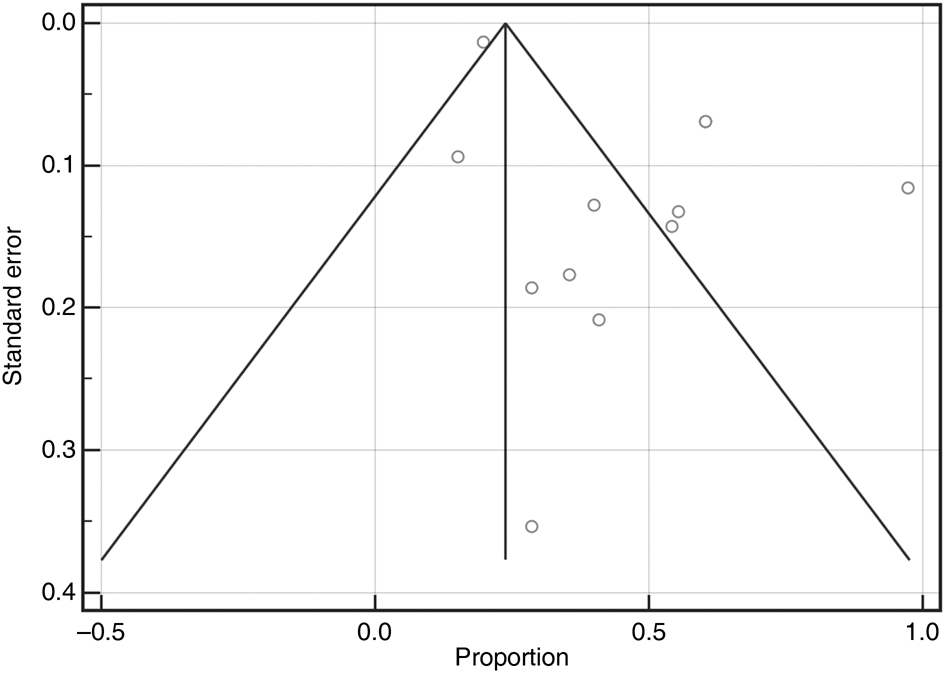
Potential publication bias was assessed with a funnel plot. Two diagonal lines represent (pseudo) 95 per cent confidence limits (effect size ± 1.96 standard error) around the summary effect for each standard error on the vertical axis. These show the expected distribution of studies in the absence of heterogeneity or selection bias. In the absence of heterogeneity, 95 per cent of the studies should lie within the funnel defined by these diagonal lines.
A p-value of less than 0.05 was considered to indicate a statistically significant difference for all statistical tests.
Results
Study characteristics
A total of 237 studies remained after the removal of duplicates. Screening on the premise of titles and abstracts rendered 33 studies for full-text review. Fourteen studies met our inclusion criteria, with 1 additional study identified from references, totalling 15 studies for analysis (Figure 1).Reference Söderman, Bagger-Sjöbäck, Bergenius and Langius9,Reference Arroll, Dancey, Attree, Smith and James10,Reference Celestino, Rosini, Carucci, Marconi and Vercillo13–Reference Furukawa, Kitahara, Horii, Uno, Imai and Ohta15,Reference Bruderer, Bodmer, Stohler, Jick and Meier22–Reference Yuan, Yu, Shi, Ke and Zhang31
Preferred Reporting Items for Systematic Reviews and Meta-Analyses (‘PRISMA’) diagram. MD = Ménière's disease

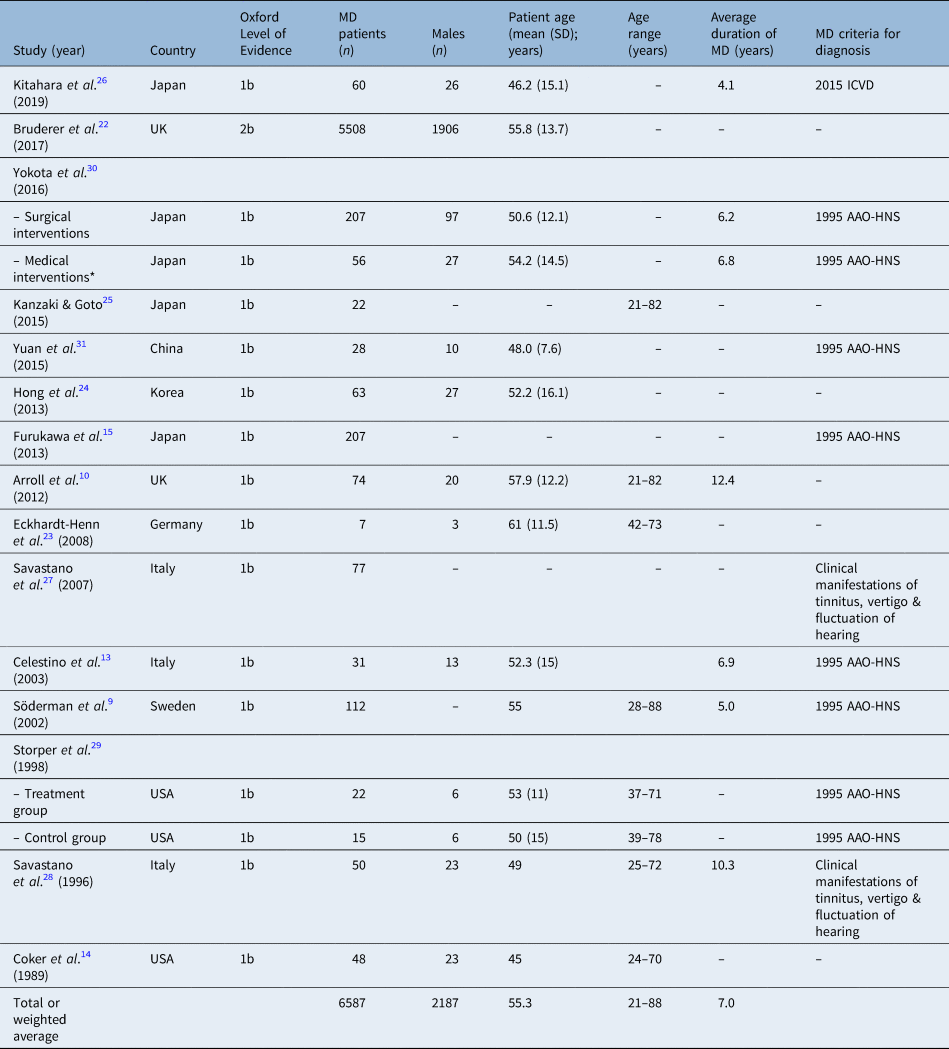
Publication dates of the included studies ranged from 1989 to 2019. The studies comprised a total of 6587 patients. There were 2187 (35 per cent) males, with a weighted average age of 55.3 years (range, 21–88 years). The weighted average duration of Ménière's disease was 7.0 years. The population included was diverse, with studies originating from eight different countries (four from Japan, three from Italy, two from the USA, two from the UK, and one each from China, Korea, Germany and Sweden).
Of the 15 studies, 6 diagnosed patients with Ménière's disease based on the 1995 AAO-HNS guidelines,1 2 diagnosed patients based on the clinical combination of tinnitus, vertigo and fluctuations in hearing, and 1 used the 2015 International Classification of Vestibular Disorders guidelinesReference Lopez-Escamez, Carey, Chung, Goebel, Magnusson and Mandala8 created by the Barany Society. The remaining six studies did not explicitly state the criteria used to diagnose their patients, but did define their patients as having Ménière's disease. A summary of the study characteristics is provided in Table 1.
Demographics of included studies

*Medical interventions in Yokota et al.Reference Yokota, Kitahara, Sakagami, Ito, Kimura and Okayasu30 included: diuretics, betahistine, diphenidol, dimenhydrinate and diazepam. MD = Ménière's disease; SD = standard deviation; ICVD = International Classification of Vestibular Disorders; AAO-HNS = American Academy of Otolaryngology – Head and Neck Surgery
Two studies had an intervention arm to assess the efficacy of treating depression in Ménière's disease. One of these studies compared endolymphatic sac surgery against medical management (diuretics, betahistine, diphenidol, dimenhydrinate and diazepam), while the other study compared the effects of glycopyrrolate versus placebo.
Quality assessment
Based on the Oxford Level of Evidence criteria, 14 of the 15 studies are of level 1b evidence. Each of these studies had a prospective cohort of patients with Ménière's disease, in which various psychoanalytical scales were utilised. The remaining study was an epidemiological study, qualifying it as of level 2b evidence. The risk of bias was assessed for each included study (Appendices 1 and 2, available online). A funnel plot depicting publication bias can be found in Figure 2.
Funnel plot of studies included for analysis of overall prevalence of depression.

Depression scales
The following scales were employed to determine depression: Zung's Self-Rating Depression Scale was utilised by seven studies; the Hospital Anxiety and Depression Scale was employed by three studies; the Beck Depression Inventory was used by two studies; and the Illness Behavior Questionnaire – Dysphoria was employed by two studies.
The remaining studies incorporated other metrics, including: the Structural Clinical Interview for Diagnostic and Statistical Manual of Mental Disorders IV (‘DSM-IV’) Axis I; the Center for Epidemiologic Studies – Depression scale; the Hamilton test; the Minnesota Multiphasic Personality Inventory; and the Diagnostic Inventory of Personality and Symptoms. These were included in our analysis as they were used to determine the prevalence of depression in each respective study.
Prevalence of depression
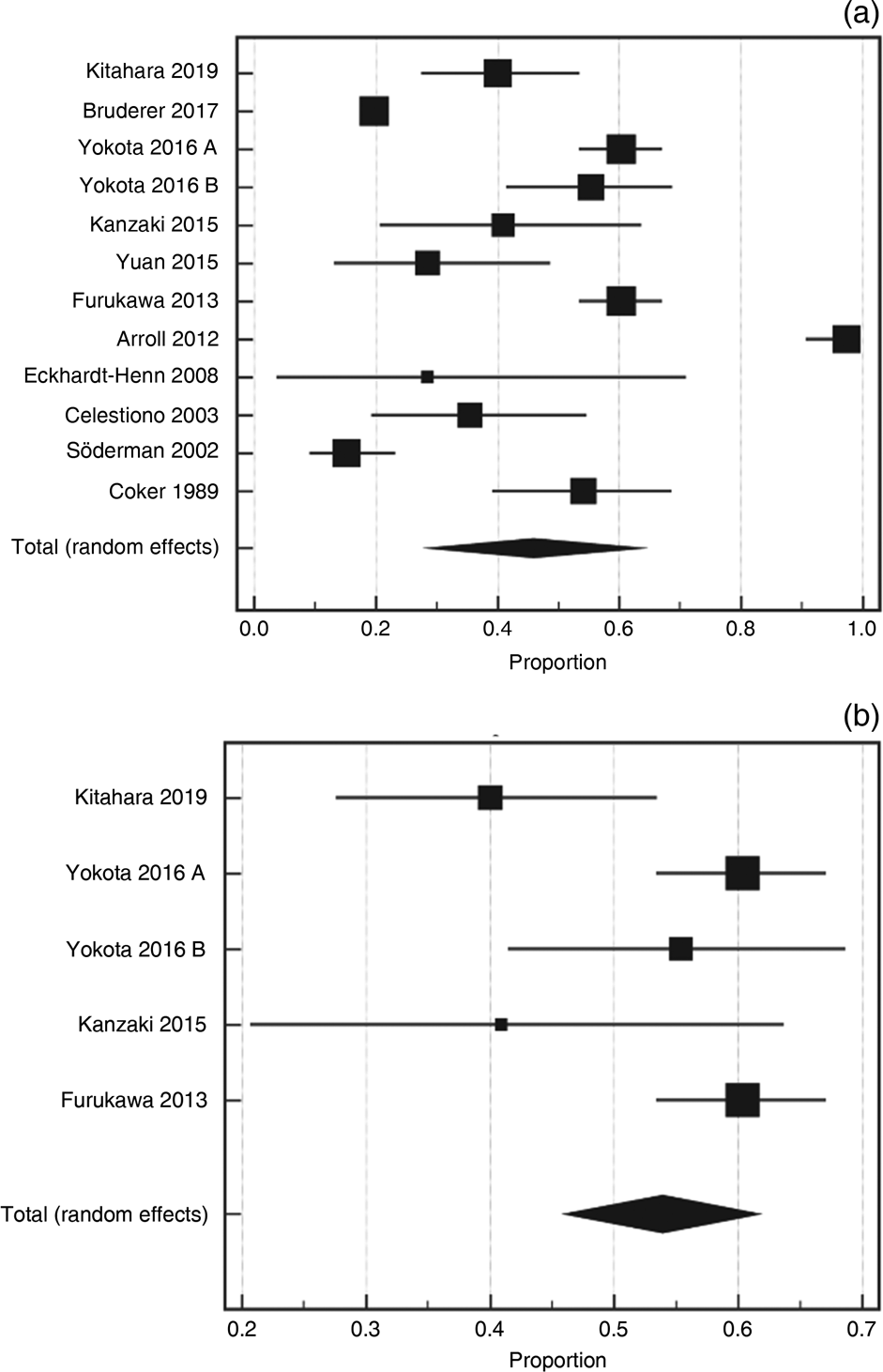
Eleven studies reported the prevalence of depression in their populations. The pooled analysis on the prevalence of depression indicated that the rate was 45.9 per cent (95 per cent CI = 28.9–63.3) among the 6360 patients.
Five of the 11 studies determined the prevalence of depression through Zung's Self-Rating Depression Scale, one through the Center for Epidemiologic Studies – Depression scale, one through the Hamilton's test, one with the Hospital Anxiety and Depression Scale, one with the Minnesota Multiphasic Personality Inventory and Diagnostic Inventory of Personality and Symptoms, one with the Structural Clinical Interview for Diagnostic and Statistical Manual of Mental Disorders IV Axis I, and one by a database review for Ménière's disease with a co-morbid diagnosis of depression.
Four of the five studies utilising Zung's Self-Rating Depression Scale employed the Japanese translation of the test, while the remaining study utilised the Chinese version. A meta-analysis of the Japanese version of Zung's Self-Rating Depression Scale indicated that 53.9 per cent (95 per cent CI = 46.1–61.6) of the 552 patients reported a score greater than 40, which was defined as clinically significant for depression.Reference Furukawa, Kitahara, Horii, Uno, Imai and Ohta15,Reference Kanzaki and Goto25,Reference Savastano, Maron, Mangialaio, Longhi and Rizzardo28,Reference Lahmann, Henningsen, Brandt, Strupp, Jahn and Dieterich32 Figure 3 shows a forest plot of the findings for prevalence of depression.
Forest plots for (a) the prevalence of depression and (b) the proportion of patients with Zung's Self-Rating Depression Scale scores greater than 40. A = surgical interventions; B = medical interventions

Severity of depression
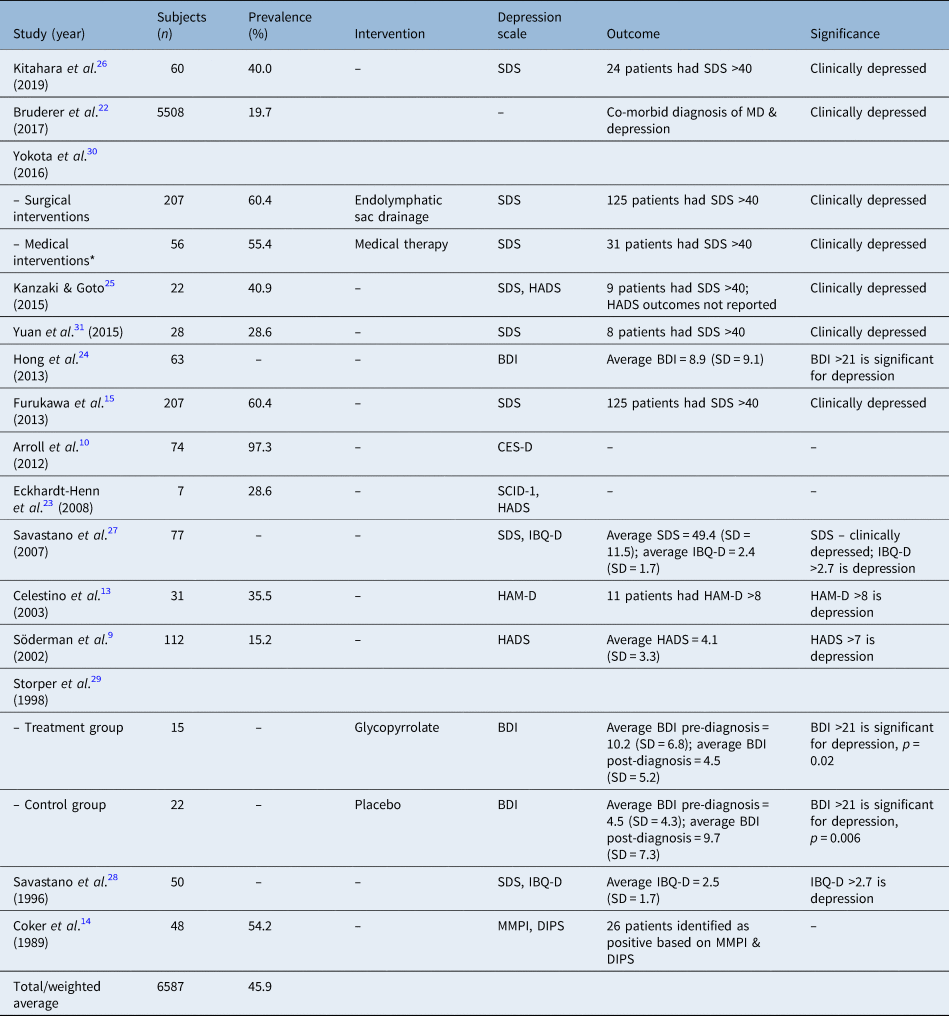
Of the three studies that utilised the Hospital Anxiety and Depression Scale, only one reported an average value (± standard deviation (SD)), which was 4.1 ± 3.3. The two studies that utilised the Illness Behavior Questionnaire – Dysphoria had a weighted average (± SD) of 2.4 ± 1.7. The Beck Depression Inventory was used by two studies, of which one had a control and a treatment group, representing a total of three different datasets; the weighted average (± SD) was 8.5 ± 7.9. See Table 2 for a summary of the depression scales.
Depression scales and prevalence

*Medical interventions in Yokota et al.Reference Yokota, Kitahara, Sakagami, Ito, Kimura and Okayasu30 included: diuretics, betahistine, diphenidol, dimenhydrinate and diazepam. SDS = Zung's Self-Rating Depression Scale; MD = Ménière's disease; HADS = Hospital Anxiety and Depression Scale; BDI = Beck's Depression Inventory; SD = standard deviation; CES-D = Center for Epidemiologic Studies – Depression; SCID-1 = Structural Clinical Interview for Diagnostic and Statistical Manual of Mental Disorders IV Axis I; IBQ-D = Illness Behavior Questionnaire – Dysphoria; HAM-D = Hamilton – Depression; MMPI = Minnesota Multiphasic Personality Inventory; DIPS = Diagnostic Inventory of Personality and Symptoms
Discussion
Psychiatric co-morbidities are known to be associated with various chronic vestibular problems.Reference Lahmann, Henningsen, Brandt, Strupp, Jahn and Dieterich32 In the USA, the lifetime prevalence of major depressive disorder is approximately 20 per cent for the general population.Reference Hasin, Sarvet, Meyers, Saha, Ruan and Stohl33 Within the population described here, the burden of depression is substantially greater. Comparatively, the rate of depression is even greater than in patients who have experienced a stroke (33 per cent) or myocardial infarction (31 per cent).Reference Hackett, Yapa, Parag and Anderson34,Reference Thombs, Bass, Ford, Stewart, Tsilidis and Patel35 Screening for depression after life-threatening diseases such as these is routine given the sequelae of poor outcomes and the decrease in QoL.Reference Hackett, Yapa, Parag and Anderson34,Reference Ruo, Rumsfeld, Hlatky, Liu, Browner and Whooley36 However, routine assessment of depression in patients with Ménière's disease is yet to be established. Our findings suggest that approximately half of patients with Ménière's disease have some extent of depression, warranting screening and a high level of suspicion by clinicians.
A wide array of validated instruments are used to screen patients for depression. Our study reflects this, as eight different screening tools were utilised to assess depression, with Zung's Self-Rating Depression Scale being the most commonly used scale.
Zung's Self-Rating Depression Scale was first published in 1965. It is composed of 20 questions; each question is scored between 1 and 4 points.Reference Zung37 Summing the values of these scores produces the raw score. The minimum score is 20 and the maximum is 80, with a cut-off of 40 points signifying depression.Reference Zung37 In 1971, Zung created an index score (raw score × 1.25) to shift the raw score scale (20–80) to an index score scale (25–100), with 50 as the new cut-off for depression.Reference Zung38 This created confusion regarding which cut-off was utilised as the reference point for signifying depression.Reference Dunstan and Scott39 Both studies by Savastano et al. utilised 50 as the reference value.Reference Savastano, Marioni and Aita27,Reference Savastano, Maron, Mangialaio, Longhi and Rizzardo28 However, the four Japanese studies utilised the raw score scale with 40 as their reference point.Reference Furukawa, Kitahara, Horii, Uno, Imai and Ohta15,Reference Kanzaki and Goto25,Reference Kitahara, Sakagami, Ito, Shiozaki, Kitano and Yamashita26,Reference Yokota, Kitahara, Sakagami, Ito, Kimura and Okayasu30 Notably, these studies used the Japanese translation of Zung's Self-Rating Depression Scale, which has been validated in literature.Reference Zung, Fukuda and Kobayashi40 Yuan et al. utilised a Chinese translation of Zung's Self-Rating Depression Scale; however, their threshold for depression was based on the index score, with 53 as the reference value.Reference Yuan, Yu, Shi, Ke and Zhang31 No clear reasoning was stated on why the threshold had been increased to 53.
In light of the differences between the thresholds in Zung's Self-Rating Depression Scale, only the Japanese studies were included in the meta-analysis. Based on this, our analysis indicated that more than 50 per cent of the patients had a score greater than 40, demonstrating the significance of depression for this population. Additionally, we combined the prevalence of depression from all studies, irrespective of the scale utilised, to determine the proportion of patients depressed, in a pooled fashion. This resulted in the prevalence of depression approximately approaching 50 per cent.
Given this highly elevated co-morbidity, we suggest that depression in patients with Ménière's disease be treated via an interdisciplinary approach, to increase the chances of a favourable outcome. Therefore, the treating otolaryngologist should be cognisant of the association between depression and Ménière's disease. Routine screening for depression can identify individuals who might benefit from counselling or further evaluation.
The French Society of Otorhinolaryngology and Head and Neck Surgery recommends psychological counselling for patients with Ménière's disease, in conjunction with vestibular rehabilitation (level 2 evidence). They support their claim with findings from a randomised, controlled trial, which demonstrated reduced anxiety and depression, along with a decrease in the perception of disability, for patients with Ménière's disease who were treated from both a vestibular and psychological perspective.Reference Shepard and Telian41,Reference Nevoux, Franco-Vidal, Bouccara, Parietti-Winkler, Uziel and Chays42 Perhaps further investigation of the link between depression and Ménière's disease is warranted, particularly to identify if synergistic benefits exist in treating either disease.
An additional perspective from our analysis is attained from consideration of the weighted averages of the Beck Depression Inventory and Illness Behavior Questionnaire – Dysphoria. Based on the reference Beck Depression Inventory scale, a score of greater than 11 signifies a mild mood disorder.43,Reference Beck, Ward, Mendelson, Mock and Erbaugh44 However, the analysis of the available data does not reach this value. In terms of the Illness Behavior Questionnaire – Dysphoria score, a value greater than 2.7 is considered abnormal.Reference Savastano, Marioni and Aita27,Reference Pilowsky and Spence45 Our analysis does not demonstrate this, and, ultimately, the available data for these two variables are not robust, rendering these findings difficult to interpret.
Limitations
An inherent limitation of a systematic review and meta-analysis is heterogeneity in the data. In our work, we encountered significant variability, as studies used different depression scales. However, the validity of these screening tools is supported by evidence in literature. The heterogeneity in Zung's Self-Rating Depression Scale regarding the variable use of the raw and index score cut-offs to determine depression is also a limitation.Reference Dunstan and Scott39 Furthermore, our meta-analysis on the prevalence of depression ultimately pooled data from several different scales, which introduced a degree of heterogeneity that is unaccountable.
The criteria for diagnosing Ménière's disease are yet another limitation. For example, older studies did not have a consensus statement for diagnosing Ménière's disease, and some studies did not report their criteria for diagnosing Ménière's disease, making it difficult to verify the diagnosis. Although the 2015 Barany Society guidelines are practically equivalent to the 1995 AAO-HNS guidelines for definitive Ménière's disease, the clinical heterogeneity of the population studied should also be considered a limitation. Differences in disease presentation and symptom severity can affect the level of depression.Reference Friberg, Stahle and Svedberg46 For example, the variability in the duration and frequency of Ménière's disease attacks can cause varying degrees of depression. This was difficult to address, as correlations between the severity of depression and the duration and frequency of Ménière's disease attacks were not made.
It is difficult to control such variables in a retrospective manner; thus, consideration should be given to our findings accordingly. Future investigations of depression in Ménière's disease should employ a common depression metric (e.g. Patient Health Questionnaire-9, Beck Depression Inventory or Hamilton Rating Scale for Depression),Reference Gelenberg, Freeman, Markowitz, Rosenbaum, Thase and Trivedi47 and diagnose Ménière's disease using a guideline issued by a governing body such as the AAO-HNS1 or the Barany Society.Reference Lopez-Escamez, Carey, Chung, Goebel, Magnusson and Mandala8 Depression in Ménière's disease remains a concern, as the symptoms can be invasive and disruptive to patients’ QoL.
Conclusion
Ménière's disease can severely impact patients’ QoL. Our study has identified that almost one out of every two patients with Ménière's disease might have some degree of depression; however, the exact severity of depression remains unclear. The high rate of depression in Ménière's disease emphasises the need for clinical suspicion of depression by treating otolaryngologists. Routine assessment for depression in patients with Ménière's disease could help identify those patients in need of intervention. This allows the prompt diagnosis and treatment of depression, to improve the overall well-being of the patient. We recommend that future research: include investigations of the severity of depression within this patient population, identify if synergistic benefits exist in treating either disease, and assess the utility of an interdisciplinary approach for combating Ménière's disease.
Competing interests
None declared
Appendix 1. Risk of bias graph: review authors' judgements about each risk of bias item (presented as percentages) across all included studies

Appendix 2. Risk of bias summary