



1 Introduction
1.1 Main results
A tracial von Neumann algebra is a pair
$(M,\tau )$
 of a finite von Neumann algebra and a faithful normal tracial state. Tracial von Neumann algebras have long been seen as a noncommutative analog of probability spaces. Inspired by Bolzmann’s formulation of entropy, Voiculescu [Reference VoiculescuVoi94, Reference VoiculescuVoi96] introduced the microstates free entropy and microstates free entropy dimension
$\delta _{0}(x)$
 associated to a tuple
$x = (x_{1},\cdots ,x_{k})$
 of self-adjoint elements in a tracial von Neumann algebra, which measure the quantity of matricial approximations that x has. Microstates free entropy dimension was used by Voiculescu [Reference VoiculescuVoi96] and Ge [Reference GeGe98], respectively, to show that (interpolated) free group factors have no Cartan subalgebras and are prime, and since then, free entropy techniques have had many other applications to the structural properties of interpolated free group factors.
However, one limitation of microstates free entropy dimension is that
$\delta _0(x)$
 is not known to be an invariant of the tracial von Neumann algebra generated by x. Jung [Reference JungJun07b] offered a remedy by defining strong
$1$
 -boundedness of a finite tuple x in a tracial von Neumann algebra
$(M,\tau )$
 . Strong
$1$
 -boundedness of x implies that x has free entropy dimension at most
$1$
 , but unlike the case with free entropy dimension, we know that if two tuples x and y generate the same von Neumann algebra, then strong
$1$
 -boundedness of x is equivalent to strong
$1$
 -boundedness of y [Reference JungJun07b, Theorem 3.2], hence strong
$1$
 -boundedness is an invariant of a finitely generated tracial von Neumann algebra. Implicit in Jung’s work, and explicitly given by the first named author in [Reference HayesHay18], is the notion of the
$1$
 -bounded entropy
$h(x)$
 of a tuple x; strong
$1$
 -boundedness of x is equivalent to
$h(x) < \infty $
 . Moreover,
$h(x)$
 only depends on the tracial von Neumann algebra generated by x, and thus
$h(M)$
 is well defined for a finitely generated tracial von Neumann algebra
$(M,\tau )$
 [Reference HayesHay18, Theorem A.9] (these definitions and results also extend to infinite tuples; see [Reference HayesHay18, Definition A.2]).
The
$1$
 -bounded entropy behaves nicely under many natural operations with von Neumann algebras, which leads to free entropy proofs of various indecomposability results for free product von Neumann algebras (and other similar algebras), see Section 2.3. For example, h has the following subadditivity property: If P and Q are von Neumann subalgebras of
$(M,\tau )$
 and
$P \cap Q$
 is diffuse, then
$h(P \vee Q) \leq h(P) + h(Q)$
 . Hence, a nonstrongly
$1$
 -bounded von Neumann algebra M can never be generated by two strongly
$1$
 -bounded subalgebras P and Q that intersect diffusely [Reference JungJun07b, Corollary 4.2] [Reference HayesHay18, Lemma A.12]. Hence, each time we find a new class of von Neumann algebras that is strongly
$1$
 -bounded or not strongly
$1$
 -bounded, we expand the applications of free entropy dimension theory. For instance, strongly
$1$
 -bounded von Neumann algebras include those that are amenable, have property gamma, have a Cartan subalgebra or even have a quasi-regular hyperfinite subalgebra. The main known examples of nonstrongly-
$1$
 -bounded von Neumann algebras are free products (or free with amalgamation over a totally atomic subalgebra) of Connes-embeddable tracial von Neumann algebras, including in particular the interpolated free group factors, which are a very important but not well understood family of von Neumann algebras. Because of the permanence properties of
$1$
 -bounded entropy given in Section 2.3,
$1$
 -bounded entropy can be used to prove structural results about free products, some of which are still not accessible by other methods; see, for instance, [Reference JungJun07b, Corollary 4.2], [Reference HayesHay18, Theorem 1.3, Corollary 1.7, Theorem 1.8, Corollary 1.10].
While being strongly
$1$
 -bounded guarantees having microstates free entropy dimension at most
$1$
 with respect to every generating set (we say that M has microstate free entropy dimension at most
$1$
 if this holds), there is a significant difference between these two concepts. Having microstates free entropy dimension at most
$1$
 is not known to satisfy many permanence properties (closure under joins with diffuse intersection, normalizers, quasi-normalizers, etc.) that being strongly
$1$
 -bounded enjoys; see Section 2.3. For example, it is unknown if
$L({\mathbb F}_{2})$
 can be generated by two algebras with microstates free entropy dimension at most
$1$
 with diffuse intersection (and similarly with other indecomposability results for free group factors give in [Reference JungJun07b, Reference HayesHay18]). Thus, being strongly
$1$
 -bounded is a serious improvement over having microstates free entropy dimension at most
$1$
 .
This paper undertakes a comprehensive study of the relationship between strong
$1$
 -boundedness and property (T). Property (T) is a strong rigidity property introduced first in the group context by Kazhdan [Reference KaždanKaž67]. It has numerous applications to geometric and measured group theory [Reference JungMar79, Reference GaboriauGab10, Reference FurmanFur99a, Reference PopaPop86], ergodic theory [Reference Connes and WeissCW80, Reference SchmidtSch80, Reference SchmidtSch81, Reference Glasner and WeissGW97, Reference PopaPop07, Reference PopaPop06b, Reference PopaPop06c, Reference FurmanFur99b, Reference IoanaIoa11a], probability [Reference Lyons and SchrammLS99, Reference GaboriauGab05] and the existence of expander graphs [Reference MargulisMar73]. See [Reference Bekka, De la Harpe and ValetteBdlHV08] for an extensive background on property (T) groups. A generalization to von Neumann algebras was first defined by Connes [Reference ConnesCon82, Reference ConnesCon80] and further developed by Connes–Jones [Reference Connes and JonesCJ85], Popa [Reference PopaPop06a], Popa–Peterson [Reference Peterson and PopaPP05] and Peterson [Reference PetersonPet09a]. It has been used to great effect in the theory of von Neumann algebras, especially in Popa’s deformation/rigidity theory, and is a crucial component of various general results about the structure of
$\textrm {II}_{1}$
 -factors [Reference PopaPop86, Reference OzawaOza04b, Reference PopaPop06a], many of which parallel or extend the results obtained from free entropy dimension theory; see 1.2 for further discussion.
Several previous authors gave estimates on microstates free entropy dimension for property (T) groups and von Neumann algebras. First, Voiculescu [Reference VoiculescuVoi99] showed that the standard generators of
$SL_3(\mathbb {Z})$
 have free entropy dimension 1 by using the sequential commutation property. Ge and Shen in [Reference Ge and ShenGS02] generalized this result to all generators of
$SL_3(\mathbb {Z})$
 , thus establishing that free entropy dimension is a von Neumann algebra invariant in this case. The next breakthrough by Jung and Shlyakhtenko [Reference Jung and ShlyakhtenkoJS07] showed that a finitely generated property (T) von Neumann algebra has free entropy dimension at most
$1$
 with respect to any finite generating set. Jung [Reference JungJuna, Theorem 6.9] showed that, for sofic groups certain relations guarantee strong
$1$
 -boundedness, and applied this to deduce strong
$1$
 -boundedness for torsion-free sofic groups with two generators [Reference JungJuna, Section 7] which are not isomorphic to the free group on two generators. Shlyakhtenko [Reference ShlyakhtenkoShl21] generalized Jung’s result via a nonmicrostates approach and showed that all finitely presented sofic groups with vanishing first
$\ell ^2$
 -Betti number are strongly
$1$
 -bounded. This includes finitely presented sofic property (T) groups by the Delorme–Guichardet theorem [Reference DelormeDel77, Reference GuichardetGui72] (see also [Reference Bekka, De la Harpe and ValetteBdlHV08, Section 2.12]).
Our main result is a complete generalization of all the above-mentioned previous results in the property (T) setting. We show strong
$1$
 -boundedness assuming only that
$(M,\tau )$
 has a finite Kazhdan tuple, that is, some
$x = (x_1,\dots ,x_d) \in M^d$
 such that for some constant
$\gamma> 0$
 , for every Hilbert M-M-bimodule H, we have

where
$P_{\operatorname {central}}: H \to H$
 denotes the projection onto the subspace of central vectors.
Theorem 1.1. If
$(M,\tau )$
 is a tracial von Neumann algebra that admits a Kazhdan tuple
$x \in M_{\operatorname {\mathrm {sa}}}^d$
 , then M is strongly
$1$
 -bounded. In particular, this holds if
$M = W^{*}(\pi (G))$
 where G is a property (T) group and
$\pi \colon G\to \mathcal {U}(\mathcal {H})$
 is a unitary representation given by a character on G,Footnote 1 or if M is a property (T) tracial von Neumann algebra with finite-dimensional center. This also holds if
$M=W^{*}(\pi (G))$
 where G is a property (T) group, and
$\pi \colon G\to \mathcal {U}(\mathcal {H})$
 is a projective representation,Footnote 2 provided that
$W^{*}(\pi (G))$
 is a finite von Neumann algebra.
As mentioned earlier in the introduction, this result expands the applications of free entropy to the structure theory of finite von Neumann algebras. From the subadditivity property of h, we see the following: A nonstrongly
$1$
 -bounded von Neumann algebra M can never be generated by a property (T) subfactor P and another strongly
$1$
 -bounded von Neumann subalgebra Q (e.g., amenable, property gamma, nonprime, having a diffuse hyperfinite quasi regular subalgebra) such that
$P \cap Q$
 is diffuse. We remark that in the special case when M is a nontrivial free product it is possible to obtain some of these indecomposability results by combining existing techniques in Popa’s deformation-rigidity theory. However, the advantage of the 1-bounded entropy approach is in the uniformity of being able to handle all the various cases at once.
Our proof of Theorem 1.1 works directly with covering numbers of Voiculescu’s matricial microstate space. It draws upon the dimension-reduction technique of Jung and Shlyakhtenko [Reference Jung and ShlyakhtenkoJS07] as well as the iterative technique that Jung used in his study of torsion-free sofic groups with two generators [Reference JungJuna]. The significant technical novelty in our proof is found in a careful control of the packing number estimates in an iterative fashion while using the Kazhdan constant at each step.
It is natural to ask whether Theorem 1.1 extends to arbitrary tracial von Neumann algebras with property (T). From our analysis, we observe that the only remaining case is that of a tracial von Neumann algebra
$(M,\tau )$
 with property (T) and with atomic, infinite-dimensional center (i.e., M is an infinite direct sum of property (T) factors). By a careful analysis of this case, we show the statement that all property (T) tracial von Neumann algebras are strongly
$1$
 -bounded is equivalent to the statement that all
$\mathrm {II}_{1}$
 -factors with property (T) have nonpositive
$1$
 -bounded entropy.
Proposition 1.2. The following are equivalent:
-
(i) Every tracial von Neumann algebra with property (T) is strongly $1$
 -bounded.
-
(ii) Every tracial von Neumann algebra M with property (T) satisfies $h(M) \leq 0$
. -
(iii) Every $\mathrm {II}_1$
-factor M with property (T) satisfies
$h(M) \leq 0$
.


Moreover, if M is a finite von Neumann algebra with property (T), then there exists some faithful normal tracial state
$\tau $
 on M such that
$(M,\tau )$
 is strongly
$1$
 -bounded.
This problem of whether every
$\mathrm {II}_1$
 factor with property (T) satisfies
$h(M) \leq 0$
 does not seem to accessible by current techniques since we do not even know whether there exists a tracial von Neumann algebras with
$0 < h(M) < \infty $
 . It is thus likely that Theorem 1.1 is the optimal result; see Sections 1.2, 4.2 for a more detailed discussion.
The proof of Proposition 1.2 is based on the behavior of
$1$
 -bounded entropy under direct sums and matrix amplifications/compressions. In particular, it uses the following formula analogous to Schreier’s formula for the rank of subgroups of free groups.
Proposition 1.3. Suppose that M is a
$\mathrm {II}_{1}$
 -factor and
$\tau $
 is its canonical trace. For
$t \in (0,\infty )$
 , let
$M^{t}$
 be the amplification of M by t. Then

This formula should be compared with the compression formula for free group factors due to Voiculescu [Reference VoiculescuVoi90, Theorem 3.3], Dykema [Reference DykemaDyk94] and Rădulescu [Reference RădulescuRăd94], the Connes–Shlyakhtenko formula for
$L^{2}$
 -Betti numbers [Reference Connes and ShlyakhtenkoCS05, Theorem 2.4], the similar results for
$\ell ^{2}$
 -Betti numbers and cost of equivalence relations due to Gaboriau [Reference GaboriauGab00, Proposition II.1.6], [Reference GaboriauGab02, Théorème 5.3] and Jung’s results on the behavior of free entropy dimension under compression [Reference JungJunb]. Moreover, it has the following consequence.
Corollary 1.4. Let M be a
$\mathrm {II}_1$
 factor, and let
$\mathcal {F}(M) = \{t> 0: M^t \cong M\}$
 be its fundamental group. If
$0 < h(M) < \infty $
 , then
$\mathcal {F}(M) = \{1\}$
 . Hence, if M is a
$\mathrm {II}_1$
 factor with property (T), then
$h(M) \leq 0$
 or
$\mathcal {F}(M) = \{1\}$
 (possibly both).
Computation of the fundamental group is an important and challenging problem in the theory of
$\mathrm {II}_1$
 factors. Connes’ result [Reference ConnesCon80] that a
$\mathrm {II}_1$
 factor with property (T) has countable fundamental group is considered the first milestone in the study of rigidity of
$\mathrm {II}_1$
 factors. Popa achieved two major breakthroughs in this area; he gave the first example of a
$\mathrm {II}_1$
 -factor with trivial fundamental group [Reference PopaPop06a] and then showed in [Reference PopaPop06b] that every countable subgroup of the positive real numbers can be realized as the fundamental group of some
$\mathrm {II}_1$
 factor. Popa conjectured that every
$\mathrm {II}_1$
 factor with property (T) has a trivial fundamental group. The first examples of
$\mathrm {II}_1$
 factors with property (T) and a trivial fundamental group were obtained only recently in [Reference Chifan, Das, Houdayer and KhanCDHK] using small cancellation techniques from geometric group theory. As a consequence of Theorem 1.1 and Corollary 1.4, if there exists a
$\mathrm {II}_1$
 factor M with property (T) and
$h(M)> 0$
 , then M must also satisfy
$\mathcal {F}(M) = 1$
 and hence would be another positive example of Popa’s conjecture. But if there does not exist a property (T) factor M with
$h(M)>0$
 , then all tracial von Neumann algebras with property (T) are strongly
$1$
 -bounded by Proposition 1.2.
1.2 Discussion of Theorem 1.1
Part of our motivation for Theorem 1.1 was to expand on the connections between free entropy dimension results and Popa’s deformation/rigidity theory, in which property (T) plays a central role [Reference PopaPop06a, Reference PopaPop07, Reference PopaPop06b, Reference PopaPop06c, Reference IoanaIoa11b, Reference IoanaIoa11a]. There has been a dynamic interchange of ideas and results between deformation/rigidity theory and free probability. For example, Voiculescu’s theorem on absence of Cartan subalgebras for free group factors [Reference VoiculescuVoi96], and Ge’s theorem on primeness of free group factors [Reference GeGe98] are paralleled by Ozawa’s solidity theorem [Reference OzawaOza04a] and Ozawa and Popa’s results [Reference Ozawa and PopaOP10a, Reference Ozawa and PopaOP10b] on strong solidity of free group factors, as well as uniqueness of Cartan subalgebras for the group measure space construction of profinite actions of free groups (see [Reference Popa and VaesPV14a, Reference Popa and VaesPV14b] for the optimal results in this direction). Additionally, Jung’s work on strongly
$1$
 -bounded algebras [Reference JungJun07b] motivates Peterson’s result on primeness for von Neumann algebras of groups with positive first
$\ell ^{2}$
 -Betti number [Reference PetersonPet09b]. On the other hand, the numerous works in deformation/rigidity theory on free group factors or related algebras, particularly about the structure of normalizers of subalgebras, such as in [Reference Ozawa and PopaOP10a, Reference Houdayer and ShlyakhtenkoHS11, Reference PetersonPet09b] provided inspiration for the malnormality results present in [Reference HayesHay18]. While free probability cannot currently be used to deduce uniqueness of Cartan results, or prove theorems about general hyperbolic groups or groups not Connes-embeddable, some malnormality results such as those in [Reference HayesHay18] cannot as of yet be shown using deformation/rigidity theory.
One can draw a more precise parallel between the role of Property (T) in deformation/rigidity theory and the role of amenability in free entropy dimension theory as follows. Property (T) von Neumann algebras are a canonical class to work with in deformation/rigidity because they are characterized by rigidity–a von Neumann algebra has Property (T) if and only if it is rigid with respect to every deformation inside a larger algebra [Reference PopaPop06a, Proposition 4.1]. Meanwhile, amenable tracial von Neumann algebras are a canonical class to work with in free entropy dimension theory because by [Reference ConnesCon76, Reference JungJun07a] a separable Connes-embeddable tracial von Neumann algebra is amenable if and only if all embeddings into an ultraproduct of matrix algebras are unitarily conjugate (essentially all microstates are approximately unitarily conjugate), which implies that amenable algebras have
$1$
 -bounded entropy zero. Hence, whereas Property (T) algebras are those which are automatically rigid, amenable algebras are those which are automatically trivial in terms of matricial microstates. In this regard, compare the roles of property (T) in [Reference De Santiago, Hayes, Hoff and SinclairdSHHS, Theorem 1.5] and amenability in [Reference HayesHay18, Corollary 1.6].
However, there is also a natural connection between property (T) and matricial microstates. While amenability implies that the microstate spaces are trivial up to approximate unitary conjugation, property (T) implies that they are discrete up to approximate unitary conjugation and removal of a small corner, as Jung and Shlyakhtenko realized in [Reference Jung and ShlyakhtenkoJS07]. To make a direct connection between property (T) and microstate spaces, one turns a sequence of microstates into an ultraproduct embedding and uses property (T) to show that two embeddings that are close on a generating set have large corners that are unitarily conjugate (see Lemma 3.1); the argument is a typical example of Popa’s intertwining by bimodules technique, an important tool in deformation/rigidity theory. However, applying this estimate naively only results in bounding the free entropy dimension by
$1$
 , and so the problem of strong
$1$
 -boundedness for general property (T) factors and group von Neumann algebras posed in [Reference Jung and ShlyakhtenkoJS07, Remark 2.4] remained open. Our proof uses the Kazhdan tuple to get more explicit control over the
$\eta $
 -covering numbers of microstate spaces in terms of
$\varepsilon $
 -covering numbers for
$\eta \leq \varepsilon $
 , and then rather than immediately taking
$\eta \to 0$
 , we iteratively estimate the covering numbers for smaller and smaller
$\varepsilon $
 as in [Reference JungJuna].
We show in §4.3 that Theorem 1.1 recovers Jung–Shlyakhtenko’s result that any finitely generated property (T) algebra has microstates free entropy dimension at most
$1$
 with respect to any finite generating set.
Another natural question is whether Theorem 1.1 generalizes to all property (T) von Neumann algebras, rather than only those with finite-dimensional center. Of course, if a von Neumann algebra has diffuse center, then its
$1$
 -bounded entropy is automatically less than or equal to zero. Thus, the remaining case is a property (T) von Neumann algebra that is a countable direct sum of factors. By [Reference PopaPop06a, Proposition 4.7], a direct sum of tracial von Neumann algebras has property (T) if and only if each direct summand has property (T). We lower-bound the
$1$
 -bounded entropy in terms of the
$1$
 -bounded entropy of the direct summands. Using this, we can prove Proposition 1.2. Hence, strong
$1$
 -boundedness of general property (T) von Neumann algebras is as difficult as showing
$1$
 -bounded entropy less than or equal to zero for property (T) factors, which does not seem accessible by current techniques (if it is even true).
Finally, we remark that another possible route to deduce strong
$1$
 -boundedness from property (T) would be to go through the arguments with
$\ell ^2$
 -Betti numbers as in [Reference ShlyakhtenkoShl21]. Shlyakhtenko showed that every finitely presented sofic group with vanishing first
$\ell ^2$
 -Betti number is strongly
$1$
 -bounded, which in particular includes finitely presented property (T) sofic groups. However, an essential ingredient in this approach is to verify the positivity of a certain Fuglede–Kadison determinant, and in the group case the only known method to do this is through soficity [Reference Elek and SzabóES05]. Although Shlyakhtenko’s methods have been generalized to
$*$
 -algebras that are not group algebras [Reference Brannan and VergniouxBV18], this still requires some way of controlling the Fuglede–Kadison determinant, hence it is currently not possible to adapt this method to general property (T) von Neumann algebras (or even general property (T) groups) without some analog of soficity.
1.3 Organization of the paper
We start in Section 2 by giving some preliminary definitions on tracial von Neumann algebras, noncommutative laws and the
$1$
 -bounded entropy. This includes a discussion of permanence properties of the
$1$
 -bounded entropy and a list of examples of algebras with nonpositive
$1$
 -bounded entropy. In Section 3, we prove Theorem 1.1 that property (T) algebras with a finite Kazhdan set are strongly
$1$
 -bounded. Section 4 studies the behavior of h under direct sums and matrix amplification, proves Proposition 1.2 and shows how to recover Jung and Shlyakhtenko’s result that property (T) von Neumann algebras have free entropy dimension at most
$1$
 from Theorem 1.1.
2 Background
2.1 Tracial von Neumann algebras and noncommutative laws
A tracial von Neumann algebra is a pair
$(M,\tau )$
 where M is a von Neumann algebra and
$\tau \colon M\to {\mathbb C}$
 is a faithful, normal, tracial state. We will primarily be interested in cases where M is diffuse, that is, it has no nonzero minimal projections. An interesting class of tracial von Neumann algebras are the group von Neumann algebras. Given a discrete group G the left regular representation
$\lambda \colon G\to \mathcal {U}(\ell ^{2}(G))$
 is given by

The group von Neumann algebra
$L(G)$
 is defined to be

The group von Neumann algebra can be turned into a tracial von Neumann algebra by defining
$\tau \colon L(G)\to {\mathbb C}$
 by
$\tau (x)= \left \langle {x(\delta _{1}),\delta _{1}} \right \rangle $
 . We may also view
$\mathbb {M}_n({\mathbb C})$
 as a tracial von Neumann algebra with the tracial state
$\operatorname {\mathrm {tr}}_n$
 given by

The group von Neumann algebra is diffuse if and only if G is infinite. For a von Neumann algebra M, we use
$M_{\operatorname {\mathrm {sa}}}$
 for the self-adjoint elements of
$M,$
 and
$\mathcal {U}(M)$
 for the unitary elements of M.
Since tracial von Neumann algebras
$(M,\tau )$
 with M abelian correspond precisely to probability spaces, we may think of tracial von Neumann algebras as (a special case of) noncommutative probability spaces. Following this intuition, given a tracial von Neumann algebra
$(M,\tau )$
 and
$1\leq p <\infty $
 , we define the
$\|\cdot \|_{p}$
 on M by

It can be shown [Reference DixmierDix53] that this is indeed a norm on M. We use the notation
$ \left \lVert {x} \right \rVert _\infty $
 for the operator norm. Moreover, the definition of the norms can be extended to tuples by

If
$(M,\tau )$
 is viewed as a noncommutative probability space, then its elements maybe viewed as noncommutative random variables. In fact, a d-tuple
$x = (x_1,\dots ,x_d) \in M_{\operatorname {\mathrm {sa}}}^d$
 is the noncommutative analog of an
${\mathbb R}^d$
 -valued random variable. Although one cannot define the law (or probability distribution) of x as a classical measure, we may define its noncommutative law as a certain linear function on a noncommutative polynomial algebra, just like the probability distribution d-tuple X of bounded classical random variables defines a map
${\mathbb C}[t_1,\dots ,t_d] \to {\mathbb C}$
 sending p to
$\mathbb {E}[p(X)]$

For
$d \in {\mathbb N}$
 , we let
${\mathbb C} \left \langle {t_1,\cdots ,t_d} \right \rangle $
 be the algebra of noncommutative polynomials in d formal variables
$t_1$
 , …,
$t_d$
 , that is, the free
${\mathbb C}$
 -algebra with d-generators. We give
${\mathbb C} \left \langle {t_{1},\cdots ,t_{d}} \right \rangle $
 the unique
$*$
 -algebra structure which makes the
$t_{j}$
 self-adjoint. By universality, if A is any
$*$
 -algebra and
$x=(x_{1},\cdots ,x_d)\in A^d$
 is a self-adjoint tuple, then there is a unique
$*$
 -homomorphism
${\mathbb C} \left \langle {t_{1},\cdots ,t_d} \right \rangle \to A$
 which sends
$t_{j}$
 to
$x_{j}$
 . For
$p \in {\mathbb C} \left \langle {t_{1},\cdots ,t_d} \right \rangle $
 , we use
$p(x)$
 for the image of p under this
$*$
 -homomorphism. Given a tracial von Neumann algebra
$(M,\tau )$
 and
$x \in M^d_{\operatorname {\mathrm {sa}}}$
 , we define the law of x, denoted
$\ell _{x}$
 , to be the linear functional
$\ell _{x}\colon {\mathbb C} \left \langle {t_1,\cdots ,t_d} \right \rangle \to {\mathbb C}$
 given by

The noncommutative laws can be characterized as follows.
Proposition 2.1 (See [Reference Anderson, Guionnet and ZeitouniAGZ09, Proposition 5.2.14])
Let
$\ell : {\mathbb C} \left \langle {t_1,\dots ,t_d} \right \rangle \to {\mathbb C}$
 , and let
$R> 0$
 . The following are equivalent:
-
(i) There exists a tracial von Neumann algebra $(M,\tau )$
and
$x \in M_{\operatorname {\mathrm {sa}}}^d$
such that
$\ell = \ell _x$
and
$ \left \lVert {x} \right \rVert _\infty \leq R$
. -
(ii) $\ell $
satisfies the following conditions:-
• $\ell (1) = 1$
, -
• $\ell (f^*f) \geq 0$
for
$f \in {\mathbb C} \left \langle {t_1,\dots ,t_d} \right \rangle $
, -
• $\ell (fg) = \ell (gf)$
for
$f, g \in {\mathbb C} \left \langle {t_1,\dots ,t_d} \right \rangle $
, -
• $|\ell (t_{i_1} \dots t_{i_k})| \leq R^k$
for all
$k \in {\mathbb N}$
and
$i_1$
, …,
$i_k \in \{1,\dots ,d\}$
.
-


Remark 2.2. In fact, the proof of (ii)
$\implies $
 (i) gives an explicit description of the von Neumann algebra through the Gelfand–Naimark–Segal construction (see [Reference Anderson, Guionnet and ZeitouniAGZ09, Proposition 5.2.14]). Let
$H = L^2(\ell )$
 be separation-completion of
${\mathbb C} \left \langle {t_1,\dots ,t_d} \right \rangle $
 with respect to the semi-inner product
$\langle {f,g\rangle }_\ell = \ell (f^*g)$
 . One can show that multiplication by
$t_j$
 gives a well-defined, bounded, self-adjoint operator
$x_{j}$
 on
$\mathcal {H}$
 . We take M to be the von Neumann algebra generated by
$x_1$
 , …,
$x_d$
 and let
$\tau $
 be the state corresponding to the vector
$1$
 in
$\mathcal {H}$
 . In fact, we will denote M by
$\mathrm {W}^*(\ell )$
 , and we denote by
$\pi _\ell $
 the unital
$*$
 -homomorphism
${\mathbb C} \left \langle {t_1,\dots ,t_d} \right \rangle $
 sending
$t_j$
 to
$x_j$
 .
Let
$\Sigma _{d,R}$
 be the set of all linear maps
${\mathbb C} \left \langle {t_1,\dots ,t_d} \right \rangle \to {\mathbb C}$
 satisfying the equivalent conditions of Proposition 2.1. We equip
$\Sigma _{d,R}$
 with the weak
$^*$
 topology, that is, the topology of pointwise convergence on
${\mathbb C} \left \langle {t_1,\dots ,t_d} \right \rangle $
 . It is easy to see that
$\Sigma _{d,R}$
 is compact and metrizable using Proposition 2.1 (ii).
2.2 Microstate spaces and
$1$
-bounded entropy

Let
$(M,\tau )$
 be a diffuse tracial von Neumann algebra, and
$x\in M_{\operatorname {\mathrm {sa}}}^d$
 for some
$d \in {\mathbb N}$
 with
$W^{*}(x)=M$
 . Suppose that
$ \left \lVert {x} \right \rVert _\infty \leq R$
 . Following [Reference VoiculescuVoi94], for each open set
$\mathcal {O}$
 of
$\Sigma _{d,R}$
 and
$N \in {\mathbb N}$
 , we define

When
$\mathcal {O}$
 is a neighborhood of
$\ell _x$
 , we call
$\Gamma _R^{(n)}(\mathcal {O})$
 a microstate space for x.
Given
$d,n\in {\mathbb N}$
 ,
$p\in [1,\infty ]$
 ,
$\varepsilon>0$
 and
$\Omega ,\Xi \subseteq {\mathbb M}_{n}({\mathbb C})^{d}$
 then
$\Xi $
 is said to
$(\varepsilon , \left \lVert {\cdot } \right \rVert _p)$
 -cover
$\Omega $
 if, for every
$A\in \Omega $
 , there is a
$B\in \Xi $
 with
$\|A-B\|_{p}<\varepsilon $
 . We define the covering number of
$\Omega \subseteq {\mathbb M}_{n}({\mathbb C})^{d}$
 , denote
$K_{\varepsilon }(\Omega ,\|\cdot \|_{p})$
 to be the minimal cardinality of a set that
$(\varepsilon ,\|\cdot \|_{p})$
 -covers
$\Omega $
 . We will use covering numbers for different values of p in Section 3.
While these covering numbers work for many purposes, for unitarily invariant subsets of matrices, it is also natural to consider the orbital covering numbers modulo unitary conjugation. Given
$n \in {\mathbb N}$
 ,
$\varepsilon> 0$
 and
$\Omega ,\Xi \subseteq \mathbb {M}_{n}({\mathbb C})^d$
 we say that
$\Xi $
 orbitally
$(\varepsilon , \left \lVert {\cdot } \right \rVert _2)$
 -covers
$\Omega $
 if for every
$A\in \Omega $
 , there is a
$B \in \Xi $
 and an
$n \times n$
 unitary matrix V so that

We define the orbital covering number
$K_{\varepsilon }^{\text {orb}}(\Omega , \left \lVert {\cdot } \right \rVert _2)$
 as the minimal cardinality of a set of
$\Omega _0$
 that orbitally
$(\varepsilon , \left \lVert {\cdot } \right \rVert _2)$
 -covers
$\Omega $
 . Since we will usually be concerned with
$\|\cdot \|_{2}$
 -norms we will frequently drop
$\|\cdot \|_{2}$
 from the notation and use
$K_{\varepsilon }^{\text {orb}}(\Omega )$
 instead of
$K_{\varepsilon }^{\text {orb}}(\Omega ,\|\cdot \|_{2})$
 . Let
$R\in [0,\infty )$
 be such that
$ \left \lVert {x} \right \rVert _\infty < R$
 .
The
$1$
 -bounded entropy is defined in terms of the exponential growth rate of covering numbers of
$\Gamma _R^{(n)}(\mathcal {O})$
 (up to unitary conjugation) as
$n \to \infty $
 for neighborhoods
$\mathcal {O}$
 of
$\ell _x$
 . For a weak
$^{*}$
 -neighborhood
$\mathcal {O}$
 Of
$\ell _{x}$
 , we define

where the infimum is over all weak
$^{*}$
 -neighborhoods
$\mathcal {O}$
 of
$\ell _{x}$
 . We then define

In [Reference HayesHay18], it is shown that
$h_R(x)$
 is independent of R provided that
$ \left \lVert {x} \right \rVert _\infty \leq R$
 , and hence we may unambiguously denote it by
$h(x)$
 . In fact,
$h(x)$
 only depends on the von Neumann algebra generated by x. Hence, for every finitely generated tracial von Neumann algebra M, we may define
$h(M)$
 as
$h(x)$
 for some generating tuple x. If M is not a factor, then the
$1$
 -bounded entropy depends upon the trace we choose on M. We will use
$h(M,\tau )$
 for a tracial von Neumann algebra
$(M,\tau )$
 if we wish to emphasize the dependence of the
$1$
 -bounded entropy on
$\tau $
 . However, we will typically suppress this from the notation and just use
$h(M)$
 unless there is a possibility of confusion. The definition of h can be extended even to the case where M is not finitely generated; see [Reference HayesHay18]. However, our results only require a direct appeal to the definition in the finitely generated setting. The importance of
$1$
 -bounded entropy to the study of strong
$1$
 -boundedness is encapsulated by the following result.
Theorem 2.3 (See [Reference HayesHay18, Proposition A.16])
A tracial von Neumann algebra M is strongly
$1$
 -bounded in the sense of Jung [Reference JungJun07b] if and only if
$h(M) < \infty $
 .
Because of this result, we will not use Jung’s original definition of strongly
$1$
 -bounded [Reference JungJun07b] and will instead show that algebras are strongly
$1$
 -bounded by showing that they have finite
$1$
 -bounded entropy.
2.3 Properties and applications of
$1$
-bounded entropy

Since we will use general properties of
$1$
 -bounded entropy frequently, we list some of the main ones here. To state these we also need the notion of the
$1$
 -bounded entropy of N in the presence of M, denoted
$h(N:M)$
 , defined for an inclusion
$N\leq M$
 of tracial von Neumann algebras. The
$1$
 -bounded entropy in the presence is defined by modifying the definition of
$1$
 -bounded entropy above to only measure the size of the space of microstates for N which have an extension to microstates for M. We will not need the precise definition here, so we refer the reader to [Reference HayesHay18, Definition A.2] for details. We also use the microstates free entropy dimension
$\delta _{0}(x)$
 due to Voiculescu [Reference VoiculescuVoi96, Definition 6.1] for a tuple
$x\in M^{k}_{\operatorname {\mathrm {sa}}}$
 in a tracial von Neumann algebra
$(M,\tau )$
 . Here and throughout the paper,
$\mathcal {R}$
 refers to the hyperfinite
$\textrm {II}_{1}$
 -factor. For an inclusion
$N\leq M$
 , we let
$\mathcal {N}_{M}^{wq}(N)$
 be the set of
$u\in \mathcal {U}(M)$
 so that
$uNu^{*}\cap N$
 is diffuse. We assume all inclusions list below are trace preserving. We now list some general properties the
$1$
 -bounded entropy here.
-
1. $h(M)=h(M:M)$
for every diffuse tracial von Neumann algebra
$(M,\tau )$
, -
2. $h(N:M)\geq 0$
if
$N\leq M$
if diffuse and M embeds into an ultrapower of
$\mathcal {R}$
, and
$h(N:M)=-\infty $
if M does not embed into an ultrapower of
$\mathcal {R}$
. (Exercise from the definitions.) -
3. $h(N_{1}:M_{1})\leq h(N_{2}:M_{2})$
if
$N_{1}\leq N_{2}\leq M_{2}\leq M_{1}$
, if
$N_{1}$
is diffuse. (Exercise from the definitions.) -
4. $h(N:M)\leq 0$
if
$N\leq M$
and N is diffuse and hyperfinite. (Exercise from the definitions.) -
5. $h(M)=\infty $
if
$M = \mathrm {W}^*(x_{1},\cdots ,x_{n})$
, where
$x_{j}\in M_{sa}$
for all
$1\leq j\leq n$
and
$\delta _{0}(x_{1},\cdots ,x_{n})>1$
. For example, this applies if
$M=L({\mathbb F}_{n})$
, for
$n>1$
. (This follows from Theorem 2.2 and [Reference JungJun07b, Corollary 3.5]).) -
6. $h(N_{1}\vee N_{2}:M)\leq h(N_{1}:M)+h(N_{2}:M)$
if
$N_{1},N_{2}\leq M$
and
$N_{1}\cap N_{2}$
is diffuse. (See [Reference HayesHay18, Lemma A.12].) -
7. Suppose that $(N_{\alpha })_{\alpha }$
is an increasing chain of diffuse von Neumann subalgebras of a von Neumann algebra M. Then $$\begin{align*}h\left(\bigvee_{\alpha}N_{\alpha}:M\right)=\sup_{\alpha}h(N_{\alpha}:M).\end{align*}$$(See [Reference HayesHay18, Lemma A.10].)
-
8. $h(N:M)=h(N:M^{\omega })$
if
$N\leq M$
is diffuse, and
$\omega $
is a free ultrafilter on an infinite set. (See [Reference HayesHay18, Proposition 4.5].) -
9. $h(\mathrm {W}^*(\mathcal {N}_{M}^{wq}(N)):M)=h(N:M)$
if
$N\leq M$
is diffuse. Here,
$\mathcal {N}_{M}^{wq}(N)=\{u\in \mathcal {U}(M):uN u^{*}=N\text { is diffuse}\}$
. (See [Reference HayesHay18, Theorem 3.8 and Proposition 3.2].) -
10. Let I be a countable set and $M=\bigoplus _{i\in I}M_{i}$
with
$M_{i}$
diffuse for all i. Suppose that
$\tau $
is a faithful trace on M and that
$\lambda _{i}$
is the trace of the identity on
$M_{i}$
. Endow
$M_{i}$
with the trace
$\tau _{i}=\frac {\tau |_{M_{i}}}{\lambda _{i}}$
. Then $$\begin{align*}h(M,\tau)\leq \sum_{i}\lambda_{i}^{2}h(M_{i},\tau_{i}).\end{align*}$$(See [Reference HayesHay18, Proposition A.13].)





The above axioms imply that all the von Neumann algebras in the following list have nonpositive
$1$
 -bounded entropy:
-
• hyperfinite algebras,
-
• factors with property gamma,
-
• nonprime von Neumann algebras,
-
• algebras with diffuse center,
-
• algebras with diffuse, regular hyperfinite subalgebras (e.g., if the algebra has a Cartan subalgebra),
For proofs, see [Reference Hayes, Jekel, Nelson and SinclairHJNS21, Section 1.2]. The class of algebras with nonpositive
$1$
 -bounded entropy is also closed under direct sums (by item 10). Additionally, by item 9 if
$N\leq M$
 is regular (i.e.,
$W^{*}(\mathcal {N}_{M}(N))=M$
 ), and
$h(N:M)\leq 0$
 , then
$h(M)\leq 0$
 . This applies if
$h(N)\leq 0$
 . In particular, if N is hyperfinite, or has gamma, or is not prime, or has diffuse center, and if N is regular in M, then
$h(M)\leq 0$
 .
2.4 Property (T)
Property (T) for groups, due to Kazhdan [Reference KaždanKaž67], is defined as follows. If
$\pi : G \to \mathcal {U}(\mathcal {H})$
 is a unitary representation of the group G on a Hilbert space, then a vector
$\xi \in \mathcal {H}$
 is said to be invariant if
$\pi (g) \xi = \xi $
 for all
$g \in G$
 . We say that the group G has property (T) if there exists a finite
$F \subseteq G$
 and
$\delta> 0$
 such that for every unitary representation
$\pi $
 on
$\mathcal {H}$
 , if there exists a nonzero
$\xi \in \mathcal {H}$
 such that
$ \left \lVert {\pi (g) \xi - \xi } \right \rVert < \delta $
 for all
$g \in F$
 , then
$\mathcal {H}$
 contains a nonzero invariant vector.
It turns out that if G has property (T), then there exists a finite set
$F \subseteq G$
 and some
$\gamma> 0$
 such that for every unitary representation
$\pi $
 of G on a Hilbert space
$\mathcal {H}$
 , we have

where
$P_{\operatorname {invariant}}: H \to H$
 is the projection onto the subspace of invariant vectors. Such a set F is called a Kazhdan set and
$\gamma $
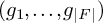
 is called the Kazhdan constant. For a proof, see [Reference Bekka, De la Harpe and ValetteBdlHV08, Definition 1.1.3, Proposition 1.1.9]. It is sometimes notationally convenient to list the elements of F as a tuple
$(g_1,\dots ,g_{|F|})$
 , which we call a Kazhdan tuple.
The von Neumann algebraic analogue of property (T), introduced by Connes and Jones [Reference Connes and JonesCJ85] for
$\mathrm {II}_1$
 factors and Popa [Reference PopaPop06a] for general tracial von Neumann algebras, uses Hilbert bimodules over a tracial von Neumann algebra M in place of group representations.
Definition 2.4.
-
(i) If M is a von Neumann algebra, then a Hilbert M-M-bimodule is a Hilbert space equipped with normal left and right actions of M.
-
(ii) A vector $\xi $
in a Hilbert M-M bimodule
$\mathcal {H}$
is central if
$x \xi = \xi x$
for all
$x \in M$
. -
(iii) If $(M,\tau )$
is a tracial von Neumann algebra, then a vector
$\xi $
in an M-M-bimodule M is bitracial if
$ \left \langle {x\xi , \xi } \right \rangle = \tau (x) = \left \langle {\xi x, \xi } \right \rangle $
for all
$x \in M$
.


There is analogy between central vectors in a Hilbert M-M-bimodule and invariant vectors in a group representation motivated by the way in which representations of a discrete group G naturally give rise to bimodules over the group von Neumann algebra
$L(G)$
 . Let
$\lambda $
 and
$\rho $
 denote the left and right regular representations of G on
$\ell ^2(G)$
 . If
$\pi $
 is a representation of G on
$\mathcal {H}$
 , then
$\pi \otimes \lambda $
 is a left representation on
$H \otimes \ell ^2(G)$
 and
$1 \otimes \rho $
 is a right representation on
$H \otimes \ell ^2(G)$
 . These representations extend to normal left/right actions of
$L(G)$
 , making
$H \otimes \ell ^2(G)$
 into a Hilbert
$L(G)$
 -
$L(G)$
 -bimodule. If
$\xi $
 is an invariant unit vector in
$\mathcal {H}$
 , then
$\xi \otimes \delta _e$
 is a central and bitracial vector in
$H \otimes \ell ^2(G)$
 . Hence, property (T) for tracial von Neumann algebras is defined as follows.
Definition 2.5 [Reference Connes and JonesCJ85, Reference PopaPop06a]
A tracial von Neumann algebra
$(M,\tau )$
 has property (T) if for every
$\varepsilon> 0$
 , there is a finite
$F \subseteq M$
 and
$\delta> 0$
 such that for every bitracial vector
$\xi $
 in a Hilbert M-M-bimodule
$\mathcal {H}$
 , if
$\sum _{x \in F} \left \lVert {x\xi - \xi x} \right \rVert < \delta $
 , then there exists a central
$\eta \in \mathcal {H}$
 with
$ \left \lVert {\xi - \eta } \right \rVert < \varepsilon $
 .
It turns out that a group G has property (T) if and only if
$L(G)$
 has property (T) [Reference Connes and JonesCJ85, Theorem 2]. One can also formulate a von Neumann algebraic version of Kazhdan tuples as follows.
Definition 2.6. Let
$(M,\tau )$
 be a tracial von Neumann algebra. We say that
$x = (x_1,\dots ,x_d) \in M_{\operatorname {\mathrm {sa}}}^d$
 is a (self-adjoint) Kazhdan tuple if there exists
$\gamma> 0$
 such that for every Hilbert M-M-bimodule
$\mathcal {H}$
 and
$\xi \in \mathcal {H}$
 , we have

where
$x \xi = (x_1 \xi , \dots , x_d \xi )$
 and
$\xi x = (\xi x_1,\dots , \xi x_d)$
 and where
$P_{\text {central}}$
 is the projection of H onto the subspace of central vectors. In this case, we call
$\gamma $
 the Kazhdan constant associated to the Kazhdan tuple x.
Unlike the group case, every tracial von Neumann algebra with property (T) need not admit a Kazhdan tuple (the finite set F in the definition of property (T) may depend a priori on
$\varepsilon $
 ). However, it is known for several natural classes of examples.
Lemma 2.7.
-
(i) If M is a property (T) von Neumann algebra with finite-dimensional center, then M has a Kazhdan tuple.
-
(ii) If G is a property (T) group, and $\pi \colon G\to \mathcal {U}(\mathcal {H})$
is a projective unitary representation such that
$W^{*}(\pi (G))$
is finite, then
$W^{*}(\pi (G))$
has a finite Kazhdan tuple.


Proof. (i): Cutting M down by the minimal central projections in M, we see that M is a direct sum of
$\textrm {II}_{1}$
 -factors. Each such factor has property (T) by [Reference PopaPop06a, Proposition 4.7.2] and thus admits a Kazhdan tuple by [Reference Connes and JonesCJ85, Proposition 1]. Combining these Kazhdan tuples gives a Kazhdan tuple for M.
(ii): Choose a Kazhdan set
$\{g_{1},\cdots ,g_{k}\}\subseteq G$
 for G. Let

Even though
$\pi $
 may not be an honest representation, note that if
$\mathcal {H}$
 is an M-M bimodule, then we do have a representation of G on
$\mathcal {H}$
 given by conjugating by
$\pi (G)$
 . Applying [Reference Bekka, De la Harpe and ValetteBdlHV08, Proposition 1.1.9] to this representation, we see that x is a Kazhdan tuple for
$W^{*}(\pi (G))$
 .
It is a standard exercise to show that a Kazhdan tuple for a group G must generate the group. A well-known result of Popa [Reference PopaPop86, Theorem 4.4.1] shows that the same is true for Kazhdan tuples associated to tracial von Neumann algebras. For the reader’s convenience, we recall the proof here.
Lemma 2.8. If
$(M,\tau )$
 is a tracial von Neumann algebra and
$x = (x_1,\dots ,x_d)$
 is a Kazhdan tuple, then x generates M as a von Neumann algebra.
Proof. Consider the standard (GNS) representation of M on
$L^2(M,\tau )$
 . Let
$N = \mathrm {W}^*(x) \subseteq M$
 . Let
$e \in B(L^2(M,\tau ))$
 be the orthogonal projection onto
$L^2(N,\tau |_N) \subseteq L^2(M,\tau )$
 . The von Neumann algebra
$M_1 = \left \langle {M,e} \right \rangle \subseteq B(L^2(M,\tau ))$
 is called the basic construction for
$N \subseteq M$
 . It is well known that
$M \cap \{e\}' = N$
 and that M has a semi-finite trace
$\operatorname {\mathrm {Tr}}$
 such that
$\operatorname {\mathrm {Tr}}(aeb) = \tau (a b)$
 for
$a, b \in M$
 by [Reference JonesJon83]. Since M embeds into
$M_1$
 , we may regard
$L^2(M_1,\operatorname {\mathrm {Tr}})$
 as an M-M bimodule. The element
$e \in L^2(M_1,\operatorname {\mathrm {Tr}})$
 satisfies
$ae = ea$
 for
$a \in N$
 and in particular this holds for
$a = x_1$
 , …,
$x_d$
 . Since X is a Kazhdan tuple for M, we have
$ae = ea$
 for all
$a \in M$
 , which implies that
$M = N$
 .
2.5 Ultraproducts of matrix algebras
At several points, we use ultraproducts of matrix algebras, so we recall the relevant background as well as the connection between ultraproducts and microstate spaces.
Definition 2.9. Let J be an infinite set. A free ultrafilter is a unital homomorphism

For every
$(a_{n})_{n\in J}\in \ell ^{\infty }(J)$
 , we will use
$\lim _{n\to \omega }a_{n}$
 for
$\omega ((a_{n})_{n\in J}+c_{0}(J))$
 .
It follows from [Reference ConwayCon90, Proposition VIII.1.12] that
$\lim _{n\to \omega }$
 is a
$*$
 -homomorphism. It thus preserves inequalities and commutes with complex conjugation, by definition
$\lim _{n\to \omega }$
 preserves sums and products. By Gelfand–Naimark duality [Reference ConwayCon90, Theorem VIII.2.1], free ultrafilters exist in abundance (in fact, there are enough to separate points in
$\ell ^{\infty }(J)/c_{0}(J)$
 ). We use
$\beta J\setminus J$
 for the space of free ultrafilters on J.
Recall that if
$\omega $
 is a free ultrafilter on
${\mathbb N}$
 , then the tracial ultraproduct of
${\mathbb M}_{n}({\mathbb C})$
 with respect to
$\omega $
 is given by

If
$(x_{n})_{n}\in \prod _{n}{\mathbb M}_{n}({\mathbb C})$
 and
$\sup _{n}\|x_{n}\|_{\infty }<\infty $
 , we let
$[x_{n}]_{n}$
 be the image of
$(x_{n})_{n}$
 under the natural quotient map

It can be shown (see [Reference Brown and OzawaBO08, Lemma A.9]) that this is a tracial von Neumann algebra, with trace given by

We say that a tracial von Neumann algebra
$(M,\tau )$
 is Connes-embeddable if every von Neumann subalgebra with separable predual admits a trace-preserving embedding into a tracial ultraproduct of matrices.
Suppose that
$d \in {\mathbb N}$
 , and
$R>0$
 . If
$(\ell _{n})_{n}$
 is a sequence in
$\Sigma _{d,R}$
 , and
$\ell \in \Sigma _{d,R}$
 , we say that
$\lim _{n\to \omega }\ell _{n}=\ell $
 if
$\lim _{n\to \omega }\ell _{n}(P)=\ell (P)$
 for all
$P\in {\mathbb C} \left \langle {t_{1},\cdots ,t_{d}} \right \rangle $
 . Suppose
$(M,\tau )$
 is a tracial von Neumann algebra and
$x\in M_{\operatorname {\mathrm {sa}}}^{d}$
 . If
$X^{(n)}\in {\mathbb M}_{n}({\mathbb C})_{\operatorname {\mathrm {sa}}}^{d}$
 satisfies
$\lim _{n\to \omega }\ell _{X^{(n)}}=\ell _{x}$
 , then there is a unique trace-preserving embedding
$\pi \colon M\to \prod _{n\to \omega }{\mathbb M}_{n}({\mathbb C})$
 which satisfies

(see, for instance, [Reference Gangbo, Jekel, Nam and ShlyakhtenkoGJNS22, Lemma 5.10] for further detail). Because of this, we may heuristically think of the microstate spaces
$\Gamma ^{(n)}_{R}(\mathcal {O})$
 as
$\mathcal {O}\to \ell _{x},n\to \infty $
 as parameterizing the space of embeddings of M into an ultraproduct of matrices.
See [Reference JungJun07a] and [Reference Atkinson and KunnawalkamAKE21, Sections 1.2, 1.3] for further discussion of the connections between ultraproducts and microstate spaces. These concepts also relate to random matrix theory; see, for instance, [Reference VoiculescuVoi94, Reference VoiculescuVoi98, Reference Dykema, Jung and ShlyakhtenkoDJS05, Reference Brown, Dykema and JungBDJ08, Reference Hayes, Jekel, Nelson and SinclairHJNS21].
3 Proof of Theorem 1.1
As in Theorem 1.1, we consider a tracial von Neumann algebra
$(M,\tau )$
 together with a Kazhdan tuple
$x = (x_1,\dots ,x_d)$
 . The following lemma is a refinement of [Reference Jung and ShlyakhtenkoJS07, Theorem 1.1]. It shows roughly that microstates for our Kazhdan tuple are unitarily conjugate except for a piece that lies under a projection of small trace. The core idea for the proof of this lemma is the corresponding statement about embeddings into ultraproducts of matrices: if two embeddings of a property (T) algebra are close on x, then they are unitarily conjugate except on a small corner of M. Further, the size of that corner can be controlled in terms of how close they are on x.
Lemma 3.1. Let
$(M,\tau )$
 be a tracial von Neumann algebra, and let
$x = (x_1,\dots ,x_d) \in M_{\operatorname {\mathrm {sa}}}^d$
 be a Kazhdan tuple with Kazhdan constant
$\gamma $
 and suppose
$ \left \lVert {x} \right \rVert _\infty < R$
 . Then for every
$\varepsilon> 0$
 and
$\delta> 0$
 , there exists a neighborhood
${\mathcal O}$
 of
$\ell _x$
 and
$n_0 \in {\mathbb N}$
 such that for all
$n \geq n_0$
 , if
$Y, Z \in \Gamma _R^{(n)}({\mathcal O})$
 with
$ \left \lVert {Y - Z} \right \rVert _2 \leq \varepsilon $
 , then there exists a unitary U in
$\mathbb {M}_n({\mathbb C})$
 and a projection P such that

Proof. Write

Fix
$\varepsilon> 0$
 and
$\delta> 0$
 . Suppose for contradiction that the claim fails. Fix a sequence of neighborhoods
${\mathcal O}_k$
 shrinking to
$\mu $
 . By our assumption, for each k there must exist arbitrarily large
$N \in {\mathbb N}$
 such that the claim about Y,
$Z \in \Gamma _R^{(n)}({\mathcal O}_k)$
 fails. Hence, we can choose
$n_k \in {\mathbb N}$
 with
$n_{k+1}> n_k$
 such that there exist
$Y^{(n_k)}$
 ,
$Z^{(n_k)} \in \Gamma _R^{(n_k)}({\mathcal O}_k)$
 with
$ \left \lVert {Y^{(n_k)} - Z^{(n_k)}} \right \rVert _2 \leq \varepsilon $
 such that

Now, choose a free ultrafilter
$\omega \in \beta {\mathbb N}\setminus {\mathbb N}$
 so that
$\lim _{n\to \omega }1_{\{n_{k}:k\in {\mathbb N}\}}(n)=1.$
 For notational convenience, extend
$Y^{(n_k)}$
 and
$Z^{(n_k)}$
 to sequences
$Y^{(n)}$
 and
$Z^{(n)}$
 defined for all
$n \in {\mathbb N}$
 (however, the values for
$n \not \in \{n_k: k \in {\mathbb N}\}$
 will not matter). Then

and

Let

that is, the tracial
$\mathrm {W}^*$
 ultraproduct of matrix algebras with respect to the ultrafilter
$\omega $
 . Let
$y = [Y^{(n)}]_{n\in {\mathbb N}}$
 and
$z = [Z^{(n)}]_{n \in {\mathbb N}}$
 in
$\mathcal {M}_{\operatorname {\mathrm {sa}}}^d$
 . Then y and z have the same law as x, and therefore, there are trace-preserving embeddings
$\pi _1, \pi _2: (M,\tau ) \to ({\mathcal M},\operatorname {\mathrm {tr}})$
 such that
$\pi _1(x) = y$
 and
$\pi _2(x) = z$
 . We can make
$L^{2}({\mathcal M},\operatorname {\mathrm {tr}})$
 into an M-M bimodule by letting M act on the left by
$\pi _{1}$
 and on the right by
$\pi _{2}$
 . Let
$T: L^2({\mathcal M},\operatorname {\mathrm {tr}}) \to L^2({\mathcal M},\operatorname {\mathrm {tr}})^d$
 be the operator
$T(a) = ya - az$
 . By definition of the Kazhdan constant
$\gamma $
 , we have

Let
$a = P_{\ker (T)}(1) \in L^2(\mathcal {M},\operatorname {\mathrm {tr}})$
 so that
$ya = az$
 by definition of T. Here, we consider a as an affiliated operator to
$\mathcal {M}$
 (see [Reference Brown and OzawaBO08, Appendix F]), and as such, it has a polar decomposition
$a = v|a|$
 , where
$|a| = (a^*a)^{1/2} \in L^2(\mathcal {M},\operatorname {\mathrm {tr}})$
 and v is a partial isometry with range equal to the closure of the range of a (see [Reference Reed and SimonRS80, Theorem VII.32]). It is not hard to show that
$yv = vz$
 (see [Reference PopaPop04, Lemma 5]), and it follows that
$v^*v$
 commutes with z. Furthermore,

Let
$p = 1 - v^*v$
 . Since
$\mathcal {M}$
 is a finite von Neumann algebra, there exists a partial isometry sending
$1 - v^*v$
 to
$1 - vv^*$
 , and therefore, there is a unitary u such that
$v = u(1 - p)$
 . Since
$1 - p = v^*v$
 commutes with z, we have

It is a standard exercise to show that there exists a sequence of projections
$(P^{(n)})_{n \in {\mathbb N}}$
 and a sequence of unitaries
$(U^{(n)})_{n \in {\mathbb N}}$
 such that
$p = [P^{(n)}]_{n \in {\mathbb N}}$
 and
$u = [U^{(n)}]_{n \in {\mathbb N}}$
 . We also have

and

Therefore,

which contradicts our choice of
$Y^{(n)}$
 and
$Z^{(n)}$
 , and thus the argument is complete.
Now that we know that microstates are conjugate up to a small projection, in order to control the covering number of the microstate space, we need to estimate the covering numbers of the space of these projections. We rely on an estimate of Szarek [Reference SzarekSza98] on the covering numbers of Grassmannians, which we state in the following form.
Lemma 3.2. There exists a universal constant C such that for
$t \geq 0$
 ,

Proof. First, the two covering numbers are equal because we can make the substitution
$P \mapsto 1 - P$
 . Thus, it suffices to estimate the first one. For
$\ell \in {\mathbb N}\cup \{0\}$
 , let
$G(\ell ,n-\ell )$
 be the subset of
$\mathbb {M}_n({\mathbb C})$
 consisting of rank
$\ell $
 orthogonal projections. By [Reference SzarekSza98, Theorem 8 and Remark (ii) below it], there is a uniform
$C> 0$
 so that

Note that

The number of terms in the union is the ceiling of
$n\min (1,t)$
 which is bounded by
$1 + nt$
 . The covering number of each of the individual sets can be bounded by
$(C / \varepsilon )^{2\ell (n-\ell )} \leq (C / \varepsilon )^{2n^2t}$
 since
$\ell \leq nt$
 and
$n - \ell \leq n$
 .
Next, we combine Lemma 3.1 and Lemma 3.2 to obtain the following estimate, which bounds the
$\eta $
 -covering numbers for microstate spaces in terms of the
$\varepsilon $
 -covering numbers for
$\eta \leq \epsilon $
 . We will then conclude the proof of the theorem by iterating this estimate.
Lemma 3.3. Let
$(M,\tau )$
 be a tracial von Neumann algebra, and suppose
$x \in M_{\operatorname {\mathrm {sa}}}^d$
 is a Kazhdan tuple with
$ \left \lVert {x} \right \rVert _\infty < R$
 and with Kazhdan constant
$\gamma $
 . Let
$0 < \eta \leq \varepsilon < \gamma /2$
 . Then

where C is a positive universal constant.
Proof. Fix
$\delta> 0$
 with
$\delta < \eta /3$
 and
$(2\varepsilon / \gamma )(2 + 2\varepsilon / \gamma ) + \delta < 6\varepsilon / \gamma $
 (the latter being possible because
$\varepsilon < \gamma $
 ). Let
${\mathcal O}$
 and
$n_0$
 be as in Lemma 3.1 for the constants
$\delta $
 and
$2\varepsilon $
 (rather than
$\delta $
 and
$\varepsilon $
 ), and assume that
$n \geq n_0$
 . For ease of notation, let
$t = 6 \varepsilon / \gamma $
 .
By Lemma 3.2, choose a set
$\Xi $
 of projections of rank less than or equal to
$nt$
 such that every projection P with
$\operatorname {\mathrm {tr}}_n(P) \leq t$
 satisfies
$ \left \lVert {P - Q} \right \rVert _\infty < \eta / (6Rd^{1/2})$
 , such that
$|\Xi | \leq (1 + nt)(6C_1Rd^{1/2}/\eta )^{2n^2 t}$
 , for some universal constant
$C_{1}$
 . For each
$Q \in \Xi $
 with rank
$\ell $
 , the space
$\mathbb {M}_n({\mathbb C})^d Q$
 has real dimension
$2n \ell d \leq 2 n^2 t d$
 and therefore there exists
$E_Q \subseteq \mathbb {M}_n({\mathbb C})^d Q$
 that
$(\eta /3, \left \lVert {\cdot } \right \rVert _2)$
 -covers
$\overline {B}_{\mathbb {M}_n({\mathbb C})^d Q, \left \lVert {\cdot } \right \rVert _2}(0,2Rd^{1/2})$
 and satisfies

for some universal constant
$C_{2}$
 . Finally, fix
$\Omega \subseteq \Gamma _R^{(n)}({\mathcal O})$
 that orbitally
$(2\varepsilon , \left \lVert {\cdot } \right \rVert _2)$
 -covers
$\Gamma _R^{(n)}({\mathcal O})$
 and satisfies
$|\Omega | \leq K_{\varepsilon }(\Gamma _R^{(n)}({\mathcal O}), \left \lVert {\cdot } \right \rVert _2)$
 .
We claim that
$\Omega ' = \bigcup _{Q \in \Xi } (\Omega + E_Q)$
 is an
$(\eta , \left \lVert {\cdot } \right \rVert _2)$
 -covering of
$\Gamma _R^{(n)}({\mathcal O})$
 . To see this, suppose
$Y \in \Gamma _R^{(n)}({\mathcal O})$
 . Then there exists
$Z \in \Omega $
 and a unitary V such that
$ \left \lVert {Y - VZV^*} \right \rVert _2 < 2\varepsilon $
 , hence
$ \left \lVert {V^*YV - Z} \right \rVert _2 < 2 \varepsilon $
 . By our choice of
$n_0$
 and
${\mathcal O}$
 , there exists a projection P and a unitary U such that

To simplify notation, let us rename
$VU$
 to U so that
$ \left \lVert {(U^*YU - Z)(1 - P)} \right \rVert _2 < \eta /3$
 . Fix a projection
$Q \in \Xi $
 such that
$ \left \lVert {P - Q} \right \rVert _\infty < \eta / (6Rd^{1/2})$
 . Note that

Moreover,

hence there exists
$W \in E_Q$
 such that

It follows that

This shows that
$\Omega '$
 orbitally
$(\eta , \left \lVert {\cdot } \right \rVert _2)$
 -covers
$\Gamma _R^{(n)}({\mathcal O})$
 as desired.
Therefore,

where
$C_3 = 6 \max (C_1,C_2)$
 . After applying
$\limsup _{n \to \infty } (1/n^2) \log $
 to both sides, we obtain

Substitute back
$t = 6 \varepsilon / \gamma $
 and letting
${\mathcal O}$
 shrink to
$\ell _x$
 , we obtain the asserted result.
Now, we can finish the proof of Theorem 1.1 by iterating Lemma 3.3.
Proof of Theorem 1.1
Let
$(M,\tau )$
 be a tracial
$\mathrm {W}^*$
 -algebra with a Kazhdan tuple
$x = (x_1,\dots ,x_d)$
 with Kazhdan constant
$\gamma $
 and
$ \left \lVert {x} \right \rVert _\infty < R$
 . For
$\varepsilon < \min (\gamma ,1)$
 , we can take
$\eta = \varepsilon ^2$
 in the previous lemma and obtain

Iterating this estimate, we have that for
$\varepsilon < \min (1,\gamma )$
 ,

Fix
$\varepsilon \in (0,\min (1,\gamma ))$
 . As
$k \to \infty $
 , we have
$h_{R,\varepsilon ^{2^k}}(x) \to h(M)$
 . Therefore,

Since the sum on the right-hand side converges, we have
$h(M) < \infty $
 , and thus M is strongly
$1$
 -bounded.
4 Direct sums, amplification and strong
$1$
-boundedness

The main goals of this section are to prove Proposition 1.2 and show that our Theorem 1.1 implies Jung and Shlyakhtenko’s result that tracial von Neumann algebras with property (T) have free entropy dimension at most
$1$
 for every finite generating set [Reference Jung and ShlyakhtenkoJS07] using previously known facts about free entropy dimension. To these ends, we study the behavior of
$1$
 -bounded entropy under direct sums and matrix amplification.
4.1 Direct sums and strong
$1$
-boundedness

In order to prove Propositions 1.2 and 1.3, we must understand the behavior of h under direct sums of tracial von Neumann algebras. Let J be a countable index set and
$(\lambda _j)_{j \in J} \in (0,\infty )^J$
 such that
$\sum _{j \in J} \lambda _j = 1$
 , and for each
$j \in J$
 , let
$(M_j,\tau _j)$
 be a tracial von Neumann algebra. Then

is defined as the tracial von Neumann algebra
$(M,\tau )$
 , where

and

It is shown in [Reference HayesHay18, Proposition A.13(i)] that

Our goal in this section is to give a corresponding lower bound for
$h(M,\tau )$
 (see Lemma 4.2). As with many results in free entropy theory, we run into the issue that we do not know whether using a
$\liminf $
 instead of
$\limsup $
 in the definition of h would yield the same result. Thus, we will need to use the ‘
$\liminf $
 version’ of
$1$
 -bounded entropy
$\underline {h}$
 in our formula. It is also convenient for the proof to use the description of
$1$
 -bounded entropy in terms of relative microstates rather than unitary orbits. We therefore recall the following definitions.
Definition 4.1. Let
$(M,\tau )$
 be a tracial von Neumann algebra,
$l\in {\mathbb N}$
 and
$y\in M_{\operatorname {\mathrm {sa}}}^{l}$
 . A microstates sequence for y is a sequence
$(Y^{(n)})\in \prod _{n}{\mathbb M}_{n}({\mathbb C})_{\operatorname {\mathrm {sa}}}^{l}$
 with


Suppose that
$d\in {\mathbb N}$
 , that
$x\in M_{\operatorname {\mathrm {sa}}}^{d}$
 and that
$Y^{(n)}$
 is a microstates sequence for y as above. Fix

For
$n\in {\mathbb N}$
 and
$\mathcal {O}$
 a weak
$^{*}$
 -neighborhood of
$\ell _{x,y}$
 , we let

We let
$K_{\varepsilon }(\Omega ,\|\cdot \|_{2})$
 be the minimal cardinality of a subset of
${\mathbb M}_{n}({\mathbb C})^{d}$
 which
$(\varepsilon , \left \lVert {\cdot } \right \rVert _2)$
 -covers
$\Omega $
 . Let
$(M,\tau )$
 be a tracial von Neumann algebra,
$d,s,l\in {\mathbb N}$
 and let
$x\in M_{\operatorname {\mathrm {sa}}}^{d},y\in M_{\operatorname {\mathrm {sa}}}^{s},a\in M_{\operatorname {\mathrm {sa}}}^{l}$
 . Suppose that
$(A^{(n)})_{n}$
 is a microstates sequence for a. Fix
$R\in (0,\infty )$
 with
$R>\max (\|x\|_{\infty },\|y\|_{\infty },\sup _{n}\|A^{(n)}\|_{\infty })$
 . For
$n\in {\mathbb N}$
 , let
$\pi _{r}\colon M_{n}({\mathbb C})_{\operatorname {\mathrm {sa}}}^{d+s}\to M_{n}({\mathbb C})_{\operatorname {\mathrm {sa}}}^{d}$
 be the projection onto the first d-coordinates. For a weak
$^{*}$
 -neighborhood
$\mathcal {O}$
 of
$\ell _{x,y,a}$
 , and
$n\in {\mathbb N}$
 , we set

We will heuristically refer to the collection of spaces
$(\Gamma ^{(n)}_{R}(x|A^{(n)}:\mathcal {O}))_{n,\mathcal {O}}$
 as the microstates spaces for x relative to a in the presence of y. Roughly speaking, the usual microstates spaces correspond to embeddings of
$W^{*}(x,a)$
 into an ultraproduct of matrices. As in Section 2.5, relative microstates spaces in the presence correspond to embeddings of
$W^{*}(x)$
 into ultraproducts of matrices which both restrict to the embedding of
$W^{*}(a)$
 given by
$(A^{(n)})_{n}$
 , and have an extension to
$W^{*}(x,y,a)$
 .
We now define

where the infimum is over all weak
$^{*}$
 -neighborhoods
$\mathcal {O}$
 of
$\ell _{x,y,a}$
 . If
$W^{*}(a)$
 is diffuse and hyperfinite, and if
$W^{*}(a)\subseteq W^{*}(x)$
 , we then define

By standard methods, it can be shown that
$\underline {h}(x:y)$
 does not depend upon the choice of R, and this justifies dropping it from the notation. If
$W^{*}(a)$
 is diffuse and hyperfinite, then the above quantity is independent of a and the choice of
$(A^{(n)})_{n}$
 by the same arguments in [Reference HayesHay18, Lemma A.5, Corollary A.6]. In [Reference HayesHay18], this is only shown when a is a single element which generates a diffuse, abelian von Neumann algebra, but the same argument works for any tuple generating a diffuse, hyperfinite von Neumann algebra. By the same arguments as in [Reference HayesHay18, Theorem A.9], one can show that if
$d',s'\in {\mathbb N}$
 and
$x'\in M_{\operatorname {\mathrm {sa}}}^{d'},y\in M_{\operatorname {\mathrm {sa}}}^{s'}$
 satisfies
$W^{*}(x')=W^{*}(x)$
 ,
$W^{*}(x,y)=W^{*}(x',y')$
 and if
$W^{*}(x),W^{*}(y)$
 are diffuse, then
$\underline {h}(x:y)=\underline {h}(x':y')$
 . Thus, if
$M_{1}\leq M_{2}\leq M$
 and
$M_{1},M_{2}$
 are finitely generated and diffuse, we can set

where
$x_{j},j=1,2$
 are finite self-adjoint tuples in M with
$W^{*}(x_{1})=M_{1}$
 ,
$W^{*}(x_{1},x_{2})$
 . We then set

where the infimum is over all finitely generated subalgebras Q of M which contain
$M_{1}$
 . Finally, for
$N\leq M$
 , we let

where the supremum is over all finitely generated, diffuse subalgebras P of N. We call
$\underline {h}(N:M)$
 the lower
$1$
 -bounded entropy of N in the presence of M, and we set
$\underline {h}(M)=\underline {h}(M:M)$
 . The above definition using relative microstates can intuitively be thought of describing the
$1$
 -bounded entropy as a measurement of how many embeddings N has into an ultraproduct of matrices which both restrict to a given embedding of
$W^{*}(a)$
 and have an extension to M. The definition of
$1$
 -bounded entropy using unitary conjugation orbits can be thought of as a measurement of how many embeddings M has into an ultraproduct of matrices modulo unitary conjugation. It is a fact that when
$N = M$
 , these measurements are the same [Reference HayesHay18, Lemma A.5].
We remark that the properties of h given in Section 2 are satisfied, mutatis mutandis, for
$\underline {h}$
 with the exception that the analogue of item 6 is that

The lower bound for the
$1$
 -bounded entropy of direct sums is as follows.
Lemma 4.2. Suppose that J is a countable index set and that
$((M_{j},\tau _{j}))_{j\in J}$
 are diffuse tracial von Neumann algebras. Let
$(\lambda _{j})_{j\in J}$
 be positive numbers with
$\sum _{j}\lambda _{j}=1$
 , and set
$(M,\tau )=\bigoplus _{j}\lambda _{j}(M_{j},\tau _{j})$
 . Suppose that
$N_{j}\leq M_{j},j\in J$
 are diffuse, and set
$N=\bigoplus _{j}N_{j}$
 . Then


Proof. If there is a
$j \in J$
 so that
$M_{j}$
 is not Connes-embeddable, then both sides are
$-\infty $
 , and there is nothing to prove. So we will assume without further comment throughout the proof that all algebras involved are Connes-embeddable. The proofs for h and
$\underline {h}$
 are nearly identical, so we will only give the proof for
$\underline {h}$
 . First, consider the case where
$J = \{1,2\}$
 . Fix tracial von Neumann algebras
$(M_{j},\tau _{j}),j=1,2$
 , and diffuse
$N_{j}\leq M_{j}$
 . Without loss of generality, we may assume that
$N_{j},M_{j}$
 are finitely generated, so let
$r_{j},s_{j}\in {\mathbb N},j=1,2$
 , and let
$x_{j}\in (N_{j})_{\operatorname {\mathrm {sa}}}^{r_{j}}$
 ,
$y_{j}\in (M_{j})_{\operatorname {\mathrm {sa}}}^{s_{j}}$
 be generating sets. Let
$z_{j},j=1,2$
 be the identity of
$M_{j}$
 , regarded as a projection in
$M_{1}\oplus M_{2}$
 . Let
$a_{j}\in (N_{j})_{\operatorname {\mathrm {sa}}},j=1,2$
 be an element with diffuse spectrum. We will use microstates relative to
$b=(a_{1}\oplus 0,0\oplus a_{1},z_{1},z_{2})$
 to compute the entropy. So let
$C^{(n)}\in {\mathbb M}_{n}({\mathbb C})_{\operatorname {\mathrm {sa}}}^{4}$
 be a microstates sequence for b. To ease notation set
$A_{j}^{(n)}=C^{(n)}_{j},j=1,2$
 and
$Z^{(n)}_{j}=C^{(n)}_{j+2},j=1,2$
 . We may, and will, assume that
-
• $Z^{(n)}_{1},Z^{(n)}_{2}$
are diagonal projections with
$Z^{(n)}_{1}+Z^{(n)}_{2}=1$
for all n, -
• $n\operatorname {\mathrm {tr}}_{n}(Z^{(n)}_{1})=\lfloor {\tau (z_{1})n\rfloor }$
for all n, -
• $Z^{(n)}_{j}A^{(n)}_{j}Z^{(n)}_{j}=A^{(n)}_{j}$
for all n and all
$j=1,2,$
-
• $A^{(n)}_{j}$
are diagonal for all n and all
$j=1,2$
.


Set
$b_{j}=(a_{j},z_{j}),j=1,2,$
 and let
$B^{(n)}_{j}=(A^{(n)}_{j},\operatorname {\mathrm {id}}_{\ell _{n,j}})$
 where we regard
$A^{(n)}_{j}$
 as an element of
$M_{\ell _{n,j}}$
 , where
$\ell _{n,j}=n\tau (Z^{(n)}_{j})$
 Set
$x=(x_{1}\oplus 0,0\oplus x_{2})$
 , and
$y=(y_{1}\oplus 0,0\oplus y_{2})$
 . Finally, fix

Given a neighborhood
$\mathcal {O}$
 of
$\ell _{x,y,b}$
 , we may find neighborhoods
$\mathcal {O}_{j},j=1,2$
 of
$\ell _{x_{j},y_{j},b_{j}}$
 so that

Given
$\varepsilon>0$
 , let
$\Omega _{n,j}\subseteq \Gamma ^{(\ell _{n,j})}(x_{j}|B^{(\ell _{n,j})}_{j};\mathcal {O}_{j})$
 be
$\varepsilon $
 -separated with respect to
$\|\cdot \|_{2}$
 (meaning that distinct points in
$\Omega _{n,j}$
 are distance at least
$\varepsilon $
 from each other). Then for all sufficiently large n, we have that
$\Omega _{n,1}\oplus \Omega _{n,2}$
 is an
$\varepsilon $
 -separated subset of
$\Gamma ^{(n)}(x|B^{(n)};\mathcal {O})$
 and thus has cardinality at most
$K_{\varepsilon /2}(\Gamma ^{(n)}_{R}(x|B^{(n)};\mathcal {O}),\|\cdot \|_{2})$
 .
Thus, for all
$\varepsilon>0$
 and for all sufficiently large n,

Since
$\{\lfloor {\tau (z_{1})n\rfloor }:n\in {\mathbb N}\}$
 and
$\{\lceil {\tau (z_{2})n\rceil }:n\in {\mathbb N}\}$
 have finite complement in
${\mathbb N}$
 , and since limit infimums are super additive, the above inequality shows that for all
$\varepsilon>0$
 we have

Letting
$\mathcal {O}$
 decrease to
$\ell _{x,y,b}$
 and letting
$\varepsilon \to 0$
 completes the proof of the case where
$J = \{1,2\}$
 .
The case where J is finite follows by induction. Now, suppose that J is infinite and assume without loss of generality that
$J = {\mathbb N}$
 . Let
$(N_{j}\leq M_{j})_{j\in J}$
 be as in the statement of the lemma. For each
$j\in J$
 , fix a diffuse abelian
$A_{j}\leq N_{j}$
 . For
$r\in {\mathbb N}$
 , let

Since
$\bigoplus _{j=r+1}^{\infty }A_{j}$
 has
$1$
 -bounded entropy zero, we have by the case of finite J that

Since
$N_{\leq r}$
 are an increasing sequence of subalgebras of N and
$\bigvee N_{\leq r}=N$
 , we have that

4.2 Amplification and strong
$1$
-boundedness

This section will show that
$h(M^t) = t^{-2} h(M)$
 for
$\mathrm {II}_1$
 factor M (Proposition 1.3) and then conclude the proof of Proposition 1.2. To prove Proposition 1.3 for
$t \in (0,1)$
 , we consider a projection
$p \in M$
 with trace t and analyze the
$1$
 -bounded entropy of certain subalgebras of M related to
$pMp$
 . At a key point, we use the fact that if N is a von Neumann subalgebra of M, then for
$h(N:M)$
 to equal
$h(M)$
 , it is sufficient that every sequence of matricial microstates for N extends to a sequence of matricial microstates for M. We state this property more precisely as follows.
Definition 4.3. Let
$(M,\tau )$
 be a tracial von Neumann algebra, and
$N\leq M$
 . We say the inclusion
$N\leq M$
 has the microstates extension property if for every free ultrafilter
$\omega \in \beta {\mathbb N}\setminus {\mathbb N}$
 for every
$N_{0}\leq N$
 ,
$M_{0}\leq M$
 so that
$N_{0},M_{0}$
 have separable predual and
$N_{0}\leq M_{0}$
 , and for every trace-preserving embedding
$\Theta \colon N_{0}\to \prod _{k\to \omega }{\mathbb M}_{k}({\mathbb C})$
 into a tracial ultraproduct of matrix algebras
${\mathbb M}_{k}({\mathbb C})$
 , there exists a trace-preserving embedding
$\widetilde {\Theta }\colon M_{0}\to \prod _{k\to \omega }{\mathbb M}_{k}({\mathbb C})$
 with
$\widetilde {\Theta }\big |_{M_{0}}=\Theta $
 .
The following lemma formulates the microstates extension property in terms of microstates spaces. The proof is an exercise in understanding the definitions and is left to the reader.
Lemma 4.4. Let
$(M,\tau )$
 be a tracial von Neumann algebra, and let
$N\leq M$
 . Then the inclusion
$N\leq M$
 has the microstates extension property if and only if for every
$d,s\in {\mathbb N}$
 , every
$x\in N_{\operatorname {\mathrm {sa}}}^{d},y\in M_{\operatorname {\mathrm {sa}}}^{s}$
 , every
$R>\max (\|x\|_{\infty },\|y\|_{\infty })$
 and every neighborhood
$\mathcal {V}$
 of
$\ell _{x,y}$
 there is a neighborhood
$\mathcal {O}$
 of
$\ell _{x}$
 so that

where
$\pi _{d}\colon {\mathbb M}_{k}({\mathbb C})_{\operatorname {\mathrm {sa}}}^{d+s}\to {\mathbb M}_{k}({\mathbb C})_{\operatorname {\mathrm {sa}}}^{d}$
 is the projection onto the first d coordinates.
The following lemma gives some examples and also explains the relevance to
$1$
 -bounded entropy.
Lemma 4.5.
-
(i) Suppose that $(M,\tau )$
is a tracial von Neumann algebra, that
$N\leq Q\leq M$
, that N is diffuse and that the inclusion
$Q\leq M$
has the microstates extension property. Then
$h(N:Q)=h(N:M)$
and
$\underline {h}(N:Q) = \underline {h}(N:M)$
. -
(ii) If $(M,\tau )$
is Connes embeddable and
$N\leq M$
is hyperfinite, then the inclusion
$N\leq M$
has the microstates extension property. -
(iii) If $(M_{j},\tau _{j}),\ j=1,2$
are Connes-embeddable, then
$M_{1}*1\leq M_{1}*M_{2}$
has the microstates extension property.


We remark that (i) makes sense from our intuitive description of
$1$
 -bounded entropy. The quantity
$h(N:Q)$
 (resp.
$h(N:M)$
 ) is supposed to be a measurement of ‘how many’ embeddings there are of N into an ultraproduct of matrices which have an extension to Q (resp. M). If
$Q\leq M$
 has the microstates extension property, then every embedding of Q extends to M and thus the quantities
$h(N:Q)$
 ,
$h(N:M)$
 should be the same.
Proof. (i): This is an exercise from Lemma 4.4.
(ii): Without loss of generality we may, and will, assume that
$N,M$
 have separable predual. Fix a free ultrafilter
$\omega \in \beta {\mathbb N}\setminus {\mathbb N}$
 . Let
$\Theta \colon N\to \prod _{k\to \omega }{\mathbb M}_{k}({\mathbb C})$
 be a trace-preserving embedding. Since M is Connes-embeddable, there exists a trace-preserving embedding
$\Psi \colon M\to \prod _{k\to \omega }{\mathbb M}_{k}({\mathbb C})$
 . By [Reference ConnesCon76, Reference JungJun07a], there exists a unitary
$u\in \prod _{k\to \omega }{\mathbb M}_{k}({\mathbb C})$
 so that
$\Psi \big |_{N}=\operatorname {\mathrm {ad}}(u)\circ \Theta $
 . Set
$\widetilde {\Theta }=\operatorname {\mathrm {ad}}(u^{*})\circ \Psi $
 . Then
$\widetilde {\Theta }$
 is the desired extension.
(iii): Without loss of generality we may, and will, assume that
$M_{1},M_{2}$
 have separable predual. Our desired result is now a consequence of [Reference VoiculescuVoi98, Theorem 2.4], [Reference PopaPop14, Corollary 0.2]. Namely, fix a free ultrafilter
$\omega \in \beta {\mathbb N}\setminus {\mathbb N}$
 , and let
$\mathcal {M}=\prod _{k\to \omega }{\mathbb M}_{k}({\mathbb C})$
 . Then, by assumption, there exists trace-preserving embeddings
$\Theta _{j}\colon M_{j}\to \mathcal {M}$
 ,
$j=1,2$
 . By [Reference VoiculescuVoi98, Theorem 2.4], [Reference PopaPop14, Corollary 0.2], there exists a unitary
$u\in \mathcal {M}$
 which is Haar distributed and freely independent of
$\Theta _{1}(M_{1})\vee \Theta _{2}(M_{2})$
 . Then
$\Theta _{1}(M_{1}),u\Theta _{2}(M_{2})u^{*}$
 are freely independent, and this produces an extension
$\widetilde {\Theta }\colon M_{1}*M_{2}\to \mathcal {M}$
 of
$\Theta $
 .
Now, we are ready to prove Proposition 1.3, and in fact we also give the analogous result for
$\underline {h}$
 . We remark that the point
$h(M^t) \leq t^{-2} h(M)$
 for
$t \in (0,1)$
 was already shown in [Reference HayesHay18, Propostion A.13(ii)].
Proposition 4.6. Suppose that M is a
$\textrm {II}_{1}$
 -factor and
$\tau $
 is its canonical trace. For
$t\in (0,\infty )$
 , let
$M^{t}$
 be the
$t^{th}$
 amplification of M. Then

Proof. We first handle the case when
$t \in (0,1)$
 . Fix a hyperfinite
$\textrm {II}_{1}$
 -subfactor R of M. Let
$p\in R$
 be a projection with
$\tau (p)=t$
 . Observe that
$M^{t}\cong pMp$
 . Let
$N=pMp+(1-p)R(1-p)$
 Since R is a factor, we may find partial isometries
$v_{1},\cdots ,v_{n}\in R$
 so that
$v_{j}^{*}v_{j}\leq p$
 and
$\sum _{j}v_{j}v_{j}^{*}=1$
 . Thus,

So

Step 1. We show that
$\underline {h}(M^{t})\geq \frac {1}{t^{2}}\underline {h}(M)$
 . By Equation (4.2) and the fact that
$N\cap R=pRp+(1-p)R(1-p)$
 is diffuse, we have

Here, we use the analogues of [Reference HayesHay18, Lemma A.12 and Proposition A.13 (i)] for
$\underline{\mathrm{h}}$
 .
Step 2. We prove that
$\underline {h}(M^{t})\leq \frac {1}{t^{2}}\underline {h}(M)$
 . We start with the following claim.
Claim.
$N\leq M$
has the microstates extension property

Suppose that
$\omega $
 is a free ultrafilter on the natural numbers, and let
$\mathcal {M}=\prod _{k\to \omega }{\mathbb M}_{k}({\mathbb C})$
 be the tracial ultraproduct of
${\mathbb M}_{k}({\mathbb C})$
 . Let
$\Theta \colon N\to \mathcal {M}$
 be a trace-preserving embedding. Since
$N\cap R$
 is hyperfinite, we know that
$N\cap R\leq R$
 has the microstates extension property by Lemma 4.5 (ii). So there exists a trace-preserving embedding
$\Psi \colon R\to \mathcal {M}$
 with
$\Psi \big |_{N\cap R}=\Theta \big |_{N\cap R}$
 . Let
$v_{1},\cdots ,v_{n}$
 be as before the proof of Step 1. Define
$\widetilde {\Theta }\colon M\to \mathcal {M}$
 by

Observe that
$v_{i}^{*}Mv_{j}\subseteq pMp\subseteq N$
 for all
$i,j$
 , so the formula above makes sense. For all
$1\leq i,j,k,l\leq n$
 and all
$x,y\in M$
 , we have

From here, it is direct to show that
$\widetilde {\Theta }(xy)=\widetilde {\Theta }(x)\widetilde {\Theta }(y)$
 for all
$x,y\in M$
 . It is also direct to show that
$\widetilde {\Theta }$
 preserves adjoints. Finally, for all
$x\in M$
 :

This proves the claim.
By Equation (4.2) and the fact that
$N\cap R$
 is diffuse, we have that

the last step following by the claim and Lemma 4.5 (i). By Lemma 4.2,

This completes the proof of Step 2 and hence also the proof for
$\underline {h}$
 when
$t\in (0,1)$
 . The case
$t=1$
 is trivial, whereas if
$t>1$
 , then
$\frac {1}{t}\in (0,1)$
 and so

For the case of h, it was already shown in [Reference HayesHay18, Proposition A.13(ii)] that
$h(M^{t})\leq \frac {1}{t^{2}}h(M)$
 for
$t \in (0,1)$
 , and the proof of the opposite inequality proceeds in a similar manner to Step 2 above.
With Lemma 4.2 on direct sums and Proposition 4.6 on amplifications in hand, we are ready to finish the proof of Proposition 1.2 showing that strong
$1$
 -boundedness of all tracial von Neumann algebras with property (T) is equivalent to
$h(M) \leq 0$
 for all
$\mathrm {II}_1$
 factors with property (T).
Proof of Proposition 1.2
(iii)
$\implies $
 (ii). Assume that every
$\mathrm {II}_1$
 property (T) factor has nonpositive
$1$
 -bounded entropy. Let M be a tracial von Neumann algebra with property (T), and we will show that
$h(M) \leq 0$
 . Decomposing the center of M into diffuse and atomic parts, we see that there is a countable index set J (potentially empty) so that

where
$M_{0}$
 either has diffuse center or is
$\{0\}$
 , and each
$M_{j}$
 is a factor. Since
$M_{0}$
 either has diffuse center or is
$\{0\}$
 , we know
$h(M_{0})\leq 0$
 . Since M has property (T), each
$M_{j}$
 has property (T) by [Reference PopaPop06a, Proposition 4.7.2]. Thus, by Equation (4.1), we have
$h(M) \leq 0$
 .
(ii)
$\implies $
 (i). If every tracial von Neumann algebra with property (T) satisfies
$h(M) \leq 0$
 , then it is strongly
$1$
 -bounded since strong
$1$
 -boundedness is equivalent to
$h(M) < \infty $
 by [Reference HayesHay18, Proposition A.16].
(i)
$\implies $
 (iii). Proceeding by contraposition, assume that N is a property (T) factor with
$h(N)> 0$
 , and we will show that there is a tracial von Neumann algebra
$(M,\tau )$
 with property (T) such that
$h(M,\tau ) = \infty $
 . Let
$(N^{4^{-k}},\tau _k)$
 be the compression of N, and let

By [Reference PopaPop06a, Proposition 4.7.1], we know that M has property (T). By Lemma 4.2 and Proposition 4.6, for each
$j \in {\mathbb N}$
 , we have

Since
$h(N)>0$
 , we know that N is Connes-embeddable, and thus
$\underline {h}(N)\geq 0$
 . So

Letting
$j\to \infty $
 we see that
$h(M)=\infty $
 , that is, M is not strongly
$1$
 -bounded.
Finally, we show that for each finite von Neumann algebra M with property (T), there exists a faithful normal tracial state
$\tau $
 such that
$(M,\tau )$
 is strongly
$1$
 -bounded. As in (iii)
$\implies $
 (ii), write
$M = \bigoplus _{j=0}^{\infty } M_j$
 such that
$M_0$
 is zero or has diffuse center, and
$M_j$
 is a factor for
$j \geq 1$
 . Let
$\tau _j$
 be the unique tracial state on
$M_j$
 . Since
$h(M_0) \leq 0$
 and since
$h(M_j) < \infty $
 for
$j \geq 1$
 by Theorem 1.1, we may choose nonnegative constants
$(\lambda _j)_{j=0}^{\infty }$
 such that
$\sum _{j=0}^{\infty } \lambda _j = 1$
 ,
$\sum _{j \in {\mathbb N}_0} \lambda _j^2 h(M_j) < \infty $
 , and
$\lambda _{j}>0$
 if and only if
$M_{j}\ne 0$
 . Let
$\tau $
 be the faithful normal tracial state on M given by
$\bigoplus _{j=0}^{\infty } \lambda _j \tau _j$
 . It follows by Equation (4.1) that
$h(M,\tau ) < \infty $
 .
4.3 Direct sums and free entropy dimension
In this section, we show that Theorem 1.1 implies Jung and Shlyakhtenko’s result that a property (T) tracial von Neumann algebra has microstates free entropy dimension at most
$1$
 with respect to every finite generating tuple [Reference Jung and ShlyakhtenkoJS07]. In fact, at the end of the section, we also sketch how to generalize the argument to show that
$\delta _{0}(x)\leq 1$
 for any infinite generating tuple x. First, we recall the definition of Voiculescu’s microstates free entropy dimension.
Definition 4.7. Let
$(M,\tau )$
 be a tracial von Neumann algebra,
$x\in M^{d}_{\operatorname {\mathrm {sa}}}$
 . Fix
$R>\|x\|_{\infty }$
 . For
$\varepsilon>0$
 , and a weak
$^{*}$
 -neighborhood
$\mathcal {O}$
 of
$\ell _{x}$
 , we set

where the infimum is over all weak
$^{*}$
 -neighborhoods
$\mathcal {O}$
 of
$\ell _{x}$
 . We then set

We call
$\delta _{0}(x)$
 the microstates free entropy dimension of x.
By standard methods,
$\delta _{0}(x)$
 does not depend upon the choice of R and this justifies dropping it from the notation. This is not the original definition in [Reference VoiculescuVoi96]; however, by [Reference JungJun03a, Corollary 2.4] they are the same. The following lemma, based on previous work of Jung, describes the behavior free entropy dimension under direct sums.
Lemma 4.8. Let
$(M,\tau )$
 be a tracial von Neumann algebra,
$d\in {\mathbb N}$
 and
$x\in M^{d}_{\operatorname {\mathrm {sa}}}$
 . Let J be a countable set and
$(z_{j})_{j\in J}$
 be central projections in M with
$\sum _{j\in J}z_{j}=1$
 . For
$j\in J$
 , let
$x_{z_{j}}$
 be
$xz_{j}$
 regarded as an element of
$Mz_{j}$
 . Then

Proof. Fix
$R>\|x\|_{\infty }$
 . We first handle the case where J is finite. By induction, to handle the case of finite J it suffices to handle the case where
$J=\{1,2\}$
 . In this case, we use z for
$z_{1}$
 . Let
$P_{n}\in {\mathbb M}_{n}({\mathbb C})_{\operatorname {\mathrm {sa}}}$
 be microstates for z such that each
$P_{n}$
 is an orthogonal projection. By [Reference JungJun06, Lemma 3.2 and Corollary 4.3], we have

where in the last step we use [Reference JungJun03b, Corollary 5.8]. It follows from the proof of [Reference HayesHay18, Proposition A.13(i)] that

Dividing by
$\log (1/\varepsilon )$
 and letting
$\varepsilon \to 0$
 , we obtain that

and by direct computation this is equivalent to the desired inequality.
We now handle the case of infinite J. We may, and will, assume that
$J={\mathbb N}$
 . For
$n\in {\mathbb N}$
 , let
$z_{\leq n}=\sum _{j=1}^{n}z_{j}$
 . Then, by the case of finite J:

We have that
$\delta _{0}(x_{1-z_{\leq n}})\leq d$
 , and thus

The proof is thus completed by letting
$n\to \infty .$

Since being strongly
$1$
 -bounded implies microstates free entropy dimension at most
$1$
 with respect to any set of generators, the preceding lemma automatically implies the following.
Corollary 4.9. Let J be a countable set and
$((M_{j},\tau _{j}))_{j\in J}$
 tracial von Neumann algebras. Suppose that
$(\lambda _{j})_{j\in J}\in (0,1]^{J}$
 with
$\sum _{j\in J}\lambda _{j}=1$
 . Let
$(M,\tau )=\bigoplus _{j}\lambda _{j}(M_{j},\tau _{j}).$
 Assume each
$(M_{j},\tau _{j})$
 is strongly
$1$
 -bounded. Then for any
$x\in M_{\operatorname {\mathrm {sa}}}^{d}$
 with
$W^{*}(x)=M$
 we have
$\delta _{0}(x)\leq 1$
 .
We now recover the results of Jung–Shlyakhtenko.
Corollary 4.10. Let
$(M,\tau )$
 be a Property (T) von Neumann algebra which is finitely generated. Suppose that
$x\in M_{\operatorname {\mathrm {sa}}}^d$
 satisfies
$W^{*}(x)=M$
 . Then
$\delta _{0}(x)\leq 1$
 .
Proof. We may write
$M=M_{0}\oplus \bigoplus _{j\in J}M_{j}$
 where J is a (potentially empty) countable set, each
$M_{j}$
 is a property (T) factor, and
$M_{0}$
 is either
$\{0\}$
 or an algebra with diffuse center. Since
$M_{0}$
 either has diffuse center or is
$\{0\}$
 , we have
$h(M_{0})\leq 0$
 . If J is finite, we see that M is strongly
$1$
 -bounded by Theorem 1.1, and by how
$1$
 -bounded entropy behaves under direct sums. If J is infinite, then we may apply Corollary 4.9 to complete the proof.
We remark that if one works carefully with free entropy dimension in the presence in Lemma 4.8, then a proof of the Corollary 4.9 can be given for infinite tuples as well. Using this, one can show that if M is a property (T) algebra, then
$\delta _{0}(x)\leq 1$
 for every tuple which generates M, even if x is infinite. We will not give the full proof here, but sketch the details for the interested reader.
Given a tracial von Neumann algebra
$(M,\tau )$
 and finite tuples
$x\in M_{\operatorname {\mathrm {sa}}}^{d},y\in M_{\operatorname {\mathrm {sa}}}^{s}$
 with
$d,s\in {\mathbb N}$
 , an
$R>\max (\|x\|_{\infty },\|y\|_{\infty })$
 , a weak
$^{*}$
 -neighborhood
$\mathcal {O}$
 of
$\ell _{x,y}$
 and
$\varepsilon>0$
 , we set

where the infimum is over all weak
$^{*}$
 -neighborhoods
$\mathcal {O}$
 of
$\ell _{x,y}$
 . We then define the free microstates free entropy dimension of x in the presence of y by

by standard methods we can show that this is independent of R, and this justifies dropping R from the notation. One can show that if
$a\in M_{\operatorname {\mathrm {sa}}}^{t}$
 for some
$t\in {\mathbb N}$
 and
$W^{*}(x,y)=W^{*}(x,a)$
 , then
$\delta _{0}(x:y)=\delta _{0}(x:a)$
 . So we set

and this does not depend upon the choice of y.
Now, suppose that
$x=(x_{j})_{j\in J}\in M_{\operatorname {\mathrm {sa}}}^{J}$
 for some set J. For a finite
$F\subseteq J$
 , let
$x_{F}\in M_{\operatorname {\mathrm {sa}}}^{F}$
 be given by
$x_{F}=(x_{j})_{j\in F}$
 . We then set

where the infimum is over all finitely generated
$Q\leq M$
 with
$x_{F}\in Q^{F}_{\operatorname {\mathrm {sa}}}$
 , and the supremum is over all finite subsets F of J. We set
$\delta _{0}(x)=\delta _{0}(x:W^{*}(x))$
 .
To generalize Corollary 4.9 to infinite tuples, one first proves a modification of Lemma 4.8. Namely, if x is a self-adjoint tuple in M and
$(z_{j})_{j\in J}$
 are projections in
$Z(M)\cap W^{*}(x)$
 , then

To prove Equation (4.3), one first handles the case x is a finite tuple, and
$J=\{1,2\}$
 . The proof of Equation (4.3) in this case is a minor modification of Lemma 4.8. Namely, one modifies the proof of [Reference JungJun06, Lemma 3.2 and Corollary 4.3] to show that if
$z\in Z(M)\cap W^{*}(x)$
 is a central projection, then

One then modifies the proof of [Reference JungJun03b, Corollary 5.8] to say that
$\delta _{0}(x:M)=\delta _{0}(x,z:M)$
 . After changing the results in [Reference JungJun06, Reference JungJun03b] to work for free entropy dimension in the presence, the proof of Equation (4.3) in the case that x is a finite tuple and
$J=\{1,2\}$
 proceeds exactly as in Lemma 4.8. The proof of the general case of Equation (4.3) from this special case also follows precisely as in Lemma 4.8.
The inequality (4.3) automatically shows that if M is a direct sum of strongly
$1$
 -bounded algebras and if x is any self-adjoint tuple in M, then
$\delta _{0}(x)\leq 1$
 , and from this one deduces a version of Corollary 4.10 where x is any self-adjoint tuple (finite or not).
Acknowledgements
Dima Shlyakhtenko deserves special thanks for inspiring us to work on this problem. We thank Thomas Sinclair and Ionut Chifan for helpful discussions about the applications of the paper and Dima Shlyakhtenko and Adrian Ioana for comments on a draft of the paper.
Data availability
The authors confirm that the data supporting the findings of this study are available within the article (e.g. in the proofs of the theorems).
Competing interest
The authors have no competing interest to declare.



