The year 1924 marked a fundamental turning point in the history of the Weimar Republic. After months of deep crises in 1923, which included foreign occupation, hyperinflation, and attempted coups d'état by both communists and Nazis, the German economy and polity entered a phase of relative stability, and social peace loomed on the horizon. Recognizing the dramatic shift in the sociopolitical landscape, the German Communist Party (Kommunistische Partei Deutschlands, KPD) also underwent a significant transformation. On the political front, the most notable event was the ousting of Ruth Fischer and Arkadij Maslow, under the heavy hand of Moscow, in favor of Ernst Thälmann.Footnote 1
Thälmann dramatically refashioned the KPD beginning in 1925. Among the most significant changes he initiated was an organizational overhaul known as “into the masses” (Heran an die Massen), which he hoped would transform the KPD from a revolutionary party, dominated by militant male cadre, into a mass movement.Footnote 2 At the heart of this shift was the creation of a host of ancillary organizations designed to broaden the party's appeal. The KPD sought to attract all members of the working-class family by sponsoring social organizations for fathers, mothers, and children.Footnote 3 Eventually, leaders hoped, members of the ancillary organizations would join the party itself. Among the most touted of these new groups was the Red Women and Girls' League (Roter Frauen- und Mädchen Bund, RFMB), which the party founded in late 1925 to attract a broad female working-class constituency. Party leaders envisioned the RFMB as a vital tool to recruit women who were reluctant to join the KPD itself, and they instructed the league to appeal to proletarian women by politicizing issues that they faced in their daily lives, such as the prices of everyday goods, women's wages, welfare, and reproductive rights. The aim was to provide working-class women with a political education to bring them into the “class-fighting front”—into the KPD.Footnote 4
An examination of the RFMB sheds critical light on the political organization of working-class women in Weimar Germany. Above all, it offers insight into the ways that communism appealed to women. Which issues mobilized working-class women? How did communists adjust their politics to attract them? And how did female actors influence the polity? The study of the RFMB also provides a compelling glimpse into gender relations within the KPD and communist movement more broadly. How did communists construct their feminine ideal, and to what extent did the rank and file accept her? Lastly, the history of the RFMB provides an excellent case study to assess the extent to which the KPD disciplined (in communist parlance “bolshevized”) its cadre. In other words, did RFMB women toe the party line?
Although the history of the RFMB provides critical insight into how communist politics unfolded on the ground, especially among Weimar's newly enfranchised female voters, few scholars have examined the organization.Footnote 5 Even Silvia Kontos's pioneering study on women in the KPD devoted little attention to the RFMB.Footnote 6 While Hans-Jürgen Arendt and Werner Freigang offered important contributions to the study of the league, their research was framed by a teleological perspective that characterized East German scholarship on Weimar communism more generally.Footnote 7 The few scholars who cursorily investigated the RFMB focused mainly on institutional questions, primarily the league's relationship with the KPD. To mobilize working-class women, especially those who shunned political parties, the RFMB was to assume an “above-party” (außerparteilich) orientation. As its founding statutes explained, the RFMB was “not a political party organization, but a collection of all proletarian women and girls without consideration to party affiliation and religious beliefs.”Footnote 8 Despite such a bold claim of independence, the KPD crafted the league to bring working-class women into its political fold. As James Diehl asserts, “Politically, the RFMB was strictly subordinate to the needs of the party. It was a women's communist organization, rather than a communist women's organization.”Footnote 9 In other words, the KPD sought to fashion the RFMB into a front organization and concomitantly subject it to its drive for Bolshevization.
While this research concurs that the KPD did attempt to bolshevize the RFMB and its ranks, it deepens the investigation of the RFMB's relationship with the KPD by examining this relationship from leaders' and members' perspectives, and in doing so, it demonstrates that the party's effort to bolshevize RFMB women was fraught with tension, for RFMB women widely contested the KPD's stance on a number of decisive issues. When viewed from the ground level, RFMB women did not march in lockstep, especially in regard to directives on factory organization and the party's call for them to renounce militarism. To this extent, this research is consistent with recent scholarship that challenges the long-standing interpretation that the KPD silenced dissent within the party.Footnote 10 As the newer scholarship maintains, the cadre operated with considerable autonomy and often in opposition to party directives.Footnote 11
While the newer scholarship has provided a vital corrective to research that overemphasizes the KPD's totalitarian features, it is also evident that the RFMB, following the cues of party leaders, did indeed cultivate an internal culture that exalted conformity, which was guided largely by the disciplinary function of the culture of Bolshevization. Institutionally, the drive for Bolshevization emanated from Moscow and was fostered to varying degrees in communist parties throughout Europe. As Sheila Fitzpatrick maintains, by the late 1920s, Russian communists had developed a distinct mentalité that defined “discipline and unity . . . in almost mystical terms” in an effort to check political adversaries, including party members.Footnote 12 Instrumental to the propagation of this Soviet disciplinary ethos was the Comintern, which worked to instill Soviet ideology and values in communist parties throughout the world.Footnote 13 The emphasis on orthodoxy was particularly prevalent during international communism's “Third Period” beginning in 1928 when leaders undertook an aggressive campaign to eliminate opposition, especially Trotskyist elements.Footnote 14 Examining the interwar Spanish Communist Party, Tim Rees demonstrates that communists deployed political culture to nurture unswerving orthodoxy and party discipline.Footnote 15 German communists, including RFMB women, likewise promoted political discipline largely through a host of performative rituals that extolled political obedience. By exploring the RFMB's political culture, this research thus forges a middle ground between interpretations that emphasize rank-and-file initiatives and those that characterize the KPD as a monolith.
That RFMB women disregarded some KPD directives underscored the conflicts they faced as they advanced a set of politics geared toward working-class women. The 1990s marked a significant historiographical shift in the study of German communism, as scholars began to investigate gender relations within the KPD. Although the RFMB did not receive prominent attention, scholars demonstrated that the communist movement underwent a process of masculinization, which was especially evident in its political culture. Klaus-Michael Mallman, for example, maintained that the RFMB's founding intensified the masculine orientation of the KPD's paramilitary organization, the Red Front Fighting League (Rotfrontkämpferbund, RFB).Footnote 16 Eric Weitz similarly asserted that the RFMB, by assuming a militant profile, testified to the masculinization of communist political culture more generally.Footnote 17 Despite these important contributions, no scholar has investigated how the RFMB sought to fashion communist femininity, and yet the RFMB represented a critical effort to promote a distinct female archetype. In 1926 RFMB leaders explained, “The RFMB devotes itself to the task of the education of Germany's proletarian women and girls for the proletarian class struggle.”Footnote 18 Employing typical mid- to late-1920s KPD rhetoric, this statement asserted that the RFMB was to prepare women for “proletarian class struggle.” But what would their roles be during revolution? Communists were uncertain.
Yet questions about women's militancy were at the heart of the debates about the communist woman. For KPD and RFMB leaders, Bolshevization on the gender front initially translated into a normative femininity. Throughout most of the 1920s, KPD and RFMB leaders called on women to assume a conventional feminine profile to rally a broad female audience. But many RFMB women refused to conform to this feminine representation. Rejecting the Bolshevization of the communist woman, some RFMB members advocated a radical femininity rooted in militancy and militarism. In 1929, however, RFMB leaders abruptly reversed their stance on communist femininity in favor of militancy. Decisive to this about-face was both the Comintern's belief in impending revolutionary upheaval, articulated in its 1928 declaration of the “Third Period,” and the increasing political violence on the streets throughout Germany. Following the party's cues, RFMB leaders called on members to prepare for combat by enlisting in the KPD's antifascist movement. RFMB women subsequently assumed a distinctly militarized profile, which included both physical and weapons training, thus refashioning RFMB women into antifascist warriors.
Gender Troubles at the Founding
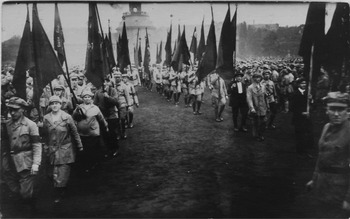
Gender troubles within the ranks of the communist movement were evident even before the creation of the RFMB. Adhering to Comintern and KPD directives that “proletarian women cannot be excluded from any proletarian organization,” the RFB had welcomed female members at its inception in 1924.Footnote 19 Indeed, women had even held key positions at the district level.Footnote 20 They also marched alongside their male comrades, wore the same uniform, ran military drills, and tended to the men's combat wounds.Footnote 21Figure 1, which is a photograph from an August 1925 RFB demonstration, shows at least one woman marching alongside her male comrades.
RFB demonstration, August 1925. Source: SAPMO-BA, Bild Y 1-55/00N.

While the RFB never attracted women in large numbers, women's presence in the paramilitary organization was a source of significant gender conflict.Footnote 22 According to the RFB's national leadership, the central problem was that the women were not sufficiently physically fit for their activities, and some women, it alleged, even collapsed during their marches.Footnote 23 RFB men also charged that women were politically uneducated, susceptible to nervous disorders, and psychologically unsuited for military operations, and they further complained that women undermined the discipline of the paramilitary organization by flirting with their male comrades.Footnote 24 In sum, “the RFB feared that . . . the organization of women would destroy its character as a front-fighting organization,” as RFMB leaders later recalled.Footnote 25 By spring 1925, opposition against the women was mounting, exemplified by the Berlin branch's ban on women from participating in an upcoming demonstration.Footnote 26 The women's fate was sealed in May when the RFB expelled them at its Second National Conference. Thereafter, KPD leaders directed the women into a provisional organization, the Red Women's League (Rote Frauenliga), a precursor to the RFMB.Footnote 27
That the KPD and communist men more generally resisted integrating women fully into the movement underscored the persistent debates about the organization of women within the German labor movement since its inception in the late nineteenth century. As a number of scholars have demonstrated, the prewar German Social Democratic Party (Sozialdemokratische Partei Deutschlands, SPD) neglected to mobilize women in earnest and fully integrate them into party life. Despite theoretical support for women's rights, SPD leaders relegated women to the margins of the party, even after the 1908 repeal of the law that banned women from joining political parties.Footnote 28 Contradictions between the theory and praxis of female emancipation persisted within the SPD during the Weimar Republic as well. As Karen Hagemann contends, social democracy, with its orientation toward parliamentary and industrial politics, remained “a masculine affair,” containing distinct strands of “modern proletarian antifeminism.”Footnote 29 Social democratic political culture, she argues, showcased a masculine “military discipline” that reinforced the gender divide within the SPD.Footnote 30 As a consequence of gender discrimination within the SPD, party women were called upon to work on family issues (i.e., reproduction, welfare, and education), which many male and female social democrats believed was women's “natural” sphere.Footnote 31
Research on women in interwar Soviet society provides further insight into the gendered hierarchy of the KPD, for conventional gender patterns also dominated the social landscape of early Soviet society, despite prominent pro-feminist initiatives. In her examination of the Zhendotdel, the Soviet women's organization that was established in 1919 under the leadership of Alexandra Kollontai, Wendy Goldman maintains that from the turn of the century until January 1930 when the Politburo eliminated the Zhendotdel, Russian communists displayed a profound ambivalence about whether women should be organized in a separate women's organization. The Soviet leadership, she argues, failed to articulate a “consistent position” regarding the organization of women due largely to the persistence of traditional gender patterns and attitudes not only among rank-and-file communists but also among the leadership.Footnote 32 Elizabeth Wood concurs that “an underlying ambivalence about women's emancipation and citizenship” prevailed in the Soviet Union.Footnote 33 German communists' organization of women was similarly laced with deep ambivalence: on the one hand, they courted working-class women by advancing the most pro-feminist agenda of all Weimar political parties; on the other hand, they consistently cast women as adjunct revolutionaries.
While KPD leaders characterized the women's ousting from the RFB as an opportunity to create an organization devoted exclusively to working-class women, a number of women adamantly denounced their expulsion. As Comrade (Genossin) Fischer from Hamburg asserted, “It is a mistake to separate women from the RFB. Just as the husband and wife have to fight together, so, too, do they belong together in the proletarian organization. Before separation from the RFB, we worked well together in Hamburg; only afterward did differences arise.”Footnote 34 Resistance was particularly fierce in Thuringia and the Ruhr Valley, where female members remained in the RFB even after their official ouster, which explains why women subsequently participated in RFB functions, as seen in Figure 1.Footnote 35
Other women, by contrast, championed the establishment of a separate women's organization. Most prominently, Clara Zetkin, the grande dame of Weimar communism, maintained that the RFB's militaristic orientation did not appeal to the majority of working-class women.Footnote 36 Helene Overlach concurred, contending that the masculine militaristic culture of the paramilitary organization deterred women from joining it; instead, she advocated a separate women's organization that would be more welcoming to a wide female working-class constituency.Footnote 37 On the ground, communist women also complained that the RFB's and even the Red Women's League's militaristic culture repulsed most working-class women.Footnote 38 At the RFMB's founding congress in November 1925, Zetkin and Overlach's argument won the day, as representatives voted nearly unanimously in favor of the RFMB's establishment.Footnote 39 They also elected Zetkin as first chairperson, but the real force behind the league was Overlach, who soon became a central figure in the KPD's Women's Section and a Reichstag delegate.Footnote 40
Recruiting Women
Zetkin and Overlach's position underscored the difficulties that the KPD had experienced in attracting women during its formative years. With a distinctly militant profile during an era of social upheaval, the KPD was a bastion of masculinity in the early 1920s. But as the party reorganized itself during a non-revolutionary period in the mid-1920s, it worked to reinvent itself as a mass party that enthusiastically welcomed women. Party leaders hoped that the RFMB would politicize the masses of working-class women by championing their causes. They also hoped that the RFMB would attract working-class women away from Germany's other 250 women's organizations.Footnote 41
Topping the RFMB's agenda was the KPD's central strategy: “mobilization of workingwomen in the factories.”Footnote 42 As leaders explained, “The workingwomen must know that we are really the representatives of their interests.”Footnote 43 To win female workers for communism, RFMB leaders instructed branches to implement KPD directives regarding factory organization. Members were to hold meetings at factories with large female workforces, run candidates for work council elections, and publish articles addressing workingwomen's concerns in the KPD's factory cell papers. They were also to tailor the party's agenda to female workers by politicizing issues that affected them, including unemployment, the lengthening of work hours, rationalization, wage reductions, as well as the KPD's chief slogan regarding workingwomen: “equal pay for equal work.”Footnote 44 Tactically, however, RFMB members faced a multitude of challenges, as their female colleagues widely ignored their efforts to politicize the shop floor. Indeed, the RFMB never attained the support it sought from workingwomen. In 1927, at the high point of the organization's membership, only fifty percent of its ranks were workingwomen.Footnote 45 Typical of the RFMB's failure to recruit workingwomen were the statistics that Overlach presented in 1929 on the league's activities at Werner Works, a subsidiary of Siemens. Of the 10,000 women who worked there, only three or four were RFMB members.Footnote 46 The rank and file echoed Overlach's evaluation, as one member from the Lower Rhine explained, “For two years, we have been trying to get our foot in the door in a few factories, but without much success.”Footnote 47 In the opinion of an RFMB representative from East Saxony, the central problem was the factory cell paper, which included little that interested workingwomen. Accordingly, the men in the factory cell who oversaw the paper did not publish articles geared toward women because they claimed that they did not know which issues mattered to workingwomen.Footnote 48 While gender differences among communists on the factory floor likely contributed to the league's failure to recruit workingwomen, the members themselves generally did not support the KPD's industrial strategy. As internal documents readily disclosed, RFMB leaders consistently reported that its ranks widely resisted shop floor and factory cell directives, illustrating a key failure in the drive for Bolshevization.Footnote 49 While party leaders advanced the factory cell as the primary organizational tool on the shop floor, many RFMB women rejected workplace organization altogether.
In contrast to its efforts to politicize workingwomen, the RFMB enjoyed considerable success courting homemakers. To appeal to working-class housewives, the RFMB advocated an array of issues that specifically affected the working-class family, such as high rents, the shortage of housing, escalating utility prices, the cost of groceries, and welfare.Footnote 50 Although some historians have posited that the RFMB avoided controversial issues, especially abortion, the league was also a steadfast proponent of reproductive rights.Footnote 51 In fact, most issues of the league's organ, Frauenwacht, contained at least one article on abortion, demonstrating that the RFMB rallied behind some of the most radical feminist causes in Weimar Germany. RFMB activities in working-class neighborhoods focused on politicizing working-class women where they lived. Leaders instructed branches to engage women at department stores, at the market place, and in their homes.Footnote 52 RFMB members were also active in the production of neighborhood cell papers, writing about issues that were important to working-class homemakers.Footnote 53 In contrast to its work on the shop floor, the RFMB's appeals visibly resonated with working-class mothers. In 1926, seventy percent of its membership was married, and by 1927 the RFMB was based almost exclusively in working-class neighborhoods.Footnote 54 In fact, some branches reported that as much as ninety percent of its members described themselves primarily as housewives.Footnote 55 Thus, despite KPD and RFMB leaders' calls to focus on factory organization, the RFMB experienced its greatest success in mobilizing homemakers.
To recruit women, the RFMB routinely sponsored Agitprop forums, called “Red Evenings,” that featured lighter political fare, such as skits, artistic exhibitions, films, and the singing of proletarian standards. RFMB leaders reasoned that entertainment not only helped to forge a “collective spirit,” but it also functioned as a didactic tool in the political schooling of women.Footnote 56 Such gatherings included a speech, followed by a question-and-answer session, and the Red Evenings generally concluded with a triple “Red Front” yell.Footnote 57 The aim was “to give women the feeling that they have learned something very important.”Footnote 58 RFMB leaders' instructions for the Red Evenings provide keen insight into the ways that communists viewed their working-class sisters. Not only did RFMB leaders emphasize entertainment as a means to politicize the audience, but they also repeatedly reminded members that most proletarian women's political education was “primitive” and their ability to grasp political and theoretical concepts was limited.Footnote 59 They, therefore, urged their ranks to engage recruits on practical issues that women faced in their daily lives and in a “simple language” that a female audience could readily understand.Footnote 60 RFMB leaders thus perpetuated the stereotype of working-class women as political neophytes, which explains why Frauenwacht published political word puzzles as a tool to educate readers about communism.Footnote 61
While the RFMB initially enjoyed considerable success, recruiting 25,000 members by the end of 1926, membership plummeted in the late 1920s.Footnote 62 During the first quarter of 1929, it numbered just under 6,000, and by the end of the year, it totaled less than 4,000, marking a decrease of thirty-five percent in only one year.Footnote 63 The wavering support for the RFMB was largely consistent with party membership trends in the late 1920s. In 1929, for example, women totaled only 16.5 percent of KPD membership, which marked the high point of female membership in the party.Footnote 64 It was no wonder then that the contemporary statistician Dr. Hartwig described the KPD as an “out-and-out men's party.”Footnote 65 By comparison, women represented on average nineteen percent of the SPD's membership from 1919 to 1932.Footnote 66 Such statistics underscored the challenges that labor broadly faced in recruiting women.
Bolshevization of Communist Women
An examination of the RFMB's institutional apparatus, political platforms, organizing strategies, and cultural practices demonstrates that the league and the KPD were intimately intertwined. Despite Overlach's assertion that the birth of the league occurred spontaneously, the KPD heavily influenced the RFMB from the outset.Footnote 67 In fact, the establishment of the RFMB itself highlighted the prominent role the KPD was to play within the RFMB. Under Fischer and Maslow (1924–25), the KPD had opposed the creation of a separate women's organization, but when Thälmann assumed leadership, he immediately pressed for the founding of the RFMB. This move, however, was met with considerable resistance from party women, who feared not only that the league would drain the KPD of talented women, but also that a separate organization would marginalize women within the party.Footnote 68 Furthermore, many party women disparaged the RFMB, as explained by a league representative from Remscheid, who complained that party women mocked RFMB members, chiding that “the RFB didn't want the women anymore, so they threw them out. Now they stand there in field jackets and chinstraps [shouting] ‘Comrades, Red Front.’”Footnote 69 As this report intimated, party women's hostility to the RFMB was rooted in their opposition to the militarization of women under the RFMB banner. In response to such resistance, the Central Committee actively squashed opposition to the RFMB among its own cadre, reminding its female members that they “are obligated to carry out national leadership's instructions strictly.”Footnote 70 Nevertheless, both the RMFB and the KPD's Women's Section continued to report that numerous party women refused to work with the RFMB.Footnote 71
Organizationally, the KPD also influenced the RFMB. Most notably, the party brass played a pivotal role in determining the RFMB's leadership, despite assertions that that RFMB leaders were not obligated to join the KPD.Footnote 72 Furthermore, KPD leaders viewed the RFMB women as vital foot soldiers for the party. Reasoning that the women could gain entrée into the working-class home, they instructed RFMB members to engage in a variety of party propaganda activities to rally proletarian women to the communist banner. Given the KPD's perennial problem of attracting female voters, RFMB women were especially critical during election seasons.Footnote 73
For its part, the RFMB closely followed KPD directives and enthusiastically supported the party. Not only did the league's structure resemble that of the KPD, but RFMB leaders also directed members to participate in a variety of party activities, including recruitment drives and demonstrations.Footnote 74 The close relationship between the RFMB and the KPD was especially apparent on the league's agenda. Although RFMB leaders instructed members to politicize issues important to working-class women, KPD platforms consistently trumped specific women's concerns in the league's work. As early as the RFMB's founding congress in 1925, the opening speech, delivered by Ernst Schneller from the Central Committee, focused explicitly on the party's program, which included opposition to imperialism, capitalist exploitation, the Dawes Plan, and the Locarno Pact. Only toward the end of his speech did Schneller address issues tailored to a female audience, such as the shortage of housing, the rising prices of household goods, and reproductive rights.Footnote 75 Clearly demonstrating that it would support the KPD's agenda, the RFMB set an indelible precedent whereby it prioritized the KPD's political objectives. Meanwhile, the call for addressing women's daily issues dissipated on the RFMB's agenda. The hierarchy of the political agenda was clear: issues that appealed specifically to women were subordinated to the KPD's central platforms. Frauenwacht summed up the RFMB's relationship with the party: “[O]nly the KPD can be the leader of the proletariat, and we pledge faithfully always to stand next to it and to fight together with it until the victory of the working class is achieved.”Footnote 76
The effort to bolshevize RFMB women was not merely an institutional question, however, for the entire culture of Bolshevization sought to create an army of committed and disciplined communist women. At the heart of this culture was an array of rituals and symbols designed to foster political loyalty and cohesion. Scholars have long noted the importance of collective rites in the cultivation of group solidarity. As Catherine Bell explains, political rites “use symbols and symbolic action to depict a group of people as a coherent and ordered community based on shared values and goals.”Footnote 77 David Kertzer affirms that collective ritual practices serve to forge an esprit de corps. “Ritual activity is not simply one possible way of creating group solidarity; it is a necessary way. Only by periodically assembling together and jointly participating in such symbolic action can the collective ideas and sentiments be propagated.”Footnote 78 From showcasing red flags to singing “The International,” the RFMB borrowed heavily from the KPD's cultural arsenal to promote a collective spirit that nurtured political discipline.Footnote 79
As the RFMB integrated communist rituals and symbols into its political pageantry, it also developed an internal culture that ritualized acts of self-disciplining. From its founding, the league was infused with organizational principles that stressed discipline. “A strict league discipline is required,” explained the founding directives. “If the leadership calls, then members must take their positions.”Footnote 80 As numerous scholars have demonstrated, KPD leaders pursued strategies to foster political conformity and suppress dissent.Footnote 81 Taking their cues from the KPD brass, RFMB leaders worked actively to bolshevize members and bring them into the KPD fold. The method through which RFMB women became integrated into the party, however, was often a result of a self-disciplining process, rather than merely coercion. Indeed, RFMB women conformed to the culture of Bolshevization by adopting the languages and rites of Bolshevization. In this regard, the RFMB's internal culture mirrored that of other communist movements throughout the world. In the Soviet Union, for example, the state developed “criticism and self-criticism” rituals in the 1920s to ensure revolutionary commitment.Footnote 82 Examining the Communist Party in Chicago, Randi Storch shows that party discipline was cultivated through routine criticism and self-criticism campaigns whereby the party encouraged members to reflect upon their roles to ensure that they adhered to the party's ideology and tactics.Footnote 83 As Tim Rees further elucidates, the interwar Spanish Communist Party promoted such political discipline largely through ritualistic performance. “[T]he introduction of regular ‘criticism and self-criticism’ sessions in which individuals were invited to accept their own failings and to expose the errors of others . . . was as much educative as disciplinary, requiring the participants to learn the latest [political] formulas.”Footnote 84
RFMB women likewise developed cultural practices that emphasized self-discipline and the rituals of self-disciplining to cultivate political unity. Central to such political dramaturgy were semi-public statements of praise for the league's leaders and confessions of political error, which was consummately illustrated at the RFMB's 1929 national congress. According to the minutes, district representatives not only offered obsequious declarations of their support for the leadership, but they also deferentially conceded their numerous mistakes. Indeed, the minutes contain a series of confessions about the shortcomings of their work, such as the contribution by the representative from Hamburg: “What was lacking with us was that we went out in public too little. We hope, if we put other work more in the foreground, that our organization will move forward.”Footnote 85 Admitting to the branch's recruiting failure, the member vowed to work more diligently. Such a statement epitomized the culture of Bolshevization: a semi-public confession of mistakes, followed by a promise to execute party directives more fully. A reflection on the function of ritual helps to explain the ways that the self-disciplining process operated within the RFMB. Emile Durkheim posits that rituals reinforce communal bonds by “attaching the individual to the society of which he is a member.”Footnote 86 The RFMB set up a pattern of ritualistic performance in which members reaffirmed their political orthodoxy and commitment to the league by declaring their support for leadership's decisions, which was especially critical after members had gone astray. Such rituals served not only to bring accused deviators into line, but also to school other comrades through the didactic theater, and this political spectacle worked in tandem with the more heavy-handed measures that RFMB and KPD leaders implemented as they strove for Bolshevistic unity.
Constructing the Communist Woman
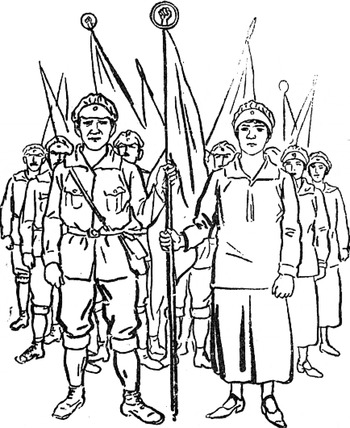
While Bolshevization of the communist woman can be gauged by the extent to which leaders convinced RFMB women to commit themselves to the KPD's political platforms and organizational strategies as well as the extent to which RFMB women participated in communist cultural practices, Bolshevization can also be measured by the extent to which RFMB women assumed an identity that was consistent with leaders' vision of the communist woman. Beginning with the founding of the RFMB, league leaders consciously crafted the RFMB's public profile by propagating a distinct appearance for members. Central to the construction of the communist woman was the promotion of a united appearance to make members “feel like national comrades,” as the RFMB's founding statutes explained.Footnote 87 Analogous to RFB men, communist athletes, and Young Pioneers, RFMB women donned uniforms in symbolic gestures of revolutionary allegiance, thus transfiguring their bodies into political statements that publicly declared their commitment to communist politics. For RFMB leaders, the uniform was an important visual tool to promote a disciplined unity and to present a unified image to the public. Leaders instructed members to wear a blue skirt, an RFB tunic without a belt, a white or grey blouse, a field jacket, a red head scarf at meetings, and a wide-brimmed hat at demonstrations.Footnote 88 As Figure 2 depicts, the RFMB uniform closely resembled that of the RFB. Standing resolute alongside RFB men were women who donned the RFMB's military-style uniform. Except for the omission of the belt and the substitution of a skirt for trousers, the women's uniform mirrored that of their male comrades.
RFMB women with RFB men on “Red Pentecost.” Source: Frauenwacht, June 1926. Library of the Friedrich Ebert Stiftung.

Views on the RFMB uniform revealed that the league's political identity was replete with inconsistencies, however. On the one hand, RFMB leaders staunchly advanced the wearing of the uniform to foster an esprit de corps. “League clothing,” they argued, “has a propagandistic effect for the league, strengthening the feeling of collectiveness, strengthening proletarian discipline.”Footnote 89 On the other hand, leaders were concerned that the sight of a large number of uniformed women sporting military-style attire would scare off potential recruits, and therefore, they instructed that only one-third of demonstrators wear RFMB clothing.Footnote 90 But soon the RFMB brass, frustrated about the dearth of uniforms at its demonstrations, called on members to showcase the uniform more prominently. At its Third National Congress in 1929, leaders declared, “The RFMB must march in the same dress. We must demonstrate the unity of our organization to the outside. We must strengthen the feeling of unity.”Footnote 91
The uniforming of RFMB women did not simply represent an exercise in cultivating solidarity, for the uniform also nurtured a particular vision of communist femininity. Indeed, with the propagation of distinct attire for members, the RFMB promoted a physical image of the communist woman that emphasized a normative femininity. Even before the founding of the RFMB, communists had made a concerted effort to mold communist women into a conventional feminine representation. In fact, when the RFB expelled women, concerns about them wearing the RFB uniform sparked considerable conflict within the RFB and KPD, as RFB men insisted that their former female comrades relinquish their uniforms and cease appearing at RFB activities in the clothing of the men's organization.Footnote 92 Having ousted the women, RFB men adamantly objected to the women sporting their martial uniform. RFMB leaders largely concurred that communist women should assume an identity that distanced themselves from the martial appearance of RFB men. At its national congress in November 1926, the RFMB affirmed that “because it is not a military organization, hats and armbands are inappropriate.”Footnote 93
For RFMB leaders, the feminine ideal appeared “healthy” and “simple.”Footnote 94 Among her conventional feminine features were her knee-length skirt and stockings. Simplicity was conveyed with an unadorned red head scarf. That she sported loose-fitting clothing and short hair demonstrated that communist femininity was influenced by the image of the New Woman.Footnote 95 In fact, the communist woman offered a working-class rendering of the New Woman who was “youthful, healthy, slender, [and] athletic.”Footnote 96 But communists rejected other elements of the New Woman entirely, as explained in 1926:
Coquettishness must not be accentuated with the uniform because it is repulsive. On the contrary, the uniform should overcome women's clothing that is especially designed for the fashion addicted (putzsüchtigen) and the hunt for men (Männerfang). Whoever wears curls on her forehead, a jacket and hat over her ears, along with . . . high heels, proves that she does not grasp [the concept of] the uniform.Footnote 97
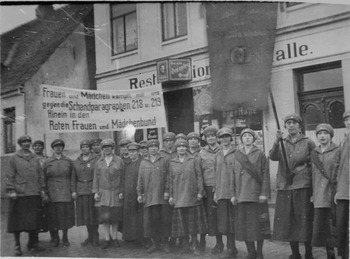
For RFMB leaders, the uniforming of the communist woman signaled the rejection of some popular fashion conventions, especially those that emphasized seductiveness. The pinnacle image of the communist woman, by contrast, was one that personified revolutionary seriousness and discipline in her dress and demeanor, as illustrated in Figure 3.
RFMB abortion rights demonstration in Bremen, 1928. Source: SAPMO-BA, Bild Y 1-11781.

Although there are some variations in these women's attire, they embody the RFMB's conception of communist femininity, appearing modern and serious. Most of them also wore a bobbed cut, one of the most emblematic features of the New Woman and a symbol of female emancipation during the interwar years. In fact, short hair was often associated with communist femininity in popular culture. As relayed by a male bourgeois character in Elisabeth Urbschat's Klassenunterschied. Eine Erzählung aus dem Leben des RFMB, “A German woman with such a bobbed cut—she looks like a Bolshevik!”Footnote 98
As the cultivation of the uniform demonstrated, league leaders sought to temper militancy within its ranks to appeal to a broad female working-class constituency, and they severely reproached those who advocated a more militant profile.Footnote 99 Leaders especially called on members to distance themselves from the martial aspects of the RFB's culture. As Frauenwacht explained, the RFMB “is not an organization whose main emphasis and task are demonstrations and military parades. Our work lies elsewhere.”Footnote 100 Zetkin, in particular, asserted that members' advocacy of militarism demonstrated their inability to understand the female mindset.Footnote 101 Despite such rebukes, RFMB leaders failed to convince their ranks to renounce militarism. Even before the founding of the RFMB, many communist women propagated a militant image, even advocating the arming of members.Footnote 102 Furthermore, not only did a significant number of women refuse to relinquish their RFB uniforms after their expulsion from the paramilitary group, but some even wore their RFB attire to the RFMB's founding congress, much to the chagrin of the league's leaders.Footnote 103 Between 1925 and 1929, a fierce battle brewed within the RFMB, as many within the ranks resisted their leaders' “systematic” efforts to mold them into a normative feminine ideal.Footnote 104 KPD leaders disapprovingly confirmed that the league generally “retained an external military character.”Footnote 105 It was not only the disgruntled ranks that advocated a militaristic profile, however, for the RFMB itself promoted female militancy, albeit inconsistently, which was already evident at the organization's founding. While its statutes stated that the RFMB was not “a military organization,” they also claimed that the RFMB was “a fighting organization of proletarian female masses.”Footnote 106 Failing to differentiate clearly between militarism and militancy, RFMB leaders opened the door for members to interpret the league's character independently.
The militancy within the ranks of the RFMB was further reinforced by their adoption of the cultural practices of the RFB. Although the RFMB had officially established itself as a nonmilitaristic organization that embraced all working-class women, RFMB women deployed many rituals and symbols associated with the RFB, including its most aggressive ones. Most notably, the RFMB's official greeting was the RFB's “Red Front,” which members performed at both formal and informal demonstrations, such as in 1929 when women in Königsberg escorted a speaker to the train station by marching, singing revolutionary songs, and chanting “Red Front.”Footnote 107 RFMB women, like their male comrades, also marched in disciplined formation during their demonstrations. Even at less formal activities, the RFMB mimicked the RFB's militaristic cultural practices, such as after a 1929 regional meeting when RFMB women gathered around a kitchen table for coffee and cake while singing “fighting” songs.Footnote 108 Such martial rituals, inspired by the RFB's political culture, served to increase the RFMB's militant character, despite the leadership's continuous attempts to soften members' militancy.
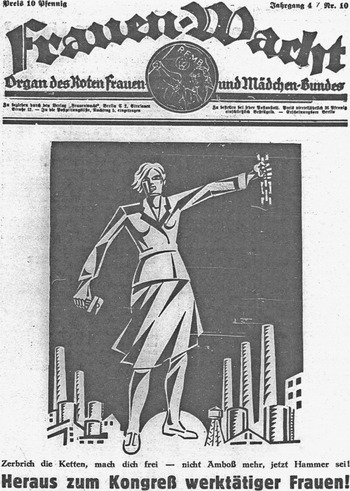
Underpinning RFMB women's militarization was their core belief that they should occupy center stage in revolutionary struggle. On the front lines of battle, communist women would achieve equality, they envisioned. As Frauenwacht explained, “It would be a dangerous illusion to believe that the male proletariat could victoriously carry out this fight without the support of the women.”Footnote 109 By 1929, the RFMB's own imagery boldly projected the female communist warrior, as seen in Figure 4.
Front page of Frauenwacht, October 1929. Source: Library of the Friedrich Ebert Stiftung.

Forcefully wielding a stylized hammer and broken chain, this female representation personified the RFMB's feminine ideal. She dons modern military-style clothing, including a knee-length skirt and a military jacket with a belt. Additionally, she sports a bobbed cut atop her angular head and face, demonstrating the influence of Cubism on communist aesthetics. Most prominently, this figure towers over the factories, reminiscent of the numerous images of men lording over the workplace in KPD publications. She thus demonstrates her revolutionary preparedness, physical prowess, and equality on the front lines of class struggle.
RFMB women's efforts to fashion themselves into revolutionary soldiers catalyzed profound conflict not only among its own ranks, but also within the communist movement more widely. Indeed, the debates about RFMB women's appearance and martial nature illustrated that many communists opposed women's equality, especially as it manifested itself in the RFMB's military-style political culture. At the heart of the question was some women's rejection of a conventional femininity in favor of a masculinized profile. As Eric Weitz points out, the RFMB's militaristic style highlighted the “masculinization of women” in the communist movement.Footnote 110 Similar to the widespread public indignation about the masculine features of the New Woman, a militarized, masculinized communist woman sparked great anxiety about women's roles in revolutionary struggle.Footnote 111 KPD leaders especially criticized the RFMB's militarism. Even before the founding of the RFMB, party leaders complained that the women “laid too much weight on the wearing of uniforms and far too less value on communist influence over women.”Footnote 112 At its Eleventh Party Congress in March 1927, party bosses reiterated that the RFMB had to break its ties with the RFB and its militant political culture. Instead of engaging in paramilitary activities, RFMB should develop its “own profile” and concentrate on appealing to all proletarian women, they asserted.Footnote 113
Hostility toward the women's militarism was particularly prominent among the male cadre, especially RFB members. Despite Hermann Dünow's assertion that the RFB and RFMB enjoyed a “close comradely relationship,” the relationship between the men and the women was replete with conflict.Footnote 114 At the RFMB's 1926 national congress, the RFB's leader, Willy Leow, promised that the men would work for “a true fighting-community” between the RFB and RFMB, and he vowed that the men would always stand behind the RFMB.Footnote 115 Nevertheless, many RFB members unilaterally rejected collaboration with the RFMB.Footnote 116 According to RFMB leaders, there was “strong resistance” against the women among male comrades who were not “convinced about the importance of work among the broad female masses.”Footnote 117 On the ground, RFMB members corroborated this evaluation. In Cologne, for example, they complained that the RFB “did not support [the RFMB] in the slightest up until now,” and in Bremen they reported that “the RFB very strongly sabotages our work.”Footnote 118 Cognizant of the widespread hostility to the RFMB, the league's leaders called on the KPD to exercise “a permanent ideological influence over the entire” body of male party officials to convince them of the importance of the RFMB.Footnote 119
Such hostility toward the RFMB revealed an entrenched skepticism about the political organization of women among the male cadre. At the root of men's discrimination was the pervasive belief that women were simply “not concerned about politics,” as explained in one RFMB report.Footnote 120 Moreover, while RFB men were content to have their wives participate in the organization's ancillary activities, such as sewing RFB banners, they opposed women's equal participation on the front lines of struggle.Footnote 121 In fact, the RFMB conceded that communist men, believing that “women don't belong on the street,” laughed at the women as they marched on May Day 1929.Footnote 122 Having to tolerate the RFMB on the orders of the KPD, the RFB men relegated the women to the status of adjunct revolutionary: revolutionary helper, but not frontline fighter. The RFMB's auxiliary status was especially showcased at the RFB's Red Days. RFMB women were enthusiastic participants in these military-style demonstrations.Footnote 123 At the RFB's 1927 national meeting, for example, approximately 8,000 women took part.Footnote 124 Appearing in large numbers, the uniformed women marched in disciplined formation in full support of their male comrades.Footnote 125 A report on the spring 1926 Red Days, however, patently revealed the women's adjunct status: “Approximately 2,000 female comrades came together,” an RFMB participant recounted. “For 3-1/2 hours our women stood in lines and let the Red Front Fighters' parade march by.”Footnote 126 As this testimony inadvertently disclosed, the political culture showcased on the Red Days revealed the gendered hierarchy in the communist movement: uniformed women, posing in disciplined formation, stood on the sidelines as the men marched past.
Refashioning RFMB Women
The RFMB clearly never realized its goal of becoming a mass organization of proletarian women. While district leaders occasionally reported that they had experienced some successes, by and large most RFMB reports characterized the league as “weak.”Footnote 127 Its problems were summed up by the Cologne KPD, which reported that many male and female comrades viewed the RFMB as a “dunghill.”Footnote 128 Even RFMB leaders admitted that middle-class, social democratic, and pacifist women's organizations continued to win a large portion of its target audience.Footnote 129 Thus, as the RFMB gathered for its Third National Congress in August 1929, it had reached a critical juncture.
This meeting coincided with a dramatic escalation in the militancy of the communist movement. In Germany, the decisive moment came on May Day 1929 when Berliners in the working-class districts Neukölln and Wedding protested in defiance of a ban on open-air demonstrations, which had been issued by the social-democratic Police President Karl Friedrich Zörgiebel the previous year. While the events of May Day 1929 have been the focus of considerable scholarly research, both the primary and secondary literature is rife with inconsistencies.Footnote 130 What is widely known is that the police responded by declaring a state of siege and putting down the demonstration with substantial force. Fully armed and manning tanks, the police closed in on Neukölln and Wedding, leaving approximately thirty-two dead and 194 wounded after three days of battle. This event marked the fiercest street fighting in Berlin since 1919.
May Day 1929 transpired during a phase of increased militancy not only among German communists, but also within the international communist movement, articulated by the Comintern as the “Third Period.” According to this postulation, capitalism had entered a phase of acute crisis, and consequently, the cadre should prepare for revolutionary struggle by adopting “class-against-class” and “united-front-from-below” tactics, which sought to appeal to the working classes primarily by attacking noncommunist labor leaders as traitors, or in communist phraseology, “social fascists.” In Germany, the events of May Day 1929 lent decisive credence to the Comintern's assertion that social democrats were “social fascists.” In the aftermath of May Day, German communists aggressively condemned social democrats as “social fascists,” as exemplified in the Rote Fahne's characterization of social democracy as “socialism in words, fascism in deeds.”Footnote 131
The convergence of international communism's Third Period with the events of May Day 1929 brought about a marked radicalization of communist political culture in Germany, distinguished by militancy, militarization, and intransigent politics—all of which manifested themselves in the RFMB's political culture. Even though KPD and RFMB leaders had earlier denounced members' martial tendencies, after May Day, communist leaders abruptly reversed their stance and began to promote military training for the women in response to both the new politics of international communism and the escalating tensions on the streets. The decisive moment came at the RFMB's Third National Congress in August 1929 when the league resolved to conduct military training among its members:
The congress has the task . . . [to show] how we will carry out the task of making proletarian women fit for military service. . . . We have proposed the easiest form, hiking, hiking with scouting games, not in the old way, but rather how the Pioneers and the youth groups already use them, that one plays “Red and White army,” that one uses these games to influence and strengthen the belief that we must fight to destroy the Whites, that we must become stronger and more fit.Footnote 132
In contrast to their original antimilitarization stance, RFMB leaders, at the behest of the KPD bosses, announced that military training was now an organizational imperative. As Overlach declared, the women needed to become “soldiers of the revolution.”Footnote 133Frauenwacht summed up the league's new mission: to “hammer into the heads of workingwomen” that they “must steel their wills for class struggle” by undertaking “military training.”Footnote 134
The sudden reversal on the question of militarization had a decisive impact on the ways that the RFMB constructed the communist woman. While previously RFMB and KPD leaders had advocated a normative femininity rooted in many traditional assumptions about gender roles, the league's new emphasis on military preparation necessitated a new vision of communist femininity. Above all, the RFMB now sought to refashion women's bodies to promote a feminine ideal that emphasized physical fitness in preparation for combat.Footnote 135 Although the RFMB had previously engaged in physical exercises, beginning in 1929 it increasingly emphasized sports as a means to build strong female bodies.Footnote 136 By 1930, it prioritized physical training in preparation for conflict, as explained in the Sozialistische Republik:
Through working-class calisthenics (Werksport), shooting, and other sports associations, the women of the proletariat want to get used to thinking about war and making themselves militarily ready. . . . In all of the struggles of the proletariat, the members learn to participate, shoulder to shoulder, with their male class comrades. Thus, they learn to fight courageously and intrepidly against the enemy. Disciplined and [standing] in the first row, they defend the proletariat's position.Footnote 137
As street fighting began to escalate, communists increasingly asserted that class warfare was imminent, and therefore, all comrades should steel themselves for battle. Molding women's bodies into revolutionary warriors through physical exercise was an important ingredient in this military preparation. Furthermore, this new orientation dovetailed with general trends of women's athleticism in Weimar Germany whereby female athletes increasingly viewed sports, which had traditionally been the exclusive preserve of men, as a pivotal domain to propagate a new female image.Footnote 138
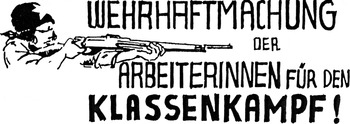
The RFMB's new martial feminine ideal was also evident in the league's iconography. In 1929 a clear shift in the RFMB's propaganda was apparent, as it began to showcase women as fighters. Most striking were the numerous images in Frauenwacht of uniformed women from around the globe, particularly from the Soviet Union, wielding arms beginning in March 1929. One of the organization's most frequent images starting in 1929 was a communist woman brandishing a rifle, as shown in Figure 5. Boldly aiming a rifle, this female representation is fully prepared for revolutionary battle.Footnote 139 She thus embodied the national leadership's new position: “Women of this organization must get used to taking part in the fight with a weapon in their hand.”Footnote 140 No longer concerned about RFMB women appearing as united, political soldiers, the leaders now urged members to make a disciplined martial impression. Such propaganda represented an effort to redefine not only women's roles in revolutionary struggle but also a new communist feminine aesthetic that was militant, masculine, and modern.Footnote 141
RFMB Flyer (n.d.). “Military preparedness of the workingwomen for class struggle.” Source: SAPMO-BA: RY1 I 2/8/66.

The league sought to project a more martial image also during its public appearances, underscoring the masculinization of communist political culture more generally. One change that signaled the RFMB's increasing militant profile was the inclusion of drum corps in its demonstrations. While leaders had previously renounced drum corps because they had associated the musical troupes with the militarism of the RFB, by 1929 the RFMB began to incorporate drum corps into their demonstrations to provide the cadence that ensured a regimented display of revolutionary commitment.Footnote 142 A 1930 report described the women's new public character: “In countless demonstrations . . . the RFMB marched at the front of thousands of proletarian women, with their discipline, their unitary national clothing, their banners against the imperialist war.”Footnote 143
As the RFMB increasingly emphasized a disciplined militancy, the women transformed all political work into martial demonstrations, as exemplified in spring 1930 when one hundred RFMB women traveled to Zehdenick in Brandenburg to recruit members and sell literature. According to a Frauenwacht report, the group arrived in the small town bedecked with an array of communist paraphernalia, including drums, red flags, and large posters that boldly showcased a raised fist. They proceeded to engage in house-to-house propaganda work, and thereafter, they marched to the market square where they held a demonstration that included a flag consecration ceremony and the singing of revolutionary songs, all the while police reportedly attempted to obstruct their presence.Footnote 144 These outings provided an excellent illustration of the nature of the RFMB's work in late Weimar, showing especially how the women transformed all political work into combative political practices whose militant aspects were enhanced by the most aggressive rituals and symbols in the communist cultural repertoire.
The RFMB's mounting militancy did not go unnoticed by government authorities. Believing that the RFMB was an auxiliary organization of the RFB, the police had kept close tabs on the league since its inception.Footnote 145 According to RFMB reports, however, police surveillance of its members increased significantly after May 1, 1929.Footnote 146 Although the government did not ban the RFMB when it outlawed the RFB in the immediate aftermath of May Day, authorities were alarmed by the RFMB's deployment of communist ritualistic practices, according to members. The RFMB's unfurling of the red flag especially antagonized the police. Typical of such confrontations was an attempt by police in Silesia to capture an RFMB flag from members as they traveled to a regional conference in 1930.Footnote 147 Other RFMB symbols also sparked conflict, such as when police seized a child's wagon, which was decorated to mock a government edict that awarded a coffee cup to women upon the birth of their twelfth child, from the Hamburg RFMB branch at a 1929 demonstration.Footnote 148 Hanna Ludewig, the league's national secretary and a Landtag representative who had been arrested for her RFMB activities, confirmed that the police routinely seized RFMB flags and harassed members “if they go across the street [wearing] our badge.”Footnote 149 Even the women's red ties and their playing of instruments reportedly goaded police.Footnote 150 But what most alarmed police was the women's showcasing of ritualistic practices associated with the banned RFB. In particular, the cry of “Red Front” incited police who sought to prevent the display of combative communist culture, including arresting women who yelled it.Footnote 151 The potency of communist political culture was especially apparent in the numerous reports about police confrontations that ended in violence. After May Day 1929, RFMB women frequently reported that their public presence resulted in violent clashes with police, which the KPD press was quick to publicize. Representative of such accounts was a 1930 article that stated that police had “struck women and children with unimaginable brutality” at an RFMB demonstration in Breslau.Footnote 152
Many RFMB members embraced the league's new martial profile, as explained by one woman who praised the women for their militancy on May Day: “Our women built barricades on the front line with the men. . . . May First [was] . . . good schooling for us. . . . It shows that women have realized that they do not belong at the cooking pot, but on the street.”Footnote 153 Another woman declared, “Yes, we are going to strengthen ourselves physically so that we can, with all the means and in every situation, take the place of our husbands against imperialist war and for the defense of the Soviet Union.”Footnote 154 But other women rejected the RFMB's new militaristic orientation entirely. In fact, the national leadership reported that a number of branches opposed militarization, and several local leaders had refused “to tell women that they must get themselves fit for military service.”Footnote 155 Resistance to the RFMB's new martial profile was also visible within the ranks of the communist movement more broadly. Indeed, the events of May Day 1929 did little to change opposition to women's equal participation on the front lines of struggle.Footnote 156 As one woman explained, “On May 1 [1929], there were still male workers who said, women and children should stay at home because this is a fight with state power.”Footnote 157 Thus, as the RFMB attempted to fashion communist women into revolutionary soldiers, it continued to spark profound gender conflict not only within its own ranks, but also within the communist movement more generally. While it is impossible to assess fully the response to the RFMB's new militancy, it is clear that the league failed to attract significantly more members after May Day 1929.Footnote 158 Thus, Eric Weitz has good reason to argue that the league's militaristic ethos did not appeal to the masses of working-class women.Footnote 159
Fighting Fascists
The militancy of RFMB women reached its apex in the early 1930s as communists mobilized to confront Nazism. With the National Socialists' stunning electoral success and the dramatic increase in its membership, the Nazis quickly became potent adversaries by 1930, challenging communists at the ballot box, in the workplace, and on the street. Acutely aware of the meteoric rise of National Socialism, the KPD rallied members and sympathizers to confront Nazism by founding an array of antifascist organizations.Footnote 160 At the center was the Fighting League against Fascism (Kampfbund gegen den Faschismus), which the KPD established in September 1930, directly upon the heels of the Nazis' triumph in the Reichstag election that month. The KPD designed the Fighting League to recruit a broad spectrum of sympathizers to combat National Socialism through mass protest under the communist banner. By December 1931, it had enlisted well over 100,000 members.Footnote 161
In its efforts to confront Nazism, the KPD sought to transform its ancillary organizations into antifascist battalions. Among the most enthusiastic was the RFMB, which began to build its own squadrons dedicated to antifascist physical training.Footnote 162 KPD leaders unconditionally supported the recruitment of women as antifascist soldiers. “The workingwomen and girls,” they asserted, “belong in our ranks as active female fighters [Kämpferinnen].”Footnote 163 One important consequence of the KPD's new antifascist emphasis, however, was a complete loss of independence for the RFMB. Instead of championing welfare, reproductive rights, and affordable housing, RFMB women now became absorbed into the battle against Nazism, focusing on military training in preparation for revolutionary struggle. The league even renamed Frauenwacht, adding the subtitle Organ of the Antifascist Women's Movement, to transform it into the women's paper for the Fighting League.Footnote 164 That the RFMB lost its semi-autonomous status was best reflected by the fact that after 1930 neither KPD nor police reports generally mentioned the RFMB by name since its members had been subsumed within the Fighting League.Footnote 165
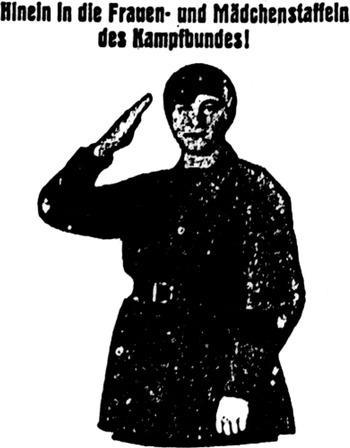
For RFMB women, the battle against Nazism provided the opportunity to showcase their new militaristic orientation. As Figure 6 illustrates, the Fighting League's propaganda projected a militaristic image of the communist woman. Dressed in full military gear and saluting her comrades, this representation embodied the feminine antifascist ideal. She was serious, committed to struggle, and prepared to fight. While a good portion of communist women's work focused on antifascist propaganda, many women also engaged in the most militant aspects of the struggle against Nazism.Footnote 166 The scholarly literature on the political violence in the early 1930s portrays the struggle as one that concerned primarily men.Footnote 167 While it is valid to cast the violence chiefly as a masculine political expression, women also encountered violence.Footnote 168 Indeed, KPD internal documents and newspaper reports testified to the violence communist women experienced as they confronted Nazis. Typical of such incidents was a 1930 battle that broke out between an RFMB drum corps from Altona, which was traveling to a demonstration in Elmshorn, and local Nazis. Bedecked in RFMB insignia, the women arrived at the Elmshorn train station prepared for struggle. Tensions quickly rose and a physical battle ensued, which was subsequently broken up by the police who confiscated the women's instruments.Footnote 169 Similarly, as RFMB women traveled to a Red Athletes' Meeting in Erfurt in spring 1930, they were besieged by Nazis who allegedly attacked them with knives, clubs, and stones. According to a report in a neighborhood cell paper, the women fought back, but they eventually had to yield because many of them were seriously injured.Footnote 170 Even more ominous were the events on March 2, 1932, when Minna Karl, a Red Aid (Rote Hilfe) official, was killed by police as she participated in a demonstration to protest a Nazi parade in East Prussia.Footnote 171 That women were antifascist activists was supported by court statistics as well. From August to September 1932, for example, at least twenty-three women were imprisoned for their participation in antifascist violence.Footnote 172
“Into the Women and Girls Squadrons of the Fighting League,” Die Fanfare. Kampforgane des Faschismus, February 1932. Source: SAPMO-BA, RY1 I 4/9/3.

While all-female battalions routinely battled Nazis, on numerous occasions women also collaborated with their male comrades. For instance, men and women joined together to obstruct Nazis from embarking upon a propaganda excursion to Dessau in July 1932 by blocking their automobiles. As one woman recounted, “On this Sunday we saw that we are one power against the Nazis if we are united . . . We women showed that we understand [that we must] stand [next to] our husbands in the antifascist fight.”Footnote 173 Numerous other reports confirmed that communist women fought alongside their husbands, such as a June 1932 article about a fight between communists and Nazis in Franzburg (Mecklenburg-Vorpommern). Accordingly, the Nazis had attacked the men with boards that had nails protruding out of them, which prompted the women to arm their husbands with clubs. One woman recalled, “We were not going to stand by and do nothing or run away when we saw that these beasts wanted to kill our husbands.”Footnote 174 As this declaration suggested, battling Nazis was a family affair, for communist women aggressively confronted their political foes alongside their husbands. Neighborhood cells reiterated the importance of the familial relationship in the antifascist struggle, urging wives to “fight together with your husbands.”Footnote 175 Tapping into working-class familial culture, communists sought to leverage the spousal relationship to transform housewives into revolutionary fighters.
Although the historical record provides substantial evidence to demonstrate that women engaged in antifascist violence either as participants or victims and although it shows that communist men and women sometimes collaborated to combat fascism, at the grassroots level, communist men widely continued to resist working with women. While the men generally accepted their political sisters as antifascist propagandists, they did not want to fight alongside them. As an internal report summed up, “From the start, we had to overcome the significant resistance among the male comrades who, because of their political backwardness, took the position that women have nothing to seek in a military organization. Even today, this view has not yet been conquered.” Accordingly, the majority of men believed that women should work in “women's organizations” such as the Red Aid, but not in the antifascist brigades.Footnote 176 In fact, male Fighting League members sometimes even blocked doors to prevent women from attending meetings, and some male leaders threatened to quit their local organization if women were admitted to the league.Footnote 177 Such debates about women's roles in the antifascist movement reprised many of the arguments about female militancy that had been advanced in 1925 when the RFB had expelled women based on the belief that women were physically and psychologically ill suited for combat. Communist men's opposition to women's participation on the front lines of class struggle became more pronounced in the final years of the Weimar Republic as they advanced a militant masculinity in the face of a political opponent that threatened their core beliefs as well as a cataclysmic socioeconomic crisis that challenged their traditional role as provider. As Karen Hagemann argues, many working-class men “increasingly sought to create ‘women-free’ space in the political arena—in ‘self defense.’”Footnote 178 Faced with a formidable political foe and the inability to provide for their families, communist men sought to reaffirm their masculinity by restricting women's political expression.Footnote 179
KPD leaders responded to the defiance of their male members by repeatedly reprimanding them for their political “backwardness” and “reactionary attitude.”Footnote 180 Although women made up ten to fifteen percent of the Fighting League's membership, KPD leaders made little headway in changing deeply entrenched antifeminist views, however.Footnote 181 In response to men's refusal to collaborate with women, KPD leaders issued the following directive in 1931:
The fight against fascism is not only a thing for men. More than half of all working people are women, and the workingwoman is affected the hardest by the measures of a fascist dictator . . . Every local group, every squadron, is obligated to accept the organization of women and girls immediately into the attack. Whoever refuses or sabotages this work has no place in our ranks.Footnote 182
Such statements unequivocally castigated male comrades who refused to work with women; however, party leaders themselves did not always prioritize the organization of women in the fight against Nazism. In fact, many leaders hoped that the women would function primarily as propagandists who would expose the Nazis' antifeminist views and rally social democratic women to the communist banner.Footnote 183 That communist men cast women as adjunct revolutionaries was clearly demonstrated in Thuringia where local leaders, under financial duress, opted to send organizational materials only to male members.Footnote 184
Conclusion
When the KPD founded the RFMB, it did not articulate a clear and consistent purpose for the league. While party leaders sought to establish an organization that was less overtly political and militant to appeal to a wide range of working-class women, they simultaneously attempted to fashion the RFMB into a subordinate organization that fully supported all KPD campaigns. The lack of a consistent vision for the RFMB opened the door for significant political and gender conflict within the RFMB and the communist movement more broadly. Indeed, the RFMB profoundly tested both the KPD's drive for Bolshevization as well as communists' commitment to women's equality.
At its inception, the RFMB declared that its central aim was to promote issues that mattered to working-class women, but it soon strayed from this agenda, as it became subsumed within the KPD's efforts to bolshevize the communist movement. Instead of asserting an independent identity, the RFMB championed the KPD's program; yet, it never achieved full Bolshevization. While many women readily adopted party cultural practices and conformed to the organization's self-disciplining culture, they also refused to toe the party line at times. Most notably, their resistance to factory organization and their cultivation of militancy signaled their rejection of Bolshevization.
Especially contested was the RFMB's feminine profile. Beginning in 1925, communist leaders attempted to fashion RFMB women based on a normative femininity, demonstrating how Bolshevization of the communist woman extended far beyond the realm of institutional politics. But leaders encountered stiff opposition from RFMB members who widely supported a radical femininity that was rooted in militancy. At the heart of the question was whether militarism was compatible with communist femininity. While communists widely renounced militant femininity before 1929, KPD leaders abandoned their advocacy of a conventional femininity after May Day 1929 as the Weimar Republic entered an epoch of acute political violence. Now leaders called on RFMB women to steel their bodies in preparation for physical conflict, thus signaling a fundamental metamorphosis of the league. With the Comintern's declaration of the “Third Period,” the onset of the Depression, and the meteoric rise of Nazism, the KPD sought to reconstruct the RFMB woman as an antifascist warrior; however, opposition to militant femininity quickly reemerged, particularly among communist men. In response, KPD leaders directed their male cadre to welcome women on the front lines of struggle, and in their efforts, they laid bare the pervasive ambivalence about the organization of women within the ranks of the communist movement.
The debate about the militarization of the RFMB highlighted a fundamental aspect of the politicization of everyday life in Weimar Germany. Despite the league's initial opposition to militarism, it began to pursue aggressive political practices in response to directives from Moscow and escalating tensions on the streets. The challenge it faced was the range of options for political expression. In Weimar Germany, everyday politics often were articulated in public displays of military prowess, particularly after the onset of the Depression. Throughout Germany, political parties founded paramilitary groups that transformed republican democracy into street fighting. With the establishment of the RFMB, communists sought to construct an organization that appealed to working-class women by offering an alternative to militant politics. Yet the RFMB was forced to operate within a context in which militarism increasingly became the dominant mode of political expression. Therefore, even though the RFMB had initially sought to distance itself from combative political practices, it, too, came to rely on an everyday politics that grew increasingly belligerent.