Introduction
There is now substantial empirical evidence demonstrating that social ties and social support play an influential role in health maintenance and differential vulnerability to a range of illnesses. Research repeatedly finds that those reporting higher levels of emotional support and social integration have lower rates of both mortality and morbidity than the more isolated and/or those receiving little social support (House et al., Reference House, Landis and Umberson1988; Findlay, Reference Findlay2003; Tomaka et al., Reference Tomaka, Thompson and Palacios2006). Social support and social integration appear to be important for health promotion and well-being in the general population, but these social processes may both be especially important and problematic among persons with serious and persistent mental illness. Previous research indicates that those diagnosed with a psychiatric disorder tend to have access to fewer social ties and consequently fewer potentially supportive resources. Regardless of how such potential social resources are measured – by network indicators, number of family and/or friends, availability of at least one confidant, or by marital status – the social resources of the chronic mentally ill tend to be both fewer and less diverse than those never requiring mental health services (Nelson et al., Reference Nelson, Hall, Squire and Walsh-Bowers1992; Sorgaard et al., Reference Sorgaard2001). A number of factors may contribute to the overall paucity of support resources that is characteristic of psychiatric patients. Sporadic periods of hospitalization, poor social skills and a general reduction in social competence, the occurrence of symptoms that often produce bizarre and/or paranoid behavior and the resulting stigma and social rejection and marginalization associated with mental illness, all may erode the ability to secure and maintain social ties. Many patients find themselves in a situation requiring social support, yet, at the same time, lack the personal and social resources that facilitate the support process. Among older cohorts, psychogeriatric patients may be especially vulnerable to lower levels of support and may well represent a group in double jeopardy for social isolation, having both a history of mental illness and older age.
Although there is certainly no paucity of literature documenting the health-enhancing qualities of social integration and supportive ties, much less attention has been given to the determinants of such ties. If social support and social integration can positively influence both social and emotional adaptation among individuals with psychiatric illnesses, as available evidence suggests, it represents a highly promising target for intervention efforts in the service of community adaptation. However, such therapeutic efforts require an understanding of the factors and circumstances that promote or diminish social ties and social support (Cohen et al., Reference Cohen2000). Thus there is a need in the research literature to shift the focus on social integration and support from an independent to dependent variable. This exploratory study examines factors associated with isolation from informal social ties among geriatric psychiatry in-patients. Specifically, the associations of diagnoses, psychiatric history, and measures of current functioning with social isolation are examined. The analyses rely upon data derived from the Resident Assessment Instrument – Mental Health (RAI-MH; Hirdes et al., Reference Hirdes2001), a client-centered information system for inpatient psychiatry.
Social support, integration and social relations
A problem with the comparison of the early social support/relations research is the fact that a general consensus on what constitutes social support and how it is best measured did not exist. Many different definitions were used and, correspondingly, an array of operationalizations (of such definitions) were employed in the literature. Terms such as social support, social networks, social bonds, loneliness, integration, and social ties were often used interchangeably and/or in an ambiguous manner (Sarason et al., Reference Sarason, Pierce, Sarason, Avison and Gotlib1994; Smith, Reference Smith1996; Ell, Reference Ell1996). So enthusiastic was the endeavor to demonstrate that social support influenced health and emotional well-being that research was undertaken prior to reaching any general consensus as to what constituted social support. To achieve results with greater validity and reliability, and hence to better understand the support process, House and his colleagues called for the decomposition of support into its component terms. For these authors, social support, as well as such constructs as social integration, social networks and received support, all belong to the larger domain of “social relations” (House et al., Reference House, Landis and Umberson1988). Two prominent structures of social relationships include social integration and social network characteristics. Social integration refers to the actual presence of social ties. According to House and his colleagues, measures of integration should be reserved to index the type and quantity of actual ties (for example, marital status, number of friends) and the frequency of contacts between such ties. Social isolation, the subject matter for this paper, is associated with fewer social ties, and reduced contact with such ties (Hall and Havens, Reference Hall and Havens2002; Findlay, Reference Findlay2003). Social networks, on the other hand, refer to the structural characteristics between social ties. Various characteristics are included here. For example, the degree of reciprocity of exchanges between provider and receiver, the strength of the bonds between ties, and/or the degree of similarity between network members, all constitute the structural characteristics of social ties. In turn, these two structures of social relations may result in three distinct social processes: social regulation and control, social conflicts and hassles, and social support. In summary, both social networks and social integration are important determinants of social support.
Social integration and older age
In the social epidemiology of support and social relations, considerable research has focused upon the significance of age and gender differences. A number of studies have demonstrated that the majority of older, community-dwelling individuals maintain social contact with family and friends. Although physical, face-to-face interaction may decline with age, alternate forms of social contact are commonly maintained, such as telephone and, increasingly, email communication. However, various life events may interact with age to reduce the opportunities for social interaction, resulting in isolation. Age and the corresponding entry and exit into various stages of the life cycle often result in changes to network memberships and role participation. A number of researchers have found age differences in the social support process. For example, in their analyses of support perceptions among adults living in a small, rural-American town, Vaux and Harrison (Reference Vaux and Harrison1985) found that age showed a small yet significant inverse association with social network size. Overall, the younger portion of the study sample reported larger social networks and higher levels of perceived social support from friends than did older respondents. In their study of Toronto residents aged between 18 and 55, Turner and Marino (Reference Turner and Marino1994) found that perceived social support varied with age in a convex manner. Lowest levels of perceived support were reported by both males and females 18–25 years old and by those respondents 46–55 years of age. Those in the 35–45 age range reported highest levels. A life cycle approach helps to explain some of the observed differences in the age-social support relationship. As individuals pass through various stages of the life cycle: from childhood, adolescence, through to adulthood and into older age, both the sources and functional needs of social support become modified. Throughout the life course, we may receive support from a number of different sources. Due to such life events as changes in employment, marriage, divorce, illness and retirement, “an individuals' social supportive milieu may correspondingly change in both content and need” (Hall and Havens, Reference Hall and Havens2002). Social isolation is therefore associated with advancing age due to changes within one's social network, reduced personal health, and/or a reduction in the participation of social roles which facilitate social interactions. Consequently, experiencing such life events may reduce the number of opportunities for social interaction with others, potentially leading to increased social isolation. Older individuals with a history of mental illness, especially a serious and persistent mental illness, may be especially vulnerable to social isolation. Since previous literature has identified older individuals with health impairments and individuals with a mental illness as two unique groups at risk of isolation, an individual who fits both of these groups may be especially vulnerable to social isolation. Having a dual status of a history of mental illness and being older may thus represent a form of double jeopardy for social isolation.
Methods
Study sample
These analyses were based upon data collected from a larger study with the goal of developing a case-mix classification system for inpatient psychiatry. As part of the study protocol individual assessments based upon the RAI-MH were completed for a convenience sample of patients from 34 psychiatric facilities in three Canadian Provinces – Ontario, Manitoba and Alberta. The volunteer facilities were representative of inpatient psychiatry in these three provinces, including urban/rural facilities, teaching facilities, and designated psychiatric beds from general acute care hospitals. The use of a convenience sample suggests estimates of the prevalence of isolation should be treated with some caution; however, sampling bias associated with this approach is less likely to have a major impact on the detection of the associations of interest here.
The RAI-MH is a patient-focused, multidimensional, comprehensive assessment instrument designed to be a component of a larger, integrated health information system linking mental health with home care, long-term care, acute care, rehabilitation, and palliative care (Hirdes et al., Reference Hirdes1999). Previous research has shown the RAI-MH to be a valid and reliable assessment instrument (Hirdes et al., Reference Hirdes2002). Ideally, the RAI-MH is used as a common intake assessment form for inpatient psychiatry. It was explicitly designed to replace existing admission forms/assessments that a facility or unit would complete for newly admitted patients. In addition, a shorter version of the instrument can be used for follow-up reassessment, during episodes of symptom exacerbation, and/or at discharge. Ultimately, the goal when adopting the RAI-MH is to eliminate the number of alternative assessment instruments, thereby reducing the assessment burden placed upon patients. All variables used in the analyses reported here are contained within this RAI-MH assessment. The original study sample included patients occupying beds classified as acute, long-term stay, forensic, or geriatric psychiatry. About one-quarter of the sample had been in the facility for two weeks or less and about one-third had been in hospital for one year or more. The secondary data analyses reported here were restricted to patients aged 65 or older in the study sample (N = 848). Forensic patients were excluded from the analyses. With a sample of this size, differences of about 6% in the rate of the dependent variable (assuming a 25% prevalence rate for social isolation) will be significant at the 0.05 level with a study power of 0.80.
Measures
Sociodemographic and diagnostic characteristics
Gender was coded 1 = male, 2 = female. Age of respondents was coded as a continuous variable in years. In bivariate analyses, marital status was also coded as a categorical variable (1 = single/never married, 2 = married/partnered, 3 = widowed, 4 = separated, 5 = divorced). In the multivariate analyses, marital status was recoded into two dummy variables: married and widowed. The reference group was singe/divorced/separated. In addition to measures of marital status, a single dichotomous item was used to evaluate residential status prior to the current admission. Being admitted from a private home or house (coded as “1”) was compared to all other potential residential settings (such as group home, nursing home, etc.). Provisional psychiatric diagnosis was coded through a series of dichotomous variables: organic disorders, mood disorders, schizophrenia or other psychotic disorders, anxiety disorders, developmental handicap, personality disorders, and substance-related disorders (all coded 0 = no, 1 = yes). Finally, a single item was used to evaluate the patient's predicted length of stay, as evaluated by nursing staff. Within a section entitled “discharge potential” the RAI-MH contains an item asking intake staff to predict projected length of stay for the patient (at the time of the RAI-MH assessment). On the RAI-MH this item is coded 0 = longer than 90 days, 1 = 31–90 days, and 2 = within 30 days. In the analyses here, this item was recoded into a dichotomous variable entitled “long predicted discharge” (0 = less than 90 days, 1 = longer than 90 days). Psychiatric history was addressed through two variables: a count of number of lifetime admissions to psychiatric facilities, and a measure of age at first admission to a mental health facility. Coding options included, 0 = age 24 or younger, 1 = age 25 or older.
Indicators of functioning and self-care
The RAI-MH contains a number of individual items and embedded scales measuring functional ability and impairment. The Cognitive Performance Scale (CPS) is based upon four items from the RAI-MH that are used compute a seven-category cognition scale (0 = intact, 1 = borderline intact, 2 = mild impairment, 3 = moderate impairment, 4 = moderate-severe impairment, 5 = severe, and 6 = very severe impairment. For information on the validity of the CPS, see Morris et al. (Reference Morris1994). The Activities of Daily Living (ADL) Hierarchy Scale measures functional performance by categorizing ADLs in a scale ranging from independent to late loss impairment. The ADL scale is based on four items measuring the amount of assistance patients need to perform personal hygiene, locomotion, toilet use and eating. For each item a patient is given a score ranging from 0 (independent) to 4 (total dependence). For information on the validity of this ADL measure, see Morris et al. (Reference Morris, Fries and Morris1999). The Depression Rating Scale (DRS) has been validated against both the Hamilton Depression Rating Scale and the Cornell Scale for depression severity. The scale is based on seven items measuring the frequency over the last three days of: negative or depressive statements, persistent anger, fears/phobias, repetitive health complaints, repetitive anxious complaints, sad/worried/pained facial expressions, and tearfulness. As a continuous scale, scores range from 0 to 14. Scores of 3 or more can be used as a cut-off point for major or minor depressive disorder (Burrows et al., Reference Burrows, Morris, Simon, Hirdes and Phillips2000). The Aggressive Behavior Scale (ABS) is a new scale used to summarize the frequency of aggressive behaviors in the last three days. The scale is composed of four items contained within the RAI-MH assessment: physical abusiveness to others, verbal abusiveness to others, socially inappropriate behaviors, and resisting care. The Cronbach's α for the scale ranges between 0.79 and 0.93 in nursing homes and complex continuing care hospitals, respectively, and the scale was found to be highly correlated (r = 0.72) with the Cohen-Mansfield Agitation Inventory Aggression susbcale (Perlman and Hirdes, in press). RAI-MH assessors are asked to rate these four items over the three-day period prior to the assessment date. The scale ranges from 0 to 12, with higher values indicating increased aggressive behaviors. For the present analyses, this scale was stratified by no aggressive behavior present (0), and recent history of aggressive behavior (1 or more).
Study outcome – social isolation
The RAI-MH contains a number of items indexing social relations, social support, and caregiver burden. One such item asks directly about recent contact with informal ties (and potential supports) since the time of assessment. This item is coded in an ordinal manner (1 = contact with either family and/or friends more than 30 days ago, 2 = contact within last 30 days, 3 = contact within last 7 days). For the analyses presented here, a new variable was created by collapsing all cases scoring 2 and 3 into 0 (= not isolated) and retaining a score of 1 as “contact more than 30 days ago”. Of the total study sample, 29% (N = 243) of patients were found to be isolated.
Analyses
Distributional properties of the data were examined using frequencies, percentages, and means. Bivariate comparisons were done using t-tests for continuous variables and cross-tabulations for categorical variables. Two approaches were used for multivariate analyses. First, logistic regression was used to estimate odds ratios for social isolation using independent variables found to be significant at the bivariate level. When describing rare events, the value of odds ratios tend to be similar to estimates of relative risks; however, given that social isolation occurs in a substantial portion of this sample, odds ratios and relative risks would not be equivalent with the present data set. Lee (Reference Lee1994) proposed that proportion hazards models with a fixed risk period could be used as an alternative approach to modeling binary data that do not involve rare events. The hazard ratios obtained from such models can be interpreted as rate ratios, and these tend to provide somewhat more conservative estimates of associations than odds ratios obtained from logistic regression.
Results
Descriptive
The study sample was evenly distributed by sex (51% female). Almost 29% of the patients were currently married, while 21% were single/never married. The largest category for marital status was widowed (33%), reflecting the older age of the study sample. In addition, the high percentage of widows may also be attributed to those individuals diagnosed with an organic disorder (later age onset of mental illness). Just over 29% of the sample had a current admission from a private house/apartment. The following provisional psychiatric diagnoses were present: organic disorders (37.5%), mood disorders (39%), schizophrenia and other psychotic disorders (19.5%), substance-related disorders (8%), anxiety disorders (9%), personality disorders (6.3%), and developmental disability (4.1%). (Note: these diagnoses do not sum to 100% as patients could be associated with more than one provisional diagnosis.) Just over 35% of the patients had a first admission to a psychiatric bed prior to age 25 and the mean number of admissions over the life course was 3.25 (SD = 3.50). The study sample had a mean age of 75 (range 65–99). On average, respondents had experienced just over three previous admissions to a psychiatric facility. On measures of functional status, a study sample mean of 2.63 on the cognitive performance scale (CPS) represents mild impairment. A score of 2.0 on the CPS is approximately equal to an average score of 19.2 on the Mini-mental State Examination (Morris et al., Reference Morris1994). The sample was associated with a mean score of 3.30 on the Depression Rating Scale. On the ADL self-performance hierarchy scale, the sample mean of 1.63 represents a general dependence classification between “some supervision required” and “limited impairment.” Finally, on the aggressive behavior scale (range 0–12), the study sample had a mean of 1.65.
Bivariate
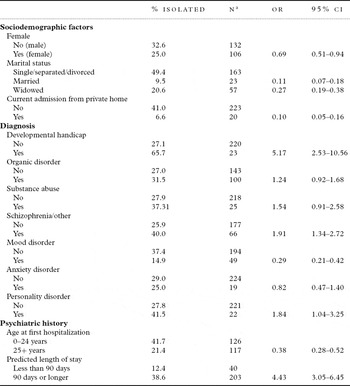
Table 1 lists bivariate associations for isolation by sociodemographic and psychiatric characteristics. Compared to males, females had an overall lower risk for experiencing isolation – about 25% of the female patients were isolated compared to almost 33% of males. Hence, being female reduced the odds of isolation (OR = 0.69). Compared to patients either never married or separated/divorced, either being currently married or widowed reduced the odds of isolation. In addition, patients identified as being admitted from a private home environment were also less likely to be isolated.
Bivariate analysis for “risk of being isolated” by sociodemographic and psychiatric factors

aTotal N = 243 for those patients identified as being “isolated”.
Turning to psychiatric characteristics, patients with a diagnosis of developmental disability, organic, substance abuse, schizophrenia, adjustment, and personality disorders were associated with higher odds for isolation compared to those patients without such diagnoses. For example, individuals with schizophrenia were almost twice as likely (OR = 1.91) to be isolated from informal contacts outside the institution. Individuals with personality disorders were also almost twice as likely to be isolated (OR = 1.84). Of the diagnoses considered in this study, having a history of developmental disability was associated with the highest odds for isolation (OR = 5.17). Conversely, diagnoses associated with lower odds for isolation included anxiety and mood disorders (OR = 0.82 and 0.29, respectively). Age at first hospitalization was also shown to be a predictor for social isolation. Patients with an older age at first hospitalization were less likely to be isolated compared to those patients associated with younger ages.
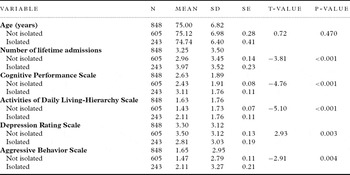
Table 2 shows the bivariate associations between isolation and continuous measures indexing age in years, number of lifetime admissions to psychiatric facilities, and measures of functioning. Patients falling within the isolated category had significantly higher mean scores on number of lifetime hospitalizations, cognitive impairment, activity limitations, and behavior disturbance. Of interest was the unexpected finding of higher mean levels of depression among the non-isolated group. Isolated patients had a lower mean score (2.81 compared to 3.50) on depression severity as measured by the depression rating scale. With regards to age, a statistically significant difference was not found comparing isolated to non-isolated patients.
Mean variation in continuous measures by “not isolated”/“isolated”

Multivariate analyses
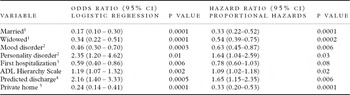
At a first stage, isolation was regressed on all variables that were significant in the bivariate analyses. Age was controlled in all regression models. Variables that did not reach statistical significance at the p < 0.05 level were removed from the model one at a time but alternative models were tested in order to rule out order of deletion effects. Table 3 shows the final logistic regression model predicting isolation and the same model using proportion hazards with a fixed risk period. Both models yielded highly similar results with few substantive differences except for one variable whose effects were no longer significant at the 0.05 level in the proportional hazards model.
Logistic regression and proportional hazards models to predict being isolated among elderly psychiatric patients (N = 848)

1Dummy variables, 0 = never married/separated/divorced (reference group).
2Dummy variables, 0 = all other diagnostic groups (reference group).
30 = 24 years old or younger, 1 = 25 or older.
40 = less than 90 days (reference group), 1=longer than 90 days.
50 = no (reference group), 1 = yes, usual residence is private home or house.
ADL = activities of daily living.
Patients currently married or widowed had lower odds of isolation from informal ties. This trend may reflect the fact that individuals from intact marital relationships are more likely to have continuing contact with their spouse/partner during hospitalization. In the case of being widowed, informal contacts may potentially be derived from children. Of the diagnostic groups, only mood and personality disorders remained significant predictors of isolation with the former having lower and the latter having higher odds of isolation. As predictors of isolation, the significance of schizophrenia and developmental disabilities disappeared in the multivariate analyses, most likely due to the inclusion of marital status. For example, based upon additional analyses, persons with schizophrenia had about twice the odds and those with developmental disabilities had almost five times the odds of other patients to be single (results available upon request). Patients admitted from a private home and having a later age for first hospitalization were less likely to be isolated. Again, patients diagnosed with schizophrenia or developmental disabilities were important considerations as each diagnosis tends to be associated with a much earlier age of first admission, compared to the other diagnostic groups. In addition, patients whom staff rated as most likely to have a long predicted discharge had more than two times higher odds of being isolated. In the multivariate model, the majority of the outcomes scales became non-significant predictors for isolation. Only the ADL hierarchy scale remained significant, with each incremental point increase on the ADL hierarchy scale being associated with a 1.19 times increased odds for isolation.
Discussion
The analyses presented here demonstrate the detrimental effects of an earlier life experience of mental illness on social integration in later life. Age at first hospitalization was shown to be a potential independent risk factor for isolation. Patients with an older age for first hospitalization had lower odds of being isolated compared to those patients with earlier ages. A shorter history of psychiatric illness could help protect individuals from social isolation. Individuals experiencing mental illness at a later stage of life may have already had the opportunity to secure social ties (e.g. more likely to have married, more likely to have children). Having an earlier age of onset may lead to a potentially greater impairment in establishing and maintaining informal social ties throughout the life course. In addition, an earlier age of illness onset may be associated with a reduced number of opportunities to establish social ties (for example, in school and work settings). A personal biography of institutionalization was clearly associated with an increased risk of isolation. Patients hospitalized at an earlier age and/or predicted to have a longer stay on the current admission were much less likely to have contact with informal supports. Although a strong relationship was found between the bivariate relationship of schizophrenia and isolation, this association became non-significant once indicators of marital status and age of first admission were added. In the multivariate analyses, marriage was an important resource for avoiding isolation. Either being presently married or widowed protected patients from isolation within inpatient settings. The finding of elevated odds of social isolation for patients with schizophrenia, personality, and/or developmental handicap disorders is consistent with the research literature (Smith, Reference Smith1996). The diagnosis of schizophrenia is typically associated with an earlier age onset – slightly younger for males compared to females (Sorgaard et al., Reference Sorgaard2001). Once the independent effects of marital status on social isolation were accounted for, individuals with a personality disorder were still associated with increased odds for isolation (OR = 2.35). This trend is consistent with the higher incidence of turbulent relationships among patients with personality disorders.
Although significant bivariate predictors for isolation, cognitive impairment and aggressive behavior were not significant predictors of isolation in the multivariate analyses. Hence, it was not patients displaying aggressive or demented behaviors that were more likely to be isolated but rather, as noted previously, those with an extended history of mental illness and institutionalization. In a very real sense, patients with a longer history of illness and institutionalization were more likely to have fewer contacts and social resources. Such a situation is reminiscent of the “social death” phenomenon – a situation whereby individuals experience a reduction in social ties and social support (a “social death”) prior to an actual physical death. This concept was first used in the social gerontology literature describing end-of-life care. The literature noted one potential consequence of providing end-of-life care within institutions in combination with the overall increasing institutionalization of seniors (into nursing homes): the death of older individuals in the absence of close, supportive ties. More recently, the concept of social death has been applied to a number of different, often stigmatized social groups – from HIV patients (Robins, Reference Robins2006), dementia patients (Sweeting and Gilhooly, Reference Sweeting and Gilhooly1997), to teenage mothers (Whitehead, Reference Whitehead2001) – all whom are at a higher risk of experiencing varying degrees of exclusion and marginalization from mainstream society. Furthermore, schizophrenia and developmental disability may be important because specific symptoms (such as paranoid delusions) may impair the individual's ability to form lifelong, strong relationships at the early stages of their lives. By the time such individuals reach older age, they are at very high risk of lacking the basic social relationships and social resources needed to avoid isolation in latter life. In addition, a large literature exists demonstrating the harmful effects of stigmatization and resulting marginalization experienced by both individuals with mental illness and specific subgroups of older age groups. For example, the work of Scharf and colleagues (Reference Scharf, Phillipson and Smith2005) has documented the various processes in which the living situations of lower-income individuals are more likely to experience social exclusion in later life. In a study of older people living in lower-income, deprived urban areas of London, Liverpool and Manchester, these researchers explicitly examined five sub-domains of social exclusion: exclusion from material resources, exclusion from civic activities, service exclusion, neighborhood exclusion, and exclusion from social relationships. The domain of “social exclusion” was found to be the most common. Exclusion from social relations was found among 41% of their study sample (Scharf et al., Reference Scharf, Phillipson and Smith2005). These findings are significant for the present study as individuals with a longer history of mental illness are more likely to experience low income and social deprivation.
The finding of a relationship between increasing limitations in ADLs and increased odds for social isolation is also consistent with previous research. Studies have shown the potential for physical health conditions and the resulting limitations in usual activities and mobility to lead to increased isolation (Hall and Havens, Reference Hall and Havens2002). The isolation brought about by physical illnesses can be a significant issue in rural communities or where publicly funded mobility programs to assist individuals with their transportation needs are not readily available.
Finally, these analyses also reinforce the need for comprehensive assessment of patients on admission. The basic point of comprehensive assessment is that the determinants of physical and mental health are a complex combination of social, physical, psychological and environmental factors and that client needs often go undetected in the absence of such assessment. In addition, new needs may emerge among clients over time and through different phases of service provision. Although service providers in mental health settings have long recognized the multidimensional needs of their clients, for a number of reasons day-to-day care practices may miss domains warranting clinical and therapeutic intervention. In fact, over the years there have been repeated calls to adopt comprehensive functional assessment within psychiatry in general and in geriatric psychiatry specifically (Blazer, Reference Blazer2000). The RAI-MH is one such instrument that allows clinicians and other service providers the opportunity to identify and respond to needs in a multidimensional, person-centered approach. In order to detect change of an individual's status over the course of an admission or between cycles of hospital and community care, the RAI-MH (and the companion interRAI Community Mental Health instrument) can be used for reassessment to monitor changes in status and the emergence of new needs. Ideally, once social isolation is identified among patients, therapeutic interventions based upon evidence-based practice guidelines may be put in place both for the inpatient phase and upon discharge to the community outpatient phase of service provision. The more recent literature demonstrates that programs designed to reduce social isolation (and loneliness) are commonly not evaluated in a rigorous manner for overall effectiveness. Systematic reviews of the literature focusing on programs to reduce social isolation among older individuals (Findlay, Reference Findlay2003; Cattan et al., Reference Cattan, White, Bond and Learmouth2005) or individuals with serious mental disorders (Morgan et al., Reference Morgan, Burns, Ffitzpatrick, Pinfold and Priebe2007) have found that group programs rather than individual-level interventions are associated with improved outcomes. In particular, group programs based upon a health promotion approach; in which more homogeneous participants are actively involved in program design and which build upon existing community capacity are more effective over time than individual-based therapeutic programs (Cattan et al., Reference Cattan, White, Bond and Learmouth2005). If both the inpatient and community versions of the RAI-MH instruments were used in a service catchment area, multiple assessments of the client over time could assist with providing evidence for the effectiveness of these therapeutic interventions.
Conflict of interest
None.
Description of authors' roles
Dr. Smith analyzed the data for this paper and wrote the original manuscript. Dr. Hirdes was the principal investigator on the original project to develop the RAI-MH in Canada and he collaborated on the data analyses and the writing of this paper.
Acknowledgment
The RAI-MH is a copyrighted instrument that is jointly owned by the Ontario Ministry of Health / Long Term Care, the Ontario Hospital Association, and interRAI (www.interrai.org). As of 2005, the RAI-MH constitutes part of the Ontario Mental Health Reporting System (OMHRS). Administered to every patient occupying a designated psychiatric bed in the Province of Ontario, Canada, this information is administrated and supervised by the Canadian Institute for Health Information.