I. The cult of Connan
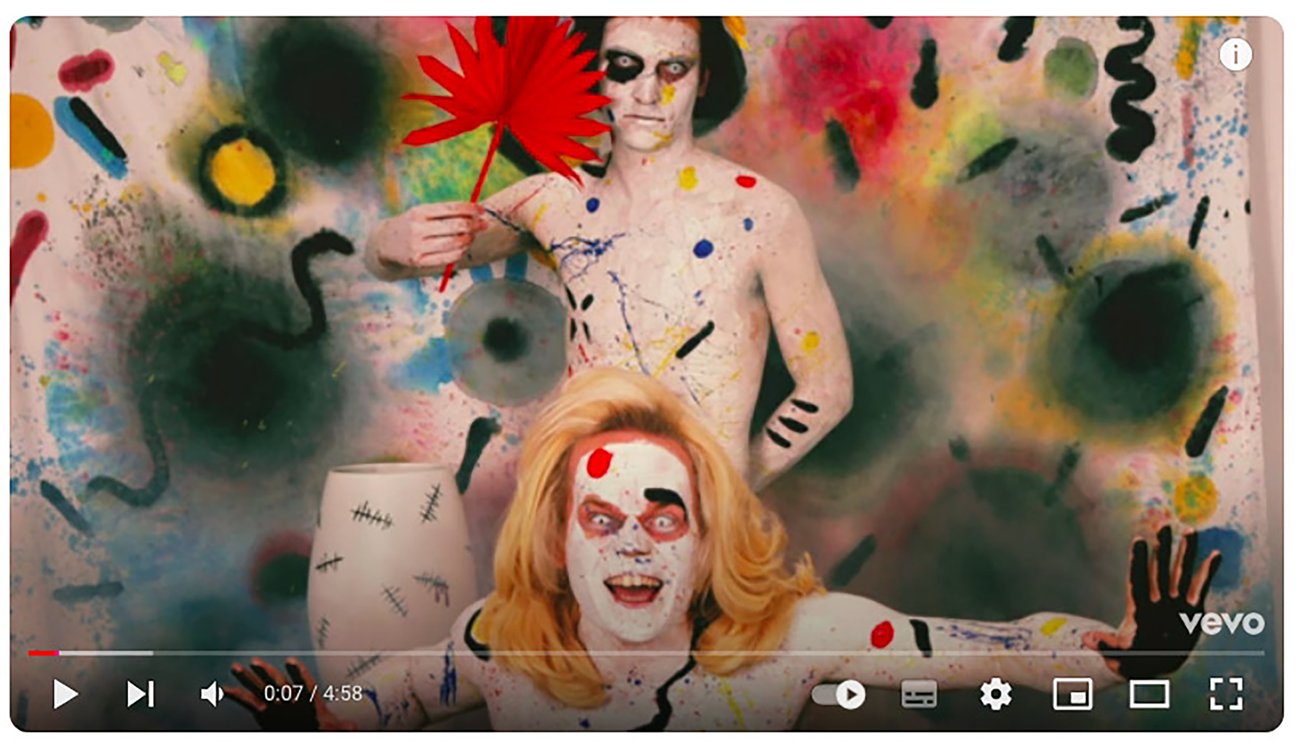
Since his collaboration with French singer and actress Charlotte Gainsbourg in the early 2010s, I have closely followed the work of New Zealander Connan Mockasin (born in 1983 as Connan Tant Hosford in Te Awanga, a small seaside village). In October 2018 I discovered the live show to his new record during the Jassbusters tour in Ghent, Belgium. In comparison with earlier concerts from the period of his debut album Forever Dolphin Love (2011) and the subsequent Caramel (2013), the Jassbusters gig presented something even more unusual than the playful and slightly unsettling stage presence for which he was already known. Over the course of the 2010s, the artist gradually consolidated his oddball status within indie music through a distinct use of theatrical and surrealistic imagery. In the music video for the 10-minute-long ‘Forever Dolphin Love’ (2010), directed by Daniel Brereton, Mockasin and his co-performers appear in colourful papier-mâché costumes, painted faces and wigs (Figure 1), before the camera follows Mockasin as a dolphin-costumed girl seems to guide him around London. The album cover and press materials for one of Mockasin's side-projects with Sam Dust, Soft Hair, bear that same stamp of child-like and free-spirited surrealism (Figure 2).
Screenshot from music video ‘Forever Dolphin Love’ (2011). © Phantasy Sound/Because Music, YouTube, https://youtu.be/E7CaTJ2SvG8?si=Ttd2XZ17MaMX899y

Screenshot from ‘Soft Hair - In Love (Official Audio)' (2016), © Domino Recording Co. Ltd., YouTube, https://www.youtube.com/watch?v=TelwW8nN1eA&abchannel=SoftHairVEVO.

Resonating with the artist's equally psychedelic musical palette and corresponding stage routines, this imagery crystallised into the artist's aesthetic trademark. The universe that Mockasin orchestrates as a musician clearly draws on a long history of pop music artists adorned in theatrical fashion. When the artist started out with his band Connan and The Mockasins in 2006, the heyday of the indie Myspace era, pop music had already hitched its cart to the dramatic arts in a variety of ways. Indeed, since the 1960s, pop music culture had established the narrative frameworks of concept albums turned into on-stage rock operas. The pioneering performances of The Who's Tommy (1969) or Pink Floyd's The Wall (1979), or of pop dandies such as David Bowie ‘turning one's identity into a theatricalized event’ (Hawkins Reference Hawkins2009, p. 11), paved the way for the large-scale spectacle shows of pop divas like Madonna (see Chatzipapatheodoridis Reference Chatzipapatheodoridis2021) and the non-narrative stories of the music video format (see Shaviro Reference Shaviro2017), as well as other digital novelties such as hologram projections, for instance used by Gorillaz. Presenting forms of fictional(ised) or highly stylised characters in a live context, within video content or through film adaptations, had thus already been extensively explored in a wide variety of directions by the time Mockasin came on stage.
Yet, even in sight of the myriad possibilities available to music artists when shaping a mediated performance of their identity on and off stage, the set-up of Mockasin's Jassbusters concert in 2018 managed to propose something even more idiosyncratic. The concert presented itself as a three-part package. Instead of starting with a traditional support act or band, the concert evening kicked off with a screening of Belly Bubble, the first episode of Mockasin's five-part melodrama and television series called Bostyn ’n Dobsyn. The musician both starred in and directed the film project which was recorded with some friends in an empty hair salon in Hollywood. The screening of the first episode of this series in the concert hall, with a standing audience as in a regular concert setting, recalled the music video for ‘Con Conn Was Impatient’, the single that had announced his new album earlier in the summer of 2018. The music video, which was uploaded to YouTube with the cryptic ‘(music video{trailer[live]})’ in the title, was the audience's first encounter with the Jassbusters protagonists, Mr Bostyn and his pupil Dobsyn. With Mr Bostyn, Mockasin adopts the role of a musician-turned-music teacher who develops an infatuation with student Dobsyn, who he actually believes to be a girl named Josie. Without any clear-cut narrative, the concert audience was confronted with fragments set in a cardboard classroom environment, in which the tension between Mr Bostyn and his object of affection, Dobsyn/Josie, unfolded in a piecemeal fashion (Figures 3 and 4).Footnote 1
Screenshot from the music video for ‘Con Conn Was Impatient’ (2018). © Mexican Summer, YouTube, https://youtu.be/oBf-EBSgWnw

Screenshots from the music video for ‘Con Conn Was Impatient’ (2018). © Mexican Summer, YouTube, https://youtu.be/oBf-EBSgWnw

While the sequence of scenes is clearly intended to be humorous, it teeters on the verge of becoming uncomfortable: the music teacher that Mockasin embodies by means of spectacles, that accentuate a frighteningly lewd gaze, and a massive mullet wig, asks his student to stay behind, invites them home to watch recordings of himself as a band leader and tries to impress them at the open mic event with his fellow music teachers (the Jassbusters). This incarnation of the teacher–student trope in a high school setting in the first place appeared to me as an ironic take on the student–teacher fantasy and its prevalence in popular music culture, including representations of pop stars themselves. The parodic overtone simultaneously belies the more serious undertone of how the power dynamic of teacher–student pairings, or of romantic fantasies in general that involve an age gap and/or forbidden love, appears in the context of fanfiction. Mockasin's film project Bostyn ’n Dobsyn that originated from his teenage pastime of making home videos and comics with his brother and neighbour (Carew Reference Carew2019) may not be directly linked to the fan practice of remixing popular culture. Nonetheless, its thematic exploration and imaginative engagement with fantasy share similarities with these creative fan practices. The most discomforting scene from the series, briefly featured in the music video, is undeniably the moment when Mr Bostyn drinks beer from Dobsyn's navel, hence the title of the particular episode screened at the 2018 concert series.
The final scene of the screening showed both characters sitting in front of a television while the camera zooms in on a minuscule television device that shows a Jassbusters concert, which is also the image that was used as the cover art for the first Jassbusters album (Figure 5). The camera's slow zoom-in movement transports the spectator into the blue-hued, sultry universe of the Jassbusters troupe. This screening was followed by an actual gig of the fictional band of schoolteachers in character, where Mockasin and his bandmates took the stage in Jassbusters costumes (Figure 6). Ultimately, the evening concluded afterwards with a ‘normal’ Connan Mockasin set. The tripartite structure of the concert evening, explicitly outlined on a tour poster (see Figure 7) as ‘absurdist drama meets surreal R&B as Connan Mockasin presents an exclusive screening of an episode of Bostyn ‘n Dobsyn, a performance by his band the Jassbusters and a full performance by Connan Mockasin’, features an undeniably noteworthy juxtaposition of different appearances of the artist. (1) A recorded performance – the film featuring the fictional band – is presented in a live setting, followed by (2) a live performance of the band of music teachers in character, only to culminate in (3) a concert set in which Connan Mockasin, the inspirer of the teachers’ band from the movie, comes forward as Connan Mockasin the indie musician.
Instagram post @connanmockasin including the Jassbusters (2018) album cover © Mexican Summer. https://www.instagram.com/p/BmdrPciHLin/

Instagram post @connanmockasin of Jassbusters troupe live at Barbican, London, November 3, 2018. https://www.instagram.com/p/Bp7xU7sBdqq/?img_index=1

Facebook post on Connan Mockasin's page of a tour poster for Jassbusters concert dates in Australia in 2019. © Mexican Summer. https://www.facebook.com/share/p/1MHCBxQ9V7/.

Mockasin's performance of all these layers folded into the identity he projects on stage offers a densely packed and embodied reflection on the constitution of persona in music. The friction elicited by Mockasin's three-part multimedia structure demands closer scrutiny. While the artist's endeavour to create a fictional world in relation to his music is not novel in itself, his case is suggestive and innovative insofar as it stages a meta-reflection about the relation between character-play and persona. Mockasin's persona manifests how the performed presence of a music artist is always a collaboration of theatrical play and performative display, where the dynamic between consumer, producer and media platform is under permanent negotiation.
II. Staging fictional (band) identities in music
Popular culture is rife with artists employing alter egos as a vehicle for their artistic expressions. As Mockasin's curious tripartite staging of what is a multi-layered identity performance suggests, these vehicles can consist of quite a few mutually distinct facets. Within his theory of musical identity, performance studies scholar Philip Auslander provides the triad of character/performance persona/real person for making sense of what he coined as the ‘musical persona’: ‘the version of self that a musician performs qua musician’ (Reference Auslander2006, p. 104). Mockasin's portrayal of the lascivious high school music teacher appears to present a made-up character that resonates with the role-play of dramatic arts. In the economy of Auslander's triad, such a character takes a backseat to the performance persona, equally implied by the statement that ‘in some performances, the persona embodies a third entity’ (Reference Auslander2004, p. 11). A character is what may be performed under the auspices of the self a musician performs in their social role as musician, ‘an optional element that comes in primarily when the musician is a singer performing a song that defines a character textually’ (Auslander Reference Auslander2021, p. 28).
The affinity of these popular music characters with theatre and film drama can also be inferred from the promotion text of Jassbusters Two (2021), the second Jassbusters album by Mockasin:
As a solitary janitor buffs the floor of a tired high school building, a furtively jazzy bassline slips under a door and down the hallway. It's after hours in the teachers’ lounge; perhaps someone's smoked a little confiscated weed. The leather-blazered and bemulletted faculty members of Connan Mockasin's upside-down music department adjust their sock garters and try their strings, as Jassbusters, the most tangible band of imagined music teachers the world has never seen, prepares itself for a second stab at after-school stardom. (Bandcamp Jassbusters Two)
In addition to the fact that this description reads as a scripted voice-over to an opening scene of an outdated TV series, some tour advertisements for the concert dates in 2018 and 2019 also used the visual rhetoric of old-school movie and concert posters (Figures 8 and 9). In doing so, Mockasin's rendition of Mr Bostyn not only calls upon a broader referential frame of screen cultures, but also summons the specific film genre in which fictional bands are portrayed, as explored by literature scholar Stephen Butler. Butler locates the genre of the rock fiction film on the margin of both cinema and rock cultures, notably characterising it as a specific performance of rock (Reference Butler2016, p. 280).
Facebook post on Connan Mockasin's page of a tour poster for the US and EU dates of Mockasin's Jassbusters tour in 2018 © Mexican Summer. https://www.facebook.com/share/p/1DKza7ePhN/.

Blake Pryor as Dobsyn with Connan Mockasin as Mr Bostyn during a Q&A, screenshot from 'Connan Mockasin as Mr Bostyn - Live at Rough Trade', hidden YouTube video, https://www.youtube.com/watch?v=9NlloV4V6BA&ab_channel=ConnanMockasin.

Approaching music genres and fictional band identities through the lens of performance is also what Auslander does, albeit a bit differently, in his work In Concert (2021), in which he compiles and expands upon several decades of writings on the concept of musical persona. In a chapter on neo-1950s rock ’n’ roll, Auslander turns to what he calls ‘metafictional groups’, singling out Frank Zappa and his Mothers of Invention, who released the album Cruising with Ruben and the Jets (1968) under the alias of Ruben and the Jets, and Roy Wood Wizzard's revival of 1950s-style music on Introducing Eddy and the Falcons (1974) with an eponymous fictional band. He discusses these two meta-fictional bands by locating them on a continuum, between the pole of authenticity/auteurship/modernism, and the pole of inauthenticity/stylistic pastiche/postmodernism (Auslander Reference Auslander2021, p. 203). The authenticity pole in his scheme is represented by how, for example, John Lennon harks back to the rocker identity that he inhabited pre-Beatles within the Plastic Ono Band's performance of rock ’n’ roll. Although similar in visual and musical style, he contrasts Lennon's identity performance with the stylistic pastiche of the American rock and roll revival band Sha Na Na, whose performance of a 1950s rock ’n’ roll appearance bears minimal real-life identification. Whereas in Auslander's view Zappa's Mothers lean more towards authenticity owing to actual autobiographical details surfacing in their performance, he situates Wizzard's Eddy and The Falcons closer to pastiche. As such, Auslander's analysis of these two fictional bands demonstrates that a combination of an identity performance associated with a specific genre can combine being ‘grounded in an assertion of authentic, personal experience’ with being ‘mediated through theatrical and overtly inauthentic personae’ (Auslander Reference Auslander2021, p. 192).
Measured against Auslander's framing of these metafictional bands, Mockasin's convocation of the Jassbusters can be situated closer to the pastiche pole, as the ‘make-believe band, made up of make-believe music teachers’ (Gatward Reference Gatward2018) provides an excellent pretext for evoking the sultry, if uneasy, allure of 1980s smooth jazz fused with 1970s soft rock. Additionally, the gibberish lyrics reinforce a suspicion of parody for surface-level effect. In this fashion, album descriptions such as ‘Mockasin – or his pleather-clad, alarming-wig-wearing music teacher alter-ego Bostyn’ (Harris Reference Harris2018) candidly identify Mr Bostyn as a protagonist in a fictional universe emulating a bygone era of musical aesthetics, as does the album review that notes that when Mockasin ‘decided to go off the rails and create a fake band of schoolteachers from an even-more-fictional daytime TV miniseries ‘Bost'n ‘n Dobs'n’ and record an album out of that, we were here for it. “Jassbusters” (…) got us hooked up on Connan's new nerdy character’ (Brzezicka Reference Brzezicka2021).
Upon closer inspection, Mockasin's manifestation as Mr Bostyn with the fictional band Jassbusters exhibits some peculiarities. Picking up on the title of the track ‘Conn Con was Impatient’, a different album review notes that ‘these make-believe music teachers are entirely aware of Connan Mockasin's existence, who (in the world of Jassbusters) exists as a character separate from Jassbusters, but (in the real world) is pretending to be Bostyn, the lead singer of Jassbusters. So it's also the real Connan Mockasin's album’ (Gatward Reference Gatward2018). This observation challenges the premise that the clichéd costuming and ramshackle sets are pure pastiche. This equivocalness points to the deceptive undertone of ‘theatricality’, which is a significant variable added by Auslander to his initial understanding of musical persona. He employs theatricality in the sense of ‘a mode of representation or a style of behavior characterized by histrionic actions, manners, and devices’ (2021, p. 96) that can be deployed more or less strongly, and argues that ‘a musical persona that is clearly a fictional character can be enacted with any degree of theatricality, as can a persona that appears not to be a fictional character’ (Auslander Reference Auslander2021). While I have reservations about any accord between ‘persona’ and ‘character’,Footnote 2 his specification on the degree of theatricality underscores that the amount of theatricality involved in an identity performance does not directly correlate with the degree of ‘realness’ or ‘fictionality’ of the identity presented. The fact that fictionality is not directly proportional to theatricality plays a significant role in the increasingly blurring distinction between the various ways in which an artist's persona can manifest. The easily identifiable contrivance of an identity external to oneself, or the ‘play with literal guise’ as cultural theorist David Shumway terms it (Reference Shumway2014, p. 73), nowadays continuously mixes in with what I would refer to as the less overt but ubiquitous practice of the curation of a public front. Auslander for instance references the domain of country music as ‘a particularly good arena in which to look for examples of musical personae that are simultaneously self-presentations and fictional characters’ (2021, p. 95), by which we can align his notion of self-presentation with the practice of identity curation, and fictional characters as an obvious play with concealment. However, with Mockasin, it is not merely about acknowledging the ambiguity of where Mockasin ends and Mr Bostyn begins; it is entirely about orchestrating that ambiguity as the defining trademark of his persona.
III. The friction of fiction
Mockasin's performance as a music artist is not divorced from Mr Bostyn's world; on the contrary, Mockasin's fictitious world comes across as intentionally porous. While Mockasin has refuted that the series is autobiographical (Pinard Reference Pinard2019), Bostyn ’n Dobsyn is, however, clearly advertised as inspired from cartoons and movies that Mockasin made growing up, together with his brother and former next-door neighbour friend Blake Pryor (Carew Reference Carew2019). In an interview with pop culture magazine Dazed & Confused, Mockasin claimed it was easy to slip back into these old characters with the same friend Pryor, who impersonates Dobsyn, as these characters had developed together with them over the years and the crew of friends filming was equally familiar with them (Bulut Reference Bulut2018). Bostyn ’n Dobsyn thus belongs as much to the world of fiction as to the personal history of the musician (Bulut Reference Bulut2018). Moreover, Pryor did not just appear in the guise of Dobsyn on film. Mockasin also had him show up in character for a promotional screening and signing session at the London Rough Trade record store, resulting in the mini LP Connan Mockasin as Mr Bostyn – live at Rough Trade.
Mockasin's YouTube account showcases a short aftermovie from the Rough Trade Store event. It is a video that contains rare footage of the screenings of the series in the shop, as well as some impressions of the Q&A that took place, in which the moderator announces both performers as ‘Blake and Connan’, the creators of Bostyn ‘n Dobsyn. This detail highlights that they are neither entirely entering the spotlight as actors typically do when they attend a promotional event, nor completely in character, although donning their costumes and playing their part. This grey zone resurfaces with Mockasin mentioning during the talk, as well as on several other interview occasions, how he wanted to make a record with a band rather than on his own, which is a fact that applies to both Mockasin as a musician who recorded his previous two albums without a band, and the character that Mockasin performs in the Mr Bostyn storyworld. At this point, the question arises, especially regarding Mockasin's case, whether it makes any sense at all to subsume fictional characters as closed off entities into an overall identity performance. In his 1993 analysis of Madonna's ‘Material Girl’ music video, media theorist Andrew Goodwin already raised a related issue by discussing ‘the fallacy of interpreting video clips as if they were fictional narratives’ as ‘fiction, narrative, and identity in music television are generally located at the level of the star-text’ (i.e. Auslander's performance persona) and ‘not within the discursive world of the fiction acted out by the pop star’ (Goodwin Reference Goodwin1993, p. 101). Goodwin argues so with regard to fictions that are simultaneously acted out visually in televised music videos, which is different from what for example musicologist Matthew Gelbart points out on the level of individual tracks. Gelbart considers the relation between character and persona in the Kinks songs of the late 1960s, which mainly considers live and recorded musical interpretations of songs. Resorting to a distinction between the term ‘voice’ for a musician's temporary rendition of a role during a song performance, and ‘persona’ for an imprint of an identity that is more permanent and continuous, he argues that the Kinks’ front man Ray Davies broke away from the monolithic early-rock identity by becoming ‘a character actor inhabiting various protagonist personae (…) exploring each character's motivation and ideas but not becoming co-extensive with these personae’ (Gelbart Reference Gelbart2003, p. 230).Footnote 3
Gelbart's exploration of the Kinks’ front man embodiment of characters in songs that estrange his overall identity performance as a musician neatly aligns with Auslander's understanding of song characters as a textual and optional element. As Goodwin suggests, the visual counterparts of such fictional characters portrayed within the format of the music video blur this partition significantly. The peculiar status of the music video as a delineated fictionalised space cross-linked with the sphere in which the overall identity performance of the music artist in question takes place, and which now further expands across multiple media platforms, challenges the assumption that it is possible to effectively uncouple characters from what Auslander labels as ‘a direct performance of persona unmediated by character’ (2021, p. 28). The Bostyn ’n Dobsyn promotional showcase at the Rough Trade East store in London deliberately plays with this fluidity. Mockasin and Pryor deftly introduce the in-character play, typically confined to the concert hall or the music video format, into the space of the record store – the quintessential locale for music as a commodity. This performance of theirs emphasises what an audience actually takes in when they are consuming music. They consume a persona, which is a collection of ideas, interpretations, assumptions etc. that a music fan absorbs and pieces together across varying tiers of engagement, wherein that ‘direct performance of persona’ and character-play cannot be simply pulled apart.
Therefore, in my view, the entire Mr Bostyn act evolves into an ingenious play with the ambiguity of how music artists’ identity performances are measured by their degree of fictionality. For that matter, Wesley Cray launched the notions of opacity and transparency into the evaluation of (song) characters and artists’ personae (2019). Emphasising that it is not an exclusionary binary, Cray describes a singer's persona as opaque when it is ‘much closer to –if not directly – portraying a genuinely fictional character through an act of aesthetically-controlled embodied imaginative transformation’ (2019, p. 184). When confronted with an opaque persona, ‘audiences are neither explicitly nor implicitly invited or otherwise licensed to infer conclusions about that singer from facts and observations about the persona and vice versa’ (Cray Reference Cray2019). Transparency, on the other hand, is what Cray attributes to a persona ‘when it is natural to suppose that, with respect to personas and persons, we can “see through” one to the other’, to ‘the extent that audiences are explicitly invited or otherwise licensed to infer conclusions about the singer qua private individual from facts and observations about the persona, and vice versa’ (Cray Reference Cray2019).
Thinking along the lines of Cray's tension between transparency and opacity helps determine the kind of relationship to reality a given performance signals. Such licence presupposes either an indirect or explicit form of signalling, a role that, as Auslander pointed out, cannot reliably be attributed to the degree of theatricality involved. Although a complete absence of signalling assumes transparency by default, there is the possibility that an opaque persona can be passed off as transparent, and vice versa (Cray Reference Cray2019, p. 188). Cray accounts for how the intentional flouting of this tacit norm of signalling transparency or opacity is at times undertaken for aesthetic effect. This premise proves valuable within the assessment of complicated cases, such as David Bowie's, a prominent expression of persona confusion that I have deliberately not brought into the equation until now. Cray situates Bowie as ‘a performer who frequently and freely cycled through transparent performance personas, opaque performance personas, and song personas, often layering them upon one another’ (Cray Reference Cray2019, p. 189). They give the illustration of Bowie in a later phase of his career performing a song such as the Ziggy-era ‘Moonage Daydream’ (1971), which is best understood ‘as Bowie-qua-Bowie adopting a temporary Ziggy song persona’ (Cray Reference Cray2019, p. 189). This idea of ‘Bowie-qua-Bowie’ prompts an audience to mentally navigate a cumulation of diverse layers of identity performance.
With his transitions between different parts of the Jassbusters concert evening, as well as other clear signals such as costume changes, Mockasin provides visible pointers to the various voices he employs, while at the same time undermining them. The big difference with Bowie, one could say, is that in Bowie's case the focus remains anchored upon a linear series of transformations, his fame as a rock star being understood as ‘filtered through persona atop persona’ (Cray Reference Cray2019). Mockasin's play with Mr Bostyn stages the in-the-moment splintering of self-presentation across a multitude of stages, steering more towards a compression of the different layers amassed in the process of persona-building. The picture that the artist posted after the Jassbusters tour in 2018, depicting all band members in costume at the Barbican show (Figure 6) with the caption ‘RIP Jassbusters’ (@connanmockasin, Instagram, 8 November 2018), echoes Bowie bidding farewell to Ziggy Stardust and his backing band The Spiders from Mars in 1973.
In contrast, Mr Bostyn has never fully eclipsed Mockasin's existence for any extended period. Furthermore, ‘killing off’ Mr Bostyn is a performative gesture part and parcel of the layer-stripping sections that were strung together during the Jassbusters concert dates.
Mockasin as Mr Bostyn essentially consists of bringing a heightened plethora of performed presences so close together that they rub off on each other. He does so not only figuratively with a compression of layers in which transparent elements pierce through what is initially signalled as an opaque character, but also tangibly with a concert format that translates the concurrent dovetailing of medial presence, dramatic character, social role and personal history through a staged performance. In doing so, Mr Bostyn's orchestrated ambiguity conveys the layered complexity of persona as an archive embodied in human flesh.
IV. A fictional body (of work)
With this framing of persona-as-a-body-of-work, in both the literal and metaphorical senses, in mind I would like now to return to the central theme of the Bostyn ’n Dobsyn's imaginary – the student–teacher trope and the cringe-worthy Mr Bostyn character around which Jassbusters is woven. The spoken line ‘You can do anything to get good grades’ on the ‘You Can Do Anything’ track unambiguously suggests a problematic power dynamic between a teacher and his student that surprisingly only raised minimal concern at a moment in time when the #metoo movement was already strongly present in the performing arts sector. The general absence of criticism undoubtedly relates to the presumed fictionality and/or theatricality of the performance. Although a high degree of theatricality cannot be equated with the opacity of a performed identity, theatre scholars Josette Féral and Ronald P. Bermingham make a complementary observation to Cray's evaluation of opacity: the production of a theatrical space ‘no longer subject to the laws of the quotidian’ not only results from a performer's communicated intention, but also the spectators’ ability to decide what they behold as a ‘spectacular object’ (Féral and Bermingham Reference Féral and Bermingham2002, p. 105), for instance by recognising it as humorously coded. Nonetheless, it remains striking that the risky subject of Mockasin's album, and everything that accompanied it, was addressed so minimally, especially considering Auslander's contention that music is generally considered more continuous with life than other performing arts (Reference Auslander2006, p. 105).
Only in a few places some criticism has appeared. Some users for instance addressed the uncomfortable topic of the TV series and album on the Instagram profile of the artist onto which he had posted several excerpts, or in the YouTube comment section for the music video ‘Conn Con was Impatient’. Furthermore, there is one interview that makes the following astute observation:
Mockasin has a cult-leader presence, and his followers will enable him in this, even at a time when the rest of the woke world rages against abuses of power by men. I wonder if any other musician could pull this off? (Johnstone Reference Johnstone2018).
This interpretation differs from the material's timeliness hinted at in the digital leaflet for Mockasin's Jassbusters tour show at the Barbican in London:
The stories are fairly nonsensical, but each has a different scenario, like Bostyn and Dobsyn meet at school or a jazz comedy club. There's always borderline danger but nothing too much happens. It just felt like now was a good time to show them in public. (Aston Reference Aston2018)
The suggestion that the problematic situation lingering throughout ultimately never manifests chafes with the few seconds in the Conn Con was impatient music video where we see Dobsyn drop his trousers in the background of a tucked in Mr Bostyn (3:15–3:17). A somewhat less suggestive derivative snapshot of this is used as the album cover for the follow-up to Jassbusters, Jassbusters Two (2021).
Without compromising the ethically questionable underpinnings of the series and ensuing album, I want to leverage the disturbing dimension of Mockasin's project to delve further into the idea of persona as a fictional body of work in its multiple meanings. Bostyn ’n Dobsyn's lingering transgression relies to some extent on the seedy pop aesthetics of cheap movie productions, but unmistakably also reads as a parodying re-enactment of the older man/younger woman fantasy deeply engrained in pop culture at large, as I already touched upon. The lack of three-dimensionality in the cardboard décors in the series mirrors the flat, cardboard-like quality of how that stereotype is often uncritically reproduced in popular culture. The dynamic of such romantic pairings eventually extends into the stereotype of the (typically feminised) figure of the fan and (the typically male, and in many cases also senior) performer in the context of pop music, which is an image that is highly romanticised but maintains a double standard. Fandom at large, symbolised by the gendered figure of the fan girl, is still significantly, despite extensive academic efforts, ridiculed and pathologised in mainstream society. This dynamic, although subversively, is equally echoed in the loose narrative of Bostyn ’n Dobsyn. The whole set-up ultimately revolves around the fact that ‘rock star’ Mr Bostyn aims to impress his student Josie (Dobsyn).
The allure of Bostyn ’n Dobsyn, however, mainly riffs on second-hand embarrassment elicited by the middle-aged music teacher's inflated sense of self-importance, which is not limited to his misjudged projection of gender on Dobsyn, but also springs from the character's conviction that his self-presentation as the Jassbusters’ band leader plays to his advantage. Mockasin has underlined that observations throughout his own schooling experience of ‘teachers that fancied themselves (as rock stars)’ served as an inspiration for the series and album (Bulut Reference Bulut2018). The Mr Bostyn character instrumentalises his band leader image to lure his student into the fantasy upon which his aspirational self-presentation is anchored, which supposes that the student is willing to take the bait of his persona. The problematic story element of Dobsyn going along with the gender misidentification indicates that Mr Bostyn's conviction that his self-presentation is an asset only works thanks to those willing to adhere to that belief. Dobsyn playing along with Mr Bostyn's identity performance mimics the functioning of persona insofar as fans are primordial to making a persona's meaning. Persona is what fans make out of an artist's identity performance; how they navigate and interpret it. Beyond Bostyn ’n Dobsyn's cultivation of awkwardness and the exploitation of a totally skewed power dynamic lies the (not necessarily sexual) erotic power of buying into something, of giving into a desire to be consumed by the world that an identity performance in the realm of music calls into existence. The theatre of Bostyn ’n Dobsyn toys with the temporary suspension of critical thinking in these acts of conditional seduction.
With the rise of new media, the fan's inherent share in the persona of an artist comes more to the forefront than ever before, which also shifts our engagement with persona. Despite the fact that my reading hinges on the observation that the theatrical play of Mr Bostyn can be read in relation to this shift, it is the relatively outdated broadcast medium of television that takes centre stage in the Jassbusters universe. The album cover of the record (Figure 5) prominently displays a tiny television device in between Mr Bostyn and Dobsyn, transporting the two into a blue-hued colour graded performance of Mr Bostyn and his Jassbusters, as seen in the music video and during the movie screening. The recording and editing style of the material similarly pays homage to the television era, given that the entire film project was filmed with cameras dating from the era in which Mockasin, Pryor and their collaborators developed their home movies and comics. Music television and MTV set the stage for how ‘characterization, fiction, and perhaps even narrative itself exist in popular music at the point of narration, outside the diegesis of individual songs, live performances, or video clips, through the persona of the pop star’ (Goodwin Reference Goodwin1993, p. 110). New media increasingly mixes in the documentary mode's ‘mimetic reflection’ with ‘the self-evident fictions’ of drama, akin to how Goodwin already identified music television's intersection with advertising as ‘fictions presented as if they were mimetic reflection’ (Goodwin Reference Goodwin1993, p. 106). The documentary mode is exactly what Mockasin engages with on the album that I will analyse next. Mockasin can wriggle out of his leather jacket and take off his mullet wig, but the uneasy aftertaste of the Jassbusters lingers on so long as our tiny screen devices flicker.
V. Performing as popular music artist: Ade's It's Just Wind (2021)
Apart from the fictive band's second iteration as high school music teachers in the Jassbusters Two album (2021), Mockasin afterwards appears to have moved away from explicit theatrical imagery. However, I will argue that the album collaboration with his father Ade Hosford, It's Just Wind (2021), continues to exercise furtive forms of self-reflexivity about the identity performance of music artists his persona embodies. The tool he uses in these exercises involves the aforementioned ‘mimetic reflection’ of the documentary mode in popular music culture. The It's Just Wind album that he released together with his father appears to work in direct alliance with what Cray would term a transparent persona performance. Sincerity is an important factor when attributing transparency to a persona for Cray, as they understand an artist to have a more or less transparent persona when ‘facts and observations about the singer's persona hold of the singer more generally, qua private individual’ (2019, p. 183). And what could be signalling one's sincerity as an artist more than collaborating with one's own father?
Mockasin's highlighting of his father as the central figure on this album steers away from the artist identity as an entirely malleable and artificial front and underscores the inescapability of his personal history and upbringing as Connan, son of Ade, Hosford. It could also be one of Mockasin's trademark ironic gestures, since making his father the star of the show at the same time turns the prevalent nepotism in the music business inside out.Footnote 4 Mockasin's collaboration with his father draws upon a specific story, prominently advertised on the vinyl cover (Figure 10): following his father's cardiac arrest, Mockasin is urged by a fortune-teller to follow through on his intention to record an album with his father. Invoking the soothsayer experience as the decisive impetus for the album is already an unusual testimony that treads a fine line between fiction and reality.
Sticker on packaging of the It's Just Wind (2021) record, making mention of the clairvoyant story. Author's own image.

Soon after the fortune-teller's alleged prophecy, Mockasin embarked on the project with his father by taking him and his bandmates to a recording studio in Marfa, Texas (Reference Bennett, Baker and InglisBandcamp Ade & Connan Mockasin - It's Just Wind). According to the liner notes for the album, all it took was a jetlagged impromptu recording session after a few margaritas to have most of the album taped (Harris Reference Harris2021) (Figure 11). In first instance, the focus on Mockasin's father signals a move from opaque ‘acting’ to another – conscious or unconscious – ‘act’ of transparency. With Mockasin presenting himself at his father's side, the amount of theatrical imagery involved is quite minimal when compared with his performance as Mr Bostyn. Nonetheless, a friction is palpable between the opaque and the transparent, as Mockasin's self-presentation with this album deploys documentary film practice. Along with the album, the YouTube documentary ‘Old Man Gets Record Deal With Oral Sex Song (2021) (Ade Documentary)’ (Figure 12) was released, which was directed by Sam Edward Handley, who had already produced some early-career music videos for the artist.
Facebook post on Connan Mockasin's page of Ade & Connan backed by other collaborators on the album announcing the release of the It's Just Wind on July 14 - Ade's 72nd birthday, July 13 2021, https://www.facebook.com/share/p/1Cmd5YTm5J/.

‘Old Man Gets Record Deal With Oral Sex Song (2021) (Ade Documentary)’ © Mexican Summer, uploaded to YouTube by Connan Mockasin, https://youtu.be/11c1aJtJSSI.

The YouTube documentary's clickbait title and thumbnail express Mockasin's characteristic ridiculing of self-promotion, mixed in with an adoption of (outdated) internet aesthetics – another defining characteristic of his communication style on a sporadically used Twitter account that I have written about elsewhere (Vannieuwenhuyze Reference Vannieuwenhuyze2019, p. 141). Moreover, the documentary fits into Internet culture's resuscitation of what Michael Barker has called a ‘rockumentary renaissance’ (2014, p. 7), a revival of the documentary film practice that emerged in the context of 1960s popular music and supposedly offers unmediated glimpses of the ‘real’ person behind the performance (Beattie Reference Beattie2005, p. 25). That same trend extends into approaches used within (long form) music video in the YouTube era. This relates to Goodwin's claim that ‘music videos function like the kind of pseudodocumentaries regularly produced by advertising agencies, in which televisual and cinematic discourses associated with factual appeals (…) are used to promote idealised fantasies about the music industry itself’ (1993, p. 108). The pseudodocumentary status of music video clips appears to have only amplified over time with YouTube and other digital platforms serving as a space for musicians’ self-presentation. These impressions consist of ostensibly transparent imagery of the ‘artist at work’, unmediated by theatrical encoding.
The 17 minute YouTube documentary opens with a shot of Mockasin and his father driving along the coastline in a dune buggy to the album's music (Figure 13), before jumping abruptly to a passage in which the father contextualises his background as a youngster who migrated from Ireland to New Zealand in the 1960s and never quite fitted in. Smoking while surrounded by homey garden furniture, Ade's sighing immediately signals the nostalgic mode of the documentary, intensified by one of his opening lines: ‘the story, like all ephemeral stories, begins at the beginning’ (1:00–1:07). Talking head style, father Hosford recalls the different rock bands in which he played at the time, after which the narration is taken over by onscreen text and informs us about the fortune-teller's message that his son received. We then switch back to Ade putting on headphones to listen to the final product of the album, in order to recall how the unique recording session took place; Mockasin and Handley only intervene a few times from behind the camera. The remainder of the documentary meanders through what appears to be intimate footage from recording sessions in a studio, Ade's recounting of the events leading to the album's creation, and a long sequence in which we see Ade and his son rummaging through CDs and photo albums at home (Figure 14), reminiscing about the times from which the damaged master tapes of the old man's former band Autumn Stone date.
Screenshot from ‘Old Man Gets Record Deal With Oral Sex Song (2021) (Ade Documentary)’ © Mexican Summer, https://youtu.be/11c1aJtJSSI.

Screenshot from ‘Old Man Gets Record Deal With Oral Sex Song (2021) (Ade Documentary)’ © Mexican Summer, https://youtu.be/11c1aJtJSSI.

The spotlight on Mockasin's father indirectly gives the viewer some insight into the ‘backstage’ private life of the Hosford household. What gives the impression of being unscripted video material giving the viewer access to ‘the real’ looks different through the lens of film scholar Keith Beattie's reading of the rockumentary's ‘relentless foregrounding of the performing body and the performance of music’ (2005, p. 25) as performative display. The way in which the Ade Documentary copies the codes and conventions of the rockumentary and related documentary practices in the realm of popular music, replicating a ‘combination of performance footage, interviews, and undirected material’ (Barker Reference Barker2014, p. 5), simultaneously destabilises such performative display.
A prime example of a rockumentary series is the British Classic Albums, which Andy Bennett and Sarah Barker have analysed for its creative strategies in broadening the appeal of classic albums to a wide audience (2010). The Ade video incorporates elements that Bennett and Barker identify as constitutive of the popular series: an emotionally charged perspective on the album creation, the close-up interview mode, as well as a mixture of footage from the original recording sessions and nostalgic reflections on the process. Ade for example recounts with overly dedicated precision Mockasin's band's rudimentary recording set-up and the emotional experience of the music rolling over the top of him as a vocalist, causing him to shed a tear. In doing so, Ade's sincere testimonial plays with an established script without being overtly satirical. The old man's cautious nodding and humming along to the second track of the album when he is handed a pair of (cheap looking) headphones outlines another crucial feature of the series, the section-by-section analysis of specific songs. Instead of literally adopting the template of the rockumentary, the format is only suggested through a citation of typifying peripheral details such as Ade's reprise of the song's lyrics and Mockasin asking him from off-screen whether he needs more volume. Furthermore, the emotionally charged undertone of the making-off format clashes with the vernacular language performance of both father and son in the video. The brief hint at the sexually suggestive lyrics of Red Riding Hood being eaten by the wolf (much to the family's mother's dismay) and the album's title It's Just Wind, a retort Ade's own father used whenever he broke wind (Harris Reference Harris2021), introduce a vulgar tone that appears to communicate that the material is entirely uncensored, but at the same time is so banal that it undermines the purpose of authenticity.
One last factor that interrupts the performative display of the rock documentary pertains to the premature praise for the album. In general, Classic Albums uses collages of filmed reflections to look back onto the process of the album's creation while footage from the recording generates a temporal distance with the audience. Although the album was recorded in 2018, the YouTube movie documentary was released together with the album in 2021, thus chiding the retrospective cultural consecration process of documentary practices. The documentary serves as an initial introduction to an album which has not had the time to be elevated to the status of classic that such a documentary format would imply. The premature yet indirect treatment of the album as a ‘classic’ challenges the retrospective nature of the documentary mode, exposing it as a stageable performance. The liner notes of It's Just Wind similarly compare the late materialisation of Ade Hosford's musical ambitions to the ‘nearly-but-never-quite’ fictional band called Crème Brulée in the sitcom The League of Gentleman (Harris Reference Harris2021). The reference to the fictitious band draws an explicit connection between the manifestation of Mockasin giving the impression of working transparently with this album, and the theatrical play of Mockasins's Jassbusters. The video material that accompanies the album conflates the highly scripted narration characteristic of making-of documentaries for albums that have become classics over time, and the unmediated lens of the rockumentary, which understands documentary display as highly performative (Beattie Reference Beattie2005, p. 35). Beattie's designation of performance as the basis of documentary display resonates with Cray's understanding of the transparent persona as both set apart from acting and resulting from a performative act. When read in tandem with the Jassbusters albums, the figuration of father Ade on the album and in the documentary discloses the interconnection between fictional characters that present themselves as opaque, and the carefully curated acts that constitute and contribute to a transparent persona, while still recognising their inherent differences.
By bringing his father into the game – and it is a matter of extended play – Mockasin layers the transparent over the opaque, in which the contrivance of personal biography dwells, while toying with notions such as authenticity and sincerity through his Mr Bostyn impersonation. Mockasin's artistic practice is closer to that of a performance practitioner who explores the musician masquerade, deploying the tools and vocabulary of an embodied reality in order to reflect upon a mode of being in the world in which artists’ identity performances are as transparent as they are opaque, as ‘real’ as they are ‘fake’.
IV. Conclusion: a theatrical play with performative display
Throughout this close reading of Jassbusters’ Mr Bostyn alongside Mockasin's self-presentation in the Ade album, I have tried to demonstrate how the artist's identity performance is more complex than it appears at first glance, equal parts haphazard jesting and calculated exercise. His versatile persona seizes upon the performative nature of these staged self-presentations, by manipulating media formats that come across as the adoption of a surface aesthetic. Yet below this surface, there is a shift in the ontology of persona playing itself out. Mockasin's impersonation of Mr Bostyn, consistently permeating a character initially signalled as opaque with transparent details, prompts a renegotiation of the dynamic between fictional characters and the overall performance of persona. Although framed by a fictional band, Mr Bostyn layers highly theatrical features with transparent aspects of the artist's reality, which is in turn woven into Mockasin's identity performance. My discussion of two live renditions of Jassbusters emphasised the compression of identity manifestations at the core of his approach to persona. Conversely, the artist gently rubs up against the great gestures of theatricality again by staging his own father with the music documentary mode. The Ade documentary acts as a performative gesture that pretends to be an unmediated representation while intersecting with a thick haze of curation that tends towards opacity. If we add to this the psychedelic imagery of his first albums, the tripartite concert scripts, the outright naming of an album that came from an in-store session Connan Mockasin as Mr Bostyn, the Q&A as the creator of an artwork in character, and more abundant cross-references between the world of Mr Bostyn and Connan Mockasin, it becomes apparent that theatricality, or rather its subversive deployment, is Mockasin's preferred resource.
The merit of Mockasin's ambivalence, that is as challenging as it is enjoyable and digestible, elucidates an understanding of persona that provides a counterpoint to a predominant framing in which the fan is seen as secondary and in which layering of identity is seen as a linear progression rather than simultaneous and fragmented. In essence, this ambivalence stages the conceptual framework and theoretical notions and discourses that govern the concept of persona. Persona as an inherently unfinished entity allows theatrically coloured characters to be more adequately contextualised in their current constellation. Using obsolete media aesthetics to navigate the compressed layers of contemporary persona formations, Mockasin continuously re-inscribes this unfinished body of performances in his musings about using (social) media platforms to stage himself and being staged by media. Whereas Mockasin as Mr Bostyn highlights the need to adjust frameworks when popular music artists steer into the realm of theatre and performance, Mockasin's staging of the collaboration with his father points to the performativity of the identity scripts that structure pop artists’ self-presentation; the ‘theatre, no, spectacle of life’ embodied by Mockasin/Mr Bostyn.
Acknowledgments
This research was supported by Research Foundation - Flanders, project file number 1140423N.