Introduction
The wide-ranging debate over ‘non-Western’ or ‘post-Western’ theories, histories, and futures of International Relations (IR) has proliferated in recent years.Footnote 1 Indeed, at first glance, the architecture of the whole field seems to have shifted away from its traditional home in the US and Europe, with the increasing regionalisation of disciplinary institutions and the inauguration of the ISA South Convention. This shift claims a founding empirical reference point in the displacement of power from the purportedly hegemonic United States, and its post-1945 and post-1989 iterations of international order, to a new multi-polar world where ‘rising powers’, particularly those of Asia, challenge this hegemony and revise its order. This debate has produced much deliberation about the state of the discipline and how global, universal, and scientific we actually are; in particular, Amitav Acharya’s and Barry Buzan’s call for the development of ‘non-Western IR’Footnote 2 has elicited a number of responses.Footnote 3 However, this call, while doubtlessly well-intentioned, is ontologically and methodologically problematic, not least in its creation of a binary distinction between ‘West’ and ‘non-West’, which blinds us to the co-constitution of West and East, and North and South, in the emergence of the global. Nor will the transformation and regionalisation of knowledge production in itself make an American field become global.Footnote 4
This article takes steps towards developing one possible way of doing a more global and distinctly post-Western IR that takes into account both the contemporary shifts in power away from the West and the legacies of the West in the ways in which international politics is talked about (discourses) and enacted (practices). It begins with the recognition that post-Western and postcolonial International Relations have much in common: their focus on power relations between dominant and subordinate actors and a recognition of the effects of imperial legacies in contemporary international politics. Consequently, we offer two concepts drawn from postcolonial theory – Homi Bhabha’s idea of mimicryFootnote 5 (both formal, that is simple imitation, and substantive, that is the adaptation and subversion of imperial models)Footnote 6 and James C. Scott’s notion of mētisFootnote 7 (cunning, knack, practical knowledge) – as means through which to explore the overlap between post-Western and postcolonial interactions among state and non-state actors in the contemporary international system. Together, mimicry and mētis conceptualise the ways in which Western and imperial practices are challenged, rearticulated, or subverted by subordinate actors at official and everyday levels. Rather than testing a theory with comparative case studies of ‘rising powers’, this research is exploratory and oriented towards conceptual development.
Central Asia provides a promising context in which to explore the interplay of post-Western and postcolonial relations, since Western powers are weak and in decline, and one of the ‘emerging powers’ in the region, Russia, is the former imperial patron. Therefore, we offer a heuristic approach and regionally specific example of how a postcolonially informed post-Western IR works in practice across two levels: the global, in the resurgence of Russian power, and the regional, in Central Asian states’ relations with their former imperial master. We highlight Russia’s post-Western features, as a former European-centred empire that shifted from formal to substantive mimicry of the West in the post-Soviet period, which also relies on the formal mimicry and mētis developed with Central Asia in the cultural and institutional continuities of the Soviet Union. We sketch Central Asia as post-Western space of global politics, in part, because of its postcolonial relations with Russia. However, our analysis shows that the practices of postcolonial international relations do not map neatly onto those of post-Western international relations: mimicry is most substantive when deployed by Russia vis-à-vis the West, while formal mimicry and mētis allow Central Asians to evade post-imperial domination. The use of mimicry and mētis, ‘rising powers’ and post-Western IR must be seen not merely in terms of current and future trajectories but in their imperial and colonial pasts. Our study highlights the importance of investigating global politics through Area Studies, whose ethnographic orientation may highlight these continuities and provide empirically grounded theoretical tools for exploring the degree and kind of postcolonial, post-Western relations.Footnote 8
The article draws on fieldwork conducted in 2013–14 in Kyrgyzstan, Tajikistan, and Russia. The republics of Kyrgyzstan and Tajikistan are the smallest, poorest and most dependent post-Soviet states and are most likely to illustrate the postcolonial dynamics we seek to explore. Thirty-eight semi-structured interviews with Kyrgyz and Tajik business persons, officials and cultural elites, as well as Russian elites, were analysed via two approaches to coding. Firstly, we undertook an initial survey with NVivo software to identify the most prevalent ‘nodes’ of the discourse about Russia in Central Asia. Secondly, we adopted manual coding to specify aspects of mimicry and mētis as reported by native and Russian elites. Most interviews were conducted in Russian, the language of empire that remains the lingua franca of the region. Examples are supplemented by findings from our wider research on state institutions, conflict management and security affairs in the post-Soviet region.
The article is structured as follows. The first section considers three approaches to the contemporary power shifts in the international system, and argues for a postcolonially informed post-Western IR. The second section elaborates mimicry and mētis as tools for uncovering postcolonial, post-Western international relations. The third section sets out Russia as a post-Western and post-imperial power, and highlights its use of substantive mimicry and mētis of the Western-founded global order. The fourth and final section explores discourses and reported practices of formal mimicry and mētis in the post-Western and postcolonial relations of Russia in Central Asia.
The place of the West in contemporary IR
In the shadow of the emergence of ‘rising powers’ and the question of the universality of social science, the debate over the position of the West in a global IR has elicited a plethora of responses. These range from those that doubt or place caveats upon the decline of Western powers, norms, and institutionsFootnote 9 to doom-mongers of the coming ‘age of disorder’ and proponents of the ‘China threat’ thesis.Footnote 10 Many of these responses can be tied genealogically to the debate over the ‘unipolar moment’ between realists and liberals.Footnote 11 Other scholars have sought to argue for ‘non-Western IR’ as a mode of enquiry with theoretical terms and empirical objects that are not tainted by Western theories or themes deemed overly narrow or even ‘racist’.Footnote 12 This camp includes those trying to pluralise the study of international politics and those asserting its particularisation in national schools of comparative IR theory,Footnote 13 some of which have essentialist overtones.Footnote 14 A third group of scholars have advanced a ‘post-Western’ approach which seeks to develop a global study of IR, rather than a cluster of incommensurable regional approaches.Footnote 15 This approach is supported by a number of works on the history of IR, which demonstrate that concepts of world politics that extend across regions and cultures may be unearthed through comparative historical examination.
Postcolonial theorists have observed that some responses to the rise of non-Western powers, particularly those from the policy world, are rooted in an ethno-centrism in which the rise of the Other can only be understood as a challenge to the Self.Footnote 16 Here, debates about Rising Powers and their challenge to the system begin and end in these self-referential terms. For example, attempts at both ‘saving [the concept of] liberal peacebuilding’ and condemning it to an overdue demise both suffer from a profound Western bias.Footnote 17 They both fail to capture the actual power dynamics by which certain contexts become more or less violent and fall short of assessing how and why certain non-Western interveners, notably Russia, have become more active. The debate is necessarily framed in terms of a perceived challenge to a putative Western norm, institution, or economic practice. However, neither is the thesis (the Liberal Peace) entirely Western, nor the counter-thesis (the Post-Liberal Peace) entirely non-Western. West versus non-West is simply an unhelpful framing of a debate that takes place at a global level, but where former imperial powers have hitherto set an agenda for former colonies.
This empirical problem is mirrored in theoretical debates. Non-Western approaches purport to offer a pluralist alternative whereby multiple national and regional schools of IR produce different conceptions of international order; in the comparative study of these schools we begin to approach, but never reach, a single, global IR. In his earlier work, Acharya argued that International Relations should locate ‘alternative theories’ of global politics whose ontological roots lie in the Global South.Footnote 18 Methods for the development of such theories include the incorporation of regional political philosophers, politicians, or historical experiences into the construction of new theories.Footnote 19 The IR literature now contains numerous attempts to develop new concepts or theories through national or regional schools in BRIC states.Footnote 20 Although Acharya was attentive to the dangers of parochialism wrought by an increasingly regional perspective, it is difficult to see how competing particularisms could be overcome and a genuinely global account of world politics be achieved.Footnote 21
In sum, the promotion of ‘non-Western’ IR, while commendable in its intentions, has several problems. First, it may lead to a dangerous relativism whereby national schools become incommensurable with one another and no global dialogue is possible. L. H. M. Ling hints at this possibility with her elaboration of a Daoist approach to world politics, since the Chinese philosophy has no referents in Western discourse.Footnote 22 How could global problems such as climate change or economic inequality be discussed at the international level – let alone addressed – without a unifying ontology of world politics? As Rosa Vasilaki argues,
IR – or any other field for that matter – is not getting post-Westernised or decolonised, and in that sense less hierarchical, by simply opening an intellectual space where more non-Western views can be aired (pluralism) or because various forms of particularisms (local or cultural IR) are elevated into universalisms.Footnote 23
Second, the concept ‘non-Western’ relies on problematic binary thinking that does not reflect the nature of ‘West’ and ‘non-West’ as mutually constitutive subjectivities over history. As Pinar Bilgin has pointed out, ‘“Western” and “non-Western” dynamics as well as their interpretations have, over the years, clashed and fused in far too many different ways’ for mutually exclusive categories to be reflective of reality.Footnote 24 Further, when framed in these binary terms, IR is about Us and Them; as such, it remains a self-referential project. Third, the creation of national or regional schools of IR has the potential to lead to a crass ethno-centrism, which associates certain types of thinking about and doing politics with the cultural traits of specific geographical regions.Footnote 25 It is important not to assume or overstate the influence of, say, the Qing-era tributary system on contemporary Chinese foreign policy or Ghandian pacifism on Indian contemporary international behaviour. Numerous studies have emphasised rising powers’ ‘pragmatic’ approach to international affairs, rather than behaviour fuelled by any alternative ideology.Footnote 26 Fourth, the attempt to ‘democratise’ the field by requiring that ‘non-Western’ academia conduct its own version of IR does not dislodge Western hegemony as it forces the non-Western academy into the permanently subordinate position of playing ‘catch-up’.
Acharya’s recent work considers these criticisms and now casts the empirical and theoretical shift in post-Western terms. Joining Ling and Bilgin in an International Studies Association presidential Special Issue of International Studies Review (ISR) on Global IR, Acharya argues against the current state of the field with Western scholars ‘largely doing the theoretical work’ while non-Western regional specialists provide the ‘raw data’.Footnote 27 He challenges a second generation of scholars seeking to develop a Global IR in post-Western terms, ‘to demonstrate that concepts and theories derived from the non-Western or Global South contexts can also apply beyond that specific national or regional context from which they are initially derived’.Footnote 28 This article takes up his challenge. Andrew Hurrell states, in the ISR edition’s forum, that ‘the crucial first step is to recognize that dominant concepts and ideas never travel unproblematically’.Footnote 29 Novel concepts may be required but so is a recognition that all concepts in global IR are ‘travelling concepts’; many have travelled through colonised worlds and (post)colonial times.Footnote 30
This point is demonstrated in some of historical IR of the non-West, particularly of East Asia.Footnote 31 Most of this literature suggests that there were in fact commensurable social and political processes occurring in early modern East Asia and Europe, which can be analysed in a common framework.Footnote 32 Victoria Tin-Bor Hui shows that similar domestic and international processes of governance were occurring around the same time in early modern Europe and Qin-era China, such as the emergence of territorially bound sovereign units, the development of bureaucracy, and the concept of balance of power.Footnote 33 In a similar vein, Andrew Philipps argues that the transformation of both Christendom and the Sinosphere were driven by a combination of similar domestic and external factors, including institutional decay, the emergence of anti-systemic ideologies and increases in violence.Footnote 34 Alastair Johnson’s study of Chinese military engagements with the Mongols during the Ming Dynasty suggests that they were not so different from European realpolitik of parabellum, a finding corroborated by Ji-Young Lee’s study of the Qing-era tribute system.Footnote 35 Taking an English School approach, Yongjin Zhang and Barry Buzan argue that the tribute system demonstrates the existence of a form of international society in East Asia since participation therein indicates acceptance of the structure and its mode of participation.Footnote 36 Applying the English School to the Russian case, Filippo Costa Buranelli problematises the West/rest dichotomy by showing how Russia’s defeat in the Crimean War compelled European international society to view the country as a ‘non-Western’ power, despite Russia’s desire to conform to European standards of ‘civilization’.Footnote 37 Studies such as these suggest that concepts of world politics that can travel across cultures may be found through comparative historical analysis and appreciation of the common legacies of regional power asymmetries.
We situate ourselves alongside, first, those who contend that it is possible to locate and employ concepts that travel across cultures and époques, and, second, those who argue that the post-Western puzzle must be considered alongside the postcolonial question in the study of IR. A postcolonially informed post-Western IR, therefore, entails the study of the global and dialectical condition of the relative decline of Western powers, observable in practice and interpreted through discourse, not their replacement by or competition with non-Western alternatives. This requires recognition of the discipline’s colonial origins and the requirement to question ethnocentric or ahistorical usages of concepts of international order, hegemony, and even ‘emerging’ or ‘rising’ powers.Footnote 38 While, as we demonstrate below, postcolonial and post-Western international relations are not identical, what they share is an acknowledgement of both the interconnections between actors, institutions, and discourses in different regions, and the international power asymmetries that have produced (and continue to produce) global hierarchies. Adherents to this approach self-consciously seek new categories that ‘foreground human experiences of violence and poverty, political action and cultural renewal, in spaces not confined by nation-state boundaries’,Footnote 39 which may be drawn from Western or non-Western scholarship.Footnote 40 Their value is found not in their ascribed origin but in their revealing of the extant power relations patterned into global politics and practiced by amalgams of Western and Eastern, Northern, and Southern actors. The following section elaborates two concepts that might assist us to disentangle postcolonial and post-Western international relations – Bhabha’s ‘mimicry’ (expanded, following Ling, to comprise both ‘formal’ and ‘substantive’ aspects) and Scott’s ‘mētis’.
Mimicry and mētis: Towards a postcolonial approach to post-Western IR
Like the effects of the coloniser on the colonised, post-Western international relations exhibit countervailing tendencies – assimilation with, hybridisation of, and resistance to the existing discourses, practices, and institutions of global politics. Taken together, mimicry and mētis enable us to probe these tendencies. They foreground the ways in which postcolonial (and post-Western) subjects discursively represent and practically realise relations with former and prospective imperial masters (or regional/global hegemons), both at the official level or public transcript, in the case of mimicry, and at an unofficial level or hidden transcript, in the case of mētis.
Mimicry as a form of agency under colonial conditions was originally conceptualised by cultural theorist Homi K. Bhabha. For Bhabha, colonial mimicry refers to ‘the desire for a reformed, recognisable Other, as a subject of a difference which is almost the same, but not quite’ and its practices constitute colonial ‘traditions of trompe-l’œil, irony, mimicry and repetition’ between imperial Self and colonised Other.Footnote 41 An exploration of colonial mimicry as a form of agency begins with the assumption that ‘the place of difference and otherness, or the space of the adversarial … is never entirely on the outside or implacably oppositional’.Footnote 42 Thus, in contrast to outright resistance, mimicry challenges the colonial power base of the hegemon or coloniser by appropriating and subverting its discourses or behaviour. Although it implies outward and formal adherence, colonial mimicry enables subordinate actors subtly to shape the agenda of dominant actors, thereby revealing how the latter are in fact dependent on the former.
The concept of mimicry has hitherto been systematically employed in International Relations in two main ways. The first situates it within the norm-diffusion literature and conceives of mimicry as a broadly consensual activity: a step towards socialisation into the international system.Footnote 43 Since this group does not conceive of mimicry as a necessarily postcolonial or post-Western activity, it is of little relevance to our study. The second approach draws explicitly on Bhabha to explore the ways in which states are challenging the hegemony of Western ‘international’ practices and institutions. Bilgin considers India’s development of the nuclear bomb, Turkey’s policy of secularisation in the 1920s and Asia’s integration into the Western-led international society of states, in each case offering an explanation of their ‘mimicry’ of Western statehood that also implies a subversion/tailoring of it to suit their postcolonial realities.Footnote 44 In the context of IPE, John Hobson and Leonard Seabrooke have developed the concept of ‘mimetic challenge’, which refers to the ways in which ‘everyday actors adopt the discourse and/or characteristics of the dominant to cloak their resistance-challenges to the legitimacy of the dominant’.Footnote 45
Most importantly for the present study, Ling has distinguished two levels of mimicry: ‘formal mimicry’ comprises superficial emulation, while ‘substantive mimicry’ refers to a deeper level of engagement that produces a hybridised set of practices and identities.Footnote 46 Both levels of mimicry destabilise colonial relations, but formal mimicry invites ‘amusement, tolerance, even encouragement’ while substantive mimicry elicits a disciplinary action, since the postcolonial subject is now competing with the hegemon.Footnote 47 Ling’s two conceptualisations present mimicry as a means of reclaiming politics on the part of the subordinate; however, substantive mimicry represents well-established postcolonial relations while ‘formal mimicry’ is merely emergent. In our view, these levels of mimicry constitute a fruitful avenue to explore post-Western international relations because they require an understanding of both the Western/imperial projects themselves and the extents to which subordinates have the power to erode and undermine them. We employ Ling’s distinction in our analysis below.
However, a focus on types of mimicry alone is insufficient to capture the variety of cultural, economic, and political actions that compose post-Western international politics. As scholars of social movements have demonstrated, citizens’ campaigns, grassroots organisations and other less formal groups have a considerable effect on global politics.Footnote 48 Thus, as formal and substantive mimicries capture postcolonial elite discourse and practices in public, James C. Scott’s conception of mētis concerns the vernacular moral economy. For Scott, ‘public transcripts’ of conformity and unity – such as those conceptualised in mimicry – offer ‘an indifferent guide to the opinion of subordinates’.Footnote 49 Thus, he introduces the idea of a ‘hidden transcript’ that is ‘beyond direct observation by powerholders’.Footnote 50 A hidden, alternative reality – ‘an extensive offstage social existence’ – is sustained by what Scott calls ‘the infrapolitics of subordinate groups’.Footnote 51 His Seeing Like a State highlights how attempts to impose ‘high-modernist’ ideologies – from Soviet collectivism to Brazilian city-planning – onto various societies have been defeated by ‘cunning’ and ‘practical knowledge’ that he denotes with the Greek term mētis – a quality attributed to the wily Odysseus in the Trojan wars.Footnote 52 Mētis, in Scott’s usage is synonymous with ‘common sense, experience, a knack’, and is best observed at the local level, in craftsmanship and schemes of corruption, in attempts to maintain virtue and attempts to exploit it.
Scott is widely cited across disciplines, especially in Asian Studies, but his use in International Relations has, surprisingly, been limited. Moreover, his relevance to postcolonial analysis is questionable given his general conception of the state as a modernist institution. Some justification of his deployment here is therefore required. Meera Sabaratnam defends Scott’s work as consistent with anti-colonial thinking, insofar as it ‘gives us a handle on how to think about the history of political rule that does not naturalise authority but points to its location in contested relations’.Footnote 53 Andrew Philips makes a similar argument, from the perspective of Global History and in a manner consistent with Scott’s mētis, that ‘European colonialism was the product of extensive collaboration with local intermediaries’.Footnote 54 It was therefore changed and adapted by the cunning and know-how of native elites with whom it collaborated. This is what Acharya denotes as ‘localization’Footnote 55 and Philips similarly identifies as ‘customization’.Footnote 56 ‘Indigenous material, institutional, and normative resources’, Philips notes, ‘provided the raw materials out of which colonial hierarchies were constructed.’Footnote 57 Like mimicry, mētis works both for and against imperial practices. It works for neocolonial orders in that it is functional to the continuance of power relations. As Scott says, high modernism is always parasitic upon mētis, without which imperial projects would be powerless at the micro-level. However, mētis works against imperial practices and for the emergence of postcolonial hybridities in the self-consciousness it protects and the resources it reappropriates from empire.Footnote 58 This is not to say that there is something essentially democratic in mētis, which may work either for hierarchy or for anarchy.
Where mētis has been used in IR has been in the analysis of international intervention. While lacking the explicit authoritarianism of many of Scott’s examples, national and international statebuilding projects nevertheless exhibit many high-modernist features and are routinely defeated or diverted – or, alternatively, made to work in specific contexts – by practical knowledge.Footnote 59 The cognate concept of ‘tactics’ in the work of Michel de Certeau has also been deployed widely by critical scholars of statebuilding.Footnote 60 Such projects frequently only work if the power of the central state is instantiated in local patron-client relations at the periphery and national economies of resource capture are supplemented by localised asset grabs and livelihoods strategies.Footnote 61 It should be no surprise that mētis is a defining characteristic of subaltern behaviour in former socialist states where, as the popular phrase goes, ‘we pretend to work and they pretend to pay us’.
Together, mimicry and mētis reflect the postcolonial condition of East–West mimetic rivalry and elite networks of rent-seeking. They suggest that colonised, postcolonial and subordinate actors are not passive receptors of imperial/neo-imperial projects, but are able to disrupt and appropriate those projects for their own ends, both at the institutional and everyday levels. Bhavna Dave’s ‘four crucial insights of postcolonial and subaltern theory’ invoke the dynamics of mimicry and mētis. Mimicry is visible in ‘a new ontology and vocabulary of nation and statehood’ and the fact that independent statehood is not the culmination of nationhood but ‘only a starting point’ – one bequeathed by Soviet borders and institutions.Footnote 62 Mētis is present in the ‘collaboration of native elites with the colonial order’ and ‘the contestations between [elite and popular] domains in both colonial and postcolonial contexts’.Footnote 63 In this light, the relationship between mimicry and mētis is not so much dialectical as symbiotic. The following two sections explore the extent to which these two concepts can reveal postcolonial aspects of post-Western international relations at global and regional levels.
Post-Soviet Russia: From pro-Western to post-Western
Contemporary Russia may be the post-Western power par excellence, with its leaders vociferously arguing against the Western-led international order in recent years,Footnote 64 after centuries of domestic equivocation between Europhile (or ‘Westernising’) and Slavophile elements.Footnote 65 Whether current global power shifts away from the West towards Asia will set Russia’s severely marginalised Westernising forces in terminal decline remains to be seen, but for now relations between Russia and the West are at an historic low, while Russian co-operation with non-Western powers such as China and Iran is growing. However, Russia’s post-Western status should not be confused with the position of its Eurasianist scholars, who have been ‘using a culturalist terminology to argue that Russia has a Eurasian essence’.Footnote 66 In contrast to such normative essentialism, which espouses a set of timeless, inherent, cultural attributes that Russia should develop and inculcate, ‘post-Western’ refers to a temporally contingent set of relations between Russia (or indeed any other power) and the Western-led international order, which, as we show below, involve shifts from formal to substantive mimicry. This section presents Russia as a post-Western power by summarising the decline of its formal mimicry of Western discourses and practices before showing how it employs postcolonial practices of substantive mimicry and mētis in order to challenge and undermine Western global dominance.
In the aftermath of Soviet collapse, the Westernisation of Russia seemed practically inevitable, as the country’s leadership professed unreserved support for the Western-oriented reform agenda. Foreign minister Andrey Kozyrev described Russia and the West as ‘natural friends and eventual allies’,Footnote 67 liberal reformers were in charge of the economy, and Boris Yeltsin presided over a national strategy that prioritised integration with the West even above the countries of the former Soviet bloc.Footnote 68 This orientation towards the West can be conceptualised as formal mimicry, whereby, following Ling, ‘a country without an indigenous liberal tradition … adopts an imposed or borrowed liberal ideology of limited state and unfettered market’, which remains ‘dichotomised, superficial, contradictory and forever emulative’.Footnote 69 Indeed, domestic economic reforms did not progress in the way the Russian democrats envisaged. Advisers at the IMF and the US treasury were quick to advocate principles of price liberalisation and privatisation, but did not attempt to build the social institutions that would support these mechanisms and ensure they could operate under popular control.Footnote 70 Internationally, the expansion of NATO into Eastern Europe during the mid-1990s appeared to demonstrate to Russia that the West considered its Cold War-era instruments of defence still necessary. The West’s abandonment of Russia during this reform period has been described as ‘a folly comparable with that of Georges Clemenceau at Versailles or Neville Chamberlain at Munich’.Footnote 71 Already in 1992, Kozyrev was forced to announce the end of the ‘honeymoon period’ with the West and, in 1995, his replacement with Yevgeny Primakov completed the shift away from a formally pro-Western orientation and the move towards Russia as a ‘Eurasian’ power with aspirations to Great Power status.Footnote 72
From the 2000s onwards, Russian policy continued to distance itself from West, driven by fears of domestic regime change via Western-funded NGOs (the notorious ‘Colour Revolutions’) and the relentless eastward expansion of NATO.Footnote 73 In 2008, Russia’s six-day war with Georgia demonstrated that it would not tolerate NATO encroachment in its ‘near abroad’ and would be prepared to challenge the European security architecture that had progressively marginalised Russia since Soviet collapse. Likewise, the annexation of Crimea in 2014 and the ongoing crisis in Syria have both demonstrated the extents to which Russia is prepared to go in order to counter what it perceives as Western attempts at domestic regime change.Footnote 74 Russia’s military conquests of the last decade appear to have demonstrated Thakur’s assertion that ‘Westerners have lost their previous capacity to set standards and rules of behaviour for the world.’Footnote 75
Despite Russia’s ostensibly anti-Western stance, some scholars have emphasised its continuing Eurocentrism. Viatcheslav Morozov highlights Russia’s unique position in the international system that consists of ‘a subaltern condition fraught with an imperial legacy’.Footnote 76 He uses Bhabha’s formulation of the Master and Slave to illustrate how Russia simultaneously appropriates and resists Western norms and practices of global politics. ‘While opposing the West’, Morozov states, ‘Russia nevertheless frames its own demands in the Western language of democracy.’Footnote 77 Similarly, Ayşe Zarakol argues that Russia has always been an outsider state, caught between attraction to and rejection of the Western-dominated international system. Particularly in the post-Soviet period, the ongoing stigmatisation of Russia by the West as inferior fuelled its ostensible rejection of a pro-Western agenda. Yet, ‘even at the peak of its post-defeat economic prowess, Russia has not been able to reject the norms of the international order this time round’.Footnote 78 Although neither author refers to Russia in post-Western or postcolonial terms, these formulations nevertheless recall the spirit of substantive mimicry elaborated by Ling. We argue that the transformation of Russia to a post-Western power began as the formal mimicry of the West in the early 1990s transformed into substantive mimicry in the 2000s discussed below.
Substantive mimicry in Russia’s relations with the West
Russia’s post-Western status is discernible in its substantive mimicry of Western discourse and institutional formations, which produces hybridisations that expose the weaknesses of the Western liberal project and its perceived moral authority in the international system. In terms of discourse, Russia has employed Western concepts to shift power away from the West in attempts to build a multi-polar world order. Vladislav Surkov’s articulation of ‘sovereign democracy’ aimed both to provide a legitimating concept for Putin’s government and to guarantee Russia’s independence in a globalising international system.Footnote 79 In the cases of the Russia-Georgia War, the Russian war in Ukraine and the ongoing Russian intervention in Syria, the Western concept of ‘responsibility to protect’ has been invoked to justify military activities that diverged from Western norms and challenged Western power.Footnote 80 Similarly, Russia has mimicked Western cross-national human rights rankings by producing their own document showcasing Western countries’ domestic human rights abuses.Footnote 81 This mimicry not only serves to provide a legitimating narrative for Russian activities that is difficult for the West to criticise, but its use in situations that challenge the Western normative order also exposes the latter’s inconsistencies.
In terms of institution building, Russia substantively mimics Western political institutions at domestic and international levels. At the domestic level, the Russian state Duma resembles Western parliaments in form, but in practice has become a rubber-stamp body for the executive and is populated by government-approved parties that ‘mimic opposition parties’ by channelling votes away from genuine opposition.Footnote 82 This system enables the Russian ‘party of power’, United Russia, to retain dominance while rebuffing Western criticisms that Russia is not ‘democratic’. At the international level, Russia has instigated the creation of the Eurasian Economic Union (EEU), which comprises five former Soviet states and is modelled on the regional integrative principles of the European Union.Footnote 83 According to Lilia Shevtsova, one of the explicit aims of this organisation is to ‘counterbalance the EU’.Footnote 84 In applying these institutional forms to non-democratic contexts, this substantive mimicry serves subtly to challenge the notion that Western institutional models are universalisable.
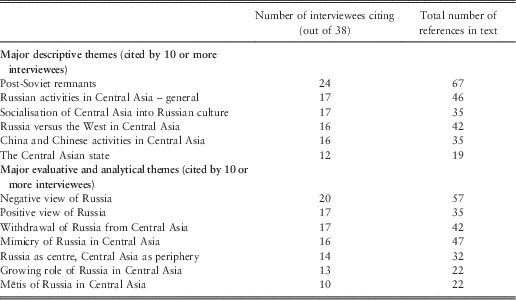
Our interview respondents bear witness to this shift from formal to substantive mimicry in Russia’s relationship with the West. Interviewees routinely referred to Russian initiatives as shadows of Western practices and institutions. The EEU was compared to the European Union, the CSTO to NATO, and the CSTO’s rapid reaction force to its NATO equivalent.Footnote 85 The obvious conclusion that Russians, in the words of a journalist in Dushanbe, ‘copy the Western experience’ is tempered by caveats on how formal post-Western mimicry works in substantively post-Soviet terms.Footnote 86 In total, interviewees made 42 references to Russian-Western dynamics in Central Asia but a further 67 to post-Soviet remnants of Soviet practices/institutions (Table 1).
Summary of themes identified in analysis.

Mētis in Russia’s relations with the West
Although mētis is present in any form of substantive social relations that extend beyond formal process, its nature as a necessarily ‘hidden’ transcript makes it difficult to observe in practice. Thus, mētis in Russian foreign policy was hinted at by interviewees in Moscow rather than made explicit, which indicates a methodological weakness in this study as (unlike our earlier work on Russia and Central Asia),Footnote 87 it did not deploy ethnographic methods. In the post-Soviet space, it is commonplace to speak in code about the informalities, inadvertent effects, and corruption of formal institutions. In discussing the EEU, one Russian scholar pointed to its malfunctions: ‘What is this body? Does it really implement anyone’s will? At least for me, it is difficult to say that it implements Russia’s will. This body is unable to control its activities.’Footnote 88
Central Asian interviewees noted Russia’s lack of an explicit strategy for Central Asia and its short-term approach. A human rights activist in Bishkek contrasted US and Russian approaches as follows: ‘If the Americans start making friends with someone from the cradle and walk with this person till the end [of his life], moulding his consciousness and his environment, then Russians form these relations with a sudden lunge [naskokom].’Footnote 89 One Kyrgyz journalist working for a Russian media outlet defined the ‘Russian approach’ as according to an ‘administrative logic’. ‘You find someone’, he noted, ‘you talk to that person, achieve mutual understanding, but where and in what form your proposal will move on is a big question. The Russian approach constitutes an administrative pyramid.’Footnote 90 Such administrative pyramids are familiar to elites who grew up in the late Soviet period with its bureaucratic hypertrophy and ‘cynical reason’.Footnote 91
These findings suggest that Russia is a ‘rising’ power chiefly in its substantive post-Western mimicry, though perhaps also in its post-Soviet mētis, through which it is able to reappropriate Western discourses and institutional forms and thereby challenge and subvert Western dominance. While mētis in this case shows us how local officials might subvert new projects such as the EEU, it is practices of substantive mimicry that are most clearly associated with the emergence of the post-Western. Substantive mimicry serves to delegitimise the existing order through the attachment of new meanings to old concepts and practices of international relations. In this way, Russia (though by no means only Russia) is helping to bring about a post-Western world order.
Central Asia: a postcolonial, post-Western region?
The Central Asian region exemplifies the convergence of postcolonial and post-Western international relations. First, it is a postcolonial region, having been colonised by the Russian Empire in the Eighteenth and Nineteenth Centuries. Second, it is a region with little, and decreasing, Western influence. This final section sets out Central Asia as a postcolonial post-Western space, before analysing the form and content of the practices of mimicry and mētis reported by interviewees.
Central Asia’s postcolonial aspect is debated by modern historians in terms of whether the Soviet Union, as the successor to the Russian Empire in the region, was a colonial empire or a multinational modernising state.Footnote 92 It is widely accepted that the USSR was a hybrid of the two as an ‘affirmative action empire’ or ‘empire of nations’.Footnote 93 However, an increasing number of scholars of Central Asia analyse the region’s Soviet history and its independence in colonial and postcolonial terms, including revealing the colonial aspects of specifically anti-colonial and internationalist Soviet strategies in Central Asia.Footnote 94 There is surely no dispute that Central Asia was colonised by the Russian Empire in a manner largely consistent with the form and content of European imperial conquest. The important question therefore is not whether Central Asia is postcolonial, but when and how it is postcolonial. ‘Post-imperial remnants’ was the most common descriptive theme in the interviews with 24 interviewees making reference on 67 occasions. One Tajik journalist noted that Russia was resurging in Tajikistan, not due to genuine closeness or regional commonality but because ‘as it turns out, it is very difficult to live without Russia’.Footnote 95
In terms of Central Asia’s post-Western status, Western influence has been receding since the waves of interventions for democratisation, development, and security assistance of the 1990s and early 2000s. Western normative engagement was unsuccessful in fomenting democratic transitions in the region, despite the formal mimicry of its constitutions and electoral processes and substantive adoption of financial liberalisation. References to Western activities were rare among our interviewees (six references by five interviewees) and therefore do not even appear in the table, in stark contrast to references to Russia (46 by 17) and secondarily China (35 by 16). Given our interviews were conducted by an ethnic Russian and specifically addressed Russian foreign policy, this is hardly surprising. However, the fact that interviewees were almost six times more likely to pivot from Russia to statements about China than about the West is telling. Analytical and evaluative statements in our interview data mirrored this decline: the West was portrayed as distant, irrelevant and inactive, a fair-weather friend that would not assist in times of crisis. One respondent described the prospect of Western involvement in the region as ‘just a beautiful idea’.Footnote 96 Further, where comparisons were made, the Western approach to conflict was seen as mired in bureaucracy and proceduralism, based on values considered alien to local populations. Russia, by contrast, was considered Central Asia’s true partner, able to act as security guarantor and control the influence of other major powers. In the words of one respondent, ‘Everybody knows that, as long as there is a Russian base here, the United States can’t play any kind of big games here.’Footnote 97 Others highlighted Russia’s absolute power in the region: ‘[The President of Tajikistan Emomoli] Rahmon can’t not make an agreement with Russia, he can’t alienate Russia. Because Russia has its interests here. It can do anything here, including a coup d'état.’Footnote 98
Accordingly, practices of mimicry and mētis in Central Asia rely heavily on the region’s ambivalent relationship with Russia, trapped between nostalgia for what is remembered as the brotherly Soviet-era relationship and a growing nationalism that instead recalls a colonial, exploitative past. Core postcolonial themes are present in the responses of our interviewees. In particular, evaluative statements of mimicry (47 references by 16 interviewees), centre-periphery relations (32 by 14), and mētis (22 by 10) were identified in the transcripts (see Table 1). Negative (20 interviewees) and positive (17) views are both common with a majority favouring negative or suspicious views of Russia. Similarly, there is debate both over Russia’s withdrawal compared to Soviet times (17) and its post-Soviet resurgence (13). Many in the region feel caught between the deep sociocultural ties that come with decades of socialisation into Russian cultural practices and a growing distaste for Russia as a political entity. This equivocal relationship between the subaltern and the hegemon breeds practices of formal mimicry and mētis – on the one hand unable to reject neo-imperialistic projects outright, but on the other disinclined to support them wholeheartedly.
Mimicry in Kyrgyz and Tajik relations with Russia
Like Russia’s mimicry of the West, state-level mimicry of Russia in Kyrgyzstan and Tajikistan is evident in both institutions and discourses. Russian governmental organisational forms, such as the Duma, have been reproduced to varying degrees across the region, and Central Asian legislative discourses tend to rearticulate those of Russia.Footnote 99 However, unlike Russia’s substantive mimicry of Western discourses, which serve to undermine Western global hegemony, Kyrgyz and Tajik reproductions and rearticulations tend towards emulation. Mimicry thus tends to remain at the formal level, unable to reappropriate the power of the former coloniser.
To consider first institutional mimicry, national parliaments mimic the form of the Russian duma. According to one respondent, ‘supposedly we have a parliament, but in reality, there are groups there who are lobbying for shadow flows [of money], and as a matter of fact, they are occupied with lobbying for their own businesses, and the mandate of an MP is there to give immunity’.Footnote 100 Another respondent called Kyrgyzstan a ‘pseudo-parliamentarian republic’.Footnote 101 Once created, such institutions, since they are not embedded in within a developmental tradition or ensemble of pre-existing supporting institutions, invent their own national raison d’être. This echoes the way in which the Russian duma mimics Western parliamentary politics; however, unlike Russia, Central Asian states do not seek to subvert hegemonic discourses of appropriate domestic political organisation. The mimicry here is formal: it is a superficial emulation of the former imperial master and does not try to rebalance power relations or challenge prevailing norms.
Post-Soviet security agencies also retain links and patterns indicating something between deep cooperation and institutional isomorphism. One Dushanbe-based respondent stated, ‘The state security and law enforcement agencies are just for show. They demonstrate the invented threat and then fight with it themselves.’Footnote 102 The deep institutional continuities and enduring relations between Central Asian state security agencies and Russia’s internal and external security services is one of the main vectors of Russia’s relations with its former colonial territories. Tajikistan and Uzbekistan in particular have successfully prosecuted campaigns against their political enemies based in Russia by orchestrating arrests, detentions, illegal formal extraditions, informal renditions, and disappearances with the direct connivance of the Russian security services. The CIS’s Minsk Treaty provides some formal provision for such cooperation but informally it is eased by customary processes whereby human rights safeguards are disregarded. There are at least 18 public records of Uzbek and Tajik exiles subject to disappearance, rendition, and assassination with the suspected connivance of the Russian security services between 2001 and 2016.Footnote 103 In some cases, Russia acted to arrest Central Asian exiles prior to the formal issues of a warrant by the Central Asian security service.
Regarding discursive mimicry, conservative laws adopted in Russia travel quickly to Central Asia, with governments adopting their own, often more conservative, versions. For example, the Russian so-called Foreign Agents law of July 2012, which requires NGOs receiving foreign funding and conducting ‘political activities’ to register as ‘foreign agents’ with the Ministry of Internal Affairs and label themselves as such on all their print and online materials.Footnote 104 Similar laws have since been approved in Tajikistan and Kazakhstan, but a Kyrgyz version was unexpectedly rejected by the parliament at the bill’s final reading in May 2016. In June 2013, Vladimir Putin signed the so-called ‘Gay Propaganda Law’ into the legal codex. This now infamous law, which claims to improve child protection, prohibited distribution of ‘propaganda’ about ‘non-traditional sexual relationships’ to minors.Footnote 105 In January 2015, Kazakh deputies debated the addition of a similar clause to child protection legislation, though it was ultimately rejected amid fears it could damage the country’s bid to host the 2022 Winter Olympics.Footnote 106 In Kyrgyzstan, a more repressive version of the law, which would impose prison sentences instead of fines to people referring to homosexuality in public, is currently going through parliament.Footnote 107
This formal mimicry works both for and against a relationship of colonial dependency with Russia. On one hand, the copying of parliamentary institutions and laws and the deep cooperation between security agencies demonstrate how Central Asian states – especially Kyrgyzstan and Tajikistan – continue the economic and security dependencies on Moscow. On the other hand, such mimicry does not imply either exclusive loyalty to Moscow, as it did in Soviet times, or adherence to a shared doctrine or ideology of governance. Formal postcolonial Central Asian mimicry therefore does not (yet) have the same disruptive potential as substantive post-Western Russian mimicry.
Mētis in Kyrgyz and Tajik relations with Russia
The practice of mētis demonstrates the practical limits of Russian power in Central Asia: at the level of discourse, mētis is visible in the use of local language to protect and make irreducible ‘local knowledge’; at the level of practice, what is often termed corruption can also be seen as mētis, since it is conducted through local clientelistic networks typically invisible to outsiders. As with Russia, our interview data on mētis is less strong given that it is often invisible without direct observation. However, unlike in Russia, in Central Asia it appeared to comprise a central aspect of everyday relations with the hegemon. Our respondents speak of mētis as they report the disintegration of Soviet institutional and ideological foundations that has left an environment fertile for the subversion of projects. As one respondent lamented, ‘contemporary Kyrgyz people don’t work, there is no proletariat, agriculture is in decline, everybody is moving to the city, there is no work here. Clerks steal everything. Politicians do the same. The youth is either leaving [the country] or joining organized crime…’.Footnote 108
While numerous respondents noted the slow decline of the Russian language in Central Asian public life as a regrettable loss, others saw it as a source of opportunity, as it enabled Central Asians to express discontent with Russia without being understood and chastised for it. ‘I always say, guys, just understand one thing: the local people often lie in the Russian language’, one Central Asian respondent noted. ‘For example, the migrants coming back are afraid to find fault with [scold/criticise] Russia in Russian – they are afraid that someone will spot them, register in some kind of book, black list – while in their own language it is possible.’Footnote 109 Corroborating this, other respondents in Tajikistan noted that a critical discourse of Russia in the public sphere is completely absent. However, social media is used to publicise incidents of violence against Central Asian migrants in Russia: ‘when something negative happens, it goes viral, becomes frantically shared, liked, tweeted, and these social networks become a powerful tool to influence public consciousness’.Footnote 110
What is often dismissed as corruption may also be understood as mētis. Order controls and trading regulations are frequently manipulated or even ignored by influential traders working on the re-export of goods of Chinese goods to Russia and other Central Asian states. It is the local knowledge of informal bureaucratic practices, and the subaltern agency of controlling those practices, that enables such manipulation to occur. ‘They bring in 10 billion, but declare only 2 billion, while the other eight billion is being re-absorbed’, noted one interviewee. ‘This practically is smuggling. This is what the whole [import/export] structure has been built on.’Footnote 111 Such practices are reported as widespread in economic exchange with the former colonial power: ‘Russian companies’, reports another interviewee, ‘faced the necessity to include into the budget money to be paid to the local elite.’ The respondent, recalling the process of applying for Russian-funded grants, laments, ‘While knowing that the project will cost 3–3.5 million roubles, we ask for 8, we get 3.5 and the rest we must write off so that the people who give this money can keep it. And it’s always like this.’Footnote 112
Inevitably, this collaboration between native elites and former colonial power for personal and familial gains creates resentment from those excluded from the kickbacks offered by Russian contractors. This is the other side of mētis in Scott’s analysis – that is, practical knowledge not just working for the maintenance of hierarchies through the completion of state projects but in its cunning containing the basis for the project’s subversion. In Kyrgyzstan, the one country in Central Asia where a significant political opposition exists, these stories have become scandals that opponents of the government use to mobilise protests both in the capital and regions against the state. They become wedges that threaten the elite’s control of its population. In recounting a story of a Russian-funded project in southern Kyrgyzstan one NGO worker in Osh remarked, they ‘invest a lot of money, but there are few results. And the state too, they don’t invest, they try to administrate, but there are few results from them too, because everything is kept within the structure (formalizovano) of the state.’Footnote 113 Such corruption is so commonplace that some projects become more about the rent-seeking opportunities than about the strategic and infrastructural objectives.Footnote 114
The post-Soviet aspect of this corruption is well-documented in both its routine (petty) and spectacular (grand) manifestations. Alena Ledeneva analyses a sistema of informal clientelist networks, integral to how Russia is governed, which have evolved from the Soviet period and adapted to global capitalism.Footnote 115 Karen Dawisha demonstrates how the economy came to be controlled by Putin’s network after he moved successfully to co-opt or control Russia’s ‘oligarchs’ of the 1990s.Footnote 116 But it is important to recognise that what appears to be specifically post-Soviet is globally post-Western. Cases from both Russia and Central Asia demonstrate that the offshore financial system is integral to grand corruption as it enables mobility, security, and secrecy for monies earned from resource capture. As Alexander Cooley and John Heathershaw show, Central Asia is just as much part of this decentred system as any other world region with a global network which connects London and New York to Moscow, Bishkek and Dushanbe via the British Virgin Islands, the Caymans, Cyprus, Gibraltar, Guernsey, and Hong Kong among other places.Footnote 117 Thus, we find the profits of Tajik aluminium – estimated at a quarter of Tajik GDP over the period from 2005–15 – transferred to BVI accounts and its disputes with the Russian Aluminium company adjudicated in UK and Swiss courts.Footnote 118 More globally still, Kyrgyzstan’s Asia-Universal Bank was set up as a node in the global financial system with tens of billions of dollars flowing in and out of the company to/from offshore accounts from Belize to New Zealand in the few years of its existence before the fall of Bakiev regime in 2010.Footnote 119
Conclusions: Towards area studies of global politics
The evidence presented here demonstrates that post-Western international relations are present in Russian foreign policy and Central Asian affairs to varying degrees. These are two distinct modes of the post-Western that are related but must not be conflated. First, as discussed in Section Three and as has been widely observed elsewhere, Russia substantively mimics the West as a post-imperial state, and challenges commonly accepted meanings of the key concepts and practices of the international community.Footnote 120 Russia’s strength in the international system means it does not have to resort so frequently to practices of mētis vis-à-vis Western hegemonic projects, but can instead employ substantive mimicry to undermine their legitimacy and expose their inconsistencies. The post-Western condition thus implies a greater amount of agency and subversive capacity than the postcolonial condition, at least in the context of Russia and Central Asia.
Second, as argued in Section Four, there are formal mimicry and mētis with Kyrgyzstan and Tajikistan’s relations with the former colonial power. Central Asia is a region emerging as properly post-Western in its rejection both of the Russian/Soviet past and the Western-sponsored ‘transition’ process of the 1990s. Russia’s international relations in this region underline the acceptance of its neocolonial projects on the surface alongside a subtle but firm resistance to fully-fledged Russian hegemony, which occasionally leads to pushbacks.Footnote 121 Relations between Russia and it postcolonies, as articulated by our interviewees, are ones based on ambivalence. Nascent discourses of mimicry and basic practices of mētis reflect, on the one hand, disillusionment with Russia and, on the other, dependence on it, echoing the postcolonial experience more broadly. To borrow from David Chioni Moore, these relations equivocate ‘between the desire for autonomy and a history of dependence, between the desire for autochthony and the fact of hybrid part-colonial origin, between resistance and complicity, between imitation (or mimicry) and originality’.Footnote 122
These two modes of the post-Western together enable us to sketch out an analytical framework that is global without being specifically Western. Four remarks may be made by way of conclusion regarding the theoretical import of the postcolonial mode of the post-Western. The first three of these are ontological and a fourth methodological. Firstly, this analytical path enables us to shift the focus away from the Western vs non-Western dyad that is the primary focus in analyses of international politics, to relations between, entanglements of, and collaboration among these actors at a global scale. Mimicry and mētis are globally instantiated phenomena even when they have specific manifestations in great power politics (Russia’s EEU project simultaneously mimicking and competing with the EU) and regional affairs (Central Asian extraction industries incorporation into the global offshore networks). Secondly, the dual focus on the postcolonial state as object and its constitutive elite as agents accurately reflects the embedded nature of agency. It decentres analysis away from an exclusive focus on the state as institution to the elite networks that flow through the state. Thirdly, mimicry and mētis are concepts within post-Western structures that are global. There is not a country in the world that has not been touched by colonialism, either as coloniser or colonised. They therefore allow the possible for commensurable claims and shared conversations about global politics upon which to begin the construction of theories. As discussed above, the alternative to this approach is either to accept the inevitably imperial optic of IR or embark on a conception of IR as comparative regional studies, as the proponents of non-Western IR imply. Fourthly, the concepts demand methodologies that pay attention to practice. Mimicry, as an elite practice, is primarily accessible through the discourse at the postcolonial state level, evident in the rationale given for the development of laws, political institutions, and foreign policy decisions. Mētis, as the practice of citizens, can be uncovered through ethnographic fieldwork and participant observation. A modest attempt in this direction has been attempted in this article, but a great deal of possible mētis was invisible to this study due to the methods used.
As our modest and illustrative study has shown, mimicry and mētis, although features of the postcolonial form of post-Western IR, are not necessarily markers of the decolonisation of international politics. There are variations in the extent of the postcolonial, as is evident in our partial examples of mimicry and mētis. Like modernities, postcolonial relations are not simply multiple but asymmetrically entangled.Footnote 123 There are methodological and epistemological challenges found in this entanglement: in the need to incorporate the micro with the macro, and to do so in a manner that is able to capture the different strands of the postcolonial. The combination of ethnographic fieldwork with discourse analysis is hard to achieve without a focus on a particular region and its languages at the expense of other neighbourhoods of the post-Western world and other manifestations of the postcolonial conditions. This is an immense challenge of research design and its limits. Collaborative research for the co-production of knowledge internationally (often between major Western universities and institutions and independent researchers of the ‘non-West’) is both a moral and practical necessity. In its research design, ontologically and methodologically, a postcolonially informed post-Western IR must be reflexive, that is, able to reflect on the problems of ethnocentrism without discarding the claim to universal value.Footnote 124
Acknowledgements
This article was produced thanks to the time afforded under the ESRC research project ‘Rising Powers and Conflict Management in Central Asia’ (ES/J013056/1).