Understanding disruptions to scheduled health-care services due to natural disasters and other emergencies is important because timely primary and preventive care can reduce demand for urgent or emergency care services and prevent exacerbations of chronic health conditions. The coronavirus disease 2019 (COVID-19) pandemic recently underscored that threats to continuity of primary and preventive care services are a concern when there are sudden limits to scheduled nonessential health-care services. Reference Lewis, Seervai and Shah1,Reference Weinstein, Ragazzoni and Burkle2 Furthermore, the United Nations strategy under the Sendai Framework for Disaster Risk Reduction identifies “the number of disruptions to health services attributed to disasters” as a key indicator (D7) for progress reporting. 3 As such, it is important to consider methods to assess the impacts of emergencies on scheduled primary care services using data from recent disasters.
This study compares impacts of 2 significant hurricanes, Harvey and Ike, on primary care appointments in Houston and surrounding areas compared with appointments in other locations that were not impacted. The Texas Gulf Coast and inland areas surrounding Houston are home to approximately 7 million residents. 4 When this region was struck by Hurricane Ike in 2008 and Hurricane Harvey in 2017, the resulting widespread damage made these storms 2 of the top 10 costliest natural disasters in US history. 5 Hurricane Ike was a category 4 storm that caused intense damage to coastal areas due to high winds and storm surge, while Hurricane Harvey’s impact was more widespread with record flooding due to its slow movement, size, and heavy localized rainfall. 5 Public health impacts of both storms have been previously assessed to document problems with environmental contamination, Reference Karaye, Stone and Casillas6 use of emergency services, and victims’ mental health. Reference Radcliff, Chu and Der-Martirosian7–Reference Lowe, Norris and Galea9
Furthermore, while more general impacts of disasters on mental and emergency medical care access have been well-described, Reference Gaston, Galea and Cohen10 no systematic evidence is available to describe the relationship between disasters and delayed or limited access to primary care services delivered in ambulatory care settings. Basic infrastructure challenges such as road closures due to flooding and or power outages due to high winds can limit operations if patients or staff are unable to access facilities for scheduled appointments. Previous research has reported on methods to capture ambulatory care appointment continuity and recovery across clinic provider types, Reference Radcliff, Chu and Der-Martirosian7 but no prior studies were identified that uniformly capture and compare appointment disruptions across different emergencies in the same geographic area.
Appointment cancellation percentages can be tracked over time to identify care disruptions that result from natural disasters or other emergencies. Specifically, tracking the percentage of missed appointments can capture the severity of disruptions based on differences in the weeks before, during, or after emergency onset. Reductions in completed appointments around emergencies may indicate operational and patient-safety related reasons versus routine scheduling issues unrelated to disasters. While this approach is not complex, it represents a promising method that health-care leaders can integrate for organizational planning and decision making.
Methods
The analysis used a retrospective cohort observational study design that compared US Department of Veterans Affairs (VA) clinics in a single administrative region, or Veterans Integrated Service Network (VISN), that included areas that were either directly affected or not directly affected by the hurricanes. VA clinics were chosen to study because they are part of a large integrated health-care system with a shared scheduling system that tracks appointment dispositions with resulting data that can be analyzed through the VA’s Corporate Data Warehouse (CDW). Institutional Review Board (IRB) approval for this research study was obtained from the VA Greater Los Angeles Healthcare System review committee.
The study sample included primary care appointments from 5 wk before to 5 wk after each storm. Appointments were selected from VA Medical Centers (VAMCs) and their associated outpatient clinics. Clinic locations that were impacted by both hurricanes were identified to include the Houston, TX, VAMC location plus 9 outpatient clinics that share common leadership with the Houston VAMC with locations in Houston, surrounding suburbs, and coastal areas, and 1 further inland. The comparison sample of clinics included 9 other VAMCs and their affiliated outpatient clinics that were identified as being in the same VISN as the Houston, TX, VAMC during Hurricane Ike, but were located outside the greater Houston and nearby coastal areas. The comparison clinics included: Alexandria, LA and its 5 outpatient clinics; Biloxi, MS and its 4 outpatient clinics; Fayetteville, AR and its 6 outpatient clinics; Jackson, MS and its 7 outpatient clinics; Little Rock, AR and its 9 outpatient clinics; Muskogee, OK and its 4 outpatient clinics; Oklahoma City, OK and its 10 outpatient clinics; and Shreveport, LA and its 3 outpatient clinics. Although also part of the same VISN, VA clinics in and around New Orleans were excluded from the analysis due to Hurricane Gustav’s impact in the same study timeframe as Hurricane Ike.
VA clinics located in impacted areas had a weekly average total of 4732 primary care appointments, with a range of 3803 to 5035 and a median of 4901 during the study period. The 9 comparison facilities had a weekly average total of 12,931 primary care appointments across all locations, with a range of 10,354 to 13,706 per week and median weekly total of 13,067 over the study time frame. The median facility in comparison areas had an average of 1783 weekly primary care appointments and range of 1339 to 2031 during the study period.
Appointment dispositions for primary care visits were recorded as follows: completed as planned, cancelled by the clinic, cancelled by the patient, patient was a “no show,” or cancelled because the appointment was no longer needed (for various reasons). Appointments that were no longer needed were excluded from the analysis. From the resulting sample of appointments, the number of weekly appointments “completed as planned” was divided by the total number of scheduled appointments to calculate the completion percentage. Grouped analysis compared weekly appointment completion percentages for clinics in locations directly impacted by the storms to those in comparison locations.
Results
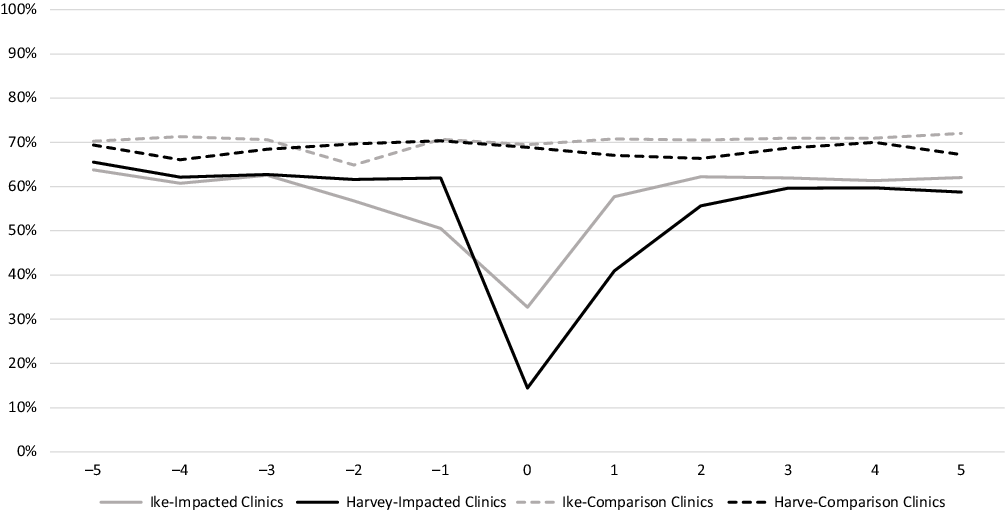
Figure 1 provides a descriptive comparison of primary care appointment continuity during the study timeframe. Comparison clinics maintained a consistent weekly percentage of completed appointments that ranged from 65% to 72% over the 11 wk studied for each event. For clinics located in areas directly impacted by the storms, there was a rapid appointment disruption and recovery pattern. Specifically, clinics in impacted areas had overall weekly appointment completion percentages ranging from 61% to 66% in the 5 wk before the storm for Hurricane Harvey, but appointment completion percentages that started to decline from over 60% to around 50% in the 2 wk before Hurricane Ike (see Figure 1). For clinics in the impacted locations, only 14% of primary care appointments were completed as scheduled the week of Hurricane Harvey’s landfall (vs 33% for Hurricane Ike), and 41% of scheduled appointments were completed the week following Harvey (vs 58% for Ike), suggesting a more sudden and intense initial impact from Hurricane Harvey on routine clinic operations. By the second week after each storm made landfall, approximately 60% of scheduled appointments were kept by clinics in impacted locations; this percentage resembled prestorm levels.
Percentage of VA primary care appointments completed by week relative to storm landfall.

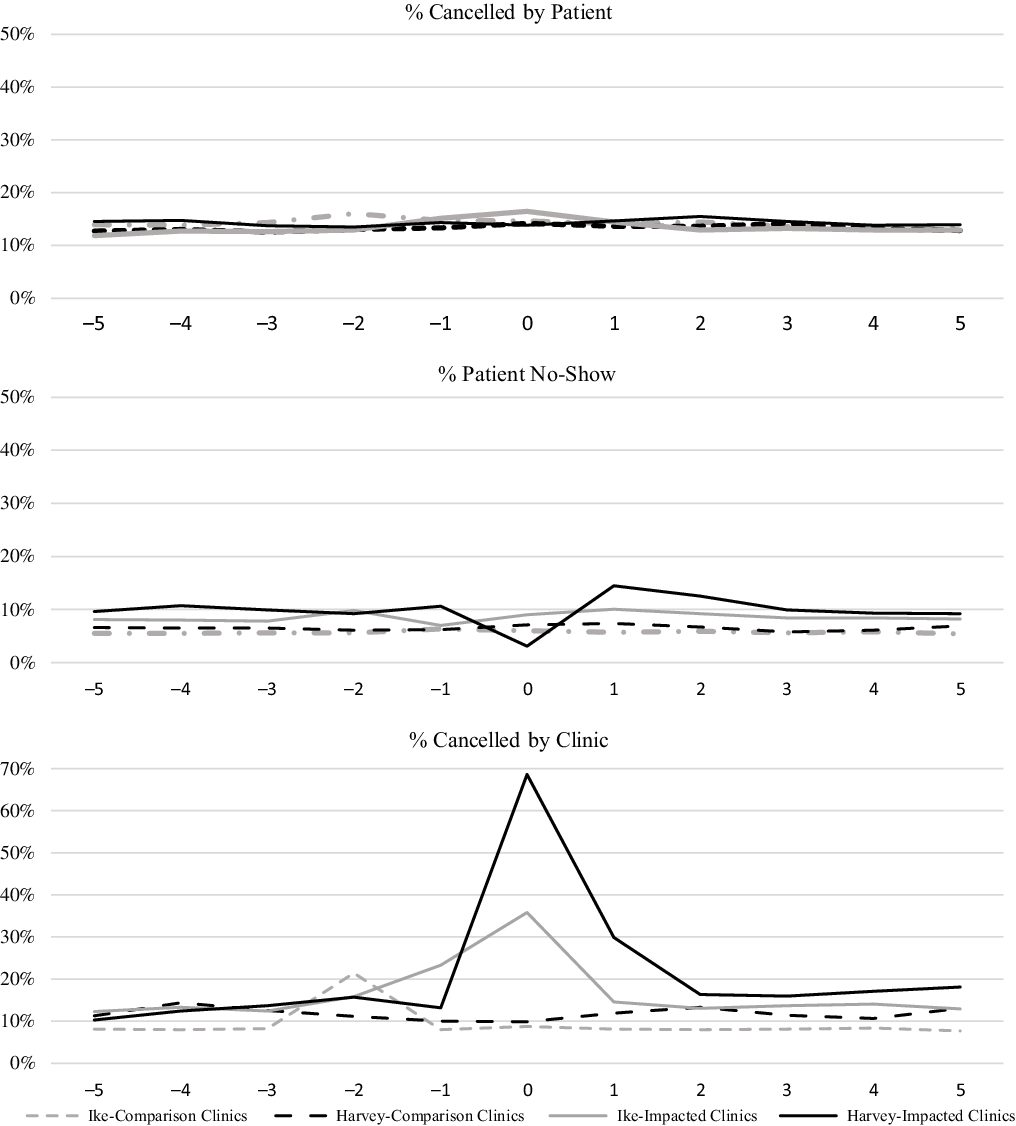
Figure 2 offers a breakdown of the reason for missed appointments in the impacted and comparison areas over time by event with distinct appointment disruptions apparent for clinics in impacted areas. Specifically, there was an increase in clinic cancellations beginning 2 wk before Hurricane Ike that peaks at 36% of appointments during the week of landfall and then returns to prestorm levels. The unexpected and quick impact of Hurricane Harvey is evidenced by the stable percentage of clinic cancellation percentages until the week of landfall when almost 70% of primary care appointments were cancelled with 30% the following week and the percentage continuing above prestorm levels through the end of the study timeframe. Patterns of weekly no-show appointments in relation to Hurricane Harvey are also reflective of the disruptions, with a lower percentage of no-show appointments during the week of landfall directly related to pro-active cancellations by the clinic followed by an uptick in no-shows to over 14% of appointments the week after landfall. The weekly percentages of appointments cancelled by patients across both events varied little for both impacted and comparison clinics with weekly percentages ranging from 12% to 16.5% during the study time frames.
Reasons for missed primary care appointments for Hurricane Ike and Hurricane Harvey by week relative to storm landfall.

Further review of appointments at the clinic location level revealed most VA clinics in the impacted areas remained open throughout both storms. Three clinics closed for at least 1 business day around Hurricane Harvey and 2 clinics closed for 1 or more business days around Hurricane Ike, with only 1 VA clinic located near the Texas coast that closed for 1 or more business days in response to both hurricanes. All VA clinics that closed or reduced clinic operations briefly during the week of hurricane landfall were observed to have kept at least 40% of scheduled appointments by the week after the storm except for 1 location near the coast that had substantial storm-related water damage that reduced operations for all 5 wk observed after Hurricane Harvey (clinic-level data not shown).
Discussion
This study leveraged existing administrative data sources and a unique natural experiment where 2 severe weather events roughly 10 y apart impacted the same coastal areas of Texas. While impacted areas had lower primary care appointment completion percentages around both storms, these effects were relatively brief.
Although descriptive, the analysis is indicative of VA’s response and ability to serve patients with primary care clinic appointments from event to event. For example, clinic closures were not prolonged for either event, tended to be in locations closer to the coast, and accounted for a relatively small proportion of the primary care appointments in impacted areas. One VA clinic location sustained substantial water damage that made clinic operations unsafe in the weeks after Hurricane Harvey, but was able to leverage temporary support of 2 mobile medical units with staff deployed from 1 of the comparison facilities to fill some of the gaps in care for veterans and others in the community. Previous research (data not shown) indicated that many patients rescheduled their VA-based care after Hurricane Ike, although some may have sought care outside of VA. However, telehealth was a more widespread alternative to address primary care needs by the time Hurricane Harvey struck in 2017. Indeed, telehealth was widely used within the New York region following Hurricane Sandy, which occurred 4 y after Hurricane Ike. Reference Der-Martirosian, Griffin and Chu11
Because many factors can impact whether an appointment is completed, there is a risk that any differences in appointment continuity identified for Hurricane Ike versus Hurricane Harvey are related to factors other than the disaster. Because disaster circumstances and consequences were not the same for Hurricane Ike (eg, a major wind event) and Hurricane Harvey (eg, sustained rain and flooding), strategies that support care continuity for 1 storm or disaster type may not necessarily help for another. Nonetheless, this research informs better understanding of routine care disruptions in similar emergency circumstances, with an easily applicable approach that could be more generally applied to support health-care operations in relation to emergency management and response.
Conclusions
With the recent increase in the prevalence and severity of catastrophic natural disasters and growing concerns regarding disease outbreaks that may cause both a surge in demand for inpatient or emergency care and potential barriers to delivering routine ambulatory care services, health-care systems should carefully consider strategies to improve primary and preventive care continuity. The findings presented here directly inform VA operational readiness, as VA facilities (hospitals and clinics) serve over a million veterans in the areas impacted by Hurricanes Ike and Harvey and millions more nationwide. The methods used in this research can serve as a more general model for assessing appointment dispositions and access to care around multiple emergencies and across health-care systems. Appointment-based measures can also readily support real-time operational assessments of whether local primary care capacity is adequate or if support from providers outside an impacted community is needed to facilitate a return to normal. Maintaining operations to deliver scheduled primary care reflects facility-level and system-level preparedness, which can vary according to the societal context for specific catastrophic events. Nonetheless, initial comparisons of primary care continuity around disasters is important to support overall emergency management planning, resilience, and recovery.
Funding
This material is based upon work supported by the Department of Veterans Affairs, Veterans Health Administration, Office of Patient Care Services.
Declaration of Conflicting Interests
The views expressed in this article are those of the authors and do not necessarily reflect the position or policy of the Department of Veterans Affairs or the United States government.