Two phonological abilities that continue to receive increasing attention in the research literature are phonological awareness and nonword repetition. Phonological awareness is of interest given its relation to reading acquisition and reading disabilities. Nonword repetition has become a frequent measure in studies on specific language impairments and second language learning. There has been less research examining the development of spoken word recognition and its relationship to these two important phonological abilities. Research findings have supported the position that phonological representations in lexical memory contribute to the development of phonological awareness (e.g., Boada & Pennington, Reference Boada and Pennington2006; Elbro, Borstrǿm, & Peterson, Reference Elbro, Borstrǿm and Petersen1998; Metsala, Reference Metsala1999) and to individual differences in children's ability to repeat nonwords (e.g., Bowey, Reference Bowey1996, Reference Bowey2001; Jones, Gobet, & Pine, Reference Jones, Gobet and Pine2007; Metsala, Reference Metsala1999). The purpose of the current study was threefold. First, we examined the effects of word age of acquisition and neighborhood density on young children's spoken word recognition across a 1-year time span. Second, we examined the relationship between spoken word recognition at Time 1, and phonological awareness and reading 1 year later. Third, we examined whether spoken word recognition and verbal memory at Time 1 contributed independent variance to nonword repetition 1 year later.
DEVELOPMENT OF SPOKEN WORD RECOGNITION
Spoken word recognition involves matching speech input to lexical patterns (i.e., words’ phonological representations) that are stored in memory and, in the adult literature, is widely viewed as a discriminative process in which various lexical alternatives must be distinguished from one another (e.g., Luce & McLennan, Reference Luce, McLennan, Pisoni and Remez2005; Luce & Pisoni, Reference Luce and Pisoni1998). Words are proposed to be organized into similarity neighborhoods (e.g., Luce & Pisoni, Reference Luce and Pisoni1998) such that words with many similarly sounding neighbors (i.e., those residing in dense neighborhoods) have more competition. Indeed, adult spoken word recognition across a variety of tasks (e.g., the identification of words in noise, lexical decision, and naming) demonstrates this “competition effect” as recognition is quicker and more accurate for words from sparse versus dense neighborhoods (e.g., Goldinger, Luce, & Pisoni, Reference Goldinger, Luce and Pisoni1989; Luce, Goldinger, Auer, & Vitevitch, Reference Luce, Goldinger, Auer and Vitevitch2000). Similarity neighborhoods have been typically defined as the number of words that vary from the target word by a one phoneme addition, substitution or deletion. Thus, “cat,” which overlaps with many words (e.g., “pat,” “hat,” “rat,” “cut,” “curt,” “cap”), resides in a dense neighborhood; “fudge” has only a few neighbors (e.g., “judge,” “fun,” “fuss”) and resides in a sparse neighborhood. The phoneme is viewed as the unit of representation and organization in the adult mental lexicon, and competition effects based on phonemic-similarity neighborhoods have been interpreted as supporting this assumption (e.g., Luce, Reference Luce1986). Further assumptions encompassed in adult models are that phonemically based representation and organization does not vary as a function of a word's neighborhood or the position of the information within a word (Storkel, Reference Storkel2002). In this paper, the term “phonological representation” is used to refer to the word-level phonological form or information stored in lexical memory. In a connectionist model of speech perception, it would be expected that this lexical-level of representation would have reciprocal associations with phoneme- and feature-level representations (e.g., TRACE model of speech perception; McClelland & Elman, Reference McClelland, Elman, McClelland and Rumelhart1986).
Current understandings of the development of spoken word recognition and lexical organization across early and middle childhood remain underspecified (e.g., Nittrouer, Reference Nittrouer2002a, Reference Nittrouer2002b; Walley, Reference Walley, Pisoni and Remez2005, in press). The lexical restructuring model proposed that vocabulary growth is instrumental in driving very young children's more holistic representations and/or processing of spoken words toward the segmental or phonemically based adult state (Metsala & Walley, Reference Metsala, Walley, Metsala and Ehri1998; see also, Fowler, Reference Fowler, Brady and Shankweiler1991; Nittrouer, Studdert-Kennedy, & McGowan, Reference Nittrouer, Studert-Kennedy and McGowan1989; Walley, Reference Walley1993). Vocabulary growth referred to increases in the number of words a child knows, and to increases in the familiarity and similarity neighborhoods of individual lexical items. As particular areas of the lexicon become more dense, lexical representations were proposed to be restructured or reorganized; that is, more segmental representations emerge or become more salient (see also, Storkel, Reference Storkel2002; Walley, Reference Walley2008). Consistent with this proposal, structural analyses of young children's lexicons have shown that as late as 7 years of age, children's receptive and productive vocabularies consist primarily of phonetically dissimilar words (Charles-Luce & Luce, Reference Charles-Luce and Luce1990, Reference Charles-Luce and Luce1995; Logan, Reference Logan1992), the recognition of which could be accomplished by relatively holistic versus segmental processes (see also Vincente, Castro, & Walley, Reference Vincente, Castro and Walley2003; but see Dollaghan, Reference Dollaghan1994; Storkel, Reference Storkel2004).
Research studies on children's spoken word recognition have not been consistent concerning the effects of word familiarity and neighborhood density. Studies have variously found that the competition effect does not differ across age groups (e.g., 7 and 9 years; Ziegler & Muneaux, Reference Ziegler and Muneaux2007), is present for older but not younger children (e.g., Munson, Swensen, & Manthei, Reference Munson, Swenson and Manthei2005), or is present in young children only for the most familiar words (e.g., Elliott, Hammer, & Evan, Reference Elliott, Hammer and Evan1987; Metsala, Reference Metsala1997a; Pitrat, Logan, Cockell, & Gutteridge, Reference Pitrat, Logan, Cockell and Gutteridge1995). The different age groups examined and differing familiarity of lexical items may account for the inconsistencies across these studies.
In the first year of this study (Garlock, Walley, & Metsala, Reference Garlock, Walley and Metsala2001), we assessed the performance of 64 preschoolers/kindergartners, 64 first and second graders, and 64 adults on a word repetition task and a speech gating task (recognition of gated words). We found robust age of acquisition (AOA) effects (see also, Walley & Metsala, Reference Walley and Metsala1990, Reference Walley and Metsala1992) and minimal effects of frequency when AOA was controlled. Older children showed a competition effect similar to adults, but strongest for the most familiar words. The competition effect was absent for young children's gating performance but observed on the word naming task for the most familiar words. We interpreted our findings as evidence that segmental processing is related to word familiarity and neighborhood density, consistent with Munson et al.'s (Reference Munson, Swenson and Manthei2005) suggestion that competition based on phonemic neighborhoods emerges with development.
Storkel's (Reference Storkel2002) structural analysis of neighborhoods is consistent with this proposal (see also Gerken, Murphy, & Aslin, Reference Gerken, Murphy and Aslin1995; Walley, Smith, & Jusczyk, Reference Walley, Smith and Jusczyk1986). Three- to 6-year-olds classified words from dense neighborhoods on the basis of phoneme similarity. For words from sparse neighborhoods, similarity was based on phonemes for the onset-nucleus position but manner for the rime position. Storkel's findings were “. . . consistent with the lexical restructuring model proposed by Metsala and Walley . . .” and extended the model by highlighting the importance of the position of information within a word (see also Walley, Reference Walley1987, Reference Walley1988; Walley et al., Reference Walley, Smith and Jusczyk1986). Consistent with these proposals, young children were better at a rime oddity task for words from dense versus sparse rime-neighborhoods and children with higher vocabularies performed particularly well for the more difficult judgments involving final consonants (e.g., meat, seat, weak; De Cara & Goswami, Reference De Cara and Goswami2003). Similarly, 3- to 4-year-olds performed better on a phoneme-blending picture-matching task for words from dense versus sparse neighborhoods (Metsala, Reference Metsala1999). Together these findings suggest that words from dense neighborhoods are represented with greater specificity prior to the development of literacy, and that this greater differentiation is supported by spoken vocabulary growth, consistent with work showing that vocabulary knowledge under girds more fine-grained speech discrimination and spoken word recognition performance (e.g., Munson, Reference Munson2001; Werker, Fennell, Corcoran, & Stager, Reference Werker, Fennell, Corcoran and Stager2002). A third study on density effects in phonological awareness found that speech and language impaired children blended words from sparse versus dense neighborhoods more accurately (Roth, Trioa, Worthington, & Handy, Reference Roth, Troia, Worthington and Handy2006). However, the cell of sparse words was of higher frequency, and a previous study found children to perform better on phonological awareness tasks for high- versus low-frequency words (Metsala, Reference Metsala1999). In our previous study (Garlock et al., Reference Garlock, Walley and Metsala2001; see also Walley, Metsala, & Garlock, Reference Walley, Metsala and Garlock2003), ceiling and floor effects on our phonological awareness tasks prevailed and we did not find a main effect of density.
It is noteworthy that in the studies with typically developing children described above, the participants were quite young (as young as 36 months in Metsala's study) and had little, if any, reading experience (see also Rvachew, Reference Rvachew2006). Even so, in three studies using different tasks, children displayed some sensitivity to the phonemic structure of the test stimuli. These findings lend additional support to the claim that some incipient phoneme awareness arises before reading experience, as a result of vocabulary growth and serves as a scaffold for early reading (e.g., Fowler, Reference Fowler, Brady and Shankweiler1991; Metsala & Walley, Reference Metsala, Walley, Metsala and Ehri1998). The present study examined both the development of spoken word recognition and its relationship to phonological awareness.
RELATIONSHIP AMONG LEXICAL REPRESENTATIONS, PHONOLOGICAL AWARENESS, AND READING
There have been suggestions that the quality of phonological representations impacts phonological awareness and early reading acquisition, and indeed, may be a primary cause of reading disabilities (e.g., Boada & Pennington, Reference Boada and Pennington2006; Elbro, Reference Elbro1996). Only a limited number of studies have examined the relations between speech perception/spoken word recognition, phonological awareness, and reading, at least with comprehensive speech measures. In these studies, tasks used to index representational quality have varied from picture naming (Swan & Goswami, Reference Swan and Goswami1997), categorical speech perception (e.g., McBride-Chang, Reference McBride-Chang1996; McBride-Chang, Wagner, & Chang, Reference McBride-Chang, Wagner and Chang1997), pronunciation accuracy for complex multisyllabic words (e.g., Elbro, Borstrom, & Peterson, Reference Elbro, Borstrǿm and Petersen1998; Elbro, Neilson, & Peterson, Reference Elbro, Nielsen and Petersen1994), word naming in noise (e.g., Boets, Wouters, van Wieringen, & Ghesquière, Reference Boets, Wouters, van Wieringen and Ghesquière2006; Garlock et al., Reference Garlock, Walley and Metsala2001), and speech gating (e.g., Garlock et al., Reference Garlock, Walley and Metsala2001; Metsala, Reference Metsala1997b; Wesseling & Reitsma, Reference Wesseling and Reitsma2001). Collectively, findings have supported associations between tasks indexing phonological representations and concurrent and/or subsequent phonological awareness.
Some of these studies have demonstrated these relationships in children with reading and language impairments. For example, Boada and Pennington (Reference Boada and Pennington2006) found that dyslexic children (11–13 years of age) performed more poorly than age and reading-level matched controls on a composite variable of implicit phonological representations (speech gating, lexical priming, and syllable similarity tasks). This “implicit factor” predicted unique variance in reading when paired with each of rapid automatized naming and nonword repetition, but not with phonological awareness. Of the total variance that phonological awareness accounted for in reading, 63% was shared with the implicit speech recognition factor. These authors suggested that their findings lend strong support for the hypothesis that dyslexic readers have less mature implicit-phonological representations. In an examination of children with speech–sound disorder, Rvachew (Reference Rvachew2006; see also Rvachew & Grawburg, Reference Rvachew and Grawburg2006) found that both speech perception and receptive vocabulary (but not articulation accuracy) were directly linked to improvements in phonological awareness from prekindergarten to kindergarten. Taken together, findings support the claim that developmental advances in basic speech representations and/or processing provide some foundation for phoneme awareness (see also, Chaney, Reference Chaney1994; Fowler, Reference Fowler, Brady and Shankweiler1991; Whitehurst & Lonigan, Reference Whitehurst and Lonigan1998).
Our previous research has led us to predict that recognition of words from sparse neighborhoods will have a special relationship to later phonological awareness and reading. In the first year of this study (Garlock et al., Reference Garlock, Walley and Metsala2001), we found that early-acquired words from sparse neighborhoods predicted phonological awareness, whereas recognition of dense words did not. In an earlier study, we had found that children with reading disabilities showed a deficit in spoken word recognition only for words from sparse neighborhoods, and did not show an advantage for words from sparse versus dense neighborhoods, as did the comparison group (Metsala, Reference Metsala1997b). For the youngest group of participants in that study (about 7 years of age), recognition of words from sparse neighborhoods, together with phoneme awareness, predicted word and pseudoword reading. The current study examined whether recognition for words from sparse neighborhoods maintains this special association with phonological awareness across a 1-year time span, and whether there is a direct or indirect relationship between spoken word recognition and reading.
SPOKEN WORD RECOGNITION AND NONWORD REPETITION
Gathercole (Reference Gathercole2006) has stated that, “The ability to repeat multisyllabic nonwords . . .is subject to a high degree of individual variation during childhood, and probably represents the most effective predictor of language learning ability that is currently known” (p. 513). Nonword repetition has been shown to have a robust relationship to vocabulary knowledge and learning. The storage framework account proposes that nonword repetition is largely a measure of phonological storage capacity, and that this capacity significantly influences learning new vocabulary items (e.g., Baddeley, Gathercole, & Papagno, Reference Baddeley, Gathercole and Papagno1998; for a review, see Gathercole, Reference Gathercole2006). One alternative account of the relationship between nonword repetition and vocabulary is that across early development, vocabulary growth propels the segmental structure or specificity of lexical–phonological representations and that these representations in lexical memory support performance on nonword repetition tasks (e.g., Bowey, Reference Bowey1996; Edwards, Beckman, & Munson, Reference Edwards, Beckman and Munson2004; Metsala, Reference Metsala1999). This second account is congruent with the lexical restructuring model of spoken word recognition. Given the importance of this measure, current research has focused on delineating the processes contributing to nonword repetition in addition to phonological memory capacity (for a review, see the Special Issue of Applied Psycholinguistics, Crago & Goswami, Reference Crago and Goswami2006).
Early on, Snowling, Chiat, and Hulme (Reference Snowling, Chiat and Hulme1991) argued that nonword repetition is not a pure measure of phonological short-term memory, but rather is impacted by the listener's long-term lexical knowledge. Metsala (Reference Metsala1999) found that measures of both phonological short-term memory and phonological awareness predicted unique variance in young children's nonword repetition. Both Bowey (Reference Bowey1996) and Metsala (Reference Metsala1999) found that nonword repetition did not predict vocabulary knowledge beyond measures argued to tap individual differences in the representation of lexical items (phonological sensitivity/awareness). Bowey (Reference Bowey2001) further found that nonword repetition, as conventionally scored, did not predict vocabulary 1 year later when a measure of phonological sensitivity was first entered into the equation. The current study sought to further explore the relationships between nonword repetition, lexical processing, and verbal memory. This study extends the results of Bowey (Reference Bowey1996) and Metsala (Reference Metsala1999) by examining an implicit measure of spoken word recognition, rather than measures of phonological sensitivity/awareness, and examined the determinants of nonword repetition across a 1-year time span.
In summary, the first objective of the current study was to examine changes in spoken word recognition over a 1-year time period. Specific predictions were that children would need less of the acoustic–phonetic input on the gating task, and become more accurate on the word naming task from Year 1 to Year 2. Further, it was predicted that the competition effect, which was somewhat restricted to early acquired words in Year 1, would become equally evident for later acquired words in Year 2. The second objective of this study was to examine the relationships between spoken word recognition in Year 1 and phonological awareness and reading in Year 2. We predicted that spoken word recognition for words from sparse versus dense neighborhoods would be a better predictor of phonological awareness in Year 2. We also predicted that children who were poorer at recognizing sparse words in Year 1 would be poorer on a test of word reading 1 year later. The final objective was to examine whether Year 1 measures of spoken word recognition would predict Year 2 nonword repetition beyond a measure of verbal memory. We expected they would, following the proposal that long-term lexical knowledge impacts nonword repetition (e.g., Jones et al., Reference Jones, Gobet and Pine2007).
METHOD
Participants
The participants were 24 first and second graders (young children) and 24 third and fourth graders (older children; mean age = 7.00 ± .15 and 9.07 ± .11, respectively). There were 9 males and 15 females (22 Caucasians [C], 2 African Americans [AA]) in the younger group, and 13 males and 11 females (17 C, 7 AA) in the older group. These groups comprised a subset of the preschooler/ kindergartener and first-/second-grade groups in our original study.
Tasks
Each child completed the battery of tasks from the original study. The standardized tests included: the Peabody Picture Vocabulary Test—Revised (PPVT-R; Dunn & Dunn, Reference Dunn and Dunn1981); the word reading subtest of the Wide Range Achievement Test—Third Edition (WRAT-3; Wilkinson, Reference Wilkinson1995); and the backward digit span subscale of the Wechsler Intelligence Scale for Children—Revised (Wechsler, Reference Wechsler1974), a measure of both short-term memory and complex working memory (Alloway, Gathercole, & Pickering, Reference Alloway, Gathercole and Pickering2006). The children completed experimental measures of spoken word recognition, gating, and word repetition; phonological awareness, initial phoneme isolation, and initial phoneme deletion; and nonword repetition.
Gating
Children were told that they would hear “a tiny part of the word, followed by more and more of it.” A series of trails with increasing amounts of acoustic–phonetic input from word onset were presented. The initial trial consisted of 100 ms of the target and each subsequent trial increased by 50-ms steps until the entire word was presented. Children guessed the word after each trial and also made a confidence rating by pointing to a scale containing the numbers 1–7, with a sad face above the 1, a straight mouthed face above the 4, and a happy face above the 7. A total of 32 words were presented across two sessions.
Word repetition
Thirty-two words were presented both in quiet and embedded in white noise (64 stimuli), along with 16 nonwords. CSRE software (Canadian Speech Research Environment, 1994) was used to create a version of each word and nonword with white noise added (0 dB signal to noise ratio; see Ryalls & Pisoni, Reference Ryalla and Pisoni1997). Listeners were told they would hear real and pretend words, some of which would sound “noisy,” and they were asked to repeat what they heard.
Initial phoneme isolation
Each listener heard 32 words and was asked to “only say the beginning sound” for each item (e.g., to say the “f ” given “foot”). A liberal scoring criterion was applied such that if the child repeated the correct initial sound coarticulated with an unstressed vowel, the response was scored correctly.
Initial phoneme deletion
For each of 32 words, the child was asked to repeat the word without the beginning sound (e.g., to say “oot” given “foot”).
Nonword repetition
Participants repeated one-, two-, three-, and four-syllable nonwords immediately after each presentation (see Gathercole, Willis, Emslie, & Baddeley, Reference Gathercole, Willis, Emslie and Baddeley1991). Ten items of each length were presented in random order.
Stimuli
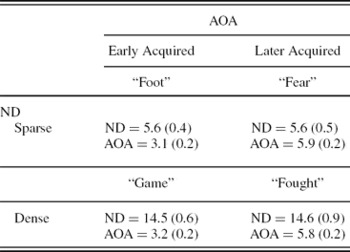
In our original study, there were 128 test words that varied orthogonally with respect to AOA (early vs. late), word frequency (high vs. low), and neighborhood density (ND; sparse vs. dense; see appendix in Garlock et al., Reference Garlock, Walley and Metsala2001). Word frequency effects were minimal in that study, and thus the current design examined AOA crossed with ND. The AOA ratings were available from our previous research (Metsala, Reference Metsala1997a) and were confirmed by an additional 16 adult raters for Garlock et al. (Reference Garlock, Walley and Metsala2001). Half the words had AOA ratings from adults that were less than 4.5 (1.5–4.4; M = 3.3), the other half had ratings greater than 4.5 (4.8–7.4; M = 5.9) on a 9-point scale (Carroll & White, Reference Carroll and White1973), where 1 = acquired at 0–2 years, 5 = acquired at 6 years, and 9 = acquired at 13 years or older. ND measures for a large corpus of words (900) were also available from our previous work (Metsala, Reference Metsala1997a). Half of the words in the present study were from sparse neighborhoods (1–9 neighbors; M = 5.8); the other half of the words were from dense neighborhoods (11–25 neighbors; M = 14.6; see Table 1). Within and across cells, the test words were balanced with respect to word frequency, based on Kucera and Francis (Reference Kucera and Francis1967). This measure was cross-validated with Kolson's (Reference Kolson1961) count of words spoken by kindergarteners, as well as a more recent frequency count of printed materials for kindergarteners and first graders (Zeno, Ivens, Millard, & Duvvuri, Reference Zeno, Ivenz, Millard and Duvvari1995; for details, see Garlock et al., Reference Garlock, Walley and Metsala2001). In addition, the cells did not differ in terms of other potentially important characteristics such as neighborhood frequency, and the number of words beginning with a stop, fricative/affricate, nasal/liquid, or semivowel was similar across cells.
2 (AOA) × 2 (ND) stimulus matrix

Note: AOA, mean age of acquisition rating; early = 3.3 (0.1), late = 5.9 (0.1). ND, mean neighborhood density; sparse = 5.7 (0.2), dense = 14.6 (0.4). There were 32 words in each of the four cells of the matrix (one example is given for each cell). Standard errors are in parentheses.
The stimuli for the gating and word repetition tasks were recorded by a female speaker from Alabama, prepared using various software programs (for details, see Garlock et al., Reference Garlock, Walley and Metsala2001), and then recorded on cassette tapes for presentation to participants. Stimuli for the nonword repetition task were recorded directly onto tape. Participants in the current study were presented with one of four sublists of 32 words each (for details, see Garlock et al., Reference Garlock, Walley and Metsala2001) for each of gating, word naming, initial phoneme isolation, and initial phoneme deletion. The four lists were counterbalanced across participants in each age group according to a simple Latin square design.
Procedure
Parents of children in our original study were contacted and invited to participate in a 1-year follow-up study. Data collection took place during the second half of the school year in two sessions (1 to 42 days between sessions, M = 14 days). All children passed a pure-tone hearing screening (500–2000 Hz at 20 dB) at the start of each session. Practice items with corrective feedback were administered at the start of all experimental tasks.
Data scoring
For the gating task, we calculated isolation points (IPs) and total acceptance points (TAPs). The IP is the stimulus duration at which a target word is first correctly identified. The TAP is the duration of the gate at which the word is identified with high confidence (6 or 7), with no subsequent change in identification or confidence rating. When the target was not identified, its total duration plus 50 ms (one gate) was used for the IP. When listeners did not maintain a correct identification or reach/maintain high confidence, the targets total duration plus 50 ms was used for the TAP. The millisecond IPs and TAPs were converted to percentages of a target's total duration to adjust for differences in durations across words (e.g., a TAP = 60.5 means that the listener needed 60.5% of the total duration of a target word to correctly and consistently identify the word with high confidence). Percent correct scores were used for the word repetition and phonological awareness tasks.
RESULTS
Spoken word recognition performance
Data from the gating and word repetition tasks were analyzed in separate 2 (Group) × 2 (Year) × 2 (AOA) × 2 (ND) mixed-model analyses of variance (ANOVAs). Unless otherwise noted, only those effects that were significant in both subject and item analyses (F1 and F2) at or beyond the α < .05 level are reported.
Gating
Results are presented for the TAPs, as these largely replicated the IP analyses (differences in findings are noted below). TAPs are the percentage of a target's total duration at which the word was identified with high confidence (6 or 7), with no subsequent change in identification or confidence rating.
The TAP data analysis revealed a main effect of group, F (1, 46) = 13.29 and F (1, 56) = 124.78, AOA, F (1, 46) = 78.34 and F (1, 56) = 52.47, ND,Footnote 1F (1, 46) = 8.22 and F (1, 56) = 5.484, and year, F (1, 46) = 3.83 and F (1, 56) = 10.28. The analysis also indicated a Group × AOA interaction, F (1, 46) = 4.50 and F (1, 56) = 9.50, and an AOA × ND interaction,Footnote 2F (1, 46) = 9.25 and F (1, 56) = 7.22.
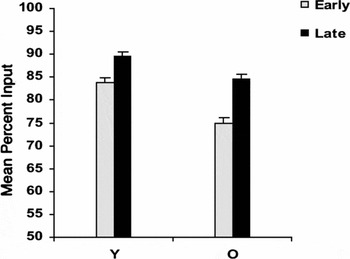
The overall effect of year indicated that as children got older, they needed less speech input to provide responses that were consistently correct and made with high confidence (M = 84.91, SD = 12.30 and M = 81.61, SD = 13.19 for Year 1 and Year 2, respectively). Older children were always consistent and confident in their correct identifications based on less input than younger children, and both young and older children needed less input to consistently and confidently identify early than late words: early, M = 83.79, SD = 14.83 and M = 75.00, SD = 11.69, respectively; late, M = 89.67, SD = 10.93 and M = 84.59, SD = 8.76 for young and older children, respectively. However, the AOA × Group interaction (see Figure 1) revealed that older children showed a more pronounced effect of AOA as they were particularly consistent and confident in their identifications of early words.Footnote 3
Mean TAPs in the gating task as a function of AOA for young children (Y) and older children (O). TAPs are expressed as percentages of total word duration, and lower scores represent better performance.

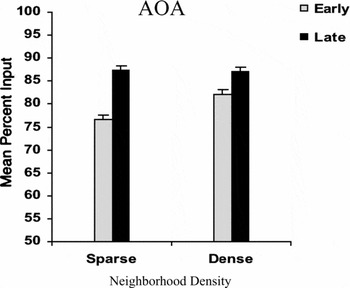
The AOA × Density interaction (see Figure 2) revealed that less input was needed for consistent and confident identification for early words that reside in sparse versus dense neighborhoods (M = 76.66, SD = 14.07 and M = 82.13, SD = 13.51); there was no effect of neighborhood density for late words (M = 87.31, SD = 10.31 and M = 86.95, SD = 10.15 for early and late words, respectively).
Mean TAPs in the gating task as a function of AOA and ND. TAPs are expressed as percentages of total word duration, and lower scores represent better performance.

Word repetition
The word repetition results are reported as average percent correct scores for words accurately identified in quiet and in the noise conditions. Results revealed a main effect of group, F (1, 46) = 9.43 and F (1, 56) = 19.30, AOA, F (1, 46) = 112.20 and F (1, 56) = 18.08, and ND, F (1, 46) = 61.13 and F 2 (1, 56) = 8.27, as well as a Group × Year × AOA interaction, F (1, 46) = 4.22 and F (1, 56) = 3.50.
Overall, children identified more early than late words: M = 71.6%, SD = 0.101 versus M = 62.4%, SD = 0.106. Children also identified words from sparse neighborhoods more accurately than those from dense neighborhoods (M = 70.1%, SD = 0.117 vs. M = 63.9%, SD = 0.106). For the Group × Year × AOA interaction, simple F tests revealed that the only improvement from Year 1 to Year 2 was for older children for early words (M = 0.720, SD = 0.106 and M = 0.753, SD = 0.105, respectively). Young and older children did not differ on their recognition of early words in Year 1 (M = 69.4%, SD = 0.096 and M = 72%, SD = 0.106), but did differ on their recognition of early words in Year 2, given older children's improvement for this cell (M = 69.7%, SD = 0.087 and M = 75.3%, SD = 0.105, for younger and older children, respectively). Conversely, young children performed more poorly than older children for late words in Year 1 (M = 59.1%, SD = 0.116 and M = 64.8%, SD = 0.102), but did not differ for late words in Year 2 (M = 61.8%, SD = 0.089 and M = 63.7%, SD = 0.087, for younger and older children, respectively).
Relationship among spoken word recognition, phonological awareness, and reading
To examine relationships among the three major constructs in this study, we calculated several composite variables. Based upon findings from our original study (Garlock et al., Reference Garlock, Walley and Metsala2001) and from our past research (Metsala, Reference Metsala1997b), our preliminary analyses confirmed our prediction that spoken word recognition for sparse and dense words would be related differentially to phonological awareness. We therefore created two composite variables from our spoken word recognition (SWR) measures; SWR-sparse and SWR-dense. For SWR-sparse, scores were first averaged across the gating IP for early-sparse and late-sparse, and averaged separately for word repetition early-sparse and late-sparse. Gating IP averages were then inverted before being further combined with word repetition scores. From these two scores, we derived a factor score using principal components analysis.Footnote 4 The same process was used to derive the SWR-dense composite variable.Footnote 5 The phoneme awareness (PA) composite variables for Year 1 and Year 2 were the percent correct collapsed across the two phonological awareness tasks, delete initial phoneme, and isolate initial phoneme.
To examine if children high and low on our SWR-sparse measure differed in their reading ability 1 year later, a 2 (Age Group) × 2 (Spoken Word Recognition Ability Group) ANOVA was carried out on Year-2 WRAT-3 standard scores. A high- and low-spoken word recognition ability group was created by using a median split for each of the young and older children's groups separately.Footnote 6 The analyses revealed a main effect of spoken word recognition ability group (F = 7.228, p = .01). For both younger and older children, the top half of the spoken word recognition ability group in Year 1 had higher standardized reading scores in Year 2 (M = 117.6, SD = 20.62 vs. M = 101.5, SD = 18.16 for younger children, respectively; M = 107.8, SD = 12.00 vs. M= 99.3, SD = 10.12 for older children, respectively). Two separate analyses of covariance (ANCOVAs) were conducted with covariates of Year 1 PA and Year 2 PA. The effect of spoken word recognition ability group remained significant in the analyses with phoneme awareness at Time 1 as the covariate (F = 5.868, p = .02) but was not significant with the covariate of phoneme awareness at Time 2 (F = 2.967, p = .092).
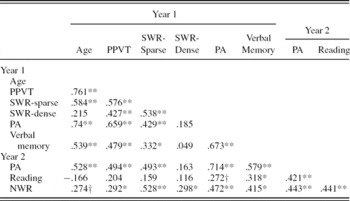
The zero-order correlations for the variables used in the following regression analyses are shown in Table 2. We asked whether spoken word recognition for words from sparse neighborhoods would have a special relationship to later PA. We first examined whether Year 1 spoken word recognition for words from sparse neighborhoods would predict phonological awareness 1 year later, as hypothesized. From the hierarchical regression (Table 3), we found that SWR-sparse predicted 5.3% of the variance in Year 2 PA, after age and Year 1 PA were entered into the equation. In contrast, Year 1 SWR-dense was not significantly correlated with Year 2 PA. As can be seen from Table 2, Year 1 SWR-sparse was not significantly correlated with Year 2 reading. This supports others who have argued for an indirect relationship between speech perception/spoken word recognition and reading (e.g., McBride-Chang, 1986).
Correlations between variables in regression analyses

Note: PPVT, Peabody Picture Vocabulary Test; SWR-sparse, spoken word recognition composite for sparse neighborhoods; SWR-dense, spoken word recognition composite for dense neighborhoods; PA, phonological awareness composite; Reading, Wide Range Achievement Test, 3rd ed., word reading subtest, standard score; NWR, nonword repetition.
*p < .05. **p < .01. †p ≤ .06.
Hierarchical regression analyses predicting Year 2 phonological awareness

Note: SWR-sparse, spoken word recognition composite for sparse neighborhoods; PA, phonological awareness composite.
The role of spoken word recognition and short-term memory in nonword repetition
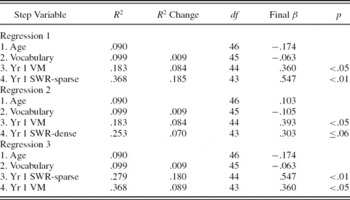
We next asked whether measures of spoken word recognition and verbal memory in Year 1 would each contribute unique variance to nonword repetition performance in Year 2. In Table 4, regression 1, age, vocabulary (PPVT-R raw scores), and Year 1 verbal memory were forced into the equation as the first three steps. As the fourth step, SWR-sparse accounted for an additional 18.5% of the variance in nonword repetition. Regression 2 shows that this finding was replicated with SWR-dense forced in as the fourth step, accounting for an additional 7% of the variance in nonword repetition. In Regression 3, age, vocabulary and Year 1 SWR-sparse were forced into the equation as the first three steps. As the fourth step, verbal memory accounted for an additional 8.9% of the variance in nonword repetition. Measures of spoken word recognition and verbal memory accounted for unique variance in children's later nonword repetition.
Hierarchical regression analyses predicting Year 2 nonword repetition

Note: Yr 1, Year 1; Vocabulary, Peabody Picture Vocabulary Test, 3rd ed., raw score; SWR-sparse, spoken word recognition composite for sparse neighborhoods; SWR-dense, spoken word recognition composite for dense neighborhoods; VM, verbal memory from the Wechsler Intelligence Scale for Children, 3rd ed., backward digit span.
DISCUSSION
Previous research has suggested that important developmental advances in lexical representations and lexical organization are still taking place across early childhood (e.g., Metsala, Reference Metsala1997a; Walley, Reference Walley1993; Storkel, Reference Storkel2002, Reference Storkel2004). In the current study, children recognized words on the basis of less acoustic–phonetic input across a 1-year time frame in the gating task, even though the absolute size of their lexicons (and thus the number of lexical alternatives) would have increased across this same time frame. Children also became consistent and confident in their responses on the basis of less of the speech input across the year. On the spoken word repetition task, the absolute level of performance did not improve from Year 1 to Year 2, with the exception of older children's performance for early acquired words. Older listener's also showed this superior recognition of early words on the gating task. Older listeners were consistent and confident on the basis of less speech input across all words; however, because of the particular efficiency for early words, they showed a more pronounced effect of AOA than younger listeners. This reflects the continued influence of experienced frequency on familiar words; our older listeners are thus becoming more like the adult listeners in our original study (Garlock et al., Reference Garlock, Walley and Metsala2001). The gating task, overall, appeared more sensitive to changes in spoken word recognition across this 1-year time frame. The consecutive presentation of more and more input may more closely tap processes in online recognition without the demands of tasks utilizing reaction times, which may not always be valid to use with younger children (for review of the gating task, see Grosjean, Reference Grosjean1996).
Both younger and older children showed evidence of a competition effect on both measures of spoken word recognition. For the gating task, the effect of neighborhood density was limited to the most familiar words. It was expected that developmental advances across 1 year might be reflected in a competition effect for even the more unfamiliar words on the gating task. This effect was present across word familiarity in the word repetition task. Garlock et al. (Reference Garlock, Walley and Metsala2001) argued that the word repetition task may be more sensitive to competition effects as performance is based on the information throughout a word. Gating may be more sensitive to the effects of lead (consonant–vowel) neighbors, given that earlier guesses are not based upon input throughout the word. However, the finding that gating was sensitive to competition effects for early words, and that in our original study adults showed this effect for all words on the gating task, also supports the position that lexical organization becomes more segmental with item familiarity, and thus the competition effect is an emergent property of lexical development (e.g., Metsala & Walley, Reference Metsala, Walley, Metsala and Ehri1998; Walley, Reference Walley1993). This is consistent with research that has shown that the competition effect is present in older but not younger listeners (e.g., Munson et al., Reference Munson, Swenson and Manthei2005); with research that has demonstrated a competition effect only for the most familiar or frequent words (e.g., Elliot et al., Reference Elliott, Hammer and Evan1987; Metsala, Reference Metsala1999), and with the recent finding that adult English language learners demonstrated a competition effect only for very familiar words (Imai, Walley, & Flege, Reference Imai, Walley and Flege2005). These studies point to the importance of including both familiarity and neighborhood density measures in developmental studies of spoken word recognition.
The development of phonological awareness in childhood follows a trend from large to smaller units, from syllables, to onsets and rimes, to phonemes (e.g., Anthony & Lonigan, Reference Anthony and Lonigan2004; Goswami & Bryant, Reference Goswami and Bryant1990; Treiman & Zukowski, Reference Treiman and Zukowski1996). The question of what phoneme awareness consists of or what drives phoneme awareness is linked to the contentious issue of whether children possess any awareness of phonemes prior to reading instruction. Some (see Rayner, Foorman, Perfetti, Pesetsky, & Siedenberg, Reference Rayner, Foorman, Perfetti, Pesetsky and Seidenberg2001; Ziegler & Goswami, Reference Ziegler and Goswami2005) assert that children only become aware of phonemes as a consequence of reading experience. In contrast, others (e.g., Fowler, Reference Fowler, Brady and Shankweiler1991; Metsala & Walley, Reference Metsala, Walley, Metsala and Ehri1998), although acknowledging the substantial role that reading plays in fostering phoneme awareness, have proposed that some incipient awareness arises early in childhood as a result of spoken vocabulary growth. In support, some studies have observed phonological sensitivity in prereaders (e.g., Chaney, Reference Chaney1994; DeCara & Goswami, Reference De Cara and Goswami2003; Metsala, Reference Metsala1999; Thomas & Senechal, Reference Thomas and Senechal1998). In addition, basic oral language skills, including receptive vocabulary knowledge, have been found to contribute to the development of phoneme awareness from kindergarten through second grade, apart from family background variables and irrespective of reading ability (Cooper, Roth, Speece, & Schatschneider, Reference Cooper, Roth, Speece and Schatschneider2002; cf. Foy & Mann, Reference Foy and Mann2001). Further, deficits in the quality of speech representation and/or processing have been proposed to constitute a core deficit affecting phonological awareness in dyslexic individuals (e.g., Snowling, Reference Snowling2000; Stanovich & Siegel, Reference Stanovich and Siegel1994).
Literacy can be viewed as being woven from many strands, one of which is early language development (Scarborough, Reference Scarborough, Neuman and Dickinson2001). However, the foundations for literacy provided by early language competencies may be more often assumed than they are demonstrated with any refinement (Dickinson & Snow, Reference Dickinson and Snow1987). Only a handful of studies have examined the relations between basic speech perception or spoken word recognition, phonological awareness, and early reading, at least with comprehensive speech measures (e.g., Boada & Pennington, Reference Boada and Pennington2006, Elbro et al., Reference Elbro, Borstrǿm and Petersen1998; Foy & Mann, Reference Foy and Mann2001; Garlock et al., Reference Garlock, Walley and Metsala2001; McBride-Chang et al., Reference McBride-Chang, Wagner and Chang1997; Metsala, Reference Metsala1997b; Swan & Goswami, Reference Swan and Goswami1997). In our original study, we observed concurrent correlations that supported the claim that developmental advances in speech representation and/or processing provide some foundation for phoneme awareness, which in turn, is important for beginning reading (see also Chaney, Reference Chaney1994; Fowler, Reference Fowler, Brady and Shankweiler1991; McBride-Chang et al., Reference McBride-Chang, Wagner and Chang1997; Whitehurst & Lonigan, Reference Whitehurst and Lonigan1998).
The current study confirmed the observation from our previous research that spoken word recognition for sparse words holds a privileged position in relation to phonological awareness and reading (Garlock et al., Reference Garlock, Walley and Metsala2001; Metsala, Reference Metsala1997b). First, children in Year 1 who were low versus high on the composite measure of SWR-sparse scored lower in word reading 1 year later. The effect of group remained significant when phonological awareness from Year 1 was controlled, but not when phonological awareness from Year 2 was controlled. McBride-Chang et al. (Reference McBride-Chang, Wagner and Chang1997) reported a similar finding with a measure of categorical speech perception with younger children (kindergarten in Year 1). We further found that spoken word recognition for sparse words predicted phonological awareness performance 1 year later, after age and autoregressive effects were taken into account. Taken together, these findings support the position that spoken word representations under gird the development of phonological awareness (e.g., Fowler, Reference Fowler, Brady and Shankweiler1991; Metsala & Walley, Reference Metsala, Walley, Metsala and Ehri1998), and that spoken word representations are related to reading indirectly through phonological awareness (e.g., McBride-Chang et al., Reference McBride-Chang, Wagner and Chang1997).
The question arises as to why there is a connection between the recognition of words from sparse neighborhoods and phoneme awareness and reading. These words enjoy a recognition advantage because they have few competitors. As a result of having few neighbors, they are also under less pressure for segmental reorganization. Recall that Storkel's (Reference Storkel2002) findings for similarity classification indicated that these words are less segmental than words from dense neighborhoods, but presumably at some point they do become more differentiated. Metsala (Reference Metsala1997b) proposed that this process may be delayed for children with reading problems. The available evidence suggests then that there is considerable variability in the representation of words from sparse neighborhoods. Perhaps these words undergo reorganization earlier for some children as opposed to others, because they know relatively more of these words’ neighbors. In contrast, for typically developing children, there may be a critical point in vocabulary development when all words become phonemically analyzed, regardless of lexical constraints on recognition. That is, analysis of input may become less tied to lexical characteristics with vocabulary development. Indeed, Metsala (Reference Metsala1999) found that younger children were more constrained by lexical factors and task demands than older children. For example, 4-year-olds’ phoneme awareness was sensitive to lexical characteristics (word vs. nonword and high vs. low frequency) for onset-rime and phoneme blending, but 5-year-olds were sensitive for only phoneme blending. Thus, there may be a developmental sequence such that segmental processing is tied to lexical characteristics, but then becomes independent in normal development. This “freer state” of phonological processing may be hampered in some children, who later have trouble learning the alphabetic code. Consistent with this position, Brown (Reference Brown1997; see also Metsala & Brown, Reference Metsala and Brown1998) demonstrated that less segmental representations caused a computational model of word reading to behave similarly to disabled readers. It is also possible that the phonotactic sequences making up words from sparse neighborhoods, which are more unusual, are somehow easier for some children to process. The current study provides the first longitudinal data that the superior recognition of words from sparse neighborhoods was related to better phoneme awareness across a 1-year time frame, and that groups differing on spoken recognition for these words differed in reading achievement 1 year later. Further research is needed to better understand why variance in spoken word recognition for words from sparse neighborhoods is particularly related to the development of phonological awareness.
The final purpose of this paper was to extend previous arguments that individual differences in phonological word representations account for unique variance in nonword repetition, and thus nonword repetition is not simply a measure of phonological storage capacity. The current study used an implicit measure of lexical structure (whereas previous research had used phonological awareness as a proxy for such; Bowey, Reference Bowey1996, Reference Bowey2001; Metsala, Reference Metsala1999) and examined the relationship over a 1-year time period. Our Year 1 implicit measures of word recognition for words from both sparse and dense neighborhoods predicted additional variance in nonword repetition after variance accounted for by age, vocabulary, and Year 1 verbal memory was removed. There has been increased attention to delineating the processes, other than short-term memory capacity, contributing to performance in nonword repetition tasks (for a review, see Gathercole, Reference Gathercole2006; see also Archibald & Gathercole, Reference Archibald and Gathercole2007). Snowling et al. (Reference Snowling, Chiat and Hulme1991) suggested early on that nonword repetition was affected by long-term lexical knowledge, and thus was not a pure measure of phonological short-term memory capacity. Indeed, a recent computational model (Jones et al., Reference Jones, Gobet and Pine2007) demonstrated that two important findings in the nonword repetition research, word length effects and word-likeness effects, can be accounted for solely by differences in phonological knowledge related to vocabulary growth. The current study is consistent with the position that spoken word representations are one important source of individual differences in nonword repetition and that this relationship extends over a 1-year time period. One alternative account is that the shared variance between nonword repetition and spoken word recognition is because of the common requirement of auditory encoding of the speech waveform. Nonword repetition appears to be a complex task that taps individual differences in linguistic knowledge and processes beyond phonological short-term memory capacity and representing it as a measure of such may be premature (e.g., CTOPP; Wagner, Torgesen, & Rashotte, Reference Wagner, Torgesen and Rashotte1999).
The present study aimed to address issues related to the development of spoken word recognition and its relationship to phonological awareness, reading, and nonword repetition. Our results provide support for the continued development of spoken word recognition and lexical organization through early and into middle childhood, with the emergence of the competition effect being linked to lexical characteristics and task demands. The recognition of words from sparse neighborhoods was predictive of later phonological awareness, and is indirectly related to word reading ability. Finally, the present study demonstrated that spoken word recognition predicted unique variance in nonword repetition across the year, consistent with the position that representations in long-term lexical memory are related to nonword repetition performance. Phonological awareness and nonword repetition are important processes in relation to reading development and language learning, respectively. Delineating the development of spoken word recognition, we would argue, is an important step toward better understanding the development of both phonological awareness and nonword repetition.
ACKNOWLEDGMENTS
Support for this research was provided by an internal grant from Mount Saint Vincent University (to J.M.) and by the National Institute for Child Health and Development Grant HD30398 (to A.W.). We are grateful to two anonymous reviewers for helpful comments on an earlier version of this paper.