Introduction
Reports of deficits in olfactory identification first appeared in the literature over two decades ago (Warner et al., Reference Warner, Peabody, Flattery and Tinklenberg1986), and are now an integral part of the clinical picture in this disorder (Serby et al., Reference Serby, Larson and Kalkstein1991; Luzzi et al., Reference Luzzi, Snowden, Neary, Coccia, Provinciali and Lambon Ralph2007). Individuals with AD are significantly less capable of choosing which of several verbal labels most likely represents an odor that is presented compared to healthy older participants (Warner et al., Reference Warner, Peabody, Flattery and Tinklenberg1986). This finding cannot be ascribed to the lexical nature of the task, as similar findings have been found when the alternatives were presented pictorially (Morgan et al., Reference Morgan, Nordin and Murphy1995).
Recent studies have shown that olfactory deficits are present and can be detected well before patients meet consensus clinical criteria for AD. Patients with amnestic Mild Cognitive Impairment (aMCI), a proportion of whom represent the preclinical stage of AD (Petersen et al., Reference Petersen2001; Yaffe et al., Reference Yaffe, Petersen, Lindquist, Kramer and Miller2006), have been shown in several recent studies to have deficits in olfactory abilities, and particularly in olfactory identification (Eibenstein et al., Reference Eibenstein2005; Djordjevic et al., Reference Djordjevic, Jones-Gotman, De Sousa and Chertkow2007). Furthermore, research has shown that impaired olfactory identification in MCI can predict conversion to AD (Devanand et al., Reference Devanand, Michaels-Marston, Liu, Pelton and Padilla2000; Peters et al., Reference Peters, Hummel, Kratzsch, Lotsch, Skarke and Frolich2003; Albers et al., Reference Albers, Tabert and Devanand2006). Because not all persons with aMCI subsequently meet criteria for AD, researchers in recent years have devoted great effort to establish markers that are more likely to differentiate aMCI patients who will meet clinical criteria for AD from those whose cognitive deficits are due to other causes.
Awareness of olfactory impairment
Patients with AD sometimes present with limited awareness of their cognitive and, indeed, other difficulties (DeBettignies et al., Reference DeBettignies, Mahurin and Pirozzolo1990; Starkstein et al., Reference Starkstein1997). Researchers have suggested that reduced awareness may be of diagnostic relevance in early AD (Wagner et al., Reference Wagner, Spangenberg, Bachman and O'Connell1997). However, research is not uniform in suggesting that limited awareness always accompanies AD or whether this deficiency is an early feature of the disease (Clare, Reference Clare2004a). More specifically, studies have shown that patients with AD may lack awareness of their olfactory deficits. Nordin et al. (Reference Nordin, Monsch and Murphy1995) found that, although the majority of AD patients (74%) and control participants (77%) reported normal odor-sensitivity (i.e. detection), AD patients were found to have significantly elevated odor-detection thresholds on testing compared to the control group.
Lack of awareness of an olfactory deficit has been suggested to be a predictor of conversion from MCI to AD. Devanand et al. (Reference Devanand, Michaels-Marston, Liu, Pelton and Padilla2000) found that MCI patients who received a diagnosis of AD at a two-year follow-up were more likely to have demonstrated a deficit in their ability to identify odors and to have reported that they had no olfactory impairment at baseline, compared with MCI patients who did not meet AD criteria at follow-up.
Several limitations in the study conducted by Devanand and colleagues compromise the conclusions. First, although a control group was used in their study, Devanand and colleagues did not report the extent to which the control participants were unaware of olfactory difficulties. Even healthy people often demonstrate limited awareness of any decline in their olfactory function (Nordin et al., Reference Nordin, Monsch and Murphy1995). Indeed, unlike in the visual and auditory domains, unawareness of olfactory decline may be more common than awareness of olfactory decline. Second, participants were asked whether they had any problems with their olfactory abilities, to which participants could answer “yes” or “no”. However, this phrasing implies that olfactory function is a unitary ability or that people are unable to dissociate different elements of their olfactory ability – such as detection and identification – which is not necessarily accurate. Conceivably, MCI participants in Devanand's study who did not demonstrate impaired olfactory detection have reasonably reported that they did not experience olfactory problems (Serby, Reference Serby2001). In addition, when asked about olfactory abilities with this simple question, participants may overstate any olfactory deficits based on long-standing olfactory difficulties. In addition, the phrasing of the question does not address the issue of deterioration in olfactory abilities, even though such decline in abilities is central to the onset of AD. Instead, when answering this simple question, participants may have been referring to entrenched rather than more recent olfactory difficulties. Other researchers interested in the relevance of reduced awareness in MCI as a marker of preclinical AD have emphasized the importance of phrasing questions in terms of decline in functioning, rather than in terms of current deficits (Crowe et al., Reference Crowe, Andel, Wadley, Cook, Unverzagt, Marsiske and Ball2006).
Indeed, Djordjevic et al. (Reference Djordjevic, Jones-Gotman, De Sousa and Chertkow2007) asked MCI, AD and healthy controls (HC) whether they were aware of any changes in their abilities to detect, discriminate, or identify odors. They found that, regardless of their diagnostic group, participants tended to overestimate their olfactory functioning. No group differences on self-reported olfactory abilities were observed. They also found no correlation between objective olfactory measures and self-report. Unlike Devanand et al. (Reference Devanand, Michaels-Marston, Liu, Pelton and Padilla2000), however, these authors did not conduct follow-up assessments to explore whether awareness of olfactory deficits predicts future conversion to AD.
The current study was designed to examine whether subjective olfactory function can differentiate aMCI patients from AD patients or control participants, and whether subjective olfactory function is relevant in the prediction of conversion from aMCI to AD. We were further interested in whether respondents indeed treated questions about different aspects of their olfactory ability separately, as well as in the nature of the relationship between subjective and objective measures of olfactory function. Follow-up assessments were offered to a subgroup of the original sample 12 months later, providing us with preliminary data which enabled us to examine whether the likelihood of meeting criteria for AD at that time is associated with subjective olfactory reports at baseline.
Methods
Participants
Twenty-five patients who met NINCDS-ADRDA criteria (McKhann et al., Reference McKhann, Drachman, Folstein, Katzman, Price and Stadlan1984) for probable Alzheimer's disease (AD), 25 patients who met consensus criteria for amnestic Mild Cognitive Impairment (aMCI; Winblad et al., Reference Winblad2004), and 22 healthy elderly controls (HC) were recruited for the current study. All participants were recruited and assessed as part of their participation in a large-scale longitudinal project on imaging brain amyloid using PiB PET (Rowe et al., Reference Rowe2007) at Austin Health, Melbourne, Australia. Recruitment procedures, as well as inclusion and exclusion criteria for the PiB study, have been published elsewhere (Rowe et al., Reference Rowe2007). Additional exclusion criteria for the olfactory testing procedure included a history of viral infections and allergies in the month immediately prior to the olfactory assessment, chronic medical conditions affecting olfactory function, or a history of head injury.
All participants provided their consent for the olfactory testing independently of their consent to participate in the PiB study. Where capacity to consent was uncertain, consent was also obtained from the primary carer, usually a spouse. This project was conducted under the approval of the ethics committees at Monash University and Austin Health, Melbourne.
Materials
The olfactory identification task in the current study comprised six items selected from the “scratch and sniff” University of Pennsylvania Smell Identification Test (UPSIT; Doty et al., Reference Doty, Shaman and Dann1984). These items were menthol, leather, strawberry, pineapple, smoke and natural gas. At the outset, a subset of 42 participants (11 HC, 17 MCI and 14 AD) was given an olfactory task comprising ten UPSIT items based on the findings of Tabert et al. (Reference Tabert2005). However, the olfactory identification task was subsequently shortened and the analysis focused on six items that were found in preliminary analysis to have the best discriminatory power. All statistical analyses were repeated, however, with the complete set of ten items and the results presented below were unchanged. Unirhinal olfactory testing has been the preferred methodology in several recent protocols with other clinical populations (Good et al., Reference Good, Martzke, Milliken, Honer and Kopala2002; Szeszko et al., Reference Szeszko, Bates, Robinson, Kane and Bilder2004), and we have reported elsewhere the contribution of unirhinal olfactory testing to group differentiation (Bahar-Fuchs et al., Reference Bahar-Fuchs, Moss, Rowe and Savage2010). Accordingly, the six items were presented to each patient unirhinally in a randomized order. Foam plugs were used to occlude one nostril, and participants were asked to block their open nostril briefly to confirm that air was not entering through the occluded nostril. The first nostril of presentation was counterbalanced between participants.
All participants underwent a neuropsychological evaluation that included the MMSE (Folstein et al., Reference Folstein, Folstein and McHugh1975), 30-item Boston Naming Test (BNT; Saxton et al., Reference Saxton2000), Digit Span (DS), and Digit Symbol-Coding (DS-C) subtests from the Wechsler Adult Intelligence Scale-Third edition (WAIS-III; Wechsler, Reference Wechsler1997), California Verbal Learning Test – Second edition (CVLT-II; Delis et al., Reference Delis, Kramer, Kaplan and Ober2000), Rey Complex Figure Test (RCFT; Meyers and Meyers, Reference Meyers and Meyers1995), and verbal fluency subtests of the Delis-Kaplan Executive Function System (D-KEFS) (Delis et al., Reference Delis, Kaplan and Kramer2001).
Procedures
Olfactory assessments were conducted as part of the comprehensive neuropsychological test battery from the imaging study protocol (Pike et al., Reference Pike2007). In a similar vein to Djordjevic et al. (Reference Djordjevic, Jones-Gotman, De Sousa and Chertkow2007), and consistent with the recommendations in Crowe et al. (Reference Crowe, Andel, Wadley, Cook, Unverzagt, Marsiske and Ball2006), in the current study patients were asked about awareness of olfactory decline rather than about awareness of olfactory problems. In addition, participants were asked about different aspects of olfactory function separately. Before commencing the task, patients were asked the following two questions: “Are you aware of any decline over the last year in your ability to detect the presence of a smell?” and “Are you aware of any decline over the past year in your ability to identify smells?” To both questions, participants could answer Yes, No, or Don't Know. Patients were instructed to use the foam plugs to block the non-tested nostril, and the test items were administered one at a time. For each item, the patients were asked to read the four alternatives aloud (e.g. clove, cinnamon, gingerbread and gasoline). Immediately after the patch containing the smell was scratched with a pencil to release the odorant, participants were instructed to position the card close to their open nostril and inhale, before the odor faded. They were then asked to decide on the label that most likely matched the odor. For each participant, the same procedure was repeated one week later with the second nostril. Approximately 12 months following the initial assessment (mean review lag = 12.78 months, range = 6–18 months), 28 participants (8 HC, 13 aMCI and 7 AD) completed an identical follow-up assessment.
Data analysis
Total scores on the olfactory identification task on the left and right nostrils were subjected to mixed design ANOVA to explore the impact of group and nostril on overall olfactory performance. In addition, ANOVA was used to explore whether there were differences in olfactory function between participants who did and did not report awareness of olfactory decline. χ2 tests were used to examine differences in the extent to which participants in the different groups reported a decline in olfactory functions. The eta (η) proportionate reduction in error (PRE) measure of association, which measures the relationship between nominal and interval/ratio variables, was calculated to explore the symmetry in the association between subjective reports regarding olfactory detection and identification and actual performance on the left and right nostrils.
Results
Demographic characteristics of the three participant groups are presented in Table 1, showing that mean age, educational attainment, and gender ratio did not vary significantly across the groups.
Demographic characteristics of the Alzheimer's disease (AD), amnestic Mild Cognitive Impairment (MCI) and healthy control (HC) groups

Data are means and (standard deviations) unless otherwise specified.
Olfactory identification scores on the left and right nostrils
Olfactory identification scores for the left and right nostrils in each group are shown in Figure 1. A mixed-design ANOVA was conducted to test whether total identification depended on nostril side and group membership; identification varied across groups, F(2,68) = 30.4, p < 0.001, η2 = 0.47. Planned group contrasts revealed that the control group (M = 4.5, SD = 0.8) performed better than the aMCI group (M = 2.6, SD = 1.1, p < 0.01, η2 = 0.44), and that the difference between the performance of the aMCI group and the AD group (M = 2.2, SD = 1.0) did not reach significance (η2 = 0.03). Nostril side did not affect identification, nor interact with the differences across groups, both Fs < 1.
Total correct responses on the left and right nostrils in each group.

Using the median score of the control group (4.5) as the cut-off point for normal performance, 23 aMCI patients (92%) and 24 AD patients (96%) were impaired on olfactory identification. When the cut-off point for normal performance was defined 1.5 SDs below the mean of the control group (3.3), 19 aMCI (76%) and 20 (80%) AD patients were found to be impaired. Therefore, not only did the AD and aMCI groups perform more poorly than the control group, but the olfactory identification performance of the majority of participants in these two groups was placed below the cut-off of normal performance.
Awareness of olfactory deficits
Table 2 presents the frequencies of participants’ responses in each group when asked about whether they have noticed any decline in their olfactory abilities. A total of 61 participants (84.7%) reported that they were either unaware, or unsure of a decline in their ability to detect smells. The proportion of HC participants who did not report a decline in their ability to detect odors was the same as the proportion of aMCI or AD participants who did not report a decline in olfactory detection (χ 2(4) = 2.2, ns). In addition, 62 participants (86.1%) reported that they were either unaware, or unsure of a decline in their ability to identify smells. The proportion of HC participants who did not report a decline in their ability to identify odors was the same as the proportion of aMCI or AD participants who did not report such decline (χ 2(4) = 2.8, ns). In contrast to the high proportion of participants with no subjective awareness of olfactory decline, only 24% of all participants had no subjective complaints of cognitive deficits.
Responses to questions regarding decline in olfactory detection and identification among the three participant groups

Data are frequencies and (percentages).
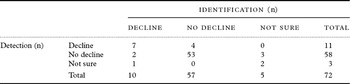
Table 3 shows how participants’ responses to the question regarding their olfactory detection was related to their response to the question regarding their olfactory identification, collapsing across groups. There was a moderate-to-high degree of concordance between responses to the two questions (Cramer's V = 0.57, p < 0.01), and the overwhelming majority of participants did not report decline in olfactory detection or identification. However, the agreement between responses to the two questions was not perfect. Four of the 11 participants who reported a decline in their ability to detect odors did not report a decline in their ability to identify odors. Similarly, of the ten participants who reported a decline in their ability to identify odors, two reported no such decline in their ability to detect smells and one participant was unsure.
Concordance in responses to the questions “Are you aware of a decline in your ability to detect smells” and “Are you aware of a decline in your ability to identify smells”

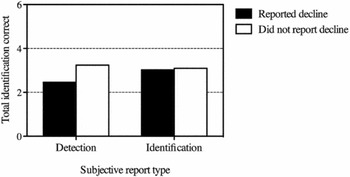
Figure 2 shows olfactory identification scores as a function of subjective reports of decline in olfactory detection (two left bars), and olfactory identification (two right bars). A mixed-design ANOVA revealed a trend toward better olfactory performance among participants who did not report decline in their ability to detect odors compared to participants who reported such a decline (F(1,69) = 3.5, p = 0.06, η2 = 0.04). No difference was observed in the olfactory identification score of participants who reported a decline in their ability to identify odors and those who did not report such decline (F<1, ns). Similarly, no interaction was observed between nostril and subjective report of a decline in olfactory detection (both Fs<1).
Mean nostril olfactory identification scores among participants with and without subjective reports of decline in olfactory detection or olfactory identification.

The eta (η) proportionate reduction in error (PRE) measure of association was calculated to explore the symmetry in the association between subjective reports regarding olfactory detection and identification and actual performance on the left and right nostrils.
As predicted from the low frequency of participants who reported olfactory decline, the association between subjective olfactory reports and actual olfactory performance was asymmetrical; prediction of participants’ subjective report regarding their ability to detect odors was moderate (left nostril η = 0.31, right nostril η = 0.33) and somewhat better than the prediction of their ability to identify odors (left nostril η = 0.20, right nostril η = 0.24). The prediction of participants’ actual performance on the left nostril from their subjective report of olfactory detection was moderate (η = 0.20), although based on participants’ report regarding olfactory identification, this prediction was poor (η< 0.01). Similarly, prediction of actual olfactory performance on the right nostril based on participants’ subjective report regarding olfactory detection was significantly better than prediction based on olfactory identification (η = 0.19, and η = 0.05, respectively). In other words, the prediction of actual olfactory performance was only marginally improved when participants’ subjective reports regarding olfactory function were considered, but this was particularly pronounced when self-reported olfactory identification is used.
Awareness of olfactory decline and the likelihood of meeting AD criteria at follow-up
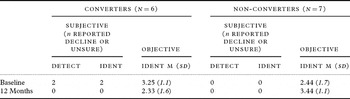
Approximately 12 months following the baseline examination (mean review lag = 12.78 months, range = 6–18 months), 8 HC, 13 aMCI and 7 AD participants completed a review investigation. At the time of review, 6 of the 13 aMCI patients tested at baseline met NINCDS-ADRDA (McKhann et al., Reference McKhann, Drachman, Folstein, Katzman, Price and Stadlan1984) criteria for AD. Examination of the mean age of aMCI participants who did not meet criteria for AD at the review, designated non-converters (M = 70.4, SD = 6.1), revealed that they were younger than the aMCI participants who did meet these criteria, designated converters (M = 79, SD = 5.1; F(1,11) = 7.89, p = 0.01). Subjective and objective olfactory scores (collapsed across nostrils) of the 13 aMCI participants at baseline and at follow-up are shown in Table 4 by conversion status. At baseline, no differences emerged in overall olfactory identification ability among aMCI converters and non-converters (F<1). In addition, despite a trend in expected direction at the follow-up assessment, converters (M = 2.33, SD = 1.6) were not more impaired on olfactory identification compared with non-converters (M = 3.44, SD = 1.1; F(1,11) = 2.3, ns).
Subjective and objective olfactory functioning of the 13 aMCI patients at baseline and at follow-up by conversion status (converters vs. non-converters)

Detect = detection; Ident = identification.
When considering subjective olfactory reports, the small number of aMCI participants who met criteria for AD at follow-up, and the even smaller number of aMCI participants who reported a decline in their olfactory abilities, precluded the use of any meaningful analytic strategies. Of the 13 aMCI patients who were seen for review, only one reported a decline in olfactory function at the baseline assessment and one additional participant reported being unsure of any decline. However, all seven non-converters were unaware of decline in either olfactory detection or identification. The performance of non-converters on olfactory identification was nonetheless impaired, as they were found to perform significantly more poorly than control participants; six of the seven non-converters demonstrated lower mean olfactory scores than the control group (F(1,27) = 13.2, p < 0.001, η2 = 0.32). Anecdotally, the two aMCI participants reported olfactory decline or, where unsure, met criteria for AD at the time of follow-up. Although these observations are preliminary, they tentatively suggest that lack of subjective report of olfactory dysfunction in persons with aMCI who are impaired on an objective measure of olfactory identification is not associated with an increased likelihood of meeting clinical criteria for AD 12 months later.
Discussion
As predicted, AD patients in the current study demonstrated significant deficits in olfactory identification on both the left and right nostrils when compared with healthy elderly people. In addition, and consistent with recent observations, participants with aMCI also displayed impaired olfactory identification scores on both nostrils when compared to the control group. However, regardless of their diagnostic status and irrespective of whether they converted to dementia status at follow-up, the large majority of participants had no subjective complaints of olfactory decline. Although the extent to which participants in the current study reported decline in olfactory detection and identification showed appreciable overlap, the concordance between responses to these two questions was not perfect with several participants responding differently to questions regarding different aspects of olfactory function. This observation implies that treating the issue of olfactory awareness as a unitary construct may be misleading. Finally, although there was a trend suggesting that participants with subjective decline in olfactory detection performed more poorly on olfactory identification, subjective dysfunction in olfactory identification bore no relationship with actual performance on olfactory identification. This pattern of findings suggests that subjective reports of decline in olfactory detection may actually manifest as decline in olfactory identification rather than detection.
The current results cast doubt over the proposition that impaired olfactory performance, coupled with lack of awareness of this deficit, is associated with an increased risk of meeting criteria for AD at follow-up (Devanand et al., Reference Devanand, Michaels-Marston, Liu, Pelton and Padilla2000). In the study by Devanand and colleagues, patients were merely asked whether or not they experience olfactory problems. In the current study, however, we asked participants to report whether they were aware of any decline over the preceding 12 months in both their ability to detect and identity smells. Importantly, the connection between olfaction and dementia implies deterioration in different abilities, including olfactory abilities. Asking participants whether they are experiencing olfactory problems or not fails to reflect the notion of change in olfactory performance. That is, participants who were afflicted with deficient olfactory abilities throughout life might misleadingly report awareness of deficits. In addition, people might interpret such a general question in terms of ability to detect smells. As commented by Serby (Reference Serby2001, p. 1534): “Because these patients can detect odors normally, they probably report no problem smelling. Thus, their negative response to the question about problems smelling does not relate to their reduced ability to name odorants; this cannot, then, be considered anosognosia.”
In our study, regardless of their group status, very few participants had subjective olfactory decline – a finding very similar to the results reported by Djordjevic et al. (Reference Djordjevic, Jones-Gotman, De Sousa and Chertkow2007), who also asked their participants about change in their olfactory abilities. No evidence was found to suggest that the likelihood of meeting AD criteria at a review assessment increases for aMCI patients who were impaired on an objective measure of olfactory identification but reported no olfactory decline. aMCI patients who did not meet criteria for AD at follow-up were just as unlikely to report an olfactory decline, despite their poor performance. The one aMCI patient who did report olfactory decline met criteria for AD at the time of follow-up. Because even healthy people show limited awareness of olfactory deficits (Nordin et al., Reference Nordin, Monsch and Murphy1995), the evidence at present does not vindicate the pertinence of limited awareness to prognostic considerations.
Importantly, in the study by Devanand et al. (Reference Devanand, Michaels-Marston, Liu, Pelton and Padilla2000), a subgroup of MCI patients was found not to be impaired on olfactory identification. To predict future diagnostic status, Devanand and colleagues therefore defined lack of awareness as poor performance on olfactory identification along with no reported olfactory deficits. In our study, however, olfactory identification was found to be impaired in almost all aMCI patients, irrespective of whether they subsequently met AD criteria or not, and there was no difference in baseline olfactory identification scores between these two groups. The poor olfactory identification score of most MCI patients in the current study is likely to reflect the stricter inclusion criteria in our study, which focused on the amnestic MCI subtype. The aMCI patients in this study are therefore more likely to be in the prodromal phase of AD (Yaffe et al., Reference Yaffe, Petersen, Lindquist, Kramer and Miller2006), and arguably, are more likely to present with an olfactory impairment. In Devanand's study, the broad definition of MCI led to the inclusion of a significant proportion of participants with no memory impairment (38.9%), as reflect by a Clinical Dementia Rating score of zero. Therefore, a significant proportion of MCI participants in their study are not likely to actually represent the preclinical phase of AD, which may explain why a considerable proportion of these participants were not impaired on olfactory identification. The greater likelihood that the aMCI patients in our study were actually preclinical cases of AD is also reflected in their diagnostic status at the review; Although 6/13 (46%) of the aMCI group met AD criteria at the one year review, only 19/77 (24%) in Devanand's study met AD criteria at the two-year review.
The issue of reduced awareness in AD and MCI is a broad and controversial topic. It is beyond the scope of this paper to offer a comprehensive discussion of the issue but detailed reviews are available elsewhere (e.g. Clare, Reference Clare2004a; Reference Clare2004b; Markova and Berrios, Reference Markova, Berrios and 2006; Roberts et al., Reference Roberts, Clare and Woods2009). Briefly, challenges to the understanding of the relevance of unawareness in early AD stem from both the theoretical frameworks within which awareness is discussed as well as from methodological problems with the way awareness is measured. Studies often fail to state explicitly the theoretical framework within which awareness is understood. In the case of AD, lack of awareness is often interpreted within a neuroanatomical or neuropsychological framework (Salmon et al., Reference Salmon2006), although some researchers have argued that psychogenic and psychosocial factors are important influences in the manifestation of poor awareness (Clare et al., Reference Clare, Wilson, Carter, Roth and Hodges2004; Naylor and Clare, Reference Naylor and Clare2008). In addition, the complex, dynamic, and multifaceted nature of awareness is often overlooked. As such, awareness is often treated as dichotomized state of mind and differences between explicit and implicit awareness are not considered.
From a methodological viewpoint, the operationalization of awareness tends to fall into one of three main categories: (i) clinician rating of awareness; (ii) discrepancy in the ratings of a patient and a carer; and (iii) discrepancy between measures of objective performance and subjective reports by the patient. Although measuring awareness from the discrepancy between subjective reports and objective measures of performance, as applied by Devanand et al. (Reference Devanand, Michaels-Marston, Liu, Pelton and Padilla2000), arguably presents some advantages over the first two methods, inherent to this approach is the assumption that patients are able to provide a valid self-rating. Because people are likely to be less aware of the functioning of their olfactory system compared to the functioning of visual or auditory systems, which often seem more pertinent to everyday life, this approach may not be optimal in the context of olfaction.
Limitations and directions for future research
Several limitations constrained the current investigation. Although participants in the current study were asked about decline in their olfactory abilities, and although we separated the questions regarding olfactory detection and identification, the response alternatives (yes, no and don't know) were categorical. Because awareness is unlikely to be categorical, but rather lie on a continuum, our methodology could not explore the relationship between severity of unawareness of olfactory decline and the likelihood of future cognitive decline. In addition, in the current study participants were asked about olfactory decline in the 12 months prior to the assessment. Given that olfactory decline may occur gradually over a long period of time, it is possible that participants would have been unaware of decline of a 12-month period, but may be aware of such decline over, say, a five- or ten-year period. The assessment of subjective olfactory function in future studies might be improved by combining questions targeting decline using a more distant anchor, with questions regarding awareness of current olfactory problems. In addition, the small sample of aMCI participants who met AD criteria at follow-up, and the even smaller number of these participants who reported olfactory decline, precluded statistical analyses of the power of awareness of olfactory decline to predict future cognitive decline. Larger longitudinal cohorts of aMCI patients who show varying degrees of awareness of an olfactory decline are necessary to improve our understanding of the relevance of awareness of olfactory decline to the prediction of incipient AD.
Conclusions
The current preliminary study supports other studies in showing that elderly people almost universally do not report decline in either olfactory detection or identification. In addition, among well-defined aMCI patients, impaired olfactory identification is almost invariably observed. Therefore, persons with aMCI are almost invariably unaware of their olfactory decline, which makes the possible prognostic contribution of this construct vanishingly small. In addition, the findings of the current study suggest that there is only a modest association between reported and actual olfactory abilities, and that subjective olfactory function should not be treated as a unitary construct. Similar results obtained from studies with larger cohorts are needed to increase confidence in these results.
Conflict of interest
None.
Description of authors’ roles
A. Bahar-Fuchs conceptualized the study, undertook literature searches, conducted all testing and the data analyses, edited all author contributions and had main responsibility for revisions and drafts of the paper. S. Moss participated in the data analysis and contributed to revisions and final drafts of the paper. C. Rowe contributed to revisions and final drafts of the paper. G. Savage conceptualized the study, participated in data analysis and contributed to revisions and final drafts of the paper.
Acknowledgments
Alex Bahar-Fuchs was supported by a PhD scholarship from Monash University to conduct studies on olfaction in AD.