Narrative comprehension is a complex high-level task in which many facets of cognition are involved. Specific to the text level, inferential processes are required to connect the various parts of the text to each other and to reader’s previous knowledge in order to build a coherent semantic representation of textual information. In the classic view (Kintsch & van Dijk, Reference Kintsch and van Dijk1978), comprehension involves extracting propositional information and adding inferred propositions; therefore, the semantic meaning representation is conceived of as a propositional network, which permits the construction of a situation model. A different view of narrative comprehension objects the propositional stance, arguing that processing text does not entail “a mental representation of the text itself” but one of “the situation described by the text” (Zwaan & Radvansky, Reference Zwaan and Radvansky1998. p. 162). This latter view presumes that a multi-modal situation model is derived online, bearing analogical correspondences to perceptual or experienced states (Zwaan, Reference Zwaan and Ross2004). Readers are sensitive to specific dimensions that add up to that experienced state including temporal, spatial, and causal relations, as well as protagonist’s goals and emotions (Zwaan, Reference Zwaan and Ross2004; Zwaan & Radvansky, Reference Zwaan and Radvansky1998). Specifically in the case of spatial inferences, this hypothesis assumes that the situation model has a spatial framework, where protagonists, objects (or tokens) and their properties are located. Any spatial information not explicitly contained in the text (inference) derives from this spatial framework which is a simulation of the real experience of perceiving.
The focusing effect or spatial distance effect found in the experimental paradigm introduced by Morrow, Greenspan and Bower (Reference Morrow, Greenspan and Bower1987) seems to support the simulation hypothesis. Participants have to learn a spatial scenario (e.g., an island’s map, a building’s layout) from a verbal description or a drawing, read a text describing a protagonist’s actions or movements, and finally perform a series of spatial judgments, registering reaction time for these responses. Usually the response time is related to the physical location of objects or landmarks with respect to the protagonists’ (De Vega, Rodrigo, & Zimmer, Reference De Vega, Rodrigo and Zimmer1996; Franklin & Tversky, Reference Franklin and Tversky1990; Morrow, Bower, & Greenspan, Reference Morrow, Bower and Greenspan1989; Morrow et al., Reference Morrow, Greenspan and Bower1987; Rinck & Bower, Reference Rinck and Bower1995, Reference Rinck and Bower2000). For example, the time required to verify sentences or to answer questions concerning objects located in front of the protagonist is shorter than the corresponding time for objects behind him. These results suggest that readers focus on the spatial position of the main protagonist and locate objects according to that perspective.
Constructing and updating the situation model requires working memory resources (Ericsson & Kintsch, Reference Ericsson and Kintsch1995; Zwaan & Radvansky, Reference Zwaan and Radvansky1998), especially during initial construction and integration (Radvansky & Copeland, Reference Radvansky and Copeland2004). The simulation hypothesis implies that the visuo-spatial component of working memory (Baddeley & Logie, Reference Baddeley, Logie, Miyake and Shah1999; Logie, Reference Logie1995) should be involved in coding and temporary retention of spatial information derived from text. De Beni, Pazzaglia, Gyselinck and Meneghetti (Reference De Beni, Pazzaglia, Gyselinck and Meneghetti2005) found that accuracy of recall and verification of information inferred from a spatial text were impaired by concurrent spatial and verbal tasks performed during encoding, while recall of a non-spatial description was impaired by a verbal secondary task only (see also Pazzaglia, De Beni, & Meneghetti, Reference Pazzaglia, De Beni and Meneghetti2007). In a similar vein, comprehension of spatial descriptions read under imagery instructions (participants had to imagine themselves moving along a route) was affected by a secondary spatial task (Gyselinck, De Beni, Pazzaglia, Meneghetti, & Mondoloni, Reference Gyselinck, De Beni, Pazzaglia, Meneghetti and Mondoloni2007). Furthermore, Meneghetti, De Beni, Gyselinck and Pazzaglia (Reference Meneghetti, De Beni, Gyselinck and Pazzaglia2011), using a verbally presented layout learning paradigm, found that a visuo-spatial concurrent task disrupted a posterior graphical recall (placing landmarks in a spatial graph) and self-reported imagery strategies were less used. However, these findings were detected after the text was presented three times but not when it was presented only once. On the other hand, the verbal secondary task impaired remembering spatial sentences from the beginning. In an experiment conducted by Brunye and Taylor (Reference Brunye and Taylor2008), participants were asked to study and memorize spatial descriptions with a secondary working memory task and the outcome was measured by sentence verification and map drawings. The findings of this study were that verbal working memory played an essential role in acquiring information from textual descriptions, whereas spatial mechanisms were involved when participants had to verify information not explicitly stated in the text. In summary, these studies (Brunye & Taylor, Reference Brunye and Taylor2008; De Beni et al., Reference De Beni, Pazzaglia, Gyselinck and Meneghetti2005; Gyselinck et al., Reference Gyselinck, De Beni, Pazzaglia, Meneghetti and Mondoloni2007; Meneghetti et al., Reference Meneghetti, De Beni, Gyselinck and Pazzaglia2011; Pazzaglia et al., Reference Pazzaglia, De Beni and Meneghetti2007) showed that learning and remembering verbal spatial descriptions involve both components of working memory.
The experimental paradigms described above require participants to explicitly learn and imagine a spatial scenario, thus orienting towards a detailed representation of space. It is well known that images help to memorize and reasoning about descriptions and routes (Denis, Reference Denis, de Vega, Intons-Peterson, Johnson-Laird, Denis and Marschark1996) and the mediation of visuo-spatial working memory is essential for this effect (Logie, Reference Logie1995). However, spatial learning from descriptions might differ from narrative reading comprehension, where the reader attempts to comprehend a story which implies also other types of inferences such as causal, temporal or emotional (De Vega, Reference De Vega1995; Rinck, Reference Rinck, Shah and Miyake2005). Several studies have addressed this critique studying spatial inferences with the consistency paradigm. In this kind of tasks, participants read sentence by sentence a short narrative involving a protagonist and a situation describing space and objects. Several sentences later, a critical phrase at the end describes the protagonist performing an action or interacting with objects, implying that the protagonist is in the same place as he or she was presented initially (consistent condition) or in a different one (inconsistent condition). For example, in O´Brien & Albrecht (Reference O´Brien and Albrecht1992) “As Kim stood inside the health club she felt a little sluggish…. She decided to go outside (or inside) and stretch her legs for a little.” This is not a spatial layout learning paradigm, nor requires explicit judgments about space. O’Brien and Albrecht (1992) demonstrated that reading times for the critical sentence in the inconsistent condition were longer than those for the consistent condition, which suggested that readers inferred the spatial location of the protagonist. Nevertheless, they did not find incongruence in reading times when the implication of a second character’s spatial movements were introduced, unless instructions required readers to explicitly use mental imagery to understand the scene. De Vega (Reference De Vega1995) replicated the consistency effect when the story involved two places (house / garden) associated with objects (dolls / roses), a protagonist located in one of the places (house) and interacting with an object consistently (dolls) / inconsistently (roses) associated with the place. However, the sole movement of the protagonist was not enough for the effect to occur; it was necessary to mention his or her interaction with the object. De Vega (Reference De Vega1995) concluded that the situation model does not depict spatial information unless a relevant text event forced the reader to do so.
In sum, evidence of the consistency paradigm shows that readers build spatial inferences during narrative reading (see also Rinck, Reference Rinck, Shah and Miyake2005) but the assumption that the consistency effect is based on a simulated or analogical representation, derived online, would not be warranted. The consistency effect could also be a result of a propositional contradiction, given that it needs two contrasting textual pieces to appear.
As stated before, in previous selective interference studies, participants read and learnt a spatial layout to answer questions about it (Brunye & Taylor, Reference Brunye and Taylor2008; De Beni et al., Reference De Beni, Pazzaglia, Gyselinck and Meneghetti2005; Gyselinck et al., Reference Gyselinck, De Beni, Pazzaglia, Meneghetti and Mondoloni2007; Meneghetti et al., Reference Meneghetti, De Beni, Gyselinck and Pazzaglia2011; Pazzaglia et al.; 2007). The scenario study and posterior recall might orient the task to imagery strategies and reliance on visuo-spatial representations in working memory. The experiments presented here have explored the role of verbal and visuo-spatial working memory in narrative comprehension containing spatial inferences, under imagery instructions (Exp.1) and reading to understand instructions (Exp. 2). The simulation or analogical representation hypothesis would predict visuo-spatial working memory involvement when readers draw a spatial inference regardless of the instructions. We have combined the dual-task and the consistency paradigms, to assess the effects of modality specific working memory interferences on spatial inferences. We employed narrative texts depicting a protagonist and two places associated with objects. In the critical sentence, the protagonist interacts with an object, which is consistent or inconsistent with that location. Longer reading times for the critical sentence would mean that the reader drew the spatial inference, constructing a mental model, which cannot assimilate the inconsistent object. Texts were read with concurrent specific verbal or spatial tasks, or without a secondary task. To show overall working memory involvement, longer reading times should be observed under interference conditions (dual-task versus no secondary task condition), because the participant would need to rely on whatever working memory he or she has, to build a correct representation of the text. However, if spatial inferences were based only, or mainly, on perceptual-like, analogical representations, an interaction between consistency and secondary task would be observed, so that under a visuo-spatial secondary task the consistency effect would be reduced, because the required visuo-spatial resources would be devoted to the secondary task, and so comprehension would be affected.
In addition, we have sought evidence for these effects under imagery reading instructions (read to form a mental image) versus comprehension reading instructions (read to understand). In the present study participants were not required to learn a spatial description or route; they read narratives about characters and locations. Also different from previous studies, the present study´s main outcome is not accuracy in remembering spatial details, but the effect of secondary tasks on reading times for the target sentence, which indexes the moment the spatial inference was made. We manipulated concurrent task within participants, as in previous studies. Consistency was also a within-subjects factor. The consistency effect (longer reading times for the inconsistent sentence) would support that the inference was drawn. Different reading times as a function of secondary task would reflect differential involvement of working memory components.
Given that the simulation hypothesis was proposed not only for those instances where imagery is explicitly required, but also for every situation model derived from reading, we were interested in contrasting imagery versus reading to understand (different from the repetition condition in Gyselinck et al., Reference Gyselinck, De Beni, Pazzaglia, Meneghetti and Mondoloni2007). We tested the consistency and secondary task effects in two different experiments: Experiment 1 asked participants to imagine the stories, while Experiment 2 employed the same texts and secondary tasks, but asked participants to read naturally to understand the texts. Experiment 1 should extend previous results concerning visuo-spatial working memory role in spatial inferences (Brunye & Taylor, Reference Brunye and Taylor2008; De Beni et al., Reference De Beni, Pazzaglia, Gyselinck and Meneghetti2005; Gyselinck et al., Reference Gyselinck, De Beni, Pazzaglia, Meneghetti and Mondoloni2007; Meneghetti et al., Reference Meneghetti, De Beni, Gyselinck and Pazzaglia2011; Pazzaglia et al., Reference Pazzaglia, De Beni and Meneghetti2007); the simulation hypothesis predicts a similar pattern of results for Experiment 2.
Experiment 1
This experiment combined the consistency and the dual task paradigms, to assess the contribution of verbal and spatial working memory to spatial inferences in narrative comprehension under imagery instructions. Participants read short narratives where a protagonist moved from one place to another, interacting with an object in the second location. According to previous textual information, the object was supposed to be there or in the other location (consistent/inconsistent condition). Participants were explicitly instructed to generate a mental image of the story, a mental picture of characters and situations.
Narratives were read in a control condition, or in two dual-task conditions, one verbal and one spatial. The verbal secondary task required repeating out loud an irrelevant syllable, which is considered to interfere with the maintenance mechanism of verbal working memory via articulatory suppression (Baddeley & Logie, Reference Baddeley, Logie, Miyake and Shah1999). The spatial secondary task consisted of sequentially tapping four corners of a square with the non-dominant hand, which would selectively interfere with maintenance in visuo-spatial working memory (Baddeley & Logie, Reference Baddeley, Logie, Miyake and Shah1999).
Thus, this experiment sought to extend previous findings concerning working memory involvement in the construction of spatial inferences; in this case, an online measure was taken (time to read the consistent / inconsistent sentence) from imaging a story, instead of memory or judgments concerning a route or map.
Method
Participants
They have voluntarily participated in the study 36 undergraduate students from the School of Psychology, University of Buenos Aires. Their gender was predominantly female (89 % women, 11% men) and their mean age was 20.6 years old (SD = 1.9).
Materials
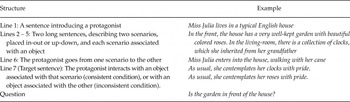
They have been used 24 short narrative stories, adapted from De Vega (1995, exp. 1; personal communication). Each story presented two places, each one associated with an object, and a character who moved in/out or up/down in those places. In the target sentence, the protagonist interacts with an object that had been presented in that place (consistent condition), or with the object related to the other scenario (inconsistent condition). Consistent and inconsistent versions of the sentence have approximately the same (± 2) number of syllables, and differ by 1 to 3 words. Each story had the structure presented in Table 1.
Structure of Experimental Narrative Stories and Example (Original, in Spanish)

Each story was presented with a concurrent interference condition: verbal interference, which consisted of repeating a nonsense syllable (“blah blah”), spatial interference, where the participant had to tap sequentially, with the left or non dominant hand, the four corners of a wooden surface with wood marks for taps, or no interference, which only presented the narrative story.
Stories were programmed and administered with E-prime v2.0 (Schneider, Eschmann, & Zuccolotto, Reference Schneider, Eschmann and Zuccolotto2002) software and ran on an IBM-compatible PC equipped with a 15 inches VGA monitor with 800 x 600 screen resolution.
Design
Two independent variables, Consistency (2: consistent / inconsistent) and Interference (3: no interference, verbal interference, spatial interference) were manipulated in a repeated measures factorial design. Dependent variables were time to read the critical sentence, and error rate in the comprehension questions.
Procedure
To counterbalance the stimuli, the 24 stories were divided randomly into six sets of four stories; each set was rotated through all possible six combinations of interference and congruence. Within each set, presentation order was randomized for each participant. Thus, participants completed all experimental conditions, reading a particular text in a combination of consistency and interference and all texts were read in all possible experimental conditions, across subject. Participants were randomly assigned to conditions and their order.
Participants also read 9 practice texts and 18 distractor ones, all having similar surface characteristics as the experimental narratives (number of lines, a protagonist doing something) but without two scenarios and a displacement. This was meant to distract participants away from realizing the nature of the experiment and deliberately seeking to spot the incongruence. All 51 texts were presented using a self-paced reading method: one line at a time on a computer screen, participants advanced through the text by pressing the space bar.
The instructions asked for reading the stories at a normal pace, but required to pay special attention to the protagonist’s location, and to use imagery: “imagine the stories, place yourself as the protagonist, and form a mental image as detailed as possible of what’s going on”. Practice stories were given to familiarize the participant with the reading and the concurrent tasks.
The interference conditions introduced the concurrent task (saying “blah blah” or tapping the wooden corners) by a sound signal (a 500 ms. tone) given in the fifth line of the text. The secondary tasks were introduced in the fifth line, just previous to the protagonist movement between scenarios and the target sentence, to maximize their effect on inferences and minimize it in the general story description.
Upon completing reading the story and the concurrent task, one question about the content appeared onscreen, participants had to respond pressing one of two labeled “YES” or “NO” keys (F and J in the keyboard).
Results
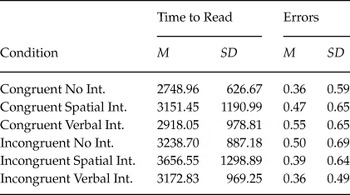
Outlier observations (beyond 2.5 SD) in the distribution of reading times for each subject per condition were deleted (Hair, Tatham, Anderson, & Black, Reference Hair, Tatham, Anderson and Black1998). Table 2 shows descriptive statistics by condition.
Experiment 1. Mean (SD) Time to Read Target Sentence (in Milliseconds) and Mean (SD) Number of Errors in Comprehension Questions

Note: Int. = Interference
Effects of consistency and interference on reading times for the target sentence were analyzed in a repeated measures ANOVA, comparing reading times and accuracy within subject. Due to the exclusion of outliers, reading times analyses were computed over 33 participants. A main effect of consistency revealed that reading times for the inconsistent condition were longer than for the consistent one, F(1, 32) = 20.41, p < .001; η2 = 0.39. There was a significant effect of interference, F(2, 64) = 3.52, p = .037, η2 = 0.10. Paired analyses for related measures revealed that reading times under the spatial interference were longer than without interference, t33 = 2.87, p = .021, whereas verbal interference did not significantly differ from the no interference condition, t33 = 0.54, p = 1.000. Interaction of consistency and interference was not significant, F(2, 64) = 1.04, p = .362. η2 = 0.03.
Regarding the comprehension questions, neither consistency, F(1, 35) = 0.39, p = .542, η2 = 0.01, nor interference, F(2, 70) = 0.05, p = .955, η2 = 0.01, nor their interaction, F(2, 70) = 1.25, p = .294, η2 = 0.07, were significant.
Discussion
Experiment 1 replicated the detrimental effects of a secondary spatial task in comprehension under imagery coding instructions. First, error rate was very low (<1%), which shows that texts were comprehended, and allows for reading times’ analyses. The consistency effect, longer reading times for the inconsistent sentence, testified that inferences were made. Longer reading times in the spatial working memory interference condition would suggest that participants relied on spatial working memory to understand the texts. As in the classic Baddeley and Hitch experiments (1974), longer response time coupled with no decrements in accuracy can be interpreted as two tasks relying on the same working memory component, without exceeding its capacity. However, the lack of interaction between consistency and secondary task would suggest that comprehension relied on both verbal and spatial working memory resources. If readers could detect inconsistencies even under dual task performance, and the consistency effect was not modulated by a secondary task, although spatial working memory seems relevant, it would not be the only relevant resource. Another possible factor in this pattern of results could be that secondary tasks were not difficult enough to prevent modality specific working memory processing.
Our results converge with previous studies but from a different perspective. Participants had to form a mental image while reading narrative stories, instead of learning from a description of a route (De Beni et al., Reference De Beni, Pazzaglia, Gyselinck and Meneghetti2005; Gyselinck et al., Reference Gyselinck, De Beni, Pazzaglia, Meneghetti and Mondoloni2007; Meneghetti et al., Reference Meneghetti, De Beni, Gyselinck and Pazzaglia2011). In addition, we have measured online inferences, as different from answering questions or performing judgments in previous studies. Thus, we extend previous findings concerning working memory involvement in comprehension of spatial texts, to online inferences.
Experiment 2
This experiment examined the contribution of verbal and spatial working memory resources to online spatial inferences under comprehensive reading. The only difference with Experiment 1 was that participants were instructed to read to understand, without explicit imagery instructions.
Method
Participants
They have voluntarily participated in the study 48 undergraduate students from the School of Psychology, University of Buenos Aires (91% women, 9% men). Their mean age was 20.4 years old (SD = 3.4).
Materials
This experiment used the same stories and interference materials as Exp. 1.
Design
The design of this experiment was identical to that of Exp. 1.
Procedure
Procedure was similar to that of Exp. 1, except for the instructions. In this case, participants were required to read the stories to understand, at their own pace, such as they did normally.
Results
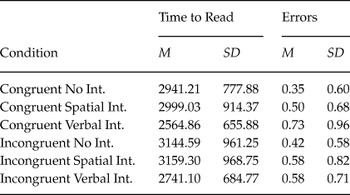
Descriptive statistics for each interference and condition after deletion of outlier observations (beyond 2.5 SD, Hair et al., Reference Hair, Tatham, Anderson and Black1998) are shown in Table 3.
Experiment 2. Mean (SD) Time to Read Target Sentence (in Milliseconds) and Mean Number of Errors in Comprehension Questions

Note: Int. = Interference.
A repeated measures ANOVA examined effects of consistency and interference on reading times for the target sentence. Due to exclusion of outliers, analyses of reading times correspond to 44 subjects. A significant effect of consistency showed that reading times for the inconsistent condition were longer than for the consistent one, F(1, 43) = 5.18, p = .028; η2 = 0.11. The interference effect was also significant, F(2, 86) = 7.97, p < .001, η2 = 0.16, while the interaction was not, F(2, 86) = 0.04, p = .132, η2 = 0.01. Paired analyses for the secondary task effect showed that reading times for the target sentence with a verbal secondary task were shorter than without interference, t45 = 3.60, p = .004, but a spatial secondary task did not significantly differ from the no interference condition, t45 = 0.30, p = 1.00.
In the comprehension question, repeated measures ANOVA found that consistency did not have a significant effect, F(1, 47) = 0.01, p = 1.00; η2 = 0, but interference did, F(2, 94) = 3.96, p = .021; η2 = 0.08. Interaction between both variables was not significant, F(2, 94) = 0.68, p = .514; η2 = 0.01. Paired analyses showed that under verbal interference the error rate was significantly higher than without interference, t47 = 2.95, p = .005. There were no other significant differences between error means.
Discussion
As in Experiment 1, we found an effect of consistency (longer reading times for the inconsistent sentence), which means that readers detected breaches in coherence in the spatial dimension. Paired comparisons showed that under a verbal secondary task participants performed faster that in the other two conditions. Also, the error rate was very low (< 1.5%), and participants had more errors with the verbal secondary task. The pattern of results showed significantly shorter reading times, coupled with an increase in error, under verbal interference, but no other interference effects. This suggests that participants solved this task employing mainly verbal resources. Thus, they could have read faster because they were having trouble maintaining the story while doing a secondary verbal task. As a result of speed and sharing verbal resources, they committed more errors. However, as in Exp. 1, the absence of an interaction between consistency and interference would weaken this interpretation, suggesting that both working memory components were at play. Also as in Exp. 1, insufficient load caused by secondary tasks could be a factor.
General Discussion
Two experiments addressing the role of working memory resources in spatial inferences in narrative comprehension were presented. Materials were similar in both experiments: Participants read narratives containing a spatial scenario, half of them containing a breach in spatial coherence, while performing a secondary verbal or spatial task (or no concurrent task). The first experiment required participants to read and form a mental image, while the second just asked to read to understand. Both experiments found that reading times were significantly longer when a sentence stated that the protagonist was interacting with an object not supposed to be where he or she was located. Therefore, we have replicated the consistency effect (De Vega, Reference De Vega1995; O’Brien & Albrecht, 1992; Rinck, Reference Rinck, Shah and Miyake2005), which suggested that participants derived the spatial inference online while reading. These results add to Rinck (Reference Rinck, Shah and Miyake2005), who in a review of the literature, argued that spatial situation models were not derived when reading narratives unless readers were explicitly asked to do so or under particular strategic conditions, such as studying a spatial description or a map previously. On the other hand, our second experiment suggests that if space is central to understanding a story, readers will be sensitive to it, even if they are not warned about it. These experiments lend support to text processing models, proposing that readers actively track multiple dimensions (time, space, emotion, causality) to build a coherent model (Zwaan, Reference Zwaan and Ross2004; Zwaan & Radvansky, Reference Zwaan and Radvansky1998).
Do these spatial inferences recruit visuo-spatial representations in working memory? We have employed selective verbal and spatial working memory secondary tasks to explore this question. Experiment 1 showed that spatial tapping, a selective spatial interference (Logie, Reference Logie1995), significantly lengthened reading times for the target sentence, compared to a control condition, whereas the difference between the articulatory suppression condition (a verbal interference) and the control condition was not significant. Thereby, when readers were explicitly instructed to imagine the story, a spatial concurrent task affected reading times, but not accuracy. This suggests that spatial working memory resources were recruited for comprehension, although not exceeding its capacity. However, there was not a differential effect of secondary task modulating the consistency effect. Therefore, comprehension did not rely exclusively on visuo-spatial resources.
Thus, extending previous findings with other paradigms (Brunye & Taylor, Reference Brunye and Taylor2008; De Beni et al., Reference De Beni, Pazzaglia, Gyselinck and Meneghetti2005; Gyselinck et al., Reference Gyselinck, De Beni, Pazzaglia, Meneghetti and Mondoloni2007; Meneghetti et al., Reference Meneghetti, De Beni, Gyselinck and Pazzaglia2011; Pazzaglia et al.; 2007) spatial working memory seems to be involved in online spatial inferences, when narratives are read under imagery instructions. In those previous studies, learning and remembering spatial layouts depended on both components of working memory, but spatial working memory was involved under imagery instructions, or preferred self-reported strategy, or when a graphical depiction was required. This study extends this line of research, to implicit inferences in online narrative comprehension. In particular, our results lend support to Brunye and Taylor’s (Reference Brunye and Taylor2008) suggestion that working memory resources are employed in spatial inferences. In their experiments, spatial inferences were judgments of objects and landmark locations not explicitly stated in the text, generated after learning a spatial scenario. In our case, we did not ask the participants to perform spatial judgments; inferences are indexed by the coherence effect in reading times. Therefore, our results extend Brunye and Taylor’s (Reference Brunye and Taylor2008) proposal about inferences to the immediate, online inferential activity during comprehension.
However, when we asked participants to read to understand, without explicit imagery instructions, a different pattern of selective interferences emerged. In this case, the spatial secondary task was no different than the single task condition. On the contrary, the verbal concurrent task caused faster reading times and more errors in comprehension. This speed-accuracy trade-off seems to suggest that participants relied mainly on a verbal working memory strategy. This result extends previous findings by Brunye and Taylor (Reference Brunye and Taylor2008) and Meneghetti et al. (Reference Meneghetti, De Beni, Gyselinck and Pazzaglia2011), who found that verbal working memory resources were the main factor in acquiring information from descriptions.
Although different working memory components appeared more relevant in each experiment, the fact that consistency did not interact with the type of secondary task downplays an exclusive interpretation regarding differential working memory involvement. Inferences did not depend solely on verbal or visuo-spatial working memory resources in any of the reading conditions.
Our results would support the position that online inferencing activity in understanding spatial scenarios involves also extracting verbal / propositional information, and not only an analogical or image-like representation, against the simulation hypothesis (Zwaan, Reference Zwaan and Ross2004; Zwaan & Radvansky, Reference Zwaan and Radvansky1998). Such analogical representations could be derived, under strategic conditions, as in Experiment 1, or when taxing verbal working memory, as in Experiment 2. A similar conclusion was drawn by Meneghetti et al. (Reference Meneghetti, De Beni, Gyselinck and Pazzaglia2011) when discussing the differential involvement of verbal and spatial working memory in the sentence verification and graphical depiction tasks, with different self-reported strategies. They identified a very basic level of representation in which the verbal format is crucial, but spatial characteristics are also coded as literal or inferred information, to be later implemented in a spatial representation as needed for the task at hand. In the same line, Brunye and Taylor (Reference Brunye and Taylor2008) argued that interference with verbal working memory mechanisms during reading appeared to restrict the propositional base formation. Following this interpretation, when text is listened to once (Meneghetti et al., Reference Meneghetti, De Beni, Gyselinck and Pazzaglia2011), or when the reader goal is to understand (e.g., no strategic or imagery instructions are involved), verbal resources are needed and spatial ones could be employed. Instead, when text is learnt more extensively in order to construct an imaged scenario or route, processing is underpinned by verbal and visuo-spatial working memory systems.
In summary, these studies have shown verbal and visuo-spatial working memory involvement during the initial online computations of text comprehension. More experiments are needed to explore the time course of inferential activity and representations involved in each step of situation model construction. Individual differences might also play a role in working memory activity during comprehension.
We thank the anonymous reviewers for their valuable comments on our manuscript.