Introduction
It is generally recognized that mental disorders currently classified under obsessive-compulsive and related disorders (OCRDs), disorders due to substance use and addictive behaviors (DABs), and impulse control disorders (ICDs), all characteristically display a reduced ability to delay or inhibit repetitive behaviors.Reference Reed, First and Kogan 1 , 2 However, there is less agreement on the exact psychopathological features that allow the typification of these behaviors as compulsive or impulsive and how they map onto existing concepts of OCRDs, DABs, and ICDs. This is a significant problem, which may have important implications for caseness and, as a consequence, policy making. For instance, early estimatesReference Hollander and Benzaquen 3 suggest that conditions under the compulsive/impulsive spectrum may affect up to 10% of the general population, thus highlighting the public health importance of these disorders.
Multiple and often untested definitions of compulsivity have proliferated in the literature including phenomenological (eg, uncontrollable), observational (eg, repetitive), and explanatory (eg, anxiety relieving) accounts.Reference Luigjes, Lorenzetti and de Haan 4 Similarly, factor-analytic studies have identified multiple facets of impulsivity, which tend to be contradictory across studies (for a review see Reference Reference Evenden5). The lack of definitional agreement suggests that both compulsive and impulsive behaviors may be multidimensional constructs, adding an extra complexity to any attempt to disentangle these concepts. Not surprisingly, the literature has described substantive overlaps between the compulsivity and impulsivity constructs, which encompass different facets of the same disorder, Reference Grant and Potenza 6 , Reference Maloney, Djamshidian and O’Sullivan 7 co-occur in the same patient as independent disorders, Reference Fontenelle, Mendlowicz and Versiani 8 , Reference Matsunaga, Kiriike, Matsui, Oya, Okino and Stein 9 or “transform” into one another with the progression of illness.Reference Koob and Volkow 10 , Reference Fontenelle, Oostermeijer, Harrison, Pantelis and Yucel 11
In terms of neurocognition, experts on DABsReference Yucel, Oldenhof and Ahmed 12 and OCRDsReference Fontenelle, Oldenhof and Moreira-de-Oliveira 13 have listed at least 3 common Research Domain Criteria (RDoC) underlying constructs as relevant for the pathophysiology of both diagnostic groups, namely response selection/inhibition, habit, and compulsivity. By doing so, these experts have endorsed much of the earlier literature on inhibitory control (and, for instance, its role as an endophenotype for obsessive-compulsive disorder [OCD])Reference Chamberlain, Fineberg and Menzies 14 and the more recent evidence in terms of habit formation across these disorders (ie, in OCDReference Gillan, Morein-Zamir and Urcelay 15 , Reference Gillan, Papmeyer and Morein-Zamir 16 and in alcohol use disorders [AUDs]Reference Corbit and Janak 17). In these Delphi reviews, experts argued that these underlying neurocognitive constructs might play different (or more prominent) roles in early versus later stages of illness, particularly in addictive disorders.Reference Yucel, Oldenhof and Ahmed 12
Importantly, the differentiation between compulsive and impulsive behaviors may also have therapeutic implications.Reference Fontenelle, Oostermeijer, Harrison, Pantelis and Yucel 11 , Reference Iancu, Lowengrub, Dembinsky, Kotler and Dannon 18 Whereas OCD (the prototypical compulsive disorder) may be responsive to high dose serotonin reuptake inhibitors and/or exposure and response prevention (ERP), Reference Seibell and Hollander 19 different DABs (eg, AUD or gambling disorder) may be resistant to SRIs and responsive to opioid antagonistsReference Piquet-Pessoa and Fontenelle 20 or responsive to psychotherapeutic techniques other than ERP. Of note, clinical neuroscience is strongly suggesting that underlying motivations may explain differences in treatment responses across compulsive and impulsive disorders. For instance, behaviors motivated by reward (eg, strong cravings) may guide clinicians toward different therapeutic approaches.Reference Kim, Grant, Adson and Shin 21 , Reference Mann, Roos and Witkiewitz 22 Arguably, changing the emphasis on the external expression of specific behaviors to the diversity of their potential motivators may represent a more useful (or at least alternate) avenue to solve the compulsive/impulsive problem.
Unfortunately, there is not much empirical information on how different motivations interact with each other and how they may be relevant for understanding the neurobiology of OCRDs, DAB, and ICD. Furthermore, no transdiagnostic tool to quantify the motivational drivers (or lack of thereof ) of repetitive behaviors was available until the Habit, Reward, and Fear Scale (HRFS) was published.Reference Piquet-Pessoa , Chamberlain and Lee 23 In a previous study of the HRFS, Reference Piquet-Pessoa , Chamberlain and Lee 23 habitual use of alcohol was associated with greater severity of alcohol dependence and lower number of detoxifications. Of note, the differentiation between these motivations may be important and linked to activation of differential neurocircuitries, that is, nucleus accumbens has been linked to rewarding stimuli whereas an amygdala-hypothalamic-central gray system more aligned with processes of pain and fear.Reference Baron and Galizio 24 , Reference van den Heuvel, van Wingen and Soriano-Mas 25 Finally, over time, continuous reinforcement of an action in the context of specific stimuli can result in that behavior becoming largely stimulus-driven (controlled by stimulus-response associations, ie, habitual), likely to be mediated by sensorimotor loops and their modulatory inputs.Reference Robbins and Costa 26
Nevertheless, while it is clear that habit, reward, and fear play a role in repetitiveness, it is still unclear whether they represent dissociable constructs or are specific to certain compulsive and/or impulsive disorders. For instance, a few studies have criticized the classification of specific events as positive versus negative reinforcers.Reference Baron and Galizio 24 However, in addition to the well-established role of nonrewarding emotions in AUD patients’ drinking behaviors, Reference Cho, Su and Kuo 27 there is an increasing recognition that OCD patients’ compulsive behaviors may be driven by “nonfearful” emotions.Reference Ferreira, Yucel, Dawson, Lorenzetti and Fontenelle 28 , Reference Pietrefesa and Coles 29 Therefore, we aimed to (1) test whether HRFS is able to generate a 3-factor solution in a population of OCD and AUD patients; (2) compare these diagnostic groups in terms of their responses to the HRFS subscales; and (3) investigate whether meaningful subgroups could be identified to resolve between- and within-disorder heterogeneity based on the motivations underlying ritualistic and drinking behaviors.
We predicted that HRFS would generate 3 independent and valid subscores that broadly reflect the concepts of habit-, reward-, and fear-based motivations for repetitive behaviors. OCD patients would be expected to show significantly higher fear- and lower reward-related motivations for engagement in their target (ritualistic) behaviors as compared to AUD patients’ target (drinking) behaviors. However, we also hypothesized that these groups (OCD and AUD patients) would not differ in terms of habit scores.Reference Burchi, Makris, Lee, Pallanti and Hollander 30 Furthermore, regardless of their diagnostic labels, we predicted that it would be possible to identify more homogeneous clusters of patients based on their responses of HRFS and that these subgroups would include different proportions of OCD and AUD patients. In other words, OCD and AUD patients would perform their repetitive behaviors because of shared emotional states.
Methods
Participants
Seventy-six OCD and 58 AUD patients aged between 16 and 77 years were included in this study. They were recruited consecutively from the Obsessive, Compulsive, and Anxiety Spectrum Research Program Clinic (76 OCD patients) and from the substance abuse outpatient clinic at the Institute of Psychiatry of the Federal University of Rio de Janeiro (15 AUD patients); and from the substance abuse inpatient clinic at a private hospital at the Great Rio de Janeiro metropolitan area (43 AUD patients). They had their OCD and AUD diagnoses confirmed by the Structured Clinical Interview for DSM-IV Axis IReference First, Spitzer, Gibbon and Williams 31 and by the Mini International Neuropsychiatric Interview, Reference Amorim 32 respectively. The local ethics committee approved the protocol, and all patients provided written informed consent.
Assessment
Habit, Reward, and Fear Scale
All patients (n = 136) completed the HRFS, a transdiagnostic self-report tool that aims to quantify the affective motivations (fear or reward) and habit features of a target repetitive behavior (termed behavior “X”).Reference Piquet-Pessoa , Chamberlain and Lee 23 The HRFS includes 18 Likert items, which should be rated from 1 (totally disagree) to 7 (totally agree). The items related to habit were selected from the existing Self-Report Index of Habit Strength, a 12-item instrument that measures how habitual a targeted behavior is.Reference Verplanken and Orbell 33 The reminder items were adapted from the Temporal Impulsive-Compulsive Scale, a clinician-administered interview that assess positive, negative, and neutral affects experienced before, in anticipation to, during and after a targeted behavior.Reference Ferreira, Yucel, Dawson, Lorenzetti and Fontenelle 28 This instrument was developed to assess any repetitive behavior. In the present study, the target behavior was alcohol consumption in AUD patients and the predominant ritualistic behavior in OCD patients.
Severity of symptoms
To assess severity of symptoms within the OCD and AUD groups, we administered the Yale-Brown Obsessive-Compulsive Scale (YBOCS)Reference Goodman, Price and Rasmussen 34 , Reference Goodman, Price and Rasmussen 35 and the Alcohol Dependence Scale (ADS).Reference Doyle and Donovan 36 The YBOCS is the most widely used instrument to measure severity of OCD. It includes a total of 20 items that cover time, interference, anxiety or distress, resistance, and control, for obsessions and compulsions separately. Its scores vary from 0 to 40.Reference Goodman, Price and Rasmussen 34 , Reference Goodman, Price and Rasmussen 35 The ADS is a 25-item self-report tool to measure severity of alcohol dependence across 3 different domains, including loss of behavioral control (eg, “After taking one or two drinks, can you usually stop?”), obsessive-compulsive drinking (eg, “Do you almost constantly think about drinking and alcohol?”), and psychoperceptual and psychophysical withdrawal (“Have you had the ‘shakes’ when sobering up (hands tremble, shake inside)?”).Reference Doyle and Donovan 36
Behavioral inhibition/activation
Most (n = 100) participants also completed the Behavioral Inhibition/Activation Scale (BIS/BAS), a 24-item self-report questionnaire designed to measure dispositional sensitivities of 2 motivational systems that underlie behavior and affect according to Gray’s theory: the behavioral inhibition system (BIS), which corresponds to motivation to avoid aversive outcomes; and the behavioral activation system (BAS), which corresponds to motivation to move toward goal outcomes.Reference Carver and White 37 The BIS/BAS is a 4-point Likert scale, rated from 1 (very true for me) to 4 (very false for me).Reference Carver and White 37 The scale has 4 subscales. One subscale corresponds to the BIS and the remaining 3 subscales correspond to 3 components of BAS—BAS Drive, BAS Reward-Responsiveness, and BAS Fun Seeking.Reference Carver and White 37
Urgency, lack of premeditation, lack of perseverance, sensation seeking, and positive urgency
The same patients (n = 100) who responded to the BIS/BAS also completed the Urgency, (lack of ) Premeditation, (lack of ) Perseverance, Sensation seeking, and Positive Urgency (UPPS-P) Impulsive Behavior Scale, a 59-item self-report tool that characterizes different personality dimensions conceptualized under the rubric of impulsivity.Reference Lynam, Smith, Whiteside and Cyders 38 Each item can be rated 1 (agree strongly) to 4 (disagree strongly). The UPPS-P generates 5 different scores (1) negative urgency (ie, the propensity to experience impulses under conditions of negative affect); (2) positive urgency (ie, the tendency toward having impulses in response to positive mood); (3) lack of premeditation (ie, the inability to reflect upon the consequences of an act); (4) lack of perseverance (ie, the failure to keep focus on long, boring, or difficult tasks); and (5) sensation seeking (ie, the propensity toward new or exciting activities).Reference Lynam, Smith, Whiteside and Cyders 38
Data Analysis
First, the factorial and construct validity on the HRFS was investigated. To do so, a confirmatory factor analysis was performed to test whether the 3-factor solution of the HRFS holds. The principal components method was used as extraction method and the Direct Oblimin was used to provide rotation. Significant loading was set at >.5. According to the results of the factor analysis, the HRFS subscores of each participant were calculated. Then, the Pearson’s correlation was used to test construct validity of the HRFS, particularly between the HRFS-habit and the YBOCS compulsions severity and the ADS loss of control; the HRFS-reward and the BAS and the UPPS-P; and the HRFS-fear and the YBOCS, the UPPS-P negative urgency, and the BIS.
In order to map the nature of HRFS subscores distributions between OCD and AUD patients, means were compared through a nonparametric test to independent samples (U-test of Mann–Whitney). Next, a logistic binary regression was performed using a backward-elimination procedure to check how much a model with the HRFS subscores were able to predict if a participant present OCD or AUD. This procedure was conducted in order to identify the most parsimonious regression model. This procedure initially tests an overall model with all candidate predictors included, and sequentially removes the least significant predictor from the model until the elimination step where the removal of a predictor significantly reduces the explained variance (change in R-squared)—in which case the model with the significantly higher R-squared would be adopted.
Finally, with the purpose of identifying more internally homogeneous subgroups to further explore mechanisms driving alcohol use or OCD behaviors, a hierarchical cluster analysis was conducted on HFRS subscales using Ward’s method of minimum variance with squared Euclidean distance.Reference Hermens, Redoblado Hodge, Naismith, Kaur, Scott and Hickie 39 , Reference Hermens, Naismith and Chitty 40 An optimal cluster solution was determined from the agglomeration schedule (examining changes in coefficients) and dendrogram (hierarchical diagram used to represent the distance between cases according to different cluster solutions). In smaller data sets (ie, 100 patients), potential cluster solutions are typically examined in successive steps until a number of relatively homogeneous subgroups become statistically and clinically meaningful.Reference Lee, Hermens and Naismith 41 Meaningfulness was determined by conducting between-groups analysis of variances and chi-squared tests of independence to determine what demographic (eg, age), phenotypic (eg, BIS), and diagnostic attributes are differentially represented between clusters.Reference Clatworthy, Buick, Hankins, Weinman and Horne 42 The level of statistical significance was set at .05.
Results
Description of the sample
The mean age of our total sample was 40.9 (13.5) years, with a predominance of males (63%). There were no significant differences between OCD and AUD in terms of age at the assessment (42.1 [14.1] vs 39.4 [13.6], t = −1.2, df = 132, p = .25). Male gender predominated in both groups and was significantly overrepresented among AUD patients (55% in OCD vs 72% in AUD; chi-square = 4.1; df = 1; p < .05). While alcohol drinking was the target symptom in terms of responses to HRFS in the AUD group, OCD patients reported their most significant compulsive behavior as belonging to checking (25%), washing (30%), symmetry or ordering (32%), hoarding (5%), and other OCD symptom dimensions (8%). These later symptoms were used, along alcohol drinking in AUD, as their target behaviors when answering the HRFS.
Factorial and construct validity of the HRFS
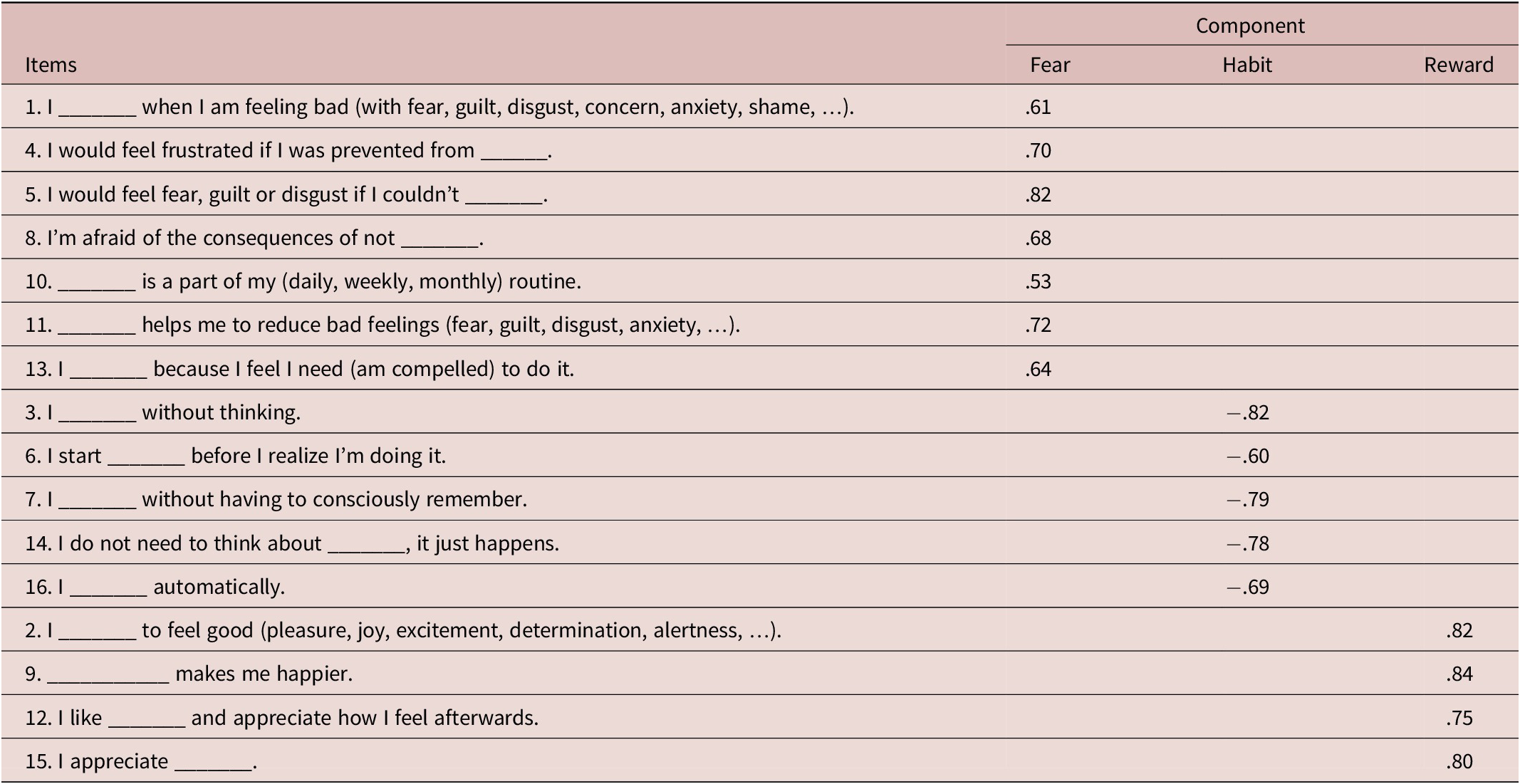
The 3-factor solution was broadly supported in the factor analysis, and explained 56.6% of the total variance of the HRFS. However, 2 items (item 17: “I give up doing things or going to places in order to ___________.” and item 18: “I avoid situations, places or people so I won’t need to _________ even more.”), which addressed avoidance motivated by the repetitive behaviors, did not significantly load on any factor. All other items loaded (each >.5) on a single factor from the 3-factor solution ( Table 1).
Three-factor solution of the Habit, Reward, and Fear Scale.

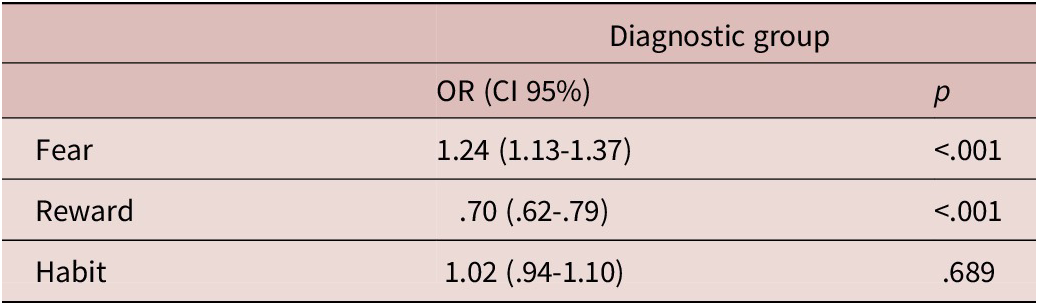
Results of logistic binary regression showing motivational predictors of a diagnosis of obsessive-compulsive disorder or alcohol disorder.

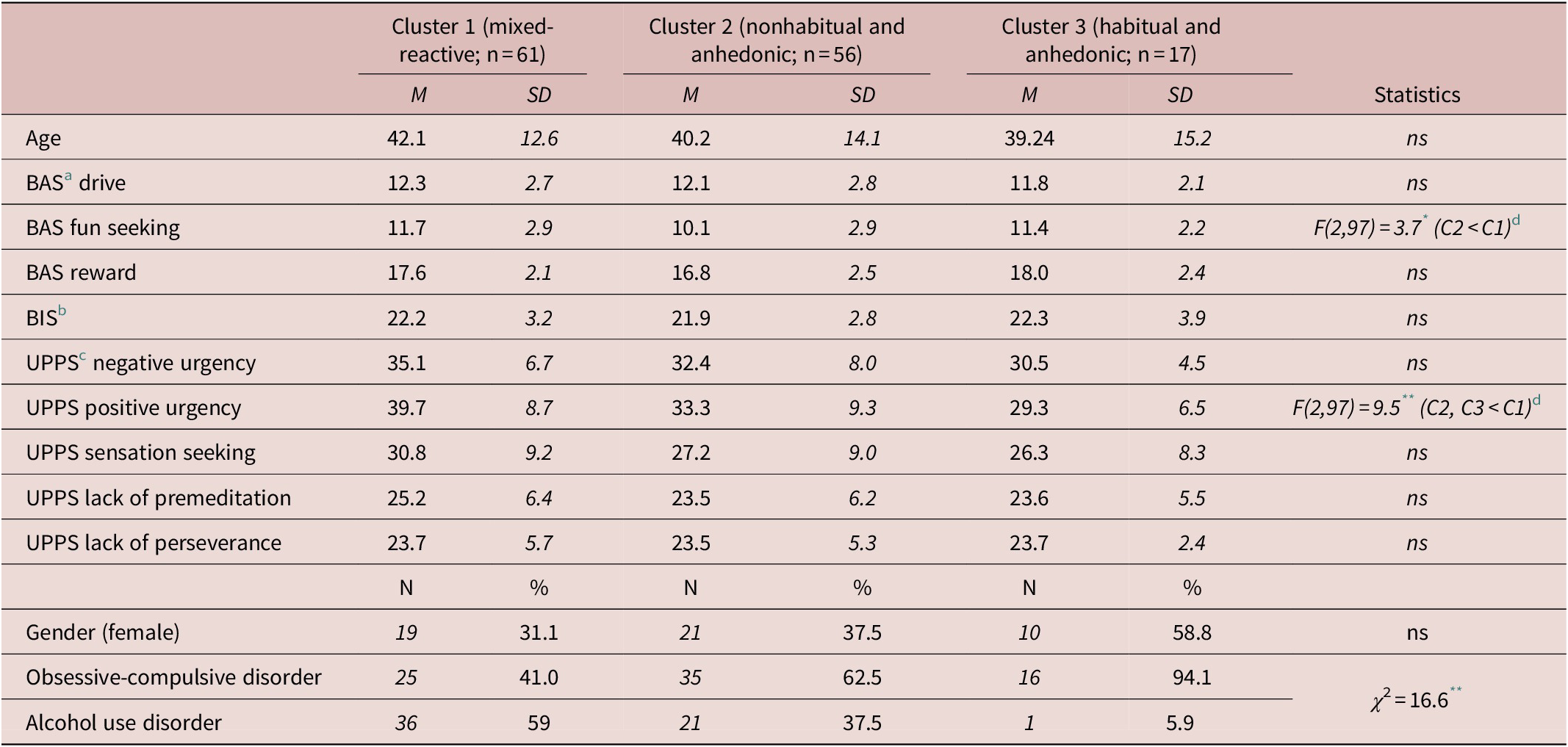
Demographic, clinical, and functional characteristics across diagnostic subgroups

Note: Data were compared through ANOVA (for continuous variables) and chi-squared tests (for categorical variables).
a Behavioral Activation Scale.
b Behavioral Inhibition Scale.
c Urgency, (lack of ) premeditation, (lack of ) perseverance, sensation seeking, and positive urgency (UPPS-P) Impulsive Behavior Scale.
d Bonferroni-corrected pairwise comparisons.
* p < .05.
*** p < .001.
As expected, HRFS-reward correlated positively with subscores of drive and fun seeking in BAS (r = .20; p = .04; and r = .42; p < .001, respectively) and with lack of premeditation, sensation seeking, and positive urgency in UPPS-P (r = .25, p = .01; r = .48, p < .001, and r = .53, p < .001, respectively). However, in contrast to our predictions, they did not correlate with the subscores of reward in BAS (r = .16; p = .10). HRFS-reward also did not correlate with BIS (r = −.11, p = .26) and with lack of perseverance in UPPS-P (r = .028, p = .7).
Similarly, as predicted, HRFS-fear correlated positively with the total YBOCS severity scores (r = .33; p = .004), but not with the BIS component of the BIS/BAS (r = .12; p = .25) or with the UPPS-P negative urgency (r = −.11; p = .29). The fear subscale also did not correlate with the BAS subscales and with the other UPPS-P subscales (see Appendix). HRFS-habit correlated positively with the ADS loss of control (r = .40; p = .004) and the YBOCS compulsions severity score (r = .25; p = .03), but not with the YBOCS obsessions severity score (r = .17; p = .13). HRFS-habit did not correlate with any UPPS-P and BIS/BAS subscale (see Appendix).
Comparison between OCD and AUD patients’ responses in the HRFS
The HRFS-reward was significantly higher among AUD patients (21.41 [SD 5.49] in AUD and 13.32 [SD 5.49] in OCD, p < .001) whereas fear was significantly higher among OCD patients (38.08 [SD 8.90] in OCD and 29.76 [SD] 8.90) in AUD, p < .001). The HRFS-habit was significantly higher among OCD patients (22.41 [SD 7.55] in OCD and 19.41 [SD 8.59] in AUD, p = .04). In a logistic binary regression, a model containing the HRFS subscores was able to predict, in 86% of cases, if a patient had OCD or AUD (X 2 (2) = 98.49; p < .001; R 2 Nagelkerke .70) However, just the HRFS-reward and -fear were significant predictors and were retained in the final model, whereas HRFS-habit was not (see results in Table 2).
Internally homogeneous subgroups based on HRFS responses
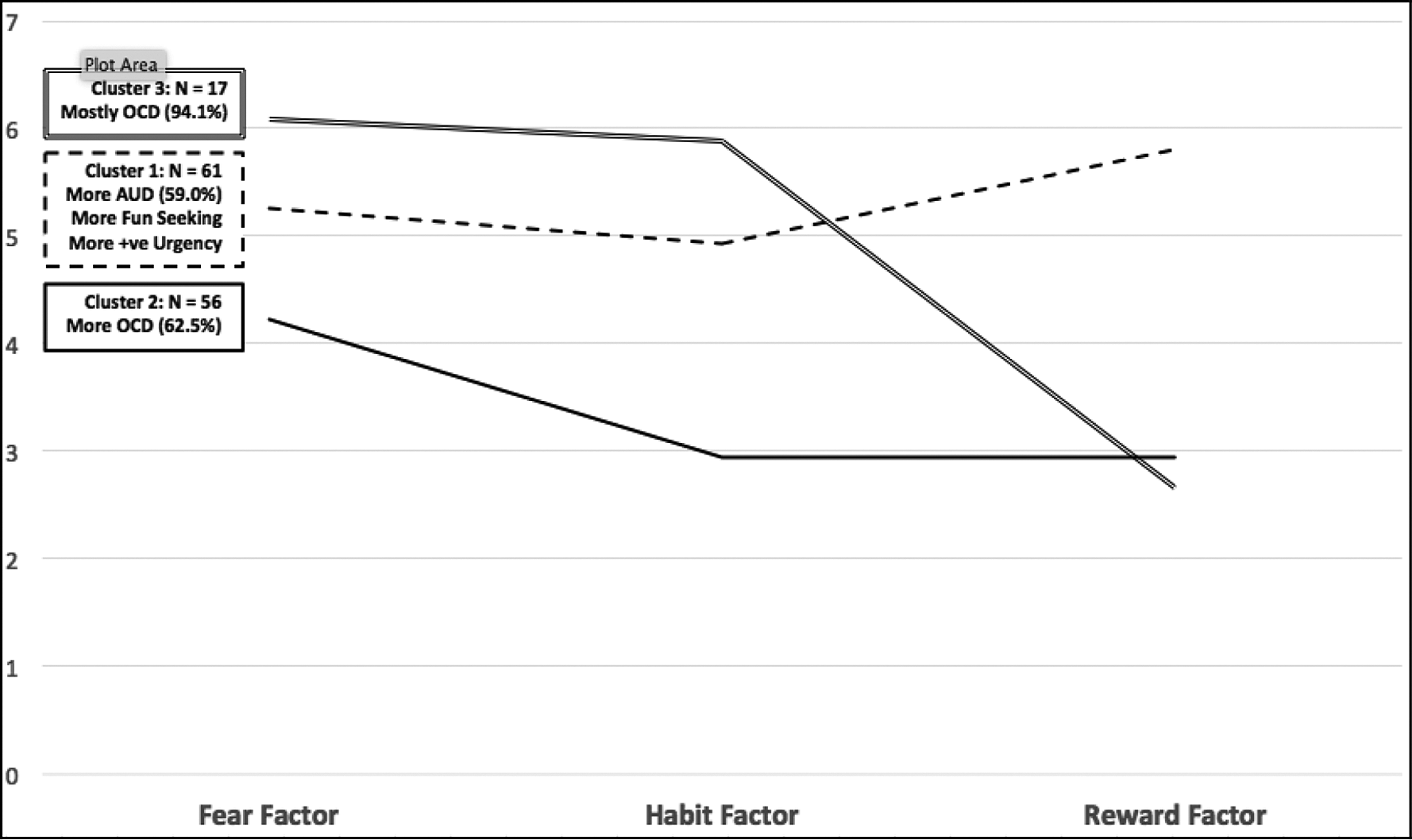
Informed by the dendrogram and agglomeration coefficients, 3 distinct and meaningful clusters were identified and participants were accordingly segregated into these subgroups ( Figure 1). Cluster 1 was termed “mixed-reactive” (N = 61) and marked by high scores on the fear and habit factors and very high scores on the reward factor. Although this group comprised mostly AUD patients (59%), it also included a substantial minority of OCD patients (41%). Cluster 2, termed “nonhabitual and anhedonic” (N = 56) was characterized by higher scores on fear than on habit and reward, the latter 2 being among the lowest across the 3 clusters. This group was characterized by a majority of OCD patients (62.5%), but also by a considerable proportion of AUD patients (37.5%). Cluster 3, the “habitual and anhedonic” cluster (N = 17) was marked by very high scores on fear and habit factors, but the lowest mean score on the reward subscale across the 3 clusters, and was represented predominantly by OCD patients (94.1%). The cluster more highly represented by AUD patients than OCD patients (cluster 1) was significantly more fun seeking than the more OCD subgroup (cluster 3, p < .05), and displayed greater positive urgency than the other 2 more OCD clusters (p < .01; Table 3).
Habit, fear, and reward subscores according to cluster membership. Clusters 1 (mixed reactive), 2 (nonhabitual and anhedonic), and 3 (habitual and anhedonic) are depicted by dashed, black, and double lines, respectively.

Discussion
In this study, we confirmed the factorial validity of the HRFS, which yielded 3 subscores, largely corresponding to habit-, reward-, and fear-based motivations. Habit, fear, and reward-related subscales were also found to be broadly concurrently and discriminantly valid. As predicted, OCD patients had significantly higher fear- and lower reward-related motivations for their ritualistic behaviors as compared to AUD patients’ motivations for their drinking behaviors. Although OCD patients had higher scores on habit than AUD patients, only reward and fear were able to predict membership to specific diagnostic groups. Finally, regardless of diagnosis, homogeneous subgroups of participants were identified based on their underlying motivations, which were associated with differing proportions of OCD and AUD patients. These findings suggest the potential utility of HRFS to tract motivations for goal-directed behaviors over time, including their potential transformation into habitual behaviors.
We have shown the HRFS-reward to be valid for correlating positively with subscores of drive and fun seeking in BAS and with lack of premeditation, sensation seeking, and positive urgency in UPPS-P. Arguably, the lack of correlation between the HRFS-reward and the subscores of reward in BAS could be due to the UPPS-P being a more sensitive or more comprehensive instrument, covering multiple domains of impulsivity rather than the ones related simply to “behavioral activation.” The validity of the HRFS-fear was confirmed by its significant positive correlation with the total YBOCS severity scores in OCD, although it did not correlate with the BIS or with the UPPS-P negative urgency across the sample, as initially predicted. Finally, the fact that HRFS-habit correlated with the YBOCS compulsions severity in OCD (besides ADS in AUD) score but not with the YBOCS obsessions severity score suggests that obsessions do not seem to contribute to understand the phenomenology of habit.
Recently, criticisms on the differentiation between positive and negative reinforcement have been renewed, including many ambiguous circumstances in which it is difficult to disentangle both concepts.Reference Baron and Galizio 24 For instance, whereas food is usually regarded to be a positive reinforcer (thus increasing reward), its presentation also serves to reduce a state of deprivation (negative reinforcement).Reference Baron and Galizio 24 Fortunately, the fact our volunteers were able to differentiate acts that increase reward from acts that decrease fear, and that both assessments appeared valid, indicated that the HRFS was able to capture the differences. Conversely, since the habit component of the HRFS correlated positively with ADS loss of control and with YBOCS severity of OCD compulsions (but not with severity of OCD obsessions), the habit component validity of the HRFS was found to be acceptable.
Although OCD patients reported significantly higher levels of “fearful” (or anxiety) motivations for their ritualistic behaviors and AUD patients described greater levels of rewarding motivations for their drinking behaviors, our findings also show that a substantial minority of OCD patients report their ritualistic behaviors to be driven by reward-seeking and a considerable proportion of AUD describe “fearful” motivations for their drinking behaviors. Thus, it seems that, regardless of their diagnostic labels, OCD and AUD patients can perform their repetitive behaviors to obtain (or because of ) overlapping motivational states. These findings also suggest that, other than focusing on patients’ most apparent behavioral expression (in the present case, ritualistic or drinking behaviors), treatments targeted at the underlying motivations (fear or reward) may be considered in the future (see References Reference Fontenelle, Oostermeijer, Harrison, Pantelis and Yucel11,Reference Iancu, Lowengrub, Dembinsky, Kotler and Dannon18,Reference Chamberlain, Lochner and Stein43). Longitudinal studies should determine the utility of the HRFS in predicting the course (natural history) or the response to different treatments addressing habit, reward, and fear (eg, habit reversal vs opioid antagonists vs SRIs/ERP). Elevated scores in more than 1 subscale of the HRFS may also support the combination of different strategies from the outset of treatment.
In fact, there are other indications that OCRDs, DABs, and ICDs (the prototypical “compulsive,” “addictive,” and “impulsive” disorders), tend to show some overlap in terms of their underlying “motivations.” For instance, few studies suggest that OCD patients (whose behaviors are thought to be typically maintained by negative reinforcement) may report greater anhedonia, Reference Abramovitch, Pizzagalli, Reuman and Wilhelm 44 -Reference Pushkarskaya, Sobowale and Henick 46 lower reward generalization, Reference Rouhani, Wimmer, Schneier, Fyer, Shohamy and Simpson 47 and increased reward expectancy from their compulsions, Reference Ferreira, Yucel, Dawson, Lorenzetti and Fontenelle 28 , Reference Fontenelle, Oostermeijer, Ferreira, Lorenzetti, Luigjes and Yucel 48 which can also be performed harshly.Reference Kashyap, Fontenelle and Miguel 49 Of note, rewarding and/or impulsive features in OCD have been associated with a range of poor outcomes, from greater duration of illnessReference Kashyap, Fontenelle and Miguel 49 to worse response to SRIs.Reference Fontenelle, Mendlowicz and Versiani 8 , Reference Matsunaga, Kiriike, Matsui, Oya, Okino and Stein 9 Laboratory experiments with OCD patients have also shown blunted responses of the nucleus accumbens during monetary expectationsReference Figee, Vink and de Geus 50 and exacerbated habit formation in response to aversive and rewarding stimuli.Reference Gillan, Morein-Zamir and Urcelay 15 , Reference Gillan, Papmeyer and Morein-Zamir 16 Although, to the best of our knowledge, no study found that OCD patients driven by positive reinforcement respond to specific treatments, 1 trial indicated that “reward” versus “relief” phenotyping of alcohol dependence could predict better response to naltrexone compared to acamprosate.Reference Mann, Roos and Witkiewitz 22
Our study has some limitations. First, its numbers can be considered relatively low for a validation study. Second, as information on comorbid disorders was not available for a substantial part of the sample, it was possible that some OCD cases had SUD and vice versa. Nevertheless, we believe that these comorbid cases were rare and HRFS was always based on the main diagnosis exhibited by the patient. Third, OCD and AUD can be somewhat difficult to compare, not only because they were recruited from different treatment settings, but also because of the particularities of their clinical presentation. For instance, in the initial validation study of the YBOCS for heavy drinking, OCD and AUD differed in terms of the “obsessionality,” which was significantly lower in former group.Reference Modell, Glaser, Mountz, Schmaltz and Cyr 51 Therefore, to increase interpretability of our findings, future studies should attempt to improve pairing of samples of OCRDs, DAB, or ICD. Fourth, our study did not contain a healthy control group, and understanding how habit, reward, and fear contribute to dysfunctional repetitive behaviors in healthy people can be issue for future research using the HRFS.
Finally, as the HRFS is supposed to have increased biological validity (for, at least theoretically, addressing specific neurocircuitries), its validation could have included specific laboratory paradigms (eg, outcome devaluation for habit subscores).Reference Hogarth, Balleine, Corbit and Killcross 52 This limitation might be particularly important in the context of a self-report scale that aims to address behaviors thought to involve decreased self-awareness, as previously suggested.Reference Ferreira, Yucel, Dawson, Lorenzetti and Fontenelle 28 Thus, bigger studies incorporating homogenous samples and further biological measures will be able to prove further support the validity of the HRFS, including a confirmation on the specific neurocircuits or cognitive processes underlying different HRFS subscales. In addition, future studies could also compare different neuropsychiatric disorders (eg, assessing whether hoarding disorder is closer to OCD rather than to DABs) or be less restrictive in terms of inclusion criteria and compare broad categories of neuropsychiatric disorders (eg, OCRDs, DAB, and ICD) in terms of their motivations.
Acknowledgments
LFF was supported by Conselho Nacional de Desenvolvimento Científico e Tecnológico (CNPq; grant #302526/2018-8), Fundação de Amparo à Pesquisa do Estado do Rio de Janeiro (FAPERJ; grant #CNE E-26/203.052/2017), the David Winston Turner Endowment Fund, and intramural grants from D’Or Institute for Research and Education (IDOR). RSCL is funded by a grant from the National Health & Medical Research Council (No. 1162031). MY has received funding from Monash University, the National Health and Medical Research Council (NHMRC; including Fellowship #APP1117188), the Australian Research Council (ARC), the Department of Industry, Innovation and Science, the David Winston Turner Endowment Fund, and law firms (in relation to court and/or expert witness reports). The funding sources had no role in study design, data analysis, and result interpretation. The authors are indebted to all volunteers for their participation in the study. We would also like to thank Karina B. Batista and the following clinicians for helping with data collection: Daniel C. Paravidino (in memoriam), Julliana N. Quintas, Isabela A. Melca, and Ilana Frydman.
Disclosure
The authors declare no conflict of interest.
Supplementary Material
To view supplementary material for this article, please visit http://dx.doi.org/10.1017/S1092852919001706.