Introduction
In common with other grain legumes (Huyghe, Reference Huyghe1998), growth habit in horse gram is one of the domestication-driven adaptive traits. Both indeterminate and determinate types of growth habits have been reported in horse gram. Most of the currently used horse gram cultivars display indeterminate growth habit (Ashwini et al., Reference Ashwini, Ramesh and Sunitha2021). Determinate genotypes by virtue of their non-overlapping vegetative and reproductive phases coupled with compact growth habit enable farmers to produce horse gram in intercropping and multiple cropping systems, a common practice that contribute to sustainable agriculture. In addition, the synchronous flowering, and pod development and maturity of determinate genotypes enable mechanical harvesting. For immediate acceptance and adoption of determinate cultivars, they should be in a high-yielding genetic background. Previous reports by Ashwini et al. (Reference Ashwini, Ramesh and Sunitha2021) in horse gram and those by researchers in a few other grain legumes such as faba bean (Nadal et al., Reference Nadal, Cabello, Flores and Moreno2005) and dolichos bean (Keerthi et al., Reference Keerthi, Ramesh, Byregowda, Mohan Rao, Mary Reena and Chandrakant2014) indicate that determinate cultivars are not as productive as indeterminate ones. However, these studies are based on indeterminate and determinate genotypes of un-related genetic backgrounds.
Reported grain yield differences between un-related indeterminate and determinate genotypes are most likely to be confounded by differences in loci controlling traits other than growth habit. We therefore hypothesize that indeterminate and determinate horse gram genotypes in near isogenic (NI) backgrounds exhibit comparable grain yield potential. To test our hypothesis, the present investigation was performed to assess the relative differences between NI pairs of indeterminate and determinate genotypes for grain yield and its component traits.
Experimental
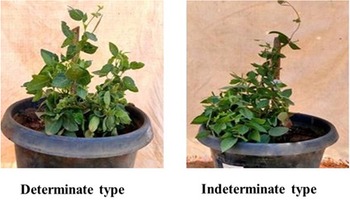
The genetic material consisted of eight pairs of near isogenic lines (NILs) differing for the growth habit (Supplementary Table 1; Fig. 1). We selected these eight pairs of NILs during the process of multiplication of seeds of 31 determinate germplasm accessions. We noticed a few indeterminate plants within the progenies of eight determinate accessions. Initially we suspected that the occurrence of indeterminate plants could be due to admixtures of seeds of indeterminate genotypes. However, a careful examination of phenotypes indicated that these indeterminate plants were morphologically similar to determinate plants. A fairly high morphological similarity coupled with simple genetic (two major genes) control with indeterminacy being recessive to determinacy (Chandana et al., Reference Chandana, Ramesh, Basanagouda and Kirankumar2021) prompted us to believe that the occurrence of indeterminate plants within the progenies of eight of 31 determinate accessions could be due to segregation only at loci controlling growth habit. In subsequent seasons, these eight pairs of determinate and indeterminate genotypes bred true (Ashwini et al., Reference Ashwini, Ramesh and Sunitha2021). We considered that these eight pairs of determinate and indeterminate genotypes are NI and used for the present investigation.
Generic photographs showing determinate and indeterminate growth habit types in horse gram.

The seeds of eight pairs of NI determinate and indeterminate genotypes were planted in a single row of 3 m length 0.3 m apart in randomized complete block design with two replications during 2019 and 2020 rainy seasons at experimental plots of Gandhi Krishi Vignana Kendra (GKVK), Bangalore, India and during 2020 rainy season at Zonal Agricultural Research Station (ZARS), Mandya, India. Fifteen-days after planting, seedlings were thinned to maintain a spacing of 0.2 m between the plants within rows. A total of 15 plants were maintained in each genotype. Data were recorded on 10 randomly selected plants in eight pairs of NI genotypes in each of the two replications for five traits, namely, days to 50% flowering, number of primary branches and pods and weights of sun-dried pods, and sun-dried grains from hand-threshed pods. The average across 10 sample plants in each replication was computed and expressed as days to 50% flowering, primary branches plant−1, pods plant−1, pod yield plant−1 (g) and grain yield plant−1 (g).
Statistical analysis
Replication-wise average trait data were used for statistical analysis by considering 2-years rainy seasons at GKVK, Bangalore and 1-year rainy season at ZARS, Mandya as three different environments. Environment-wise analysis of variance (ANOVA) was performed to detect if test genotypes differed in each environment for the traits considered for the study. After ascertaining homogeneity of error mean squares across three environments using Bartlett's test, we performed pooled ANOVA to detect if there exist significant interaction of determinate and indeterminate genotypes with the three environments. Considering that determinate and indeterminate genotypes did not interact significantly with environments, we pooled traits’ data and estimated average across three environments. We computed critical difference (CD) to examine if the eight pairs of determinate and indeterminate genotypes differed significantly for all the traits. CD was estimated using error mean squares (MSSe) from pooled ANOVA as CD = t α(0.05/0.01)$\sqrt {2\;MSSe/r}$ , where r = number of replications and t α = table ‘t’ values at 5 and 1% probabilities.
Results and discussion
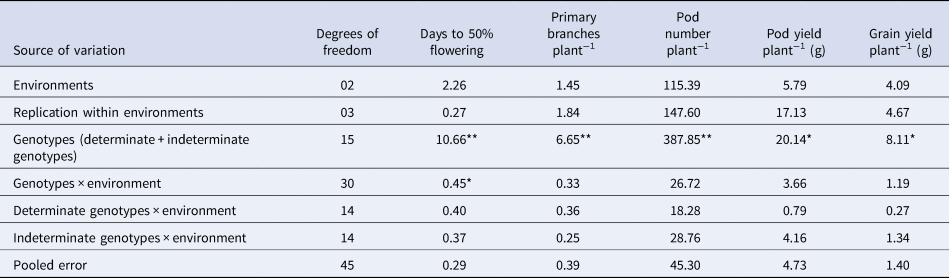
The isogenic pairs of determinate and indeterminate genotypes differed significantly for all the traits in each of the three test environments (Supplementary Table 2). However, they did not interact with the environments (Table 1) suggesting predictability of their performance for the all the traits considered in the study.
Pooled ANOVA of eight pairs of NI determinate and indeterminate horse gram genotypes for five quantitative traits

*Significance at P = 0.05, **significance at P = 0.01.
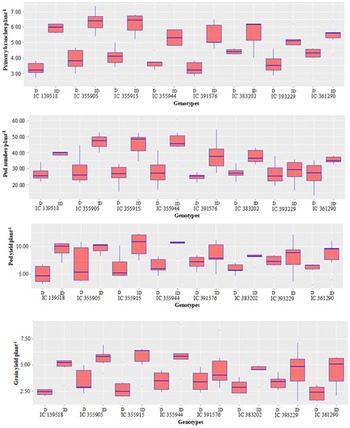
Determinate genotypes were comparable to their indeterminate counterparts suggesting that relative performances of determinate and indeterminate genotypes for other economically important traits are not likely to be confounded with differences in maturity duration. Indeterminate genotypes produced a greater number of primary branches plant−1 and pods plant−1 than their determinate counterparts in all the eight genetic backgrounds (Supplementary Table 3; Fig. 2). However, indeterminate genotypes produced pod (harvestable) and grain (marketable) yields better than their determinate counterparts only in a few genetic backgrounds. These results thus support our hypothesis that determinate genotypes are comparable to indeterminate ones, if not better than the latter for grain yields at least in a few genetic backgrounds. Kato et al. (Reference Kato, Sayama, Ishimoto, Yumoto, Kikuchi and Nishio2018) reported comparable single-grain weight between NI soybean indeterminate and determinate genotypes. Uday Kumar et al. (Reference Uday Kumar, Byre Gowda and Ramesh2017) and Chandrakant et al. (Reference Chandrakant, Uday Kumar, Ramesh, Keerthi, Mohan Rao, Byregowda and Suresh2018) in dolichos bean and Kato et al. (Reference Kato, Fujii, Yumoto, Tshimoto, Shiraiwa, Sayama, Kikuchhi and Nishio2015) in soy bean have also reported comparable grain yield potential of determinate and indeterminate recombinant inbred lines, which are necessarily in related and comparable (if not NI) backgrounds. Thus, our results and those of others suggest that it is possible to develop determinate cultivars in high-yielding genetic backgrounds in horse gram. Further, by virtue of their compact growth, productivity of determinate cultivars can be maximized using high-density planting (Chandana et al., Reference Chandana, Ramesh, Basanagouda and Kirankumar2021).
Box-whisker plots showing means of days to 50% flowering, primary branches plant−1, pods plant−1, pod yield plant−1 and grain yield plant−1.

Supplementary material
The supplementary material for this article can be found at https://doi.org/10.1017/S1479262123000643.
Acknowledgements
The senior author gratefully acknowledge Department of Science and Technology (DST), Government of India for providing financial support in the form of INSPIRE-fellowship DST/INSPIRE Fellowship/IF180603 dated 25/09/2019 for conducting thesis research for partial fulfilment for the award of PhD degree by University of Agricultural Sciences, Bangalore, India.
Author contributions
Conceptualization and design: B.R. Chandana and S. Ramesh; material preparation, field experiments and data collection: B.R. Chandana, R. Kirankumar, G. Basanagouda, G.V. Ranjitha and B. Santhoshkumari; curation and analysis of data, and tabulation of results: B.R. Chandana; original manuscript draft writing: B.R. Chandana and S. Ramesh; editing and communication – ready manuscript version: B.R. Chandana and S. Ramesh; supervision: S. Ramesh.
Ethical standards
This manuscript does not contain any studies with human participants or animals performed by any of the authors.
Consent for publication
All the authors have provided the consent for publication.
Competing interest
None.