Introduction
Aedes aegypti and Aedes albopictus are potential vectors to humans of several arboviral pathogens (Shroyer, Reference Shroyer1986; Hawley, Reference Hawley1988; CDC, 2016). Ae. aegypti is the main vector of dengue virus (DENV), chikungunya virus (CHIKV) and yellow fever virus (Kow et al., Reference Kow, Koon and Yin2001; Gubler, Reference Gubler2002). Although Ae. albopictus is capable of transmitting a large number of arboviruses (Mitchell, Reference Mitchell1995), the species has generally been considered as a secondary vector because of its lack of host specificity (Gratz, Reference Gratz2004). However, after the emergence of CHIKV epidemics involving Ae. Albopictus, its vector status has been re-examined in countries adjoining the Indian Ocean (Vazeille et al., Reference Vazeille, Moutailler, Coudrier, Rousseaux, Khun, Huerre, Thiria, Dehecq, Fontenille, Schuffenecker, Despres and Failloux2007; Delatte et al., Reference Delatte, Dehecq, Thiria, Domerg, Paupy and Fontenille2008a , Reference Delatte, Paupy, Dehecq, Thiria, Failloux and Fontenille b ; Leroy et al., Reference Leroy, Nkoghe, Ollomo, Nze-Nkogue, Becquart, Grard, Pourrut, Charrel, Moureau, Ndjoyi-Mbiguino and De-Lamballerie2009; Paupy et al., Reference Paupy, Delatte, Bagny, Corbel and Fontenille2009) and Europe (Charrel et al., Reference Charrel, de Lamballerie and Raoult2008). The involvement of this mosquito species in pandemics of chikungunya made it necessary to examine the current distribution and vector scenario for potential outbreaks (Seneviratne et al., Reference Seneviratne, Gurugama and Perera2007; Pagès et al., Reference Pagès, Peyrefitte, Mve, Jarjaval, Brisse, Iteman, Gravier, Tolou, Nkoghe and Grandadam2009; Pistone et al., Reference Pistone, Ezzedine, Schuffenecker, Receveur and Malvy2009; Yoosuf et al., Reference Yoosuf, Shiham, Mohamed, Ali, Luna, Pandav, Gongal, Nisaluk, Jarman and Gibbons2009).
Although the native geographic range of Ae. aegypti was sub-Saharan Africa (Mattingly, Reference Mattingly1957), at present it has a wide distribution range between 45°N and 35°S. This mosquito species infests all countries and occurs in a wide range of environments from sylvan to urban. Unlike Ae.aegypti, Ae. albopictus is native to Southeast Asia (Smith, Reference Smith1956), where it is a proven vector of filarial worms and dengue (Hawley, Reference Hawley1988). It has been reported in the African continent, where it was first detected in South Africa (Cornel & Hunt, Reference Cornel and Hunt1991), and later spread prolifically in Nigeria (Savage et al., Reference Savage, Ezike, Nwankwo, Spiegel and Miller1992). Over the next few decades, Ae. albopictus spread to several Central African countries (Paupy et al., Reference Paupy, Delatte, Bagny, Corbel and Fontenille2009), where it has been reported to colonize urban locales up to a latitude of 6°N (Simard et al., Reference Simard, Nchoutpouen, Toto and Fontenille2005). Ae. albopictus is now established in numerous countries throughout the USA, Europe, Africa (Medlock et al., Reference Medlock, Hansford, Schaffner, Versteirt, Hendrickx, Zeller and Van Bortel2012; Ngoagouni et al., Reference Ngoagouni, Kamgang, Nakouné, Paupy and Kazanji2015; ECDC, 2016) and Oceania (Nicholson et al., Reference Nicholson, Ritchie and van den Hurk2014) and the predominant dispersal mechanisms implicated are intercontinental trade and shipments of tires.
The geographical distributions of Ae. aegypti and Ae. albopictus overlap in tropical Asia and the USA. Spatial and ecological co-existence of these two species has been reported in different parts of the world and the larvae sometimes share common breeding sites (Simard et al., Reference Simard, Nchoutpouen, Toto and Fontenille2005; Chen et al., Reference Chen, Nazni, Lee, Seleena, MohdMasri, Chiang and Sofian-Azirun2006). In South American and Southeast Asian countries where these species are sympatric, they separate in various habitats under the influence of environmental factors (Braks et al., Reference Braks, Honório, Lourençqo-De-Oliveira, Juliano and Lounibos2003; Rey et al., Reference Rey, Nishimura, Wagner, Braks, O'Connell and Lounibos2006; Tsuda et al., Reference Tsuda, Suwonkerd, Chawprom, Prajakwong and Takagi2006). Ae. aegypti is adapted to the domestic environment, and therefore, its abundance is positively associated with increasing urbanization, while Ae. albopictus is associated with vegetation, and its abundance is reported to have been adversely affected by urbanization (Tsuda & Takagi, Reference Tsuda and Takagi2001; Rey et al., Reference Rey, Nishimura, Wagner, Braks, O'Connell and Lounibos2006; Tsuda et al., Reference Tsuda, Suwonkerd, Chawprom, Prajakwong and Takagi2006). Ae. albopictus has also the ability to colonize urban habitats, especially when Ae. aegypti is absent (Delatte et al., Reference Delatte, Dehecq, Thiria, Domerg, Paupy and Fontenille2008a ). Spatial overlap of these two mosquito species is assumed to result in a competitive interaction. Displacement of Ae. aegypti has been observed post-Ae. albopictus invasion in southeastern USA and Brazil (Lounibos, Reference Lounibos2002; Juliano & Lounibos, Reference Juliano and Lounibos2005) and is hypothesized to have occurred in La Reunion and Mayotte (Bagny et al., Reference Bagny, Delatte, Elissa, Quilici and Fontenille2009a , Reference Bagny, Delatte, Quilici and Fontenille b ). On the contrary, available reports in Asia suggests that Ae. aegypti has an overall competitive edge over Ae. albopictus in urban settings (Gilotra et al., Reference Gilotra, Rozeboom and Bhattacharya1967).
Both the species have been reported to be container breeding mosquitoes that are proximal to humans. Ae. aegypti inclines to predominate in densely populated urban settings and commonly found indoors, breeding in artificial water containers used for storage and a variety of discarded containers of fresh water (Christophers, Reference Christophers1960). Ae. albopictus prefers natural water-holding containers, such as tree holes, leaf axils and artificial containers, such as discarded tin cans and tires (Hawley, Reference Hawley1988). On the other hand, in areas where both the species co-exist, their larvae are often found together in the same larval breeding site (Braks et al., Reference Braks, Honório, Lourençqo-De-Oliveira, Juliano and Lounibos2003).
Ae. aegypti and Ae. albopictus have been known for a long time in Andamans (Barraud, Reference Barraud1934). The occurrence of Ae.aegypti in the Andaman archipelago has been documented (Nagpal & Sharma, Reference Nagpal and Sharma1983). Since then it has become significantly present and distributed widely throughout the urban agglomeration of Port Blair (Shriram & Sehgal, Reference Shriram and Sehgal1999) and has been observed to infiltrate into the peri-urban and rural areas (Shriram et al., Reference Shriram, Sugunan and Vijayachari2008). Ae. albopictus infestation has been observed in the urban peri-urban areas adjoining Port Blair (Shriram et al., Reference Shriram, Sugunan, Manimunda and Vijayachari2009). Thus, the urban and peri-urban areas are infested with both of these mosquito species and this poses a public health threat. These mosquito species were probably involved during the past outbreaks of chikungunya (Manimunda et al., Reference Manimunda, Singh, Sugunan, Singh, Roy, Shriram, Bharadwaj, Shah and Vijayachari2007) and dengue (Vijayachari et al., Reference Vijayachari, Singh, Sugunan, Shriram, Manimunda, Bharadwaj, Singhania, Gladius and Bhattacharya2011). Prevailing scenario necessitates the generation of in-depth information on the distribution pattern of these mosquito species in South Andaman, where dengue is endemic and sporadic cases of chikungunya regularly occurring after the 2006 outbreak (Manimunda et al., Reference Manimunda, Singh, Sugunan, Singh, Roy, Shriram, Bharadwaj, Shah and Vijayachari2007).
The goal of the present study was to assess the distribution of Ae. aegypti and Ae. albopictus across the heterogeneous landscapes of South Andaman Island. The information generated would help in classifying areas by risk of dengue and chikungunya transmission for public health preparedness and to develop effective vector control measures.
Materials and methods
Study area
The study was undertaken in South Andaman district. The district comprises of three administrative subunits called tehsils, viz. Port Blair Tehsil (PBT), Ferrargunj Tehsil (FGT) and Little Andaman Tehsil (LAT). More than 87% (2613.53 km2) of the total land area of 2980 km2 of the island is forest covered uninhabited/sparsely populated areas, 340.37 km2 (11.4%) is occupied by rural villages and 26.10 km2 (0.9%) by urban areas. The entire district of South Andaman was classified into four topographies, viz. (1) densely built urban – thickly populated with residential and commercial buildings; (2) low-vegetation coverage – thinly populated with short vegetation, mostly grass; (3) medium-vegetation coverage/fringe area – sparsely populated with short vegetation, shrubs and small trees, and (4) high-vegetation coverage – sparsely populated forested area with tall vegetation/trees. Demarcation of these topographies was done with the aid of satellite images.
Entomological infestation surveys
The entomological surveys were conducted during the period September and December 2012 in localities spread along the National Highway 223 (NH223), which is the main passenger and trade route of Andaman Islands. Great Andaman Trunk Road (GATR) is the popular name for this highway, which traverses through the study area of South Andaman district and connects Port Blair in South Andaman district to Mayabunder in North and Middle Andaman district.
In order to understand the geographic distribution of Ae. aegypti and Ae. albopictus, intensive pupal infestation surveys were carried out along the GATR. One starting point was identified on the part of GATR within Port Blair town and from there the survey team followed the road. Sampling locations were selected at every 3 km. Each sampling location was geo-referenced using a global positioning system hand-held device (eTrex LegendTM, Garmin International Ltd., Olathe, Kansas, USA) and assigned a unique identifier. The team then inspected an area of 1.5 km radius around the reference point on the GATR. A similar procedure was followed in LAT.
The larval sampling procedures (WHO, 2011) adopted were qualitative. The basic sampling unit was a house or a premise, and at each sampling unit, the permission of the owner/occupant was obtained. All the sampling units were systematically searched for water-holding containers, and the detected containers were examined for the presence of mosquito pupae by trained insect collectors.
The contents of the water-holding containers where mosquito breeding was detected were strained through a sieve, and the sieved contents were re-suspended in a small amount of clean water in a white enamel/plastic tray. Sweep nets were used for larger containers. All the pupae retrieved from a single habitat were transferred to a labelled plastic container. These were brought to the Centre's laboratory and the pupae were raised to adults. Emerged adults were identified using standard taxonomic keys (Barraud, Reference Barraud1934).
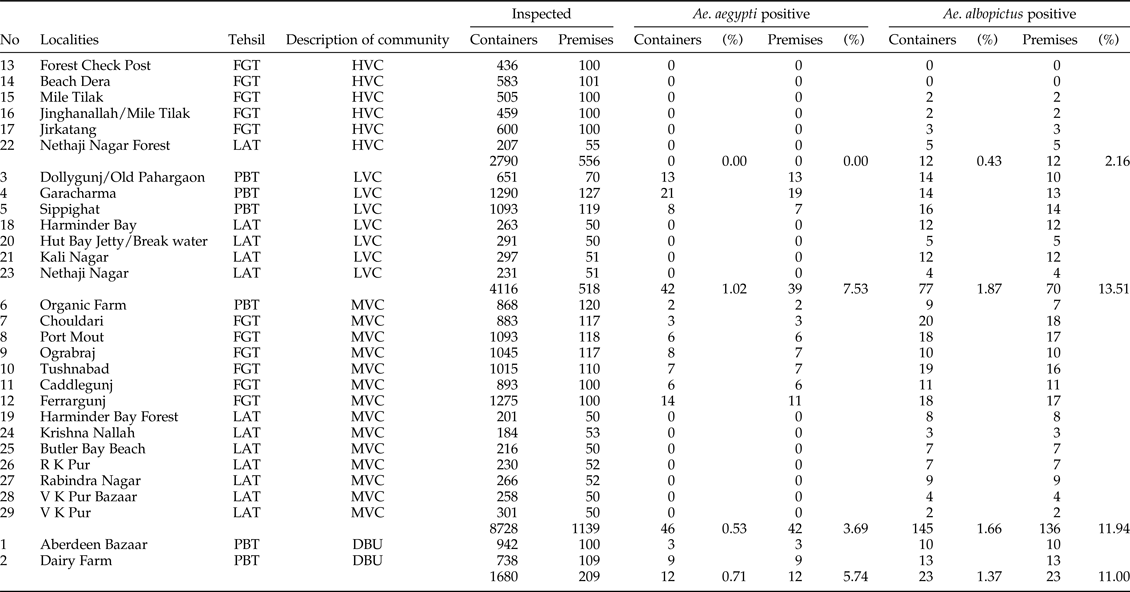
Aedes infestation surveys were done in 17 sampling locations along a stretch of 43 km on the GATR covering both PBT and FGT. Further north, the GATR traverses through the reserve area for the Jarawa tribe, and on this part, a stretch of 47 km could not be covered as no intervention in this area is allowed. In Little Andaman, infestation surveys were done in 12 sampling locations, along a stretch of 28 km on the road that connects Harminder Bay and Vivekanand Pur (fig. 1). The description of sampling locations in South Andaman district is furnished in table 1.
Map showing the sampling locations for Aedes infestation surveys (17 locations commencing from Aberdeen Bazaar to Jirkatang covering Port Blair and Ferrargunj Tehsil, a distance of 43 km; 12 sampling locations, along a stretch of 28 km road, which connects Harminder Bay and V K Pur in Little Andaman Tehsil) and relative abundance of Aedes aegypti (green) and Aedes albopictus (red) in South Andaman district.

Description of study communities, distribution and prevalence of developmental sites for Aedes albopictus and Aedes aegypti at sampling locations in South Andaman district.

Results
Geographic distribution of Ae. aegypti and Ae. albopictus in South Andaman
A total of 17,314 water-holding containers were detected in the 29 sampling locations across the South Andaman district (fig. 1), and among these, 1021 (5.9%) were colonized by immature stages of Ae. albopictus, Ae. aegypti and other mosquito species. It was observed that 357 (2.1%) containers were colonized by Ae. albopictus and or Ae. aegypti (tables 1 and 3). Other mosquito species found breeding were Aedes subalbopictus, Stegomyia w-albus, Aedes malayensis, Aedes spp, Culex (Eumelanomyia) brevipalpis, Culex (Lophoceraomyia) minor, Culex (Lophoceraomyia) mammalifer, Culex (Culiciomyia) pallidothorax, Culex (Culiciomyia) fragilis, Culex (Culiciomyia) nigropunctatus, Anopheles (Cellia) sundaicus, Armigeres (Armigeres) joloensis, Armigeres (Armigeres) kuchingensis, Toxorhynchites spp., Verralina (Neomacleaya) andamanensis, Verralina sp., Uranotaenia (pseudoficalbia) nivipleura, Uranotaenia sp, Lutzia (Metalutzia) halifaxii, Malaya genurostris, Tripteroides (Rachionotomyia) aranoides, Heizmannia (Mattinglyia) discrepans, Heizmannia sp and Christophersiomyia thomsoni.
Out of the 29 locations sampled across the three Tehsils of South Andaman district, Ae. albopictus were detected in 27 locations including all the locations in Little Andaman and 15 of the 17 locations in South Andaman Island. Neither Ae. albopictus nor Ae. aegypti was detected in the two northernmost locations in FGT of South Andaman. Ae. aegypti was absent in the entire LAT (fig. 1 and table 1). While Ae. aegypti breeding sites were found in 2–18% of the premises in localities where it existed, Ae. albopictus breeding sites were found in 2.0–24.0% of the premises. For Ae. aegypti, the highest premise and container index was in Garacharma in South Andaman. This locality is a suburban area of Port Blair. In the case of Ae. albopictus, the highest premise and container index was in Chouldari in FGT of South Andaman Island. This area is a rural area abutting forests (table 1).
The overall infestation, judged by both the container index and premise index, was the highest in the low-vegetation areas and the lowest in the high-vegetation areas both for Ae. aegypti and Ae. albopictus. In all the ecological zones, the infestation levels of Ae. albopictus was higher than that of Ae. aegypti. This difference was the most pronounced in medium-vegetation areas, where both the container and premise indices for Ae. albopictus were about three times those for Ae. aegypti (table 2).
Container and premise indices for Aedes aegypti and Aedes albopictus in the four ecological settings.

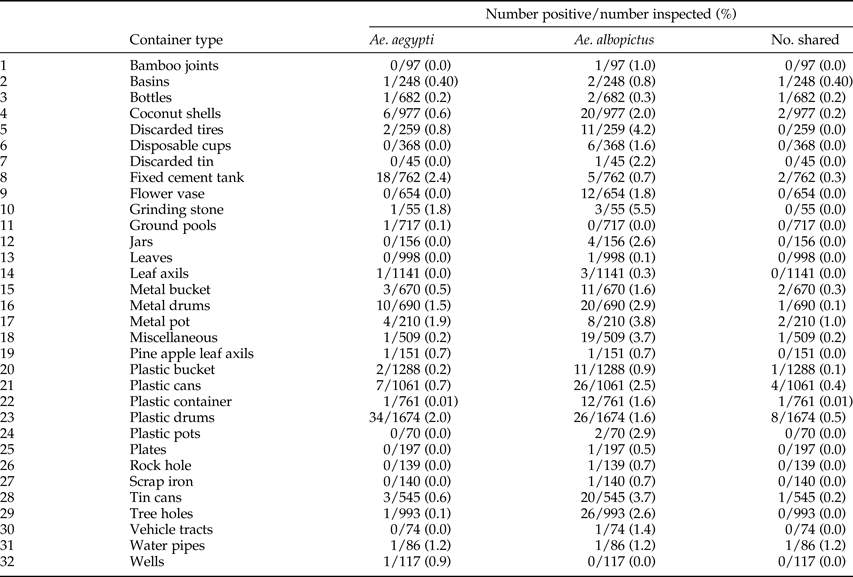
Ae. albopictus and Ae. aegypti colonized a variety of man-made, artificial and natural breeding places (table 3). The volume of water in breeding sites ranged from 2 ml to 1000 l. A total of 100 water containers were found to have breeding of Ae. aegypti, and among these, 69 (69%) were cement tanks, drums or plastic cans. Another 20 (20%) were coconut shells, discarded tires, buckets, tin cans or metal pots. Thus, vast majority of Ae. aegypti breeding sites are man-made medium and large water containers and unattended or abandoned water-holding objects littering the house premises. A total of 257 water-holding containers were colonized by Ae. albopictus, and among these, 118 (46%) were constituted by drums, cans and tree holes. Another 96 (38%) were constituted by coconut shells, tires, buckets, flower vases and miscellaneous containers.
Container preferences of Aedes albopictus and Aedes aegypti in South Andaman district.

Both species of mosquitoes were frequently found together in the same larval habitat (fig. 1, table 3). There were a total of 330 water-holding containers in which Ae. aegypti, Ae. albopictus or both were breeding, and among these, 28 (8.5%) had the breeding of both the species. These 28 water-holding containers, in which both the species were breeding simultaneously constituted 0.2% of the total containers inspected. The abundance of breeding sites for Ae. albopictus only loosely correlated with abundance of breeding sites for Ae. aegypti (Pearson's correlation coefficient =0.1536, df = 17, P = 0.119764, single-sided test, P < 0.05).
Discussion
We assessed the pupal infestation of Ae. aegypti and Ae. albopictus in various types of water-holding containers that support the breeding of these two species, across heterogeneous landscapes in South Andaman, endemic for dengue and sporadic cases of chikungunya.
Ae. albopictus was present in all the three Tehsils, while Ae. aegypti was totally absent in Little Andaman Island (LAT). In PBT and FGT, the two species co-existed, but their relative proportions and spatial distribution differed, which could probably be attributed to the differences in density of vegetation and buildings.
Ae. aegypti was present from the southernmost sampling location (location 1 – Aberdeen Bazaar) through location 12 (Ferrargunj). In Aberdeen Bazaar (densely built urban area), the relative proportion of Ae. aegypti was more compared with Ae. albopictus. Right through these sampling locations (1–12), both of these species co-existed, though their relative proportions varied. In sampling location 1, which is the most urbanized area, Ae. aegypti greatly predominated. As we moved away from urban Port Blair, this predominance of Ae. aegypti gradually decreased up to sampling location 7 (Chouldari), where Ae. albopictus greatly predominated. From Port Blair to Chouldari, on either side of the GATR, the vegetation density increases gradually, while the density of human dwellings decreases. An urban predilection of Ae. aegypti and the opposite for Ae. albopictus were evident in this trend.
As we move further up on the GATR from Chouldari, though the distance from urban Port Blair keeps increasing, the relative proportion of Ae. aegypti starts picking up to reach a further peak at Ferrargunj. This might look paradoxical, but Ferrargunj is a fairly populated village and is close to some of the densely populated areas on the opposite bank of the estuary that forms the northern boundary of Port Blair. GATR, when it winds around the estuary, reaches the farthest point from densely populated areas between Organic Farm and Chouldari (sampling locations 6 and 7). The direct distance from human dwellings seems to be a strong determinant of the relative proportion of Ae. aegypti and Ae. albopictus. The present data show that Ae. albopictus has established breeding populations all across South Andaman district. Even in areas where there was co-existence of Ae. albopictus and Ae. aegypti, which is confined to the areas around the part of GATR that goes around the estuary, Ae. albopictus predominated except in the two most densely populated areas of Port Blair and Ferrargunj. This indicates that this highly invasive mosquito species is the single dominant species in forested and medium-vegetation tracts, while it co-exists with Ae. aegypti in low-vegetation and densely built urban areas. Both of these species were absent at locations 14 (Beach dera) and 15 (Mile Tilak). Ae. aegypti is entirely absent in the isolated Little Andaman Island, the southernmost island in the Andaman archipelago.
Recent observations, on host feeding behaviour of Ae.aegypti and Ae. albopictus in South Andaman, suggest predominance of anthropophilism. The former species was reported to feed predominantly on human blood in the densely built urban, low-vegetation and medium-vegetation coverage. While the latter species showed high degree of anthrophilism in the densely built urban setting, which gradually decreased from low-vegetation to the highly vegetated forested tracts. This indicates plasticity in feeding across these landscapes (Sivan et al., Reference Sivan, Shriram, Sunish and Vidhya2015). In addition to other eco-biological variables, the difference in feeding behaviour could probably be attributed to the difference in spatial distribution of Ae. aegypti and Ae. albopictus across the sequence of heterogeneous landscapes (densely built urban to forested and vice versa) and co-existence of these two species within the same geographical region.
The key containers/habitats supporting breeding of both species are different, i.e. Ae. aegypti prefers larger water-holding containers, while Ae. albopictus prefers smaller containers for breeding. Both these species were also found in basins, bottles, coconut shells, fixed cement tanks, metal drums, metal pots, plastic drums, tin cans and water pipes, indicative of convergent habitat selection. Similar phenomenon has been reported in Singapore (Chan et al., Reference Chan, Chan and Ho1971a , Reference Chan, Chan and Ho b ), Brazil and the USA (Braks et al., Reference Braks, Honório, Lourençqo-De-Oliveira, Juliano and Lounibos2003) and Cameroon (Simard et al., Reference Simard, Nchoutpouen, Toto and Fontenille2005; Kamgang et al., Reference Kamgang, Youta Happi, Boisier, Njiokou, Hervé, Simard and Paupy2010).
Two broad categories of containers were the predominant breeding habitats of both the mosquito species. These were large and medium unattended or abandoned man-made containers and objects littering the dwelling premises, such as coconut shells and tires. However, large- and medium-sized and unattended containers formed a larger proportion of Ae. aegypti breeding habitats as compared with the breeding habitats of Ae. albopictus. On the contrary, objects littering the environment and natural water-holding sites constituted a larger proportion of the breeding habitats of Ae. albopictus. This implies that the culprit in Ae. aegypti infestation are the poorly maintained large- and medium-sized containers in the community. This behaviour of the community is probably the result of lack of risk perception of the community and a possible control strategy could be increasing the risk perception through awareness programmes. The other social behaviour that poses the risk of Aedes mosquito infestation is poor environmental hygiene resulting in the environment being littered with objects that could hold water and facilitate mosquito breeding. The solution for this also is awareness programmes for improving environmental hygiene. Part of the littering might be the results of careless habits of traders and small business establishments engaged in coconut trade and manufacture of Copra and tire vendors and vehicle repair garages. This probably has to be addressed through legislation or administrative action. Unplanned urbanization, intermittent water supply and lack of waste management facilitate burgeoning of water-holding containers, eventually facilitating to propagation of Aedes spp.
The habitats in LAT were similar to these forested northerly areas of South Andaman and the breeding was confined to Ae. albopictus. Because the 12 sampling locations in Little Andaman Island (LAT) and three northerly located sampling locations, viz. Mile Tilak, Mile Tilak/Jirkatang and Jirkatang is more forested than the other sampling localities, may provide a more favourable environment for Ae. albopictus and hence the dominance of this invasive mosquito species. Trade through the GATR road network could probably be the main source of dissemination of Ae. albopictus. Discarded tires is an important breeding habitat of Aedes mosquitoes as observed earlier during an outbreak of dengue in Havelock island, a tourist destination close to South Andaman (Sivan et al., Reference Sivan, Shriram, Sugunan, Anwesh, Muruganandam, Kartik and Vijayachari2016).
It has been observed in Sri Lanka that plastic net covers used in ground-level cemented water storage tanks resulted in significant reduction of Aedes mosquito breeding. This strategy was both user-friendly and cost-effective (Kusumawathie et al., Reference Kusumawathie, Yapabandara, Jayasooriya and Walisinghe2009). This approach appears to be feasible in South Andaman district, if awareness is created regarding the advantage of covering such water-holding containers among the community at risk.
The difference in spatial distribution of Ae. aegypti and Ae. albopictus appears to be significant for occurrences of dengue in South Andaman. Out of 80–151 annual dengue cases from 2010 to 2014 (RMRC unpublished) in South Andaman (PBT and FGT), 77.8% and 14.1% of the cases were reported from the densely built urban and low-vegetation coverage areas. While from the medium-vegetation and high-vegetation areas, 6.3% and 1.9% cases were reported. Although both these species co-exist in varying proportions in South Andaman and probably did play a role in the emergence of dengue, there has been no direct evidence of their respective roles in the transmission of DENV in the islands. Therefore, it is imperative to monitor the infestation of Ae. aegypti and Ae. albopictus for potential outbreaks of dengue in the region.
As opined by Gubler (Reference Gubler2003), invasion and further spread of Ae. albopictus into the densely built urban areas of Port Blair urban agglomeration, where Ae. aegypti is widely prevalent (Shriram & Sehgal, Reference Shriram and Sehgal1999) could have consequences of public health importance. Anthropophilism coupled with its ability to colonize urban and peri-urban areas render Ae. albopictus as a possible bridge vector that perhaps increases the risk of introduction and facilitate transmission of arboviruses (Sivan et al., Reference Sivan, Shriram, Sunish and Vidhya2015). Our recent investigations implicated the involvement of this mosquito species in an outbreak of dengue in the tourist destination, Havelock Island (Sivan et al., Reference Sivan, Shriram, Sugunan, Anwesh, Muruganandam, Kartik and Vijayachari2016). Therefore, Ae. albopictus is of public health concern.
Ae. albopictus invasion leading to decline in abundance and competitive displacement have been observed (Lounibos, Reference Lounibos2002). Therefore, future investigations in this region should consider this phenomenon, which provides an opportunity to explore competitive displacement and/or niche segregation between the widely prevalent Ae. aegypti populations and the invasive Ae. albopictus populations; but quite recently, our experience at Havelock shows that, even if Ae. albopictus helps to eliminate Ae. aegypti, that is not going to be beneficial from a public health point of view as Ae. albopictus is capable of assuming the role of dengue vector and is much difficult to control than Ae. aegypti (Sivan et al., Reference Sivan, Shriram, Sugunan, Anwesh, Muruganandam, Kartik and Vijayachari2016). Close surveillance of this probable invasion process, in this part of the country would undoubtedly advance our knowledge for the development and implementation of vector control measures.
In conclusion, Ae.aegypti and Ae. albopictus was observed in varying proportions in PBT and FGT, while Ae. aegypti appears to be absent in LAT. This survey depicts the spatial distribution of Ae. aegypti and Ae. albopictus with preponderance of the latter species, pointing towards arboviral transmission and assumes public health importance in South Andaman district, endemic setting for dengue and sporadic reports of chikungunya. The data generated on developmental sites and spatial distribution should be useful for the National Vector Control Programme.
Acknowledgements
This work was supported by the Indian Council of Medical Research (New Delhi) under the aegis of Vector Borne Disease Science Forum scheme no. 5/8-7(307) V-2011/ECD-II. The authors thank Dr P. Vijayachari, Director, Regional Medical Research Centre (ICMR), Port Blair for extending all the facilities for the conduct of the study. The authors acknowledge the assistance rendered by Mr Murthy, Deputy Conservator of Forests, and Mr Raja, Forester, Van Sadan/Department of Forests, A & N administration, Port Blair for developing GIS-based map of sampling locations and distribution maps. Technical Assistance rendered by Mr Pradeep Kumar Baniya Chhethri and Mr C. Ganesh, Insect Collectors is gratefully acknowledged.