The Italian pasta filata cheeses include soft and semi-soft varieties consumed fresh or after a brief period of ageing, and semi-hard or hard varieties that are subjected to considerable ageing prior to consumption. Milk, microorganisms, rennet type, processing methods, cheese shape, curing practices and environmental conditions during ripening, are factors determining the pasta filata cheese variety and its typical characteristics (Corsetti et al. Reference Corsetti, Corbo, Albenzio, Di Cagno, Gobbetti and Fox2001; Coppola et al. Reference Coppola, Succi, Sorrentino, Iorizzo and Grazia2003; Fox et al. Reference Fox, McSweeney, Cogan and Guinee2004; Albenzio et al. Reference Albenzio, Santillo, Russo, Caroprese, Marino and Sevi2010). The most important pasta filata cheeses in the Molise Region are Scamorza and Caciocavallo. They are usually produced from bovine milk, have a pear-like shape and the head closed by strings. Scamorza has a slight yellow colour, compact texture, about 200 g weight and could be commercialised at 1 d or after 15–20 d ripening. Caciocavallo has an amber colour, a homogeneous body with very few eyes and 1–2 kg weight. Some Caciocavallo cheeses are allowed to ripen for 15 d to 2 months, some others, typical of southern Italy, can be ripened for longer periods such as 6 months or 1 year. Both Scamorza and Caciocavallo can be consumed fresh, also as ingredients of typical traditional recipes.
The ripening of cheese is one of the longest and most expensive steps of the technological process, and different parameters can influence the ripening evolution. Ventilation allows heat and humidity produced by the cheeses to be evacuated and also determines both the weight losses and the gas concentrations in the atmosphere surrounding the cheeses (Weissenfluh & Puhan, Reference Weissenfluh and Puhan1987), which itself influences cheese ripening. Relative humidity (RH%) affects rind, water activity and water losses. A low RH% promotes the development of the rind, the weight loss and reduces the superficial pollution from moulds, however, it could result in high thickening and breaking of the rind. A high RH% promotes a slow rind formation, major pollution on the cheese surface and a shorter shelf-life. Ripening temperature is considered the major external parameter due to its accelerating or inhibitory effects on the rate of changes during ripening, for instance the degree of proteolysis, and texture evolution. Too high a temperature can lead to the development of flaws and of unwanted microorganisms, with synthesis of undesirable products (Fox et al. Reference Fox, McSweeney, Cogan and Guinee2004). Homogeneity in the distribution of climatic conditions is very hard to achieve at every point of a ripening room and industrial plants experience significant differences in the distribution of air temperature, velocity and RH%. In order to set up the optimisation of the curing process of cheese, different studies have been made on the relationship between ventilation, indoor atmosphere and quality of the cheese, highlighting heterogeneity in the distribution of climatic conditions and, consequently, differences in the cheese being ripened (Pajonk, Reference Pajonk2001; Simal et al. Reference Simal, Sanchez, Bon, Femenia and Rossello2001; Mirade et al. Reference Mirade, Rougier, Kondjoyan, Daudin, Picque and Corrieu2004; Helias et al. Reference Helias, Mirade and Corrieu2007; Riahi et al. Reference Riahi, Trelea, Leclercq-Perlat, Picque and Corrieu2007; Baudrit et al. Reference Baudrit, Hélias and Perrot2009; Picque et al. Reference Picque, Guillemin, Mirade, Didienne, Lavigne, Perret, Montel and Corrieu2009). Attempts to optimise the management of the ripening chambers are also reported in literature (Bon et al. Reference Bon, Clemente, Cárcel and Mulet2005; Mirade & Daudin Reference Mirade and Daudin2006; Mirade et al. Reference Mirade, Rougier, Daudin, Picque and Corrieu2006). New technologies to control and accelerate the ripening of cheese are increasingly being used to reduce the time and the cost of storing and maturing cheese (Law, Reference Law2001).
At an industrial-scale production, pasta filata cheeses are usually ripened at about 12–16 °C and under 85% RH, for a variable time, depending on the cheese to be obtained (Fox et al. Reference Fox, McSweeney, Cogan and Guinee2004), while, in small local industries, the traditional ripening of pasta filata cheeses still occurs in refrigerated chambers (about 15 °C), without controlled air flow and RH% levels.
Before ripening, pasta filata cheeses undergo a brief drying period, which can be called pre-ripening, in which they are kept in rooms at environmental conditions, at about 15–18 °C and under 80–85% RH (Fox et al. Reference Fox, McSweeney, Cogan and Guinee2004) or, for some products, such as Caciocavallo Silano cheese, at 15–18 °C under 50–60% RH (Corsetti et al. Reference Corsetti, Corbo, Albenzio, Di Cagno, Gobbetti and Fox2001). This step is useful for the draining of the residual whey, it accelerates the drying of the cheese surface and, therefore, the initial rind development. It lasts from few hours to 18 h for Scamorza (200–300 g) and from 7–8 h to 5–7 d for Caciocavallo (1–2 kg), depending on environmental conditions. The heterogeneity of climatic conditions used may cause texture and rind flaws, the development of an undesirable microorganisms and discontinuous sensorial properties which can influence the following ripening process and therefore the quality of the products. Moreover, the variable RH% causes different weight losses and discontinuous yields, thus affecting the productivity. Despite the importance of this drying step in the process of pasta filata cheeses, studies on the optimisation of the pre-ripening process parameters and on their effect on the product evolution during the ripening process are still lacking in literature. However, studies aimed at finding innovative pre-ripening processes able to control temperature, humidity and air flow parameters, could be useful to small cheese industries in order to accelerate the rate of processing and to obtain products of a known microbial quality and a better safety, with respect to their typical characteristics.
The aim of this work was the setting up of proper process parameters for the pre-ripening of traditional pasta filata cheeses. Pre-ripening tests were carried out by means of an industrial ripening plant fitting the process parameters to the characteristics of the investigated products. The products have been evaluated for their chemical-physical, microbiological and sensorial properties, in relationship to the tested process parameters.
Materials and Methods
Cheese making process
The cheese making process was carried out in a local dairy industry (Caseificio Molisano L. Barone s.n.c., Vinchiaturo, CB, Italy). The pasteurized milk was inoculated, at 32 °C, with a commercial starter mix (1 U/hl) composed of Streptococcus thermophilus, Lactococcus lactis ssp. lactis and ssp. cremoris, Lactobacillus helveticus, Lb. casei and Lb. delbrueckii ssp. bulgaricus. Fermentation was carried out for approximately 40 min at 37–38 °C and then commercial liquid rennet (30 ml/hl) was added. When the curd reached the proper consistency (30–40 min), the cutting process started. The curd was cut into nut-size granules (3–6 cm), then, 60% of the whey was withdrawn and maturation took place under whey. Afterward the curd was put on a table where it was left to ripen till the pH reached a value of about 5·2. The curd was then cut and mechanically stretched for 15–30 min in hot water (80 °C), to produce cheeses of about 200 g (Scamorza) and 2 kg (Caciocavallo). After shaping, cheeses were cooled in water and then soaked in brine (26%) for a variable time according to the size to be obtained (from 30 min to 8 h). Finally cheeses were pre-ripened and ripened as reported in the following section.
Cheese samples
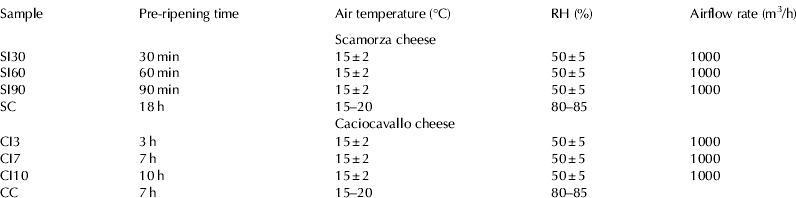
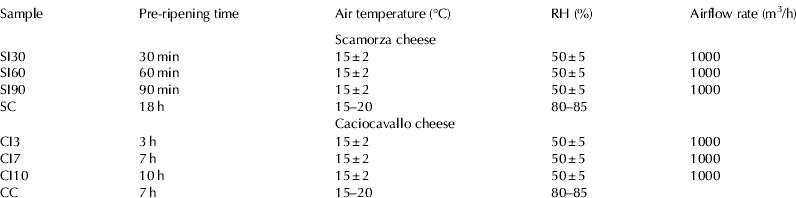
For each cheese (Scamorza and Caciocavallo) three productions were made. Three different pre-ripening innovative tests were carried out. The different test conditions are shown in Table 1. The traditional pre-ripening test represented the control. After pre-ripening all Scamorza samples were ripened at 15 °C under 80% RH for 21 d (d). All Caciocavallo samples were ripened at 10 °C under 80% RH for 60 d. Samples were analysed for their chemical-physical, microbiological and sensorial characteristics before pre-ripening (0 d), immediately after each pre-ripening treatment, and at 7, 14, 21 d ripening for Scamorza cheeses and at 7, 15, 30, 45 and 60 d ripening for Caciocavallo cheeses.
Experimental pre-ripening design for Scamorza and Caciocavallo cheeses
Pre-ripening plant
The pre-ripening plant used (Tred Technology s.r.l., Campobasso, Italy) was equipped with an air dehumidification system and worked from 5 to 20 °C. It consisted of a mono-block with an air conditioning system, in which air was dried and sent to the process chamber. The process was continuous, it allowed the elimination of the external water and part of the available water of the sample, with the expulsion of wet air. The plant was made of stainless steel and had a rotating trolley arm where the cheeses were hung; it had a small-size (2500 mm long, 1500 mm high, 1300 mm wide), cargo capacity of 400 kg and a maximum homogeneous airflow rate of 2000 m3/h. A control board set the automatic moving of the arms, the working temperature, the time schedule, the refrigerator, the evaporator units and the air extraction unit. The plant was also equipped with an automatic washing system. The working conditions are reported in Table 1.
Chemical-physical analysis
Cheeses were weighed using an electronic balance (AND GF-1200-EC, precision 0·01 g) and analysed for moisture, fat and total protein (O.J. 229/86) and lactose and galactose (Megazyme Kit K-LACGAR 05/05). Ripening index was expressed as the percentage ratio between the non-protein nitrogen (NPN) and total nitrogen (TN) (NPN/TN), determined by the Kjeldahl method (AOAC 16·036). Free amino acids were analysed using a Biochrom 30 series Amino Acid Analyzer (Biochrom Ltd, Cambridge Science Park, England) with a Li-cation-exchange column (20 cm × 0·46 cm). Samples were prepared as described by Bütikofer & Ardö (Reference Bütikofer and Ardö1999). pH was measured by means of a Crison 2001 series (Crison Instrument, Alella, Spain). Acidity (O.J. 229/86), and colour (Minolta Chromameter CR-200 observer in CIELAB space [L*, a*, b*]) were also determined.
Structure analysis
Firmness of the rind was determined on whole samples, by measuring the maximum force of compression of a cylindrical probe (P-5 mm diameter) at a speed of 1 mm/s to a depth of 10 mm by means of a Texture Analyzer (TA-XT2 Stable Micro Systems, Surrey, England). The thickness of the cheese rind was determined after scanning a cheese slice (2–3 mm thick) and measuring the external layer with a graphic program (Microsoft Photo Editor, 3.0). Three repetitions on each slice were carried out and results were averaged.
Microbiological analysis
Ten gram each cheese were aseptically transferred into a sterile stomacher bag, diluted with 90 ml sterile physiological solution (NaCl 9 g/l) and homogenized for 1 min in a Lab-blender 400 Stomacher (Seward Laboratory, London, UK). One ml of the first dilution was used to obtain tenfold serial dilutions for microbial counts. Total mesophilic bacteria were estimated on PCA (Oxoid, United Kingdom) after 48 h at 28 °C. Lactic acid bacteria (LAB) were counted, under anaerobiosis, on MRS agar (Oxoid) after 72 h at 22 °C for mesophylic bacteria and 44 °C for thermophylic LAB. Enterobacteriaceae were estimated on VRBGA (Oxoid) after 36 h at 37 °C, total and faecal coliforms on VRBLA (Oxoid) after 36 h at 37 and 44 °C, respectively. Yeasts and moulds were quantified, on the surface of the cheese, on Yeast and Mould Agar (Oxoid), after 72 h at 25 °C.
Sensory analysis
Sensory assessment was conducted by a semi-trained panel (10 judges), at University of Molise, using a check list proposed by B.U.R. Alto Adige (1996). Four terms were used: inner aspect, outer aspect, flavour, taste, with a scale from 0 to 3 for the first three terms (0 = heavy flaws; 3 = typical), and from 0 to 8 for taste (from 0 to 5 = heavy flaws, 8 = typical). The samples were served at room temperature.
Statistical analysis
The analysis of variance (ANOVA) was applied to the data. The least significant differences were obtained using an LSD test (P < 0·05). Statistical analysis was performed using an SPSS version 13.0 for Windows (SPSS Inc., Chicago, IL, USA).
Results and Discussion
The pilot pre-ripening plant allowed drying of the cheeses under standardised conditions of RH% and temperature and a homogeneous airflow. Cheese pre-ripening was carried out on samples subjected to a rotary motion, under continuous renewed air, with an airflow rate close to that reported by Mirade et al. (Reference Mirade, Rougier, Daudin, Picque and Corrieu2006). Tests were also carried out with no renewed airflow but the obtained products highlighted high levels of moulds and yeasts on their surface (data not shown). Levels of 50–60 RH% and 15 °C were chosen in accordance with those reported for a similar product, Caciocavallo Silano cheese (Corsetti et al. Reference Corsetti, Corbo, Albenzio, Di Cagno, Gobbetti and Fox2001). In preliminary experiments different time/temperature values were also set and the development of the rind and weight losses were evaluated. In particular RH% values higher than 60% resulted in low drying rates, with a slower rind evolution and lower weight losses (data not shown), in accordance with literature data, which studied the dependence of the rind dry matter (Riahi et al. Reference Riahi, Trelea, Leclercq-Perlat, Picque and Corrieu2007) and the weight losses (Bonaiti et al. Reference Bonaiti, Leclercq-Perlat, Latrille and Corrieu2004; Picque et al. Reference Picque, Leclercq-Perlat and Corrieu2006) on the relative air humidity. Temperature parameters higher than 15 °C (up to 20 °C) were also tested, however, they resulted in products with heterogeneous shapes. The different samples were therefore dried under the pre-ripening conditions reported in Table 1.
After the pre-ripening treatments on Scamorza cheeses, the control (SC) showed about 1% weight loss while it was 1·7% in the innovative samples treated for 30 min (SI30), 2·2% for 60 min (SI60) and 2·3% for 90 min (SI90). The greater weight losses observed during the innovative pre-ripening treatments could be mainly attributed to the lower RH% used, as also suggested by Bonaiti et al. (Reference Bonaiti, Leclercq-Perlat, Latrille and Corrieu2004). However, for the first 18 h of ripening, the weight loss of innovative samples tended to be lower than the control ones (P < 0·05), reaching values almost similar to the control samples (P > 0·05) till the end of the ripening period (data not shown).
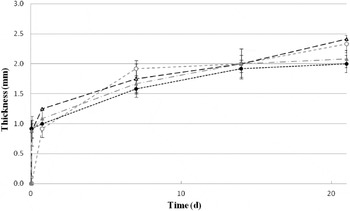
After the pre-ripening treatment for 30, 60 and 90 min, the innovative products had a rind thickness similar to that of the control sample at 18 h; moreover SI60 and SI90 showed higher values at 21 d (Fig. 1).
Evolution of rind thickness during pre-ripening and ripening of Scamorza cheeses. SC: traditional pre-ripened for 18 h (– –○– –), SI30: innovative pre-ripened for 30 min (· · · ·●· · · ·), SI60: innovative pre-ripened for 60 min (– –△– –), SI90: innovative pre-ripened for 90 min ( ).

Significant differences in chemical-physical characteristics (pH, acidity, lactose and galactose) were not found between samples. The rind of SI30 showed a heterogeneous colour only at 7 d ripening, with the yellow index (b*) lower than the control one. The rind colour of SI60 and SI90 samples didn't show differences from the control, during the whole examined interval (data not shown).
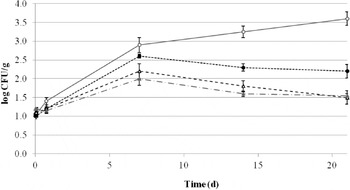
During ripening, total mesophilic bacteria counts of about 7 log CFU/g were recorded in all samples. No significant differences between the different samples were found either for mesophilic (about 6 log CFU/g) or thermophilic LAB (about 7 log CFU/g). All samples showed a very low presence of enterobacteria (<1 log CFU/g) and undetectable total and faecal coliforms, throughout the whole ripening period (data not shown). Cheeses SI60 and SI90 showed, on their rind, mould and yeast levels constantly lower than those of control samples, more evident starting from 14 d ripening (about 2 log units lower) (Fig. 2).
Evolution of moulds and yeasts on Scamorza cheese rind. SC: traditional pre-ripened for 18 h (– –○– –), SI30: innovative pre-ripened for 30 min (· · · ·●· · · ·), SI60: innovative pre-ripened for 60 min (– –△ – –), SI90: innovative pre-ripened for 90 min ().

At 7 d ripening the innovative samples presented acceptable sensorial characteristics (flavour and taste), similar to the control samples (data not shown).
Taking into account the overall results, the optimal pre-ripening innovative time was chosen at 60 min (SI60). Moreover, 60 min of innovative pre-ripening allowed the development of a homogeneous and a defined rind, which provides a distinctive product appearance and a higher water content, with a lower weight loss during the first 18 h ripening. SI60 samples showed a major firmness of the rind compared with control samples for the first 18 h ripening (0·97 and 0·57 N of maximum force, respectively). After this time values tended to be similar (data not shown).
Weight loss measurements were carried out, after pre-ripening and during ripening, for control (CC) and innovative Caciocavallo samples, at 3 h (CI3), 7 h (CI7), and 10 h (CI10) of pre-ripening. The weight loss of CI3 showed no appreciable differences from the control (P > 0·05); the weight losses of CI7 and CI10 were always similar, while they were significantly higher than CI3 till 30 d (P < 0·05) (data not shown). After 3 h innovative pre-ripening treatment, the cheese surface appeared heterogeneous and slightly yellow, contrary to what was observed for samples treated for 7 and 10 h. The pre-ripening time at 7 h was, therefore, chosen as the optimal treatment and the following evaluations were carried out on these samples.
pH, acidity, lactose and galactose values, before pre-ripening (0 d) and during ripening of Caciocavallo cheeses, did not significantly differ (P > 0·05). Also colour characteristics of innovative and traditional samples were similar (data not shown).
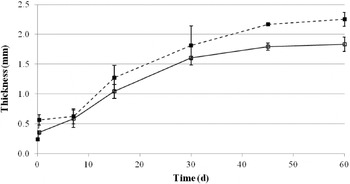
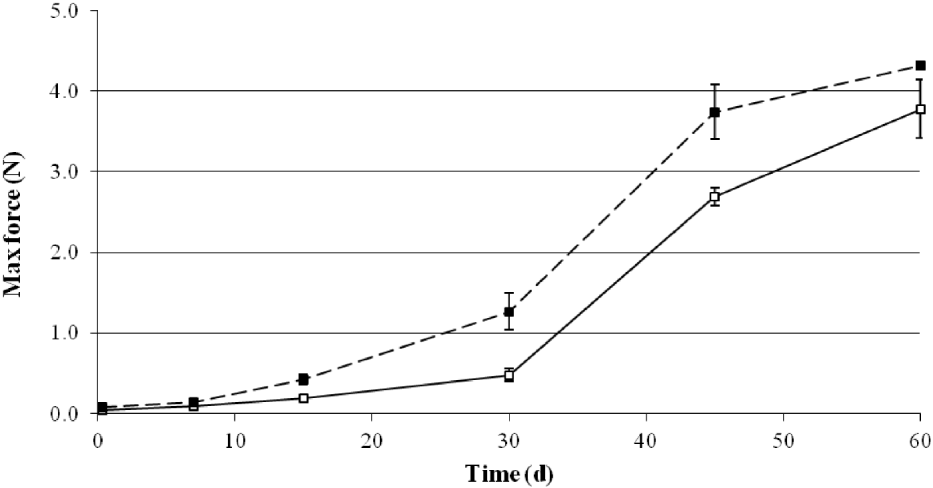
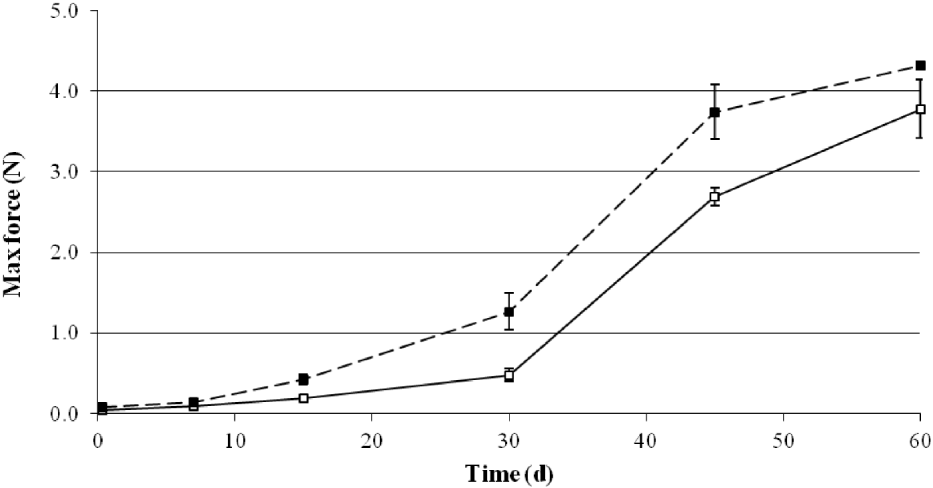
After the pre-ripening treatment at 7 h the innovative Caciocavallo had a rind thickness similar to that of the control sample at 7 d. After 45 d and till 60 d ripening it tended to increase relative to the control (P < 0·05; Fig. 3). The rind firmness of the innovative Caciocavallo cheeses was significantly higher than the control ones starting from 15 d ripening (Fig. 4).
Thickness of the rind of innovative and control Caciocavallo cheeses. CC: traditional pre-ripened for 7 h (– –□ – –), CI7: innovative pre-ripened for 7 h (– –■ – –).

Firmness of the rind of innovative and control Caciocavallo cheeses. CC: traditional pre-ripened for 7 h (– – □ – –), CI7: innovative pre-ripened for 7 h (– – ■ – –).
In order to verify the influence of the pre-ripening process on the evolution of proteolysis, the different nitrogen fractions and the free amino acids (FAA) were followed during ripening. At 60 d the ripening index (NPN/TN%) reached values of 4·9 ± 0·5 and 5·9 ± 0·9 for innovative and control samples, respectively (P > 0·05). Figure 5 shows the main FAA (mg/100 g total proteins) before the pre-ripening treatment (0 d) and at 60 d of ripening. In the innovative samples higher values than the control ones were found for the amino acid asparagine (ans), glutamic acid (glu), leucine (leu), phenylalanine (phe), ornithine (orn), while arginine (arg) was always absent. At the end of ripening total FAA reached values of 306 ± 9 mg/100 g total proteins (TP) in innovative samples and 235 ± 2 mg/100 g TP in control samples. The differences in the FAA pattern at 60 d ripening between the innovated and the control cheeses presumably depend on several factors, such as different enzymatic activities (natural or microbial) or the development of a specific microbiota during ripening, such as mesophilic LAB (Sousa et al. Reference Sousa, Ardö and McSweeney2001). This aspect, however, needs further investigation.
Evolution of free amino acids in innovative and control Caciocavallo cheeses. 0 d: before pre-ripening treatment (□), CC: traditional pre-ripened for 7 h and ripened for 60 d ( ), CI7: innovative pre-ripened for 7 h and ripened for 60 d (
 ).

Results of sensorial analysis during and after ripening showed similar values between the innovative and the control samples for the outer and inner aspects and significantly higher scores (P < 0·05) for flavour and taste in innovative samples, being perceived as sweeter and less pungent (data not shown).
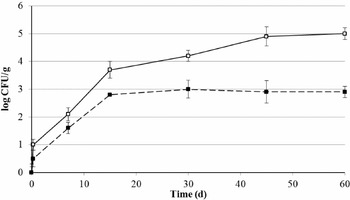
The microbiological data highlighted that the mesophilic and thermophilic LAB were predominant in all samples, reaching values higher than 6 log CFU/g, throughout the whole ripening period. Moreover, mesophilic LAB reached, in innovative samples, higher counts (7 log CFU/g) than those of control samples (6·2 log CFU/g), suggesting that the innovative pre-ripening treatment did not affect the presence of mesophilic LAB, leading to a higher presence of these microorganisms. The good microbiological quality of both innovative and control Caciocavallo samples was also confirmed by the very low or undetectable levels of undesirable microorganisms, such as enterobacteria and total and faecal coliforms (data not shown). Moreover, the innovative cheeses showed a higher microbiological quality since yeasts and moulds of the rind of innovative pre-ripening samples showed levels significantly lower than the control values during the whole examined period (P < 0·05) (Fig. 6). In accordance with what was observed for Scamorza samples, these results could be due to the lower and uniform RH% conditions of the pre-ripening that promoted a faster rind formation, offering a better cheese coating protection against unwanted microorganisms. Moreover, the water loss from the cheese surface, leading to surface drying of the cheese and inhibition of the free water diffusion, could create difficulties in the diffusion of metabolites from the core to the surface and their accessibility to microorganisms, as already observed by Bonaiti et al. (Reference Bonaiti, Leclercq-Perlat, Latrille and Corrieu2004). The natural protection offered by the rind could avoid use of antimicrobial agents or packaging strategies to prolong cheese shelf life. Finally, the acceleration of the rind development allows manufacturers to have products marketed in shorter times. In particular, the external aspect and the rind characteristics (thickness and firmness) of Scamorza cheeses pre-ripened for 60 min were similar to control cheeses at 18 h ripening, while, for Caciocavallo cheeses, the same thickness of the control sample at 7 d ripening was achieved after only 7 h of pre-ripening treatment. Therefore, the overall tested pre-ripening treatments lead to economic advantages to the dairy firms. In fact the obtained cheeses could be commercialised immediately after the pre-ripening treatment, as fresh products, or as ingredients of different typical traditional recipes. Alternatively they could undergo ripening treatment, resulting in ripened products of higher microbiological safety and quality.
Evolution of moulds and yeasts on Caciocavallo cheese rind. CC: traditional pre-ripened for 7 h (– – □ – –), CI7: innovative pre-ripened for 7 h (– – ■ – –).

Authors wish to thank Caseificio Molisano L. Barone s.n.c. for the realization of cheeses. The study was financially supported by POR MOLISE 2000/06: PROGETTO RE007 for the project: Sicurezza alimentare e innovazione tecnologica dei prodotti caseari freschi a pasta filata.