Introduction
Haemonchus spp. are parasites of the abomasum of wild and domestic ruminants with origin in Africa, where a basal diversification driven by colonization among antelopes with limited cospeciation, and subsequently a complex history of host switching to the Caprinae, Bovinae, Camelidae and Giraffidae, resulted in the 12 species-level taxa currently regarded as valid (Hoberg et al., Reference Hoberg, Lichtenfels and Gibbons2004). Haemonchus contortus and Haemonchus placei, species with a close phylogenetic relationship, are blood-feeding parasites of the abomasums of ruminants and cause significant economic losses in the livestock industry worldwide (Hoberg et al., Reference Hoberg, Lichtenfels and Gibbons2004; Amarante, Reference Amarante2011).
Following the first descriptions of biological and morphological differences between H. contortus and H. placei in Australia (Roberts et al., Reference Roberts, Newton-Turner and McKevett1954), detailed cytogenetic studies demonstrated that H. placei had an X chromosome bigger than the autosomes, in contrast with H. placei that have all chromosomes of similar size (Bremner, Reference Bremner1955). These initial findings allowed identification of hybrids from cattle and sheep grazing the same pastures. Later, Le Jambre (Reference Le Jambre1979) conducted detailed studies of hybridization between H. placei and H. contortus based on cytogenetic analysis. Laboratory studies with hybrids of H. contortus and H. placei have shown that these worms may present different degrees of genetic disorders that can cause reduction in fertility or complete sterility (Le Jambre, Reference Le Jambre1979). Interestingly, Le Jambre (Reference Le Jambre1981) reported an influence of the origin of the isolates in the fertility of hybrids: no fertile eggs were produced by the F1 of the mating between female H. placei × male H. contortus (Luisiana) or by F2 of the reciprocal mating, whereas the reciprocal matings between H. placei × H. contortus cayugensis produced an F1 and F2 that had reduced fertility but were not completely sterile.
A strong host-specificity in which cross-infection is negligible has been reported in the French West Indies (Giudici et al., Reference Giudici1999) and Brazil (Amarante et al., Reference Amarante1997; Silva et al., Reference Silva2015), where H. contortus primarily infects small ruminants and H. placei infects bovines. However, artificial infections with H. contortus can be established successfully in cattle (Bassetto et al., Reference Bassetto2011; Fávero et al., Reference Fávero2016), and with H. placei in sheep (Santos et al., Reference Santos2014a; Reiniger et al., Reference Reiniger2017). In addition, mixed infections have been reported in livestock production systems in which cattle and small ruminants share the same pasture in different areas of the world, such as West Africa (Jacquiet et al., Reference Jacquiet1998; Achi et al., Reference Achi2003), Egypt (Khalafalla et al., Reference Khalafalla, Elseify and Elbahy2011), Western Australia (Jabbar et al., Reference Jabbar2014) and the United States (Chaudhry et al., Reference Chaudhry2014). The mixed infection might allow H. contortus and H. placei to mate and produce hybrids. Therefore, there is a chance of hybridization that could give origin to new variants through gene introgression. In a mixed infection, hybridization through interspecific crossing can have major evolutionary consequences for species and populations by either promoting or preventing divergence, depending on the viability and reproductive abilities of the hybrids. In addition, adaptive traits can also be acquired through hybridization, resulting in an increase in fitness of hybrids (reviewed in Gilabert and Wasmuth, Reference Gilabert and Wasmuth2013).
The hybridization between H. contortus and H. placei can have important consequences due to gene flow, especially for traits related to anthelmintic resistance. The crossing of a population resistant to anthelmintic drugs with a susceptible population could result in introgression of anthelmintic resistance alleles in the F1 population (Chaudhry et al., Reference Chaudhry2015).
In order to increase the chances of interspecific mating, we designed a trial to allow both H. contortus and H. placei species to reach sexual maturity at the same time in artificial mixed infections. Thus, this study aimed to evaluate the hybrid production as well as the establishment rate of H. contortus and H. placei and hybrids in sheep.
Materials and methods
Production of infective larvae of Haemonchus contortus and Haemonchus placei
Infective larvae (L3) of H. placei (laboratory isolate SpHpl1) and H. contortus (laboratory isolate SpHco2) were produced in cultures made with faecal samples collected from a calf and from a lamb (donor animals), respectively. The identification of different Haemonchus species used in the present study was performed on both L3 and adults, based on morphological criteria and polymerase chain reaction (PCR) criteria previously established by Santos et al. (Reference Santos2014b) and Silva et al. (Reference Silva2015).
Management and diet of the sheep
Eighteen male Suffolk lambs of approximately 5 months of age were acquired from a commercial farm located in Paranapanema, Sao Paulo state, Brazil, and maintained in pens with a concrete floor. Faecal egg counts performed when these animals arrived at the University facility showed that they were naturally infected and were shedding on average 1531 eggs per gram of faeces (EPG), with a range of 0–11,400 EPG. Faecal cultures demonstrated that Haemonchus was the only strongyle infecting the animals. All sheep were treated with monepantel (2.5 mg/kg, Zolvix®, Novartis Animal Health), administered orally in a single dose. A series of faecal examinations were then performed to confirm the elimination of infection by nematodes (worm-free status).
The experimental animals were vaccinated against clostridiosis (Sintoxan T Polivalente®, Merial S.A.), and during the trial they received decoquinate (Deccox®, Alpharma) according to the manufacturer's recommendations. Lambs had free access to tap water and ground hay (Cynodon dactilon. cv. Tifton 85) purchased from a farm with no ruminants, avoiding risks of food contamination by L3 nematodes. These animals also had free access to mineral salts (Presensefós®, Presence) and received a commercial concentrate (Suplementa Ovino Campo®, Presence), the amount corresponding to 1% of their mean body weight.
Experimental design
Six lambs (parental group) were artificially infected with 2000 L3 of H. placei orally on day zero; 11 days later, the same animals received 2000 L3 of H. contortus (fig. 1). The difference in the timing of exposures was because the prepatent period is approximately 11 days shorter in H. contortus than in H. placei (Riggs, Reference Riggs2001; Santos et al., Reference Santos2014a).
Experimental design: lambs from the parental group (1 to 6) received artificial infection with 2000 infective larvae (L3) of Haemonchus placei (Day 0) and eleven days post infection (DPI) the same animals were infected with 2000 Haemonchus contortus L3. First filial generation (F1) of L3 produced from parental animals was used to infect lambs of the F1 group (n = 12, lambs 13 to 24). These lambs were subdivided into two groups and euthanized at 42 DPI (F1-42, lambs 13 to 18) or 84 DPI (F1-84, lambs 19 to 24).

Faeces were recovered from lambs of the parental group between 25 and 37 days post H. contortus infection (between 36 and 48 days post H. placei infection), and faecal cultures were performed individually for L3 production. This first filial generation of L3 (F1-L3) from each animal of the parental group was used to infect two animals of the F1 group (fig. 1). In order to evaluate the duration of the patent period of each species, the lambs of the F1 group were subdivided into group F1-42 (n = 6), which was euthanized at 42 days post infection (DPI), and group F1-84 (n = 6), which was euthanized at 84 DPI. Animals from the parental group with H. placei were euthanized at 50 DPI (39 DPI with H. contortus).
Parasitological analysis
Faecal samples were collected once per week directly from the rectum of each animal, for egg counting using a modified McMaster technique (Ueno and Gonçalves, Reference Ueno and Gonçalves1998). Faecal cultures were prepared separately with samples from each animal for production of L3. Differentiation of H. placei and H. contortus L3 was based on the measurement of the sheath tail (distance between the tip of the larval tail and the end of the sheath tail) of 100 larvae per faecal culture using an ocular micrometer (Zeiss®). The sheath tail is consistently shorter in H. contortus than in H. placei (van Wyk et al., Reference van Wyk, Cabaret and Michael2004; Santos et al., Reference Santos2014b). The L3 we used to infect the experimental animals of the parental group presented the following measures: H. contortus (n = 500) presented sheath tail lengths of 60.6–86.2 μm, with a mean ± SE of 69.4 ± 0.23 μm; and H. placei (n = 700) presented sheath tail lengths of 86.2–121.3 μm, with a mean ± SE of 102.61 ± 0.27 μm. These measures were used to infer the H. contortus and H. placei establishment in the experimental animals. We assumed that L3 with measures < 85 μm were H. contortus and those with measures > 87 μm were H. placei (fig. 3a, b), whereas intermediate values between 85 and 87 μm were considered to be inconsistent for species differentiation due to overlap between H. contortus and H. placei measures.
Recovery and measurement of adult worms
The animals were fasted for 12 hours before being euthanized. The abomasum was opened along the greater curvature, and its content was placed in a graduated beaker. The mucosa surface was washed with saline solution so that the parasites adhering to the mucosa could be detached from the organ. The volume was brought up to 1 l with saline solution, and the content was homogenized and divided into two containers of 500 ml each. The containers were immediately frozen for the preservation of parasites. The mucosal layers of all abomasums were soaked in saline solution at 38°C for 4 hours. All content of the digested material was collected and frozen (−20°C). Worm identification and counting procedures were performed on 50% of the content of the frozen material. If no worms were found in that sample, all the remaining content was also carefully examined for worms. The worms were stored in 70% ethanol.
The body, spicule and barb lengths were measured in 10 male adult worms chosen randomly from each animal. These specimens were placed on a glass slide, which was then placed on a ruler to measure their body length. After the measurement, the body was cut near the copulatory bursa, and the anterior region of the worm body was transferred to a 1.5 ml tube for DNA extraction, while its posterior portion was left on the slide for measurement of the spicules (Santos et al., Reference Santos2014b).
Molecular evaluation of adult worms
From each lamb, 20 males were evaluated, including those 10 for which morphological assessment (morphometrics of spicules) was carried out.
Genomic DNA was extracted from each Haemonchus specimen using a QIAamp® DNA Mini Kit (QIAGEN, Hilden, Germany) according to the manufacturer's instructions. DNA was also extracted from the blood samples of cattle and sheep for use as controls in PCR analysis.
The identification of the Haemonchus species and hybrids was performed by PCR (the gold standard analysis) using the species-specific primer pairs HcBotuF1/R2 and HpBotuF/R, designed from sequences proximal to the 3′- and 5′- ends of the large and small rDNA, which span the ETS sequence (Amarante et al., Reference Amarante2017). Each primer pair produces one single and distinct amplification band for each species. The primer pair HcBotuF1/R2 presents a band with approximately 260 base pairs (260 bp) from H. contortus samples and the HpBotuF/R pair presents a PCR product of approximately 459 bp from H. placei samples. Hybrid specimens show amplification with both species-specific primers. Negative (no-DNA) and known positive (H. contortus or H. placei) controls were included in each set of PCRs. The PCR conditions have been described by Amarante et al. (Reference Amarante2017).
The PCR products were electrophoresed on 2% agarose gel in 1% TAE buffer containing ethidium bromide and photographed under UV light using a Sony Cyber-shot DSC-HX1 camera (Sony Electronics, San Diego, California, USA). All PCR reactions were performed at least in duplicate.
Statistical analyses
Data on adult worm measurements were analysed by one-way analysis of variance using Minitab® software, version 17 (2013). Group means were compared by Tukey's test at a 5% significance level.
Results
Faecal egg counts (FEC) and worm burden
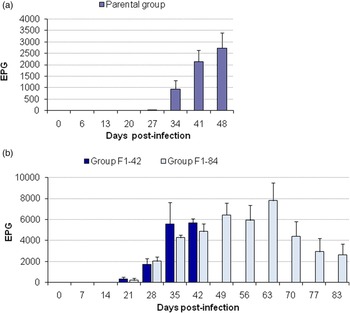
The parental group showed a progressive increase in FECs, reaching a mean of 2733 EPG (range: 1000–5100 EPG) at 48 DPI (fig. 2a). The Groups F1-42 and F1-84 showed the highest mean FEC at 42 DPI (5700 ± 379 EPG) and at 63 DPI (7800 ± 1,699 EPG), respectively (fig. 2b). In group F1-84, a progressive decrease in FEC occurred in the last samplings, indicating that a considerable number of worms had been naturally eliminated by the end of the study; this was confirmed by the worm count being lower in this group (average of 1020 adult worms) in comparison with the group euthanized at 42 DPI (average of 2395 adult specimens) (table 1). All lambs shed eggs in the last sampling, except lamb 24. This animal had a maximum of 2200 EPG at 49 DPI, but no eggs were detected in his last two faecal examinations. He had only one male and one female worm in his abomasum content. A few juvenile parasites were found in most of the lambs, with a maximum of 36 specimens.
(a) Mean number of eggs per gram of faeces (EPG) from animals of the parental group, infected with 2000 infective larvae (L3) of Haemonchus placei and 11 days later with 2000 L3 of Haemonchus contortus. (b) EPG of the F1 groups, infected with L3 produced with faecal samples of the parental lambs; the group F1-42 was euthanized 42 days post infection (DPI) and the group F1-84 was euthanized 84 DPI. Bars: standard error.

Worm burden, identification of Haemonchus specimens by PCR and percentage of the first generation of third stage larvae (F1-L3) produced in faecal cultures made with samples of each lamb of the parental group, mix-infected with 2000 L3 of Haemonchus contortus (Hc) and with 2000 L3 of Haemonchus placei (Hp).

Identification of F1-L3 based on the measurement of the sheath tails: Haemonchus contortus < 85 μm; Haemonchus placei > 87 μm; and intermediate measures between 85 μm and 87 μm.
Sheath tail length of infective larvae
F1-L3 from the parental group (lambs number 1 to 6) showed measures of both H. contortus (57.5–85.0 μm) and H. placei (89.0–124.5 μm) species (table 1). On average, 51.5% of the larvae presented H. contortus sheath tail length; 42.8% H. placei; and 5.7% intermediate measurement. These larvae were used to infect the lambs of group F1, which resulted in the production of a second generation of L3 (F2-L3). Lambs 14, 15, 16, 17 and 18 of the group F1-42 DPI showed F2-L3 with H. contortus and H. placei measures (table 2), while lamb number 13 of the same group showed only F2-L3 with H. contortus measures. Lambs of the group F1-84 showed F2-L3 with H. contortus and H. placei measures (table 1). Overall, larvae with H. contortus morphology predominated, with 81.5% in the F1-42 group and 84.0% in the F1-84 group.
Worm burden, identification of Haemonchus specimens (Haemonchus contortus, Hc; Haemonchus placei, Hp) by PCR and percentage of the second generation of third stage larvae (F2-L3) produced in faecal cultures made with samples of each lamb of F1 groups. F1-L3 produced by each parental lamb was used to infect two lambs, one euthanized 42 days post infection (group F1-42) and another 84 days post infection (group F1-84).

Identification of F2-L3 based on the measurement of the sheath tails: Haemonchus contortus < 85 μm; Haemonchus placei > 87 μm; and intermediate measures between 85 μm and 87 μm.
Morphological and molecular analysis of the adult worms
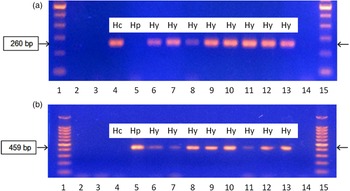
To illustrate the results of the molecular analysis, fig. 3 shows the PCR products obtained with each Haemonchus species, and fig. 4 the products obtained with hybrids that showed amplification with both species-specific primers. The establishment rate of both species was similar in the parental group (51.7% H. contortus and 48.3% H. placei) based on PCR analysis of 60 adult males (table 1). The analysis of 219 adult male specimens by PCR showed 52.2% H. contortus and 47.8% H. placei in the F1-42 group and 53.1% H. contortus and 46.9% H. placei in the F1-84 group (table 2). In addition, five and three hybrid specimens (fig. 4) were found in the F1-42 and F1-84 groups, respectively, representing 3.65% of the 219 worms (table 2).
PCR reactions with the primers HcBotuF1/R2 for Haemonchus contortus (a), and HpBotuF/R for Haemonchus placei (b). Lines 1 and 17 show 100 bp molecular markers (GE Healthcare); 2 and 3: bovine and ovine DNA, respectively (hosts); 4: H. contortus (Hc), control; 5: H. placei (Hp), control; 6 to 10: H. contortus samples; 11 to 15: H. placei samples; and 16: reagents without DNA.

PCR reactions with the primers HcBotuF1/R2 for Haemonchus contortus (a), and HpBotuF/R for Haemonchus placei (b). Lines 1 and 15 show 100 bp molecular markers (GE Healthcare); 2 and 3: bovine and ovine DNA, respectively (hosts); 4: H. contortus (Hc), control; 5: H. placei (Hp), control; 6 to 13: hybrids (Hy) from groups F1-42 DPI and F1-84 DPI; and 14: reagents without DNA.

Measurements of the adult male worms identified by PCR showed that the average body, spicule and barb lengths were longer in H. placei (table 3). Of the eight hybrids recovered, four had been evaluated by morphology before the DNA extraction. They presented spicule measurements similar to those of H. contortus (table 3).
Molecular identification by PCR and morphometrics (mean values, followed by size range in parentheses) of male adult specimens of Haemonchus contortus, H. placei and hybrids.

*Distances from spicule barbs to distal tips of spicules.
#Of the four hybrid specimens, three were in group F1-42 and one in group F1-84.
Groups F1-42 and F1-84 were euthanized 42 and 84 days post infection, respectively.
In the column, means followed by different superscripts differ significantly by Tukey's test (P < 0.05).
Discussion
The infection of the lambs of the parental group was planned to allow both H. contortus and H. placei species to reach sexual maturity at the same time, which would increase the chances of interspecific mating. Haemonchus females are polyandric and can mate with three or more males (Redman et al., Reference Redman2008), which in theory could also increase the chances of interspecific mating. Both species presented similar worm burdens in the parental group of lambs; thus it would be expected that in the F1 group of lambs there would be 25% H. contortus, 25% H. placei and 50% hybrid progeny, based on the Hardy-Weinberg equilibrium (p2 + 2pq + q2). This was not the case, as only 3.65% of hybrids were recovered (8 in 219 worms) in lambs of the F1 group. In Australia, Bremner (Reference Bremner1955) also found a similarly small percentage of hybrids (3.9%) in F1 sheep infected with L3 produced in a parental sheep that had been mix-infected with 7000 L3 of H. contortus and 7000 L3 of H. placei. Brasil et al. (Reference Brasil2012) detected only two (1.3%) heterozygous specimens carrying the ITS-2 alleles from H. placei and H. contortus from a total of 156 Haemonchus spp. from cattle, buffalo, goats and sheep raised in three states in Brazil. In Asia, Chaudhry et al. (Reference Chaudhry2015) observed, among 644 worms from sheep and goats, five specimens of H. contortus/H. placei F1 hybrids (0.078% of the total).
If H. contortus and H. placei mixed infections are common and the hybridization can occur, why is the recovery of hybrids so low? These parasites apparently avoid mating with individuals of different species and/or, if interspecific mating occurs, the hybrid progeny are not fit enough to complete their development until the adult stage. Bremner (Reference Bremner1955) noted that H. contortus and H. placei populations have maintained their morphological and distinct genetic identities despite the fact that they may have come into contact numerous times over the centuries, which would allow the occurrence of interspecific crossing. Hybrids of H. contortus and H. placei may present different degrees of meiotic disturbances, such as aneuplody, failure of chromosome pairing, and pairing between non-homologous chromosomes, that can cause reduction in fertility or complete sterility (Le Jambre, Reference Le Jambre1979, Reference Le Jambre1981), which could explain the maintenance of their distinct identities in places where both species are sympatric.
With regards to morphology, in general, the morphometrics of adult males of the present study were similar to those reported by Lichtenfels et al. (Reference Lichtenfels, Pilitt and Hoberg1994) in populations of both species from different geographical regions of the world, with males of H. placei showing longer average body, spicule and barb lengths than H. contortus, although the ranges of measurements of the two species overlapped. The hybrids found in the present study presented values similar to those of H. contortus. Thus, the employment of the PCR technique allowed the precise identification of individual specimens in the present study, overcoming the problem of overlapping in the values of morphometry.
Regarding the L3s, in a compilation of data extracted from several studies, van Wyk et al. (Reference van Wyk, Cabaret and Michael2004) found a range of 65–82 μm and 80–119 μm in the measurement of the sheath tail of L3s of H. contortus and H. placei, respectively, with little overlap in the measurements of the two. These values are similar to those found in our isolates and are therefore useful to monitor the establishment of the mixed infection. The morphological evaluation of the F1-L3 from the parental group showed predominance of larvae with H. contortus size (51.5%) in comparison with H. placei (42.8%). This difference in species percentage increased in the second generation of L3 produced by worms in the F1-lambs: L3 with H. contortus predominated, presenting a percentage 5.5 times greater than the L3 with H. placei in the F1-42 group and 6 times greater in the F1-84 group. Therefore, in comparison with H. placei, H. contortus appears to have some reproductive advantage. It is known that H. placei triggers a stronger immune response in sheep in comparison with H. contortus (Santos et al., Reference Santos2014a). This immune response may affect not only H. placei survival but also its fecundity. In future studies, it will be interesting to evaluate if hybrids present an immune evasion capacity similar to that of their parental H. contortus, or if they trigger an intense immune response in sheep similar to that of H. placei.
In conclusion, artificial mixed infections with H. contortus and H. placei were established successfully in sheep; however, they resulted in the production of only a small number of hybrids that reached the adult stage. These findings indicate that mating between different species is avoided and/or that most of the hybrids produced are unable to complete their development to the adult stage. Nevertheless, further studies are needed to evaluate if the hybrids produced play a significant role in gene introgression when both species are sympatric, i.e. when both Haemonchus species exist in the same geographical area and thus regularly encounter one another.
Acknowledgements
The authors are grateful for the technical assistance provided by César C. Bassetto, José H. Neves, Lucca B. Nápoli, Marina A. Cyrino, Marina S.G. Frontana and Nadino Carvalho.
Financial support
This study was supported by the São Paulo Research Foundation - FAPESP (M.R.V.A., grant number 2014/02305-6; and M.C.S., grant number 2012/23941-2 and 2015/12900-1); and AFTA received an Award from the National Council for Scientific and Technological Development (CNPq).
Conflict of interest
None.
Ethical standards
This trial was approved and conducted in accordance with the experimental protocol approved by the local Ethics Committee (protocol number 449-CEEA) of Sao Paulo State University (UNESP), Institute of Biosciences, Botucatu, Brazil.