


1. Introduction
As ethnic diversity increases in Western countries due to migration and refugee flows, concerns arise that this can create conditions in which interethnic hostility may develop. By growing interethnic hostility, we mean a process closely related to the concept of affective polarization (Iyengar et al., Reference Iyengar, Lelkes, Levendusky, Malhotra and Westwood2019), namely when members of one ethnic group develop increasingly negative attitudes toward another group. This process can be highly destabilizing for the entire society, as it can lead to increased stereotyping, discrimination, verbal or physical confrontations, and violence, as well as give traction to extremist political movements who exploit mutual fears and resentment. For example, a growing anti-immigrant sentiment contributed to the rise of the right-wing populist parties AfD in Germany and PVV in the Netherlands, while the minority communities reported feeling increasingly discriminated against and distrustful towards the state institutions (European Union Agency for Fundamental Rights, 2024). Manifestations of such an interethnic climate are also seen in schools, where tensions arise among classmates of different ethnic groups (e.g., Damhuis & Wansink, Reference Damhuis and Wansink2024), discussions of controversial topics result in threats towards teachers (Savenije et al., Reference Savenije, Wansink and Logtenberg2022), and even events aimed at fostering interaction among youth from diverse ethnic backgrounds sometimes end in verbal arguments and fights (e.g., Stark & Flache, Reference Stark and Flache2012). Identifying the processes and conditions that trigger sudden shifts in intergroup attitudes is critical for preventing these disruptive instances.
Adolescence is a formative period for shaping outgroup attitudes (Steinberg & Monahan, Reference Steinberg and Monahan2007), especially within multiethnic classroom friendship networks (Thijs & Verkuyten, Reference Thijs and Verkuyten2014). Processes like positive and negative contact (Laurence & Bentley, Reference Laurence and Bentley2018; Stark et al., Reference Stark, Flache and Veenstra2013), peer influence (Khuu et al., Reference Khuu, Schaefer, Umaña-Taylor and Ryan2023; Raabe & Beelmann, Reference Raabe and Beelmann2011; van Zalk et al., Reference van Zalk, Kerr, van Zalk and Stattin2013), homophily (Leszczensky & Pink, Reference Leszczensky and Pink2015; Rivas-Drake et al., Reference Rivas-Drake, Saleem, Schaefer, Medina and Jagers2019), as well as initial prejudice (Binder et al., Reference Binder, Zagefka, Brown, Funke, Kessler, Mummendey and Leyens2009; Kauff et al., Reference Kauff, Beneda, Paolini, Bilewicz, Kotzur, O’Donnell and Christ2021), shape these attitudes. Using longitudinal data on changes of attitudes and social ties among students, statistical modeling with stochastic actor-oriented models (SAOM, Snijders et al., Reference Snijders, van de Bunt and Steglich2010) can help quantify the relative strength of these processes and assess their effects on social relations and attitudes.
To understand how individual attitude shifts driven by these processes scale to interethnic hostility, it is essential to study complex interactions over time. For example, opportunities for students to be influenced by outgroup members could contribute to more favorable attitudes toward them, but a preference for coethnic friends could isolate different ethnic groups from each other, limiting these opportunities. Theoretical agent-based models (ABMs) of polarization have identified important theoretical pathways through which micro-level influence processes can lead to opinion polarization separating groups. However, micro-level processes assumed in these models are rarely connected to field data, which inhibits possibilities to empirically estimate the contribution of different processes to polarization dynamics (but see recent efforts to build empirically calibrated polarization models in, e.g., Banisch & Shamon, Reference Banisch and Shamon2025; Carpentras et al., Reference Carpentras, Maher, O’Reilly and Quayle2022). Further, most of these models do not explicitly address intergroup attitudes and therefore offer limited insight into interethnic conflict development (with some exceptions, e.g., Flache, Reference Flache2018). Integrating SAOMs that are calibrated to data on interethnic attitude dynamics in this class of ABMs could address both of these limitations (Snijders & Steglich, Reference Snijders and Steglich2015), though such applications are rare in polarization studies (but see Mepham, Reference Mepham2022; Tang et al., Reference Tang, Snijders and Flache2025) and, to our knowledge, have not yet been used to study polarization of intergroup attitudes.
This paper presents the first study of possible mechanisms driving rising intergroup hostility in multiethnic school cohorts using an empirically calibrated SAOM as simulation tool. Leveraging publicly available data from the “Friendship and Identity in Schools” project (Leszczensky et al., Reference Leszczensky, Pink, Kretschmer and Kalter2022), we examine secondary school cohorts in a diverse German region. Our model captures dynamics of attitudes towards the largest societal minority group—Turks—and evaluates the relative strength of social influence, especially from negatively minded peers, and processes driving changes of friendship ties.
We then explore the possible consequences of macro-level shocks where the minority group is associated with the perpetrator, such as Islamist terror attacks, on intergroup hostility in an initially rather positive interethnic climate. We aim to investigate how and under which conditions the effects of such shocks on micro-level processes of social influence and network formation aggregate up to potentially harmful macro-level outcomes, such as hostility towards Turks. As an example, terrorist events often evoke uncertainty and fear (Godefroidt, Reference Godefroidt2023), which can simultaneously foster negative perceptions of outgroups (Borell, Reference Borell2015), strengthen ingroup solidarity (van Hauwaert & Huber, Reference van Hauwaert and Huber2020), and drive individuals to align more closely with their reference groups, such as friends (Smith et al., Reference Smith, Hogg, Martin and Terry2007; Terry & Hogg, Reference Terry and Hogg1996). To represent the effects of such external shocks, we increase in the empirically calibrated ABM the estimated strength of mechanisms like peer influence on attitudes towards Turks and ethnic homophily. We focus in particular on peer influence dominated by negatively minded peers and evaluate changes in interethnic hostility within otherwise realistic settings. Findings indicate that thus specified peer influence, reinforced by external “shocks,” could over time amplify even minor outgroup bias, inducing interethnic hostility and overriding other behavioral and network mechanisms. We explain how these results stem from our model of the interacting mechanisms applied to the empirical context we study.
The main contribution of our study is the development of a model that theoretically links individual behavioral processes to intergroup hostility, and its use for simulations anchored in empirical data on network and attitude coevolution to explore the conditions under which such hostility could emerge. We begin by addressing the discrepancies between network studies on interethnic attitude change and agent-based modeling of interethnic polarization and proposing a framework to reconcile these research approaches (Background). We then outline our analytical approach and research questions (Present Study). In the Data and Methods section, we detail the study context, model specifications, and simulation design. Finally, we present our Results and conclude with a Discussion of the findings.
2. Background
2.1 Individual-level interethnic attitude change
Empirical studies have identified several key mechanisms driving individual attitude change, with peer influence being one of the most extensively researched. Peer influence refers to the tendency for individuals to adopt attitudes similar to those of their peers through interaction. This mechanism operates on the principle that group norms prevailing within valued peer groups are internalized through social interactions (Crandall et al., Reference Crandall, Eshleman and O’Brien2002; Terry & Hogg, Reference Terry and Hogg1996) or seen as integral to a shared reality (Cialdini & Goldstein, Reference Cialdini and Goldstein2004; Hardin & Conley, Reference Hardin and Conley2001).
This mechanism is especially strong during adolescence—a period of heightened insecurity when the influence of parents and teachers is increasingly questioned and validation by peers becomes more important (Laursen & Veenstra, Reference Laursen and Veenstra2021; Steinberg & Monahan, Reference Steinberg and Monahan2007). For adolescents, valued peer groups often consist of close friends with whom they spend significant time, such as at school. Research on intergroup relations indicates that attitudes related to outgroups, xenophobia, prejudice, and intergroup contact attitudes are susceptible to peer influence (e.g., Rivas-Drake et al., Reference Rivas-Drake, Saleem, Schaefer, Medina and Jagers2019; van Zalk et al., Reference van Zalk, Kerr, van Zalk and Stattin2013; Zingora et al., Reference Zingora, Stark and Flache2020).
As attitudes shift through peer influence, the relationships in which these processes occur can also evolve. For example, an individual’s level of prejudice may affect their choice of peers, where higher prejudice might hinder outgroup contact and friendships (Laurence & Bentley, Reference Laurence and Bentley2018; McMillan et al., Reference McMillan, Craig, la Roi and Veenstra2023; Stark et al., Reference Stark, Flache and Veenstra2013). However, the preferences underlying such choices may be constrained by the network’s opportunity structure—namely, the availability of peers of a desired ethnicity or with preferred attitudes (Blau & Schwartz, Reference Blau and Schwartz1984; Huckfeldt, Reference Huckfeldt1983).
Additionally, friendships are often formed based on shared attributes (Byrne, Reference Byrne1961; Lazarsfeld & Merton, Reference Lazarsfeld, Merton, Berger, Abel and Charles1954; McPherson et al., Reference McPherson, Smith-Lovin and Cook2001), such as gender, ethnicity, or religion (e.g., Leszczensky & Pink, Reference Leszczensky and Pink2015; Wimmer & Lewis, Reference Wimmer and Lewis2010). Structural network tendencies, including reciprocity, triadic closure, and popularity of certain peers, can further amplify or mitigate these preferences.
In dynamically evolving networks, the interplay of peer influence and preference-, attribute-, and structure-based friend selection can make it notoriously difficult to predict ensuing macro-level outcomes (Kempe et al., Reference Kempe, Kleinberg, Oren and Slivkins2016). For instance, changes in outgroup attitudes through peer influence may alter network composition, further affecting who influences whom. Homophilic friend choices and structural processes, such as reciprocating friendships, can insulate same-ethnic groups. This may limit opportunities for students with positive outgroup attitudes to connect with outgroup members or for those with negative attitudes to be influenced by positively minded peers. Consequently, ingroup friendship circles where negative outgroup attitudes dominate could emerge, fostering intergroup hostility.
Whether interethnic hostility emerges from this interplay depends on the relative strength of each process and how they amplify or dampen one another. Further, external shocks such as ethnic violence incidents can affect some of these dynamics and disrupt the balance between them. This underscores the need for both empirical modeling of these processes and simulations of their aggregate effects. However, while research in empirical network modeling begins to incorporate multiple such processes (e.g., Bracegirdle et al., Reference Bracegirdle, Reimer, van Zalk, Hewstone and Wölfer2022; Khuu et al., Reference Khuu, Schaefer, Umaña-Taylor and Ryan2023; Zingora, Reference Zingora2024), hitherto simulation studies of opinion dynamics remain largely incompatible with it, as the next section will illustrate.
2.2 Modeling the macro-level phenomenon of interethnic hostility
Studies on the macro-level consequences of micro-mechanisms in social contexts fall within the domain of agent-based modeling (ABM; Macy & Willer, Reference Macy and Willer2002; Flache & de Matos Fernandes, Reference Flache, de Matos Fernandes and Manzo2021). Numerous ABM studies on opinion dynamics generate polarization phenomena (for overviews, see Flache et al., Reference Flache, Mäs, Feliciani, Chattoe-Brown, Deffuant, Huet and Lorenz2017; Sobkowicz, Reference Sobkowicz2020). However, agent-based models of opinion or attitude polarization are often built on assumptions that diverge significantly from those adopted in network studies of interethnic attitude evolution, reducing the realism of ABM applications in empirical contexts (e.g., Chattoe-Brown & Gabbriellini, Reference Chattoe-Brown and Gabbriellini2021; Duxbury, Reference Duxbury2024; Stadtfeld, Reference Stadtfeld2018).
An important difference between agent-based studies of polarization and network studies of interethnic attitude dynamics lies in how influence is operationalized. In empirical network studies, changes of interethnic attitudes are typically measured as changes of responses to items with an interval scale (e.g., a five-point scale to express how much one likes an ethnic group). Accordingly, the process of peer influence on a respondent is modeled as moving towards the average attitude of one’s alters. However, agent-based models of social influence using this assumption of assimilative influence have been shown to inevitably generate consensus among agents in a connected graphFootnote 1 (DeGroot, Reference DeGroot1974). Agent-based models that produce polarization along a continuous scale often rely on behavioral rules like bounded confidence (Deffuant et al., Reference Deffuant, Neau, Amblard and Weisbuch2000; Hegselmann & Krause, Reference Hegselmann and Krause2002) or repulsive influence (Jager & Amblard, Reference Jager and Amblard2005; Macy et al., Reference Macy, Kitts, Flache, Benard, Breiger, Carley and Pattison2003), where agents ignore or move further apart from alters they dislike or whose views are too different from their own. Alternatively, some models introduce heterogeneity, assuming the presence of “extremists” or “stubborn agents” who resist opinion change (e.g., Deffuant et al., Reference Deffuant, Amblard, Weisbuch and Faure2002). Other polarization models explore different processes, such as agents exchanging arguments in support of opinions (e.g., Mäs & Flache, Reference Mäs and Flache2013) or influencing each other’s decision making (e.g., Meylahn & Searle, Reference Meylahn and Searle2024). In some cases, attitudes are modeled as discrete or binary (e.g., Carpentras et al., Reference Carpentras, Maher, O’Reilly and Quayle2022; Meylahn & Searle, Reference Meylahn and Searle2024). Testing these numerous assumptions empirically, however, is challenging as current statistical frameworks are not easily adaptable to these operationalizations of influence (but see a recent effort by Tang et al., Reference Tang, Snijders and Flache2025).
Agent-based models of polarization also often use different representations of social context compared to network models. When networks are employed, they tend to be stylized, such as square lattices, random graphs, or small-world networks (Amblard et al., Reference Amblard, Bouadjio-Boulic, Sureda Gutiérrez and Gaudou2015). Despite the importance of feedback loops between network structure and opinion evolution, many agent-based studies use static networks. This can influence both the macro-level outcomes of the models (Cointet & Roth, Reference Cointet and Roth2007) and the speed at which outcomes emerge (Mepham, Reference Mepham2022). For example, failing to account for initial segregation due to ethnic or racial homophily may lead to an overestimation of exposure to diverse peers and the influence they exert.
Finally, ABMs that generate polarization rarely include major destabilizing factors, often modeling them as random noise during opinion updates (but see Mäs et al., Reference Mäs, Flache and Helbing2010). However, empirical evidence indicates that negative outgroup attitudes can emerge in stable systems when triggered by events such as political rhetoric (e.g., Biskamp, Reference Biskamp2024) or violent incidents involving specific groups (e.g., Frey, Reference Frey2020). A notable study by Huet et al. (Reference Huet, Deffuant, Nugier, Streith and Guimond2019) is one of the few agent-based models to incorporate such an external shock, and it is data-driven. The authors examine the impact of a terrorist attack using a version of the bounded confidence framework, in which agents adjust their positions in the identity space in response to the event. The model shows that following a terrorist attack by Muslim extremists, attitudes towards Muslims deteriorate unless several conditions are met, such as the presence of enough agents with tolerant positions towards Muslims. However, the study does not model the processes of coevolution of relationships and attitudes beyond the immediate reaction to the event and thereby offers only limited insight on polarization development.
Most existing agent-based models provide only a partial account of the conditions for intergroup hostility development, and their predictions cannot readily be linked to empirical contexts. This is partly due to limitations in empirical methodologies, such as measuring attitudes, networks, and data availability. More importantly, it stems from how these models represent attitude evolution, network contexts, and external shocks, which does not align with empirical studies of attitude dynamics. Consequently, insights from empirical research are challenging to use in calibrating simulations of interethnic hostility development. In the next section, we argue that using correlational influence, a peer influence model that is theoretically valid, empirically plausible, and potentially able to explain polarization emergence, can bridge this gap.
2.3 Modeling peer influence in the aftermath of a shock
The discussion about what makes a good, empirically sound social influence model capable of explaining the development of interethnic hostility is still ongoing. As mentioned earlier, while assimilative influence—where individuals reduce differences between their own opinions and those of their peers—is common in empirical studies, it gives little insight into potentials for affective polarization. In a recent study, Tang et al. (Reference Tang, Snijders and Flache2025) used SAOM to test whether repulsive influence from classmates brings about opinion polarization. The study introduced a new effect capturing repulsive influence—the attitude adjustment further away from the peer opinion which is too different to one’s own (beyond a certain threshold). Although the effect was found to be significant, opinion polarization levels in the data were quite low due to the interaction of repulsive influence with other processes, like assimilative influence from friends. Other studies testing repulsive influence in various contexts and with different methods found little to no evidence supporting it as a significant driving mechanism for polarization (e.g., Keijzer et al., Reference Keijzer, Mäs and Flache2024; Kozitsin, Reference Kozitsin2023; Takács et al., Reference Takács, Flache and Mäs2016). This calls for exploring alternative causal mechanisms leading to interethnic hostility development.
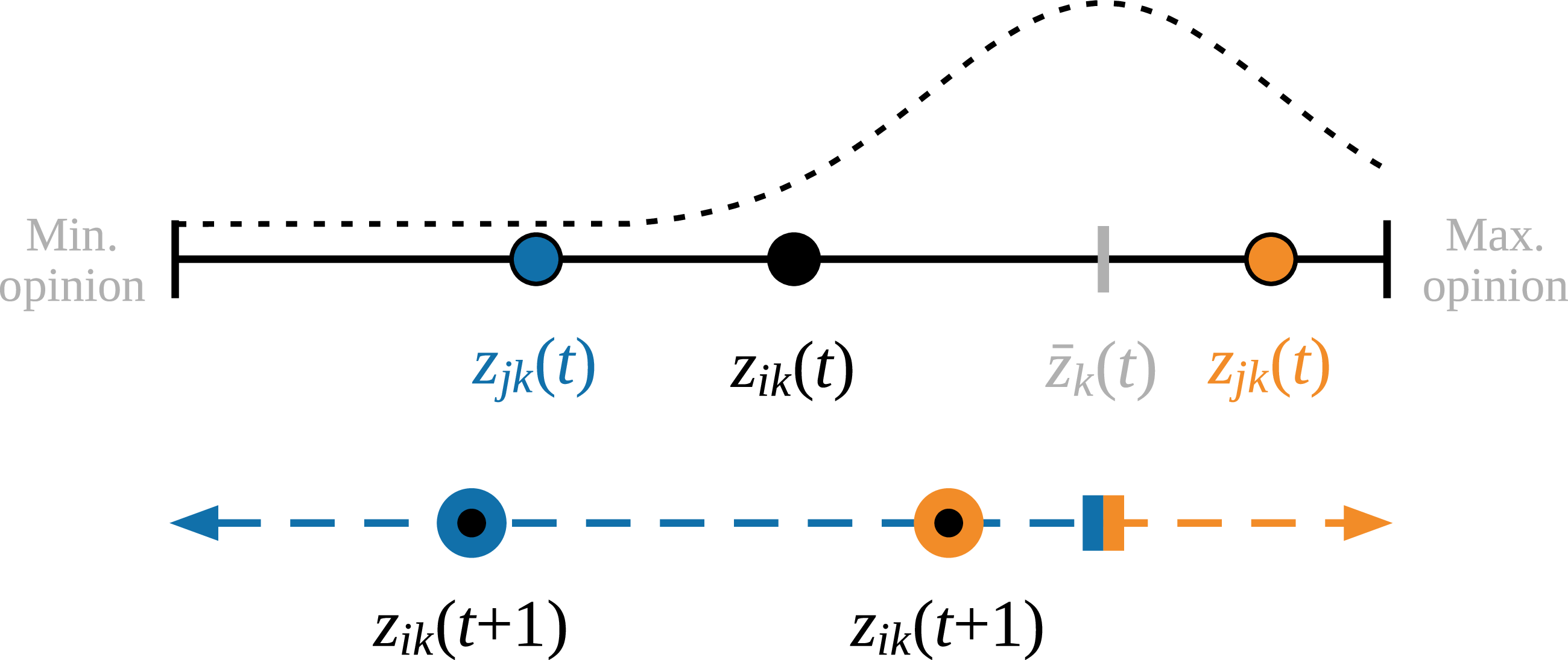
Illustration of the workings of average alter effect on attitude k when ego i has one alter j. The dotted line depicts a positively skewed distribution of attitude k in the population within the attitude range, and
 $\bar{z}$
k
(t) stands for the overall mean of this distribution at time point t. Depending on where j’s attitude (or, if i has multiple alters, their average attitude) is positioned relative to the mean at time t, i will with higher likelihood update her attitude at t + 1 in the direction indicated by the corresponding arrow. When z
jk
(t) is lower than the mean, i’s attitude z
ik
(t + 1) is likely to decrease (and can become even more extreme than j’s), and vice versa. Adapted from Snijders and Steglich (Reference Snijders and Steglich2026, Figure 14.1).

In this paper, we propose that interethnic hostility can arise through correlational influence (Snijders & Steglich, Reference Snijders and Steglich2026), sometimes also called contagion (Veenstra et al., Reference Veenstra, Bertogna, Laninga-Wijnen, Feinberg and Osgood2023: 336). It implies that “[attitude] adjustment of one actor is correlated with the [attitude] value of the other actor” (Snijders & Steglich, Reference Snijders and Steglich2026: 239), capturing a process where individuals with friends with relatively high (low) opinions increase (decrease) in these opinions (Figure 1). It follows that the biggest opinion updates are triggered by friends who hold opinions which are on the extremes of the distribution in the network as a whole. Consequently, in populations with initially mainly positive attitudes, negatively minded peers exert disproportionate influence, although peers with positive attitudes may counteract this effect.Footnote 2
Concluding whether this form of influence is present in empirical contexts is not straightforward. On the one hand, empirical studies found supportive evidence for correlational influence among adolescents for positive sentiments towards immigrants (Dahl, Reference Dahl2017) and xenophobia (van Zalk et al., Reference van Zalk, Kerr, van Zalk and Stattin2013), as well as for deviant behaviors (e.g., Gremmen et al., Reference Gremmen, Berger, Ryan, Steglich, Veenstra and Dijkstra2019) and academic achievement (Gremmen et al., Reference Gremmen, Dijkstra, Steglich and Veenstra2017) (but not for physical aggression or prosociality, as found by Dijkstra & Berger, Reference Dijkstra and Berger2018). At the same time, these studies did not test correlational influence alongside other forms of influence. Therefore, it cannot be excluded that the same data could be explained with other influence processes, such as assimilative influence, which has a lot of empirical support, as discussed above. However, separating different influence functions empirically is very challenging. For example, Tang et al. (Reference Tang, Snijders and Flache2025) needed to develop new functional specifications to model bounded confidence and repulsive influence processes and could do so only by introducing additional parameters which could not be directly estimated from the data but only compared by re-running the model for all available parameter combinations. Relative to the setting they studied, ours is even more complex, as we further distinguish students by ethnic background. As we are here not primarily interested in comparing different influence functions but in assessing the conditions for the emergence of interethnic hostility given an influence process that could in principle contribute to inducing it, we follow a different approach and focus on the process of correlational influence. We consider this mechanism plausible and relevant for theoretical reasons: because it is consistent with the psychological processes that might arise at the micro-level following an external shock, as discussed below, and because it can potentially explain attitude polarization at the macro-level, which assimilative influence model cannot.
As suggested by earlier research, when the system is destabilized by an external shock, previously dormant hostile attitudes may transpire (e.g., Biskamp, Reference Biskamp2024; Frey, Reference Frey2020). Terrorist incidents often provoke uncertainty and fear, stemming from a heightened sense of personal risk, as well as anger directed at the perpetrators (Borell, Reference Borell2015; Godefroidt, Reference Godefroidt2023; Ronen et al., Reference Ronen, Rahav and Appel2003), and feelings of uncertainty and insecurity might attract people to radical ideas (Reiter & Doosje, Reference Reiter and Doosje2021), as they might seem as more prototypical of one’s ingroup (Goldenberg et al., Reference Goldenberg, Abruzzo, Huang, Schöne, Bailey, Willer and Gross2023). Empirical evidence largely supports the idea that terrorist events can heighten Islamophobia if the attack was associated with Muslim radicalists (Borell, Reference Borell2015) or reinforce negative feelings about immigration (e.g., Bove et al., Reference Bove, Efthyvoulou, Ghazaryan and Pickard2024; Frey, Reference Frey2022; Schüller, Reference Schüller2016). However, some studies report minimal or no effects on intergroup attitudes (e.g., Castanho Silva, Reference Castanho Silva2018; Nussio, Reference Nussio2020; van Hauwaert & Huber, Reference van Hauwaert and Huber2020). Additionally, some studies suggest that terrorist events may strengthen ingroup solidarity rather than intensify outgroup hostility (van Hauwaert & Huber, Reference van Hauwaert and Huber2020).
Even in cases where outgroup attitudes deteriorate, the mechanisms driving these changes remain unclear, as few empirical studies discuss plausible after-shock social influence patterns. In Germany, Nägel and Lutter (Reference Nägel and Lutter2020) and Riaz et al. (Reference Riaz, Bischof and Wagner2024) used regression discontinuity designs to study the impact of local crime events attributed to migrants on attitudes towards refugees (Nägel & Lutter, Reference Nägel and Lutter2020) or hate crimes against them (Riaz et al., Reference Riaz, Bischof and Wagner2024). The results indicated that shocks primarily affected already radicalized individuals, triggering them for hostile action (Riaz et al., Reference Riaz, Bischof and Wagner2024) or worsening attitudes towards refugees (Nägel & Lutter, Reference Nägel and Lutter2020). Riaz and colleagues showed that hate crimes rose briefly in far-right-leaning neighborhoods but did not spread to neighboring communities and soon returned to pre-shock levels, suggesting no long-term attitudinal change (though they did not measure attitudes directly). By contrast, Nägel and Lutter observed a delayed decline in public attitudes towards refugees and suggested that it could be attributed to renewed debate about refugees rather than the shock itself. This, in our view, points to a potential opinion dynamic mechanism, where temporarily more salient negative opinions steer the attitudes of the broader public.
There is indication that these processes might also unfold among school children. On the one hand, peers become pupils’ major source of information after terrorist events (Jørgensen et al., Reference Jørgensen, Skarstein and Schultz2015); on the other hand, heightened uncertainty prompts individuals to align more closely with their reference groups such as friends (e.g., Smith et al., Reference Smith, Hogg, Martin and Terry2007; Terry & Hogg, Reference Terry and Hogg1996).
In sum, in our view, it is empirically plausible that after shock, adolescents would experience fear and uncertainty, which would lead them to seek guidance on which intergroup attitudes to adopt in the new situation. As the societal debate on the interethnic attitudes would be reinvigorated by the shock, and negative voices in this debate might become louder, students might be sensitive to such deviant opinions also among their peersFootnote 3 , which is captured in the model of correlational influence.
3. Present study
3.1 Simulating with empirically calibrated network models
To study interethnic hostility development in empirical contexts, we used a stochastic actor-oriented model (SAOM; Snijders et al., Reference Snijders, van de Bunt and Steglich2010), implemented in the RSiena package (Ripley et al., Reference Ripley, Snijders, Boda, Vörös and Preciado2024), as a tool for calibrated agent-based simulations (Snijders & Steglich, Reference Snijders and Steglich2015). In this analytical framework, the same model is used as both an estimation and a simulation device, which means that the same assumptions about attitude change and network evolution are tested in the empirical study and used as generative processes in the simulation study,Footnote 4 allowing for context-realistic computational experiments. Despite their potential in other fields (e.g., Chabot, Reference Chabot2024), such models are still rare in polarization research (but see Mepham, Reference Mepham2022, on political opinion dynamics of Swiss university students, and Tang et al., Reference Tang, Snijders and Flache2025, on the evolution of tastes among adolescents), let alone in research on intergroup hostility.
At the estimation stage, the relative strengths of agents’ behavioral rulesFootnote 5 and network update rules in shaping attitude and network changes, jointly called “effects,” were derived from the empirical data given our theoretical specification of the processes. More precisely, we started with a model-fitting stage, in which the strength of theoretically relevant processes of attitude and network change was estimated from an individual’s perspective. For instance, the process of social influence can be modeled at the individual level as a tendency for a student to adjust their attitude to align more closely with their friends’ average attitude (i.e., effect of friends’ average attitude). By including multiple processes in the model, we estimated how each effect contributed to the changing attitudes or ties, showing the relative strength of each mechanism involved in interethnic attitude change and network evolution.
At the simulation stage, these calibrated rules determined agents’ behaviors, and networks and attitudes were let to evolve from the last empirical data point onward. Manipulating the strength of several effects and assuming the strengths of all other processes to remain the same, we explored what would happen if individuals continued to interact in the same empirical context. The state of the network and the evolving intergroup attitudes were recorded throughout the simulation dynamic.
3.2 Research questions
Given that very few studies tested correlational influence as a mechanism of interethnic attitude dynamics (Dahl, Reference Dahl2017, and van Zalk et al., Reference van Zalk, Kerr, van Zalk and Stattin2013, both worked with the Swedish data), our first research question was:
-
(RQ1) Does correlational peer influence on attitudes towards Turks find empirical support in the multi-ethnic German context?
Furthermore, the macro-level outcomes of correlational influence remain untested. In a predominantly positive interethnic environment, a small minority of students with more negative views of the outgroup than the average could become disproportionately influential due to the nature of this mechanism, potentially driving a general outgroup attitude decline. However, given the presence of other interpersonal mechanisms that might either amplify or mitigate this dynamic, we posed our second research question:
-
(RQ2) Can correlational peer influence on attitudes towards Turks lead to the development of interethnic hostility in empirical multi-ethnic contexts?
Above we have argued why correlational influence on attitudes towards Turks would be reinforced by an external shock. However, other social mechanisms might be also altered. A mechanism that was found to be of key importance in the previous empirical research on the coevolution of opinions and networks among adolescents is ethnic homophily. Drawing on intergroup threat theory’s prediction (Stephan et al., Reference Stephan, Ybarra, Rios and Nelson2016) and van Hauwaert and Huber’s (Reference van Hauwaert and Huber2020) finding that shocks can strengthen ingroup solidarity, we chose to also manipulate ethnic homophily alongside correlational influence to simulate the effects of a shock. We therefore explored three simulation scenarios.
In the first scenario, we assumed that a shock influenced students’ choice of friends by increasing ethnic homophily. In the second scenario, we suggested that a shock affected how sensitive agents were to their friends’ attitudes towards Turks (how strong the correlational influence was). In the third scenario, we combined these effects, testing the implications of a shock by simultaneously increasing the strength of correlational influence and amplifying ethnic homophily. This approach assumed changes in both social influence and peer selection dynamics.Footnote 6 These considerations led us to our third research question:
-
(RQ3) Does the development of intergroup hostility become more likely depending on agents’ sensitivity to peer influence on attitudes towards Turks and/or the intensity of ethnic homophily in the choice of peers who exert such influence?
4. Data and methods
4.1 Participants
We used longitudinal data from the “Friendship and Identity in School” (FIS) project, a study examining ethnically diverse grade-level networks that surveyed over 2,000 students in Germany. Data collection began in the 5th, 6th, and 7th grades across nine schools located in nine towns in North Rhine-Westphalia. A total of 29 school cohorts were surveyed, most consisting of three or four classrooms. The study included six measurement waves, conducted at nine-month intervals between May 2013 and March 2017 (for more details, see Leszczensky et al., Reference Leszczensky, Pink, Kretschmer and Kalter2022). Due to data limitations, including missing data in specific waves and variance by ethnicity, we could use 11 cohorts for further analysis. The number of available waves per cohort ranged from three to six. Descriptive data on cohort ethnic composition and distributions of attitudes towards Turks by ethnicity are presented in the Appendix A.
As our focus was on the effects of model specification and coefficient manipulation on the distribution of attitudes towards Turks, and our main goal was to trace and explain the dynamics of attitudes under different experimental conditions, we refrained from discussing the contextual variation between cohorts. Although we ran all experiments for all 11 cohorts (the results are reported in Appendix C), in the remainder of the paper, we will discuss two example cohorts which were comparable in size, where more waves of data were available, and the ethnic composition was balanced, with comparable numbers of German and Turkish students. The latter criterion aimed to minimize the impact of selection processes driven by numeric constraints—for instance, situations where a preference for a majority or minority friend could not be fulfilled due to a small number of such individuals.
The two cohorts we chose were from the same school: one was a 6th-grade cohort with a slight dominance of Turkish students (Cohort 22), the other—7th-grade cohort with a slight dominance of German students (Cohort 23). Although similar, the cohorts differed slightly in their initial distributions of attitudes towards Turks (see Figure A1). Both cohorts had six waves of data available. In total, 137 students participated in at least one wave in the first cohort, and 132 students in the second.
4.2 Measures
4.2.1 Background characteristics
Ethnic background was assigned by Leszczensky et al. (Reference Leszczensky, Pink, Kretschmer and Kalter2022) based on the reported countries of birth of students’ parents and grandparents and was harmonized between waves. For a small percentage of students who had an ethnic minority family background but self-categorized as German in the survey, we reassigned the background to be German. Gender (binary coded) was harmonized between waves. In the analysis, we focused on German students. In Cohort 23, German students represented 46% and in Cohort 22 38% of the population.
4.2.2 Ethnic attitudes
All students answered the question, “How much do you like these groups?” for several ethnic and religious groups. Responses were rated on a 5-point scale, ranging from 1 (very much, represented by a smiley emoji) to 5 (not at all, represented by a sad emoji). For analysis, we focused on responses regarding Turks, as the most prominent societal ethnic minority. The scale was reverse-coded so that higher values indicated more positive attitudes towards the group. Responses marked as “Don’t know” were treated as missing values, which were subsequently imputed as described in the Data Imputation section. Figure A1 illustrates the distribution of reverse-coded attitudes towards Turks at wave 6. We can see that Turks were disliked predominantly by non-Turkish—mostly German—students, and in both cohorts there were students who extremely disliked Turks with the attitude of 1 out of 5.
In our models, we traced the evolution of attitudes towards Turks held by all participants in our sample.Footnote 7 . When interpreting the results, however, we focused on the attitude changes among members of the majority, Germans.Footnote 8
4.2.3 Friendship ties
All adolescents saw a list with the IDs of all students within their cohort on the screen and were asked to indicate whom they considered to be “best friends,” limited to 10 nominations. The friendship networks in two cohorts at wave 6 can be seen in Figure A2 in the Appendix.
4.2.4 Interethnic hostility
The core outcome variable was the extent to which members of the majority group held negative attitudes toward their minority peers’ ethnicity. To assess this, we measured the mean attitudes towards Turks among German students throughout the simulations and compared these values to the values observed at the start of the simulation.
4.3 Data imputation
Across the waves, around 24% of ethnic attitude values in the dataset were missing. We used the mice package (van Buuren et al., Reference van Buuren, Groothuis-Oudshoorn, Vink, Schouten, Robitzsch, Rockenschaub and Oberman2022) in R (v4.3.2; R Core Team, 2023) and the procedure described by Krause (Reference Krause2019, pp. 83–84) to impute missing attitude values. As demographic predictors, we used gender, religion (measured as Protestant, Catholic, Muslim, other, and non-religious), and ethnicity. Alongside these demographic predictors, we used responses to the questionnaire items regarding emotional attachment to Germany (for Germans) or country of origin (for non-Germans), the number of incoming friendship nominations, and average attitudes towards the corresponding ethnicity among the senders of incoming friendship nominations. The values were imputed for all the waves. The model generated an imputed dataset using the predictive mean matching method.
4.4 Analytical procedure
4.4.1 Network model estimation
The estimation model was run to assess the strength of hypothesized behavioral tendencies. SAOM for joint network and behavior evolution required specifying effects that drive the “network function” and “behavioral function,” and the model additionally estimated the rate of change of both network and behavior.
In the network function, we included homophilyFootnote 9 by gender and ethnicity, propinquity by classroom, and—following common practice in the SAOM literature—structural network processes such as reciprocity, transitivity, and popularity effects (see Table B1 in the Appendix for the full list of effects). Additionally, two attitude-related selection effects were specified. An effect we called attitude-based selection captured the tendency of students with more positive (negative) attitudes towards Turks to more eagerly select (avoid) Turkish students as friends, and this effect was estimated for non-Turks only. Further, attractiveness of attitude values in a potential friend (i.e., receiver effect) reflected the tendency of non-Turkish students to prefer peers who hold more positive (negative) attitudes towards Turks.
In the behavioral function, we included the basic controls commonly used in SAOM in the form of general attitude trends over time (linear effect) and tendencies to avoid or prefer extreme values of attitudes (quadratic effect). We also accounted for baseline tendencies among Turkish students to hold more positive attitudes towards Turks.
As discussed above and visualized in Figure 1, the effect we could use to model the social influence effectFootnote 10 is avAlt (average alter). However, this effect did not fully represent the idea of correlational influence that we theorized. The original specification of avAlt is tied to the reference point: students’ attitudes are centered at the average attitude of all students at all empirical points. This implies that, when initially the attitude distribution is skewed to the positive, negatively minded students would be especially influential, but they would also remain influential throughout the simulation even if the attitudes of other students would decline substantially. This contrasts with our conceptualization of correlational influence, where, as attitude distribution shifts to the negative, the remaining positively minded students become outliers themselves and should grow more influential, balancing out the negative influences. In estimation, this nuance is not consequential, as empirically attitude distributions tend to not substantially shift between data waves. However, in forward simulation, especially with increased coefficient values, an inflexible reference point could result in more influence from negatively minded peers and more extreme outcomes. To not hard-code this in our model, we developed a new version of avAlt where the reference point is dynamically updated, meaning that at each ministep, attitudes are re-centered based on the current global attitude mean. The effect is newly available in RSiena as avAlt_cc (where cc stands for contemporaneous centering). We used this effect in estimation instead of avAlt.
Technically, the average alter effect of attitude k is detailed in (Snijders & Steglich, Reference Snijders and Steglich2026, p. 243) as
 \begin{equation}s_{i}\left(x,z\right)=\left(z_{ik,t}-\overline{z}_{k}\right)\frac{\sum _{j}x_{ij,t}\left(z_{jk,t}-\overline{z}_{k}\right) }{\sum _{j}x_{ij,t}}\end{equation}
meaning that an individual’s attitude is more likely to decrease (increase) when their alters have attitudes
 $z_{jk,t}$
that are, on average, more negative (positive) than the overall population average
 $\overline{z}_{k}$
.
The avAlt_cc effect we used is specified as
 \begin{equation}s_{i}\left(x,z\right)=\left(z_{ik,t}-\overline{z}_{k,t}\right)\frac{\sum _{j}x_{ij,t}\left(z_{jk,t}-\overline{z}_{k,t}\right)}{\sum _{j}x_{ij,t}}\end{equation}
that is, the all-time population average
 $\overline{z}_{k}$
is replaced with contemporaneously updated
 $\overline{z}_{k,t}$
.
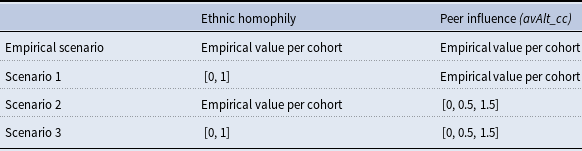
The model was estimated for each of the 11 cohorts identified as suitable for analysis. This allowed us to explore the “natural” variation in the values of coefficients to be manipulated and use these results to inform experimental manipulation values (see Figure B1 in the Appendix). The selected values for absent, moderate, and strong peer influence and ethnic homophily are shown in Table 1.
Coefficient manipulation values in each simulation scenario

Table 1 Long description
A table comparing coefficient manipulation values across different simulation scenarios. The table has four rows and two columns. The columns are labeled ‘Ethnic homophily’ and ‘Peer influence (avAlt_cc)’. The rows are labeled ‘Empirical scenario’, ‘Scenario 1’, ‘Scenario 2’, and ‘Scenario 3’. Row 1: Ethnic homophily, Empirical value per cohort; Peer influence (avAlt_cc), Empirical value per cohort. Row 2: Ethnic homophily, [0, 1]; Peer influence (avAlt_cc), Empirical value per cohort. Row 3: Ethnic homophily, Empirical value per cohort; Peer influence (avAlt_cc), [0, 0.5, 1.5]. Row 4: Ethnic homophily, [0, 1]; Peer influence (avAlt_cc), [0, 0.5, 1.5].
4.4.2 Simulation
We treated the calibrated SAOM as a generative model (Steglich & Snijders, Reference Steglich, Snijders, Gërxhani, de Graaf and Raub2022). First, we adjusted parameter values to model the hypothesized effects of external shocks. Specifically, we fixed all other parameters at their estimated values and replaced the manipulated parameter with a new value (see Table 1).Footnote 11 Several values were tested as replacements, some slightly above the empirical estimate and some substantially higher, to test different degrees of potential behavioral response to the shock. We then simulated forward from the last empirical data wave, generating distributions of 100 networks for each manipulation condition, including one condition where coefficient values remained unmodified. This approach modeled a situation where students continue interacting with peers beyond the last observed data point, following all the same processes of network and behavior updates, with the exception of the process whose value was manipulated.
We ran four simulation scenarios. In the Empirical scenario, coefficient values remained fixed at their empirically estimated values for the length of the simulation run. In Scenario 1, we adjusted the ethnic homophily coefficient in the selection part while keeping the social influence coefficient at its empirical value or at 0.Footnote 12 This scenario represented the idea that an external shock influences friend selection rules only. In Scenario 2, we adjusted peer influence (operationalized as correlational influence on attitudes towards Turks) coefficients while keeping ethnic homophily at its empirical value or at 0. This scenario represented the idea that a shock influences sensitivity to friends’ ethnic attitudes only. In Scenario 3, we simultaneously adjusted both coefficients. This scenario represented the idea that both friend selection rules and sensitivity to friends’ attitudes towards Turks change following a shock.
Table 1 summarizes the numeric manipulations applied in each scenario.Footnote 13
The length of the simulation was determined as follows: We based our calculations on the empirically derived coefficients for the network and behavior rates of change. These rate coefficients represent the average number of decisions (modifying a network tie or adjusting behavior) that agents can make in each period between two consecutive waves of data. We calculated the average rates across all the between-wave periods in the estimated models. These averages were then multiplied by five, and the resulting values were applied as fixed values of network and behavior rate coefficients in the simulation model. This multiplication effectively provided students with five times the opportunities to update their network and behavior compared to the interval between two empirical waves, reflecting the assumption that an external shock pushes students to actively reconsider their attitudes and connections.Footnote 14 All decisions made at each opportunity to update either network or behavior, which represent ministeps in the model, were recorded.
Because sensitivity to peer influence is experimentally manipulated, to understand how interethnic hostility could arise in a networked model, we looked when interpreting the results at what happened to German students’ attitudes towards Turks depending on their structural position relative to peers with negative attitudes at the start of the simulation. Students with initially negative attitudes towards Turks deviated from the “mainstream” attitudes in our samples before the external shock. Under correlational influence, these students should be especially influential after the shock. By examining how their attitudes impact their friends and friends of their friends, we tested the intuition that hostility towards Turks spreads through the network starting from the agents holding the most negative views. The structural positions we looked at were as follows:
-
• Negative & neutral: German students with initially negative or neutral (1–3 out of 5) attitudes towards Turks.
-
• First-level in-alters: German students who nominated coethnics with negative attitudes towards Turks as their friends at the start of the simulation.
-
• Second-level in-alters: German students who nominated these first-level in-alters as friends at the start of the simulation but were themselves not connected to the negatively or neutrally minded students.
-
• The rest of the network: The remaining German students, who were not directly connected to either negatively or neutrally minded students or to their immediate in-alters at the start of the simulation but could still be connected to second-level in-alters.
To explore how influential these groups of students might have been at the start of the simulation, we mapped their indegree centralities (Figure A4). We saw that overall, negatively and neutrally minded students were not the most well-connected ones, and there were some of them who received no incoming nominations. Those who nominated them were somewhat more well-connected, and the remaining German students, who had rather positive attitudes towards Turks (Figure A5), were somewhat less popular.
First-level in-alters were initially rather positive about the Turks, yet sooner or later into the simulation their outgroup attitudes would likely decline because of the influence from negatively and neutrally minded peers, and, being popular, in-alters would be likely to pull down the attitudes of those who nominated them as friends. However, as the network evolves, these students could also become less popular or themselves stop nominating negatively minded students and hence stop being influenced by them. Therefore, it is hard to predict the role of these in-alters in the outgroup attitude evolution without systematic investigation in a simulation experiment.
5. ResultsFootnote 15
5.1 Model fitting
Table B1 in the Appendix contains the estimated effects for all 11 cohorts. The model convergence ratios were < 0.25 in all cohorts, with t-ratios < 0.1, indicating good convergence. Model fit for the two cohorts under consideration here is shown in Figure B2.
5.1.1 Selection effects
In both cohorts, homophily by ethnicity and gender, as well as propinquity by classroom, were highly statistically significant, while overall Turks were less likely to be nominated as friends by non-Turks. Attitude-based selection was generally positive. In Cohort 22, attitudes towards Turks significantly influenced friend selection: Non-Turkish students who held more positive initial attitudes towards Turks preferred to befriend Turks. The popularity of higher interethnic attitudes was significant only in Cohort 23 and pertained to attitudes towards Turks: Students with more positive attitudes towards Turks were more likely to be chosen as friends.
5.1.2 Influence effects
In both cohorts, there was a significant tendency for attitudes to become more positive over time. Additionally, the significant and positive quadratic effects showed that students in both cohorts tended to move towards the extremes of the distribution of attitudes towards Turks, an effect that was independent from peer influence.
The correlational peer influence mechanism was positive and significant for attitudes towards Turks in Cohort 23, indicating that students adjusted their attitudes towards Turks to align with their friends’ attitudes (more precisely, to deviate from the average attitudes towards Turks in the same direction as their friends). It was positive but not significant for attitudes towards Turks in Cohort 22.
Finally, in both cohorts, Turkish students had a significant tendency to hold more positive attitudes towards Turks.
To sum up, both cohorts exhibited a clear tendency for students to prefer same-ethnic friends. Additionally, in Cohort 23, students were sensitive to their friends’ attitudes towards Turks. This sensitivity makes it possible for students with negative attitudes towards Turks (predominantly non-Turkish students) to spread these attitudes through peer influence, especially within same-ethnic friendships. Together with the tendency to adopt more extreme attitudes, this creates a potential for interethnic hostility emergence. Yet, empirically, the attitude distributions were not skewed to the negative extreme by the end of the data collection. On the contrary, most students tended to have fairly positive outgroup atittudes. In the simulations, we examined whether interethnic hostility can intensify over time under different conditions, even in this benign initial situation.
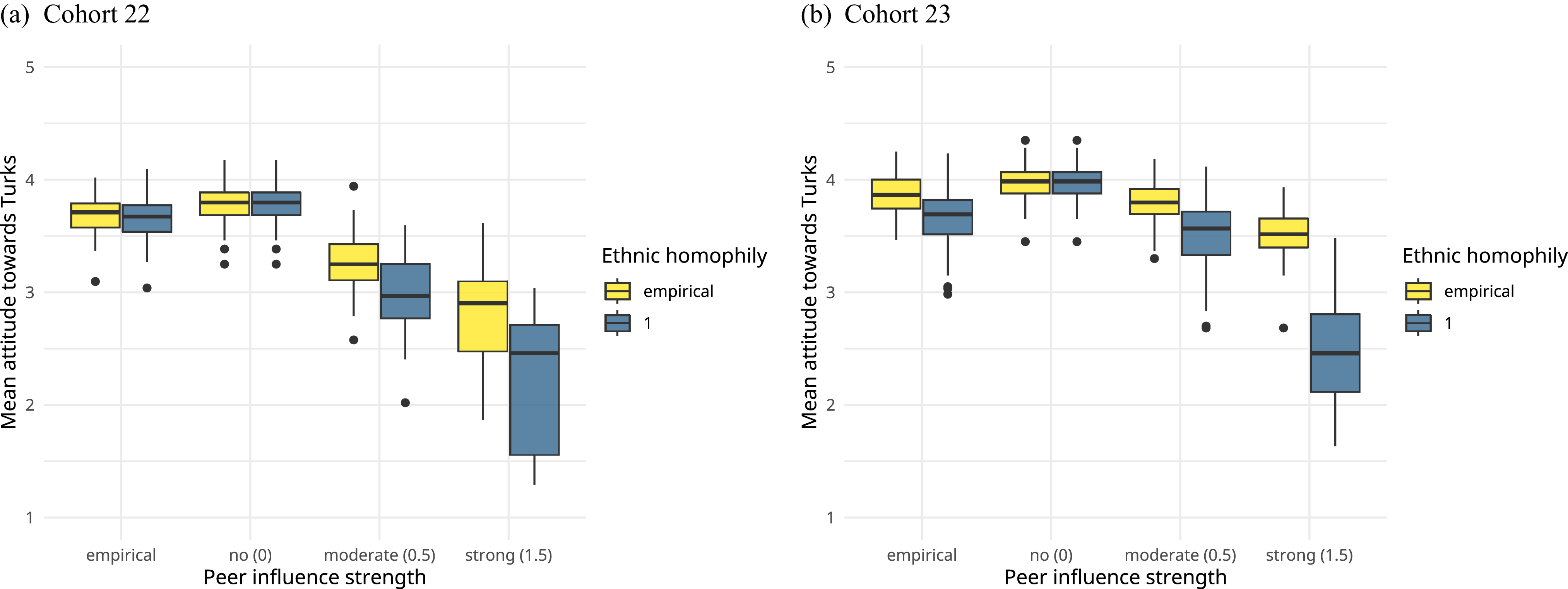
Variation of German students’ mean attitudes towards Turks across 100 simulation runs, all simulation scenarios.

5.2 Simulations
Figure 2 summarizes the results from the simulation scenarios, showing the contrast between the empirical and increased ethnic homophily values. The plots display only the German students’ attitudes towards Turks. Each data point represents a single simulation run for a given scenario, showing the mean attitudes at the end of the simulation. The boxplots illustrate the variation across all simulation runs for each scenario. The boxplots are colored according to the level of ethnic homophily used and are arranged along the X-axis based on the peer influence value.
The left-most pair of boxplots shows the results under the Empirical scenario (ethnic homophily and peer influence as estimated) and Scenario 1 (increased ethnic homophily, peer influence as estimated). No substantial decrease in attitudes towards Turks by the end of the simulation was observed. This indicates that even when there were several students with negative attitudes in the cohort and peers influenced each other as observed in our data, simply maintaining the observed pattern of interactions or starting to strongly prefer coethnic friends had no effect on interethnic attitudes within the cohort.
In Scenario 2 (yellow boxplots), we observed that increasing sensitivity to peer influence led to some decrease in mean attitudes towards Turks, especially in Cohort 22. There, the empirical coefficient for peer influence on attitudes towards Turks was small and not significant (0.14), so increasing this values to 0.5 already resulted in a noticeable decline in attitudes. In Cohort 23, the empirical coefficients for peer influence on attitudes towards Turks was relatively high (0.43), so replacing the parameter with 0.5 did not significantly reduce outgroup attitudes, and raising the parameter value to 1.5 led to a small decline in attitudes in some simulation runs.
Finally, under Scenario 3 (blue boxplots), where sensitivity to friends’ attitudes and a preference for same-ethnic peers were both increased, we observed overall the greatest decline in attitudes towards Turks among all students.
These findings suggest that heightened sensitivity to peers’ opinions on ethnic groups can negatively affect the interethnic climate, but particularly so when ethnic homophily is strong.
5.3 Explaining the rising interethnic hostility
To better understand when these effects fully emerge and to illustrate how peer influence and ethnic homophily operate in the model, we examined ministep data from the simulations. Attitude values were recorded at every 1000th simulation stepFootnote 16 and averaged across 100 simulation runs, with standard deviations calculated to show variability between runs.
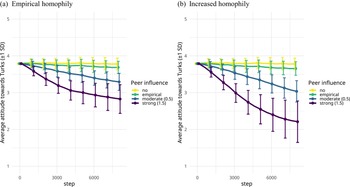
Figures 3 and 4 show the dynamics of attitudes in the scenarios with empirical and strong ethnic homophily. Each line represents the changing German students’ mean attitudes towards Turks under different values of correlational influence, with standard deviations displayed around each mean.
Dynamics of mean outgroup attitudes by peer influence strength, Cohort 22.

Figure 3 Long description
Two line graphs depict the average attitude towards Turks over time with varying levels of peer influence and homophily. Panel A: Empirical homophily. This line graph shows the average attitude towards Turks on the vertical axis and steps on the horizontal axis. The graph includes four lines representing different levels of peer influence: no influence, empirical, moderate, and strong. The lines show a general trend of decreasing average attitude towards Turks over time, with the strongest peer influence resulting in the most significant decrease. Panel B: Increased homophily. This line graph also shows the average attitude towards Turks on the vertical axis and steps on the horizontal axis. Similar to Panel A, it includes four lines representing different levels of peer influence. The trend of decreasing average attitude towards Turks over time is more pronounced in this panel, especially for the strong peer influence line, which shows a steep decline.
Dynamics of mean outgroup attitudes by peer influence strength, Cohort 23.

Figure 4 Long description
Two line graphs depict the average attitude towards Turks over steps, comparing different levels of peer influence. Panel A: Empirical homophily. The line graph shows the average attitude towards Turks on the vertical axis, ranging from 1 to 5, and the steps on the horizontal axis. The graph includes four lines representing different levels of peer influence: no influence (yellow), empirical (green), moderate (0.5, blue), and strong (1.5, purple). The yellow and green lines show a slight increase over time, while the blue line remains relatively stable. The purple line shows a significant decrease in attitude over time. Panel B: Increased homophily. The line graph shows the average attitude towards Turks on the vertical axis, ranging from 1 to 5, and the steps on the horizontal axis. The graph includes the same four lines representing different levels of peer influence. The yellow line shows a slight increase over time, while the green and blue lines remain relatively stable. The purple line shows a more pronounced decrease in attitude over time compared to Panel A.
We see that under empirical ethnic homophily (Figures 3(a), 4(a)), among Germans, a slight decline in attitudes towards Turks appeared only under strong correlational influence. Subsequently the attitudes stabilized, on average, under all peer influence values in Cohort 23, and kept declining under moderate peer influence and in some simulations under strong peer influence in Cohort 22. The stabilization of attitudes might reflect the dynamics where German students could not fully segregate from peers of other ethnicities, and continued to be influenced by peers who held positive attitudes towards Turks. Under strong ethnic homophily (Figures 3(b), 4(b)), these trends changed. Now Germans’ attitudes declined in both cohorts under strong peer influence.
We examined our considerations about the role of ethnic homophily by looking at the dynamics of incoming cross-group (Turkish–German) and ingroup ties under conditions of empirical homophily and strong homophily. If homophily was driving the decline in intergroup attitudes in Germans, it would occur because more students would interact with their coethnics, who were generally less positive about the outgroup, especially the category of negatively minded students. This should lead to an increasing number of incoming nominations for negatively minded peers from German coethnics. In other words, ethnic homophily would increase Germans’ exposure to the attitudes of ingroup members who initially held the most negative views toward the outgroup.
Figure 5 shows that, while empirical homophily did not significantly change the number or composition of incoming friendship nominations, strong homophily resulted in predominantly coethnic friendship networks.Footnote 17 Students received more nominations from coethnics, including negatively minded ones, and their friendships with outgroup members, who were generally more positive towards Turks, dissolved. We can see that negatively minded Germans in both cohorts, especially Cohort 23, were nominated as friends by fellow Germans as often as more positively minded peers, and their embeddedness in coethnic networks was preserved during the simulation.
Dynamics of average number of incoming friend nominations from coethnics and Turkish students in ego-networks by initial position relative to negatively and neutrally minded peers. Scenarios with empirical (top row) and strong (bottom row) ethnic homophily and strong peer influence.

It is important to note that both peer influence and ethnic homophily took a significant amount of simulation time to show pronounced effects. While model time does not directly correspond to real time—it can also be seen as the number of opportunities for students to reconsider their attitudes and friendships—the simulation duration represented several years in the data on which the model was based. As shown in Figures 3 and 4, if we had stopped the simulation earlier, we would not have observed such a drastic change in outgroup attitudes.
5.4 Sensitivity analyses
Replicating the analysis for the remaining nine cohorts (Appendix C), we saw that the general pattern of the results under different manipulation scenarios held across contexts, although the degree to which German students’ attitudes towards Turks decline varied, the least decline being observed in Cohorts 16 and 18. Cohort 7 deviated from the overall pattern in that already under empirical parameter values, attitudes there declined. Presumably, it happened because correlational peer influence in this cohort was estimated as marginally significant at 1.114 (Table B1), approaching the highest value we experimentally imposed (1.5).
It is plausible that a shock leads to a decrease in attitudes towards the group associated with it, without mediation through increased sensitivity to peers’, especially negatively minded peers’, opinions. In Appendix D, we show the comparison between the results of our main experiments and the experiments where attitudes of non-Turkish students towards Turks were decreased by 1 at the start of the simulation to reflect a possible direct worsening of attitudes towards the group associated with the shock (Turks). For extended discussion of the implications of this additional manipulation, the reader is referred to Appendix D. The rest of the manipulations were as described in the main text. The qualitative results reported in the main analysis were robust against this additional manipulation.
In the main analysis, we set the length of our simulations by simultaneously increasing the rates of change for both network and behavior, keeping the ratio of network-related to behavior-related decisions constant. However, one might argue that a shock could prompt individuals to reconsider their attitudes more quickly, while network rewiring might be less affected. In Appendix E, we show the outcomes of the simulation runs where the rate of attitude updates was multiplied by five while the network update rate was not affected—by that, we modeled “sped-up” attitude updates over a shorter simulation period. This analysis came to the same conclusions, highlighting the dominant role of attitude dynamics over network dynamics in bringing about interethnic hostility.
6. Discussion
Understanding how interethnic hostility develops in diverse school environments is both socially important and methodologically difficult. Two research approaches—empirical network modeling and agent-based simulation—offer insights at different levels, but streamlined integration of empirical network data into a simulation framework remains a challenge. This paper is—to the best of our knowledge—the first to use an empirically calibrated stochastic actor-oriented model (SAOM) as a simulation tool to examine potentials for intergroup attitude polarization in empirically observed multiethnic school cohorts. By basing agents’ behavior and network structures on real data, this approach enables studying the emergence of polarization in real-world contexts.
Using a model calibrated to network and attitude data from German multiethnic school cohorts, we showed how an external shock, such as a terrorist attack, can push initially positive interethnic environments toward hostility. Importantly, we explored how a shock associated with a minority ethnic group (Turks) could affect students’ attitudes towards that minority group via two fundamental processes in adolescent networks: homophily and peer influence. Our results suggest that even when such a shock would not directly worsen students’ interethnic attitudes, as suggested by some empirical studies, its indirect effects could still lead to interethnic hostility among majority students in the longer run. In our simulations, polarization mainly arose through a strong tendency to adjust one’s attitude to the opinions of friends, where those holding negative attitudes were especially influential. Ethnic homophily strengthened the effects of peer influence, leading to more extreme polarization and strongly segregated networks. This happened because with increasing homophily, more German students were exposed to coethnics who were initially prejudiced towards Turks. However, when peer influence was not that strong, even strong homophily alone did not cause polarization. This was a counter-intuitive outcome given that in theoretical ABMs, homophily often strengthens polarization of opinions between groups (e.g., Feliciani et al., Reference Feliciani, Flache and Mäs2021).
Importantly, overall the studied cohorts were resilient in our simulations: Even under strong peer influence, hostility developed only over a long simulation period, though under strong peer influence, some attitude decline was observed early in the simulation.
Conducting computational experiments with this model required several assumptions. Importantly, we had to define mechanisms to be manipulated and translate an external shock into model terms. Adjusting the strength of the peer influence mechanism involved a noticeable departure from the original parameter estimates. Peer influence on attitudes toward Turks was positive in both cohorts: significant in one but rather small and not significant in the other, thus, the data offered only partial evidence for such peer influence. As we assumed that an external shock might change students’ behavior, we imposed a larger positive coefficient on this mechanism. For ethnic homophily, this adjustment was smaller, in the sense that the estimated coefficients were already significant in both cohorts. However, one could argue that rather than intensifying correlational influence, an external shock would increase the need for agreement with one’s friends, thereby strengthening assimilative influence and leading to more consensus in attitudes. Given the initially positively skewed distributions of attitudes towards Turks, this would, in the context we considered, sustain a positive interethnic climate. A mechanism of repulsive influence, recently implemented as an RSiena effect (Tang et al., Reference Tang, Snijders and Flache2025), could also be explored, although specifying it for intergroup attitudes is not straightforward. Testing additional or competing operationalizations of peer influence unfolding after a hypothesized shock was beyond the scope of this paper but remains an important direction for future research.
To focus on the effects of the manipulated mechanisms, we made several simplifications. First, we assumed that other behavioral processes—for example, the effect of one’s intergroup attitude on cross-group friend selection—stayed constant under external shock manipulations, though these processes could also change. Second, we did not model the potential response from the ethnic group associated with the perpetrator. Empirically, there is little understanding of how minority groups react to increased hostility directed at them in the aftermath of shock events (Frey, Reference Frey2022), although there are reasons to expect that perceiving a threat directed at the ingroup can increase ingroup cohesion and self-stereotyping (see, e.g., Zerback & Karadas, Reference Zerback and Karadas2023, for the theoretical discussion and an empirical case of German Muslims reading news on Islamist terror attacks). It is also possible that, as the salience of intergroup relations temporarily rises, minority students’ attitudes towards the majority might be reconsidered in response to the (expected) majority backlash. Emerging evidence shows that collective punishment inflicted on the group by actions of its individual members can fuel less positive attitudes towards the punishing outgroup (Uysal et al., Reference Uysal, Çoksan and Kessler2026), and online hate speech directed at minorities may trigger more hostile attitudes toward the majority group (Van Houtven et al., Reference Van Houtven, Acquah, Obermaier, Saleem and Schmuck2024). Third, we treated all modeled processes as time-homogeneous, even though the effects of manipulations might fade over time. Research on prejudice dynamics after dramatic events is still in its early stages (Borell, Reference Borell2015), and more research on behavioral changes after shocks like terrorist attacks would help address our assumptions. Lastly, we assumed peer influence applies equally to all friends, but ingroup members may have stronger influence than outgroup members (Abrams et al., Reference Abrams, Wetherell, Cochrane, Hogg and Turner1990). Interaction terms could test the influence of specific reference groups.
We deviated from the data by simulating beyond the last empirical observation into the future, which requires a discussion of how time is expressed in the model. Unlike many simulation approaches, SAOM is tied to explicit time, as the models are calibrated to longitudinal data—in our case, measurement waves were nine months apart. Since the simulation used comparable intervals, it might be understood as if the students on whom the model was based would have graduated by the time the simulation ends, and even mildly pronounced hostility in the model would take months or even years to develop in real life. This contrasts sharply with empirical studies on reactions to terrorist attacks, which show that negative attitudes toward the group associated with the perpetrators often fade within weeks (e.g., Breton & Eady, Reference Breton and Eady2022). However, during model fitting, which is simulation-based, between-wave intervals are populated by simulation steps. The estimated rate parameters therefore reflect the amount of change in networks and behaviors during the estimation procedure rather than empirical time. Increased rate parameters can thus be viewed as elevated rates at which students reconsider their attitudes and connections after a shock. Alternatively, our model might be seen to better represent the impact of repeated terrorist events, though mechanisms like cognitive desensitization (Nussio, Reference Nussio2020) could complicate these dynamics, and the assumption of time-homogeneity in mechanism strength would become particularly problematic. More fine-grained data on network and attitude evolution would be better suited to studying the impact of terrorist attacks specifically.
The model’s empirical basis limits its applicability to settings similar to those studied: where ethnic groups have coexisted for some time, interethnic attitudes can be stable and positive, and polarization is low. The findings, or indeed the assumptions about peer influence, may not apply to contexts with sudden demographic changes, like an influx of refugees, or conflict-prone environments, where other psychological tendencies like dehumanization and retaliation might be affecting intergroup dynamics. Additionally, we discuss in-depth the evolution of hostility in two cohorts out of a larger dataset. While simulations with other cohorts showed overall similar patterns of outcomes, the variance in the degree of the generated hostility could result from many contextual factors. Additional counterfactual analyses—manipulating cohort size, ethnic group proportions, and initial attitude distributions—are needed to draw robust conclusions about the role of social context in the development of polarization.
Despite its limitations and the need for further research, we believe that our study contributes in a novel way to our understanding of the potentials for interethnic hostility. We demonstrated how external shocks could lead to interethnic hostility, even when they did not directly affect students’ intergroup attitudes. Our theoretical findings suggest strategies to reduce the risk of hostility caused by such shocks. Specifically, in an initially positive intergroup context, the dissolution of intergroup friendships due to increased ethnic homophily did not directly result in hostility and thus may not need priority in interventions as long as influence is primarily correlational. Instead, efforts should focus on addressing the state of uncertainty, where students with negative outgroup attitudes might receive more attention, and on limiting their influence on peers. Importantly, the analytical strategy we adopted—combining empirical data and stochastic network modeling for simulation—opens up new possibilities for exploring vulnerability and resilience of real-world social systems.
Acknowledgements
This research has greatly benefited from comments and suggestions by Anuschka Peelen, Tom Nijs, Luuk Snijder, Tibor Zingora, as well as members of the research groups Norms and Networks (NNC), Statistical Methods for the Analysis of Social Network Data (SNA), and Computational Social Science (CSS) at the Department of Sociology, University of Groningen. We gratefully acknowledge financial support by the Dutch Research Council (NWO), under the program Open Competition—SSH, grant number 406.18.5W.038. We thank the Center for Information Technology of the University of Groningen for their support and for providing access to the Hábrók high-performance computing cluster. We made use of GPT-4 to assist with editing the draft of this article for clarity and readability. GPT-4o was accessed from https://chatgpt.com/ and used without modification for correcting the grammar and rephrasing the text in February–March 2025, with further revision of the AI-refined text. We are entirely responsible for the scientific content of the paper, and the paper adheres to the Cambridge University Press authorship policy.
Supplementary material
The supplementary material for this article can be found at https://doi.org/10.1017/nws.2026.10042.
Data availability statement
The “Friendship and Identity in School” dataset is publicly available from the DeZIM Research Data Center at https://datasearch.fdz.dezim-institut.de/item/de.dezim/5bb95fb7-9483-4390-9594-59563a43eac8. The data processing and model scripts are available on OSF: https://osf.io/sg2by/overview?view_only=d6c808336d3c4f13b1662253f1490548.
Funding statement
The work on this project was supported by the Dutch Research Council (NWO) under the grant “SPIN-OUT: Predicting and preventing a spiral of mutually reinforcing negative outgroup attitudes (spin-out) in multi-ethnic classrooms” (grant no. 406.18.SW.038).
Competing interests
None.
 z¯


 Open access

