Worldwide, 7%–10% of hospitalized patients will experience a healthcare-associated infection, many of them due to multidrug-resistant organisms. 1 Control of multidrug-resistant organisms in healthcare settings is thus an important global challenge in infection control (IC), but there is wide variation in the pathogens of concern and the resources available to inhibit their spread. In resource-limited settings, local patterns of endemicity impact the choice of IC measures. 1 , Reference Cheng, Tai and Chau 2 In Thailand, while extensively drug-resistant (XDR)-Acinetobacter baumannii is the most common nosocomial infection (with >70% of isolates resistant to carbapenems), vancomycin-resistant Enterococcus (VRE) and carbapenem-resistant Enterobacteriaceae (CRE) remain relatively uncommon. As of 2014, only 5.5% of clinical isolates of Enterococcus faecium and 1.4% of those of E. faecalis were vancomycin-resistant. 3 Similarly, the national prevalence of CRE is 0.4%–1.4%. 3 Here we describe trends in the incidence of VRE, CRE, and XDR-A. baumannii infection and/or colonization at Thammasat University Hospital, a tertiary care referral hospital in Pathumthani, Thailand, and compare these with IC strategies targeted to these multidrug-resistant organisms of varying endemicities.
We conducted a retrospective evaluation of microbiologic and IC data from 2012 to 2014. All patients with clinical microbiology isolates positive for VRE, CRE, or XDR-A. baumannii were evaluated. Outpatient cases were excluded. If a patient had 2 or more isolates of the same organism within a 30-day period, only the first isolate was counted. Given the low-level endemicity of VRE and CRE in this hospital, IC measures were more stringent and included hand hygiene, contact precautions with placement in a single room, environmental cleaning, and active surveillance to detect additional cases via rectal swab cultures. For XDR-A. baumannii, with its higher-level endemicity, IC measures focused on creating ward cohorting areas, along with hand hygiene, contact precautions, environmental cleaning, real-time feedback on compliance with IC practices, and in the intensive care units, daily chlorhexidine bathing.Reference Wongcharoen, Luxamesathaporn, Khawcharoenporn, Rujanavech, Warren and Apisarnthanarak 4 , Reference Apisarnthanarak, Pinitchai, Warachan, Warren, Khawcharoenporn and Hayden 5 Incidence was calculated as cases/1,000 patient-days and the χ2 test for trend was used to evaluate trends over time. P<.05 was considered significant.
An outbreak of VRE or CRE was defined as more than 2 cases of the organism occurring in the same unit within a 30-day period from detection of the index case. XDR-A. baumannii outbreaks were defined using the historical control chart and declared on the basis of control chart threshold principles.Reference Sellick 6 We routinely monitored IC practices for hand hygiene, contact precautions, and environmental cleaning. Compliance was monitored in all units by the same IC nurse via direct observation, as previously published.Reference Apisarnthanarak, Pinitchai, Thongphubeth, Yuekyen, Warren and Fraser 7 An antibiotic stewardship program was initiated in 2003 and remains in place.Reference Apisarnthanarak, Danchaivijitr and Khawcharoenporn 8 Data on inpatient use of third-generation cephalosporins, quinolones, and carbapenems were obtained from the hospital pharmacy and used to calculate defined daily doses dispensed/1,000 patient-days.Reference Apisarnthanarak, Danchaivijitr and Khawcharoenporn 8
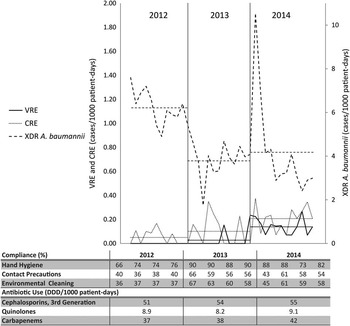
From 2012 to 2014 there were 28 cases of VRE, 57 cases of CRE, and 2,082 cases of XDR-A. baumannii. VRE incidence increased from 0 to 0.14 cases/1,000 patient-days (P=.36) (Figure 1). Similarly, CRE incidence also increased from 0.05 to 0.21 cases/1,000 patient-days (P=.29). We carefully reviewed the inpatient record of all VRE and CRE cases and found no nosocomial acquisition; all cases either had evidence of previous colonization or infection, or were transferred from other hospitals. In contrast, incidence of XDR-A. baumannii decreased from 6.22 to 4.21 cases/1,000 patient-days (P<.001). Notably, there was a peak of cases in January 2014, representing an outbreak in the medicine ward that resolved with educational interventions to improve adherence to existing IC measures (Figure 1).
Trends in drug-resistant organisms, infection control compliance, and antibiotic use. Horizontal lines represent annual rates of each pathogen per 1,000 patient-days. CRE, carbapenem-resistant Enterobacteriaceae; DDD, defined daily dose; VRE, vancomycin-resistant Enterococcus; XDR-A. baumannii, extensively drug-resistant Acinetobacter baumannii.

Compliance with all 3 IC measures (hand hygiene, contact precautions, and environmental cleaning) improved during the study period. Compliance was lowest for all measures during 2012, then increased substantially in 2013, corresponding to the institution of a hospital-wide educational program on hand hygiene and IC precautions. Compliance subsequently stabilized in 2014. The rate of third-generation cephalosporin, carbapenem, and quinolone use during this time period was unchanged (Figure 1).
The hospital’s connections with other healthcare facilities via patient sharing and referral and the regional endemicity of these organisms may have influenced surveillance and IC strategy.Reference Lee, Yilmaz and Wong 9 Although VRE and CRE rates increased during our study period, their overall incidence remained low. To control VRE and CRE at this early stage of endemicity, routine IC measures were more aggressive. In combination with increased compliance, this aggressive approach may have limited the increase in incidence of these infections. This is evidenced by the lack of documented nosocomial transmission of VRE and CRE, despite patient transfers from other healthcare facilities with higher rates, and increasing prevalence in the regional rates (mean, 4.2 cases/1,000 patient-days, unpublished data). 3 , 10
The decreasing rates of XDR-A. baumannii provide further support for the impact of compliance with IC measures. Rates of XDR-A. baumanii nationwide increased throughout the study period. 3 , 10 We documented the opposite trend in our institution, with rates going from 6.22 to 4.21 cases/1,000 patient-days over 3 years. Because of the high incidence of this pathogen, resources are not available for isolation in private rooms or active surveillance. Despite this, our basic IC measures featuring hand hygiene, contact precautions, and environmental cleaning—together with early detection of outbreaks followed by rapid interventions to improve compliance—correlate with the improving incidence rates. Importantly, we noted little change in antibiotic use over the study period, despite changes in incidence of these infections.
This was a single-center retrospective cohort study, which limits its generalizability and our ability to evaluate other factors impacting trends. However, our data suggest that control of drug-resistant pathogens is achievable and sustainable for all microorganisms, even in resource-limited settings. IC measures must be modified to fit the local infrastructure, available resources, and endemic stage. Systematic surveillance to detect early outbreaks followed by immediate implementation of strategies to improve compliance with basic IC measures is crucial to the sustainability of these practices.
ACKNOWLEDGMENTS
Financial support. National Research University Project of the Thailand Office of Higher Education (to A.A.); and the US National Institutes of Health (Washington University Division of Infectious Diseases Institutional Training Grant T32 AI007172-35, to A.L.C.).
Potential conflicts of interest. All authors report no conflicts of interest relevant to this article.