Introduction
Understanding a public conservation programme implies deducing how, why and with what effect the government follows determined lines of action or inaction (Cairney Reference Cairney2020). This understanding can be achieved through an analysis that critically reviews the actors involved, the information, the reasoning, the design and the decisions made in a particular programme (Cairney Reference Cairney2020). This analysis is important in order to understand the reasons why conservation programmes succeed or fail to achieve their objectives (Dunlop Reference Dunlop2017, Catalano et al. Reference Catalano, Lyons-White, Mills and Knight2019).
Analysing the different stages of conservation programmes, which are shaped by the key actors and the decision-making process, is key to understanding the success or failure of a programme (Jann & Wegrich Reference Jann, Wegrich, Fischer, Miller and Sidney2007). As an analytical tool, the programme cycle enables sense to be made of the events, decisions and procedures that shape programmes (Cairney Reference Cairney2020). According to several authors (Birkland Reference Birkland, Fischer, Miller and Sidney2007, Cairney Reference Cairney2020), the programme cycle comprises different stages: (1) the identification of a problem that a government should solve; (2) setting the agenda, which is the process when problems and alternative solutions gain or lose public attention; (3) programme formulation and design; (4) the implementation process, which involves following a line of action and making operational decisions for modifying or correcting the problem; and (5) programme evaluation, including measuring results, impacts and effectiveness to decide whether or not it is advisable to continue implementing the programme or whether aspects of it should be modified.
As there are a number of actors who participate throughout the whole cycle, different perspectives exist around the problem and its solutions. A variety of actors results in different framings of the same problem and different approaches to solving it (Boedhihartono et al. Reference Boedhihartono, Bongers, Boot, van Dijk, Jeans and van Kuijk2018). The most common process for conducting programmes is based on a linear flow and a hierarchy of decisions, and if the information flow is contradictory, confusing or limited, programmes can drift and fail (Howlett et al. Reference Howlett, Ramesh and Wu2015).
For several decades, there has been a broad discussion about the importance of including agrobiodiversity loss within the worldwide concern for biodiversity loss (Altieri Reference Altieri2018, Pacicco et al. Reference Pacicco, Bodesmo, Torricelli and Negri2018). This aspect is of particular importance in Mexico, since the country is the centre of the origin and domestication of maize, and there are 59–64 local varieties in the country (Kato et al. Reference Kato, Mapes, Mera, Serratos and Bye2009). Maize has adapted to specific agroclimatic conditions that farmers have maintained over time to meet their food needs. Small-scale farmers are the managers and trustees of the largest genetic diversity of maize in the country (Bellón et al. Reference Bellón, Dulloo, Sardos, Thormann and Burdon2017).
As part of this change in strategy to incorporate agrobiodiversity conservation into biodiversity conservation in Mexico, between 2009 and 2018, the Programa de Conservación de Maíz Criollo (Programme for the Conservation of Native Maize in Mexico; PROMAC) was rolled out in 52 natural protected areas (NPAs) and 22 priority regions for conservation (PRCs), which are biodiversity hotspots with unique ecosystems and high numbers of endemic species, and they are considered to have great potential for successful conservation efforts. What is interesting about this case is how the Mexican government moved from the traditional strategy of priority species conservation to considering native maize as a priority species and incorporating it into this strategy.
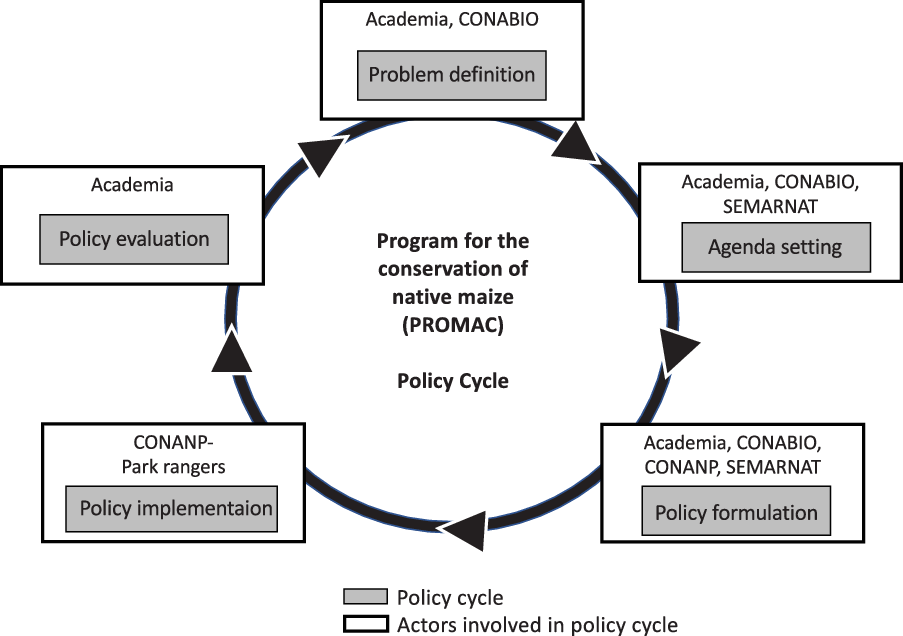
In terms of the length and the extent of the area it covers, PROMAC is the most ambitious programme to date for conserving native maize in Mexico. Its objective has been to promote the recovery of native maize varieties and their wild relatives in their natural environment. PROMAC consisted of four actions: (1) direct subsidies for planting native maize varieties in communities located in the influence zone of NPAs or PRCs; (2) community-strengthening activities, such as community or regional fairs to exchange experiences and training courses; (3) community trade-fairs for the exchange of native maize seed; and (4) the development of productive projects around native maize, such as the certification of organic production or the creation of maize packaging enterprises (CONANP 2016). All of these actions were mainly carried out by the park rangers of the different NPAs where the programme was implemented. The PROMAC programme cycle involved five phases, each with a different set of actors (Fig. 1). In spite of its ambition and the involvement of a significant number of experts, PROMAC’s results were not as expected (Foyer Reference Foyer2012, Perales Reference Perales, Maxted, Dulloo and Ford-Lloyd2016, Garibay Velasco Reference Garibay Velasco2017).
PROMAC’s policy cycle phases and actors involved.

The purpose of this paper is to reveal the perspectives surrounding the programme. In particular, our aim was to understand how and why the perspectives differ. For this research, we interviewed the actors who defined the problem and participated in the formulation of the programme, the actors who implemented the programme and the farmers or campesinos, who were the target population. For the latter, we focused on farmers located either within or in the zone of influence of a NPA in north-eastern Mexico.
Methods
Study site
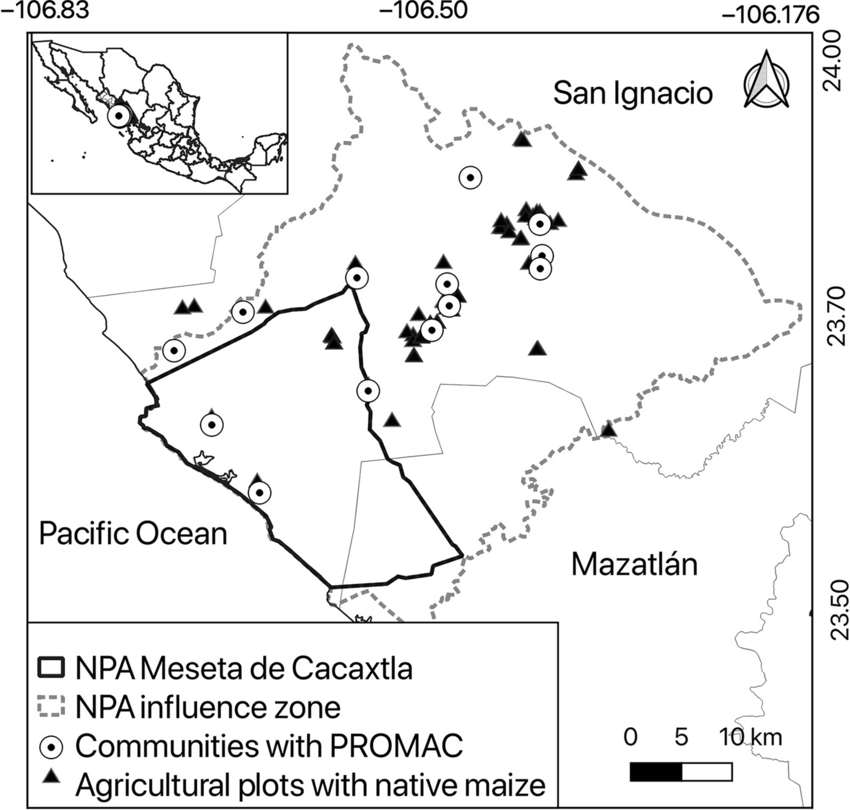
The NPA of Meseta de Cacaxtla, located in the south of the Mexican state of Sinaloa (Fig. 2), has an area of over 50 000 ha. A large area of well-conserved low-altitude deciduous forest that connects with coastal wetlands in the lower zone of the NPA constitutes its main biological richness. Several rural communities live in and around the NPA, and agriculture is one of their main economic activities (CONANP 2017). There is irrigated land used for hybrid maize cultivation and rain-fed land used for native maize cultivation.
The natural protected area (NPA) of Meseta de Cacaxtla and its zone of influence.

Sinaloa has one of the highest agricultural production levels in Mexico. The use of native varieties in Sinaloa has decreased over the last 15 years, and there has been a concomitant growth in hybrid varieties. The number of native varieties of maize reported by the state of Sinaloa fluctuates between 9 and 12 (Lazos & Chauvet Reference Lazos and Chauvet2012).
Methodology
In order to determine the different actors’ perspectives, we used the Q method and semi-structured interviews (see Supplementary Material S1, available online). The Q method is a mixed qualitative and quantitative research technique that analyses an actor’s subjective understanding of a particular topic. For this analysis, an empirical comparison is created regarding a set of beliefs about a chosen topic (Watts & Stenner Reference Watts and Stenner2012). Discourse analysis is then used to find patterns and underlying meanings in order to compare, in a consistent way, actors’ responses to a set of statements. For Van Excel and De Graaf (Reference Van Exel and de Graaf2005), the Q methodology is another tool of discourse analysis that seeks to systematically relate texts and ideas. Inverse factor analysis is then used to conduct quantitative comparisons of responses (Van Exel & de Graaf Reference Van Exel and de Graaf2005).
The concourse study, or the sum of all things people say or think about the research question (Simons Reference Simons2013), was defined as ‘native maize conservation through PROMAC in Mexican NPAs’. The statements regarding this concourse were extracted from 12 documents and were selected because of how representative they were of the different points of views of the key actors in the PROMAC: those who conceptualized and formulated the programme, those who implemented it and the target population. In addition to the 12 documents, we included opinions from a focus group discussion conducted with officials from the National Commission for the Knowledge and Use of Biodiversity (CONABIO).
A total of 25 statements were extracted from these sources, which we considered adequate for executing the Q-sort, which is the ranking of the statements, and which reflected a good balance of the opinions of the three categories of actors described above. We had a total of 27 participants (27 Q-sort): 12 had participated in the conceptualization and formulation of the programme and 15 had participated in the implementation process.
Participants in the Q method exercise were asked to sort the statements in a quasi-normal pyramidal distribution chart, according to how much each statement reflected their point of view (Watts & Stenner Reference Watts and Stenner2012). Values ranged from –4 (least like their point of view) to +4 (most closely reflecting their point of view). Additionally, for supporting information, we carried out post-sorting interviews with participants in which we asked about their interpretation of the statements distributed in high or low rankings (Watts & Stenner Reference Watts and Stenner2012).
Analysis was carried out with Ken-Q Analysis software (https://shawnbanasick.github.io/ken-q-analysis-beta/index.html#section1). The statistical factor analysis generated a correlation matrix comparing each of the 27 Q-sorts. To identify which participant Q-sorts were clustered together, a principal component analysis was carried out on the correlation matrix. The factor analysis was a centroid type with an orthogonal varimax-type rotation (Brown Reference Brown1980). The orthogonal varimax-type rotation was executed only in factors with eigenvalues ≥1, in agreement with the Guttman criterion (Yeomans & Golder Reference Yeomans and Golder1982).
Five factors or perspectives had eigenvalues >1: factors 1 (9.4), 2 (3.2), 4 (1.8), 5 (1.4) and 6 (1.2). These factors together explained 64% of the variance within the data. Only factors 1 and 2 proved significantly different enough to explain the variation of the data, with a correlation of 0.39. The other three factors were therefore discarded from the construction of the idealized Q-sorts. Statement correlations with a significance of p < 0.01 were used for the construction of the idealized Q-sorts of each factor or perspective, in accordance with the criterion described by Brown (Reference Brown1980).
We also carried out the exercise with several farmers; however, because we found that they had difficulty understanding the statements and following the instructions, we decided to use semi-structured interviews in which we introduced the same topics represented in the statements. In total, we carried out 39 semi-structured interviews with farmers in the NPA of Meseta de Cacaxtla. Interviews were analysed using ATLAS.ti, a software program used for qualitative data analysis. The analysis consisted of searching for common patterns of ideas.
Results
Our analyses with Q method enabled us to discern two types of perspectives (A and B) on native maize conservation in the context of PROMAC. Through the analysis of the semi-structured interviews, we disentangled farmers’ views about their lives, experiences or situations with native maize, as expressed in their own words. We first present the quantitative results of Perspectives A and B, and then we present the narratives around Perspectives A and B and the farmers’ views.
Quantitative analysis
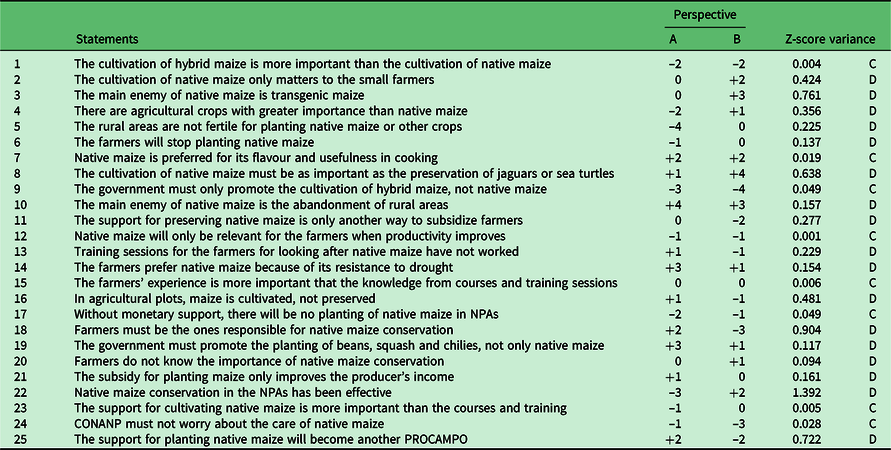
The ideal Q-sorts for the perspectives obtained with the Q method showed that statements S2–S6, S8, S10, S11, S13, S14, S16, S18–S22 and S25 were significantly different (Table 1), so we have called them ‘statements of dissent’. Some of these statements, but not all, were used for generating the narrative regarding the perspectives. The ‘statements of consensus’ are S1, S7, S9, S12, S15, S17, S23 and S24. These statements show the similarities in both Q-sorts for each identified perspective.
The perspectives or discourse associated with the statements and their Z-scores. Ideal Q-sorts are shown for Perspectives A and B, according to a value of –4 (strong disagreement) up to +4 (strong agreement). The variance value of each Z-score indicates the difference between each statement for comparing perspectives. High variance values signify dissent with a statistical significance of p < 0.05. Low variance values show similarity with a statistical significance of p > 0.05. The letters C and D identify a statement of consensus and dissent, respectively.

NPA = natural protected area.
Regarding the statistical values of each perspective, Perspective A was significantly associated with ten participants, of whom eight were in the group of respondents who conceptualized and formulated the programme and two were from the implementation group. This perspective had a factor associated with an eigenvalue of 3.2 and explained 12% of the variance. Perspective B showed a significant association with 13 participants, of whom ten were from the group that implemented the programme and three were from the group that formulated it. The associated factor had an eigenvalue of 9.4 and explained 35% of the variance. Four participants were not significantly associated with any perspective.
Qualitative analysis
Perspective A: native maize will be conserved only through the support of the community processes
This perspective comprised three key elements: (1) the issue of native maize conservation is entwined with the processes of the abandonment of rural areas (S10); (2) native maize conservation is the joint responsibility of farmers and government (S18 and S19); and (3) PROMAC did not fulfil its objectives (S1, S22 and S25).
The abandonment of rural areas was seen as being the greatest threat to native maize. As one participant said, ‘The main reason for the disappearance of native maize is that each time there are fewer farmers that plant it; the work force is depleted because young people look for other alternatives for their livelihoods and often choose to migrate’. In this perspective, migration recurred repeatedly. ‘For 30 years, the rural areas have been abandoned because of the effect of migration’.
PROMAC was conceptualized between 2007 and 2008. Various participants attached to Perspective A were involved in the programme’s formulation. According to one participant, in those years ‘meetings were undertaken between SAGARPA [the Secretariat of Agriculture, Livestock, Rural Development and Fishing], SEMARNAT [the Secretariat of the Environment and Natural Resources] and various experts on native maize to jointly address the topic of native maize conservation’. The motivation was ‘to address the recommendation by the [Mexican] Senate for safeguarding native maize in the face of the introgression of genetically modified maize in Mexico’. SEMARNAT unilaterally led the creation of the strategy, with help from experts. ‘In workshops with academics and the CONABIO, it was suggested that a conservation strategy be established that would not give out subsidies like PROCAMPO [Programme of Direct Support to the Countryside – a SAGARPA initiative that allocates economic resources to Mexican agricultural producers to compensate for the subsidies that their foreign agricultural competitors received before the opening up of trade under the North American Free Trade Agreement (NAFTA)], since international and national experiences have shown that subsidies are not a good option. A better option is to offer comprehensive assistance to rural communities, addressing the fundamental problem of migration’. However, SEMARNAT decided that the best strategy was to implement the programme through direct subsidies to farmers – a strategy that the experts disagreed with: ‘There was a period of estrangement between academia and the government regarding the subject; in the end, and in spite of the reluctance of the academics, they decided that it was better to have something [PROMAC] than to have nothing’. Once it was decided that the subsidy would be one of the main elements of the programme, ‘PROMAC managed to put in place other strategies, such as courses, workshops, and trade-fairs’. In 2009, ‘PROMAC was implemented as a conservation programme operated by CONANP [the National Commission of Natural Protected Areas], and subsidies were provided to farmers so that they would not stop planting native maize’. According to this perspective, therefore, PROMAC did not focus on the issues that could solve the problem of native maize conservation in Mexico.
The second key element concerned who was responsible for native maize conservation. According to Perspective A, farmers and the government should be the main actors concerned with its conservation. In addition to native maize, this perspective argues that the government should also encourage the use of other species connected to the production of native maize. The argument clearly supported agrobiodiversity in its broadest sense and did not see native maize conservation exclusively as a priority species. For example, one participant said, ‘Farmers are the main people in charge of preserving the diversity of maize because they are the ones that perform agricultural activities in their communities and they have the knowledge. Nevertheless, the government and society must not stay disconnected from this effort, [and should] set up spaces or markets that value maize in a fair way’. Regarding other species, such as beans, chilies or edible weeds (quelites), another participant commented that ‘hundreds of other elements exist that would help the conservation of native maize in an integral way in a community. The theme should not only be maize. It is certain that maize is central in the milpa, but around this there is great agrobiodiversity’. However, as another participant mentioned that ‘currently, there is no clarity regarding the policy for addressing the problem of native maize conservation in the NPAs, nor outside them. It is unknown if we must conserve maize to preserve nature and the species, or if we must preserve people to preserve nature’.
The third key element is related to the effectiveness of PROMAC. In Perspective A, there was strong disagreement regarding PROMAC’s effectiveness. According to one of the participants, the programme’s failure to achieve its objectives lay in how it was conceived and implemented: ‘During the beginning of PROMAC, I suggested that the programme should be modified to address the original causes for the native maize disappearance, and to address migration through giving comprehensive assistance to the communities regarding their milpas and agrobiodiversity, and in this way to protect native maize’. As PROMAC was implemented without addressing these recommendations made by the experts, some of the actors who participated in the conceptualization process of the programme perceived that the threats to native maize would be ongoing. For example, one participant spoke about how PROMAC had had only a minuscule impact ‘both on the surface [area] planted with native maize and on the farmers assisted. Representativeness was too low to see an effect on the number of native maize varieties that PROMAC claimed to preserve’. In this sense, ‘PROMAC should not have fallen to CONANP for its execution. CONANP had no knowledge of native maize and was not the appropriate institution to handle this issue’. Combined with this, other participants also mentioned problems of corruption in the delivery of monetary subsidies, as well as problems arising from continuing to implement the programme without having information about the results that the programme was having.
Perspective B: the government as being responsible for native maize conservation
There were four key elements to this perspective: (1) native maize conservation is linked to the depopulation of rural areas and to the presence of transgenic maize (S3 and S10); (2) the idea that the government, rather than farmers, is responsible for native maize conservation (S18); (3) that native maize should be another conservation element inside NPAs (S8); and (4) PROMAC as a strategy for preserving native maize was successful (S22).
This perspective saw the depopulation of rural areas and the presence of transgenic maize as key to the problem of native maize conservation: ‘Among farmers, a negative perception of rurality exists that [makes them feel] they have to leave and automatically people look for alternatives [other economic activities]’. Unlike Perspective A, the introduction of transgenic maize was seen as more problematic than migration. Statements such as the following were common: ‘PROMAC emerged from a need to protect native maize from possible contamination from transgenic maize’. ‘A [social] movement was initiated by the academic sector, supported in part by the public sector, for protecting native maize’. The risks were seen as being at the genetic level and also at the cultural level: ‘Native maize is the main food of Mexicans, it is an important genetic resource that we should protect from the contamination of transgenic maize’.
However, although farmers were seen as most impacted by the threat to native maize, Perspective B did not consider them to be relevant actors in its conservation. ‘The idea of the conservation of native maize is complicated to explain to them [farmers]. Although some [farmers] already have understood the importance of native maize, it is not easy to make myself understood’. Another participant took this thought further: ‘[T]here is a question that we must ask ourselves: what does conservation mean? For the farmers, conservation means keeping their seeds for the next year, but for us in charge of NPAs, it means protecting species, such as the sea turtle and the jaguar, and this is not easy to explain’. This reflection was shared by other participants holding this perspective: ‘We must be consistent with species extinction, if the native maize is in danger like the jaguar, CONANP must be the authority for protecting this species [native maize] that is also part of biodiversity’.
However, CONANP’s participation in PROMAC, along with its role as the institution responsible for the conservation of native maize, was more complex. According to one participant, ‘At the beginning of the implementation of PROMAC, the programme was received in different ways. Some NPA directors saw it as another way to deliver monetary subsidies to the communities of the NPAs. Others showed their rejection through the fear of having agricultural activities within NPAs, and others saw PROMAC as a form of collaboration with the local communities’.
Perspective B believed the programme to be successful: ‘PROMAC was effective, mainly in the recognition of native maize by the communities’. ‘Farmers again felt in love with their native maize. It reminded them of their fathers and grandfathers and the need to reconnect with the maize varieties they used before’. ‘PROMAC was successful in establishing a space of understanding between farmers and us [park rangers]. We learnt about the form of agriculture that they practice’. Other participants mentioned that the main success was the trade-fairs for seed exchange, in which ‘the farmers were reunited with other farmers and achieved recognition for their work in front of other farmers’. ‘The trade-fairs changed the view of the farmers to [them] putting greater value on their varieties of maize’.
Farmers’ views on native maize
In general, from the interviews with farmers, we highlight four key elements: (1) the use of native maize has to do with meeting dietary needs; (2) the motivation for participating in PROMAC was essentially due to the financial support it offered; (3) farmers did not modify their agricultural practices due to PROMAC; and (4) the recognition that, with or without a programme, farmers will continue to use native maize.
The majority of the interviewees expressed need as the principal motivation for planting native maize: ‘We are used to planting this maize, it is what we do to survive’. ‘For farmers this is our business, it is what we have to do, we cannot do something else’. ‘[If] we are on the ranch and not planting maize, then we won’t be anything’. In most cases, the responses showed some kind of resignation in practising this activity. Only a couple of interviewees expressed pride in being native maize farmers: ‘I am a rural farmer, I have a green thumb for planting maize, always have, for this, I continue planting it’. ‘I happily plant my maize in order for the harvest to be good’. Respondents also spoke about their reasons for using native maize: ‘Maize allows me to sustain myself well, it covers my family expenses’. ‘Purchased maize is very expensive, better I plant it for me and for my livestock [rather than buying it]’.
According to farmers, they participated in PROMAC because of the subsidies they received. Respondents said that the money helped them with their expenses, such as buying fertilizers, pesticides and pumps and renting agricultural machinery: ‘PROMAC helped us with money for everything, not only the maize’. ‘The help gives you a little shortcut [aid] in buying other things’. Only two farmers expressed interest in the other interventions that PROMAC offered, such as training courses or trade-fairs for exchanging seeds: ‘I liked it because they gave us talks about maize’. ‘I like the programme because I went to the seed trade-fairs’.
However, according to our interviewees, PROMAC did not make them modify their agricultural practices: ‘Everything is the same, it has given me the same results as I have done until now. Why change it? There is no reason’. ‘We cannot invent new things, I follow the same. More with these droughts, my seeds are adapted to this season [i.e., they are drought resistant seeds]’. ‘Planting as they told us to do means more work, and I don’t have time to do that, I have to take care of my cows, too’. Only some farmers made some changes during their participation in PROMAC, but even they had since reverted to their old methods. ‘We always follow custom, only in the time of the PROMAC we did buy organic fertilizers, and that helped us save. We haven’t done that since’. ‘I planted maize for 4 years as they asked me. Afterward, they stopped visiting us, and we continue planting the same because it is the custom to do it like this’. ‘When I planted with PROMAC there was a rule that had to be followed, what the programme demanded. After I stopped being supported, I used what I did before’.
The farmers said that, with or without the programme, they would continue to plant native maize due to its inherent benefits: ‘While I can, I am going to continue planting, for me, for my family to eat’. ‘Until I die, I have animals and a family to maintain’. ‘I am used to planting with this type of rain, with this dryness, and these [native] seeds work well here. Another type of seed would not root here’. ‘This maize is recognized as the best maize, because it is brief [grows quickly], it tolerates the dryness’.
Discussion
The two perspectives and the farmers’ views we have described allow us to understand in a conceptual way the worldviews and mind-sets that the different actors had about native maize in NPAs. We now discuss the results in relation to two aspects that we found most relevant: actors’ different interpretations of native maize conservation during the programme cycle and native maize as an element of conservation in NPAs.
Actors’ common ground in the programme cycle
The creation of public programmes involves input from the actors who participate in the formulation, implementation and evaluation processes. Although there may be a clear definition of the problem to be addressed and a specific line of action for how to implement the interventions, each actor approaches those interventions with his or her own interests and convictions shaping their perceptions and behaviour (Dunlop Reference Dunlop2017).
Our research found that although on the surface it seemed that actors had different framings of the problem, in reality they all shared the belief that the fundamental problem was not with native maize per se, but that rural communities in Mexico were not being supported as they should be and, for that reason, it was very difficult to carry out agricultural activities as a small farmer. For those who formulated and implemented PROMAC, the larger problem was that rural residents were abandoning their land and their way of life. For farmers, however, the problem was that agriculture was a very difficult activity to carry out. Because of this, some farmers had migrated, but others continued to develop their activities despite the difficulties they faced. This is not a novel finding. According to other studies (Nadal Reference Nadal2000, Sweeney et al. Reference Sweeney, Steigerwald, Davenport and Eakin2013), neoliberalism in Mexico has resulted in a reduction of support for agricultural activities, including native maize. Many consequences derived from this process have been documented, particularly in relation to the negative impact that NAFTA has had on small subsistence farmers in Mexico (Barnes Reference Barnes2009).
There are common arguments among certain actors regarding the process of broadening the national conservation agenda to include native maize. For example, for the programme implementers – mainly park rangers of NPAs – the presence of transgenic maize was the trigger for the PROMAC conservation strategy. The controversial appearance of transgenes in native maize in 2000 (Quist & Chapela Reference Quist and Chapela2001) provoked a series of social and academic initiatives regarding native maize conservation. Indeed, the Sin Maíz No Hay País (Without Maize There Is No Country) campaign emerged as a result of the evidence of gene contamination. For Foyer and Ellison (Reference Foyer and Ellison2018), this perspective is the product of native maize being positioned as a symbol of national identity. However, for the programme formulators, the problem is deeper and has to do with rural communities as a whole, with their productive activities and also with their community organization and institutions. Native maize is a pivotal element of the agricultural system; however, it needs to be understood in conjunction with the rest of the agrobiodiversity. Together, native maize and other agriculture species, as well as the processes that sustain the management of traditional agricultural practices, shape the elements that must be strengthened for undertaking the conservation of native maize. This argument highlights the importance of focusing on both the species and the management processes (Bellón et al. Reference Bellón, Dulloo, Sardos, Thormann and Burdon2017). This view contrasts with approaches that focus on the production, genetic modification and use of modified seeds, which SAGARPA has used for decades in Mexico.
Native maize as a priority species in natural protected areas
For many decades, NPAs were decreed and managed for the conservation of ecological processes, priority species and emblematic landscapes. In Mexico, conservation strategies focusing on priority species were common. Up to a point, the implementation of PROMAC in 2009 modified the ways in which many NPAs functioned. The main change had to do with the fact that native maize became conceptualized as a priority species. Therefore, as the management of maize is carried out by farmers, those in charge of managing NPAs were forced to work with the farmers, who, for many years, had been seen as the main cause of land-use change in these areas.
According to some of the park rangers who implemented PROMAC, native maize is a vulnerable species within the biodiversity that is found in the NPAs; therefore, there are arguments in favour of its conservation. The inclusion of native maize as a priority species in NPAs maintains CONANP’s conservationist approach. However, the focus of attention widened from wild species to include agricultural species, and this created a conflict with the NPAs’ administrators, who were not clear on PROMAC’s objective, nor on how to express it to the farmers. Another positive impact was that while the relationship between farmers and the NPAs’ administrators had, for decades, been tense or non-existent, according to some of the NPAs’ administrators, PROMAC fostered a space for dialogue and understanding that, to an extent, allowed farming communities and administrators to exchange their views of conservation regarding native maize.
For this reason, it is important to highlight the differences of perspective that our research highlighted, and which have been discussed in the literature (Toledo & Barrera-Bassols Reference Toledo and Barrera-Bassols2017). For farmers, the mainstream approach to conservation is not part of their understanding of what farming entails. For them, the action of conservation is achieved through their agricultural practices: conservation is a result and not an objective. This type of management, based on local knowledge, allows farmers to meet their personal needs, in addition to perpetuating and preserving species, such as native maize. For conservationists, it is the ecological processes and biodiversity that most need to be preserved. This debate is not new. Louette et al. (Reference Louette, Charrier and Berthaud1997) long ago argued that it was necessary to have a clear definition of conservation objectives in terms that are meaningful for farmers, but also for scientists, policymakers and those who inform policymakers.
We believe that there were also positive changes among the actors. As Hirsch et al. (Reference Hirsch, Adams, Brosius, Zia, Bariola and Dammert2011) noted, in order to establish a dialogue regarding conservation, it is important to recognize that the consequences arising from the actions of conservation are perceived, understood and experienced from different perspectives. Putting the key actors’ different perspectives on the table makes it clear that there is more than one interpretation of what constitutes successful conservation. This is of utmost importance to remember when conservation is the result of a management process carried out by actors who, for many decades, have not been seen as allies of conservation.
Conclusions
The conservation of native maize is clearly a cultural, social, economic and environmental challenge for Mexico. Its importance – culturally, politically and economically – is an irrefutable fact; nevertheless, the approaches and reasons for protecting it differ between different actors and stakeholders. In the case of PROMAC, this situation contributed to a contradictory flow of information throughout the programme’s implementation, which likely contributed to it not fulfilling its objectives. Although the original conceptualization of the programme generated some consensus among key actors, the problem was that its design ignored what the experts determined to be the main threats to native maize. Furthermore, designing the programme as a series of financial subsidies led to a significant rift between the conceptualizers and the implementers. For farmers, native maize is part of their culture; thus, with or without a public programme, they will continue to grow it, as it is best adapted to local environmental conditions.
Supplementary material
To view supplementary material for this article, please visit https://doi.org/10.1017/S0376892920000417
Acknowledgements
The first author extends acknowledgement to the PhD Programme in Sustainability Sciences, UNAM ‘Doctorado en Ciencias de la Sostenibilidad, Universidad Nacional Autónoma de México’, and a PhD scholarship received from CONACYT, Mexico. We thank Daniel Cohen and David González for their advice on the methodological design of the research. We thank Francisco Mora for his support in statistical analysis and for having read a previous version of the article. We also thank Sofía Monroy, Perla Sinco and Javier Rendón for their support in the fieldwork. We are very grateful to the anonymous reviewers who made suggestions and very relevant observations that improved our manuscript. Mary-Ann Hall translated the manuscript into English and Sarah Bologna carried out the final English editing of the manuscript.
Financial support
This research was funded by UNAM-PAPIIT IN302517.
Conflict of interest
None.
Ethical standards
None.