Introduction
Tropical mountains are of great importance to biodiversity and natural resource conservation (Pratt & Preston, Reference Pratt and Preston1998; Price, Reference Price1998). They have great biological diversity, especially of plant species, with high levels of endemism (UNEP–CBD–AHTEG-MB, 2003; Martinelli, Reference Martinelli2007). They also present different types of environments and phytophysiognomies, from open vegetation to various forest formations (Chaverri-Polini, Reference Chaverri-Polini1998). One of the characteristic formations of tropical mountains, the tropical montane cloud forest (TMCF), is found usually between 1000 m and 2500 m above sea level and is characterised principally by frequent immersion in ground-level clouds (Hamilton et al., Reference Hamilton, Juvik, Scatena, Hamilton, Juvik and Scatena1995a; Fahey et al., Reference Fahey, Sherma and Tanner2016). Cloud immersion can affect forest structures in different ways. Common features of these forests include low canopy height, high stem density and high density of epiphytes, but these features vary between different regions, and more studies are needed to characterise global relationships (Fahey et al., Reference Fahey, Sherma and Tanner2016).
Tropical montane cloud forests are found in more or less isolated areas in the landscape (Vázquez-Gárcia, Reference Vázquez-Gárcia, Hamilton, Juvik and Scatena1995) and tend to have a different structure and floristic composition compared with lowland forests (Bertoncello et al., Reference Bertoncello, Yamamoto, Meireles and Shepherd2011). The transition between montane rain forests and TMCFs is not always evident and abrupt, but as elevation increases, three types of TMCF can be recognised: 1) above montane rain forests, trees become gradually smaller, bryophyte cover on stems increases and lower montane cloud forests are observed; 2) upper montane cloud forests (UMCFs) are found above lower montane cloud forests and are characteristically of shorter stature (2–20 m) and have high bryophyte density and diversity; and 3) at even higher elevations, where average maximum temperatures fall below 10°C, a subalpine cloud forest can be found, with smaller trees (1.5–9 m) and fewer tree species (Scatena et al., Reference Scatena, Bruijnzeel, Bubb, Das, Bruijnzeel, Scatena and Hamilton2010).
Tropical montane cloud forests are distributed in the tropical regions of the world, conditioned by complex interactions between climatic conditions, topography and atmospheric circulation (Scatena et al., Reference Scatena, Bruijnzeel, Bubb, Das, Bruijnzeel, Scatena and Hamilton2010). In Brazil, they are associated with large mountain ranges, such as the Aparados da Serra, Serra do Mar and Serra da Mantiqueira, and also occur in high-altitude areas on Guiana's plateau (Aldrich et al., Reference Aldrich, Billington, Edwards and Laidlaw1997; Bruijnzeel et al., Reference Bruijnzeel, Scatena and Hamilton2010; Pompeu, Reference Pompeu2015). In the Atlantic Forest Domain, low temperatures, ground-level clouds and strong winds function as limiting factors for forest vegetation, and TMCFs tend to have a unique flora distinct from the flora of other forest areas of the domain (Scarano, Reference Scarano2009; Bruijnzeel et al., Reference Bruijnzeel, Scatena and Hamilton2010; Bertoncello et al., Reference Bertoncello, Yamamoto, Meireles and Shepherd2011; Williams-Linera et al., Reference Williams-Linera, Toledo-Garibaldi and Hernández2013; Neves et al., Reference Neves, Dexter, Pennington, Valente, Bueno, Eisenlorh, Fontes, Miranda, Moreira, Rezende, Saiter and Oliveira-Filho2017). Owing to their position on usually difficult terrains in mountainous areas, TMCFs have until recently remained well conserved in comparison with other tropical forests. The situation has changed over the past few decades as a result of expansion of human activity in these areas. In the early 1990s, TMCFs were already among the most threatened terrestrial ecosystems (Scatena et al., Reference Scatena, Bruijnzeel, Bubb, Das, Bruijnzeel, Scatena and Hamilton2010). Conversion to agriculture and grazing lands, overharvesting, invasions by non-native species and construction of roads are the most prevalent threats to TMCFs worldwide (Scatena et al., Reference Scatena, Bruijnzeel, Bubb, Das, Bruijnzeel, Scatena and Hamilton2010). Recent studies have shown that TMCFs could be severely affected by climate change (Martin & Bellingham, Reference Martin and Bellingham2016). Changes in cloud formation, precipitation and temperature can be especially dangerous for TMCFs, but changes in other aspects, such as increasing dry seasons, droughts and intensity of rainstorms, can also severely damage these forests (Foster, Reference Foster2001). However, climate change may affect TMCFs differently worldwide, making it necessary to investigate more sites of this phytophysiognomy (Martin & Bellingham, Reference Martin and Bellingham2016).
To better understand the future consequences of climate change and other threats, it is important to know the current patterns of structure and floristic composition of these forests. Information about TMCFs has increased over the past few decades (see, for example, the revisions in Hamilton et al., Reference Hamilton, Juvik and Scatena1995b, and Bruijnzeel et al., Reference Bruijnzeel, Scatena and Hamilton2010). However, the structure, composition and floristic affinities of TMCFs are still poorly understood, and more investigations on this phytophysiognomy are greatly needed (Bertoncello et al., Reference Bertoncello, Yamamoto, Meireles and Shepherd2011).
Tropical montane cloud forests are usually very heterogeneous, even in small areas. They can show differences in richness, composition and structural parameters (Pereira et al., Reference Pereira, Oliveira-Filho, Botelho, Carvalho, Fontes, Schiavini and Silva2006; Meireles et al., Reference Meireles, Shepherd and Kinoshita2008; Meireles & Shepherd, Reference Meireles and Shepherd2015). In this study, we aimed to analyse the composition, structure and biodiversity of trees in TMCFs in Serra do Papagaio State Park, Minas Gerais State, Southeast Brazil. We also tested the hypothesis that TMCF areas can be highly heterogeneous, by comparing tree species composition and structural parameters of 10 TMCF patches in the studied landscape.
Material and Methods
Study area
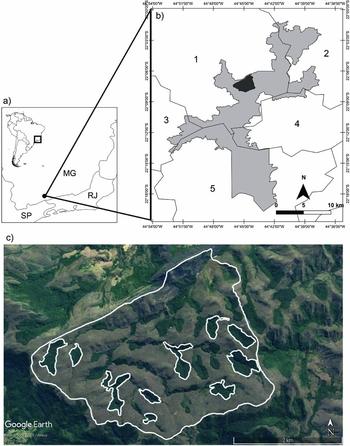
The Serra do Papagaio State Park protects a total area of 22,917 ha of the Atlantic Forest Domain in the south of Minas Gerais State, Brazil (IEF, 2009). It is located at 22°07′24.26″S, 44°44′51.15″W (Fig. 1), with a mean altitude of 1774 m and a maximum of 2359 m. The park is part of the Serra da Mantiqueira Environmental Protection Area, one of the world's most valuable protected areas for conservation (Le Saout et al., Reference Le Saout, Hoffmann, Shi, Hughes, Bernard, Brooks, Bertzky, Butchart, Stuart, Badman and Rodrigues2013). Serra da Mantiqueira is characterised by an imposing escarpment facing the Paraíba Valley, with over 2000 m of altitude variability (Almeida & Carneiro, Reference Almeida and Carneiro1998). It forms the second step of the Brazilian Plateau, and together with Serra do Mar, represents one of the coldest and wettest regions of eastern South America (Moreira & Camelier, Reference Moreira and Camelier1997). Two geomorphologic units can be recognised: ‘Mantiqueira Meridional’, where the study area is located, and ‘Mantiqueira Setentrional’ (Machado-Filho et al., Reference Machado-Filho, Ribeiro, Gonzalez, Schenini, Santos-Neto, Palmeira, Pires, Teixeira and Castro1983).
A, Location of the Serra do Papagaio State Park, Minas Gerais, Brazil. B, Light grey area, Serra do Papagaio State Park; dark grey area, central portion of the park, known locally as ‘Chapadão’, where the study was conducted, in the municipalities of 1) Baependi, 2) Aiuruoca, 3) Pouso Alto, 4) Alagoa and 5) Itamonte. C, The 10 patches of tropical montane cloud forest selected for this study; the outer line delimits Chapadão. MG, Minas Gerais; RJ, Rio de Janeiro; SP, São Paulo. Sources: IBGE (no date) and Google Earth (Google Inc., no date).

The landscape is characterised by a rugged relief, with declivities of about 40% and large areas with over 75% declivity (IEF, 2009). The climate is Cwb, following the Köppen classification (Alvares et al., Reference Alvares, Stape, Sentelhas, Gonçalves and Sparovek2013), with cold, dry winters and mild, wet summers. The temperature varies from 0°C to 10°C in the winter and can reach 30°C during some summer days. Mean annual precipitation is 1568 mm, concentrated between October and March (with 80% of annual precipitation), and there is no dry period (IEF, 2009).
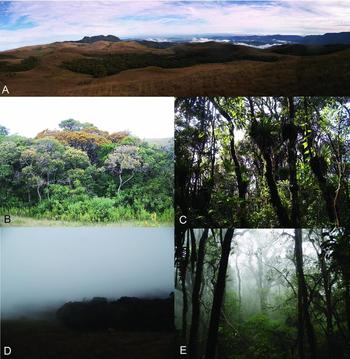
The vegetation of the study area is a mosaic of Atlantic Forest (Araucaria mixed forest and dense ombrophilous forest) and open vegetation (‘campos de altitude’) (IEF, 2009). TMCFs (highland ombrophylous forests sensu IBGE, 2012) are located above 1800 m a.s.l. (IEF, 2009) (Fig. 2). The central portion of the park where this study was carried out is known locally as ‘Chapadão’ and is characterised by elevated hills and valleys, with altitudes ranging from 1800 m to 2000 m and 3–20% declivity. High-altitude fields exist in litholic soils, whereas cloud forest exists on patches of inceptisols and histosols in the valleys, usually associated with small rivers and springs (IEF, 2009).
Tropical montane cloud forest patches of Serra do Papagaio State Park, Minas Gerais, Brazil. A, Forest patches on a high-altitude field matrix. B, External view of a forest patch. C, Interior of a forest patch, showing the abundance of epiphytes. D, Formation of clouds at ground level. E, Interior of a forest patch, showing canopies immersed in clouds. Photographs from the authors’ personal archives.

Sampling and data collection
Tropical montane cloud forest patches with areas greater than 2 ha were mapped using satellite images and information gathered on field trips. Ten forest patches were selected randomly from all the patches mapped (Fig. 1C). On each of the selected patches, we superimposed a 10 × 20 m grid. Using this grid, 10 permanent plots of 10 × 20 m were randomly chosen, covering 0.2 ha in each patch and 2 ha in total. Field data were collected between September 2014 and April 2016.
All trees with a circumference ≥ 15.5 cm at breast height (1.30 m) were marked with aluminium plates. Circumferences were measured at breast height, and total height was estimated for all individuals. Botanical material was collected for identification to species level. Identification of botanical material was performed by reference to the literature (identification keys, species descriptions and family monographs), consultation with experts, and comparison with material deposited in the Leopoldo Krieger Herbarium (CESJ; code following Thiers, continuously updated) of the Federal University of Juiz de Fora. Names of species and botanical synonyms were verified by consulting Brazilian Flora Group (2015) and the International Plant Names Index database (IPNI, continuously updated), and the classification of botanical families followed APG IV (Angiosperm Phylogeny Group, 2016) and PPG I (2016).
Data analysis
Structural parameters of species were evaluated according to formulas described by Kent and Coker (Reference Kent and Coker1992): absolute and relative frequency (AF and RF, respectively), absolute and relative density (AD and RD, respectively), absolute and relative dominance (ADo and RDo, respectively) and importance value (IV, calculated as the sum of RF, RD and RDo).
Histograms of diameter distribution for all live and dead individuals were generated. The class intervals were defined by an approximation of Spiegel's formula (Felfili & Resende, Reference Felfili and Resende2003), resulting in class intervals of 7 cm. To explore vertical structure, a histogram for height values of live individuals, with class intervals of 2 m, was prepared.
The average number of live individuals and basal areas per plot were compared between forest patches by using a one-way anova test. Assumptions for the anova test (i.e. homogeneity of variances and normality of residuals) were checked using Levene and Shapiro–Wilk normality tests. When these assumptions were not satisfied, a non-parametric Kruskal–Wallis test was performed. When a significant difference was observed, an a posteriori Tukey test was used to locate the differences. Tests were performed on R version 3.4.0 (R Core Team, 2017), using the packages CAR (Fox & Weisberg, Reference Fox and Weisberg2011) and Vegan (Oksanen et al., Reference Oksanen, Blanchet, Friendly, Kindt, Legendre, McGlinn, Minchin, O'Hara, Simpson, Solymos, Stevens, Szoecs and Wagner2017).
To compare species richness between forest patches, individual-based rarefaction/extrapolation curves were used, following Colwell et al. (Reference Colwell, Chao, Gotelli, Lin, Mao, Chazdon and Longino2012) and Hsieh et al. (Reference Hsieh, Ma and Chao2016a). Curves were generated on R version 3.4.0 (R Core Team, 2017), using the packages ggplot2 (Wickham, Reference Wickham2009) and iNEXT (Hsieh et al., Reference Hsieh, Ma and Chao2016b). Differences between rarefaction curves were tested following Cayuela et al. (Reference Cayuela, Gotelli and Colwell2015), using the package rareNMtests (Cayuela & Gotelli, Reference Cayuela and Gotelli2014).
Differences in species composition were analysed based on similarity matrices between all forest patches, using Jaccard (for incidence data) and Bray–Curtis (for abundance data) similarity indices. Multiresponse permutation procedures (MRPP) analysis was used to test for significant differences in similarity indices between the forest patches. The analysis was performed on R version 3.4.0 (R Core Team, 2017), using the Vegan package (Oksanen et al., Reference Oksanen, Blanchet, Friendly, Kindt, Legendre, McGlinn, Minchin, O'Hara, Simpson, Solymos, Stevens, Szoecs and Wagner2017).
Results
Floristic composition and structure
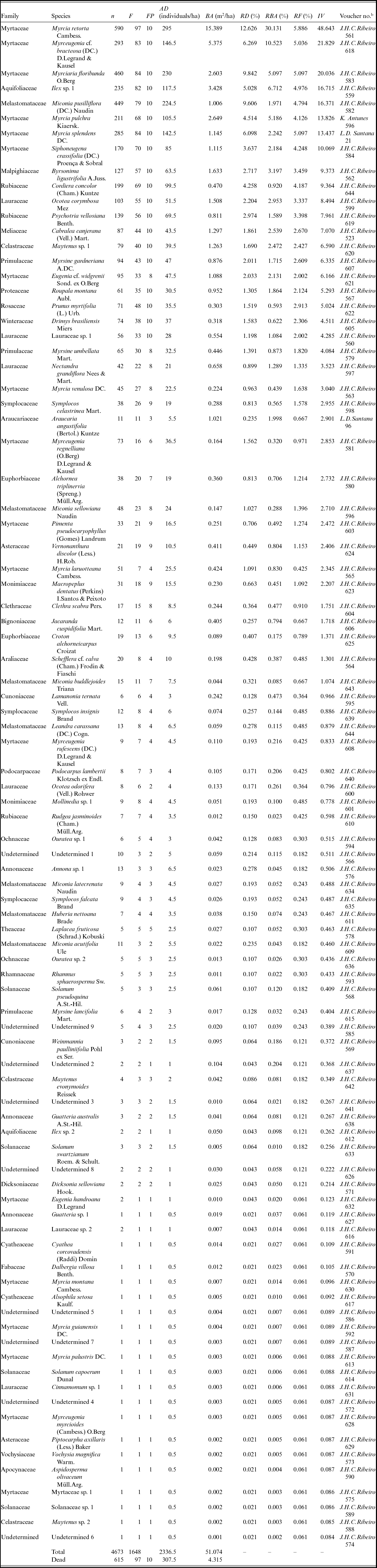
In all the forest patches, 4673 individuals were found, representing 89 morphospecies distributed across 32 families and 49 genera (Table 1). A total of 66 morphospecies were identified at the species level, 10 at the genus level and 4 at the family level; 9 were not identified. Myrtaceae was the richest family, with 18 species, followed by Melastomataceae and Lauraceae (with 7 and 6 species, respectively). The most species-rich genus was Myrcia (with 8 species), followed by Miconia (5 species) and Myrceugenia (4 species).
Structural parameters for 89 morphospecies found in 10 tropical montane cloud forest patches in Serra do Papagaio State Park, Minas Gerais, Brazila

a Species ordered by decreasing importance value.
b The vouchers are deposited in the Leopoldo Krieger Herbarium (CESJ) and the Laboratory of Plant Ecology, Department of Botany, Federal University of Juiz de Fora, Minas Gerais, Brazil.
AD, absolute density; BA, basal area; F, frequency in the plots; FP, number of forest patches in which the species occurred; IV, importance value; n, number of individuals; RBA, relative basal area; RD, relative density; RF, relative frequency.
Four species are considered endangered: Araucaria angustifolia (Bertol.) Kuntze, Dicksonia sellowiana Hook., Ocotea odorifera (Vell.) Rohwer and Myrceugenia cf. bracteosa (DC.) D.Legrand & Kausel (Martinelli & Moraes, Reference Martinelli and Moraes2013; CNCFlora, continuously updated). Two other species are considered near threatened: Weinmannia paulliniifolia Pohl ex Ser. and Huberia nettoana Brade (CNCFlora, continuously updated).
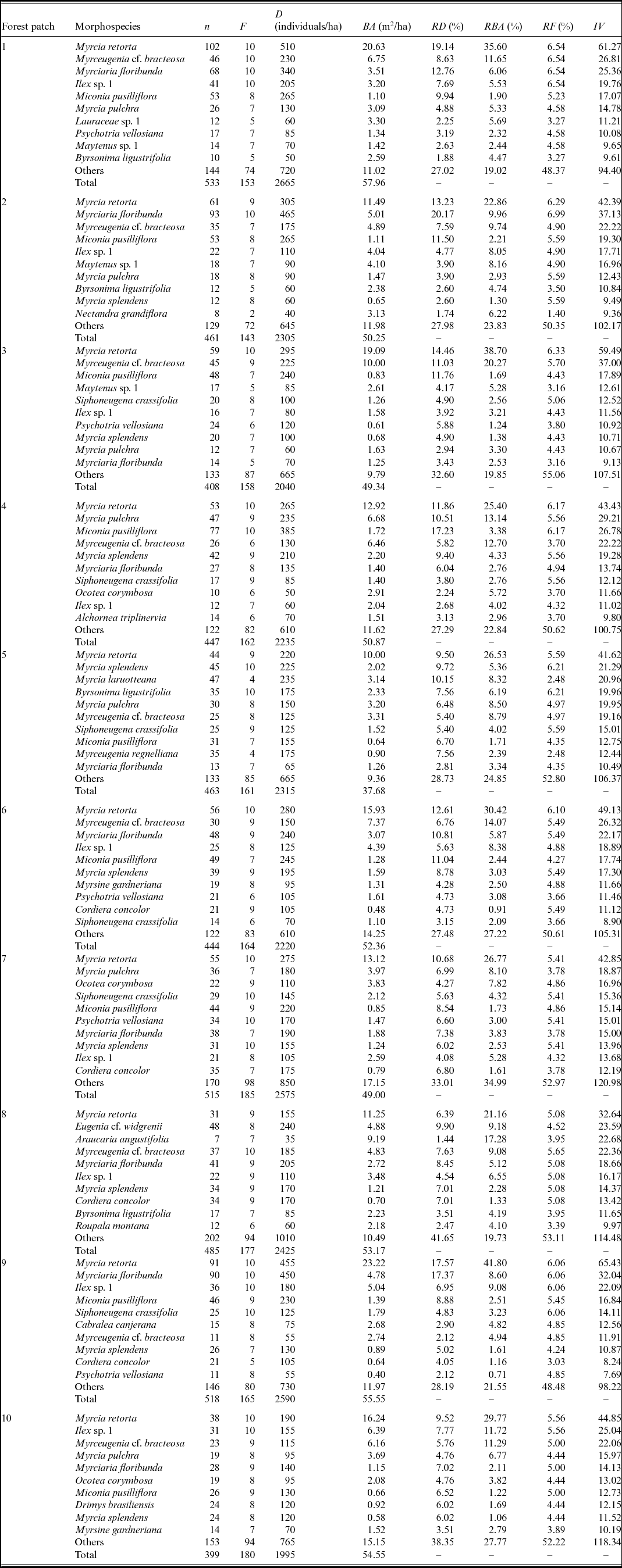
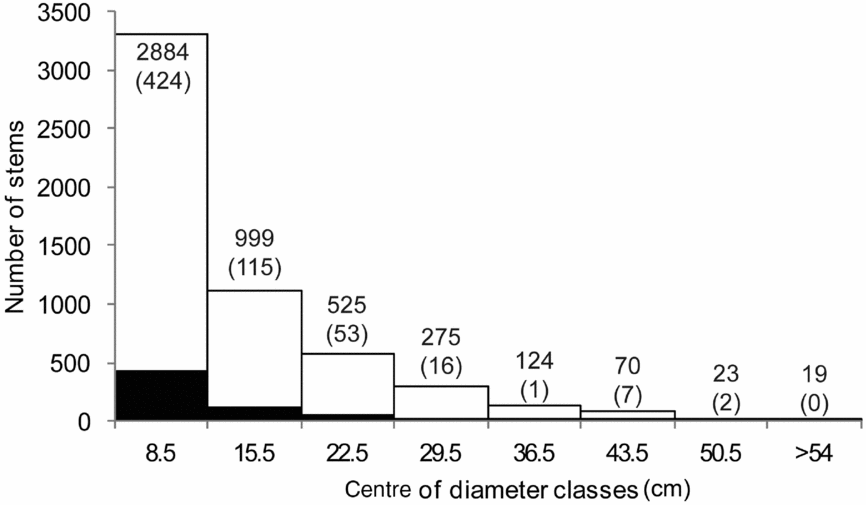
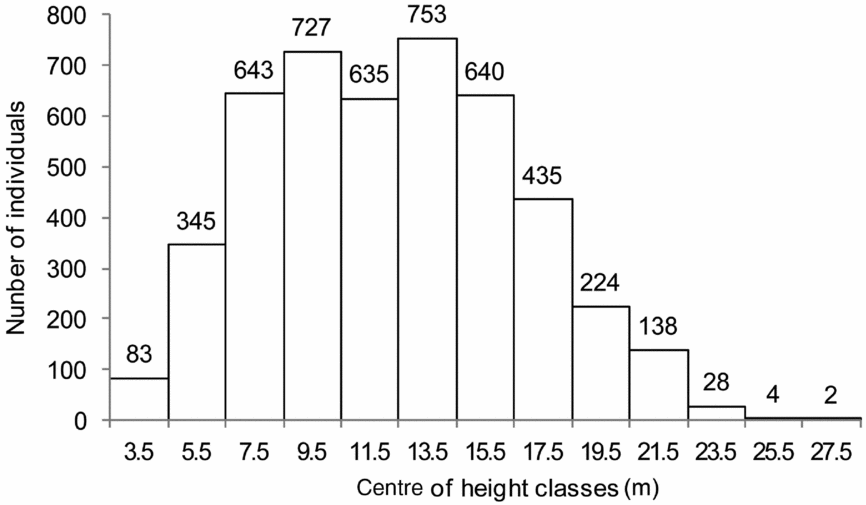
Species with higher IV in all forests were Myrcia retorta Cambess., Myrceugenia cf. bracteosa and Myrciaria floribunda O.Berg, all from the Myrtaceae family, which together account for 30% of IV, 29% of total density and 46% of total basal area (Tables 1 and 2). Myrtaceae was the most important family, with 18 species, almost 50% of total density and 61% of total basal area. The distribution of diameter classes shows a reversed-J pattern, with most individuals in the smaller classes (Fig. 3). The average height was 11.2 m, with emergent trees reaching a maximum of 26 m (Fig. 4).
Structural parameters for the 10 morphospecies with the highest importance values for each tropical montane cloud forest patch in Serra do Papagaio State Park, Minas Gerais, Brazila
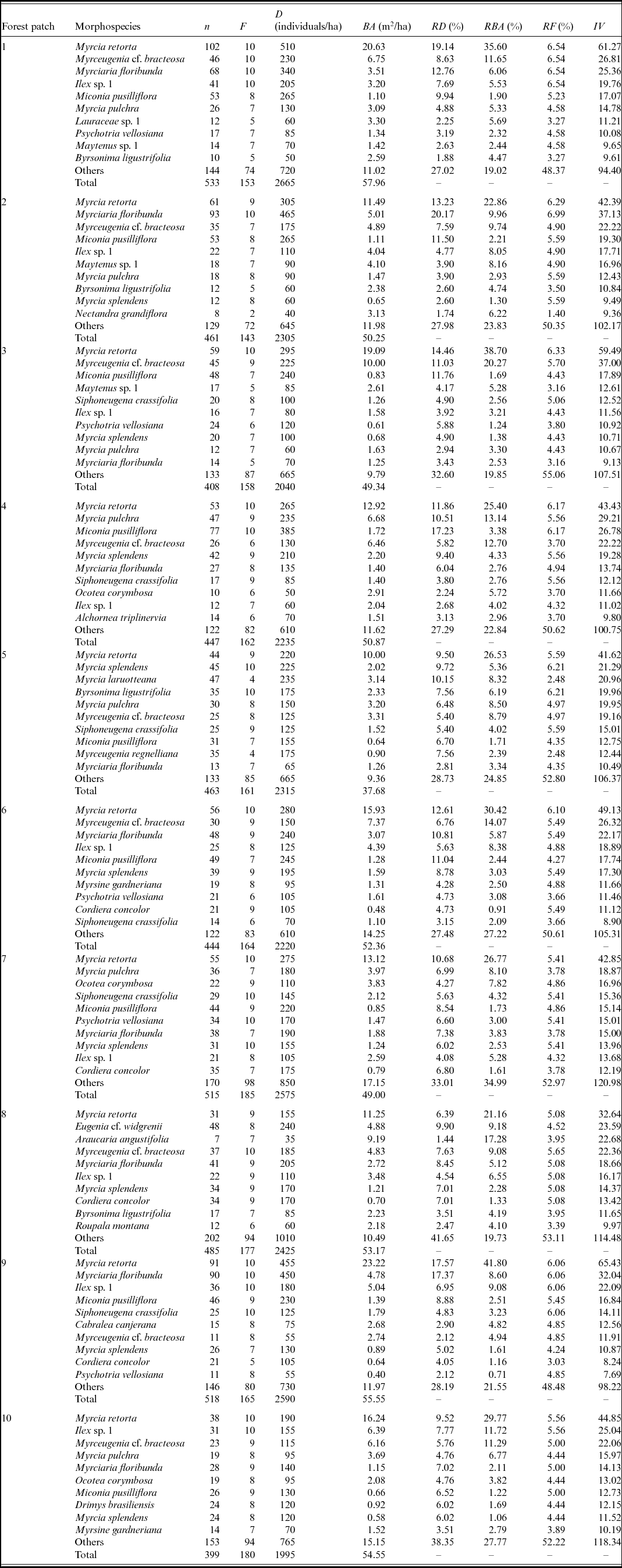
a Species ordered by decreasing importance value.
BA, basal area; D, density; F, frequency in the plots; IV, importance value; n, number of individuals; RBA, relative basal area; RD, relative density (%); RF, relative frequency (%).
Distribution of diameter classes for trees with a circumference at breast height ≥ 15 cm in Serra do Papagaio State Park, Minas Gerais, Brazil. White bars represent numbers of live stems, and black bars, numbers of dead stems. Numbers above the bars represent numbers of live stems in each class (the numbers of dead stems in each class are given in parentheses).

Distribution of height classes for live trees with a circumference at breast height ≥ 15 cm in Serra do Papagaio State Park, Minas Gerais, Brazil. Numbers above the bars represent numbers of live trees in each class.

Structure and composition heterogeneity
Densities and basal areas
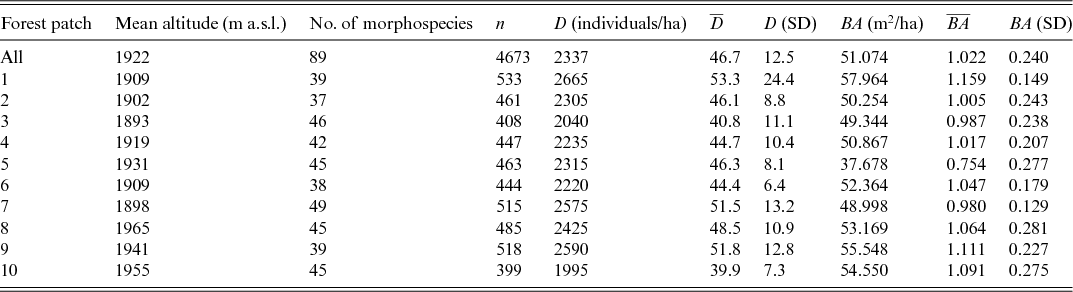
Table 3 shows the parameters for 10 cloud forest patches. Densities varied from 1995 individuals/ha to 2665 individuals/ha. A Levene test showed that the variances were not homogeneous (F = 2.099, DF = 9, P = 0.037). The Kruskal–Wallis test showed no significant differences between the 10 cloud forest patches (k = 9.773, DF = 9, P = 0.369).
Structural parameters of 10 cloud forest patches in Serra do Papagaio State Park, Minas Gerais, Brazil
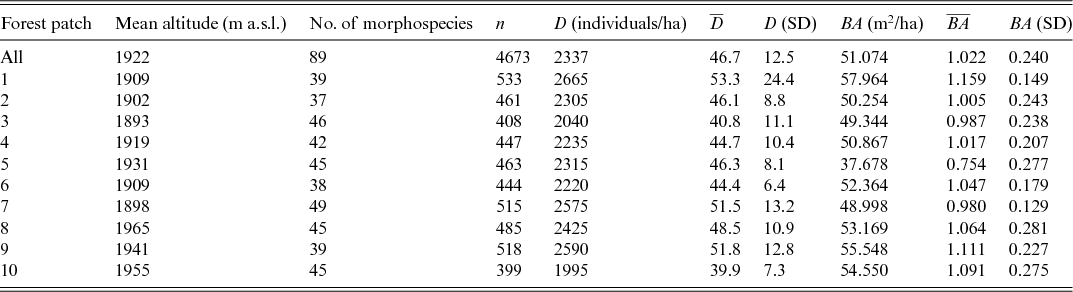
BA, basal area;  $\overline{BA}$, mean basal area/plot; BA (SD), basal area/plot standard deviation; D, density;
 $\bar{D}$, mean density/plot; D (SD), density/plot standard deviation; n, number of individuals.
Basal areas varied from 37.68 m²/ha to 57.96 m²/ha. A Levene test showed homogeneous variances (F = 0.734, DF = 9, P = 0.676), and residuals were normally distributed according to the Shapiro–Wilk normality test (W = 0.987, DF = 9, P = 0.446). The anova test showed significant differences between at least two forest patches (F = 2.371, DF = 9, P = 0.018). The Tukey test showed that only forest patch 5 had significantly lower basal areas when compared with forest patch 1 (P = 0.004), forest patch 9 (P = 0.038) and forest patch 10 (P = 0.021). All other comparisons were not significantly different (P > 0.05).
Richness and composition
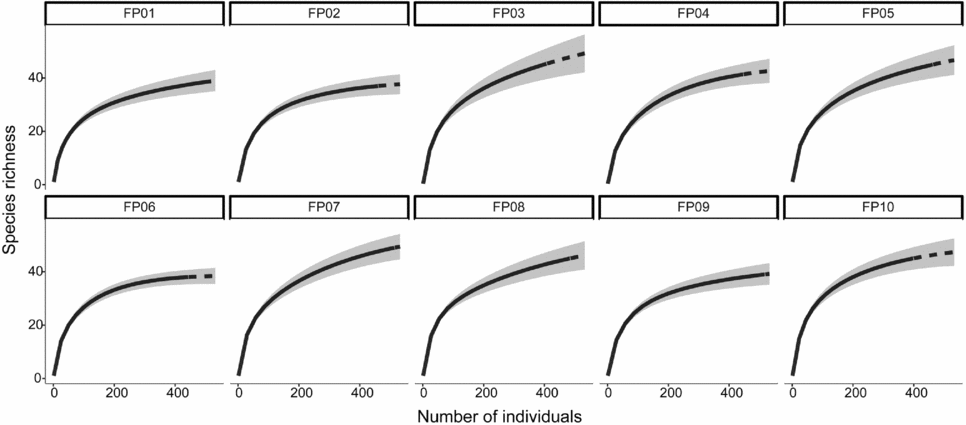
A total of 89 morphospecies were found in all forest patches. Richness varied from 37 to 49 morphospecies in each forest patch. Figure 5 shows rarefaction/extrapolation curves for all forest patches studied. The curves show a tendency towards stabilisation and are visually very similar. When comparing the rarefaction curves, the ecological null hypothesis (i.e. that samples were drawn from the same underlying assemblage and therefore have similar composition, species richness and relative abundance) was rejected (Z = 23,253.82, P = 0.001). However, the biogeographical null hypothesis (i.e. that samples were drawn from assemblages that share similar species richness and relative abundance but not necessarily the same composition) was accepted (Z = 59,916.09, P = 0.291).
Rarefaction/extrapolation curves for 10 tropical montane cloud forest patches in Serra do Papagaio State Park, Minas Gerais, Brazil. Curves were extrapolated to the number of individuals in the forest patch with the most individuals (i.e. 533 individuals). Solid line, rarefaction portion of the curve; dashed line, extrapolation portion of the curve; grey area, confidence interval.

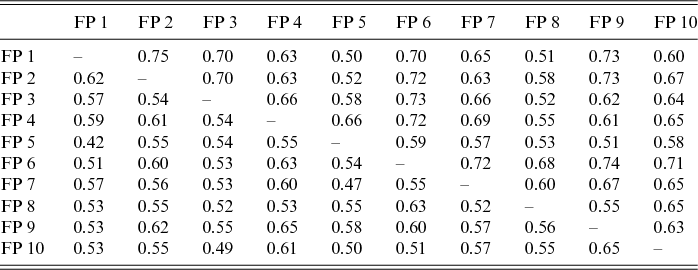
Similarity indices were high for both incidence and abundance data (Table 4). Values for the Jaccard index varied from 0.42 to 0.65, and values for the Bray–Curtis index from 0.50 to 0.75. Although similarity indices were high, the MRPP analysis showed significant differences between forest patches for the Jaccard similarity index (delta = 0.567, P = 0.001, A = 0.069) and the Bray–Curtis similarity index (delta = 0.716, P = 0.001, A = 0.046).
Similarity indices between 10 cloud forest patches in Serra do Papagaio State Park, Minas Gerais, Brazila
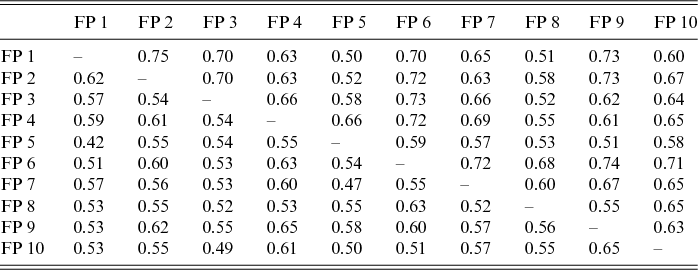
a Top right values correspond to Bray–Curtis similarity index for abundance data. Bottom left values correspond to Jaccard similarity index for incidence data.
FP, forest patch.
Discussion
Floristic composition and structure
The floristic composition of TMCFs in Serra do Papagaio State Park is similar to the patterns found in high-altitude forests in Southeast Brazil. The richest families found (Myrtaceae, Melastomataceae and Lauraceae) were identified by Oliveira-Filho and Fontes (Reference Oliveira-Filho and Fontes2000) as the most important families in terms of species numbers for high-altitude rain forests of the Atlantic Domain in Southeast Brazil. Myrtaceae was also found to be one of the most important families in other studies of cloud forests of Southeast Brazil (França & Stehmann, Reference França and Stehmann2004; Carvalho et al., Reference Carvalho, Oliveira-Filho, van den Berg, Leite, Fontes, Sá, Marques and Carvalho2005; Pereira et al., Reference Pereira, Oliveira-Filho, Botelho, Carvalho, Fontes, Schiavini and Silva2006; Meireles et al., Reference Meireles, Shepherd and Kinoshita2008; Valente et al., Reference Valente, Garcia, Salimena and Oliveira-Filho2011; Pompeu et al., Reference Pompeu, Fontes, Santos, Garcia, Batista, Carvalho and Oliveira-Filho2014). The same pattern was observed for the richest genera, with Myrcia, Miconia and Myrceugenia among the most important genera for high-altitude rain forests of the Atlantic Domain (Oliveira-Filho & Fontes, Reference Oliveira-Filho and Fontes2000).
Of the species sampled, 10 were identified by Oliveira-Filho and Fontes (Reference Oliveira-Filho and Fontes2000) as associated with high-altitude forests in the Atlantic Forest Domain: Clethra scabra Pers., Drimys brasiliensis Miers, Laplacea fruticosa (Schrad.) Kobuski, Myrcia laruotteana Cambess., Myrsine lancifolia Mart., Nectandra grandiflora Nees & Mart., Pimenta pseudocaryophyllus (Gomes) Landrum, Schefflera cf. calva (Cham.) Frodin & Fiaschi, Symplocos celastrinea Mart. and Weinmannia paulliniifolia. Bertoncello et al. (Reference Bertoncello, Yamamoto, Meireles and Shepherd2011) also identified Drimys brasiliensis and Weinmannia paulliniifolia as indicator species for cloud forests in South and Southeast Brazil. They also indicated that Pimenta pseudocaryophyllus, Rhamnus sphaerosperma Sw. and Symplocos falcata Brand were preferential species of cloud forests.
Six species were considered to be under some degree of threat. Of these, five occurred at densities of less than 20 individuals/ha (see Table 1). The exception was Myrceugenia cf. bracteosa, which occurred at high densities and so deserves special attention. According to Martinelli and Moraes (Reference Martinelli and Moraes2013) and CNCFlora (continuously updated), this species occurs at very low densities, about three individuals per hectare. Pompeu et al. (Reference Pompeu, Fontes, Santos, Garcia, Batista, Carvalho and Oliveira-Filho2014) also found Myrceugenia bracteosa at low densities, 13.3 individuals/ha, in an upper montane forest near Serra do Papagaio State Park (Itamonte, Minas Gerais). In contrast, in this study we found a density of 146.5 individuals/ha, and Santana et al. (in press) found a density of 498 individuals/ha in another mixed rain forest in Serra do Papagaio State Park. However, the identification of Myrceugenia species is very difficult, and the latest taxonomic revision was in 1981 (Landrum, Reference Landrum1981). It is possible that other populations, with more individuals, are still unknown or have been misidentified. Rather than casting doubt on the need to protect this species, our results show the importance of Serra do Papagaio State Park for its conservation and highlight the pressing need for more studies on the taxonomy and distribution of Myrceugenia species as well as other taxa typical of upper montane forests that are still poorly known.
The forest patch structure is similar to other TMCFs, especially UMCFs, with high stem densities, low canopy heights and few emergent trees (Scatena et al., Reference Scatena, Bruijnzeel, Bubb, Das, Bruijnzeel, Scatena and Hamilton2010; Fahey et al., Reference Fahey, Sherma and Tanner2016). Species richness and density values were close to those observed in other high-altitude forests in Southeast Brazil, and basal area was among the highest observed (Table 5). Other features of UMCFs were observed in the field, such as abundant and diverse vascular and non-vascular epiphytes, very few climbers, and few species with compound leaves (only 9 of the 89 species found have compound leaves) (Scatena et al., Reference Scatena, Bruijnzeel, Bubb, Das, Bruijnzeel, Scatena and Hamilton2010). However, multistemmed and twisted trees, another typical feature of TMCFs (Fahey et al., Reference Fahey, Sherma and Tanner2016), were rarely observed (only 120 individuals, 2.6% of all individuals sampled, had two or more stems at 1.3 m above ground). Bellingham and Sparrow (Reference Bellingham and Sparrow2009) explain that the prevalence of multistemmed trees in montane rain forests can be related to low soil nutrient content and disturbance (such as wind storms and fires). The positions of the forest patches studied, in valleys and associated with springs and small rivers, could favour the prevalence of single-stemmed trees by allowing accumulation of organic matter in the soil and providing protection against wind storms and fires.
Comparison of species richness and structural parameters between selected areas of high-altitude forests in Minas Gerais, Southeast Brazil

BA, basal area; CBH, minimum circumference at breast height used; D, density.
Structure and composition heterogeneity
Tests showed no significant difference in densities and basal areas between forest patches. When comparing rarefaction/extrapolation curves, the two tests showed different results. Cayuela et al. (Reference Cayuela, Gotelli and Colwell2015) explain that the ecological null hypothesis test is sensitive to floristic composition, whereas the biogeographical null hypothesis test is influenced only by richness and relative abundance. Therefore, there is no significant difference in richness between forest patches. Although MRPP showed significant differences between forest patches, the size effect measured by coefficient A was very small, and the differences observed between forest patches can be considered to be without ecological significance (McCune & Grace, Reference McCune and Grace2002).
Therefore, we reject the initial hypothesis that TMCF patches could be highly heterogeneous even at the small geographical scale studied here, because the forest patches were very similar in terms of stem density, basal area, richness and composition. This could be due to the small distance between the forest patches and their similar environmental conditions (similar altitudes and position on the landscape). However, spatial structure could explain only 11% of tree community data, and spatial autocorrelation seems not to be a problem (Ribeiro, Reference Ribeiro2018). Other studies that showed heterogeneity between TMCFs usually compared areas on a broader geographical scale or at different altitudes with different environmental conditions (Pereira et al., Reference Pereira, Oliveira-Filho, Botelho, Carvalho, Fontes, Schiavini and Silva2006; Meireles et al., Reference Meireles, Shepherd and Kinoshita2008; Meireles & Shepherd, Reference Meireles and Shepherd2015). Ongoing studies relating soil properties to the structure and composition of the 10 forest patches studied, as well as monitoring of the forest dynamics in the permanent plots established by the current study, may contribute to the elucidation of these patterns.
Final Considerations
The forest patches studied in Serra do Papagaio State Park showed a similar structure and composition to other TMCFs, especially UMCFs, of Southeast Brazil. Structurally, the 10 forest patches were uniform in terms of stem density, basal area, and species richness and composition. TMCFs of Serra do Papagaio State Park are of particular interest for conservation, because they contain important populations of threatened species. This study was the first to investigate tree composition and structure of TMCFs in Serra do Papagaio State Park, and the data can be used as a reference for conservation and restoration projects of TMCFs in the region. The monitoring of the permanent plots established by this study will contribute to a better understanding of TMCF dynamics and responses to incoming threats.
Acknowledgements
We thank colleagues at the Leopoldo Krieger Herbarium and the Laboratory of Plant Ecology and Department of Botany, Federal University of Juiz de Fora, for their help with fieldwork. We also thank the specialists who helped with botanical identification, especially Luciana Leitão (Melastomataceae); Kelly Antunes, Marcos Sobral and Leonardo Meireles (Myrtaceae); Juliana Amaral (Rubiaceae); Rafaela Freitas (Euphorbiaceae); and Vinicius Dittrich (pteridophytes). We are grateful for all the support provided by staff at the Serra do Papagaio State Park and the Instituto Estadual de Florestas, especially Clarice Silva, Emanuel Landroz, Clarice Rosa Silva and Sebastião Nunes Ramos. This work was supported by the Brazilian National Council of Technological and Scientific Development (CNPq) under grant 454008/2014-7 and the Research Support Foundation of Minas Gerais (FAPEMIG) under grant APQ 2165/14. The first and second authors are grateful to Coordenação de Aperfeiçoamento do Pessoal de Nível Superior (CAPES) for their Ph.D. scholarships.