I. INTRODUCTION
Mg-based lightweight alloy has been attracting large research interests for potential applications in modern automobiles and aerospace industries over the past decades. Reference Wang, Zhang, Hudon, Jung, Medraj and Chartrand1–Reference Aghion, Bronfin, Eliezer, Von Buch, Schumann and Friedrich4 However, uses of Mg alloys are still limited because of the restrained properties such as inferior tensile strength, the limited creep, and corrosion resistance. Reference Mordike5–Reference Arora, Singh and Dhindaw7 To further improve mechanical properties of Mg alloys, addition of alloying elements is found to be an effective way. Calcium element improves creep resistance and strength of Mg alloys and reduces the cost, Reference Hampl, Gröbner and Schmid-Fetzer8 and silicon is also considered to improve mechanical properties, Reference Grobner, Chumak and Schmid-Fetzer9 so binary Mg–Ca and Mg–Si alloy systems have been developed and studied extensively. Reference Farahany, Bakhsheshi-Rad, Idris, Kadir, Lotfabadi and Ourdjini10,Reference Silsby, Sui, Ma, Kauzlarich and Latturner11 Furthermore, several industrial Mg alloys with simultaneous addition of Ca and Si have been developed, and many ternary phases, such as MgCaSi, Ca7Mg7.5±δSi14, Ca2Mg3Si, and Ca2MgSi3 Reference Grobner, Chumak and Schmid-Fetzer9,Reference Whalen, Zaikina, Achey, Stillwell, Zhou, Wiebe and Latturner12 have been attracting a significant research interesting due to the superior mechanical properties. Especially, MgCaSi is the crucial strengthening phase that could increase tensile strength of alloys and so is of great interest. Moreover, MgCaSi is also a promising thermoelectric (TE) material. However, the research on the ternary phase is very scarce.
Various point defects in crystals, such as vacancies and antisite defects in intermetallic compounds have been a hot topic of theoretical and experimental research. Vacancy defects are crucial mediums in atomic diffusions in intermetallics, so the study of native point defects is useful to understand the diffusion behavior. Reference Pearson13,Reference Zheng, Tian, Wei, Shao, Pan and Tang14 Furthermore, point defects affect the thermodynamic behavior and formation of materials and further have an important impact on the microstructure and properties of materials. Especially, point defects have a crucial significance on ductility, strength, Reference Ayub, Khwaja and Haq15 and creep resistance Reference Li and Conrad16 of materials. It is shown that the defect concentration is related closely to ductility, strength, phase equilibrium, and lattice stability. Reference Korzhavyi, Pourovskii, Hugosson, Ruban and Johansson17 Because of the change of atomic bonding around point defects, mechanical properties can be directly modified. Reference Kulkova and Bazhanov18 Alternatively, the mechanical properties of materials can be indirectly changed by the interaction between other lattice defects. As demonstrated in Ref. Reference Pearson13, the behavior of dislocations (sliding and dissociation, etc.) can be changed apparently owing to the disordering of the lattice caused by antisite defects and segregation of impurities or alloying atoms to dislocations.
TE materials have attracted significant interest owing to promising properties. However, the decoupling of TE parameters coupled by the carrier concentration has been a challenge for a long time. Reference Hu, Gao, Liu, Xie, Shen, Zhu and Zhao19,Reference Hu, Zhu, Liu and Zhao20 The point defect engineering has become one new possible solution, which can simultaneously improve the lattice thermal conductivity and electrical properties. Point defects play a crucial role in TE transport. For example, adding extra Mg during the synthesis can compensate for the Mg loss, which often leads to Mg interstitials in Mg2(Si,Sn) TE materials and increases the carrier concentration, Reference Du, Zhu, Chen, He, Gao, Jiang, Tritt and Zhao21 while Mg vacancies, which serve for additional phonon scattering centers can decrease the lattice thermal conductivity κph. Reference Dasgupta, Stiewe, Hassdorf, Zhou, Boettcher and Mueller22 Point defects can also change the band structure, and theoretical calculations demonstrate that in ZrNiSn-based half-Heusler TE alloys the band-gap decreases with increasing the Zr/Sn antisite defect content. Reference Xie, Yu, Zhu and Fu23
Evidently, the formation and structure of point defects in MgCaSi, as the strengthening phase and the TE material, are fundamental and crucial. Although the point defects are crucial to the mechanical behavior, TE performances, and other physiochemical properties of materials, investigation of point defects can hardly be accessed experimentally Reference Kulkova and Bazhanov18 because it is difficult to directly observe and measure through the experiment. First-principles calculations can provide a powerful approach to study the point defects in detail. The formation energy, interaction energy, and electronic structure of point defects can be easily achieved through the first-principles calculation. Reference Kai and Averback24
In this paper, we present density functional theory (DFT) based ab initio calculations to study the point defects in the ternary MgCaSi phase. The complex chemical potential limits are first determined using a two-dimension (∆μMg, ∆μCa) diagram, defect formation energies as a function of chemical potential of constitutional species are obtained, the bonding energy is first introduced to uncover the intrinsic feature of defect formation energy, and the geometric distortion around the point defects and electronic properties of nine kinds of point defects in MgCaSi are also further studied. Section II a gives brief description of the computational methods. Results and discussion are described in details in Sec. III, and conclusions are presented in Sec. IV.
II. COMPUTATIONAL METHOD
Ab initio calculations were performed based on DFT with a plane-wave basis set, as implemented in the Vienna Ab initio Simulation Package code. Reference Kresse and Furthmüller25 The electron–ion interaction was described using the projector-augmented wave potentials, Reference Kresse and Joubert26 and the energy cutoff of the plane waves was 400 eV for all the calculations. The valence electron configuration is, respectively, 3s 2 for Mg, 3p 64s 2 for Ca, and 3s 23p 2 for Si. The exchange-correlation energy was described by the generalized gradient approximation Reference Perdew27 with the well-established Perdew–Burke–Ernzerhof functional. Reference Perdew, Burke and Ernzerhof28 The present study adopted a 2 × 2 × 2 supercell, and the convergence with respect to supercell size was also studied by testing calculations with 2 × 2 × 2 96-atom, 3 × 2 × 2 144-atom, 3 × 3 × 2 216-atom, and 3 × 3 × 3 324-atom supercells. The calculated results show that the difference in raw energy Reference Hu, Yang, Hao, Xu and Li29 for CaMg and VCa defects is less than 0.01 eV between these supercells, and this small difference would not alter the present results. So, a 2 × 2 × 2 with a 96-atom supercell is used. The Brillouin zone integration was performed with the Gamma-centered Monkhorst–Pack scheme Reference Monkhorst and Pack30 of 2 × 8 × 2 k-points for the optimization geometrical structure, and 4 × 10 × 4 k-points for calculation of the electronic structure. To obtain a precise defective crystal structure, shape and internal coordinates were optimized by full relaxation, until Hellman–Feynman forces on each atom were less than 0.01 eV/Å, and the maximum stress on the atom was within 0.02 GPa. The systematic testing calculation further shows that with the above calculation parameters, the total energy is converged to less than 10−6 eV/atom. So the convergence for the formation energies of nine point defects should be sufficient. During the present investigation, calculations of the total energy and electronic structure were performed employing the linear tetrahedron method with the Blöchl correction.
III. RESULTS AND DISCUSSION
The ternary MgCaSi phase has a orthogonal structure with a space group Pnma (No. 62). Reference Eisenmann, Schafer and Weiss31 The unit cell contains 4 Mg, 4 Ca, and 4 Si atoms, and the Mg, Ca, and Si atoms are located at three independent 4c sites. The optimized lattice constants of MgCaSi are a = 7.4671 Å, b = 4.4313 Å, and c = 8.3012 Å, which are in accordance with the available experimental data a = 7.4752 Å, b = 4.4272 Å, and c = 8.3149 Å, Reference Whalen, Zaikina, Achey, Stillwell, Zhou, Wiebe and Latturner12 and theoretical results Reference Eisenmann, Schafer and Weiss31 of a = 7.4800 Å, b = 4.4000 Å, and c = 8.2900 Å. So the selection of calculation parameters is reasonable, and our calculations are adequately reliable.
In the ternary MgCaSi phase structure, the Mg, Ca, and Si atoms are located in three independent 4c sites. So nine possible point defects are studied, i.e., MgCa and MgSi for Mg antisite at Ca and Si position, CaMg and CaSi for Ca antisite at Mg and Si position, SiMg and SiCa for Si antisite at Mg and Ca position, and Mg vacancies VMg, Ca vacancies VCa, and Si vacancies VSi.
A. Valid limits of atomic chemical potentials for chemical stability
To evaluate the formation energy of point defects, valid limits of atomic chemical potentials should be first determined. The chemical potentials are restrained by equilibrium conditions and by the requirement of no appearance of secondary phases unwanted. In the state of equilibrium, the total energy for these atoms in MgCaSi and in reservoirs needs be equal. To maintain a stable MgCaSi compound at an equilibrium state, the chemical potentials would satisfy the following equation:
 $$\Delta {\mu _{{\rm{Mg}}}} + \Delta {\mu _{{\rm{Ca}}}} + \Delta {\mu _{{\rm{Si}}}} = \Delta {H_{\rm{f}}}\left( {{\rm{MgCaSi}}} \right)\quad ,$$
where ΔμMg, ΔμCa, and ΔμSi denote the relative chemical potentials for Mg, Ca, and Si, defined as:
 $\Delta {\mu _{{\rm{Mg}}}} = {\mu _{{\rm{Mg}}}} - \mu _{{\rm{Mg}}}^0$
,
 $\Delta {\mu _{{\rm{Ca}}}} = {\mu _{{\rm{Ca}}}} - \mu _{{\rm{Ca}}}^0$
, and
 $\Delta {\mu _{{\rm{Si}}}} = {\mu _{{\rm{Si}}}} - \mu _{{\rm{Si}}}^0$
. Here
 $\mu _{{\rm{Mg}}}^0$
,
 $\mu _{{\rm{Ca}}}^0$
, and
 $\mu _{{\rm{Si}}}^0$
are the atomic chemical potentials in elemental solid Mg, Ca, and Si, respectively. The ΔH
f(MgCaSi) in Eq. (1) is the formation enthalpy per formula unit MgCaSi. The calculated formation enthalpy ΔH
f(MgCaSi) is about −1.35 eV/f.u.
Furthermore, to avoid precipitation of elemental solid from atoms Mg, Ca, and Si in reservoirs, the energy of the atom in the reservoir requires to be less than the energy of the atom in elemental solid, Reference Alahmed and Fu32 which gives:
 $$\Delta {\mu _{{\rm{Mg}}}} \le 0,\;\Delta {\mu _{{\rm{Ca}}}} \le 0\;{\rm{and}}\;\Delta {\mu _{{\rm{Si}}}} \le 0\quad .$$
Moreover, to avoid the occurrence of secondary unwanted phases, chemical potentials should also be lower than the formation enthalpy of the competing phases, Mg2Si and Ca2Si Reference Grobner, Chumak and Schmid-Fetzer9,Reference Hosono, Kuramoto, Matsuzawa, Momose, Maeda, Matsuyama, Tatsuoka, Fukuda, Hashimoto and Kuwabara33 :
 $$2\Delta {\mu _{{\rm{Mg}}}} + \Delta {\mu _{{\rm{Si}}}} \le \Delta {H_{\rm{f}}}\left( {{\rm{M}}{{\rm{g}}_2}{\rm{Si}}} \right) = - 0.49\;{\rm{eV/f}}{\rm{.u}}\quad .$$
 $$2\Delta {\mu _{{\rm{Ca}}}} + \Delta {\mu _{{\rm{Si}}}} \le \Delta {H_{\rm{f}}}\left( {{\rm{C}}{{\rm{a}}_2}{\rm{Si}}} \right) = - 1.41\;{\rm{eV/f}}{\rm{.u}}\quad {\rm{.}}$$
Equations (1)–(4) thus determine the valid ranges of chemical potentials in the stability region of defective MgCaSi.
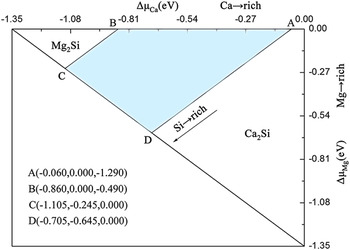
Figure 1 shows the thermodynamic stability diagram, where the stability of MgCaSi without any secondary phases is maintained inside the blue region A–B–C–D in the (ΔμMg, ΔμCa, ΔμSi) phase diagram that is obtained from the formation enthalpies. Mg2Si and Ca2Si define the chemical potential region for MgCaSi between the line BC and AD, respectively. The line A–B denotes extreme Mg-rich condition, the point A stands for Si-poor (Ca-rich) and point B represents the Si-rich (Ca-poor) environment. The line B–C denotes the Mg-rich condition, the point C stands for the Si-rich (Ca-poor) environment. The line C–D is the extreme Si-rich (ΔμSi = 0 eV) condition, the point D represents the Ca-rich (Mg-poor) environment. The line D–A is the Ca-rich condition. Therefore, the reasonable enthalpy of formation calculated here provides the appropriate chemical potential coordinates in evaluating the formation energy of point defects in MgCaSi.
Stability diagram of MgCaSi. Points A, B, C, and D enclose the region within which MgCaSi can be produced without any secondary phases. Line C–D is the Si-rich condition. Point A gives us the extreme reduction condition, where ΔμSi = −1.29 eV. All values of chemical potential coordinates are given in the lower left corner.

B. Formation energy of point defects
From the atomic chemical potential ranges defined in Fig. 1, the defect formation energy as a function of the atomic chemical potential can be computed in terms of the ab initio thermodynamic approach as following Reference Freysoldt, Grabowski, Hickel, Neugebauer, Kresse, Janotti and Van de Walle34,Reference Murphy, Cooper and Grimes35 :
 $${E_{\rm{f}}} = {E_{{\rm{total}}}}\left( {{\rm{defect}}} \right) - {E_{{\rm{total}}}}\left( {{\rm{perfect}}} \right) - \sum\limits_i {\Delta {n_i}{\mu _i}} \quad ,$$
where E total(defect) and E total(perfect) are the total energies of the defected and perfect supercell, respectively, Δn i suggests the number of atoms i that is added to (Δn i > 0) or removed from (Δn i < 0) the supercell when the defect is formed, and μ i is the corresponding chemical potential of atomic species.
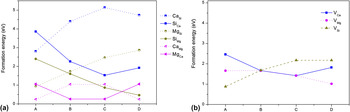
The calculated formation energies for antisite defects and vacancy defects are plotted in Figs. 2(a) and 2(b), respectively. Within the stability region of MgCaSi, the defect formation energy depends evidently on the chemical potentials ΔμMg, ΔμCa, and ΔμSi. For antisite defects, the defect formation energies of CaMg and MgCa change in opposite trends with the variable chemical potentials, so do other two defect pairs, MgSi and SiMg; CaSi, and SiCa. At point A (Si-poor, Ca-rich, Mg-rich), the defect formation energy demonstrates an ascent order from CaMg to MgSi, MgCa, SiMg, CaSi, and SiCa, so the CaMg is the most favorable. With the increase of the Si chemical potential from A to B (the chemical potential of Ca decreases and one of Mg is fixed at constant), the defect formation energies of SiCa, SiMg, and MgCa decrease gradually, while the defect formation energies of CaSi, MgSi, and CaMg increase gradually. At point B (Si-rich, Ca-poor, Mg-rich), the MgCa has the lowest defect formation energy, followed by CaMg, SiMg, MgSi, and SiCa, while CaSi is the most unfavorable. When Si chemical potential continues to increase from B to C (the chemical potentials of Ca and Mg decrease), the defect formation energies of SiCa and SiMg gradually decrease, while CaSi and MgSi gradually increase, the MgCa and CaMg have relatively low defect formation energies and keep fixed at a constant, because the change of chemical potential of Ca and Mg from B to C is nearly equal. At point C (Si-rich, Ca-poor, Mg-rich), MgCa is favorable owing to the lowest formation energy, followed by SiMg, CaMg, SiCa, and MgSi, while CaSi is the most unfavorable. From C to D, the Mg chemical potential further decreases (the chemical potential of Ca increases and one of Si is fixed at constant), the defect formation energies of CaSi, SiMg, and CaMg continue to decrease, and the defect formation energies of SiCa, MgSi, and MgCa continue to increase. At point D (Si-rich, Ca-rich, Mg-poor), the CaMg is the most favorable, followed by SiMg, MgCa, SiCa, and MgSi, while CaSi is the most unfavorable.
Variation curves of the formation energies of (a) antisite defects and (b) vacancy defects (eV) in MgCaSi as a function of chemical stability along points A, B, C, and D shown in Fig. 1.

The above results show that chemical potentials have an important influence on defect formation energies. MgCa and CaMg have relatively high stability with low defect formation energies. The present investigations suggest the MgCa is most energetically favorable at the Mg-rich condition, the results are in accordance with the phase diagram, Reference Grobner, Chumak and Schmid-Fetzer9 and while CaMg is predominant at the Ca-rich condition, the results can also reasonably explain the phase diagram. Reference Grobner, Chumak and Schmid-Fetzer9 It is noted that the atomic radii mismatch possesses obvious influence. Defect formation energies gradually decrease from CaSi and MgSi to CaMg when big antisite atoms at small sublattice, because the atomic radius of calcium, magnesium, and silicon are 1.97 Å, 1.60 Å, and 1.34 Å, respectively. The defect formation energies show a decreasing trend from SiCa and SiMg to MgCa when small anti-site atoms at big sub-lattice. SiCa has the highest defect formation energies at the Si poor condition, CaSi has the highest defect formation energies in most chemical environments, owing to the bigger atomic radii mismatch. For CaSi and SiCa, MgSi, and SiMg, a small atom is more likely to displace a large atom to form an antisite defect in most chemical environments.
For vacancy defects, From Fig. 2(b) it can be seen clearly that at point A (Si-poor), VSi with the lowest defect formation energy possesses more stability compared to VMg and VCa. From A to B, the defect formation energy of Si
 ${E_{{{\rm{V}}_{{\rm{Si}}}}}}$
gradually increases,
 ${E_{{{\rm{V}}_{{\rm{Ca}}}}}}$
decreases and
 ${E_{{{\rm{V}}_{{\rm{Mg}}}}}}$
is essentially constant. At point B (Si-rich) the defect formation energies of VCa, VMg, and VSi are nearly equal. When the Si chemical potential continues to increase from B to C (the chemical potentials of Ca and Mg decrease), the defect formation energies of VCa and VMg gradually decrease while VSi gradually increases. At point C (Ca-poor), the defect formation energies of VCa and VMg are lower, while the VSi is higher. From C to D, the Mg chemical potential continues to decrease (the chemical potential of Ca increases and Si is fixed at constant), the defect formation energy of Mg
 ${E_{{{\rm{V}}_{{\rm{Mg}}}}}}$
decreases gradually,
 ${E_{{{\rm{V}}_{{\rm{Ca}}}}}}$
increases gradually and
 ${E_{{{\rm{V}}_{{\rm{Si}}}}}}$
is fixed. At point D (Mg-poor), VMg has the lowest defect formation energies, followed by VCa and VSi vacancies. The results exhibit that under both-metal-poor conditions, Mg vacancy is more favorable and at the extreme Si poor condition, Si vacancy is the most favorable.
It is noted that the above results do not take into account the influence of entropy on the Gibbs potential, because of very small entropy contribution, as shown in Refs. Reference Kohan, Ceder, Morgan and Walle36 and Reference Berger, Oberhofer and Reuter37. In fact, we also roughly estimate the effect of entropy on the Gibbs potential. Using the formulae in Ref. Reference Chen, Wolf, Podloucky, Rogl and Marsman38, the calculated vibrational entropy contributions −T∆S vib for VCa and CaMg are, respectively, below −0.02 and −0.003 eV at the melting point 900 K of most Mg alloys. The calculated configurational entropy contributions −T∆S conf of VCa and CaMg by Boltzmann statistical modeling Reference Freysoldt, Grabowski, Hickel, Neugebauer, Kresse, Janotti and Van de Walle39 are −0.0054 and −0.0072 eV at 900 K, respectively. Even if incorporating into entropy contribution, the change of Gibbs potential is still very small, and this small difference would not alter the present results. Therefore, the entropy effects are not considered in detail in the present study, as done in most investigations.
To uncover the competition between vacancy and antisite defect on sublattice of a small atom, the bonding energy is also introduced and defined by the following expression:
 $${E_{\rm{b}}} = E_{\rm{t}}^{{\rm{NR}}} - E_{\rm{t}}^{\rm{p}} + {E_{\rm{a}}}\quad ,$$
where E
b is the bonding energy, which is defined as energy difference between the nonrelaxation energy after an atom is removed out and the energy of the original cell nonatom is removed out.
 $E_{\rm{t}}^{{\rm{NR}}}$
represents the total energy of the cell after the atom is removed out under a nonrelaxation state,
 $E_{\rm{t}}^{\rm{p}}$
represents energy of the original cell. E
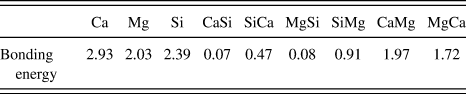
a represents the energy of the removed atom at its elemental solid. The larger the bonding energy of an atom, the harder it is to be removed because it has a stronger interaction with surrounding atoms, thus vacancy is more difficult to form. From Table I, one can see that the Mg atom has the lowest bonding energy, showing that the Mg atom is most likely to form vacancy. Because the bonding energy decreases from SiCa to CaSi and from SiMg to MgSi, indicating a gradually weak interaction of antisite defects with surround atoms, so the stability decreases from SiCa to CaSi, and from SiMg to MgSi. The bonding energies of MgCa and CaMg are relatively large, and the difference between MgCa and CaMg is very small, indicating that MgCa and CaMg interact strongly with the surrounding atoms, and the formation of antisite defects MgCa and CaMg are very possible. The above results are consistent with the defect formation energies.
The calculated bonding energy of point defects (eV) in MgCaSi.

C. The geometric distortion around the point defects
Generally, geometrical and electronic factors would play a crucial role in the stability and formation of point defects. The off-stoichiometry leaves nonzero Hellman–Feynman forces on the atoms around the defect sites. Reference Alayeabbas, Nazir, Noor, Amin and Shaukat40 As a consequence, bond lengths of nearest neighbors (NN) atoms may change depending on the strength of interactions between neighboring atoms. Moreover, the above results of the defect formation energies have demonstrated that the atomic radius mismatch inevitably affects the properties of point defects. For the purpose of fully revealing the influence of the geometrical factor on the formation of point defects, the local geometrical distortion around point defects is also further studied.
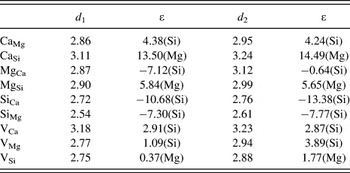
Since structural relaxation around defects occurs in a short range, the calculated NN distance (d 1) and the second NN distance (d 2) in pristine MgCaSi and the percentage ε of the bond length variation around the defects are listed in Table II. For CaMg, the nearest neighbor Si atom and the second-nearest Si atom move away, and the increased distance between the nearest CaMg–Si is slightly larger than one between the second-nearest CaMg–Si. For CaSi, the neighboring Mg atoms move away from the CaSi site. The extended distance between the second-nearest CaSi–Mg is larger than the one between nearest CaSi–Mg. The above elongation variations can be understood because the atomic radius of Ca is larger than that of Mg and Si (Ca = 1.97 Å, Mg = 1.60 Å, and Si = 1.34 Å). For MgCa, the nearest neighbor Si atom contracts inward about 7.12%, and the second-nearest Si atom relaxes inward about 0.64%. Therefore, compared with the perfect MgCaSi, the neighboring Si atom moves closer to the Mg antisite atom because of the smaller atomic radii of Mg. For MgSi, because the radius of the Mg atom is larger than the radius of the Si atom, the nearest neighbor and second adjacent Mg atoms are far away from the MgSi site, and the distance change between MgSi and the nearest adjacent Mg atoms is greater than the one between MgSi and the second adjacent Mg atoms. For SiCa and SiMg, the neighboring Si atoms move closer to the SiCa and SiMg site because the smaller Si antisite atoms at Ca and Mg sublattice after relaxation. The distance change SiCa–Si is larger than SiMg–Si. From the above analysis, for the antisite defect, because of large antisite atoms at a small sublattice, the distances of CaMg–Si, CaSi–Mg, and MgSi–Mg become longer, implying that the neighboring atoms move away from the antisite atoms after full relaxation. On the contrary, because of small antisite atoms at a large sublattice, the distances MgCa–Si, SiCa–Si, and SiMg–Si decrease compared with the perfect MgCaSi structure. Evidently, these variations in the bond lengths reveal that the radii of the defect atoms have an evident impact on local atomic geometry.
The bond lengths (Å) between the point defects and adjacent atoms, and the percentage ε of the variations with respect to the perfect MgCaSi. d i gives the distance to the ith nearest adjacent and + and − denote, respectively, the elongation and contraction. First- and second-nearest neighbors to the point defects are shown in parenthesis.

Furthermore, for big antisite atoms at a small sublattice, the local geometric distortions around antisite defects increase from CaMg, MgSi to CaSi defect, evidently the geometrical distortions are consistent with the energetic results because the formation energy of CaSi is the highest, followed by MgSi and CaMg. For small antisite atoms at a big sublattice, the local geometric distortions around the antisite defect from the MgCa, SiMg to SiCa defect gradually increase, which exhibits an evidently opposite trend of energetic results, because the formation energy of SiCa is the highest, followed by SiMg and MgCa. This shows that the simple geometrical parameters are insufficient to describe the stability of antisite defective MgCaSi.
For VCa, the nearest and second-nearest Si atoms move away from the vacancy site, the larger distance change for the nearest VCa–Si than that for the second-nearest VCa–Si implies that the interaction of the nearest atom with original Ca is stronger. For VMg and VSi, the nearest and second-nearest atoms also keep away from the vacancy site, the distance change from the second-nearest neighbor atoms to the vacancy site is larger than that of the first nearest neighbor atoms to the vacancy site. The result may be owing to the electro-statically interaction of surrounding atoms. Reference Shao, Shi, Zheng, Pan and Tang41 Overall, the local geometric distortions around the vacancy decrease in the order of VCa, VMg, and VSi. Also this is not completely consistent with the energy results because under Si-rich conditions, VSi has the highest defect formation energy, followed by VCa and VMg. This also indicates that the electronic factor would play a more crucial role for vacancy defect structures of MgCaSi. For a better understanding of the defect structures observed in the MgCaSi compound, the electronic structure of the defected compound should be further considered.
D. Electronic structure
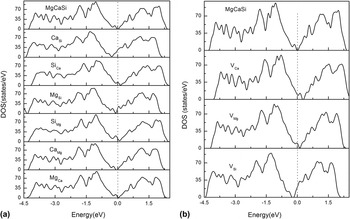
The electronic structure is clearly related to the structure of materials and mechanical properties, so further affects the formation and structure of point defects; therefore, the electronic structure in the defective system is studied. The density of states (DOS) offers crucial information on the stability and bonding feature, so the DOS of all kinds of defected system is computed and compared with one of the perfect MgCaSi, and the results are shown in Fig. 3. Obviously, there is a local minimum near the Fermi energy in all structures, this energy valley is called pseudo-gap, which can unambiguously distinguish the bonding states in a low-energy area near the Fermi level and the antibonding states in the high-energy region. Reference Zheng, Tian, Wei, Shao, Pan and Tang14,Reference Li, Zhang, Zeng, Wang, Cheng, Ren and Guan42 The pseudo-gap of DOS near the Fermi energy is associated to the stability of materials. The lower DOS at the Fermi level, the higher the stability, Reference Zheng, Tian, Wei, Shao, Pan and Tang14,Reference Lue, Su, Xie and Cheng43 whereas the larger departure of the Fermi level from the bottom of the pseudo-gap indicates that the stability of the system is lower. From Fig. 3, the pseudo-gap in perfect MgCaSi is deeper and the Fermi level is nearly at the bottom of pseudo-gap, so perfect MgCaSi is stable.
The total DOS (a) perfect and antisite defects and (b) perfect and vacancy defects.

In comparison with the perfect MgCaSi, the DOS of defective system demonstrates the subtle difference. From Fig. 3(a), for CaSi, MgSi, and CaMg, the Fermi level moves from the pseudo-gap valley to the right hand side, the departure of the Fermi level from the bottom of the pseudo-gap for CaSi is the largest, followed by MgSi and CaMg, indicating the gradually higher stability from CaSi and MgSi to CaMg. For SiCa, SiMg, and MgCa, the Fermi level moves from the pseudo-gap valley to the left hand side, the deviation of the Fermi level from the bottom of the pseudo-gap for SiCa is the largest, followed by SiMg and MgCa, suggesting a gradually higher stability from SiCa and SiMg to MgCa. The deviation of the Fermi level from the bottom of the pseudo-gap for CaMg and MgCa is very little, so the MgCa and CaMg defects can have high stability. The above results are in agreement with the relative stability from the energetic results. For vacancy defects in Fig. 3(b), the Fermi level moves from the pseudo-gap valley to the right for VSi, while the Fermi level moves strongly toward the left for VCa, VMg, and the deviation of the Fermi level from the bottom of the pseudo-gap gradually decreases from VSi and VCa to VMg, indicating a gradually higher stability from VSi and VCa to VMg. This is also consistent with the results of defect formation energies.
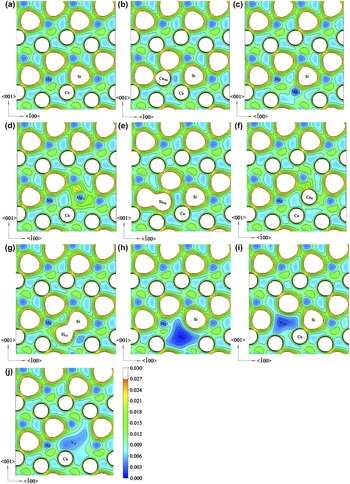
To gain more insight into the electronic structure due to the formation of point defects, the deformation charge densities of perfect and defective MgCaSi structure on the (010) plane are studied and presented in Fig. 4. From Fig. 4(a), one can see clearly that in perfect crystal, the Ca–Si, Mg–Si and Si–Si bonding possess a characteristic of covalent bonding due to the obvious overlap of charge distribution. Moreover, the obvious difference value of charge density around Mg and Ca atom indicates that the bond of Mg–Ca exhibits ionicity of covalence feature. The Ca–Ca bonding is mostly metallic owing to the relatively uniform charge distribution.
The deformation charge densities on the (010) planes of perfect and defective MgCaSi: (a) perfect structure, (b) CaMg anti-site, (c) MgCa anti-site, (d) MgSi anti-site, (e) SiMg anti-site, (f) CaSi anti-site, (g) SiCa anti-site, (h) Ca vacancy, (i) Mg vacancy, and (j) Si vacancy.

From Fig. 4, it can be seen that far away from the point defect, the deformation charge densities are very similar to the perfect structure, indicating that point defects possess obvious local effects that only affect the local charge distribution. For CaMg and MgCa, it can be seen from Figs. 4(b) and 4(c) that the strength of the covalent bonding CaMg–Si and Ca–Si around CaMg is higher than Mg–Si and MgCa–Si around MgCa, while the strength of Si–Si covalent bonding around MgCa is higher than that around CaMg, so the stability of MgCa and CaMg is comparative. For MgSi and SiMg, as shown in Figs. 4(d) and 4(e), the strength of the covalent bonding Mg–Si around MgSi is lower than that of SiMg–Si around SiMg, and the MgSi–Ca ionic bonding around MgSi is lower than the Si–Ca covalent bonding around SiMg, so the stability of MgSi is weaker than that of SiMg. For CaSi and SiCa, as shown in Figs. 4(f) and 4(g), the metallic bonding CaSi–Ca around CaSi is weaker than that of the covalent bonding SiCa–Si around SiCa, so the stability of CaSi is weaker than that of SiCa. The result is consistent to the above description of DOS and defect formation energies. For vacancy defective systems in Figs. 4(h)–4(j), the charge distributions around vacancy defects are redistributed, and the shapes of the electronic cloud are deformed, and the charge around VSi is deformed most obviously, followed by one around VCa and VMg, so the stability is increased from VSi and VCa to VMg. The result is consistent with the energetic calculation. So the electronic structure plays a significant role in the defected system in comparison with the geometric factors.
IV. CONCLUSIONS
Nine point defects in MgCaSi, at three independent 4c Wyckoff positions of Mg, Ca, and Si, are investigated systematically within the DFT framework. Due to the significant influence of the chemical potential on formation energies of point defects, we first determine the valid limits of complex atomic chemical potentials. The calculated defect formation energies of antisite defects exhibit a tendency to increase from SiCa to CaSi, from SiMg to MgSi, and from the MgCa to CaMg defect. And MgCa is the most energetic in Mg-rich conditions, while CaMg is dominant at the Ca-rich condition, indicating that the defect structure depends on the chemical potentials. For vacancy defects, in both-metal-poor conditions, Mg vacancy is favorable. The definition of bonding energy is first proposed to reveal further the intrinsic feature of defect formation energies. The calculated atomic geometry exhibits that for big antisite atoms at a small sublattice, the local geometric distortion around the antisite defect increases gradually from the CaMg, MgSi to CaSi defect, and evidently the geometrical distortion exhibits a similar tendency to the defect stability of the energetic results, while for small antisite atoms at a big sublattice, the prediction from geometrical distortion and energetic results show the opposite trend. The pseudo-gap feature of DOS indicates the gradually higher stability from CaSi and MgSi to CaMg, and from SiCa and SiMg to MgCa. The further studied charge density reasonably reveals that defect stabilities have a tendency to decrease from SiCa to CaSi, from SiMg to MgSi, and from the MgCa to CaMg defect. So the electronic structure plays a significant role for formation of point defects and the structure.
ACKNOWLEDGMENT
This work was supported by the Natural Sciences Foundation of China under Grant No. 51461002.