INTRODUCTION
Several species in the phyla Porifera, Cnidaria, Acoelomorpha, Platyhelminthes, Mollusca and Chordata have photosynthetic microorganisms as symbionts (Barneah et al., Reference Barneah, Brickner, Hooge, Weis, LaJeunesse and Benayahu2007; Venn et al., Reference Venn, Loram and Douglas2008). These animals obtain photosynthetic metabolites from the symbionts (mostly single-celled dinoflagellates, green algae, diatoms, or cyanobacteria), for survival, growth, or reproduction (Hoegh-Guldberg et al., Reference Hoegh-Guldberg, Hinde and Muscatine1986; Wägele & Johnsen, Reference Wägele and Johnsen2001; Little et al., Reference Little, van Oppen and Willis2004; Venn et al., Reference Venn, Loram and Douglas2008; Serôdio et al., Reference Serôdio, Silva, Ezequiel and Calado2011). Sacoglossan opisthobranchs also show such photosynthetic symbiosis but in a manner that is unique within the animal kingdom: they incorporate the chloroplasts from food algae into their own cells to perform photosynthesis (functional kleptoplasty) (Kawaguti & Yamasu, Reference Kawaguti and Yamasu1965; Hinde & Smith, Reference Hinde and Smith1975; Gallop et al., Reference Gallop, Bartrop and Smith1980; Clark et al., Reference Clark, Jensen and Stirts1990; Evertsen et al., Reference Evertsen, Burghardt, Johnsen and Wägele2007; Rumpho et al., Reference Rumpho, Worful, Lee, Kannan, Tyler, Bhattacharya, Moustafa and Manhart2008; Evertsen & Johnsen, Reference Evertsen and Johnsen2009).
The extent and duration of kleptoplast retention varies greatly among sacoglossan species, from immediate digestion to more than 11 months of retention (Clark et al., Reference Clark, Jensen and Stirts1990; Evertsen et al., Reference Evertsen, Burghardt, Johnsen and Wägele2007; Evertsen & Johnsen, Reference Evertsen and Johnsen2009; Händeler et al., Reference Händeler, Grymbowski, Krug and Wägele2009; Pelletreau et al., Reference Pelletreau, Bhattacharya, Price, Worful, Moustafa and Rumpho2011). For instance, Evertsen et al. (Reference Evertsen, Burghardt, Johnsen and Wägele2007) recognized eight levels of kleptoplasty based on the duration of retention: sacoglossans at levels 1–3 cannot maintain functional chloroplasts (corresponding to ‘non-functional kleptoplasty' in Händeler et al., Reference Händeler, Grymbowski, Krug and Wägele2009); those at levels 4–5 maintain functional kleptoplasts for up to 1 week (‘short-term kleptoplasty’); and those at levels 6–8 maintain them longer than 1 week (‘long-term kleptoplasty').
Chloroplasts comprise many proteins that are encoded by nuclear genes to maintain their functions, and some nuclear genes from the algae have actually been transferred horizontally to the sacoglossan genome (Rumpho et al., Reference Rumpho, Worful, Lee, Kannan, Tyler, Bhattacharya, Moustafa and Manhart2008; Schwartz et al., Reference Schwartz, Curtis and Pierce2010; Pelletreau et al., Reference Pelletreau, Bhattacharya, Price, Worful, Moustafa and Rumpho2011). However, such genes appear to be too few to support the functions of chloroplasts, and until now, no evidence exists for the presence of algal nuclei in sacoglossan cells (Pelletreau et al., Reference Pelletreau, Bhattacharya, Price, Worful, Moustafa and Rumpho2011). Thus, how kleptoplasts remain functional over time is an enigma, and most studies focus on the genetic, microscopic, or physiological mechanisms responsible for this phenomenon (e.g. Gallop et al., Reference Gallop, Bartrop and Smith1980; Clark et al., Reference Clark, Jensen and Stirts1990; Rumpho et al., Reference Rumpho, Worful, Lee, Kannan, Tyler, Bhattacharya, Moustafa and Manhart2008, Reference Rumpho, Pelletreau, Moustafa and Bhattacharya2011; Händeler et al., Reference Händeler, Grymbowski, Krug and Wägele2009; Schwartz et al., Reference Schwartz, Curtis and Pierce2010; Pelletreau et al., Reference Pelletreau, Bhattacharya, Price, Worful, Moustafa and Rumpho2011; Wägele et al., Reference Wägele, Deusch, Händeler, Martin, Schmitt, Christa, Pinzger, Gould, Dagan, Klussmann-Kolb and Martin2011).
The role of kleptoplasty in sacoglossans has received comparatively less attention. The presence of chloroplasts in sacoglossans might be advantageous to reproduction or crypsis (due to the green colour) of the hosts (Wägele & Johnsen, Reference Wägele and Johnsen2001; Händeler et al., Reference Händeler, Grymbowski, Krug and Wägele2009), but virtually no studies have tested these possibilities. Several researchers have examined the role of photosynthesis in survival or size changes (sometimes gains but, in most cases, losses) of sacoglossans by rearing them under light or dark conditions. For instance, the wet weight of Elysia viridis (kleptoplasty level 7 in Evertsen et al., Reference Evertsen, Burghardt, Johnsen and Wägele2007) adults tended to be heavier when reared under light conditions than under dark conditions (Hinde & Smith, Reference Hinde and Smith1972, Reference Hinde and Smith1975). Similarly, higher survival and/or larger body sizes were suggested for Plakobranchus ocellatus (level 8) (Dunlap, Reference Dunlap1975) and E. cauze (level 6) (Clark et al., Reference Clark, Busacca, Stirts and Stancyk1979) in light versus dark conditions. These results imply that kleptoplasts are utilized by sacoglossans as a means of obtaining substantial nutrients, with relatively long-term functional kleptoplasty. However, these early studies either lack statistical tests or the experimental design involves pseudo-replication. Recently, Trowbridge (Reference Trowbridge2000) used sound statistics but did not detect significant effects of light conditions in recently metamorphosed, juvenile E. viridis. Giménez Casalduero & Muniain (Reference Giménez Casalduero and Muniain2008) studied E. timida (level 7) and used two-way analysis of variance (the light level and duration of the experiment as the independent variables), but the main effect of light was not significant either for survival or size changes (although their interaction was significant). Thus, positive roles of photosynthesis for sacoglossans have not been well supported statistically or objectively. In addition, the photosynthetic effects in sacoglossans with shorter-term chloroplast retention have not been studied thus far. Therefore, it is unclear whether photosynthesis actually benefits sacoglossans, especially for species with short-term retention. Because kleptoplasty first evolved as short-term retention (Händeler et al., Reference Händeler, Grymbowski, Krug and Wägele2009), information on species with short retention is crucial when we consider the evolutionary causes of kleptoplasty. Furthermore, previous rearing studies were conducted under various temperature, light, or rearing conditions, making it difficult to compare the results among species. No studies have compared survival or size changes of two or more sacoglossan species under similar experimental conditions, with the exception of Williams (Reference Williams2000).
To clarify the roles of photosynthesis in sacoglossans, we studied two species, Elysia trisinuata Baba, 1949, and Plakobranchus ocellatus van Hasselt, 1824 (‘type 1' sensu Adachi, Reference Adachi1991, or ‘black type’ sensu Trowbridge et al., in preparation, which is a new species). These are among the most common sacoglossans in Japan and co-occur in several localities. Both species are known to utilize chloroplasts for photosynthesis (Yamamoto et al., Reference Yamamoto, Yusa, Yamamoto, Hirano, Hirano, Motomura, Tanemura and Obokata2009), but the extent of their dependence on photosynthesis or the duration of functional chloroplast retention is unknown for both E. trisinuata and the ‘black type' of P. ocellatus. However, P. ocellatus (sensu lato) is one of the species exhibiting the highest retention level (level 8; chloroplast retention for more than 11 months: Dunlap, Reference Dunlap1975; Evertsen et al., Reference Evertsen, Burghardt, Johnsen and Wägele2007), whereas the retention period of E. trisinuata appears to be much shorter, judging from a more rapid change in body colour (from green to pale brown) during rearing without algal food (within several days). The objectives of this study were to investigate: (i) the effects of photosynthesis on the survival and relative weight in E. trisinuata and P. ocellatus under starved conditions; and (ii) whether the species differences, if any, are related to differences in the chloroplast retention period between the two sacoglossans.
MATERIALS AND METHODS
Field collection
The individuals of Elysia trisinuata used for the rearing experiment were collected at Banshozaki Cape, Shirahama, Wakayama, Honshu, Japan (33°41′N 135°20′E), in August and September of 2009. The animals were collected while we were walking or snorkelling in the intertidal or subtidal zones shallower than 2 m relative to the mean sea level. The population was composed of adult specimens late in the reproductive season at this study site. The collection site comprises both rock platforms and sandy beaches with many thalli of the green algae Codium cylindricum Holmes, C. subtubulosum (Okamura) and C. fragile (Suringar) Hariot. To quantify the algal abundance roughly, we performed 5-minute collections by snorkelling twice (each within the area of approximately 100 m2) and found 1976 ± 23 g (mean ± standard error (SE)) of Codium spp. We collected 56 individuals of E. trisinuata on the thalli of Codium spp. (mostly C. cylindricum), and we did not notice individuals on other substrata. In addition, 12 individuals of E. trisinuata were collected from Codium spp. in May 2010 (early reproductive season) at the same site to measure the temporal changes of chlorophyll fluorescence.
The individuals of Plakobranchus ocellatus used for both rearing and fluorescence measurements were collected in the intertidal or subtidal zones (<2 m) at Toguchi Beach, Yomitan, Okinawa, Japan (26°22′N 127°44′E), in December of 2009. Although reproductive ‘black type' P. ocellatus individuals were present year-round in Okinawa (Adachi, Reference Adachi1991), December was the season when large individuals were most abundant (personal observation). The site is a beach with coral sand and cobbles and relatively few green macroalgae. We made five 5-minute collections, but none of the algae reported as food for P. ocellatus were found, including Rhipidosiphon javensis Montagne, Caulerpella ambigua (Okamura) Prud’homme van Reine & Lokhorst, or Chlorodesmis hildebrandtii A. Gepp et E. S. Gepp (Dunlap, Reference Dunlap1975; see also Wägele et al., Reference Wägele, Deusch, Händeler, Martin, Schmitt, Christa, Pinzger, Gould, Dagan, Klussmann-Kolb and Martin2011). Other macroalgae except for Ulva spp. were scarce. We found 113 individuals of P. ocellatus directly on the sand or cobbles, 51 of which (45%) were resting, whereas most of the remaining individuals were in motion.
The individuals of each sacoglossan species were maintained in an aquarium with approximately 10 l natural seawater and food algae (C. cylindricum for E. trisinuata and R. javensis for P. ocellatus) for 3 days until the beginning of the experiments; an exception was for the P. ocellatus used to measure the chlorophyll fluorescence, which had to be kept for approximately 1 month prior to the experiment due to the limitation of laboratory space. In either case, these sacoglossans were reared with aeration under natural light near a window at approximately 25°C.
Rearing experiment
Both adult E. trisinuata and P. ocellatus were individually reared in 500 ml containers (diameter of 90 mm; height of 120 mm) with 400 ml artificial seawater (Acute Premium Salt; Gex, Osaka). Individuals of each species were maintained under two different light conditions. One (‘light treatment') group was reared under a 14-hours light:10-hours dark photoperiod, and the other (‘dark treatment') group was reared under 24-hours darkness, both at 25 ± 1.5°C (range). This rearing temperature was determined based on the annual temperature ranges at both of the collection sites (the monthly values in 2009 ranged from 16 to 28°C in Shirahama and from 20 to 30°C in Yomitan: Japan Meteorological Agency, http://www.data.kishou.go.jp/kaiyou/db/kaikyo/dbindex.html). The containers for the dark treatment were wrapped with aluminium foil, whereas the containers for the light treatment were not wrapped. The containers of both groups were placed randomly in the rearing chamber. Illumination was provided by fluorescent lamps for growing plants (the bulbs encompassed the natural spectrum of wavelengths; FL40S·BRN-A; Toshiba, Tokyo), with an irradiance level of 28 µmol m−2s−1 at the water surface. Although most of the previous studies used irradiance levels from 15 (Klochkova et al., Reference Klochkova, Han, Kim, Kim and Kim2010) to 200 µmol m−2s−1 (Giménez Casalduero & Muniain, Reference Giménez Casalduero and Muniain2006, 2008), the relatively low irradiance level in this study was chosen based on preliminary experiments using E. trisinuata that showed that the fluorescence-based light response curves were nearly saturated at this level (see also Giménez Casalduero & Muniain, Reference Giménez Casalduero and Muniain2006) and that the mortality rates became greater at higher irradiance levels.
The number of E. trisinuata and P. ocellatus individuals reared under the light treatment was 22 and 27, and it was 24 and 28 under the dark treatment, respectively. No food was provided to the individuals during the experiment, and the seawater in the containers was continuously aerated and changed every 3 or 4 days. The experiments were conducted for 21 days. Although spawning was infrequently observed in both species, it was not quantified because the individuals were reared singly and this would have greatly affected their reproductive patterns.
The individuals were monitored for survival, and their wet weight was recorded every 7 days; the animals were gently placed on and wrapped with paper towel for 2 seconds to remove any excess water and then weighed to the nearest 0.0001 g. The wet weight is a reliable measure of size in sacoglossans (Trowbridge, Reference Trowbridge1991); furthermore, there was a high correlation between two consecutive wet weight measurements of the same E. trisinuata individuals (r 2 = 0.97, P < 0.001, N = 17; personal observation).
Measurement of chlorophyll fluorescence
The photosynthetic activity of the two sacoglossan species was assessed by the measurement of the chlorophyll fluorescence yield using pulse-amplitude-modulated (PAM) fluorometry. Using a MINI-PAM fluorometer (Heinz Walz GmbH, Germany), we measured the ΔF/Fm′ value, which is the effective quantum yield of photosystem II measured using light-adapted samples (Vieira et al., Reference Vieira, Calado, Coelho and Serôdio2009). PAM fluorometry has the benefit of measuring samples non-destructively and in situ and is widely used for sacoglossans (Williams, Reference Williams2000; Evertsen et al., Reference Evertsen, Burghardt, Johnsen and Wägele2007; Evertsen & Johnsen, Reference Evertsen and Johnsen2009; Händeler et al., Reference Händeler, Grymbowski, Krug and Wägele2009; Yamamoto et al., Reference Yamamoto, Yusa, Yamamoto, Hirano, Hirano, Motomura, Tanemura and Obokata2009; Jesus et al., Reference Jesus, Ventura and Calado2010). A preliminary experiment using the same individuals of E. trisinuata showed that there was no significant difference in the ΔF/Fm′ (light-adapted) and Fv/Fm (dark-adapted) values (paired t = 1.52, P = 0.17, N = 7).
Individuals of both species were reared either with or without food (N = 6 each for E. trisinuata and N = 5 each for P. ocellatus). Other conditions were the same as in the rearing experiment, including a light intensity of 28 µmol m−2s−1 under a 14-hour light:10-hour dark photoperiod. ΔF/Fm′ was measured at the beginning and after 4, 11 and 18 days of the experiment for E. trisinuata and at the beginning and after 4, 12, and 17 days for P. ocellatus. On each occasion, the individual sacoglossan was placed on a plastic Petri dish (85 mm in diameter) without seawater, and a cover glass was gently placed on the sacoglossan so as not to squish it. Then, the PAM probe (5 mm diameter) that irradiates the light was set directly on the cover glass. Actinic light (7 µmol m−2s−1; default value) was applied for 30 seconds for each sacoglossan individual with its parapodia closed. This procedure was repeated three times at intervals of 2–3 minutes, and the highest ΔF/Fm′ value was used for the analyses because the movement of the sea slug during the measurements often resulted in extremely low values (especially for small E. trisinuata individuals).
Statistical analyses
The wet weight was expressed as a value relative to the initial weight (= final weight/initial weight) and compared between the light and dark treatments. To ensure statistical independence of the data, only the final values were compared between the two treatments, both in the rearing experiment (relative weight) and fluorescence measurement (ΔF/Fm′). However, because the fluorescence decreased rapidly in E. trisinuata, the ΔF/Fm′ values on day 4 were additionally compared between treatments. The relative weights and ΔF/Fm′ values were compared between the treatments using Student's t-tests after checking the normality of the residuals and homogeneity of the variances. If these assumptions were not met even after various transformations, Mann–Whitney's U-tests were employed. Differences in the survivorship (whether dead or alive) between the light and dark treatments were tested by likelihood ratio Chi-squared (χ2) tests. All of the statistical analyses were conducted using JMP version 8.0 (SAS Institute, Cary, North Carolina).
RESULTS
Survival rate
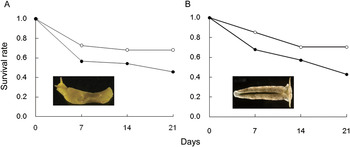
In Elysia trisinuata, the survival rate in the light was 0.68 (= 15/22) and 0.46 (= 11/24) in the dark after 21 days of the rearing experiment (Figure 1A); the difference between the treatments was not statistically significant (likelihood ratio χ2 = 2.36, P = 0.13). In Plakobranchus ocellatus, the survival rate in the light was 0.70 (= 19/27) and 0.43 (= 12/28) in the dark (Figure 1B); a significant difference was detected (likelihood ratio χ2 = 4.29, P = 0.038).
Survival rates of two sacoglossan species reared under a light or dark condition: (A) Elysia trisinuata; (B) Plakobranchus ocellatus. Open circles indicate the light treatment (14-hour light: 10-hour dark), and filled circles indicate the dark treatment (24-hour dark).

Relative wet weight
The initial wet weight of the E. trisinuata individuals reared under the light treatment was 0.0235 ± 0.0021 g (mean ± SE, N = 22) and that under the dark treatment was 0.0227 ± 0.0020 g (N = 24). In P. ocellatus, the initial weights in the light and dark were 1.11 ± 0.07 g (N = 27) and 1.09 ± 0.07 g (N = 28), respectively. There was no difference in the initial weights between the treatments (U = 270, P = 0.83 in E. trisinuata; U = 384, P = 0.81 in P. ocellatus).
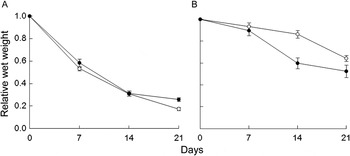
In E. trisinuata, the wet weight relative to the initial weight decreased greatly (Figure 2A); furthermore, the wet weight was significantly smaller, not greater, in the light (mean = 0.17) than in the dark (0.26) after 21 days (t = −4.00, P < 0.001). The relative wet weight of P. ocellatus tended to remain larger than that of E. trisinuata (Figure 2B). Furthermore, the relative weight of P. ocellatus was significantly larger in the light than in the dark after 21 days (t = 2.08, P = 0.046).
Change in the relative wet weight (mean ± SE) of individuals of two sacoglossan species reared under a light or dark condition: (A) Elysia trisinuata; (B) Plakobranchus ocellatus. Open circles indicate the light treatment (14-hour light: 10-hour dark), and filled circles indicate the dark treatment (24-hour dark).

Measurement of chlorophyll fluorescence
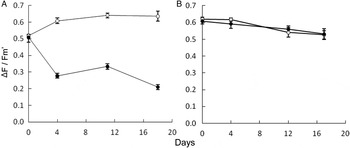
There was no difference in the initial weight between the two treatments either in E. trisinuata (0.0203 ± 0.0014 g with food and 0.0204 ± 0.0017 g without food; mean ± SE; Student's t-test; t = −0.08, P = 0.94) or in P. ocellatus (0.397 ± 0.054 g with food and 0.397 ± 0.046 g without food; t = 0.01, P = 0.99). The ΔF/Fm′ value for E. trisinuata decreased rapidly from greater than 0.5 to less than 0.3 by day 4 in individuals without food (Figure 3A), whereas the value for the individuals with food remained greater than 0.5 for 18 days. The ΔF/Fm′ values for the E. trisinuata individuals without food were significantly lower than those for the individuals with food on day 18 (t = 10.83, P < 0.001) and was 41% of the original value. A significant difference was already detected on day 4 (t = 16.10, P < 0.001). In P. ocellatus, the ΔF/Fm′ did not decrease much in 17 days, irrespective of the food condition (Figure 3B), and the decrease was almost linear. The final value without food was 87% of the initial value, and there was no significant difference between the individuals with food and those without food on day 17 (t = −0.13, P = 0.90).
The ΔF/Fm′ values (mean ± SE) of two sacoglossan species with or without food algae: (A) Elysia trisinuata; (B) Plakobranchus ocellatus. Open circles indicate individuals with food, and filled circles indicate individuals without food.

DISCUSSION
The survival rate of Elysia trisinuata was not significantly higher in the light than in the dark in our rearing experiments. Moreover, the relative wet weights of individuals were smaller, not greater, in the light than in the dark. These results indicate that photosynthesis is not important for the survival and retention of body weight of E. trisinuata under a starved condition. This conclusion is consistent with the result that only the starved individuals decreased photosynthetic activity (ΔF/Fm′) to less than 0.5 in 4 days. In sacoglossans, Fv/Fm values greater than 0.5 are generally regarded as photosynthetically active (Evertsen et al., Reference Evertsen, Burghardt, Johnsen and Wägele2007; Händeler et al., Reference Händeler, Grymbowski, Krug and Wägele2009; Yamamoto et al., Reference Yamamoto, Yusa, Yamamoto, Hirano, Hirano, Motomura, Tanemura and Obokata2009), and there was no significant difference between the ΔF/Fm′ and Fv/Fm values in this study. Thus, the photosynthetic activity of E. trisinuata corresponds to level 5 (functional kleptoplasts lasting for 1–7 days) in Evertsen et al. (Reference Evertsen, Burghardt, Johnsen and Wägele2007) and ‘short-term retention' in Händeler et al. (Reference Händeler, Grymbowski, Krug and Wägele2009).
The greater relative weight of E. trisinuata in the dark than in the light was unexpected, but we offer two explanations. First, essentially, chloroplasts cannot be reproduced in sacoglossans (Hinde & Smith, Reference Hinde and Smith1975). Furthermore, the chloroplasts themselves (Hinde & Smith, Reference Hinde and Smith1975; Vieira et al., Reference Vieira, Calado, Coelho and Serôdio2009) and many components of photosystems (Warner et al., Reference Warner, Fitt and Schmidt1999; Klochkova et al., Reference Klochkova, Han, Kim, Kim and Kim2010) are deteriorated by light. Such degraded components might be detrimental and may have injured the sacoglossans in the light. In fact, the E. trisinuata individuals reared in the light appeared to become unhealthy and turned pale brown in colour earlier than those reared in the dark. Second, E. trisinuata might be more active in the light and consume more energy than the animals in the dark, and this might have resulted in a decrease in their wet weight. However, this is unlikely because a preliminary experiment showed that there was no difference in the proportion of active E. trisinuata individuals in the light and dark (t = 0.81, P = 0.44, N = 11 observation times).
Temporal or spatial variation in food availability, especially the scarcity of food algae, has been invoked as a factor affecting the duration of kleptoplast retention or the dependence on photosynthesis by sacoglossans (Hinde & Smith, Reference Hinde and Smith1975; Clark & Busacca, Reference Clark and Busacca1978; Waugh & Clark, Reference Waugh and Clark1986; Clark & DeFreese, Reference Clark and DeFreese1987; Clark et al., Reference Clark, Jensen and Stirts1990; Marin & Ros, Reference Marin and Ros1993; Evertsen et al., Reference Evertsen, Burghardt, Johnsen and Wägele2007). In the present study, the short duration of functional kleptoplast retention and the lack of photosynthesis effects in E. trisinuata might also be related to food availability under natural conditions. The food algae (Codium spp.) of E. trisinuata occurred abundantly in the field, and the E. trisinuata individuals were always found attached to the algae. Trowbridge et al. (Reference Trowbridge, Hirano and Hirano2008) also reported similar close associations between E. trisinuata and Codium spp. throughout the year on the Pacific Coast of Honshu Island, Japan. Therefore, starvation due to lack of food is unlikely to occur in E. trisinuata, and, thus, the individuals need not depend much on photosynthetic energy.
In Plakobranchus ocellatus, the survival rate was significantly higher, and the relative weight of living individuals was greater, in the light than in the dark. The survival rate was not very high (70% in 21 days) even in the light, possibly due to water fouling by using small containers for housing this relatively large sacoglossan. Even so, the results indicate that photosynthesis is important for both survival and the maintenance of body weight in this species. In accordance with this, there was no significant difference in the ΔF/Fm′ values between P. ocellatus with known algal food and those without food after 17 days, indicating that the function of the chloroplasts was maintained for a long time even in the absence of food. Although we could not completely exclude the possibility that some P. ocellatus individuals did not feed during the experiment, the high ΔF/Fm′ value for 17 days without food directly indicates a long-term retention of kleptoplasts.
The food macroalgae of P. ocellatus were uncommon, and the individuals occurred directly on the sand or cobbles in their habitat. Dunlap (Reference Dunlap1975) made similar but more detailed observations: P. ocellatus individuals (although probably of a different ‘type') were never observed feeding on macroalgae throughout the year in Hawaii. However, she noted that P. ocellatus appeared to feed on microalgae in the sand. Although it is possible that, in the present study, some of the individuals that were ‘resting' with their heads in the sand were also feeding on microalgae, the proportion of individuals ‘resting' on the sand was not high (45%) when compared with the proportion of E. trisinuata on the food algae (100%). Apparently it is difficult for P. ocellatus to find sufficient food. Thus, P. ocellatus would benefit greatly from the long-term retention of functional chloroplasts and from the dependence on photosynthesis for survival and growth.
In conclusion, the retention of functional chloroplasts was short in E. trisinuata, and there were no positive effects of photosynthesis on the survival or weight retention of this species. Plakobranchus ocellatus had a much longer chloroplast retention period, and photosynthesis had positive effects on the survival and maintenance of the body weights. However, similar experiments using juveniles (Trowbridge, Reference Trowbridge2000), other food algae, or individuals from other populations are required to confirm our results. Moreover, these two sacoglossans differ in various aspects, including taxonomic positions, food algae and life cycles. The chloroplast retention period and most likely the effects of photosynthesis on life history traits vary among sacoglossan species (Clark & Busacca, Reference Clark and Busacca1978; Clark et al., Reference Clark, Jensen and Stirts1990; Evertsen et al., Reference Evertsen, Burghardt, Johnsen and Wägele2007; Evertsen & Johnsen, Reference Evertsen and Johnsen2009; Händeler et al., Reference Händeler, Grymbowski, Krug and Wägele2009; Yamamoto et al., Reference Yamamoto, Yusa, Yamamoto, Hirano, Hirano, Motomura, Tanemura and Obokata2009; Maeda et al. Reference Maeda, Kajita, Maruyama and Hirano2010). Thus, other sacoglossans, including more closely related species, should be compared using standardized experimental conditions, and their environmental factors, including food availability and quality, should be studied in the field. Such investigations will elucidate the selection pressures that have acted in the evolution of functional kleptoplasty in the Sacoglossa.
ACKNOWLEDGEMENTS
We thank Professor K. Wada and the anonymous referees for their critical reading of the manuscript and members of the Laboratory of Population and Community Ecology, Nara Women's University for their help and advice. This research received no specific grant from any funding agency or commercial or not-for-profit sectors.