1. Introduction
Recently, we have begun to uncover a population of BHs that do not merge or accrete; they are ‘dormant’ BHs. One of the methods to detect dormant BHs is in star-BH (S-BH) binaries via the astrometric movement of the star. In this regard, the Gaia mission has been key to uncovering these systems, with a confirmed detection of three dormant BHs, with many more such systems expected to be discovered in the next Gaia Data Release (DR4).
From the discovered dormant BHs, Gaia BH3 stands out. It consists of a massive BH (
 $m_{\mathrm{BH}} = 33\,\mathrm{{\rm M}_\odot}$
) in a wide, eccentric orbit with an extremely metal-poor, low-mass giant star. Gaia BH3 is remarkably close to the Sun (
 $590\,\mathrm{pc}$
), in an orbit around the Milky Way (MW) halo associated with the ED-2 stellar stream (Balbinot et al. Reference Balbinot, Helmi and Callingham2023; Balbinot et al. Reference Balbinot, Dodd and Matsuno2024), which formed from a now-dissolved star cluster. The BH is more massive than any other (stellar-origin) BH detected in the MW, and is close to the median BH mass detected via GWs (see Fig. 3 in Mar n Pina et al. 2024). This binary bridges the populations of BHs detected via electromagnetic measurements and GWs, and understanding its formation pathway can provide constraints on the populations of binaries with BHs and the formation of GW sources.
There are two competing explanations for the origin of Gaia BH3 : either it was formed from the quasi-isolated evolution of a binary of stars (e.g., Iorio et al. Reference Iorio, Torniamenti and Mapelli2024; El-Badry Reference El-Badry2024), or it formed via dynamical interactions in the progenitor cluster of the ED-2 stream (Mar n Pina et al. 2024). In this contribution, we present models of the progenitor cluster of the ED-2 stream and show that the effect of dynamics in the formation of Gaia BH3 can not be neglected, therefore favouring a dynamical over a quasi-isolated formation scenario.
2. Methods
We show preliminary results of the simulations of the ED-2 progenitor cluster from Marn Pina et al. (in prep, MP25 hereafter). These simulations are run using the high-performance N-body code petar (Wang et al. Reference Wang, Iwasawa and Nitadori2020). We initialise all models using a Plummer (Reference Plummer1911) density profile with a Kroupa (Reference Kroupa2001) initial mass function (IMF) between
 $0.08\,\mathrm{{\rm M}_\odot}$
and
 $150\,\mathrm{{\rm M}_\odot}$
. We fix the (approximate) dissolution time of the cluster to
 $t_{dis}\in[4, 8]\,\mathrm{Gyr}$
, and then use different values of initial cluster mass and half-mass density within the constraints imposed by Balbinot et al. (Reference Balbinot, Dodd and Matsuno2024),
 $2\times 10^3 \lesssim M_0/{\rm M}_\odot \lesssim 5.2\times 10^4$
(see MP25 and Gieles and Gnedin Reference Gieles and Gnedin2023).
These models are run both with and without a primordial binary population (originated as part of the cluster formation process). For the models with primordial binaries, we pair up all stars above
 $5\,\mathrm{{\rm M}_\odot}$
using the Sana and Evans (2011) period and eccentricity distributions. Then, we pair lower-mass stars using the Duquennoy and Mayor (Reference Duquennoy and Mayor1991) period distribution and a thermal eccentricity distribution until we reach an initial binary fraction of
 $f_b=0.4$
. We assume a metallicity equal to that of the Gaia BH3 star,
 $\mathrm{[Fe/H]} = -2.56$
.
We evolve the cluster until
 $13\,\mathrm{Gyr}$
, where single and binary stars are evolved with bseEmp (Tanikawa et al. Reference Tanikawa, Yoshida and Kinugawa2020). The cluster is evolved in a Milky Way-like potential using the mwpotential2014 in galpy (Bovy Reference Bovy2015). The initial conditions are such that, after
 $13\,\mathrm{Gyr}$
, the centre of mass of the cluster matches the current position of Gaia BH3.
3. Formation of the ED-2 stream
To verify that our simulations are representative of the parent cluster of the ED-2 stream, we compare the streams formed in our simulations to the ED-2 Gaia data reported in Balbinot et al. (Reference Balbinot, Helmi and Callingham2023). Since the cluster is old (
 $t\gtrsim 13\,\mathrm{Gyr}$
, Balbinot et al. Reference Balbinot, Dodd and Matsuno2024), it must have undergone several orbits around the Milky Way. Since there are many uncertainties associated with the evolution of the galactic potential, our goal is not to match the shape of the observed stream exactly, but rather to show that our models dissolve and form a stream similar to ED-2.
Because the cluster is dissolved, most stars are dispersed through the Galaxy and are faint. To account for detectability, we convert the output of our simulations to the Gaia G magnitudes using the corrections from Flower (Reference Flower1996); Torres (Reference Torres2010); Jordi et al. (Reference Jordi, Gebran and Carrasco2010). We then limit our sample to stars above the G-band limits of the ED-2 sample from Balbinot et al. (Reference Balbinot, Helmi and Callingham2023).
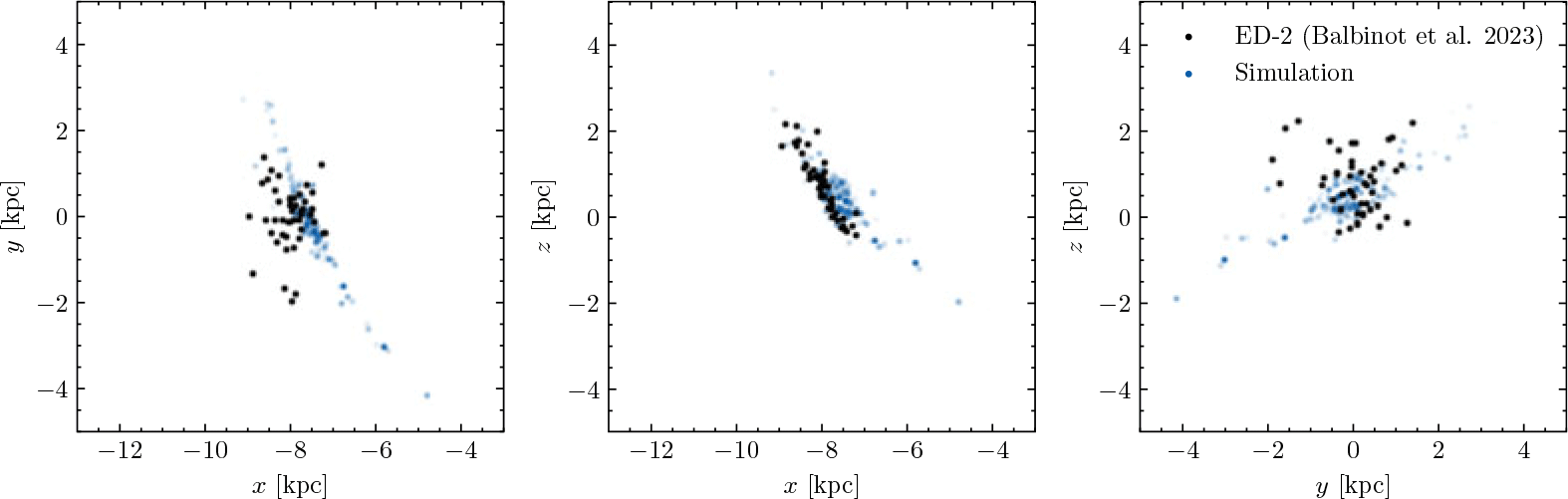
In Fig. 1, we show the result of one of our simulations that dissolved
 $5\,\mathrm{Gyr}$
ago, and the members of ED-2 from Balbinot et al. (Reference Balbinot, Helmi and Callingham2023). The data qualitatively match the output of the simulations, which shows that the simulations are representative of the ED-2 progenitor.
Positions of the stars of the ED-2 stream in Galactocentric cartesian coordinates. In black, Gaia data from Balbinot et al. (Reference Balbinot, Helmi and Callingham2023). In blue, a simulation with
 $M_0=7.7\times 10^3\,\mathrm{{\rm M}_\odot}$
and
 $\rho_{h, 0}=760 \,\mathrm{{\rm M}_\odot}\,\mathrm{pc}^{-3}$
, with each star coloured according to its magnitude.

4. The origin of Gaia BH3
In the previous section, we showed that our models of GCs dissolve in the Gaia BH3 orbit and form streams similar to ED-2, therefore showing that Gaia BH3 formed in the ED-2 progenitor cluster. In a cluster, we distinguish the following formation channels for Gaia BH3 :
-
• ‘primordial’, where the binary originated as part of the cluster formation process, but interactions with other stars, BHs, and binaries significantly altered its properties;
-
• ‘exchange’, where the BH formed in a primordial binary but exchanged its companion star via dynamical interactions;
-
• ‘dynamical’, where the binary was assembled from a previously-unbound star and a BH via dynamical interactions.
In the following Sections, we determine the most likely formation channel for Gaia BH3 and explore whether dynamical interactions have a significant effect on the formation of S-BH systems in the ED-2 stream progenitor, thereby testing a quasi-isolated formation scenario for Gaia BH3. We stress, however, that all S-BH formed from primordial binaries in the cluster simulations undergo multiple strong interactions.
4.1 Formation of Gaia BH3 in the ED-2 progenitor
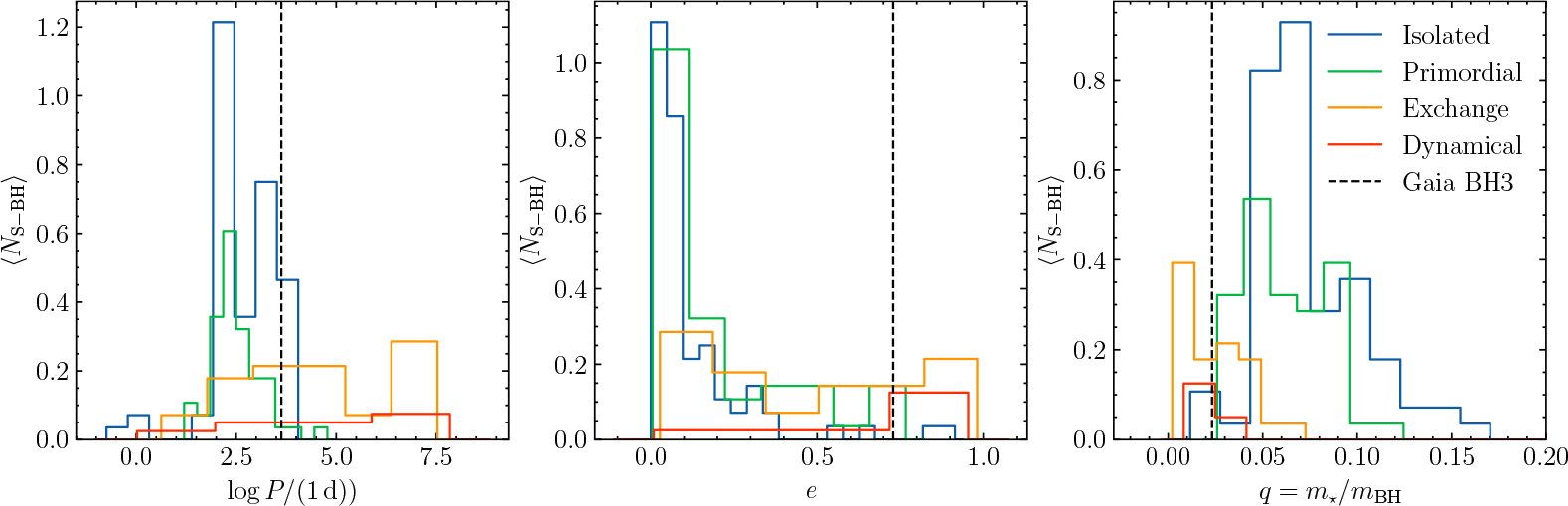
Here we estimate the likelihood of the different formation scenarios. For the first two scenarios, we use the cluster models with primordial binaries, separating the S-BH depending on whether they were paired up at the beginning of the simulation. For the third formation scenario, we use our models without primordial binaries. The distribution of the parameters of S-BH in our simulations is shown in Fig. 2.
Average number of S-BH binaries per cluster in our simulations as a function of the logarithm of the period (left), the eccentricity (middle), and the mass ratio (right). In green and yellow, the primordial and exchanged (respectively) S-BH formed in simulations with primordial binaries; in red, the dynamical S-BH formed in simulations without primordial binaries; in blue, the S-BH formed from primordial binaries extracted from the simulations and evolved in isolation; in dashed black, the parameters of Gaia BH3.

To separate the most likely formation scenario, we compute the marginal probabilities (posteriors)
 $P(\text{prim}\,|\,\theta_G)$
,
 $P(\text{exc}\,|\,\theta_G)$
, and
 $P(\text{dyn}\,|\,\theta_G)$
, with
 $\theta_G=\{\log P, e, q\}$
the measured parameters of Gaia BH3. Each posterior represents the probability that Gaia BH3 formed in its respective scenario. Using Bayesian statistics, we have
 \begin{align}{P(\text{dyn}\,|\,\theta_G)=\frac{P(\theta_G\,|\,\text{dyn})P(\text{dyn})}{P(\theta_G\,|\,\text{prim})P(\text{prim})+P(\theta_G\,|\,\text{exc})P(\text{exc})+P(\theta_G\,|\,\text{dyn})P(\text{dyn})}}\end{align}
Here,
 $P(\text{prim})$
,
 $P(\text{exc})$
, and
 $P(\text{dyn})$
are the respective priors.
 $P(\theta_G\,|\,\text{dyn})$
is the probability density function (PDF) of the parameters found in the dynamical channel, evaluated at
 $\theta_G$
. The priors are computed from the total number of S-BH systems per cluster; the PDF is computed via a Kernel Density Estimation (KDE). The posteriors for the other channels are computed using the same approach.
On average, there are significantly more S-BH systems in clusters with primordial binaries. In general,
 $P(\text{prim})\gg P(\text{dyn})$
and
 $P(\text{exc})\gg P(\text{dyn})$
. In our Bayesian analysis, the posteriors are
 $P(\text{prim}\,|\,\theta_G)=8\%$
,
 $P(\text{dyn}\,|\,\theta_G)=3\%$
, and
 $P(\text{exc}\,|\,\theta_G)=89\%$
. We conclude that the most likely scenario is that Gaia BH3 formed as an exchange S-BH binary.
4.2 Could Gaia BH3 have formed in quasi-isolation?
In the previous Section, we showed that Gaia BH3 most likely formed from a primordial binary in the ED-2 progenitor cluster that exchanged its companion star. We now test the effect that dynamical interactions in the cluster had on shaping the properties of the binaries. This is akin to asking if Gaia BH3 could have formed in quasi-isolation, as proposed in e.g. Iorio et al. (Reference Iorio, Torniamenti and Mapelli2024); El-Badry (Reference El-Badry2024).
To test the quasi-isolated channel, we have extracted all binaries at the start of our cluster simulations and evolved them in isolation. We have used the same binary stellar evolution code as in the cluster simulations, so that all differences are strictly due to dynamical interactions. In Fig. 2, we show the properties of binaries evolved in isolation, as well as those found at the end of our cluster simulations.
As expected, we find that dynamics significantly modifies the S-BH binaries formed in the models. About
 $\sim 40\%$
of S-BH binaries in clusters have undergone at least one exchange of the companion star. From the binaries that do not exchange their companions, their distributions are skewed towards smaller periods and eccentricities. Furthermore, the S-BH binaries in our simulations undergo a median of 84 strong binary-single interactions and 9 strong binary-binary interactions. These data reject a quasi-isolated approach to studying the formation of Gaia BH3.
5. Conclusions
In this paper, we present part of the simulations of MP25. We show that the likely progenitor of the ED-2 stream is a now-dissolved GC, with a mass within the uncertainties of Balbinot et al. (Reference Balbinot, Dodd and Matsuno2024). We show that Gaia BH3 likely formed from a primordial binary of the ED-2 cluster that exchanged its companion star via dynamical encounters. We neglect the possibility that Gaia BH3 formed as a dynamical binary from a previously-unbound BH and a star due to the low rates of this channel. Furthermore, we show that the properties of primordial S-BH binaries in the ED-2 progenitor cluster are modified by dynamical interactions. We, therefore, recommend being cautious when interpreting the comparison of isolated binary models to the observed properties of Gaia BH3.
Acknowledgements
DMP and MG acknowledge financial support from the grants PRE2020-091801, PID2021-125485NB-C22, PID2024-155720NB-I00, CEX2019-000918-M, CEX2024-001451-M funded by MCIN/AEI/10.13039/501100011033 (State Agency for Research of the Spanish Ministry of Science and Innovation).
 M0=7.7×10³M⊙
 ρh,0=760M⊙pc−3