Implications
Circannual day length in Nordic regions may affect bovines’ ability to form vitamin D3, thus limiting the animal's ability to absorb dietary calcium. Calcium activates μ-calpain, aiding in post-mortem proteolysis and the tenderisation process during meat ageing. The μ-calpain activity was similar between steers supplemented vitamins A, D3 and E at Swedish recommended levels and non-supplemented steers during winter indoor or outdoor grazing finishing programmes. Warner–Bratzler shear force assessment of meat tenderness did not differ between supplemented and non-supplemented steers. Meat quality from vitamin supplemented and non-supplemented animals was similar, suggesting vitamin supplementation was not necessary under these trial conditions.
Introduction
Meat tenderness has been identified as the key criterion for assessing meat preference by consumers (Morgan et al., Reference Morgan, Savell, Hale, Miller, Griffin, Cross and Shackelford1991). To improve meat quality and consumer acceptance, research has focused on identifying factors that affect post-slaughter tenderisation. Post-slaughter proteolytic activity is a natural enzymatic-induced tenderising process involving the breakdown of cross-linkages between muscle myofibrillar proteins. The biochemistry involved during the post-slaughter tenderisation process has been reviewed by Koohmaraie and Geesink (Reference Koohmaraie and Geesink2006).
Calpains consist of a group of proteolytic proteins that are activated in the presence of calcium. Two proteins, μ- and m-calpain, have been identified as the most likely candidate proteases responsible for myofibrial degradation and protein turnover in growing animals (Goll et al., Reference Goll, Thompson, Taylor and Ouali1998). The μ- and m-calpain designations relate to the intracellular molar calcium concentration at which they are activated; the calpains begin to autolyse once activated (Goll et al., Reference Goll, Thompson, Li, Wei and Cong2003). The estimated calcium concentration required to achieve half-activity has been shown to be in the range of 3 to 50 μM and 400 to 800 μM for μ- and m-calpain, respectively (Goll et al., Reference Goll, Thompson, Taylor and Ouali1998). The calcium requirement for the calpains to reach half-activity has been shown to be reduced during autolysis (Dayton, Reference Dayton1982).
Although μ- and m-calpain share many similar characteristics in growing animals, evidence has indicated that only μ-calpain is extensively involved in post-mortem proteolysis of bovine tissue (Koohmaraie and Geesink, Reference Koohmaraie and Geesink2006). This finding was based on the observed post-mortem μ-calpain reduction in bovine muscle, whereas m-calpain was stable (Koohmaraie et al., Reference Koohmaraie, Seidemann, Schollmeyer, Dutson and Crouse1987). Calpastatin has been identified as a specific inhibitor common to the calpains that regulates the calpain activity by binding to the calcium molecule once the calpain has been activated, see review by Goll et al. (Reference Goll, Thompson, Li, Wei and Cong2003).
Earlier studies have shown that the activity of μ-calpain can be enhanced by increasing the calcium concentrations in the muscle tissue. The association between plasma 25-hydroxyvitamin D3 (25-OH D3), which is converted to 1,25-OH D3 in the kidneys, and the absorption of dietary calcium has long been established (DeLuca, Reference DeLuca1974). Higher plasma 1,25-OH D3 concentrations have been shown to increase the production of calcium-binding protein in the small intestine, facilitating the absorption of calcium (National Research Council, 1984).
Studies have focused on optimising the conditions to increase post-mortem μ-calpain activity. Ante-mortem dietary supplementation with D3 has been shown to increase the amount of calcium sequestered by the muscle tissue and to improve muscle tenderness when supplemented continuously before slaughter in beef steers (Swanek et al., Reference Swanek, Morgan, Owens, Gill, Strasia, Dolezal and Ray1999; Montgomery et al., Reference Montgomery, Parrish, Beitz, Horst, Huff-Lonergan and Trenkle2000). However, single doses fed days before slaughter (Lawrence et al., Reference Lawrence, Doyle, Elliott, Loxton, McMeniman, Norton, Reid and Tume2006) or on single occasions further from slaughter (Wertz et al., Reference Wertz, Knight, Trenkle, Sonon, Horst, Huff-Lonergan and Beitz2004), have not been effective in increasing post-slaughter tenderisation. Post-slaughter proteolytic activity has been shown to be stimulated via injecting CaCl2, increasing meat tenderness (Wheeler et al., Reference Wheeler, Koohmaraie, Lansdell, Siragusa and Miller1993).
Most studies have focused on improving the meat quality from intensively reared beef production systems, specifically through therapeutic vitamin D3 supplementation, with little attention placed on smaller scale, more extensive, finishing programmes. To our knowledge, there has been no research on how diets not supplemented with vitamins A, D3 and E at recommended levels affects meat quality, specifically meat tenderness. Moreover, northern latitudes experience circannual variations in ultraviolet (UV) sunlight exposure, limiting the animals’ ability to synthesise vitamin D3. Seasonal variations in vitamin requirements may play a significant role in animal performance that may subsequently affect meat quality. The objective of this trial was to determine whether current Swedish recommended vitamins A, D3 and E supplementation levels are vital to the meat quality of steers finished indoors on silage and concentrates or when finished on semi-natural pastures.
Material and methods
Animal feeding and housing
Swedish Red breed steers from a previous vitamin trial (Hymøller et al., Reference Hymøller, Jensen, Lindqvist, Johansson, Nielsen and Nadeau2009) were divided into vitamin supplemented (n = 12) and non-supplemented (n = 15) groups while on pasture before the finishing period. This trial started at the beginning of November when the steers were moved indoors and began the finishing phase. The steers remained in their groups, either being provided with 100 g mineral supplement (Lactamin Inc., Stockholm, Sweden) that included 400 000 IU vitamin A, 100 000 IU vitamin D3 and 3000 IU vitamin E daily, as recommended for Swedish production practices (Spörndly, Reference Spörndly2003) or the same mineral without vitamins A, D3 and E. During the winter indoor period, the steers were fed a 55 : 45 DM barley : grass-clover silage total mixed ration (12.0 MJ ME/kg DM, 361 g NDF/kg DM, 119 g CP/kg DM). Individual steers were slaughtered at a target live weight of 630 kg. The indoor finished group was comprised of vitamin supplemented (n = 6) and non-supplemented (n = 8) steers slaughtered between 27 February and 18 June, after an average of 155 days on feed. The outdoor finished vitamin supplemented (n = 6) and non-supplemented (n = 7) steers were fattened past the target weight then turned out to pasture to compensate for the expected weight loss at the start of pasture. This was done to ensure all animals reached the target live weight by the end of the grazing season. Steers finished outdoors were turned out to pasture (10.2 MJ ME/kg DM, 533 g NDF/kg DM, 143 g CP/kg DM) on 25 April and slaughtered between 18 June and 25 September, averaging 103 days of grazing. The pasture consisted mainly of open Deschampsia cespitosa/Agrostis capillaries/Festuca ovina meadows. Animal weight was averaged from two consecutive weigh days just before slaughter. Conformation and fatness classifications were measured according to the EUROP grading system on the day of slaughter along with carcass weight.
Slaughter sample collection
At slaughter, a core sample (10 g) was removed between the 10th and 11th rib from the left Musculus longissimus dorsi (LD) 40 min post-exsanguination and frozen in liquid nitrogen for subsequent calpain/calpastatin analysis. Entire left-side loins were collected from the steers 24 h after slaughter, were vacuum packed and transported at 5°C to Uppsala, Sweden. At 48 h post-slaughter, the pH of the LD was measured and a 2-cm slice was collected and stored at −80°C for vitamins A and E and lipid analysis. The remaining LD was divided into 3-cm sections, re-vacuum packed and aged at 5°C for 2, 7 or 14 days post-slaughter then frozen at −20°C until analysis. Drip loss percentage was calculated as the difference between initial and final thawed weight divided by initial weight. Cooking loss percentage was calculated as the difference between initial raw and final cooked weight divided by initial raw weight.
Warner–Bratzler shear force
Shear force samples were thawed for 24 h at 5°C before heat treatment in a 72°C water bath to an internal temperature of 70°C. Samples were cooled in running water to room temperature before Warner–Bratzler shear force (WB-SF) analysis as described by Honikel (Reference Honikel1998). Heat-treated meat samples were cut into 1 × 1 × 3 cm strips parallel to the muscle fibre for analysis. Maximum and total force measurements were based on the average of 12 samples from each animal and ageing time measured perpendicular to the muscle fibre using a Texture Analyser HD 100 (Stable Micro Systems Inc., Surry, UK) equipped with a WB-SF blade. Blade dimensions include a cutting area of 11 × 15 mm with a blade thickness of 1-mm; blade speed was 0.83 mm/s.
μ-, m-Calpain and calpastatin extraction
Calpains and calpastatin were extracted as described by Pomponio et al. (Reference Pomponio, Lametsch, Karlsson, Costa, Grossi and Ertbjerg2008) with modifications. Briefly, 1.5 g frozen tissue was thawed slightly, then homogenized while on ice for 2 × 30 s in 15 ml cold extraction buffer (50 mM Tris-base; 5 mM disodium ethylenediaminetetraacetate dehydrate (EDTA); 10 mM monothioglycerol, pH 8.0). Homogenate was centrifuged at 1.5 × 10⁴ × g for 30 min at 4°C. Then, 1 ml supernatant was transferred to an eppendorf tube, heat treated for 5 min at 100°C followed by centrifugation at 2.0 × 10⁴ × g for 8 min at 4°C. An aliquot of the heat-treated supernatant was transferred to an eppendorf tube and stored at −20°C until calpastatin analysis. Remaining non-boiled supernatant was mixed to form an 11% glycerol suspension and stored at −80°C until calpain activity analysis.
Casein zymography separation of μ- and m-calpain
Separation of μ- and m-calpain was carried out as described by Pomponio et al. (Reference Pomponio, Lametsch, Karlsson, Costa, Grossi and Ertbjerg2008). Previously extracted supernatant was thawed, mixed 1 : 1 with sample buffer (300 mM Tris, 40% glycerol, 200 mM dithiothreitol, 0.02% bromophenol blue, pH 6.8). Pre-cast gels (12.5% casein gels, Bio-Rad Laboratories, Hercules, CA, USA) were pre-conditioned for 15 min at 80 V in running buffer (25 mM Tris, 4 mM CaCl2, 192 mM glycine, 1 mM EDTA, pH 8.3). To each well, 15 μl diluted supernatant was applied and then run at 80 V for 3 h at 4°C. Next, gels were rinsed with de-ionized water and then agitated for 30 min in 100 ml incubation buffer (50 mM Tris, 4 mM CaCl2, 10 mM monothioglycerol, pH 7.5). Gels were then placed in 100 ml stopper buffer (20 mM Tris, 10 mM EDTA). Gels were stained overnight with colloidal Coomassie Brilliant Blue G, and then rinsed with de-ionized water repeatedly. Quantitative comparisons were measured using the density of reference standards. The reference standards were represented on each gel and the average was assigned the arbitrary value of 1. Band density was measured using LabScan UMAX PowerLook 1120 (Amersham Bioscience, Buckinghamshire, UK) analysing images with the Phoretix 1D version 2003.02 (Nonlinear Dynamics, Newcastle upon Tyne, UK).
Calpastatin analysis
Calpastatin was quantified by inhibition of m-calpain at various dilutions as described by Ertbjerg et al. (Reference Ertbjerg, Henckel, Karlsson, Larsen and Moller1999) and using partly purified m-calpain from bovine LD. Briefly, an aliquot of previously heat-treated supernatant in a total volume of 50 μl was added to 50 μl of 4 U/ml m-calpain followed by 300 μl casein substrate. The reaction was stopped with the addition of 400 μl 10% trichloroacetic acid. One unit (1U) calpastatin activity was defined as the amount that inhibited one unit m-calpain activity. One unit of m-calpain activity was defined as an increase in absorbance at 278 nm of 1.0 per hour at 25°C.
Lipid extraction
Tissue samples were separated from surrounding adipose tissue and extracted for intramuscular lipid content. Lipid extraction followed a modified Hara and Radin (Reference Hara and Radin1978) procedure by separately homogenizing 5 g of fresh muscle tissue in 75 ml HIP (hexane : isopropanol, 3 : 2, v/v) using an Ultra-Turrax. To remove non-lipids, 32.5 ml of 6.67% Na2SO4 was added to the homogenate. The solvent was evaporated and lipid determined gravimetrically.
Vitamin analysis
Vitamin A (retinol) and vitamin E (α-tocopherol) content of fresh muscle was determined according to the procedure of Högberg et al. (Reference Högberg, Pickova, Babol, Andersson and Dutta2002) with modification. Briefly, 20 mg lipid was suspended in 2 ml 99% ethanol while on ice. To each tube, 1.2 ml of 20% ascorbic acid, 0.6 ml methanol and 1.2 ml of 17.9 M KOH was added, vortexing thoroughly between additions. Samples were placed in a 70°C agitating water bath for 20 min. Samples were cooled on ice, then extracted with 3 ml hexane twice. Samples were evaporated, then suspended in 300 μl mobile phase and applied directly to the HPLC. Mobile phase consisted of 95% acetonitrile : methanol (1 : 1, v/v) and 5% CHCl3 with a flow rate of 1.2 ml/min. The HPLC column was a 4.0 × 250 mm RP-18 LiChroCART (Merck KGaA, Darmstadt, Germany). Quantifications of retinol and α-tocopherol were done by comparison to an external standard (Calbiochem, La Jolla, CA, USA). Retinol and α-tocopherol were identified at an excitation wavelength of 290 nm and 344 nm, respectively, and with an emission wavelength of 327 nm and 472 nm, respectively.
Plasma 25-OH D3
Initial plasma samples were collected at the beginning of the indoor housing period previously reported by Hymøller et al. (Reference Hymøller, Jensen, Lindqvist, Johansson, Nielsen and Nadeau2009). Final plasma samples were collected on the day of slaughter and analysed at the Faculty of Agricultural Sciences (Aarhus University, Tjele, Denmark) according to the procedure described by Hymøller et al. (Reference Hymøller, Jensen, Lindqvist, Johansson, Nielsen and Nadeau2009). Briefly, 2 ml plasma was mixed with 150 ng internal standard, 1-α hydroxyvitamin D3 (Fluka Chemie AG, Buschs, Switzerland). To each sample, 2.0 ml 96% ethanol, 0.5 ml methanol, 1.0 ml 20% ascorbic acid and 0.3 ml 50% KOH were added. Samples were saponified in an 80°C water bath for 20 min. Samples were cooled and extracted with 2 × 5.0 ml heptane. Extracted samples were centrifuged at 1500 × g for 10 min to facilitate separation. Recovered heptane was evaporated under N2 then re-suspended in 200 μl 90% methanol and centrifuged at 1500 × g for 10 min before transferring to micro vials. Quantification of 25-OH D3 was done by HPLC (UltiMate 3000, Dionex Corp., Sunnyvale, CA, USA) fitted with an YMC C30 column (250 × 4.6 mm i.d., 5 μm particle size, YMC Europe GmbH, Dinslaken, Germany) equipped with UV detector set at a fixed wavelength of 265 nm. Flow rate of 1.0 ml/min with acetonitrile/methanol/H2O and a gradient from 3/87.4/9.6% to 97/3/0% during 45 min. Data were integrated using the Chromelion version 6.80 software (Dionex Corp., USA).
Preparation of fatty acid methyl esters (FAME)
Lipid extracts were methylated according to the procedures described by Appelqvist (Reference Appelqvist1968). To each sample, 15 μg of methyl-15-methylheptadecanoate (Larodan Fine Chemicals, Malmö, Sweden) was added as an internal reference standard. First, 2 ml 0.01 M NaOH in dry methanol was added, shaken and placed in a 60°C heating block for 10 min. Next, 3 ml 20% BF3 reagent (Merck KGaA, Germany) was added and the samples were reheated for 10 min. Once cooled to room temperature, 2 ml 20% NaCl and 2 ml hexane were added. Test tubes were shaken, then centrifuged at 600 × g for 5 min to facilitate separation of the solvent. The organic solvent was recovered, then evaporated under nitrogen gas; recovered FAME were dissolved in hexane and stored at −80°C until analysed.
Gas chromatography
Analysis of FAME were conducted by GLC CP3800 (Varian AB, Stockholm, Sweden) equipped with flame ionisation detector using a 50-m fused silica capillary column BPX 70 (id. 0.22 mm, 0.25 μm film thickness; SGE, TX, USA) equipped with an auto-injector with a split ratio set at 1 : 5. Column temperature was programmed to start at 130°C hold for 5 min, then increase 2°C/min from 158°C to 220°C then hold for 8 min. Injector temperature was 230°C and detector temperature was 250°C. Individual FAs were identified by retention time comparison to a standard sample (GLC-461, Nu-Chek Prep Inc., MN, USA). Peak areas were integrated using Star Chromatography Workstation software version 5.5 (Varian AB, Stockholm, Sweden). The carrier gas was helium (22 cm/sec, flow rate 0.8 ml/min) and nitrogen was used as the make-up gas.
Statistical analysis
Measured parameters were analysed by ANOVA using the MIXED Procedure of Statistical Analysis Software (SAS; 2002) with vitamin supplemented v. non-supplemented as fixed effects separate for the two independent finishing programmes. Results are reported as differences between the least square means, with the standard error (s.e.) at a significance level of P < 0.05. When comparing different ageing times within each sub-group (finishing programme and vitamin supplementation) for drip and cooking loss and WB-SF, animal was included as a random factor. Influence of vitamin supplementation on meat quality was analysed within finishing programme due to factors inherent to the trial design, such as animal age and diet nutrient composition, which would confound comparisons of the measured attributes.
Results
Slaughter results and tenderness
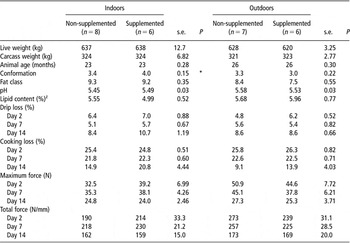
Carcass conformation and characteristics from vitamins A, D3 and E supplemented and non-supplemented steers finished either inside or outdoors on pasture are presented in Table 1. At the respective slaughter points, vitamin supplemented and non-supplemented steers did not differ with regard to live weight or carcass weight. For the inside finishing programme, the vitamin supplemented steers had a higher carcass conformation grade than non-supplemented steers (P < 0.05). Supplemented groups did not differ for outdoor, pasture finished steers. Fat class scores were similar between supplemented groups within their respective indoor or outdoor groups. Vitamin supplemented groups did not differ with regard to lipid content, pH, drip loss or cooking loss percentage for meat aged 2, 7 or 14 days for either indoor or outdoor finished animals. Overall, maximal force or total energy values did not differ between vitamin supplemented groups for either indoor or outdoor finished animals. Shear force values within each group were similar day 2 and 7 with a significant decrease by day 14 (results not shown).
Carcass characteristics of Musculus longissimus dorsi from steers fed indoors or outdoors, with (supplemented) or without (non-supplemented) vitamins A, D3 and E supplementation during the finishing period

Conformation = EUROP grading system describing muscle definition, 3 = P+ and 4 = O−; higher number means more muscling.
Fat class = EUROP grading system describing fat cover, 7 = 3− and 9 = 3+, higher number means thicker fat cover.
Level of significance where *P < 0.05.
zLipid content based on percent extract from M. longissimus dorsi used for lipid analysis.
μ-, m-Calpain and calpastatin analysis
Activity of μ-calpain and m-calpain did not differ between vitamins A, D3 and E supplemented and non-supplemented animals finished either indoors or outdoors (Table 2). Calpastatin activity for vitamin supplemented animals was significantly higher than that the non-supplemented animals finished indoors (P < 0.05), whereas no difference was found in calpastatin activity between vitamin supplemented groups for the outdoor finished animals.
μ-Calpain, m-calpain and calpastatin activity in Musculus longissimus dorsi from steers fed indoors or outdoors, with (supplemented) or without (non-supplemented) vitamins A, D3 and E supplementation during the finishing period

Level of significance where **P < 0.01.
zMean densities of μ- and m-calpain bands from samples are expressed relative to the mean density of reference standards within each gel.
Vitamin analysis
Vitamin 25-OH D3 content in the plasma was known to differ between the two supplement groups at the start of winter housing (Table 3). Plasma vitamin 25-OH D3 content was higher for vitamins A, D3 and E supplemented steers measured at slaughter for the indoor finishing animals. Plasma vitamin 25-OH D3 content did not differ for the animals finished outdoors on pasture. Vitamin E content was significantly higher from the indoor vitamins A, D3 and E supplemented steers than non-supplemented steers when analysed on a wet-tissue basis and when corrected for lipid content (P < 0.05). Vitamin E content did not differ between supplemented and non-supplemented steers finished outdoors on pasture. Vitamin A content was unaffected by vitamin supplementation regardless of indoor or outdoor finishing programmes when expressed as mg/100 g fresh tissue or adjusted for lipid content.
Plasma 25-hydroxyvitamin D3(25-OH vitamin D3) concentration pre-trial and at slaughter and vitamin A and E content of Musculus longissimus dorsi from steers fed indoors or outdoors, with (supplemented) or without (non-supplemented) vitamins A, D3 and E supplementation during the finishing period
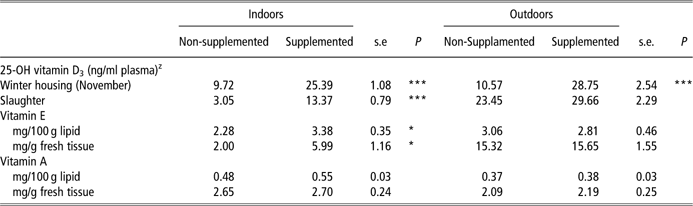
Level of significance where *P < 0.05; ***P < 0.001.
z25-OH vitamin D3 analysis provided by Hymøller L. et al. (unpublished data).
FA profile
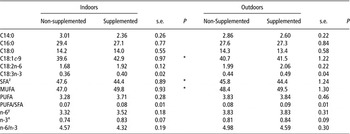
Minor variations in FA composition were observed among vitamins A, D3 and E supplemented and non-supplemented animals within their respective indoor or outdoor finishing programmes (Table 4). The only significant effects observed were a higher proportion of 18:1c-9 and a concurrent increase in then total monounsaturated fatty acid level from indoor supplemented steers compared with non-supplemented steers (P < 0.05). A corresponding decrease in the proportion of the total saturated fatty acid (SFA) was also present in the profile of indoor supplemented steers. The outdoor finished animals FA profile did not differ significantly between the supplement groups.
Comparison of FA profiles (% identified) of Musculus longissimus dorsi from steers fed indoors or outdoors, with (supplemented) or without (non-Supplemented) vitamins A, D3 and E supplementation during the finishing period

FA = fatty acid; SFA = saturated fatty acids; MUFA = monounsaturated fatty acids; PUFA = polyunsaturated fatty acids.
Level of significance where *P < 0.05.
zSummed total of identified SFA; MUFA; PUFA.
yn-6 = C18:2n-6 + C20:3n-6 + C20:4n-6.
xn-3 = C18:3n-3 + C20:5n-3 + C22:5n-3 + C22:6n-3.
Discussion
Regardless of the finishing programme, WB-SF maximum and total force values were not affected between vitamins A, D3 and E supplemented and non-supplemented animals after each ageing time point. During the ageing process, overall meat tenderness as assessed by WB-SF varied between what would be deemed ‘tender’ (22 to 35 N) and ‘intermediate tenderness’ (50 to 53 N) as defined by Boleman et al. (Reference Boleman, Boleman, Miller, Taylor, Cross, Wheeler, Koohmaraie, Shackelford, Miller, West, Johnson and Savell1997). Regardless of variations in tenderness between ageing times, after 14 days of ageing, supplemented and non-supplemented groups from both the indoor and outdoor finishing programmes would be deemed tender by consumers. No other differences in assessed meat quality characteristics were apparent suggesting that not supplementing vitamins A, D3 and E during the finishing programme did not affect meat quality.
The higher carcass conformation achieved by the indoor vitamins A, D3 and E supplemented group indicated a more prominent muscle definition of the carcass. Differences in the FA profile of indoor finished animals, as well as the calpastatin results, suggest that vitamin supplementation may slightly affect muscle development positively. The higher calpastatin activity of the indoor vitamins A, D3 and E supplemented animals, along with equivalent μ- and m-calpain activity between the indoor groups, would suggest a slower rate of protein turnover, leading to accumulation of protein, that is, muscle growth, of the vitamin supplemented animals (Goll et al., Reference Goll, Thompson, Taylor and Ouali1998). Moreover, the increased C18:1c-9 level together with the decreased SFA level would suggest higher Δ-9 desaturase activity. Smith et al. (Reference Smith, Lunt, Chung, Choi, Tume and Zembayashi2006) reported increased desaturase gene expression during periods of adipocyte differentiation as found during muscle growth and that gene expression may depend more on post-weaning weight than on energy intake. Although Daniel et al. (Reference Daniel, Salter and Buttery2004) reported that vitamin A supplementation can stimulate Δ-9 desaturase activity, leading to higher proportions of C16:1c-9 and C18:1c-9, such effects would not be relevant to this trial because vitamin A content was not affected by vitamin supplementation in either the indoor or outdoor finishing programmes.
The difference in plasma 25-OH D3 between supplemented groups present at the start of the trial (Hymøller et al., Reference Hymøller, Jensen, Lindqvist, Johansson, Nielsen and Nadeau2009) remained at the indoor finishing period slaughter point. However, UV light exposure during the outdoor pasture finishing programme was sufficient to equalise the plasma 25-OH D3 concentrations between outdoor vitamins A, D3 and E supplemented and non-supplemented animals. Equivalent plasma 25-OH D3 concentrations would suggest that the supplemented and non-supplemented animals did not differ in their ability to sequester Ca2+ from the diet; thus, no differences in post-mortem tenderisation processes related to the μ-calpain activation should exist. Although not measured in this experiment, a Ca2+ concentration of 1400 μg/g in beef tissue, achieved by soaking the tissue in a 150 mM CaCl solution, was effective in inducing calpain activity, leading to improved meat tenderness (Gerelt et al., Reference Gerelt, Rusman, Nishiumi and Suzuki2005). In addition, Cena et al. (Reference Cena, Jaime, Beitran and Roncales1992) showed that μ-calpain had a half-maximal activity at a calcium concentration of 50 μM and achieved maximal activity at a 500 μM concentration in ovine myofibrils. As animals from the indoor and outdoor finishing programmes had similar μ- and m-calpain activities, we assumed the tissue calcium concentrations were similar. We do not know whether the tissue calcium concentration in this trial was sufficient to elicit a tenderising response. However, based on the results, the post-mortem tenderisation process in supplemented and non-supplemented animals seemed to proceed in a similar way in both indoor and outdoor finishing programmes. Hence, no detrimental effects were observed on meat tenderness from only supplying vitamins A, D3 and E that was naturally present in the feed.
Conclusions
Withholding A, D3 and E vitamin supplements during indoor or outdoor finishing programmes did not affect meat quality in terms of parameters assessed during this trial. There were slight indications suggesting higher muscle development after indoor finishing with vitamins A, D3 and E supplementation. From a meat quality perspective, this absence of differences between vitamin supplemented and non-supplemented of measured parameters suggests that the diet provided sufficient vitamins and that supplementation was not warranted during indoor finishing. Animal classification and meat quality appeared to be unaffected by vitamin supplementation during outdoor pasture finishing, suggesting the diet and UV light exposure provided an adequate vitamins A, D3 and E supply, making supplementation unnecessary during summer.
Acknowledgements
The authors thank the Swedish Farmers’ Foundation for Agricultural Research for their financial support. The authorsalso like to thank the staff at the Götala Research Station for taking care of the animals.