INTRODUCTION
Soil transmitted helminths (STHs), such as Ascaris lumbricoides, Trichuris trichiura and hookworm, are neglected parasitic infections of major public health importance with a considerable impact on the economic development of the affected communities. The World Health Organization (WHO) estimates that around 2 billion people are currently infected and may suffer from subtle morbidity to severe manifestations of these diseases and that preschool children comprise between 10% and 20% of the 3·5 billion people living in STH endemic areas (WHO, 2006a). In Zambia, prevalences of up to 50% A. lumbricoides, 35% T. trichiura and 80% hookworm have been reported in school-age children (Ministry of Health, 2003). However, the prevalence of STH infections in preschool children is not well documented.
The morbidity associated with these infections affects more than 700 million people with an annual number of deaths of 135,000 (WHO, 2002). The known conditions that accompany STH infections include: reduced food intake, interference with digestion and absorption of food, impaired nutritional status, reduced iron stores, iron-deficiency anaemia, vitamin A deficiency, eosinophilic pneumonia and decreased physical and cognitive performance (Bain and Flower, Reference Bain and Flower1996; Montresor et al. Reference Montresor, Awasthi and Cromptom2003; Albonico et al. Reference Albonico, Allen, Chitsulo, Engels, Gabrielli and Savioli2008). From the health system perspective, there is ample evidence showing that regular treatment of the STHs produces immediate and long-term benefits, significantly contributing to the health of children (WHO, 2006b).
There are many interventions which can interrupt the transmission of STH including chemotherapy aimed at reducing worm burden and decreasing transmission, improvement of sanitation aimed at reducing soil and water contamination, and health education aimed at encouraging health behaviour (WHO, 1999). Improvement in sanitation and behavioural change through health education interventions are long-term measures, which should be considered within a comprehensive control strategy. Morbidity control of these infections can be achieved with inexpensive, single dose and highly effective drugs. These drugs are affordable, with a dose of benzimidazoles (albendazole or mebendazole) costing US$ 0·02 (WHO, 2005). With regard to costs and benefits of STH de-worming, the best evidence relates to school-age children who are treated through the school system, making it a low-cost intervention and at the same time producing substantial returns (The Partnership for Child Development, 1997). The same economies of scale are likely to be observed in younger children who are being targeted through large-scale interventions like Child Health Days and vitamin A campaigns (WHO & UNICEF, 2004; WHO, 2006b; Conteh et al. Reference Conteh, Engels and Molyneux2010).
Since 2003, the Ministry of Health in Zambia has implemented a de-worming intervention of routine treatment with mebendazole of children aged 12–59 months. This is conducted twice yearly in June and December during child health weeks through health centres and supplements the school health programme that gives anthelminthic treatment against schistosomiasis and STHs in school-age children. Treatment coverage in children aged 12 to 59 months varies a lot between health centres, and between successive child health weeks within the same health centre. Some districts and health centres consistently record low levels of treatment coverage (National Food and Nutrition Commission – child health week reports, 2007 – unpublished). This means that many children will not be treated regularly. As a result, the community-directed treatment (ComDT) approach was proposed and implemented as a complementary strategy to the health facility-based (HF) approach in the control of STH infections in children aged 12 to 59 months.
MATERIALS AND METHODS
Study area and population
The study was conducted in Mazabuka district in the catchment areas of Chivuna and Magoye Rural Health Centres (RHCs) from June 2006 to December 2007. The two areas were selected for the following reasons: (1) the RHCs had comparable and low treatment coverage during the child health week of December 2005 (24% and 25%, respectively); (2) the two RHCs had catchment populations of under-five children of 2,404 and 2,431, respectively. This was important as the study was targeting areas with at least 1,500 under-five children, from which to randomly select 500 children from each area for the surveys; (3) the number of children infected with STHs were between 5 and 10 per quarter in 2005 detected by the laboratory at each RHC (an indication of high prevalence of the infections) and (4) comparable numbers of trained health workers at each RHC (13 and 12, respectively).
The terrain of Chivuna and Magoye is generally flat with numerous small rivers, but is mountainous in a few areas of Chivuna. The households in the study areas are generally scattered widely apart. A majority of the population are subsistence farmers involved in household and cash crop production. Formal education levels are low, rarely going beyond 7th grade. STH infections (mayoka) are well known in the area, but the perceptions of their impact on health vary, some individuals perceive them as serious but others do not (Halwindi, Reference Halwindi2010). The access to latrines and clean water by households varied significantly between the two study areas as a higher proportion (P<0·001) of households had access to both latrines (46%) and clean water (56%) in the area of Magoye, compared to the area of Chivuna (23% and 49%, respectively).
Study design
Repeated cross-sectional surveys were conducted. Before any parasitological survey was carried out, Chivuna RHC was randomly allocated as the intervention area where the ComDT approach was implemented simultaneously with the regular HF approach to anthelminthic treatment, growth monitoring and vitamin A supplementation, thereby becoming the HF+ComDT area. This made Magoye RHC the comparison area, where the HF approach continued as usual. The two approaches are presented in detail below. Villages in each catchment area were grouped into local geographic areas (LGA) based on the existing neighbourhood health committee (NHC) zones. Five LGAs were created in each catchment area. In each LGA, 100 children aged 12 to 59 months were randomly selected by systematic sampling, whereby children were chosen at regular intervals from the overall sampling frame obtained from the census. Eligible children were those living in the area and aged 12 to 59 months. At baseline, prevalence of STH infections was determined in the selected children from both areas. At the 12 and 18 months follow-up new random samples of 500 children from each treatment arm were selected and investigated for STH infections.
Description of the two treatment approaches
The health facility (HF) based approach
The child health week at the health facility is a multi-intervention programme linking vitamin A supplementation with immunization, anthelminthic treatment with mebendazole (Johnson and Johnson), growth monitoring and promotion of malaria control. The child health week activities take place at health centres and designated outreach health posts, and are carried out by staff from the health centres. The child health week takes place every year during a five-day period in June and December. During the weeks, supplies are made available in all health facilities by the government of Zambia and the public is simply encouraged to go to the nearest facility. The services provided are widely advertised in the press, radio and TV.
The community–directed treatment (ComDT) approach
The implementation process of this approach was adapted from the standardized approach developed for the control of onchocerciasis (APOC, 1998). Before implementation of the programme, health authorities at national, district and health centre levels were informed of the planned programme. The RHC in the HF+ComDT area was requested to participate in implementation of ComDT and the training and supervision of community drug distributors (CDDs). Preparatory meetings were performed with village leaders and health centre staff and CDDs were selected during community meetings. After selection of the CDDs a two-phase training programme was designed for the CDDs, to give them theoretical as well as hands-on training on how to administer mebendazole and vitamin A supplementation, how to carry out growth monitoring, how to fill-in the under-five cards and how to report.
Four rounds of treatment were carried out during the 18 months of intervention: in June 2006, December 2006, June 2007 and December 2007. The drugs used by the CDDs were from the Ministry of Health stock and were collected from the district pharmacy by the RHC and stored at the RHC. The RHC was supplied with enough drugs to cover all eligible children in the catchment area. All communities decided to have the CDDs treat immediately after the child health week to cater for children left out during this activity. CDDs were retrained before each round of treatment.
Data collection methods
Parasitological data were collected using the standard Kato Katz technique (WHO, 2004). A duplicate 41·7 mg Kato Katz cellophane thick smear of a single stool sample was examined from each child because it was not feasible to collect additional stool samples on consecutive days. The arithmetic mean of the duplicate egg readings was used to calculate egg intensities. Children's caretakers were given a plastic container and asked to collect a faecal sample from the child within the following 24 hours. Samples were collected from the caretakers by the field assistants the following day and examined by four qualified laboratory technicians within 60 minutes of preparation of slides to avoid degeneration of hookworm eggs. Quality control was ensured by re-examining a randomly selected 10% sample of all slides by the principal investigator within 60 minutes of preparation to confirm the accuracy of the results. No discrepancies in readings of slides were observed between technicians.
Data handling and analysis
Microsoft Excel spread sheets were used for parasitological data entry. All statistical analysis was done using STATA 9.2 (StataCorp, College Station, Texas, USA). P values, odds ratios (ORs) and 95% confidence intervals (CI) were computed and used to compare helminth prevalence between treatment arms at baseline, 12 months and 18 months. Chi-square for trend (Mantel extension) was computed to test for any trend in STH prevalence and intensity. The baseline prevalence and intensity were used as the reference and each subsequent survey (12 and 18 months follow-up) as a different exposure level. Children were categorized into two age groups, 12 to 36 months, and 37 to 59 months. Age-group and gender were included as co-variables in a logistic regression in order to adjust for the potential confounding effect on the association between the study areas and prevalence. Logistic regression specified robust standard errors to account for clustering. The village was taken as a cluster in order to minimize the effect of within village clustering of STH infections since the risk of a child being infected by STH is likely to be similar to the risk of another child in the same village, and different from the risk of a child from another village. The bias due to sampling and due to different levels of non-response from each LGA was corrected by weighting the analysis using sampling weights by LGA (Bennett et al. Reference Bennett, Woods, Liyanage and Smith1991). The change in STH prevalence for each age group was calculated in order to identify the age group in which the intervention was most effective.
Crude egg counts were recorded and converted to eggs per gram faeces (epg) by multiplying the crude egg count by 24. Baseline percentiles were used to define heavy and low intensity infections, rather than an absolute threshold epg for high intensity. A percentile threshold allows heavy infections to be defined in a specific manner in a community when worm burden is measured indirectly by egg counts (Hall and Holland, Reference Hall and Holland2000; Shapiro et al. Reference Shapiro, Tukahebwa, Kasten, Clarke, Magnussen, Olsen, Kabatereine, Ndyomugyenyi and Brooker2005). The 90th percentile defined heavy infection, i.e. epg ⩾1992 (95% CI 1348–2737) defined heavy infections for A. lumbricoides while epg ⩾792 (95% CI 279–1384) defined heavy infection for hookworm. For comparison, the WHO intensity thresholds (light, moderate and heavy) for A. lumbricoides and hookworm infections are as follows: 1–4999 epg, 5000–49 999 epg and ⩾50 000 epg, and 1–1999 epg, 2000–3999 epg and ⩾4000 epg, respectively (WHO, 2002). Infection intensities did not follow a normal distribution, even after various transformations, and were therefore compared between treatment arms by the Two Sample Mann-Whitney U test. Chi-square for trend was used to test for linear change in proportion of heavy intensity levels within each treatment arm across subsequent follow-up surveys. The analysis of infection intensities was done on the infected children only. A result yielding a P-value of less than 5% was considered statistically significant.
Ethical consideration
The research proposal was reviewed and approved by the Research Ethics Review Committee in Zambia (ref.: 003-01-06) and recommended by the Danish National Committee on Biomedical Research Ethics (ref.: 2006-7041-83). In addition, the Ministry of Health (MoH) in Zambia also reviewed and approved the research proposal. During surveys, informed consent was sought from the caretakers for the participation of the children in the project, after an explanation of the objectives and data collection methods of the project. They were also informed that confidentiality and anonymity will be preserved. After each child health week, children found to be positive with any STH were followed up and treated.
RESULTS
Characteristics of the study population
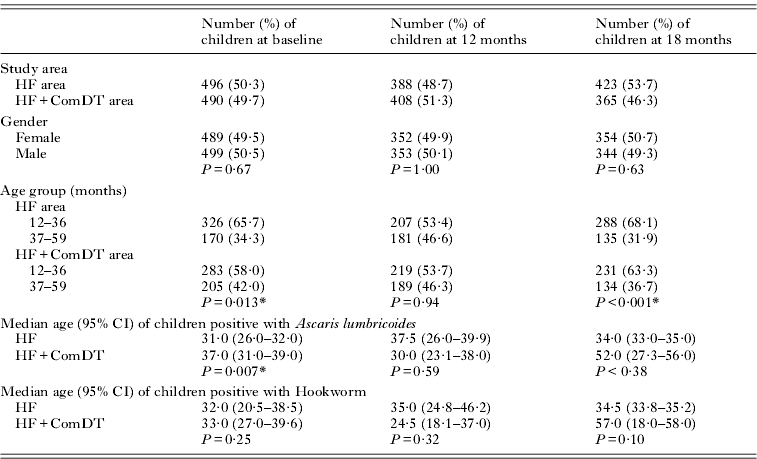
Table 1 summarizes distribution of the children sampled by treatment area, age group and sex for the three surveys. A total of 986, 796 and 788 children were sampled at baseline, 12 months and 18 months of follow-up, respectively. The proportion of boys and girls was not significantly different (P>0·05) at any survey. The distribution of children by age group was significantly different between the HF+ComDT and the HF areas at baseline and 18 months follow up (P=0·013 and P=0·001, respectively), but did not differ significantly at 12 months follow-up. The median age of children infected with A. lumbricoides was significantly higher (P=0·007) in the HF+ComDT area than in the HF area at baseline, but was not significantly different at 12 and 18 months follow-up. The median age of children infected with hookworm did not differ significantly between the HF+ComDT and the HF areas at baseline, 12 and 18 months.
Composition of study population stratified by study area, gender and age-group at baseline, 12 months and 18 months follow-up

* Statistically significant result.
Prevalence of STH infections
Comparison of prevalence between study areas
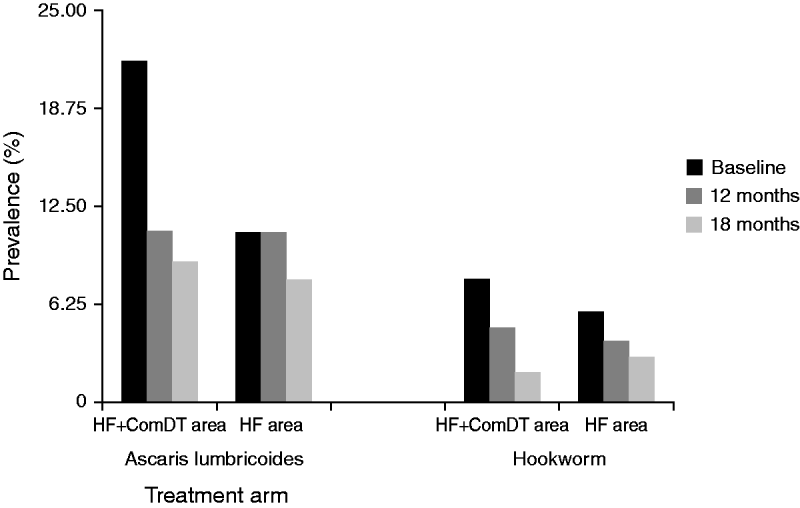
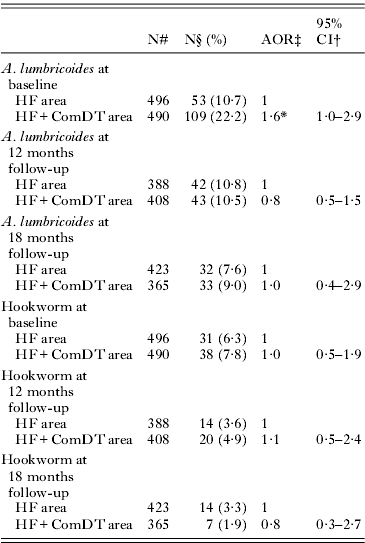
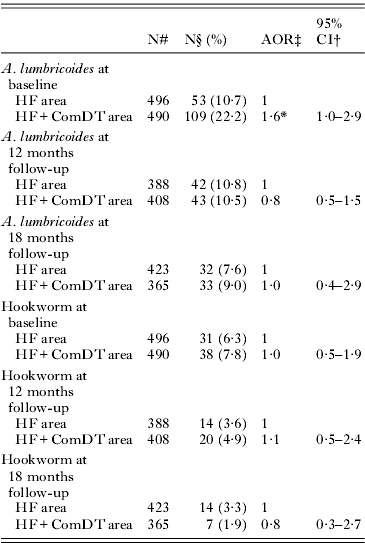
At baseline, the prevalence of A. lumbricoides was significantly higher (P=0·048) in the HF+ComDT area compared to the HF area as shown in Table 2 and Fig. 1. Thus, compared to children living in the HF area, children in the HF+ComDT area were 60% (AOR=1·6; 95%CI [1·0, 2·9]) more likely to be infected with A. lumbricoides at baseline. At 12 months and 18 months follow-up the prevalence of A. lumbricoides did not differ significantly between the two areas. The prevalence of hookworm did not differ significantly between the two areas at baseline, 12 months and 18 months.
Prevalence with 95% confidence intervals of Ascaris lumbricoides and hookworm in children aged 12 to 59 months in the area, where community-directed treatment was added to the routine health facility approach (HF+ComDT), and in the area with the health facility approach alone (HF) at baseline, 12 months and 18 months.

Comparison of prevalence of Ascaris lumbricoides and hookworm between HF area and HF+ComDT area, at baseline, 12 months and 18 months follow-up
# Total number of children whose stool samples were examined.
§ Number of children infected with the respective parasite (in percent of investigated).
‡ AOR=Adjusted odds ratio for confounding effect of age group and sex on infection status.
† 95% confidence interval.
* P=0·048; children in the HF+ComDT area were 60% (AOR=1·6) more likely to be infected with A. lumbricoides compared to children in the HF area.
Changes in prevalence of A. lumbricoides and hookworm over time
Analysis of trend in the HF+ComDT area showed a significant linear decrease (P<0·001) in prevalences of A. lumbricoides and hookworm. The analysis of trend in the HF area showed no significant linear change in the prevalence of A. lumbricoides, but there was a signicant linear decrease in prevalence of hookworm (P<0·05).
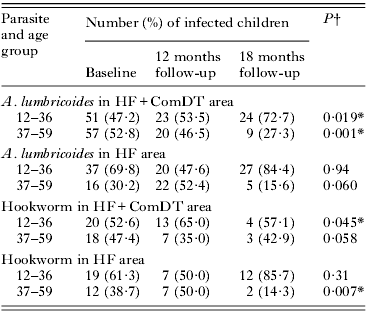
Table 3 shows the change in prevalence with time by age-group. In older children, a significant linear reduction in prevalence was found of A. lumbricoides in the HF+ComDT area and of hookworm in the HF area (P=0·001 and P=0·007, respectively). There was a significant linear increase in the prevalence of A. lumbricoides and hookworm in younger children of the HF+ComDT area (P=0·019 and P=0·045), but no linear change in the rest of the comparisons.
Change in prevalence of Ascaris lumbricoides and hookworm over time by age group
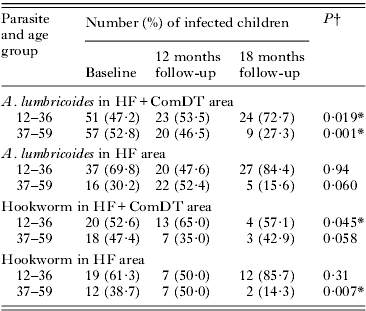
† P-value of Chi-square for trend analysis.
* Statistically significant result.
Intensity of STH infections
Comparison of infection intensities between study areas
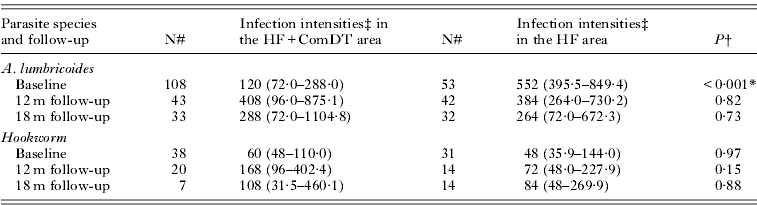
At baseline the HF+ComDT area had significantly higher intensity of A. lumbricoides compared to the HF area (P<0·001, Table 4). However, no significant difference in intensity between the treatment arms was observed at 12 months and 18 months follow-up. Also, no significant difference in hookworm intensities between the HF+ComDT and the HF areas were recorded at baseline and at 12 and 18 months.
Comparison of infection intensities of Ascaris lumbricoides and hookworm between HF+ComDT area and the HF area, at baseline, 12 months and 18 months follow-up
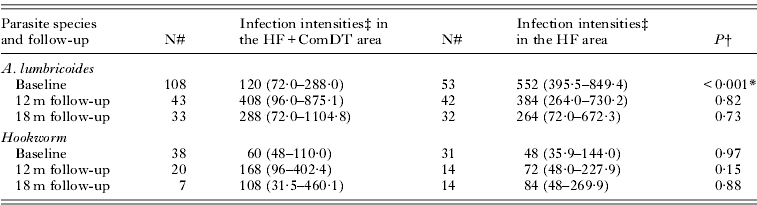
# Total number of infected children.
‡ Median (epg) and 95% confidence intervals.
† P value for Mann-Whitney U test.
* Statistically significant result.
Changes in infection intensity levels within each study area during the intervention period
Analysis of trend showed no significant change in the proportions of heavy intensity of A. lumbricoides in neither the HF+ComDT area (5·5%, 13·9%, and 12·1%) nor HF area (11·3%, 11·9% and 9·4%) with P values of 0·13 and 0·81, respectively. Likewise, analysis of linear trend for hookworm showed no significant reduction in proportions of heavy intensity in the HF+ ComDT area (13·2%, 10% and 0·0%) and the HF area (9·7%, 14·3% and 7·1%) with P values of 0·33 and 0·89, respectively.
DISCUSSION
The impact of adding ComDT to the HF approach on the prevalence and intensity of STH infections over a period of 18 months was measured. The data presented here were obtained in an operational control programme setting which was able to achieve high treatment coverage (Halwindi et al. Reference Halwindi, Magnussen, Meyrowitsch, Handema, Siziya and Olsen2010), and reflects what ComDT may be capable of achieving using a strategy of twice-annual treatment in under-five children.
The prevalences of both A. lumbricoides and hookworm were low in the study population even before implementation of the intervention. This could in part be a result of the continuous treatment of children through the HF approach since 2003, despite the low treatment coverage. Of unknown reasons, T. trichiura infection was not found in the study population. The most pronounced effect of adding ComDT to the HF approach was observed when targeting A. lumbricoides as prevalence in the HF+ComDT area was reduced by 11·2% between baseline and 18 months follow up compared to 3·1% in the HF area. However, it should be pointed out that the prevalence of A. lumbricoides was significantly higher in the HF+ComDT area at baseline, and it is possible that the observed reduction in prevalence in this area could be as a result of that. There was a significant linear reduction in hookworm prevalence in both treatment arms, but the difference between the two treatment arms remained not statistically significant throughout the 18 months. There are two possible reasons for this observation. Firstly, mebendazole was used for treatment, which is more effective against A. lumbricoides and less effective against hookworm (Albonico et al. Reference Albonico, Bickle, Ramsan, Montresor, Salvioli and Taylor2003; Keiser and Utzinger, Reference Keiser and Utzinger2008). Mebendazole was used as it is currently the drug of choice in Zambia during child health weeks. This ensured that children from both areas received the same drug, and their results were thus comparable. Secondly, the prevalence of hookworm was already very low in both areas and therefore the increase in treatment coverage might not have had much effect on prevalence, especially when a drug with low efficacy against hookworm was used.
The intervention was apparently most effective in reducing the prevalence of A. lumbricoides in the HF+ComDT area in children aged 37 to 59 months as shown by the significant linear reduction in the prevalence between June 2006 and December 2007. The significant reduction in the prevalence in this age group could be due to several factors. Comparison of the median age of infected children between the HF+ComDT and the HF areas showed that children in the HF+ComDT area were older than those in the HF area. Furthermore, the proportion of children aged 37 to 59 months was significantly higher in the HF+ComDT area compared to the HF area. Therefore, the older children who had higher prevalences also benefited the most from treatment. This is further supported by the fact that treatment coverage increased significant over time in the HF+ComDT area (Halwindi et al. Reference Halwindi, Magnussen, Meyrowitsch, Handema, Siziya and Olsen2010), and that the increase in coverage was largely attributed to an increased number of older children accessing treatment by utilization of the ComDT intervention (Halwindi, Reference Halwindi2010). It is not known why there was a significant linear increase in the prevalence of A. lumbricoides in the HF+ComDT area and of hookworm in the HF area among the younger children (age 12–36 months).
Infection intensity for A. lumbricoides was significantly higher in the HF+ComDT area compared to the HF area at baseline, but decreased and became non-significantly different at 12 months and 18 months follow-up. The hookworm intensity remained non-significantly different throughout the intervention period. This is likely to be because of the already low hookworm intensity observed at baseline in both study areas, and also because of the already mentioned low efficacy of mebendazole. In spite of this, ComDT reduced the proportion of high intensity hookworm infections between baseline and 18 months follow-up. Though not statistically significant, this result was important because the target of STH control programmes is to reduce the infection intensity in order to reduce morbidity rather than eliminating the infections completely (WHO, 2002; Crompton and Savioli, Reference Crompton and Savioli2007). However, even light infections are thought to suppress protein metabolism, appetite and erythropoiesis by triggering an inflammatory cytokine response (Stoltzfus et al. Reference Stoltzfus, Chway, Montresor, Tielsch, Jape, Albonico and Savioli2004). Therefore continuing with STH control initiatives is important to keep infections at very low levels and provide benefit to the health of the child.
The differences in baseline prevalence and intensity could partly be attributed to the differences in access to latrines and water in the two study areas. The HF area had significantly higher proportions of households accessing latrines and clean water. It has been shown in earlier studies that a significant association exists between lack of access to latrines and high prevalence of STH (Crompton and Savioli, Reference Crompton and Savioli2007; Stothard et al. Reference Stothard, Imison, French, Sousa-Figueiredo, Khamis and Rollinson2008). This underscores the importance of improved sanitation aimed at reducing soil and water contamination, in addition to mass drug administration and health education as interventions to interrupt transmission (WHO, 1999). Curtis and colleagues (1995) suggested that households which have improved source of water may feel the need to conform to safer hygienic behaviour and thus make more efforts to prevent unhygienic behaviour. In this way, transmission of STH is likely reduced in communities with access to clean water. In the communities participating in the present study, health education was given to caretakers verbally by the health facility staff during child health weeks and at the monthly under-five clinics. In addition, the CDDs in the intervention area gave some basic information about STH infections to the caretakers during drug distributions.
Community-directed interventions have been shown to achieve higher coverage without any increase in implementation costs at the health district and health facility level. At the community level there is an increase in ‘opportunity costs’ from community implementers who volunteer their time, thus forgoing other remunerative activities (TDR, 2008). In the current study, there were no major direct additional costs incurred because all the drugs, training materials and stationary were provided by the RHCs from their available resources, and the CDDs were not given any monetary incentives. The major additional costs included the indirect cost of labour hours for the CDDs and the RHC staff during training and running of the programme. No data are available on these costs from the present study. However, for conditions of national scale-up the biggest challenge is likely to be the cost of training and the issue of incentives for the CDDs.
The limitations of this study were, firstly, that our results were based on cross-sectional surveys and a real cause-effect relationship between infection status and intensity and intervention therefore could not be established as it is not possible to control for the independent variables and thus not possible to account for the effect of other factors which could contribute to the differences in infection prevalence and intensity observed between the treatment arms. Secondly, the laboratory technicians who were reading the slides were not blinded to which treatment arm the samples belonged because stool samples from the HF+ComDT area were collected and examined separately of the samples from the HF area. This could have biased the results due to the technicians’ preconceptions of expecting lower infection rates in the HF+ComDT area compared to the HF area. Thirdly, the significantly higher prevalence of A. lumbricoides in the HF+ComDT area at baseline limits the power of the study results as a significant reduction in prevalence in the HF+ComDT area and the non-significant reduction in prevalence in the HF area at 12 and 18 months follow-up could have resulted from the baseline differences. Additionally, the significantly higher proportion of households with access to clean water and latrines in the HF area compared to the HF+ComDT area suggests that the two study area had different levels of risk of STH transmission in the children. Fourthly, the lack of baseline data on important confounding factors like the availability and the type of faecal disposal facilities and type of water source for each child means these factors were not controlled for in the analysis, resulting in increased chances of the occurrence of type 1 error in the data analysis where we find a significant relationship when in actual fact there is none.
The ComDT approach using mebendazole generally enhanced the treatment effect among under-five year children and this alternative approach may also have advantages in other geographical settings. There is a great potential for scaling up the ComDT programme to other parts of the country through already existing community based programmes like the Community Based Growth Monitoring and Promotion (CBGMP) programme which is already running in 40 out of 73 districts of Zambia. This programme, among other things, is delivering vitamin A supplementation and growth monitoring activities to children aged less than 2 years old.