Introduction
Bael (Aegle marmelos Correa, family: Rutaceae; subfamily: Aurantioideae) is a subtropical fruit tree native to India. It is grown throughout the Indo-Malayan region, extending from the Sub-Himalayan tracts of India to the Philippines and Fiji Islands in South East Asia (Agarwal, Reference Agarwal1997). The tree has a long history of use as a food and medicine, dating back to 5000 B.C. Charaka Samhita, a renowned book of all the essential ayurvedic information cites bael tree as a necessary component of several ayurvedic medicines. All parts of the tree have medicinal value and are widely used in the Siddha, Unani and Ayurvedic systems (Sarkar et al., Reference Sarkar, Salauddin and Chakraborty2020). The ripe bael fruit pulp has a unique taste and cooling properties, making it attractive for fresh consumption or as ‘Sharbat’, one of the most popular drinks in North India during the summer season. In Hinduism, the tree is revered for its mythological significance and is commonly planted near Lord Shiva temples (Rishabha et al., Reference Rishabha, Ajay and Anupama2012).
Despite its cultural and medicinal significance, bael production in India is based on seedling populations growing on roadsides, fallow lands and forest areas with little to no inputs and traditional practices. This has led to a lack of precise data on acreage and production. However, a concentration of bael tree population has been reported in the eastern parts of the Gangetic plains, particularly in Uttar Pradesh, Bihar, West Bengal and Odisha (Saroj et al., Reference Saroj, More and Singh2008). In South India, bael trees are valued only for their medicinal properties and religiously significant leaves, as most trees produce small, sour fruits that are unsuitable for fresh consumption.
The fruit pulp of bael is resinous, sweet, aromatic and embeds the seeds. Each seed is covered in an adhesive, transparent mucilage sac that solidifies when dried. Open pollination and propagation by seeds have contributed to the extensive diversity of this crop (Singh et al., Reference Singh, Singh and More2014). A. marmelos has been reported to be a rich source of phytochemicals such as phenolic acids, flavonoids, alkaloids, tannins and coumarins. Other than these, amino acids, fatty acids, a wide range of organic acids, minerals, carbohydrates, vitamins and fibers make it a highly nutritious fruit with immense health benefits (Bhar et al., Reference Bhar, Mondal and Suresh2019). Bael is also useful in industrial food processing and a valuable source for extracting pharmaceuticals and many other economically significant herbal compounds (Shinde et al., Reference Shinde, Katekhaye, Mulik and Laddha2014; Kaur and Kalia, Reference Kaur and Kalia2017).
Despite its potential for providing nutritional and economic security, bael is still considered an underutilized fruit species. To increase its production, productivity and quality, it is crucial to genetically profile the most suitable genotypes for large-scale propagation and to biochemically identify the key phytochemicals. Molecular markers, such as SRAP (sequence-related amplified polymorphism) markers (Li and Quiros, Reference Li and Quiros2001), have become indispensable tools for the assessment of genetic diversity in plant species. Compared to SSR, ISSR or RAPD markers, SRAP markers have been shown to be more effective in uncovering genetic diversity among closely related cultivars (Budak et al., Reference Budak, Shearman, Parmaksiz, Gaussoin and Riosdan2004). They provide a rapid, accurate and reliable way to distinguish between genotypes, facilitating the identification of diverse and desirable traits for breeding programmes and conservation efforts.
The current research aimed: (i) to investigate the diversity in two populations of bael growing at a common site using morphological, biochemical, and molecular markers, (ii) to evaluate the correlations between morphological and biochemical characteristics and, (iii) to identify appropriate genotypes for food, nutraceutical and industrial applications. This study has the potential to improve the continuity of bael production by identifying suitable genotypes and developing strategies for its conservation.
Materials and methods
Experimental material
Twenty-four bael genotypes were selected for the study based on their growth, flowering and fruiting behaviour under Bengaluru conditions during March–April of year 2020–2021. These genotypes were chosen from among thirty genotypes that were planted through seed at the experimental field of the Indian Institute of Horticultural Research in Bengaluru, India (located at 13°7' N, 72°29' E at 890 m msl). The seeds for genotypes B1–B18 were obtained from the Faizabad district, a significant bael cultivation area in Uttar Pradesh, located in the Eastern Plain Agroclimatic Zone. Meanwhile, seeds for genotypes B19–B24 were collected from trees growing close to temples in the Mysuru district of Karnataka, which falls within the Southern Dry Agroclimatic Zone.
Morphological characterization
In this study, we conducted morphological characterization using 10 fruits per genotype in three replications. We observed 12 quantitative traits that were selected based on the guidelines for the conduct of test for distinctiveness, uniformity, and stability (DUS) for bael (A. marmelos L. Correa) as established by the Protection of Plant Varieties and Farmers Rights Authority, New Delhi, India (Singh et al., Reference Singh, Pandey and Verma2011). To determine palatability, the TSS: acidity ratio was calculated, where a higher ratio indicated good taste for fresh consumption.
Biochemical characterization
Mature fruits from the selected 24 genotypes were harvested and washed using Millipore water. The analysis was conducted using three independent biological replications for each genotype. The pulp of the fruit samples was extracted to analyze various biochemical parameters such as carotenoids, FRAP, DPPH, vitamin C, acidity, total phenols, flavonoids, total sugars and protein using standard procedures. The vitamin C content was determined using the 2,6-dichlorophenol indophenol (DCPIP) method (AOAC, 2006). The total carotenoid content was analyzed using the spectrophotometric method (Lichtenthaler and Buschmann, Reference Lichtenthaler and Buschmann2001). The total phenol content present in the fruits was estimated using the Folin–Ciocalteu method (Singleton et al., Reference Singleton, Orthofer and Lamuela-Raventos1999), while the total flavonoid content was estimated using the method described by Chun et al. (Reference Chun, Kim, Moon, Kang and Lee2003), using catechin as a standard. The total antioxidant potential was estimated in terms of the radical scavenging activity using the DPPH (1,1-diphenyl-2-picrylhydrazyl) assay (Singh et al., Reference Singh, Jyothi, Reddy and Shivashankara2018) and in terms of reducing power using the FRAP (ferric-reducing antioxidant power) method (Benzie and Strain, Reference Benzie and Strain1996). The total sugar content was estimated using the method described by Sadasivam and Manickam (Reference Sadasivam and Manickam1992).
Molecular characterization
Genomic DNA was extracted from young leaves for sequence-related amplified polymorphism (SRAP) analysis and its quality was checked and adjusted to a concentration of 50 ng/μl for PCR reactions. A total of thirty primer combinations (PC) were initially screened, and 10 PCs were selected based on good and reproducible amplification. Standard PCR conditions were used as suggested by Li and Quiros (Reference Li and Quiros2001). The resulting PCR product was analyzed on a 2% agarose gel with ethidium bromide staining in 1 × TBE (Tris-borate-EDTA) buffer, and a 100 bp DNA ladder was used as the fragment size marker (Thermo Fisher Scientific). Each SRAP primer pair was considered as one genetic marker, and the SRAP matrix data sheet was prepared by recording the presence of a band (1) or absence of a band (0). To estimate the band size, a medium range DNA ruler (100 bp) was run alongside the amplified products.
Statistical analysis
The data collected on quantitative morphological and biochemical traits of bael genotypes were analyzed using R software version 4.0.4 (R Core Team, 2021). Variability was estimated using coefficients of variation (CV%), while Spearman correlation coefficients were used to determine correlations between traits. Principal component analysis (PCA) was used to investigate relationships among genotypes, and standardized principal component (PC) scores were extracted from a correlation matrix created using mean values. Prior to cluster analysis, each character was normalized using Z scores to avoid scaling differences. Hierarchical cluster analysis was performed using hclust function and Ward's method. SRAP marker analysis involved calculating the number of alleles, polymorphic information content, expected heterozygosity and analysis of molecular variance (AMOVA) using GENALEX 6.41 (Peakall and Smouse, Reference Peakall and Smouse2012). Distance matrices were generated based on Jaccard's similarity coefficient and used to construct a dendrogram using the unweighted pair group method with arithmetic mean (UPGMA) in R software version 4.0.4 (R Core Team, 2021).
Results
Morphological and biochemical characterization
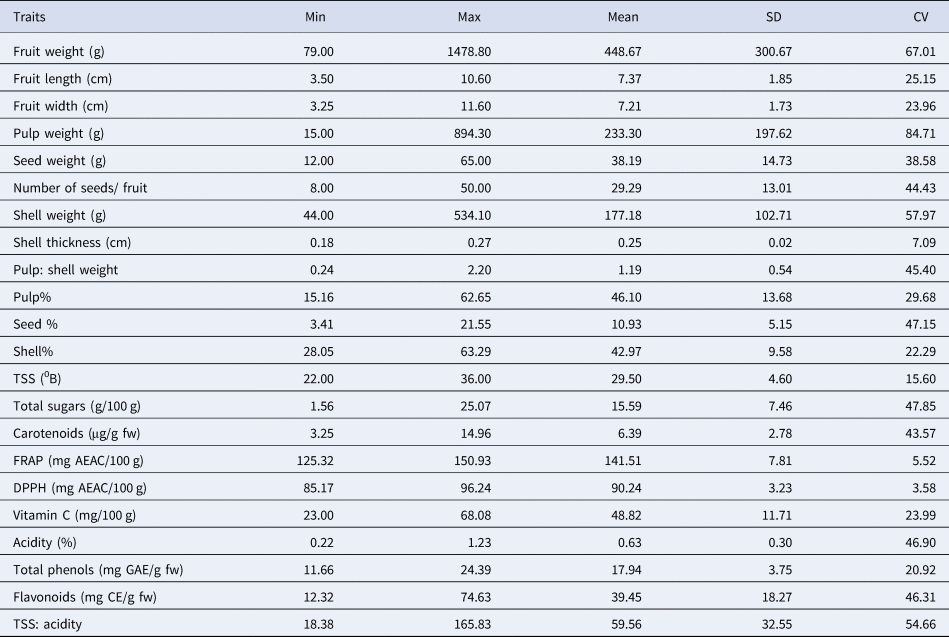
Table S1 presents the quantitative fruit traits recorded in 24 bael genotypes, while Table 1 shows the range of variation for each trait. High values of coefficient of variation (CV%) and significant differences (P < 0.0001) were observed for almost all the traits among the genotypes. Pulp weight (85%), fruit weight (67%), shell weight (58%), TSS: acidity (55%), total sugars (48%), seed per cent (47%), acidity (47%), flavonoids (46%), pulp: shell weight (45%), number of seeds (44%), carotenoids (44%), seed weight (39%), pulp per centage (30%), fruit length (25%), vitamin C (24%), fruit width (24%), shell per centage (22%), and total phenols (21%) showed high CV values (>20%), while TSS (16%) and shell thickness (7%) exhibited low CV values.
Descriptive statistics for morphological and biochemical fruit traits showing range of variation for 24 A. marmelos genotypes

The data show that there is a wide range of variation in the important fruit traits among the 24 bael genotypes. The fruit and pulp weight ranged from 79.0 to 1478.8 g and 15.0 to 894.3 g, respectively, with a mean value of 448.67 and 233.3 g. Similarly, the seed and shell weight ranged from 12.0 to 65.0 g and 44.0 to 534.1 g, respectively, with mean values of 38.19 and 177.18 g.
TSS or total soluble solids, which is an important indicator of fruit taste and quality, ranged from 22 to 36 0Brix with a mean value of 29.5 0Brix. Twenty genotypes had TSS more than 30 0Brix, with the highest TSS recorded in genotypes B11 and B2 (36 0Brix) and the lowest in B9 (27 0Brix) with a standard deviation of 4.60.
Another important trait affecting consumer acceptability is acidity. The preference is for low acid genotypes, and this trait varied widely among the genotypes, with the lowest acidity recorded in B1 (0.12%) and the highest in B22 (1.23%).
Total sugar content varied from 1.56 g/100 g (B-23) to 25.07 g/100 g (B-1), while carotenoid content varied from 3.25 μg/g fw (B-11) to 14.96 μg/g fw (B-16) with a mean value of 6.39.
The total phenolic content (TPC) and total flavonoid content (TFC), varied significantly among the genotypes. The TPC (mg GAE/g fw) was highest in B17 (24.39) and lowest in B19 (11.66), with a mean value of 17.94, while the corresponding values for TFC (mg CE/g fw) were 74.63 (B10), 12.32 (B24), and 39.45. The antioxidant potential, as measured by FRAP and DPPH (mg AEAC/100 g) methods, varied between 125.32 (B-20) to 150.93 (B-10) and 85.17 (B-2) to 96.24 (B-14), respectively. Vitamin C (mg/100 g) was highest in B-9 (68.08) and lowest in B-24 (23.00), with a mean of 48.82. Genotypes B1, B7, and B8 recorded good taste, as expressed by the TSS: acidity ratio (166, 100 and 95, respectively), while all the genotypes from Karnataka were unpalatable, with values lower than 25. These variations in the important fruit traits among the bael genotypes highlight the need for further studies to identify the genotypes with desirable traits for commercial cultivation and breeding purposes.
Correlation analysis
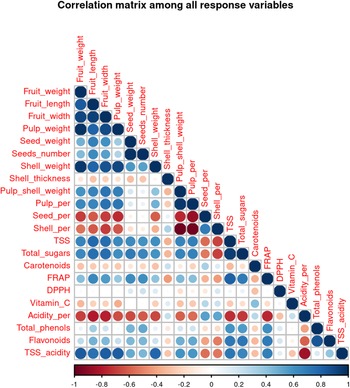
The correlation analysis revealed several significant associations between morphological and biochemical traits (Fig. 1). Fruit weight was strongly positively associated with all fruit size traits and other traits such as pulp per cent (r = 0.64), TSS (r = 0.66) and total sugar (r = 0.64). Negative associations were found between fruit weight and seed per cent (r = −0.69) and acidity (r = −0.68). Pulp weight was positively correlated with fruit length (r = 0.8), pulp per cent (r = 0.72), shell weight (r = 0.90), total sugars (r = 0.61) and TSS: acidity (r = 0.82) and negatively correlated with seed per cent (r = −0.74), shell per cent (r = −0.62) and acidity (r = −0.64). Total sugar showed positive associations with all fruit and pulp traits as well as with FRAP (r = 0.70) and flavonoids (r = 0.72). TPC and TFC were significantly and positively correlated to their antioxidant capacity as determined by FRAP (r = 0.61 for phenols; r = 0.74 for flavonoids) and also showed positive correlations with TSS (r = 0.59; r = 0.71) and total sugar (r = 0.57; r = 0.72).
Map of linear correlations between morphological and biochemical variables. Size and colour intensity of the circles indicate the magnitude of correlation.

Principal component analysis and clustering
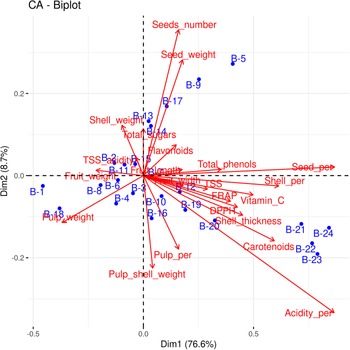
The principal component analysis (PCA) was performed on the quantitative traits to make the data set more understandable. The results are shown in Supplementary Table S2, which provides eigenvectors for the first four principal components (PC1–PC4). The majority of the variation was explained by the first principal component (PC1), which accounted for 76.55% of the total variation and had high loading values for acidity (0.26), shell per cent (0.22), seed per cent (0.21) and carotenoids (0.11). PC2 explained 8.71% of the total variation and accounted for the variation in pulp per cent (0.27), pulp/shell weight (0.26) and pulp weight (0.24). PC3 (6.94%) mainly represented TFC (0.37), TPC (0.31), pulp/shell weight (0.27) and pulp per cent (0.25) while variation in DPPH (0.45) was accounted for by PC4 (2.56%). To compare genotypes based on a range of traits and identify the best ones for a breeding program, a bi-plot analysis of components based on PC1 and PC2 was conducted (Fig. 2). The projection of the variables on the factors planes with individual genotypes revealed diversity among them. For example, genotypes (B17, B9, B5, B14) with higher values for seed-related traits, such as seed number, seed weight and seed per cent, were grouped together in the first quadrant (+,+) while all genotypes from Karnataka (B19–B24) grouped together in the fourth quadrant (+,−) along with variables such as acidity, shell thickness, DPPH, FRAP and vitamin C. Genotypes B18, B1, B4, B8 and B6 with higher values for commercially important traits such as fruit and pulp weight occupied the third quadrant (−,−).
Two-dimensional bi-plot for PC1 and PC2 (85.26% of total variance) based on morphological and biochemical characters of A. marmelos.

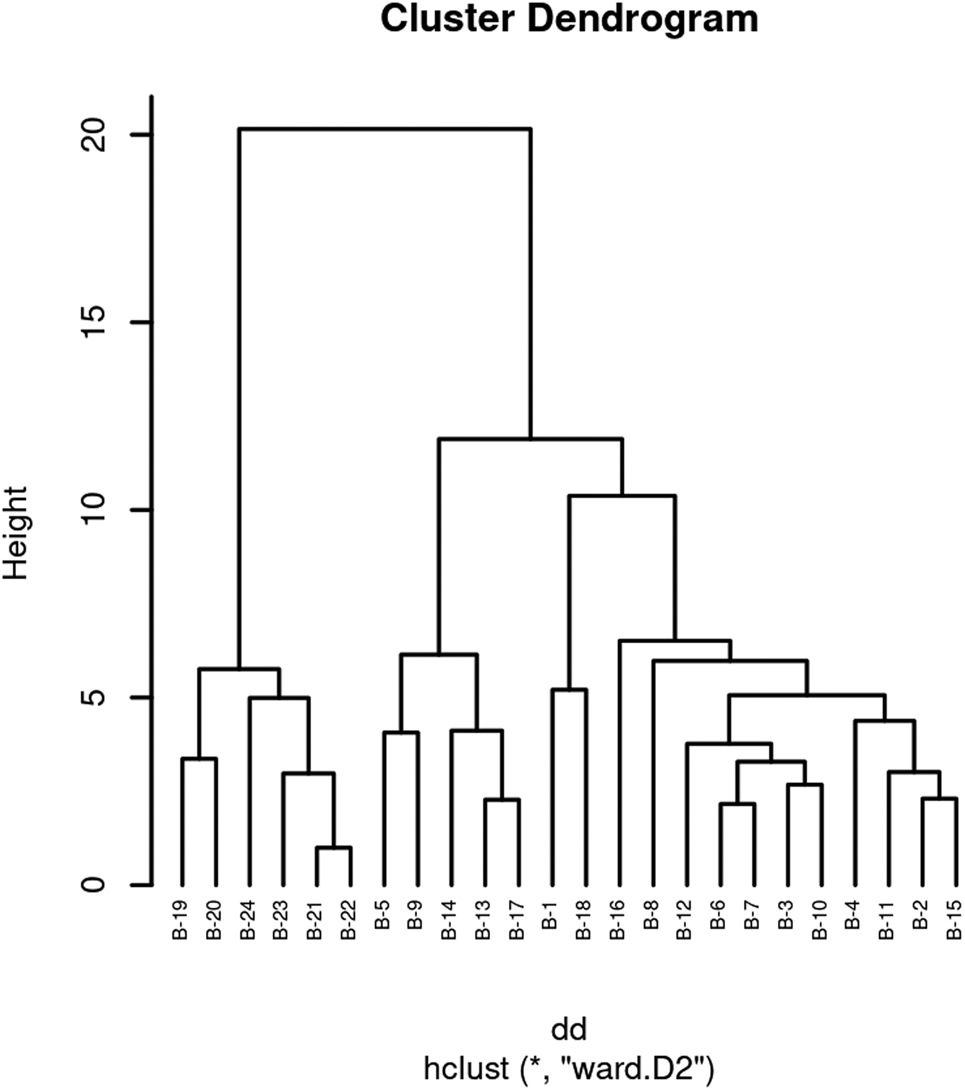
The dendrogram (Fig. 3) of the morpho-physiological data obtained through the Hclust function in R revealed that the 24 bael accessions could be divided into two distinct groups, namely, Group I and Group II. Group I was composed of six genotypes collected from the Karnataka region, while Group II included all the genotypes from Uttar Pradesh. This dendrogram was useful in illustrating the variability of the analysed parameters among the genotypes. Notably, it indicated that promising genotypes, such as B18 and B1, which had high quantities of fruit and pulp weight, as well as low values for seed per cent and shell thickness, were clustered together in Group I. This finding was consistent with the results obtained from the PCA.
Hierarchal clustering of 24 bael genotypes based on morphological and biochemical characters.

Molecular characterization
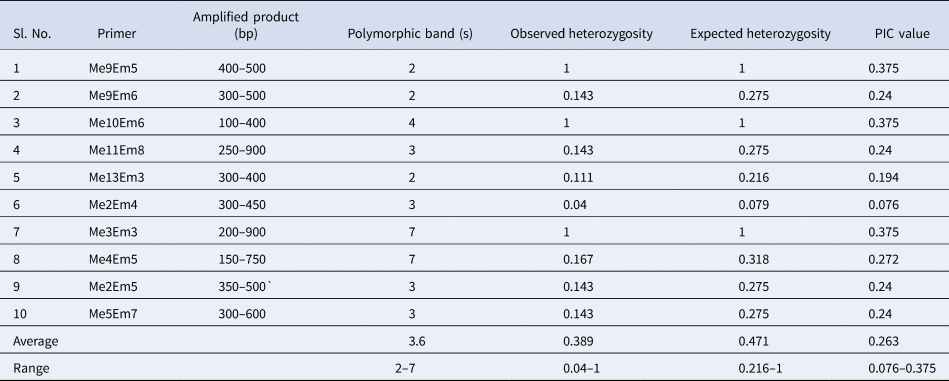
Out of 30 SRAP primer combinations (PCs), 10 were selected for screening, which yielded 64 amplification bands with clear and reproducible results ranging from 100 to 1200 bp. Of the amplified bands, 36 (56%) were found to be polymorphic, as presented in Table 2 The mean Polymorphic Information Content (PIC) value for the selected PCs was 0.26, ranging from 0.08 to 0.38. The PCs Me9Em5, Me10Em6 and Me3Em3 had the highest PIC value (0.38), while the lowest was observed for Me2Em4 (0.08). Based on these results, Me9Em5, Me10Em6 and Me3Em3 can be considered the most effective for studying genetic diversity among bael genotypes.
Summary statistics of the genotyping assay for the 24 A. marmelos genotypes based on 10 SRAP markers

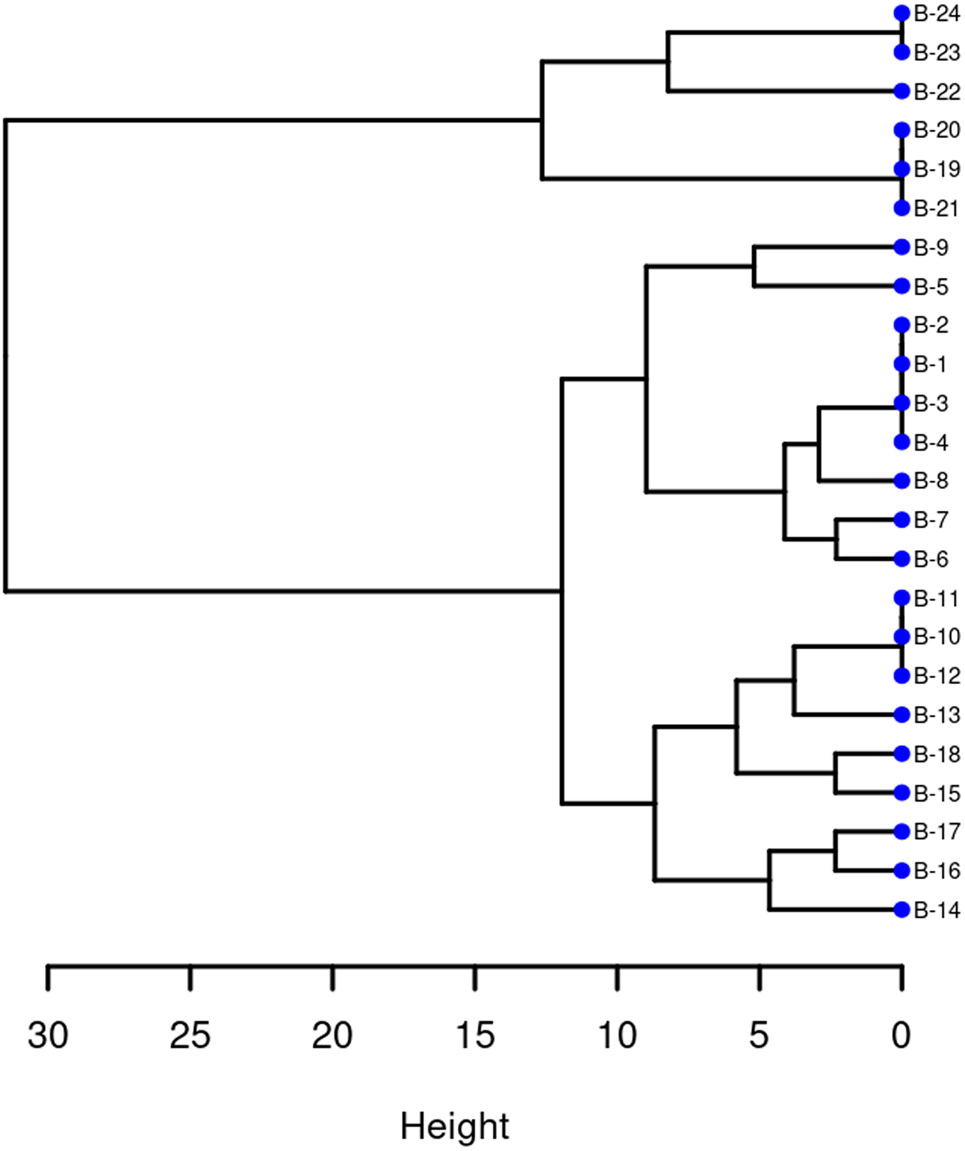
To further describe the relationship between the genotypes based on the similarity coefficient, an UPGMA dendrogram was constructed (Fig. 4). The dendrogram clustered the 24 bael genotypes into two groups: the first cluster (A) included all six Karnataka genotypes, while the second cluster (B) included 18 Uttar Pradesh genotypes divided into two subclusters. The analysis of molecular variance (AMOVA) was also employed to investigate genetic differentiation between the two populations and to estimate the percentage of intra- and inter-population genetic variation (Table S3). The results of the AMOVA indicated significant regional variation (P = 0.001), with 70% of the total SRAP marker variation being due to interpopulation variation and 30% due to genetic variation within regions.
Dendrogram of A. marmelos genotypes based on the UPGMA method of cluster analysis using Jaccard's similarity co-efficient from 10 SRAP marker data.

Discussion
The cultivation of bael in India has a long history, with availability of numerous cultivated and wild types (Rishabha et al., Reference Rishabha, Ajay and Anupama2012). The objective of this study was to identify important traits using morphological, biochemical and molecular (SRAP) markers to enhance our knowledge of genetic variation, population structure and relationships among and within the genotypes.
The study investigated 24 bael genotypes from two different agroclimatic zones and identified wide genetic variations among them based on twenty-two morphological and biochemical quantitative traits. Fruit weight, pulp weight, pulp per cent, taste (TSS: acidity), total sugars, seed per cent, acidity and flavonoids were found to be the most valuable traits contributing towards fruit quality and differentiation among populations. The cross-pollinated nature of the crop, propagation through seeds and distribution across diverse agroclimatic zones spanning from Indo-Gangetic plains and Sub-Himalayan tracts in North-East India, to dry and deciduous forests of Central and Southern India, are believed to have contributed to the wide variation in shape, size and fruit quality of this crop (Pandey et al., Reference Pandey, Tandon, Hudedamani and Tripathi2013; Neeraj et al., Reference Neeraj, Bisht and Johar2017).
The high coefficient of variation (CV) observed for pulp weight (84.71%) and other fruit quality traits among the bael genotypes suggests that genetic factors play a more significant role in determining these traits than environmental factors. Similar findings have been reported in other fruit species such as tomato, cherry and olive (Rosati et al., Reference Rosati, Zipanćič, Caporali and Padula2009; Zhang et al., Reference Zhang, Sebolt, Sooriyapathirana, Wang, Bink, Olmstead and Iezzoni2010). This high genetic control over fruit quality traits offers the potential for accelerating genetic improvement through the selection of superior trees and clonal propagation, thereby bypassing traditional tree breeding methods. Promising bael genotypes for cultivation could be identified based on desirable fruit size and pulp characteristics such as average fruit weight (>1.0 kg), low seed % (<4), low shell % (<30), thin shell thickness (<2 mm), high pulp % (>60), low acidity % (<0.5), high carotenoid content (>10 μg/g FW) and high TSS (>30 0B), according to consumer preferences (Dhakar et al., Reference Dhakar, Das, Nath, Sarkar and Singh2019). Our study focused on bael genotypes from Uttar Pradesh and Karnataka regions. We found that the genotypes B1, B8, B10 and B18 (Fig. S1) from Uttar Pradesh displayed most of the desirable parameters, while the fruits from Karnataka were comparatively smaller in size and less preferred due to their high acidity. The PC biplot graph effectively showcased the variability present in the genotypes, and the cluster analysis identified two distinct groups. Our results indicated a positive correlation between pulp weight and various fruit characteristics, such as fruit length, pulp percentage, shell weight, total sugar, and TSS: acidity. This suggests that bael breeding programmes can simultaneously target fruit size, quality and higher medicinal/nutritional value.
The bael fruit pulp is found to be rich in various health-boosting polyphenols, such as phenolic acids (e.g. gallic acid) and flavonoids, which are known for their antioxidant properties. The total phenolic content (TPC) and total flavonoid content (TFC) of bael fruit pulp varied among different genotypes, with genotypes from Uttar Pradesh showing higher TPC and TFC compared to genotypes from Karnataka. The TPC in bael fruits was found to be higher than that reported for common Asian fruits and vegetables, such as sapodilla, strawberry, starfruit, grapes, mangosteen, soursop, plum, and banana, (0.1–15.9 mg GAE/g fw) as reported by Sarkar et al., (Reference Sarkar, Salauddin, Roy, Sharma, Sharma, Yadav, Jha, Rebezov, Khayrullin, Thiruvengadam, Chung, Shariati and Simal-Gandara2022). The mean TPC value in our study (17.94 mg GAE/g fw) was also comparable or slightly higher than those reported in earlier studies for bael pulp (343.00 μg/mg to 8.73 g GAE/100 g; Charoensiddhi and Anprung, Reference Charoensiddhi and Anprung2008; Panda et al., Reference Panda, Sahu, Behera and Ray2013; Tagad et al., Reference Tagad, Sahoo and Annapure2018; Vardhini et al., Reference Vardhini, Sivaraj, Arumugam, Ranjan, Kumaran and Baskar2018). Similarly, the TFC value in fruit pulp (39.45 mg CE/g fw) was higher than those reported in some previous studies by Tagad et al., (Reference Tagad, Sahoo and Annapure2018) and Vardhini et al., (Reference Vardhini, Sivaraj, Arumugam, Ranjan, Kumaran and Baskar2018) 15.20 and 21.92 mg CE/g fw, respectively. The flavonoid content in bael was found to be higher than other fruits from South-East Asia, such as tamarind, velvet apple, lolly fruit and sugar apple, with a content of over 260 mg CE/100 g fw (Recuenco et al., Reference Recuenco, Lacsamana, Hurtada and Sabularse2016). In terms of antioxidant activity, some genotypes of bael, namely, B10, B8 and B7, had the highest reducing power, with over 150 mg AEAC/100 g. The DPPH assay also revealed that different extracts of fresh bael fruit samples had varying hydrogen-donating abilities, with B14 having the highest activity (96.24 mg AEAC/100 g) and B2 having the lowest activity (85.17 mg AEAC/100 g).
Bael fruit is reported to be a good source of ascorbic acid (vitamin C), which is a crucial antioxidant and water-soluble nutrient that can help prevent diseases like scurvy. The highest amount of ascorbic acid was found in genotype B9 (68.08 mg/100 g). Additionally, bael fruit pulp was found to contain carotenoids, which are known to promote human health and add colour diversity to fruits. The total carotenoid content in bael fruit pulp ranged from 3.25 to 14.96 μg/g fw, similar to the range found in carotenoid-rich fruits and vegetables such as papaya, mango, pumpkin, ginger, and cabbage (12–70 μg carotenoid/g dw) as reported by Inocent et al. (Reference Inocent, Ejoh, Issa, Schweigert and Tchouanguep2007). Overall, these findings suggest that bael fruit has potential health benefits due to its high antioxidant content.
Molecular characterization using SRAP markers was employed to examine the genetic diversity among different genotypes of bael. SRAP markers are commonly used in agronomic and horticultural research to assess genetic diversity in germplasm collections due to their high variability and ease of use (Longya et al., Reference Longya, Talumphai and Jantasuriyarat2020). However, the use of SRAP markers has not been reported in bael until this study. Ten polymorphic pairs of SRAP markers were used to examine the genetic relationships among genotypes collected from two zones. The number of polymorphic bands ranged from 2 to 7, with 100% polymorphism and a mean observed heterozygosity of 0.39, expected heterozygosity of 0.47 and mean PIC of 0.26. These values were comparable to those obtained by Sharma and Sharma (Reference Sharma and Sharma2015), who used citrus-specific microsatellite markers to examine the genetic diversity of A. marmelos leaves collected from 40 different places in India. Similarly, other PCR-based marker systems such as RAPD and ISSR markers have reported high levels of polymorphism in bael genotypes from different regions of India (Amulya et al., Reference Amulya, Adivappar, Shivakumar and Satish2022; Nayak et al., Reference Nayak, Singh, Sabarinathan, Singh and Nayak2013; Walvekar and Kaimal, Reference Walvekar and Kaimal2014; Mujeeb et al., Reference Mujeeb, Bajpai, Pathak and Verma2017). A dendrogram was constructed to show the genetic relationships among the 24 bael genotypes based on their geographic origin. The results clearly differentiated the Uttar Pradesh genotypes as one group and the remaining genotypes as another group, which was consistent with the clustering pattern obtained using morphological and biochemical parameters. This finding indicates the effectiveness of the PCR-based dominant SRAP marker for differentiation and quantification of genetic diversity. AMOVA analysis revealed that 70% of the total SRAP marker variation was due to among-population variance, while 30% of total genetic variation occurred within regions.
Conclusion
The study examined 24 A. marmelos genotypes using morphological, biochemical and molecular means to identify genetic variation between two populations. Among morphological traits, characters, viz., pulp weight, fruit weight, shell weight, number of seeds per fruit and seed per cent showed higher variability than other traits. Higher FRAP-based scavenging activity of genotypes from Uttar Pradesh revealed variation in antioxidant potential, indicating the presence of high phenol and flavonoid content than compared to genotypes from Karnataka. SRAP markers proved useful for molecular characterization. Morpho-molecular clustering pattern clearly differentiated the genotypes on basis of their geographic origin by grouping them separately. The genotypes with high average fruit weight (>1.0 kg), seed (<4%), shell (<30%), shell thickness (<2 mm), pulp (>60%), acidity (<0.5%), carotenoids (>10 μg/g FW) and TSS (>30 0B) identified in the study may serve as potential candidates for table purpose and development of nutraceutical products from bael.
Supplementary material
The supplementary material for this article can be found at https://doi.org/10.1017/S1479262123000485.
Financial support
This research did not receive any specific grant from funding agencies in the public, commercial, or not-for-profit sectors.
All data generated or analyzed during this study are included in this published article and its supplementary information files.
Conflict of interest
The authors declare no competing interests.
Ethical standards
The authors declare that there is no ethical issue(s) in this study.
The author(s) declare that appropriate permissions for collection of plant or seed specimens were obtained.