Introduction
Dementia caregiving, bereavement, and the post-caring experience
According to the second European Quality of Life Survey (EQLS), a total of 27.5% of citizens in the European Union are currently caring for an elderly or disabled relative several times a week (Anderson et al., Reference Anderson, Mikulic, Vermeylen, Lyly-Yrjanainen and Zigante2009). It is currently estimated that Greece represents the highest percentage of the aging population among European countries, which is expected to increase to over 20% by 2050 (Mestheneos et al., Reference Mestheneos, Triantafillou and Kontouka2004). Women represent the majority of those providing care in Greece (81%), of which 47% are still in employment, despite providing care for an average of 51 hours per week or more (Triantafillou et al., Reference Triantafillou, Mestheneos, Prouskas, Goltsi, Kontouka and Loukisis2006). Caring for a relative with dementia can dramatically influence the life of carers, with both direct and indirect consequences on their physical well-being (Parks and Pilisuk, Reference Parks and Pilisuk1991), with more than a quarter of dementia carers at risk of psychological distress (Mahoney et al., Reference Mahoney, Regan, Katona and Livingston2005; Papastavrou et al., Reference Papastavrou, Kalokerinou, Papacostas, Tsangari and Sourtzi2007).
Despite evidence that dementia carers may be at risk of poor bereavement outcomes (Kiecolt-Glaser et al., Reference Kiecolt-Glaser, Dura, Speicher, Trask and Glaser1991; Schulz et al., Reference Schulz2003), research identifying the key factors associated with adjustment to bereavement remains limited (Holland et al., Reference Holland, Currier and Gallagher-Thompson2009). The stress and coping framework (Pearlin et al., Reference Pearlin, Mullan, Semple and Skaff1990) has been used to guide bereavement research in dementia caregiving, arguing that appraisal of loss (stressful event), will vary depending on a number of contextual, social, and personal factors. According to the depletion model (Mullan, Reference Mullan1992; Schulz et al., Reference Schulz, Newsom, Fleissner, Decamp and Nieboer1997), caring is a chronic stressor depleting coping resources, therefore the loss of the loved one (and loss of the caring role), will pose carers more vulnerable to negative consequences. On the contrary, the relief model argues that the end of caring (and the death of the person with dementia), will provide stress relief for carers, allowing them to reengage in life by easing psychological adjustment to bereavement (Schulz et al., Reference Schulz, Newsom, Fleissner, Decamp and Nieboer1997; Reference Schulz2001).
In a recent systematic review of grief reactions in dementia caregiving (Chan et al., Reference Chan, Livingston, Jones and Sampson2013), carer burden and feelings of guilt associated with home care placement were identified as amongst the key psychological changes associated with post-death grief experiences in carers (Collins et al., Reference Collins, Liken and Kokinakis1993; Almberg et al., Reference Almberg, Graftstrom and Winbald2000; Frank, Reference Frank2007). More recent studies have developed theoretical models specific to post-death grief in dementia (Marwit and Meuser, Reference Marwit and Meuser2002; Romero et al., Reference Romero, Ott and Kelber2014), in order to understand the large variability in response to loss, consistent with research in the general population (Wortman and Silver, Reference Wortman, Silver, Stroebe, Hansson, Stroebe and Schut2001). Being the spouse of the person who died, and experiencing depressive symptoms prior to the death are amongst factors predictive of negative bereavement outcomes, such as complicated grief (Boerner et al., Reference Boerner, Schulz and Horowitz2004; Schulz et al., Reference Schulz, Boerner, Shear, Zhang and Gitlin2006). Complicated or prolonged grief, is a term used to refer to a subgroup of carers experiencing increased psychopathology after the death of the person with dementia (Chan et al., Reference Chan, Livingston, Jones and Sampson2013), often characterized by disbelief about the loss, intense longing for the deceased, and intrusive thoughts related to the death (Schum et al., Reference Schum, Lyness and King2005; Shear et al., Reference Shear, Frank and Houck2005).
The long-term effects of provision of care, such as reduced income, loss of confidence, limited social contact, and declining physical health (McLaughlin and Ritchie, Reference McLaughlin and Ritchie1994; Means et al., Reference Means, Richards and Smith2003), can leave carers poorly prepared for life after care (Larkin, Reference Larkin2009). Despite the concept of “former carers” being recognized since the late 1980s, we know very little about how carers cope and adapt to “life after dementia care.” For example, most studies have examined post-caring within the context of a long-term illness (Lewis and Meredith, Reference Lewis and Meredith1988; McLaughlin and Ritchie, Reference McLaughlin and Ritchie1994; Brown et al., Reference Brown, Brown, House and Smith2008; Larkin, Reference Larkin2009), as opposed to dementia. Larkin (Reference Larkin2009) explored determinants of the post-caring life, and identified three important phases of the post-caring experience, referred to as the “post-caring void,” “closing down caring time”, and “constructing life past caring.” The “post-caring void” reflects feelings of loneliness and losing purpose in one's life, followed by loss of social networks and support. “Closing down the caring time” is characterized by a transitional period of change in daily routines during which carers seek to financial and legal issues that are inevitable after the death of a loved one, whereas the final phase of “constructing life post-caring” is described as getting “life together again,” and “coming up to the surface,” through spending time on hobbies, and going back to activities the carer found enjoyable.
There is currently limited evidence in terms of understanding carers’ bereavement experiences, and how they cope with transitioning to their new role. As far as we know, this is the first study in the literature that examines post-caring trajectory experiences for carers of people with dementia and aims to further our knowledge on carers’ psychological adjustment to bereavement. Understanding carers’ psychological experiences and how they adjust to bereavement has important implications for clinical practice as it may help identify carers who are in need of further support. The main aim of our study was to identify the key changes associated with how carers adapt to bereavement, and how they experience “life after care.” The secondary aim was to identify which strategies used by carers may predict successful adaptation to bereavement, which can inform the development of future interventions supporting carers.
Method
Participants
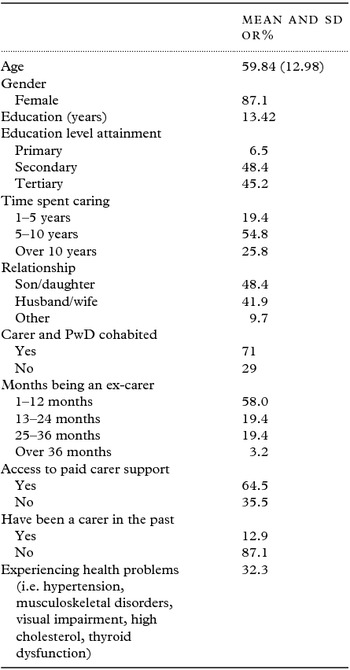
Participants were former family carers of people with a diagnosis of dementia according to DSM-IV criteria that have been receiving services from the Dementia Day Care Centre of the Athens Association of Alzheimer's Disease and Related Disorders. In the current study, we used the operational definition of former caring provided by Larkin (Reference Larkin2009), which was described as an unpaid form of caring that ended with the death of the loved one. Characteristics of the sample can be seen in Table 1. For each carer, the cessation of caring had coincided with the death of their relative. As can be seen from Table 1, our sample is representative of the Southern European model of supportive care for people with dementia (Triantafillou et al., Reference Triantafillou, Mestheneos, Prouskas, Goltsi, Kontouka and Loukisis2006), in which the majority of carers (77%) provide in-home care to their relative.
Demographic characteristics of the sample

Procedure
A total of 31 semi-structured in-depth interviews were conducted. The interviewer first invited participants to identify and describe key emotional changes associated with bereavement, and adapting to loss. In the second phase of the interview, participants were asked to discuss changes in their daily lives and strategies for managing problems associated with adapting to loss and their new role. The order of questions allowed rapport to develop prior to the discussion of potentially very intimate and emotionally intense information. Ethical approval was granted by the Athens Association of Alzheimer's Disease and Related Disorders Ethics Committee. Informed consent was obtained from all participants.
All interviews were conducted by telephone-scheduled appointments at a time comfortable to the respondents and lasted on average 45 minutes. Two psychologists with expertise in counseling conducted the interviews, which included collecting demographic data (age, education, living status, financial status, health problems, ex-carer period in months, and any external support/services provided to the carer) and the main body of the semi-structured interview. The key questions asked in relation to the bereavement transition period were about emotional experiences that were prevalent after caring has ceased, how carers’ daily life/routine has changed, and the strategies that carers used that were helpful in adapting to the loss of their loved one. The questions comprising the semi-structured interviews were the following: (a) how has your life changed after no longer caring for your loved one? (b) what have been the most difficult changes or experiences during your post-caring life? (c) how has your life changed? (d) what did you do in order to adapt to your new role?
Data analysis
To analyze responses, we used thematic analysis (Braun and Clarke, Reference Braun and Clarke2006), which was data driven, allowing themes to emerge from the transcripts. After verbatim transcription, two researchers read through all the responses in order to become familiar with the data. The second step was identifying units of meaning in each response and summarizing these into a smaller list of themes or categories within the unit (identifying and producing concepts, sub-categories, and core categories). Themes and categories were derived independently by two researchers (AV, AE), and any differences were discussed with a third author (VO) until reaching a consensus.
Results
Psychological adjustment to bereavement and the post-caring experience
Emotional reactions
Loss of the care dependant. A significant number of carers reported being challenged to accept the reality of their situation, and this included dealing with a range of emotional responses. The majority of carers reported that no longer being able to provide care for their loved one was associated with feelings of loss. The most common emotional reaction was missing their loved one and taking care of them. Carers specifically commented on missing their close relationship with their relative, the time they spend together, emphasizing the caring aspects of the relationship. One carer reported: “You lose your partner in life, that is the most difficult part. I miss taking care of him.” Another added: “You keep thinking that this time I used to care for him, talk to him, feed him.” For some carers, the feeling of loss for their loved one was described as one that may continue for many years into their post-caring life. One carer said: “I think the pain of losing him will always be there for me.” Another carer added: “I do not think I can go back to my normal life, it will be very difficult.”
Loneliness. Feelings of loneliness were observed to be as frequent as feelings of loss, with a particular emphasis on lack of companionship. Comments included: “I was all alone, and coming home finding no one was very difficult for me,” “The most difficult part was not been able to talk to him.” A total of 32% of carers reported intense feelings of loneliness as the most difficult event associated with loss of the caring role.
Void. A prominent theme was experiencing “void,” and loss of their role and sense of purpose after their loved one had died, which was often associated with strong emotional reactions, related to the death of their relative. One carer mentioned: “The void is unbearable, and it becomes more difficult as time passes.”
Other emotions experienced: Less common but frequently reported emotional reactions by carers included sadness, anger, and relief. For nearly half of the sample (47%), feelings of sadness, and relief were described as the key emotional reactions to loss of their loved one. A common theme amongst carers reporting feeling relieved was the concept of “dual relief,” referring to feelings of relief both for themselves but also for the person with dementia not continuing to “suffer.” For example, one carer reported: “It was a difficult time but he can now be free. During the last days, I kept thinking that I did not want him to suffer.” Less common emotional reactions reported by 23% of carers, were feeling lost, like being at a “standstill,” or feeling “numb.” One carer mentioned: “Immediately after the death of my mother I went to my cottage and I was looking at the sea. It was the only thing I could do.” For a small percentage of the sample, guilt was a frequent emotional reaction, during which carers questioned whether they “have done enough” during their caring role: One carer mentioned: “I kept thinking that I did not do enough when caring for him.” For 15% of the sample, carers recalled “stressful experiences” specifically related to the death of their loved one, (i.e. details of the funeral, what happened the last day before their relative died). One carer recalled: “I was very calm the day he died, I closed his eyes and did not make a sound.”
Difficulties experienced specific to adapting to bereavement and life after care
A significant number of carers reported that one of the most difficult experiences for them immediately after the death of their relative was dealing with closure tasks. These included funeral arrangements, sorting loved one's possessions, and financial and legal paperwork associated with the loved one's death. One daughter commented: “Having to empty the house and pack my mum's personal belongings was the most difficult thing I’ve done, it was unbearable.” Some carers described as “overwhelming” and “difficult” experiences events in the environment that specifically triggered memories of their loved one, such as their relative's possessions, photos, sounds, geographic locations, or specific family events. One carer stated: “There are still times when every object around me reminds me of my husband.” Other difficulties less frequently reported included poor sleep patterns, which for some carers comprised a significant barrier with “getting on with life.” One carer added: “It was very difficult at night, trying to sleep; everything came to my mind at night. Thinking through all that have happened, I kept looking for him.”
Changes in every-daily life and life as a whole after the loved one's death
During the second part of the interview, carers were asked to report any changes in their daily lives as a result of no longer caring for their relative. More than half of the sample reported that the most significant change in their daily life after the death of their relative was that they had more time available, that they experienced less stress and felt more relaxed in their daily routine. One carer mentioned: “My everyday life is better. I have time for myself and my family. The most important change is that I have less stress.” Some carers reported that they enjoyed having more time for their daily duties, resting, or taking care of themselves. The majority of carers reported increases in their free time as the most important positive change in their life after care, alongside being less physically tired, and no longer feeling “exhausted.”
The second most important change was resuming friendships and social networks and having time to focus on their own physical health and well-being such as seeking treatment for health problems experienced whilst caring. Although most carers reported that their “life after care” has significantly changed, for some carers everyday life remained the same. Comments included: “My life changed for the better. I could start taking care of myself again.” For approximately 8% of the sample, daily life after care was affected by significant life events, such as divorce or physical health problems whereas less than 5% reported going back to work as an important change in their daily life.
When asked about changes in their social life and support systems available, most carers reported that they experienced very limited changes overall in their close relationships or immediate social networks, which they described as relatively stable. One carer mentioned: “We always had many people around us; everyone calls me even now that he is gone.” When prompted to describe which types of social networks carers accessed, most reported meeting close family members, followed by friends, no one or both friends and family. In terms of the most important sources of support for carers, more than half of the sample described support from family (most often provided by children, siblings, or other close relatives) as key. One carer added: “It helped talking to my friends about all I have been through, I felt so much better.”
Coping strategies aiding adaptation to bereavement and life after care
In the final part of the interview, we asked family carers to report any strategies they used in order to feel better, overcome the loss of their loved one, and adapt to their new role. The following strategies were reported: (a) meeting relatives or friends, (b) outdoor activities, (c) voluntarism, (d) caring for other dependent persons, (e) self-care, or (f) nothing as yet.
Socially focused. Carers described that spending time with family members or friends, going back to previous interests, and hobbies such as taking holidays and travelling, helped them get their “life back together,” and “move on,” which was often described as a gradual process. One carer pointed out: “I want to go out and be social again, but it will take time.” A small number of carers reported engaging in local community groups, undertaking voluntary work, or continuing to care for others (i.e. parents, providing care as a local volunteer). One carer mentioned: “I have been involved and volunteer in many organizations. This is something that is very close to my ideals and beliefs.” For those reporting caring for another dependant or engaging in caring duties, feelings of altruism were described as a central part of their “post-caring life.” One daughter mentioned: “Giving to other people is very important in life, it makes you feel useful.”
Emotion focused. Most carers described “accepting their loss” as an important coping strategy. Comments included: “I have accepted my father's death; I thought about it so long, I was not sad but relieved.” Additional useful coping skills were being able to exert emotional control or “reappraising” the loss of their loved one and viewing caring as a positive experience. For some carers coping with the loss included avoiding thinking of their loved one, by purposely avoiding places they used to visit or doing things they did “together.” One spouse said: “I do not go to places we went together, it reminds me that I’ve lost everything.” For some cares however continuing to maintain a relationship with their loved one was considered very important and key in adapting to loss. This was described as an emotional need to “still provide care” (i.e. visiting their relative's grade regularly), “maintain a connection,” “talk to them” as they were still here, or sometimes “feeling” their relative was still alive, indicative of the importance of maintaining a strong emotional attachment with their relative. Comments included: “I pretend that I talk to him that gives me great relief”; another carer added: “I look after my husband's grave; to me that means I can still care for him.”
Other responses described as helpful were finding satisfaction and meaning through their “life giving care” despite this ending. As one caregiver stated: “This experience of caring for her, brought me closer to my mother. I can now see my strengths as a person.” For some carers, time was described as an important part of adapting to loss, and overcoming feelings of “void.” Comments included: “You no longer have your significant other, your partner in life, but time heals all these things.” “Although I am not that tired anymore, I know it will take time before I get better.” Accepting that their caring role has ended was perceived as an important part of the “circle of life.” One carer added: “I am not back to my normal routine yet, but I know this is the circle of life.”
Given the variation in time since death, additional analyses were conducted by considering data of participants having bereaved within the last year. There were no qualitative differences in grief themes in those bereaved the last year compared to those that have bereaved longer. However, analyses by type of caregiving relationship showed that feelings of loneliness were more common in spousal carers, which were also more likely to report symptoms of complicated grief. At the end of each semi-structured interview, carers were asked to indicate at which stage of the post-caring path of recovery they would describe themselves. A total of 61.3% of the sample reported that they have been able to adapt to bereavement and their new role, 19.4% described themselves as being in a “transitional phase,” whilst the remaining of the sample reported that they have not been able to adapt to the loss of their loved one.
Discussion
Our study has shown that carers experience a range of psychological reactions as they grieve. To our knowledge, this is the first study exploring key changes associated with the post-caring trajectory in dementia caregiving, alongside changes associated with psychological adjustment to bereavement. On the whole, our qualitative findings provide support for a “process model” of adaptation to bereavement and life after care in terms of conceptualizing carers’ bereavement experiences, which most carers described as a gradual dynamic process (Ott et al., Reference Ott, Sanders and Kelber2007), similar to anticipatory grief (Meuser and Marwit, Reference Meuser and Marwit2001). The most dominant theme of our analyses exploring key changes associated with adapting to loss was the lack of physical tiredness and “exhaustion,” relief from stress, and experiencing less anxiety. In line therefore with the stress reduction and relief theory (Bass and Bowman, Reference Bass and Bowman1990; Schulz et al., Reference Schulz, Newsom, Fleissner, Decamp and Nieboer1997), transitioning from bereavement to life after care provided relief for most carers, as opposed to posing them at risk of decreased well-being (Mullan, Reference Mullan1992; Schulz et al., Reference Schulz2003).
The majority of carers interviewed reported at least one positive life change post loss, with support from family and friends and engaging in pleasant activities described as key in adjusting to bereavement. In terms of emotional strategies employed, carers described processes through which they were able to make sense and accept their loss, manage their feelings in an adaptive way, maintain emotional stability, and develop or rebuild friendships, indicative of improvements after their relative's death (Schulz et al., Reference Schulz2003). Most carers were able to employ active coping strategies which may have been protective for their emotional well-being (Bonanno et al., Reference Bonanno, Papa, Lalande, Westphal and Coifman2004).
In relation to previous theoretical models, our qualitative data provide support for both the relief and depletion models of bereavement in caregiving (Bass and Bowman, Reference Bass and Bowman1990; Schulz et al., Reference Schulz, Newsom, Fleissner, Decamp and Nieboer1997). Although most carers reported adapting relatively quickly to the loss of their loved one, experiencing relatively minor distress, some carers reported difficulties in adjusting to the loss, often characterized by experiencing separation distress, negative, and upsetting thoughts about their relative's death, indicative of complicated grief (Schulz et al., Reference Schulz2003; Reference Schulz, Boerner, Shear, Zhang and Gitlin2006). This suggests that there is variability in bereavement outcomes for dementia carers, with possibly different trajectories with regards to carer well-being. On the other hand, carers reporting being grateful that caring had ended, were more likely to report being satisfied with the care they provided and ready to “move on” (Jones and Martinson, Reference Jones and Martinson1992).
The present study has advanced our understanding of the key psychological changes that accompany post-death grief experiences in dementia carers. Most carers reported feeling intense emotions, and no longer caring for the person with dementia was an “emotionally challenging time,” indicative of personal suffering characterized by feelings of loss, and loneliness (Collins et al., Reference Collins, Liken and Kokinakis1993). Experiencing the “post-caring void” was common and central to life after care and responding to loss (Schulz et al., Reference Schulz, Newsom, Fleissner, Decamp and Nieboer1997; Larkin, Reference Larkin2009). As carers reviewed their bereavement experiences, many reported mixed feelings of intensified grief and relief (Almberg et al., Reference Almberg, Graftstrom and Winbald2000; Meuser and Marwit, Reference Meuser and Marwit2001). Carers viewed their relative's death both as a relief from stress for their everyday life but also as a means to end “the suffering” for the person with dementia (Almberg et al., Reference Almberg, Graftstrom and Winbald2000). For some carers remaining emotionally attached to their relative, by “keeping the connection” (Jones and Martinson, Reference Jones and Martinson1992) was described as an important need for adapting to the loss.
Our additional analyses did not indicate that time since death played an important role in shaping adjustment to bereavement (Bass and Bowman, Reference Bass and Bowman1990; Bodnar and Kiecolt-Glaser, Reference Bodnar and Kiecolt-Glaser1994). Although we found no evidence of variability related to time since death, those caring for a spouse experienced greater difficulties adapting to loss compared to those providing care for a parent, in line with evidence that spouses may be more prone to both normal and complicated grief responses (Boerner et al., Reference Boerner, Schulz and Horowitz2004; Chan et al., Reference Chan, Livingston, Jones and Sampson2013).
Consistent with the general caregiving literature, carers reported finding other or new carer-related volunteer activities (Arksey, Reference Arksey2003; Larkin, Reference Larkin2009), during which they contributed and supported their local community (Davies and Nolan, Reference Davies and Nolan2004). In our sample, a quarter of carers reported that they started caring for another frail person. This is consistent with the findings of Larkin (Reference Larkin2009), whereby some former carers will undertake new caring duties by “filing the gap,” and therefore become “vocation” or “serial carers” (Lewis and Meredith, Reference Lewis and Meredith1988). Although we did not investigate the reasons of this phenomenon in detail, our results provide support for previous reports that a notable percentage of the caregiving population continues their caring role.
In regards to ill health, we found that only a small percentage of carers reported that their health problems have continued or have started after the death of their relative (McLaughlin and Ritchie, Reference McLaughlin and Ritchie1994), possibly as a result of stress. For some carers, health problems existed long before their caring role had ended but were left untreated similar to quantitative findings (Shear et al., Reference Shear, Frank and Houck2005). On the contrary, changes to social networks were characterized by most carers positively and only a fifth of our sample talked about negative changes, such as minimal or no contact with others (Burton et al., Reference Burton, Haley, Small, Finley, Dillinger-Vasille and Schonwetter2008). Given that a high percentage of former carers reported that they met as regularly with close family and friends as during the caring period indicates that overall social support systems remain unchanged for bereaved carers (Ott et al., Reference Ott, Sanders and Kelber2007).
Our findings have important implications for health policy making and clinical practice in Greece, which lacks integrated dementia services, despite the majority of people with dementia being cared for at home (Mestheneos et al., Reference Mestheneos, Triantafillou and Kontouka2004). Given that family carers in Greece provide the majority of care in the context of limited services available (Triantafillou et al., Reference Triantafillou, Mestheneos, Prouskas, Goltsi, Kontouka and Loukisis2006), our results indicate an urgent need to support carers, which should include specialist services for those at risk of poor bereavement outcomes.
Limitations
An important limitation of our study is that the period between the loved one's death and the time of interview varied considerably between carers from 2 to 72 months, with a mean duration of 17 months. Our sample size was relatively small, and heterogeneous, which limits the extent to which the results can be generalized. Future studies will be strengthened by using a long-term follow-up, and studying a more diverse population of carers. Most of the former carers had been recipients of services provided by the Athens Association of Alzheimer's Disease and Related Disorders, therefore the generalizability of our findings is limited and may not be applicable to carers not affiliated with such an organization. Variables such as gender, ethnicity, socio-economic circumstances, and previous history such as experiencing significant depressive symptoms, could not be explored in depth and therefore require further investigation. Levels of care during active caring, such as provision of intensive care may have confounded our findings, and although there was considerable variability in bereavement experiences, the present study cannot provide any information on factors accounting for this variability.
Conclusion
Given the increasing prevalence of informal dementia carers, understanding the long-term post-care effects of caring on the well-being of dementia carers, should be an important priority for research. Future studies should investigate in depth the role of the carer–patient relationship, in predicting bereavement outcomes and consider this variable in the development of theoretical models. Our study expands current knowledge on the key emotional and cognitive patterns associated with successful adaptation to bereavement for dementia carers. We found that most family carers adapt well to loss of their loved one; however, a minority experience intense psychological distress and may be vulnerable to psychiatric morbidity. Our findings will be useful in designing interventions for carers at risk of negative bereavement outcomes.
Conflict of interest
None.
Description of authors’ roles
Aggeliki Vlachogianni, Areti Efthymiou, Dimitra Potamianou, and Paraskevi Sakka designed the study and wrote the research proposal. Aggeliki Vlachogianni, and Areti Efthymiou, performed the literature searches, undertook the analyses and wrote parts of the manuscript. Aggeliki Vlachogianni and Dimitra Potamianou contributed to data collection and recruitment. Vasiliki Orgeta performed part of the literature search, contributed to data analyses and wrote parts of the manuscript. All authors contributed to and have approved the final manuscript.
Acknowledgments
Aggeliki Vlachogianni, Areti Efthymiou, Dimitra Potamianou, Paraskevi Sakka and Vasiliki Orgeta, Athens Association of Alzheimer's Disease and Related Disorders and Division of Psychiatry, University College London. We would like to thank those who kindly volunteered to participate in the study.