


Introduction
Loneliness has become an important topic of social and public health concern, receiving substantial attention in many nations around the world (Surkalim et al. Reference Surkalim, Luo, Eres, Gebel, Van Buskirk, Bauman and Ding2022). The experience of loneliness may be particularly salient in later life, due to such factors as widowhood, the loss of friends and family members, and health declines (Hajek and König Reference Hajek and König2020; Sheftel et al. Reference Sheftel, Margolis and Verdery2024). Moreover, the Covid-19 pandemic further intensified concerns about loneliness among older Canadian adults, with reports indicating significant increases in loneliness compared to before the pandemic (Kirkland et al. Reference Kirkland, Griffith, Oz, Thompson, Wister, Kadowaki, Basta, McMillan, Wolfson, Raina, Anderson, Balion, Costa, Asada, Cossette, Levasseur, Hofer, Paterson and Cosco2023). In response to growing concerns about loneliness, extensive research has sought to examine the causes of loneliness among older adults, with the ultimate goal of developing effective interventions to mitigate feelings of loneliness (Li et al. Reference Li, Rao, Su, Sul, Caron, D’Arcy, Fleury and Meng2023; World Health Organization 2024). Despite such efforts, loneliness has continued to rise, and current interventions show only minor, short-term effects and lack robust evidence of effectiveness among older adults (Gardiner et al. Reference Gardiner, Geldenhuys and Gott2018; Kirkland et al. Reference Kirkland, Griffith, Oz, Thompson, Wister, Kadowaki, Basta, McMillan, Wolfson, Raina, Anderson, Balion, Costa, Asada, Cossette, Levasseur, Hofer, Paterson and Cosco2023; Lasgaard et al. Reference Lasgaard, Bo, Nielsen, Swane, Qualter and Christiansen2023). A major limitation of current loneliness research is the predominant focus on individual and relational factors (Buecker et al. Reference Buecker, Maes, Denissen and Luhmann2020; Li et al. Reference Li, Rao, Su, Sul, Caron, D’Arcy, Fleury and Meng2023). The focus on relational factors is a weakness because loneliness also has socio-economic origins, with socially disadvantaged groups disproportionately experiencing loneliness (Barjaková et al. Reference Barjaková, Garnero and D’Hombres2023). Social disadvantage arises from structural inequalities that create unequal access to resources, opportunities and privileges (McLeod Reference McLeod, Aneshensel, Phelan and Bierman2013). Addressing loneliness therefore requires recognizing it as an ‘unequally distributed’ burden (Barreto et al. Reference Barreto, Doyle and Qualter2024 p. 158; Prohaska et al. Reference Prohaska, Burholt, Burns, Golden, Hawkley, Lawlor, Leavey, Lubben, O’Sullivan, Perissinotto, Van Tilburg, Tully, Victor and Fried2020).
Guided by the need to address the socio-economic origins of loneliness in later life, we focus on the implications of an understudied marker of disadvantage among older adults – housing ownership status. We are led to focus on home-ownership status by its long-lasting recognition as a fundamental aspect of socio-economic advantage, further reinforced by recent developments in sociological theory (Rohe et al. Reference Rohe, Van Zandt and McCarthy2002; Zavisca and Gerber Reference Zavisca and Gerber2016). Homeownership signifies an advantageous background and accumulated wealth (Kricheli-Katz and Posner Reference Kricheli-Katz and Posner2023; Sodini et al. Reference Sodini, Van Nieuwerburgh, Vestman and Von Lilienfeld-Toal2023); conversely, affordability challenges created by mortgages and rent demands often lead to financial strain (Park, Grignon et al. Reference Park, Grignon, Young and Dunn2022). Financial strain refers to the difficulty of affording bills and basic needs (Bierman et al. Reference Bierman, Upenieks, Lee and Harmon2023). A sociological perspective on mental health encapsulated within a stress process perspective in turn positions financial strain as one of the most critical chronic stressors due to the degree to which financial strain wears on the individual psyche (Pearlin Reference Pearlin1999; Kahn and Pearlin Reference Kahn and Pearlin2006). More recent research not only supports the dominant role of financial strain in the panoply of stressors (Qian and Fan Reference Qian and Fan2023) but also demonstrates that financial strain is a critical determinant of loneliness among older adults (Bhatta et al. Reference Bhatta, Miller and Lekhak2023; Bierman et al. Reference Bierman, Upenieks, Lee and Mehrabi2024). Building on prior empirical findings and stress process perspective, fundamental cause theory explains how structural inequalities, like housing disparities, shape exposure to chronic stressors and contribute to persistent inequities in health and wellbeing. Fundamental causes, such as housing ownership, influence access to resources that protect against adverse health outcomes, ensuring that individuals with greater socio-economic advantage can mitigate risks more effectively (Phelan et al. Reference Phelan, Link and Tehranifar2010). The synthesis of these theoretical perspectives therefore leads us to expect that mortgage-paying and renting will be associated with greater financial strain and loneliness than outright home ownership, and that financial strain will be a mediator in the observed association between housing status and loneliness. Yet, the stress process perspective also emphasizes that the indirect processes through which socio-economic disadvantages influence psychological wellbeing may be differentiated by additional social statuses (Pearlin Reference Pearlin1999), with gender shown to be one of the most critical in differentiating exposure to financial stressors in later life (Bierman et al. Reference Bierman, Upenieks, Glavin and Schieman2021).
Guided by this synthesis of theoretical perspectives on the stress process and fundamental causes theory, the current study addresses three critical questions. First, using a national survey of older adults, we examine whether individuals who rent or pay a mortgage experience greater levels of loneliness compared to those who own a home outright. Second, we investigate whether differences in exposure to financial strain explain disadvantages in loneliness among renters and mortgage-payers. Third, we explore whether associations between housing status, financial strain and loneliness differ by gender. By examining the links between home-ownership status, financial strain and loneliness in the context of gender, this research contributes to a shift in the narrative surrounding loneliness from a relational perspective to one that expands to emphasize the basis of loneliness in socio-economic disparities. In highlighting the socio-economic nature of loneliness, we point to potential avenues for more effective interventions to halt and reverse the rise in later-life loneliness.
Literature review
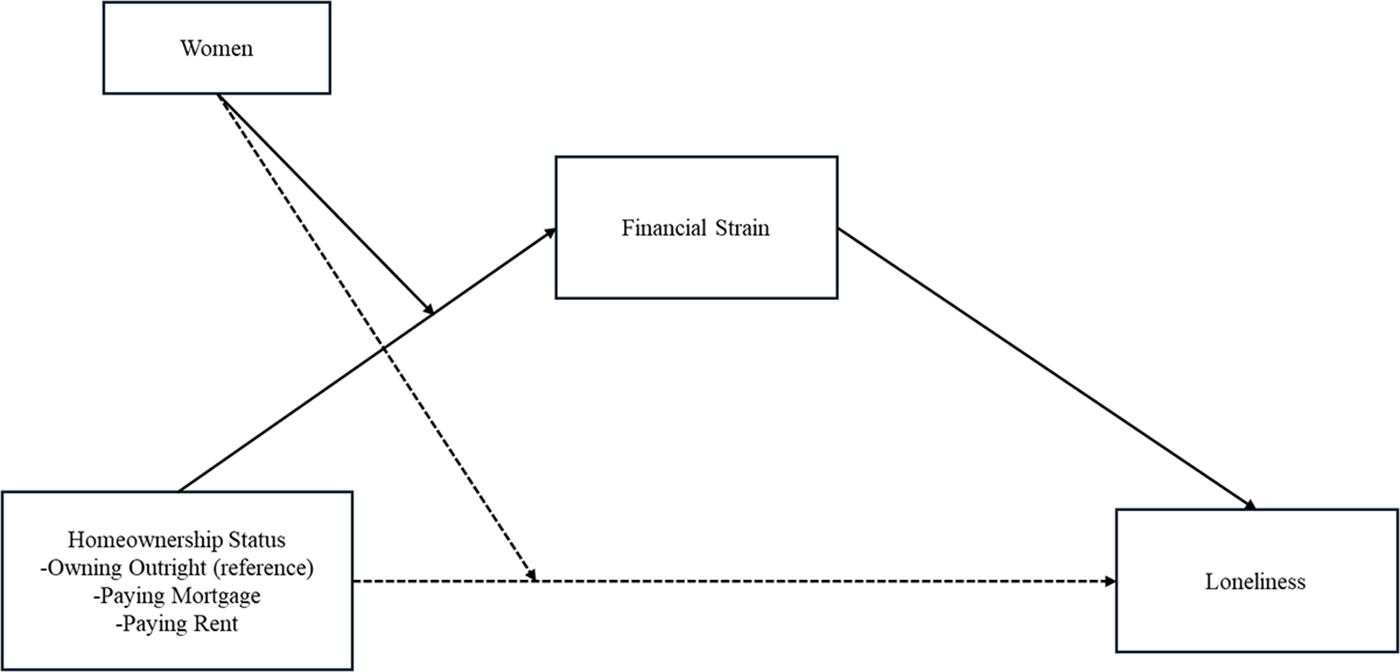
Figure 1 describes the general conceptual framework of this article. Fundamental to this study is the argument that housing status is a critical dimension of socio-economic status (SES) and a potentially important socio-economic correlate of loneliness (De Jong Gierveld et al. Reference De Jong Gierveld, Keating and Fast2015). In later life, whether one owns a home outright, holds a mortgage or rents reflects accumulated socio-economic resources(Milne Reference Milne2020; Petersen and Tilse Reference Petersen and Tilse2024; Gustafson Reference Gustafson2024). Consequently, housing status is a crucial aspect of SES, not just a living arrangement (Park, Grignon et al. Reference Park, Grignon, Young and Dunn2022; Leviten-Reid et al. Reference Leviten-Reid, Digou and Kennelly2025). Recognizing renters as the most disadvantaged among housing status groups is essential, particularly since a home is typically the only major asset for many low-income families (Wainer and Zabel Reference Wainer and Zabel2020), and the absence of home ownership indicates significant socio-economic challenges (Keeling Reference Keeling2014; Bates et al. Reference Bates, Kearns, Coleman and Wiles2020; Marshall et al. Reference Marshall, Eke, Guthrie, Pugh and Seth2024). The sociological literature demonstrates the disadvantages of renting by comparing renters to a combined group of outright homeowners and mortgage-holders (Zavisca and Gerber Reference Zavisca and Gerber2016). This line of research shows that the combined group of outright homeowners and mortgagors generally enjoy greater financial stability and psychological wellbeing than renters (Angel and Gregory Reference Angel and Gregory2023; Sodini et al. Reference Sodini, Van Nieuwerburgh, Vestman and Von Lilienfeld-Toal2023; Ettman et al. Reference Ettman, Subramanian, Fan, Adam, Abdalla, Galea and Stuart2024), while renters tend to feel less community belonging (Leviten-Reid and Matthew Reference Leviten-Reid and Matthew2018). However, research that merges mortgage-payers with outright homeowners can obscure the distinct challenges that mortgagors face, as some research suggests that the financial burdens of mortgages can offset the benefits of home ownership (Will and Renz Reference Will and Renz2023). Research among older adults illustrates disadvantages in psychological wellbeing for both mortgage-payers and renters compared to homeowners (Park, Park et al. Reference Park, Park and Kim2022), but research on older adults has generally not examined loneliness by separating mortgage-payers from outright homeowners.
Conceptual model of the indirect association between home-ownership status and loneliness. Adapted from Hayes (Reference Hayes2017). Solid lines indicate direct associations; dashed lines indicate indirect (i.e. mediated) associations. Arrows represent hypothesized associations, not causal direction.

Figure 1 also shows that financial strain is expected to be a potential pathway to greater loneliness among mortgage-payers and renters compared to older adults who own their own homes. For mortgage-holders, financial strain arises from the necessity to meet regular, often substantial, payment obligations that extend over a long period (Loibl et al. Reference Loibl, Moulton, Haurin and Edmunds2022). Smith et al. (Reference Smith, Clark, Ong Viforj, Wood, Lisowski and Truong2022 p. 170) use the term ‘the edge of ownership’ to highlight the precarious position of mortgagors who, despite legally owning their property, face complex risks and significant financial pressures. In the case of older adults, fixed or reduced incomes during retirement may make it increasingly challenging to manage mortgage expenses (Lusardi et al. Reference Lusardi, Mitchell and Oggero2020) and housing-related costs such as property taxes, insurance and maintenance (Park and Seo Reference Park and Seo2022). Renters, on the other hand, face frequent moves and housing burden costs due to rising rental costs (Colburn et al. Reference Colburn, Hess, Allen and Crowder2025). In Canada, renters are particularly vulnerable as rental prices have steadily increased, consuming a larger portion of their incomes (Farhan Reference Farhan2024). For example, between 2016 and 2021, average monthly rents in major urban centres increased by approximately 20 per cent, while median household incomes grew by only 3 per cent during the same period (Government of Canada 2022). This situation is compounded by the lack of equity growth, which adds to financial pressures for renters as there is no return on investment for rental payments (Loewentheil and Weller Reference Loewentheil and Weller2005). We therefore expect that both renters and mortgage-payers in later life will experience greater levels of financial strain when compared to older adults who own their own homes outright.
Financial strain is, in turn, linked with greater loneliness among older adults (Bierman et al. Reference Bierman, Upenieks, Lee and Harmon2023; Drost et al. Reference Drost, Snyder, Betz and Loibl2024). Financial strain can foment loneliness in later life because financial challenges make it extremely difficult to maintain social ties (Corman et al. Reference Corman, Noonan, Reichman and Schultz2012). The financial strain associated with renting or paying a mortgage creates difficulties affording phone bills or the costs of going out and engaging in social activities, leading to increased isolation (Morris and Verdasco Reference Morris and Verdasco2021). Moreover, due to the necessity of maintaining a stable shelter, housing costs will often be placed in a primary position when addressing financial demands (Desmond Reference Desmond2016), with the result that there is often no money left for other essential aspects of older adults’ lives, such as health-care expenses, let alone social activities (Airgood-Obrycki et al. Reference Airgood-Obrycki, Hermann and Wedeen2023). Additionally, financial issues foster a sense of shame, further deteriorating the quality of social relationships and causing individuals to distance themselves from others (Akhter-Khan et al. Reference Akhter-Khan, Prina, Wong, Mayston and Li2023; Bierman et al. Reference Bierman, Upenieks, Lee and Harmon2023). For example, mortgage-holders experiencing financial difficulties often feel ashamed and try to conceal their troubles, leading to social isolation (Keene et al. Reference Keene, Cowan and Baker2015). Therefore, we expect financial strain to be associated with greater loneliness and test whether mortgage-paying and renting have statistically significant indirect associations with loneliness through financial strain.
Figure 1 further shows that the associations between housing status and exposure to financial strain may differ by gender, suggesting that mortgagors and renters could experience differing levels of loneliness across gender groups when compared to older adults who own their own homes outright. Research consistently finds that women report higher levels of loneliness than men in older age (Boehlen et al. Reference Boehlen, Heider, Schellberg, Hohls, Schöttker, Brenner, Friederich, König and Wild2023). These gendered experiences of loneliness intersect with economic challenges (Schmitz Reference Schmitz2021). Greater economic disadvantages among women stem from structural inequalities such as gender wage gaps, occupational segregation and interrupted work histories for care-giving (Sheen Reference Sheen2017; Mutchler et al. Reference Mutchler, Roldán and Li2021). These factors lead to more part-time work, lower-paying jobs and, ultimately, lower levels of lifetime earnings, thereby harming women’s financial security (Blau and Kahn Reference Blau and Kahn2017; Darab et al. Reference Darab, Hartman and Holdsworth2018). Women’s financial disadvantages make home ownership less likely and mortgages or rents harder to manage (Goldsmith‐Pinkham and Shue Reference Goldsmith‐Pinkham and Shue2023). Consequently, older women struggle more with a lack of home ownership due to lower financial resources (Gonçalves et al. Reference Gonçalves, Ponchio and Basílio2021; Watson Reference Watson2023). Given women’s greater financial vulnerability in later life, we expect housing-status differences in financial strain to be more pronounced among women than men and examine whether this pattern corresponds to stronger indirect associations with loneliness through financial strain.
Summary
In summary, this research seeks to emphasize the basis of loneliness in socio-economic disparities in later life by examining whether both mortgagors and renters experience greater levels of loneliness when compared to older adults who own their own homes outright, as well as whether these differences in loneliness are linked to greater levels of financial strain experienced by mortgagors and renters. We further examine whether women who are mortgagors and renters are particularly exposed to greater financial strain, thereby enhancing experiences of loneliness among women who are mortgagors or renters.
Method
Data
The cross-sectional data for this research were derived from the Caregiving, Ageing, and Financial Experiences Study. This national survey was designed to gather comprehensive information on older Canadian adults’ socio-economic conditions and psychological wellbeing. Data collection was a collaborative effort with the Angus Reid Forum, a leading survey research organization in Canada that maintains an ongoing national panel of Canadian respondents from which nationally representative samples can be drawn. Data collection occurred in late September and early October of 2021, employing an online questionnaire among a demographically representative cohort of 4,010 Canadians aged 65 to 85. The response rate was 56 per cent, but analyses are weighted based on the latest Census information on age, gender and geographical location to ensure a representative sample of older Canadians.
Focal measures
Loneliness was measured as a latent variable based on a three-item scale adapted from Hughes et al. (Reference Hughes, Waite, Hawkley and Cacioppo2004). The three-item Hughes scale was developed as a brief measure of loneliness suitable for large-scale population surveys (Hughes et al. Reference Hughes, Waite, Hawkley and Cacioppo2004). Respondents were asked to report how often in the past seven days they experienced feelings of lacking companionship, feeling left out and feeling isolated from other people. The response options ranged from 1 (indicating that these feelings were experienced most or all of the time, 5–7 days) to 4 (indicating that these feelings were rarely or never experienced, less often than once a day). Responses were reverse-coded, so that higher scores corresponded to higher levels of loneliness. The adequacy of the latent measurement model was assessed using confirmatory factor analysis. All three indicators loaded strongly and significantly on the latent loneliness factor (standardized loadings ranged from 0.82 to 0.89), supporting the construct validity of the measure. Prior work demonstrates that the three-item Hughes scale has strong convergent validity with the full UCLA scale (r = 0.82), supporting its use in population-based research (Hughes et al. Reference Hughes, Waite, Hawkley and Cacioppo2004).
Financial strain was also measured as a latent variable using a three-item scale adapted from Koltai et al. (Reference Koltai, Bierman and Schieman2018), which inquired about respondents’ frequency of financial difficulties over the past three months. This included having trouble paying the bills, not having enough money to buy household needs, and how their finances usually worked out by the end of the month. The response scale ranged from 1 (‘never’) to 5 (‘very often’) for the first two items and from 1 (‘not enough to make ends meet’) to 5 (‘a lot of money left over’) for the third item, with responses to the third item reverse-coded. The adequacy of the latent measurement model was assessed using confirmatory factor analysis. All three indicators loaded strongly and significantly on the latent financial strain factor (standardized loadings ranged from 0.73 to 0.87), supporting the construct validity of the measure. This measure of subjective financial strain has been widely used in stress-process research and demonstrates acceptable reliability and validity in prior studies (Koltai et al. Reference Koltai, Bierman and Schieman2018).
Home-ownership status was assessed through the question: ‘Do you own your home outright, are you paying a mortgage or do you rent? (If you have more than one home, answer for your primary residence.)’ Based on the responses, participants were categorized into three distinct groups: those owning their home outright (used as the reference category in all analyses), those with a mortgage and those renting.
Gender was coded with men assigned a code of 0 and women assigned a code of 1. Respondents could also indicate that they preferred to self-describe their gender, but no respondent chose this option.
Control measure
Covariates in statistical analyses focused on indicators of background social statuses and social integration, which were likely to predict financial strain and loneliness. Age was recorded in years. Household income was measured on a 14-level scale from less than $10,000 to over $500,000. Educational attainment was measured using a set of dichotomous indicators: some post-high school education (including college, trade school or university), trade school graduates, individuals with university undergraduate degrees and those with postgraduate qualifications, with high school degree the comparison group (less than 3 percent of the raw sample had less than a high school degree, and these respondents were combined with the high school degree group). Canadian research conventionally uses a ‘visible minority’ category in the measurement of race (Little Reference Little2016). Participants were therefore asked, ‘Would you say you are a member of a visible minority here in Canada (in terms of your ethnicity/race)?’ Responses were coded dichotomously, with affirmative answers assigned a value of 1. To control for alternative aspects of social integration that may potentially influence loneliness and financial strain, we controlled for the number of household members and also included dichotomous variables for marital status (married coded as 0 and non-married coded as 1), retirement status (with non-retired coded as 0 and retired coded as 1), and rural/urban living environment (with urban coded as 0 and rural coded as 1). Finally, geographic location was included to take into account provincial differences in housing policies and affordability. A set of dichotomous variables indicated Quebec, British Columbia, Saskatchewan/Manitoba, Alberta and the Atlantic provinces, with Ontario as the reference.
Plan of analysis
All analyses were conducted using Stata 18.0. We applied sampling weights with Taylor series linearization that estimated standard errors, which were robust to heteroskedasticity. We utilized structural equation modelling (SEM) in the main analyses, which enabled the estimation of latent constructs for financial strain and loneliness, thereby diminishing the measurement errors typically associated with self-report instruments (Brown Reference Brown2015). The SEMs were estimated using full information maximum likelihood (FIML), which utilizes all information that is available from each case, thereby minimizing biases from item non-response (Enders Reference Enders2022).
In our first model, we examine the bivariate focal association between housing status and loneliness. In Model 2, we incorporate background covariates to assess if differences in loneliness by home-ownership status remain after controlling for these factors. In Model 3, we estimate the indirect associations linking each home-ownership indicator (the indicators of renting and paying a mortgage, compared to owning a home outright) with loneliness through financial strain. Model 3 first examines how these housing indicators are associated with the latent measure of financial strain (a) and then how financial strain is associated with the latent measure of loneliness (b). The product of these two paths (ab) quantifies the indirect association of each home-ownership indicator with loneliness through financial strain. To assess the significance of these indirect associations, we employed the Sobel test of the ab (Preacher and Hayes Reference Preacher and Hayes2008). In ancillary analyses, we applied the percentile bootstrap to ab and confirmed the pattern of significance indicated by the Sobel tests. Lastly, in Model 4, we include interactions between gender and home-ownership indicators in predicting financial strain and loneliness. The inclusion of these interactions serves to show if the total and indirect associations between home-ownership indicators and loneliness differ significantly between men and women (Hayes Reference Hayes2017).
Additionally, SEM produces multiple indicators of model fit.Footnote 1 Fit indices for all SEMs presented in this article yielded a significant chi-square statistic, which could generally be attributed to the study’s large sample size (West et al. Reference West, Wu, McNeish and Savord2023). Consequently, we assessed model fit using alternative fit indices based on the comparative fit index (CFI) and root mean squared error of approximation (RMSEA). For all models presented in this article, the CFI was greater than 0.95 and the RMSEA less than 0.05, which generally indicates an acceptable model fit (Byrne Reference Byrne2013).
Result
Table 1 presents weighted descriptive statistics for the observed study variables among respondents with complete data (N = 3,854). The focal SEM analyses used FIML and retained the full sample of 4,010 respondents in the adjusted models. On average, participants were 72 years old, and just over half were women. A majority owned their homes outright, while approximately one-quarter rented and one-fifth held a mortgage. For descriptive purposes, loneliness and financial strain are represented by observed composite scales calculated by averaging their respective items. In the focal SEM analyses, these constructs are modelled as latent variables to account for measurement error.
Weighted descriptive statistics based on observed data

Table 1 Long description
Weighted descriptive statistics report mean with standard deviation for continuous variables and percentages for categorical variables. Mean age was 72.26 years with standard deviation 5.47, and mean household members was 1.81 with standard deviation 0.70. Mean loneliness was 1.58 with standard deviation 0.82, and mean financial strain was 1.64 with standard deviation 0.75. Gender percentages were men, ref., 47.49 and women 52.51. Housing status percentages were own outright, ref., 56.49, paying a mortgage 19.2, and rent 24.31. Visible minority status percentages were no, ref., 93.86 and yes 6.14; marital status percentages were married partnered, ref., 55.49 and not married 44.51. Retirement status percentages were not retired, ref., 15.55 and retired 84.45; residential context percentages were urban, ref., 80.76 and rural 19.24. Educational attainment percentages were less than high school 2.37, high school 12.37, post high school experience 24.96, trade school 20.92, and university graduate 39.37. Province percentages were Atlantic provinces 8.1, Quebec 25.38, Ontario, ref., 37.9, Manitoba and Saskatchewan 6.09, Alberta 8.3, and British Columbia 14.23.
Notes: Values represent means (standard deviations) for continuous variables and proportions for categorical variables. Descriptive statistics are weighted using survey weights and based on respondents with complete data on Table 1 variables (N = 3,854). SEM analyses used full-information maximum likelihood (MLMV) and therefore retained a larger analytic sample (N = 4010).
Models of the association between the indicators of home-ownership status and latent measure of loneliness are shown in Table 2. Model 1 indicates that individuals with mortgages and those who rent their homes have significantly higher latent levels of loneliness compared to those who own their homes outright. We evaluated the strength of these differences using semi-standardized coefficients. Semi-standardized coefficients are similar to Hedges’ g and show group differences in units of standard deviations of the dependent variable. The semi-standardized coefficient for renters was 0.355, and for mortgage-payers it was 0.132. Brydges’ (Reference Brydges2019) meta-analysis of ageing research provides guidelines for effect sizes in gerontological research, with effect sizes of Hedges’ g of 0.15 recommended to indicate the 25th percentile of effect sizes and 0.40 to represent the 50th percentile for effect sizes. Based on these criteria, the difference between renters and homeowners was relatively notable, by approaching the 50th percentile for effect sizes in gerontological research. Moreover, although the difference between mortgage-payers and homeowners is weaker, this difference still approaches the 25th percentile of effect sizes, suggesting a non-trivial difference in latent levels of loneliness in later life.
Home-ownership status differences in latent loneliness

Table 2 Long description
Regression coefficients for latent loneliness are reported for two models, each with columns for b, standard error, and p. Model 1 includes housing status with owning outright as the reference: mortgage b 0.108, standard error.037, p marked with two asterisks; rent b 0.288, standard error.042, p marked with three asterisks. Model 2 adds covariates and repeats housing status: mortgage b 0.108, standard error.037, p marked with two asterisks; rent b 0.136, standard error.044, p marked with two asterisks. Additional Model 2 main effects are age b minus 0.000, standard error 0.003, with no p marker; women versus men b 0.169, standard error 0.0293, p marked with three asterisks. Educational attainment versus high school shows post high school degree b 0.111, standard error 0.051, no p marker; trade school degree b 0.066, standard error 0.052, p marked with one asterisk; university degree b 0.113, standard error 0.050, p marked with one asterisk; post graduate degree b 0.113, standard error 0.057, no p marker. Other Model 2 covariates are income b minus 0.042, standard error 0.006, p marked with three asterisks; visible minorities yes versus no b 0.098, standard error 0.065, no p marker; not married versus married partnered b 0.146, standard error 0.037, p marked with three asterisks; retired versus not retired b minus 0.002, standard error 0.036, no p marker; number of household members b minus 0.057, standard error 0.027, p marked with one asterisk; rural versus urban b minus 0.050, standard error 0.034, no p marker. Province versus Ontario lists Atlantic provinces b minus 0.114, standard error 0.056, p marked with one asterisk; Quebec Province b minus 0.204, standard error 0.039, p marked with three asterisks; Manitoba and Saskatchewan b minus 0.112, standard error 0.058, no p marker; Alberta b minus 0.001, standard error 0.050, no p marker; British Colombia b 0.005, standard error 0.043, no p marker. Coefficients of determination are listed for lack of companionship at 0.704 in Model 1 and 0.709 in Model 2, feeling left out at 0.678 and 0.676, feeling isolated at 0.798 and 0.794, and latent loneliness at 0.022 and 0.092.
Notes: SE = standard error. N = 4010. Factor loadings can be obtained as the square root of the coefficients of determination. *p < 0.05, **p < 0.01, ***p < 0.001 (two-tailed tests)
With the inclusion of control variables in Model 2, the coefficient for individuals with mortgages is unchanged from Model 1. Conversely, for renters, including control variables leads to a substantial decrease in the coefficient, with the adjusted coefficient halved from Model 1 but still statistically significant. Moreover, not only did renters and mortgage-payers continue to face a significantly greater experience of loneliness but, for renters, this difference was larger than approximately 25 per cent of effect sizes in gerontology (semi-standardized coefficients = 0.167 for renters and 0.133 for mortgage-payers).
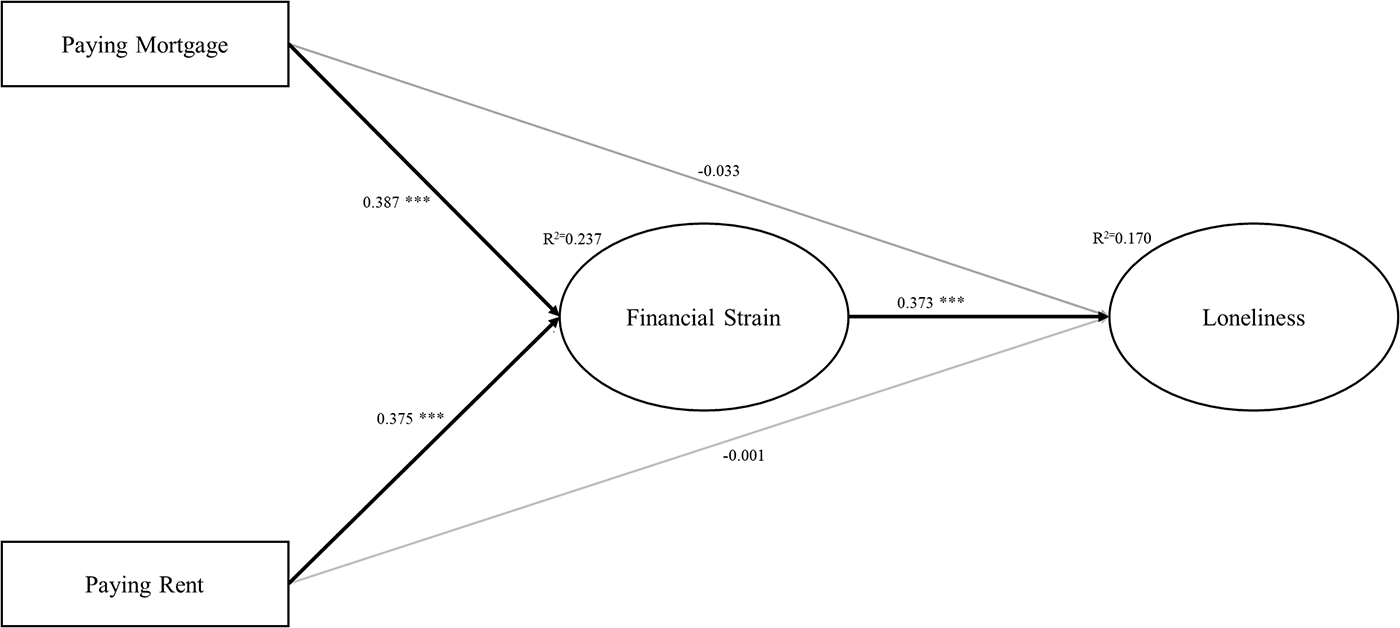
Figure 2 illustrates the results of the analyses examining the latent measure of financial strain as a mediator in the relationship between home-ownership status and latent levels of loneliness. Parameter estimates for control variables are available in the supplementary Appendix A. Figure 2 shows that mortgage payers and renters have significantly higher financial strain when compared to homeowners (semi-standardized coefficient for renters = 0.538; for mortgage-payers = 0.555, showing substantial effect sizes). Moreover, financial strain is significantly associated with higher levels of loneliness (standardized slope = 0.223). Further analyses underscored significant indirect associations between both housing-status indicators and loneliness through financial strain (for renters: ab = 0.140; for mortgage-payers: ab = 0.144; both p < 0.001). Moreover, when adjusting for financial strain, the direct associations of rent-paying (b = −0.001, p = 0.983) and mortgage-paying status (b = −0.033, p = 0.376) with loneliness were rendered non-significant. This pattern of results indicates that financial strain fully mediates the relationship between the home-ownership status indicators and loneliness, thereby demonstrating that financial strain is a substantial factor in explaining greater latent levels of loneliness among renters and mortgagors.
Test of indirect effects of home-ownership status on loneliness, with outright homeowners as reference. Black lines refer to statistically significant paths; grey lines refer to non-significant paths. *p < 0.05, **p < 0.01, ***p < 0.001 (two-tailed tests). N = 4010. Arrows represent hypothesized associations, not causal direction.

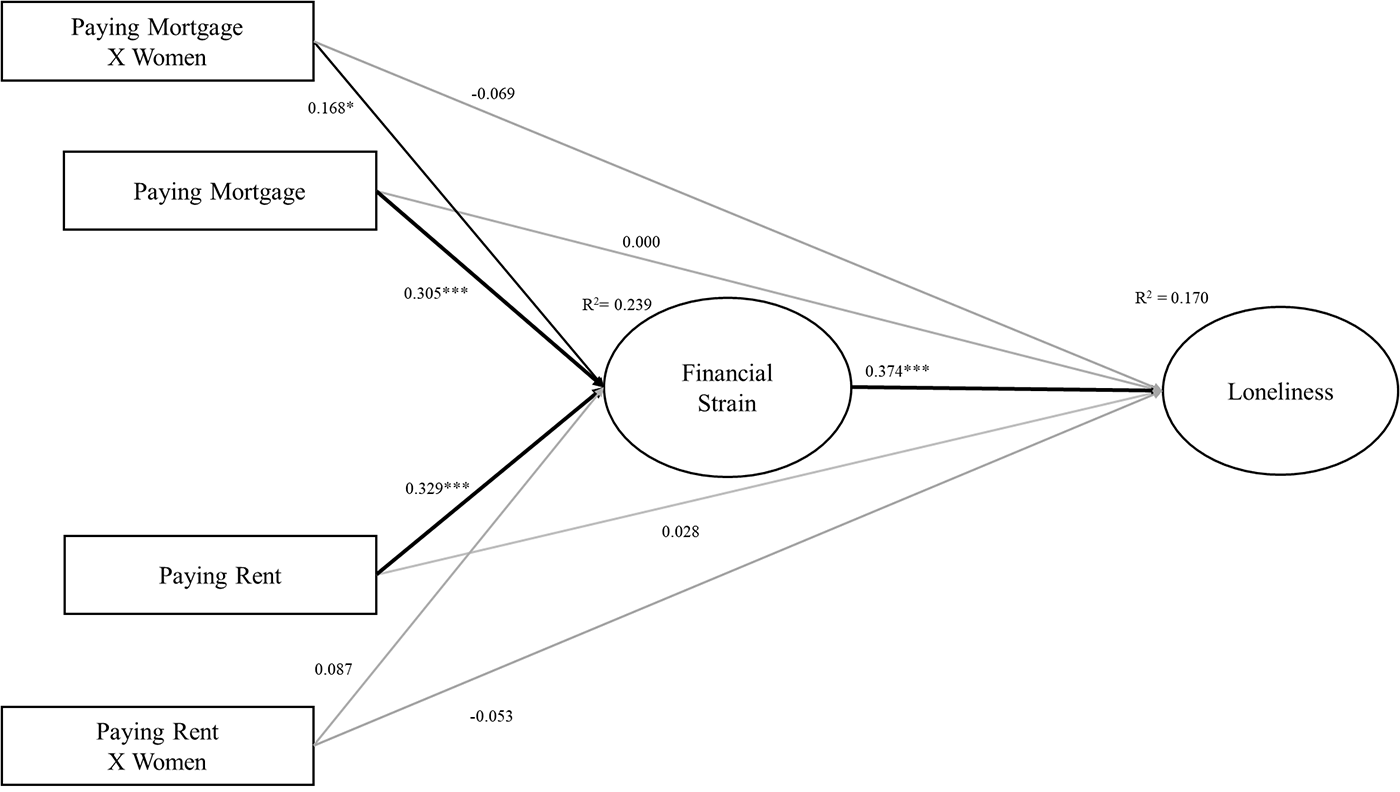
The final model depicted in Figure 3 tests the interaction between indicators of home-ownership status and gender. Figure 3 shows that the interaction of the mortgage-paying indicator and gender is significantly associated with financial strain (b = 0.168, p < 0.05), indicating that the difference in financial strain between mortgage-payers and older adults who own their homes differs by gender. Since we coded men as 0, the coefficient for the relationship between the home-ownership status indicator and financial strain in Figure 3 can be interpreted as the difference in latent levels of financial strain between homeowners and mortgagors, specifically among men. The significant positive coefficient for the mortgage-payer indicator therefore indicates that men who pay mortgages have significantly higher levels of financial strain than homeowners who are men (b = 0.305, p < 0.001). The positive direction of the interaction between gender and the mortgage-payer coefficient further shows that the difference in financial strain between mortgage-payers and homeowners is significantly greater among women. Ancillary analyses showed that the difference in financial strain between mortgage-payers and homeowners among women was 0.472 (p < 0.001). In terms of semi-standardized differences in financial strain between mortgage-payers and homeowners, the semi-standardized difference for men (0.434) indicates a difference just above the 50th percentile in gerontological research; for women, the semi-standardized coefficient is 0.673, which is near the 75th percentile (Brydges Reference Brydges2019).
Test of indirect effects of home-ownership status on loneliness, with outright homeowners as reference. Black lines refer to statistically significant paths; grey lines refer to non-significant paths. *p < 0.05, **p < 0.01, ***p < 0.001 (two-tailed tests). N = 4010. Arrows represent hypothesized associations, not causal direction.

Figure 3 Long description
Indirect effects of homeownership status on loneliness are shown, with various paths labeled by coefficients. On the left, four boxes represent different homeownership statuses: ′Paying Mortgage X Women′, ′Paying Mortgage′, ′Paying Rent′ and ′Paying Rent X Women′. Lines extend from these boxes to an oval labeled ′Financial Strain′ in the center. The lines are marked with coefficients: from ′Paying Mortgage X Women′ to ′Financial Strain′ is 0.168, from ′Paying Mortgage′ is 0.305, from ′Paying Rent′ is 0.134 and from ′Paying Rent X Women′ is 0.057. From ′Financial Strain′, lines extend to another oval labeled ′Loneliness′ on the right. The lines are marked with coefficients: from ′Financial Strain′ to ′Loneliness′ is 0.125 and from ′Paying Mortgage X Women′ directly to ′Loneliness′ is 0.029. The diagram uses black lines to indicate statistically significant paths and gray lines for nonsignificant paths, with coefficients indicating the strength of association between the variables.
The significant interaction between mortgage payments and gender in predicting financial strain suggests that this interaction will be indirectly associated with loneliness through financial strain. An ancillary Sobel test confirmed a significant indirect association between the mortgage-payment-by-gender interaction and loneliness through financial strain (ab = 0.063, p < 0.05). A significant indirect effect of the interaction, in turn, indicates that the indirect effect of mortgage-paying on loneliness differs significantly between men and women (Hayes Reference Hayes2017). Ancillary analyses showed that the indirect association between the mortgage-payer indicator and loneliness through financial strain was significant for both men and women, but almost 55 per cent stronger for women (for men: ab = 0.114; for women: ab = 0.177, both p < 0.001). Thus, the additional mortgagor disadvantage in financial strain among women resulted in greater disadvantages in loneliness as well. Moreover, since the direct association between the mortgage–gender interaction on loneliness is not significant, the gendered difference between mortgage-payers and homeowners in financial strain fully explains why we observe that the difference in loneliness between mortgage-payers and homeowners is greater among women.
We find quite different results for gender differences in the comparison between renters and homeowners. Figure 3 shows that the interaction of the rent-paying indicator with gender is not significantly associated with financial strain (b = 0.087, p = 0.173), indicating that the greater financial strain experienced by rent-payers does not vary significantly between genders. By extension, the indirect association between the rent-payer indicator and loneliness through financial strain did not differ significantly between men and women. The direct association between the interaction and loneliness is also not significant, indicating that disadvantages in loneliness when renters are compared to older adults who own their homes outright also do not differ significantly by gender.
Sensitivity analyses
Although these analyses suggest that financial strain is a primary explanatory mechanism for disadvantages in loneliness experienced by older adults who do not own their own home, the broader empirical literature on loneliness has repeatedly emphasized a dearth of social connection as a key determinant of loneliness among older adults (Smale et al. Reference Smale, Wilson and Akubueze2022). We therefore explored the robustness of financial strain as a key mediator through sensitivity analyses that controlled for measures of frequency of social contact – both in person and online. Our complementary analysis revealed that adjusting for in-person and online social contact resulted in subtle changes in the association of housing status and financial strain. For mortgage payers, the path to financial strain decreased slightly by approximately 3.28 per cent, while for renters the decrease was about 5.77 per cent. More notably, the path coefficient from financial strain to loneliness is reduced by 11.76 per cent, indicating that social contact does play a role in some of the association between financial strain and loneliness. Despite these reductions, the indirect associations between lack of outright home ownership and loneliness through financial strain remained significant for both mortgage payers (ab = 0.098, p < 0.001) and renters (ab = 0.103, p < 0.001). These sensitivity tests were conservative tests of the mediating role of financial strain because it is likely that part of the way financial strain enhances loneliness is by deterring social engagement (Bierman et al. Reference Bierman, Upenieks, Lee and Mehrabi2024). That the indirect association between non-ownership and loneliness through financial strain remained in these sensitivity analyses therefore reinforced socio-economic disadvantage as a key basis for loneliness in later life, particularly when one does not own a home, irrespective of broader aspects of social connection.
Discussion
This study advances understanding of the socio-economic dimensions of loneliness in later life by examining the associations among housing status, financial strain and loneliness within a gendered context. Our findings highlight three key contributions. First, we find that older adults who rent or hold a mortgage experience significantly higher levels of loneliness than homeowners. Second, the experience of financial strain explains the higher loneliness of renters and mortgage payers. Finally, increased financial strain experienced by mortgage-holders is even more pronounced among women than men, resulting in higher levels of loneliness.
Greater loneliness among older adults who are not homeowners extends the application of fundamental cause theory by suggesting that housing status may represent an important structural correlate of loneliness in later life. A lack of outright home ownership signals fewer accumulated socio-economic resources and, through continuing rent or mortgage obligations, greater exposure to financial strain. Consequently, initiatives focused solely on strengthening social connections may not address the socio-economic conditions that contribute to loneliness. The role of housing as a fundamental cause becomes particularly evident when placed within the context of Canada’s housing crisis. Chronic underproduction of housing, compounded by delays in construction projects, rising building costs and restrictive zoning laws, has created a significant gap between supply and demand (Boswell Reference Boswell2023; Bawuah Reference Bawuah2024; Farhan Reference Farhan2024). These structural forces, far removed from individual control, have driven up prices and left many unable to achieve home ownership, underscoring the deeply embedded nature of housing inequalities that shape wellbeing. Thus, loneliness is not merely situational or a consequence of individual choices. Unless structural inequalities in areas like housing are addressed, long-term disparities in loneliness will persist (Clouston and Link Reference Clouston and Link2021).
An additional contribution of our study is highlighting the vulnerability of mortgagors to loneliness in later life. Much previous research on housing status has grouped mortgagors with those who own their own home outright (Zavisca and Gerber Reference Zavisca and Gerber2016), generally under the assumption that people who can afford to purchase a home are still an advantaged class (Lisi Reference Lisi2024). Yet, a mortgage will still encompass financial demands through regular payments, and our analyses in fact show that mortgagors also face higher levels of loneliness associated with financial strain incumbent in this housing status. This distinction challenges the conventional categorization of mortgage payers as homeowners, since the financial burdens of holding a mortgage appear to place mortgagors in a situation more akin to renters. Additional research should therefore not only consider home ownership as a critical aspect of socio-economic advantages that may contribute to disparities in psychological wellbeing but also consider those who hold a mortgage as distinct and likely disadvantaged due to increased financial precarities incumbent in the mortgagor status.
While our study is consistent with an association in which housing status is linked with financial strain and loneliness, it is important to acknowledge that the cross-sectional design does not allow firm conclusions about temporal ordering. There is also the possibility of reverse causation, such that financial strain could constrain individuals’ housing options and contribute to more precarious housing statuses. However, the critical insight from our findings is not the precise sequence of housing status and financial strain but instead their intertwined nature. Housing status was examined in this study within a fundamental cause framework because owning one’s home outright represents a salient structural indicator of access to flexible economic resources that are linked with psychosocial wellbeing (Phelan et al. Reference Phelan, Link and Tehranifar2010). Financial advantages and disadvantages accumulated throughout the lifecourse will tend to structure home ownership in later life, but it is for this reason that housing status is a critical understudied indicator of SES in later life. The need to dedicate proscribed financial resources to rent or a mortgage later in life exacerbates financial challenges, reinforcing the basis of loneliness in socio-economic disadvantages.
Our findings also indicate that the gap in loneliness between homeowners and mortgagors is significantly stronger for women as compared to men. This pattern likely reflects the increased economic vulnerability that women face in later life. Over the lifecourse, women are disadvantaged by lower lifetime earnings due to persistent gender wage gaps, occupational segregation and the disproportionate burden of care-giving responsibilities, all of which result in fewer financial resources in old age (Sheen Reference Sheen2017; Gonçalves et al. Reference Gonçalves, Ponchio and Basílio2021; Marshall et al. Reference Marshall, Eke, Guthrie, Pugh and Seth2024). These disadvantages are compounded as women age, leading to larger pension gaps and fewer savings, making it harder for women to meet the financial demands of mortgage payments (Lavee and Kuronen Reference Lavee and Kuronen2025). The intersection of gender and socio-economic disadvantage inherent in a lack of home ownership thus creates a structural foundation that further exacerbates loneliness by enhancing exposure to financial strain. Interestingly, we did not find significant gender differences in comparisons between homeowners and renters. Importantly, supplementary analyses showed that the rent-by-gender interaction was not statistically significant in unadjusted models prior to the inclusion of covariates, indicating that the null moderated indirect effect is unlikely to be attributable solely to control variables. Rather, this result suggests that renting may be so fundamentally indicative of a financial situation that is markedly precarious that this disadvantage nullifies financial advantages among men. Renting may, therefore, serve as a master status that overrides additional social status characteristics, suggesting a greater need to examine renting in future studies of the psychological consequences of socio-economic disadvantage.
Despite the insights provided by this study, several limitations should be acknowledged. First, our study does not account for older adults in less conventional housing situations, such as those in nursing homes or experiencing homelessness, although it should be noted that the overwhelming majority of older adults do not live in care facilities (Public Health Agency of Canada 2021). Second, although our study reveals how a lack of home ownership is associated with greater loneliness in later life, how home ownership relates to changes in loneliness is less clear. It may be possible that home ownership is indicative of persistent inequality, in which these differences are stable over time. However, it may also be that age acts as a leveller, in which age-related transitions ultimately overwhelm socio-economic advantages in loneliness (Cheng et al. Reference Cheng, Sommet, Jopp and Spini2024). Moreover, loneliness was measured using an adapted version of the three-item Hughes scale, and although the adapted items captured the core dimensions of loneliness, modification of the original measure may limit direct comparability with findings from studies that use the standard Hughes instrument. Additionally, the cross-sectional design of the study precludes firm conclusions about temporal ordering or causality. Future research that examines how home ownership intersects with age trajectories of loneliness would help to reveal this question. Moreover, broader lifecourse research would better show how earlier lifecourse advantages and disadvantages translate into home-ownership statuses that influence loneliness in later life.
Conclusion
Loneliness in later life is fundamentally structured by SES, with a lack of home ownership and financial strain seen as critical markers of disadvantage. Our findings underscore the importance of addressing the structural inequalities inherent in housing, as disparities in loneliness in later life extend beyond relational or social factors to reflect deeper structural inequalities tied to SES. Renters and mortgage-holders face greater financial strain, which is a critical factor in loneliness. Additionally, the intersection of gender and non-ownership further amplifies vulnerabilities to loneliness, as women who are mortgagors face compounded financial strains that are associated with even greater loneliness. These findings challenge dominant relational and psychological paradigms of loneliness, advocating for a broader sociological framework that situates loneliness within systems of social stratification. Addressing loneliness among older adults requires an interrogation of the structural conditions that perpetuate socio-economic inequalities, such as a lack of affordable housing. Policies that reduce housing inequities, alleviate financial strain and consider the gendered dimensions of economic vulnerability are necessary to mitigate the effects of these structural disadvantages. By recognizing loneliness as a product of intersecting social hierarchies, future research and interventions can move beyond individual-level approaches to address the systemic and enduring roots of loneliness.
Supplementary material
The supplementary material for this article can be found at https://doi.org/10.1017/S0144686X26101007.
Financial support
This work was supported by grants from the Social Sciences and Humanities Research Council of Canada to Yeonjung Lee (430- 2018-00437) and Alex Bierman (435-2022-0220).



 Open access

