Statement of Research Significance
Research Question(s) or Topic(s): Children experiencing neurocognitive impacts of cancer benefit from educational supports, but parent and educator understanding of survivors’ needs and implementation of appropriate supports are often lacking. A framework to assist parents and educators in understanding the breadth of a child’s neurocognitive needs and the extent to which needs are addressed by educational support plans could help. We piloted a novel neurocognitive needs-to-educational supports alignment tool in a referred pediatric sample. Main Findings:Inter-rater reliability across disciplines was strong. Alignment of supports to patient needs was minimal overall, highlighting the need for reliable tools in this domain. Study Contributions: A reliable rubric summarizing alignment of supports to neurocognitive needs can 1) provide a roadmap to help scaffold the decision-making process for caregivers and school team members and 2) offer a metric to evaluate implementation of interventions such as school liaison programs or parent- or teacher-focused education efforts.
Introduction
Pediatric cancer survivorship rates continue to increase, with nearly a half-million survivors currently alive in the U.S. However, cancer treatment, even when not specifically directed at the central nervous system (CNS), leaves survivors with substantive late-effects that impact successful schooling and overall quality of life (Klassen et al., Reference Klassen, Anthony, Khan, Sung and Klaassen2011; Kline & Mueller, Reference Kline and Mueller2020). Among long-term, persisting, and impairing posttreatment morbidities, most prevalent and persistent of these is neurocognitive late-effects (Phillips et al., Reference Phillips, Padgett, Leisenring, Stratton, Bishop, Krull, Alfano, Gibson, de Moor, Hartigan, Armstrong, Robison, Rowland, Oeffinger and Mariotto2015). Neurocognitive impacts include important domains such as attention, executive function, processing speed, reasoning, and learning, with downstream effects on core academic skills such as reading and math (Cheung & Krull, Reference Cheung and Krull2015; Kline & Mueller, Reference Kline and Mueller2020; Liu et al., Reference Liu, Cheung, Conklin, Jacola, Srivastava, Nolan, Zhang, Gurney, Huang, Robison, Pui, Hudson and Krull2018; Palmer, Reference Palmer2008).
Given the prevalence of neurocognitive impacts, cancer survivors are less likely to graduate from high school than their peers and siblings (Gummersall et al., Reference Gummersall, Skaczkowski and Wilson2020), consistent with evidence that students with disabilities/other chronic illnesses are also less likely to be successful academically (Kirkpatrick, Reference Kirkpatrick2020; Lum et al., Reference Lum, Wakefield, Donnan, Burns, Fardell, Jaffe, Kasparian, Kennedy, Leach, Lemberg and Marshall2019; McKinley Yoder & Cantrell, Reference McKinley Yoder and Cantrell2019). Conditions associated with increased risk for cancer, such as neurofibromatosis, also convey increased risk for neurocognitive deficits, which occur early and progress over time, impacting academic achievement (Hou et al., Reference Hou, Zong, Wu, Liu, Wolters, Janusz, Walsh, Morris, Payne, Pride, Garg, Robinson and Stavinoha2025). Educational attainment is an important social determinant of health (The Lancet Public Health, 2020). Evidence suggests that accessing formal educational supports such as special education increases the likelihood of graduation for these youth (Mitby et al., Reference Mitby, Robison, Whitton, Zevon, Gibbs, Tersak, Meadows, Stovall, Zeltzer and Mertens2003). Even regular education accommodations and supports implemented via a Section 504 plan can be helpful in addressing educationally relevant late-effects of cancer and its treatments. Federal mandates including the Individuals with Disabilities Education Act (via special education services) and the Americans with Disabilities Act (via 504 accommodation plans) even require public schools to provide supports to children who have identified neurocognitive needs, including survivors.
Despite these mandates, however, it is often difficult for parents of survivors to access appropriate educational supports (Ruble et al., Reference Ruble, Paré-Blagoev, Cooper, Martin and Jacobson2019). In fact, parents report that returning to school after treatment can be challenging and that accessing needed supports can be a struggle. Multiple barriers exist (Jacobson et al., Reference Jacobson, Paré-Blagoev and Ruble2020; Parrillo et al., Reference Parrillo, Perrin, Ruble, Paré-Blagoev and Jacobson2023) that limit timely implementation of appropriate supports for survivors (re)entering school following diagnosis and treatment. Parents of cancer survivors have identified lack of knowledge about specific child needs and available supports as one key factor in post-diagnosis schooling challenges.
In addition, neurofibromatosis type 1 (NF1) is a cancer predisposition syndrome affecting 1 in 3000 individuals and associated with neurodevelopmental disorders (Gutmann et al., Reference Gutmann, Ferner, Listernick, Korf, Wolters and Johnson2017). Similar to cancer survivors, NF1 results in lifelong risk of cognitive challenges with 80% of children and adolescents experiencing neurobehavioral issues impacting learning (Torres Nupan et al., Reference Torres Nupan, Velez Van Meerbeke, López Cabra and Herrera Gomez2017). A variety of neurocognitive impacts are frequently seen in this population, including impairments across academic domains that are associated poor overall academic performance (Geoffray et al., Reference Geoffray, Robinson, Ramamurthy, Manderson, O’Flaherty, Lehtonen, Tordjman, Green, Vassallo and Garg2021; Hyman et al., Reference Hyman, Shores and North2005). Consistent with findings in cancer survivorship, parents and educators often lack a clear understanding of the neurocognitive impacts of NF1 which can lead to limited access to needed services to support the education of these children (Hinton & Kirk, Reference Hinton and Kirk2015). On a wider scale, educators report lacking knowledge regarding academic and support needs of children with complex or chronic medical conditions (Hinton & Kirk, Reference Hinton and Kirk2015; Lum et al., Reference Lum, Wakefield, Donnan, Burns, Fardell, Jaffe, Kasparian, Kennedy, Leach, Lemberg and Marshall2019).
Referrals for neuropsychological evaluation, recommended as standard of care for youth with receiving CNS-directed therapies for cancer and encouraged as a model of care for children with NF1 (Chambers et al., Reference Chambers, Miller and Ullrich2018), can help support families in the process of identifying and accessing needed supports for pediatric survivors. Neuropsychological evaluation reports provide a comprehensive view of children’s abilities, including areas of strengths and needs. Consideration of an individual’s specific profile of neurocognitive needs can help drive targeted educational supports and maximize the likelihood of academic success. However, while providing valuable information and guidance, neuropsychological evaluation reports can be lengthy (Robinson et al., Reference Robinson, Lazar, Zarabba and Gold2025) and to date, no specific tools exist to assist families or providers in using neuropsychological evaluation results to determine specific neurocognitive domains in which a pediatric patient needs academic support. Further, for those patients with existing supports in place (via IEP or 504 plan), we lack a rubric that could help to determine whether the existing academic supports in the support plan adequately and comprehensively address that patient’s documented neurocognitive needs.
A clear and streamlined tool or rubric can help to clarify domains in need of supports as well as whether a child’s supports adequately address the breadth of their identified needs. Schmitt and colleagues (2014) piloted a comparison of documented speech-language needs to IEP goals, demonstrating the potential feasibility of this approach. Expanding their approach, a concise summary of educationally-relevant neurocognitive domains (e.g., attention, processing speed, reading, etc.) that fall below the level expected for age can provide a roadmap to help scaffold the decision-making process for caregivers and school team members. For patients with existing educational supports in place already, a rubric for quantifying the alignment between neurocognitive needs (as demonstrated on the neuropsychological evaluation report) and school supports offered (on a special education or accommodation plan) can help identify areas that require greater support, organize the decision-making process, and quantify outcomes of intervention services designed to support patient upon school (re)entry. For example, a summarized view of evaluation data showing that a student falls below the level expected in the domains of attention, processing speed, as well as reading or math can help both the family and educational team ensure that appropriate scaffolds or services are put into place; in such a case, academic subject area supports alone (i.e., for reading or math) would not fully address the student’s learning needs and the attention and/or processing speed weaknesses might significantly limit the student’s availability for instruction and academic progress. Further, quantifying alignment of supports to needs could offer a metric to evaluate interventions such as school liaison programs or parent- or teacher-focused education efforts, such that improved alignment is a positive outcome of such interventions— even when a child’s needs remain significant over time. No such guiding tool exists, so we partnered with educator and provider stakeholders to develop and pilot a needs-to-supports alignment measure.
Method
The study was approved by the Johns Hopkins Institutional Review Board (IRB) and clinical records from usual care of referred patients were accessed under a waiver of consent. This research was completed in accordance with the Helsinki Declaration.
Needs to Supports Alignment Tool. Expanding upon comparison of IEP goals to speech-language needs piloted by Schmitt et al. (Reference Schmitt, Justice, Logan, Schatschneider and Bartlett2014), we created a rubric for assessing the number of evaluated neurocognitive domains falling below the normative mean for each patient and the number of domains in which their corresponding school plans offered relevant supports, services, or accommodations. The goal was to quantify the degree of alignment between demonstrated neurocognitive needs and existing educational supports as a metric for measuring the impact of educationally focused interventions such as school liaison programming or targeted provider or family-directed programming.
First, eight commonly assessed, educationally-relevant, neurocognitive domains were identified based upon review of the late-effects literature (i.e., attention, processing speed, executive function, memory, cognitive ability, language, reading, math). For each neurocognitive domain, three neuropsychologists identified a list of corresponding test or subtest scores most commonly used to assess each domain. Although survivors may certainly show psychosocial adjustment or mental health needs as well, the current tool focused specifically on neurocognitive domains for which schools can be expected to provide instructional support or accommodation. A domain was determined to reflect an area of neurocognitive need if at least one identified subtest score fell more than 1SD below the mean (or above the mean, for scales assessing problem behaviors).
Neuropsychological Report and Support Plan Review. Following IRB approval, patients’ neuropsychological evaluation reports were reviewed and neurocognitive domains scored accordingly. At the conclusion of each patient’s report review, the total number of domains of need was summed. Total number of neurocognitive domains of need could range from 0-8. Record review also extracted relevant medical (i.e., diagnosis, date of diagnosis, date of neuropsychological evaluation) and demographic (i.e., patient age, sex, school grade) variables for analyses.
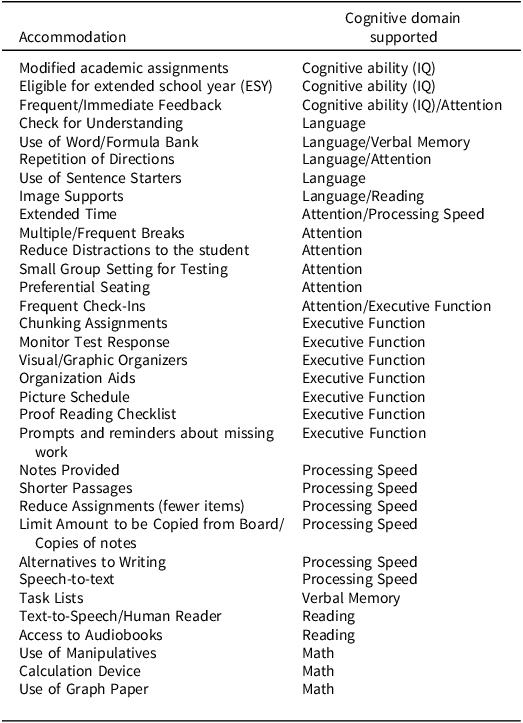
Second, when made available at the time of the neuropsychological evaluation, the patient’s school support plan document (504 plan or IEP) was reviewed to determine whether the plan included relevant supports, accommodations, or services addressing the identified domains of neurocognitive need. In collaboration with the clinic’s school liaison and special educator, the authors reviewed published guidance on recommended instructional and testing accommodations for students with disabilities from the Vanderbilt IRIS center (IRIS Center, 2025) as well as the Maryland state accommodations manual (Maryland State Department of Education, 2024). From these, we developed a consensus matrix listing minimal classroom or testing supports and relevant domains that each type of support can be expected to address (i.e., “preferential seating to reduce distractions” as a support for identified need in the attention domain; see Table 1 for example accommodations considered in addition to specific services and/or IEP goals). For each patient, plans were reviewed to determine whether any formalized supports were included in a given patient’s plan to address their identified domains of need. Importantly, supports or accommodations were not rated for quality or adequacy, but simply for presence or absence. Following plan review, the total number of domains of need met with a support was summed. Total number of neurocognitive domains of need met with a plan support could range from 0 – 8. Neurocognitive need domains were summed for all school-age patients; mean number of need domains was compared for patients with and without support plans to determine whether greater need was associated with likelihood of having formal supports.
Accommodations and cognitive domains matching guide

Note: Assess child-specific accommodations, goals, supports, or services listed on the 504 plan or Individualized Education Program. Do not count universal supports or the “testing accommodations for ALL students” section of the plan.
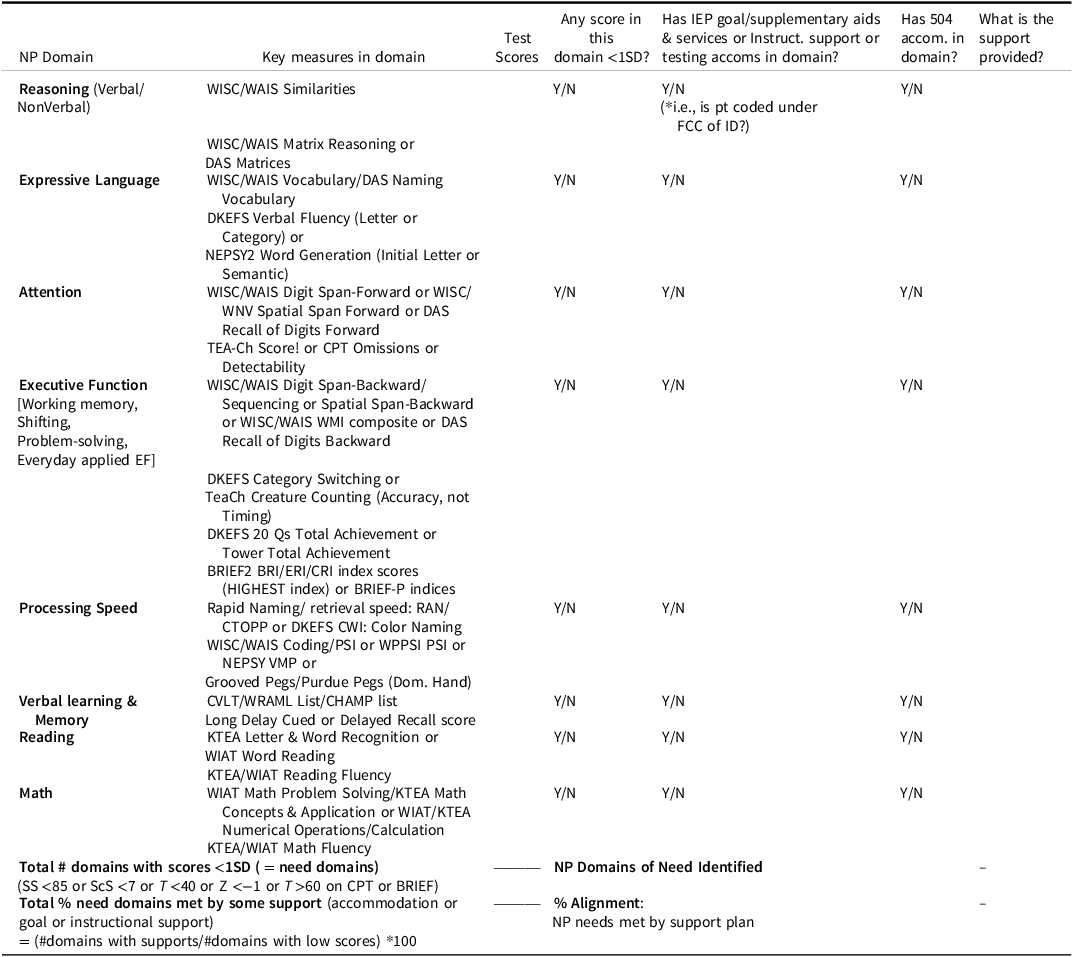
Alignment. Once both the domains of need and existing supports were summed, needs-to-support alignment was calculated as the proportion of identified needs met by a support or accommodation for each patient, using the formula: (number of domains with listed supports/number of domains with below average scores) multiplied by 100. The alignment tool content is presented in Table 2. Alignment could range from 0 – 100%. Alignment was examined for all school-age patients, assigning 0% alignment for patients with no support plan.
Neurocognitive needs to supports alignment rating tool

Identify test scores in evaluation report that correspond to key measures, record in Test Score column.
Determine if any test score within a domain falls below 1SD of the mean (i.e., SS <85 or ScS <7 or T <40; but T >60 on BRIEF/CPT indices; see 2nd to last row).
Identify whether each domain has a corresponding goal, instructional support, or accommodation in the patient’s documented school support plan (504 plan or Individualized Education Program, IEP).
Finally, calculate the % alignment, in last row of table.
Analysis plan
Reliability. Inter-rater reliability of the measure was calculated by comparing ratings from three independent raters (a neuropsychologist, special educator, and research assistant) separately for identification of neurocognitive domains falling below the identified point and for identification of corresponding supports from school support plans, using Krippendorf’s alpha (Marzi et al., Reference Marzi, Balzano and Marchiori2024).
Alignment. Alignment proportion was calculated for all reviewed cases and examined descriptively (mean, SD) for all cases (overall sample) and separately for patients with available support plans. Alignment was compared across visit types (initial vs. follow up evaluation; via independent samples t-test), by patient age at diagnosis (Pearson’s correlation), diagnostic groups (via one way ANOVA), and school level (elementary, middle, high; via one way ANOVA). Independent samples t-tests were used to compare neurocognitive needs (number of domains below the mean) between cases with and without a school support plan at the time of the evaluation appointment.
Results
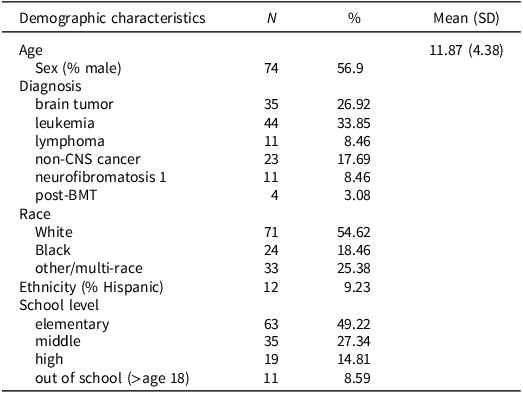
The initial sample included records from 130 patients (mean age at visit: 11.87 years, 56.9% male; see Table 3) consecutively referred to a pediatric neuropsychological assessment clinic during 2023 – 2024 with diagnoses of cancer (n = 115), cancer predisposition syndromes (e.g., neurofibromatosis, with and without optic pathway glioma, n = 11), or referred for evaluation post-bone marrow transplant (n = 4). Among these, 50.8% were seen for initial evaluations and the remaining 49.2% were seen for follow-up evaluations. In terms of evaluation timing, 81% were seen for post-treatment evaluation, 14% were on treatment at the time of evaluation, and the remaining 5% were pre-treatment or not expected to receive treatment. On average, oncologic patients were 5.22 years (SD = 4.54, range: 0.16 – 19.01) post-diagnosis, with 24% evaluated within the first year since diagnosis. These youth were from diverse backgrounds: 54.6% identified as White, 18.5% Black, and 25.4% of other or multi-racial backgrounds, with 9.2% of Hispanic ethnicity. Among cancer survivors, 33.8% were treated for leukemia, 8.5% for lymphoma, 26.9% for brain tumors, and 17.7% for non-CNS cancer.
Sample demographics (whole sample, N = 130)

Note: CNS = central nervous system, BMT = bone marrow transplant
The majority of patients were enrolled in primary or secondary school at the time of evaluation (8.5% were over age 18 and no longer in school). Of those enrolled in school (pre-kindergarten through 12th grade, n = 119), 75.4% were attending public school. Among enrolled students, 42.9% had a support plan; 29.4% had an IEP and 13.5% a 504 plan. Conversely, 57.1% (n = 68) had no formalized school supports in place. Of those with documented supports, 33 of those plans were available in the medical record for review. Three of seventeen private school students had accommodation plans (e.g., 504 plan equivalent) and one was receiving services through a continued early childhood IEP following transition into Kindergarten. As private schools are not federally mandated to provide accommodations or specialized instruction to students with disabilities, only plans from public school students were included in review.
For patients enrolled in public school programs with available support plans, recent neuropsychological evaluation reports and the school support plans available at the evaluation visit were reviewed systematically with the needs-to-supports alignment tool to identify areas of neurocognitive weakness (domains falling <1SD below the normative mean) and any corresponding supports or services identified on the school plan. Neuropsychological evaluation reports of patients without available support plans were also reviewed to identify areas of need only. On average, patients demonstrated at least three neurocognitive domains that fell more than 1SD below the normative mean (mean: 3.47; range: 0 – 8 domains), indicating nearly half of the assessed domains reflected a need for support. Alignment was calculated as the proportion of neurocognitive domains of need met by a corresponding support or service; across the entire school-aged sample assessed, alignment ranged from 0 to 100%, with a mean of 20.3%. For those who had existing support plans, needs-to-supports alignment averaged 47.4% (range: 0 – 100). Although overall alignment appeared slightly higher in high school students relative to elementary or middle school students (23.3% vs. 22.1% vs. 38.1%, respectively; F (2,89) = 1.06, p = 0.35), this difference was not significant.
Examining factors that might prompt recognition of potential neurocognitive needs, likelihood of having a plan was not associated with diagnosis type (X 2(3) = 1.02, p = .797). Likewise, diagnosis conferring CNS risk was not associated with alignment; children with brain tumor or leukemia/lymphoma diagnoses did not have better needs-to-supports alignment than those with non-CNS cancers or other conditions (F (3,89) = 0.91, p = .44, see Figure 1). Figure 1 presents the documented domains of neurocognitive need and associated alignment of supports by diagnostic group. Child age at the time of evaluation was also not significantly associated with alignment (r = .13, p = .37). Visit type was associated with alignment, with patients seen for follow-up evaluations showing better (although still limited) alignment relative to initial evaluations [t(88) = 2.19, p = 0.031; Alignment: M initial = 16.94; M follow-up = 34.52). Likewise, patients with an existing support plan tended to demonstrate a greater number of neurocognitive needs (i.e., 2.62 vs. 4.54 domains below the mean; t (88) = −5.55, p < .01).
Alignment of supports to neurocognitive needs by diagnostic group. Note: BT = brain tumor, L/L = leukemia/lymphoma, non-CNS = non-central nervous system cancer, non-CA = non-cancer primary diagnosis (e.g., NF1 with/without glioma, BMT post-anemia). Solid bars show the group mean proportion of demonstrated neurocognitive needs met with a service, support, or accommodation on the child’s support plan by diagnosis; the dashed line indicates the mean number of below average neurocognitive domains demonstrated for each diagnostic group.

Inter-rater reliability of the measure across three independent raters was calculated using Krippendorf’s alpha (Marzi et al., Reference Marzi, Balzano and Marchiori2024). Across raters, reliability of identification of domains of need (Krippendorf’s alpha: 0.973 [95%CI: 0.960, 0.985]) and agreement on supports (K-alpha: 0.892 [95%CI: 0.800, 0.940]) was very satisfactory.
Discussion
In this paper we describe the development and testing of a rubric to assess the alignment of school supports with areas of cognitive need identified on a neuropsychological assessment report. The tool offers a reliable method for systematically assessing specific areas of educationally-relevant neurocognitive need and their alignment with school supports. The goal of developing the needs-to-supports alignment tool was two-fold. First, use of this tool can provide a roadmap to help scaffold the decision-making process for caregivers and school team members, identifying needs most likely to go unmet and ensuring that supports offered in the school setting are better tailored to demonstrated needs. The rubric could also be employed as a communication tool between the education and healthcare domains to facilitate critical information sharing between hospital based programs (neuropsychologist, school liaison programs) and school teams/educators. Second, alignment proportion can offer a quantitative metric for assessing the impact of educationally focused interventions such as school liaison programming or targeted provider or family-directed programming. In cases where neurocognitive abilities might not be expected to show substantial improvements even with intervention (i.e., in patients who received craniospinal radiation early in childhood), alignment may offer a way to document positive supports implementation as a function of targeted family- or school-directed programming. Importantly, the rubric demonstrated strong inter-rater reliability for identification of both domains and supports among 3 independent reviewers from different disciplines and backgrounds, indicating the tool can be reliably utilized across disciplines and increasing the likelihood it can be implemented in diverse settings.
Our previous work has revealed that one of parents’ greatest frustrations when their child returns to school post-diagnosis is the lack of communication between the healthcare team and school staff (Jacobson et al., Reference Jacobson, Paré-Blagoev and Ruble2020; Ruble et al., Reference Ruble, Paré-Blagoev, Cooper, Martin and Jacobson2019), and the struggle to access needed supports for their child. Receiving appropriate educational supports can significantly improve survivors’ academic progress and high school graduation rates (Mitby et al., Reference Mitby, Robison, Whitton, Zevon, Gibbs, Tersak, Meadows, Stovall, Zeltzer and Mertens2003; Moore et al., Reference Moore, Hockenberry, Anhalt, McCarthy and Krull2012), suggesting that more information and direction regarding how best to implement findings from neuropsychological evaluations may be critical to key patient outcomes. Employing the alignment rubric described in this study could help school and healthcare teams make the best use of the neuropsychological assessment and efficiently utilize school resources to meet individuals’ needs.
While not the primary aim of this work, we did find that across all school-aged cases in this referred sample, just 20% of identified patient neurocognitive needs were supported by documented educational accommodations or interventions. Examining cases with existing support plans at the time of evaluation, alignment was still only 47%, suggesting that even among children identified by their school teams as having some degree of educational disability, a substantial proportion of children’s needs are going unrecognized and unmet. We did find that those children with a greater number of impacted domains were more likely to have a support plan, indicating that the educational system is striving to identify some patient needs. Despite the deployment of support plans in this population, however, the only moderate proportion of observed alignment suggests that among survivors with the greatest needs there is still inadequate support. Utilization of the new measure and subsequent feedback to the school may help to close the gap for this vulnerable population.
The current estimate of 47% alignment between documented needs and supports in our sample with educational support plans is consistent with a qualitative study of childhood brain tumor survivors that found that only 41% of recommendations from neuropsychological assessments were implemented in the academic setting (Cheung et al., Reference Cheung, Wakefield, Ellis, Mandalis, Frow and Cohn2014). Findings were also consistent with initial evidence from speech-language pathology that indicated very limited alignment between measured impairments on evaluation and targeted supports provided via IEPs (Schmitt et al., Reference Schmitt, Justice, Logan, Schatschneider and Bartlett2014). In our referred sample, well over half (57%) of patients had no formal educational supports in place at all. Although neuropsychological assessment is recommended as standard of care (Annett et al., Reference Annett, Patel and Phipps2015; Wiener et al., Reference Wiener, Kazak, Noll, Patenaude and Kupst2015) during and after treatment for childhood cancer, our findings highlight a gap in linking neurocognitive findings to targeted educational supports for patients.
Serial assessments are typically recommended for pediatric cancer survivors who may exhibit new challenges during critical developmental time points, for example emergence of later executive function challenges in high school (Castellino et al., Reference Castellino, Ullrich, Whelen and Lange2014). While we report on alignment in a cross-sectional sample, the rubric could also be utilized longitudinally to identify emerging cognitive needs and ensure breadth of supports, as well as anticipate needed changes over time as these serial assessments are completed. Future work could also use this tool to longitudinally assess the impact of the neuropsychological report itself on implementation of subsequent patient supports and their alignment with evaluation findings.
Beyond survivorship, estimates suggest that at least 25% and up to 43% (32 million) of children and adolescents in the U.S. have a chronic health condition (Bethell et al., Reference Bethell, Kogan, Strickland, Schor, Robertson and Newacheck2011; Miller et al., Reference Miller, Coffield, Leroy and Wallin2016), including nearly 9% with developmental disabilities (Zablotsky et al., Reference Zablotsky, Ng, Black and Blumberg2023). Many of these conditions convey neurocognitive risk, and youth with chronic health conditions and developmental disabilities are subsequently at risk for poor academic achievement, reduced employment, and reduced quality of life in adulthood (Institute of Medicine, 2012; Lansford et al., Reference Lansford, Dodge, Pettit and Bates2016; Perrin et al., Reference Perrin, Bloom and Gortmaker2007). Many of these children could benefit from educational supports that align with the cognitive challenges associated with their chronic health condition. For these youth, accessing appropriate educational supports and accommodations may improve long-term functional outcomes through increasing high school graduation rates. Implementation of the needs-to-supports alignment rubric as a way to guide educational planning may be helpful for ensuring appropriately tailored supports in these populations. Future studies should explore alignment of needs to support in these conditions and potential utility of the rubric for supporting educational planning.
This study offers a novel approach to understanding the degree to which educational supports align with documented neurocognitive needs in pediatric populations. While offering promising utility and strong reliability for this methodology in a relatively diverse sample, our use of a referred sample for piloting the tool is both a strength and limitation. Specifically, neurocognitive needs would be expected to be more evident in a sample of youth referred for neuropsychological evaluation, relative to the general population; however, estimates of alignment may vary across populations. We did not find differences by diagnosis in likelihood of having a support plan or adequacy of alignment of needs for those who did have a plan. This likely reflects the convenience sample of referred patients who may be more likely to have educational challenges prompting referral from the healthcare team, regardless of underlying diagnosis. An additional limitation includes the reliance on the local state accommodations and IEP framework, which may not map precisely onto those in other states; however, our accommodation rubric also leveraged the Vanderbilt IRIS center, a national resource. Furthermore, the educational support side of the rubric was not intended to assess quality or appropriateness of a given accommodation for that specific child or area of need, simply presence of any intended support. For example, although “extended time” was included as a potential support for inattention based on available guidance, this may not be the most appropriate or evidence-based accommodation for this target concern (Pritchard et al., Reference Pritchard, Koriakin, Carey, Bellows, Jacobson and Mahone2016). Future studies might investigate a more precise characterization of supports based upon published evidence for efficacy. We also acknowledge that test results may not always accurately reflect a child’s functioning within their school environment. Finally, although we achieved consensus among the neuropsychologists polled regarding the assignment of tests/scales to neurocognitive domains, we acknowledge that many measures used clinically lack this degree of specificity.
Conclusion
Beyond academic achievement alone, there are important long term individual and societal consequences for children who complete secondary education. High school graduation is associated with improved health status and quality of life, including job prospects and resources to manage health, benefiting individuals and their communities (Lansford et al., Reference Lansford, Dodge, Pettit and Bates2016). The siloed nature of our healthcare and educational systems can make it challenging to meet the educational support needs of children with cancer or other chronic health conditions (Champaloux & Young, Reference Champaloux and Young2015; Crump et al., Reference Crump, Rivera, London, Landau, Erlendson and Rodriguez2013). We propose that utilizing a tool such as the one presented here is a critical step needed to ensure the best life-long outcomes for vulnerable populations at risk for neurocognitive challenges.
Funding statement
This work was supported by the Patient Centered Outcomes Research Institute (EASCS-23183).
Competing interests
The authors declare none.