Traumatic brain injury (TBI) has been identified as one of the leading causes of disability and death internationally among individuals under age 40 (De Silva et al., Reference De Silva, Roberts, Perel, Edwards, Kenward, Fernandes and Patel2009; Fleminger & Ponsford, Reference Fleminger and Ponsford2005). According to the World Health Organization, TBI affects approximately 10 million individuals annually. Moreover, the worldwide medical and rehabilitative costs of treating individuals with TBI continues to increase, as do other indirect costs, such as individuals with TBI taking time off from work to recuperate or experiencing physical and cognitive sequelae that impair their job performance, totalling an estimated $76.5 billion in the United States alone in lost work productivity (Finkelstein, Corso, & Miller, Reference Finkelstein, Corso and Miller2006; Hyder, Wunderlich, Puvanachandra, Gururaj, & Kobusingye, Reference Hyder, Wunderlich, Puvanachandra, Gururaj and Kobusingye2007). As with other regions, TBI is a major health problem in Latin America, where the common causes of TBI include road traffic accidents, exposure to physical violence, and falls (Hyder et al., Reference Hyder, Wunderlich, Puvanachandra, Gururaj and Kobusingye2007; Puvanachandra, Gururaj, & Kobusingye, Reference Puvanachandra, Gururaj and Kobusingye2008). In Mexico, the focus country for this study, TBI is the third highest cause of death after cancer and cardiovascular diseases (Julio César, Torres Norma, Lozano, & Zúñiga Carrasco, Reference Julio César, Torres Norma, Lozano and Zúñiga Carrasco2008).
While the immediate causes of TBI vary greatly, international reports demonstrate consistency in the types of post-injury consequences that individuals with TBI experience. Cross-culturally, individuals with TBI often report a myriad of changes in their cognitive, physical, neurological, emotional and social functioning that impair their abilities to function independently or lead to increased use of informal caregiving from family members (Dikmen, Machamer, & Temkin, Reference Dikmen, Machamer and Temkin2001; Draper, Ponsford, & Schönberger, 2007; Gamboa Jr, Holland, Tierney, & Gibson, Reference Gamboa, Holland, Tierney and Gibson2006; Lezak, Reference Lezak1987; McCarthy, Dikmen, Langlois, Selaisse, Gu, & Horner, Reference McPherson, Pentland and McNaughton2006). Common post-injury physical impairments include problems with balance, ambulation and motor coordination (Basford et al., Reference Basford, Chou, Kaufman, Brey, Walker, Malec and Brown2003), as well as difficulty with hearing (Jury & Flynn, Reference Jury and Flynn2001) and vision (Kapoor & Ciuffreda, Reference Kapoor and Ciuffreda2002). Cognitive impairments are also common in executive functioning, attention, information processing, memory, learning and language (Greenspan, Wrigley, Kresnow, Branche-Dorsey, & Fine, Reference Greenspan, Wrigley, Kresnow, Branche-Dorsey and Fine1995; Lehtonen et al., Reference Lehtonen, Stringer, Millis, Boake, Englander, Hart and Novack2005; Mathias & Wheaton, Reference Mathias and Wheaton2007; McAllister, Reference McAllister2008; Vakil, Reference Vakil2005). Due in part to these cognitive and physical changes, many individuals with TBI also experience emotional and psychosocial issues such as anxiety, depression, substance abuse, decreased life satisfaction and lower perceived social support (Anson & Ponsford, Reference Anson and Ponsford2006; Ewing-Cobbs & Barnes, Reference Ewing-Cobbs and Barnes2002; Kreutzer, Seel, & Gourley, Reference Kreutzer, Seel and Gourley2001; Ponsford, Whelan-Goodinson, & Bahar-Fuchs, Reference Ponsford, Whelan-Goodinson and Bahar-Fuchs2007; Stalnacke, Reference Stalnacke2007).
Activity and participation limitations with TBI
For many individuals with TBI, the combination of physical, cognitive, emotional and psychosocial impairments often leads to increased disability, decreased employment and over-utilisation of informal care and support from family caregivers (Knight, Devereux, & Godfrey, Reference Knight, Devereux and Godfrey1998; Kreutzer et al., Reference Kreutzer, Seel and Gourley2001; Arango-Lasprilla et al., Reference Arango-Lasprilla, Ketchum, Dezfulian, Kreutzer, O'Neil-Pirozzi, Hammond and Jha2008). As a result, post-injury consequences not only affect the lives of individuals with TBI, but also their family members and the family system (Arango-Lasprilla, Quijano et al., Reference Arango-Lasprilla, Quijano, Aponte, Cuervo, Nicholls, Rogers and Kreutzer2010; Degeneffe et al., Reference Degeneffe, Boot, Kuehne, Kuraishi, Maristela, Noyes, Price, Stooten and Will2008; Dikmen et al, Reference Dikmen, Machamer and Temkin2001; Draper et al., Reference Draper, Ponsford and Schönberger2007; Gamboa et al., Reference Gamboa, Holland, Tierney and Gibson2006; McCarthy et al., Reference McCarthy, Dikmen, Langlois, Selassie, Gu and Horner2006). Caregivers of individuals with TBI often report financial difficulties, substance abuse, health problems, unemployment, burden, depression, anxiety, distress, decreased social support, decreased personal independence and decreased satisfaction with life (Chronister & Chan, Reference Chronister and Chan2006; Chronister, Chan, Sasson-Gelman, & Chiu, Reference Chronister, Chan, Sasson-Gelman and Chiu2010; Degeneffe, Reference Degeneffe2001; Kolakowsky-Hayner, Miner, & Kreutzer, Reference Kolakowsky-Hayner, Miner and Kreutzer2001; Marsh, Kersel, Havill, & Sleigh, Reference Marsh, Kersel, Havill and Sleigh2002; Moules & Chandler, Reference Moules and Chandler1999; Rivera, Elliott, Berry, Grant, & Oswald, Reference Rivera, Perrin, Senra, Olivera, Reyes, Villaseñor, Moreno and Arango-Lasprilla2007; Verhaeghe, Defloor, & Grypdonck, Reference Verhaeghe, Defloor and Grypdonck2005; Wade, Taylor, Drotar, Stancin, Yeates, & Min, Reference Wade, Taylor, Drotar, Stancin, Yeates and Minich2002). While the decrease in caregiver quality of life is cause for concern in and of itself, the research literature demonstrates that family caregiver mental and physical health problems may also affect the functioning of the care recipient and the quality of care that caregivers can provide (Ergh, Hanks, Rapport, & Coleman, Reference Ergh, Hanks, Rapport and Coleman2002; Verhaeghe et al., Reference Verhaeghe, Defloor and Grypdonck2005; Weddell & Leggett, Reference Weddell and Leggett2006; Vangel, Rapport, & Hanks, Reference Vangel, Rapport and Hanks2011).
Significance of social support to TBI recovery
Because of the important role that family caregivers fulfill, researchers have investigated the needs of family members who care for relatives with TBI. Specific family needs identified include respect from health care professionals, information regarding TBI impairments and related issues, access to individuals with knowledge about TBI care, and the ability to obtain advice from health care professionals (Kreutzer, Serio, & Bergquist, Reference Kreutzer, Gervasio and Camplair1994). Additional needs identified by Leith and colleagues (Reference Leith, Phillips and Sample2004) include early interventions, continuous and comprehensive services, information and education about TBI-related outcomes, advocacy, empowerment for families and individuals with TBI, and connectedness/social belonging. Finally, in a sample of TBI caregivers in Colombia, Arango-Lasprilla and colleagues (Reference Arango-Lasprilla, Quijano, Aponte, Cuervo, Nicholls, Rogers and Kreutzer2010) identified the following family needs: health information, involvement with care, professional support, community support, emotional support and instrumental support.
Role of family
In addition to identifying family needs of TBI caregivers, researchers have also examined which needs tend to be met and unmet, as well as some of their associations with other outcomes. Marsh and colleagues (Reference Marsh, Kersel, Havill and Sleigh2002) reported that unmet social needs were associated with an increase in subjective reports of burden among TBI caregivers. A recent study (Doyle et al., in preparation) found that when family needs for instrumental support were met, caregivers reported less burden and depression and greater satisfaction with life. Kreutzer and colleagues (Reference Kreutzer, Stejskal, Ketchum, Marwitz, Taylor and Menzel2009) found that when family needs of TBI caregivers’ were met, they reported fewer perceived obstacles to care, while those who reported unmet needs continued to experience obstacles to care. Additional findings in the literature suggest that when assessing family needs longitudinally and across different categories of TBI (e.g. mild, moderate and severe), the family's needs often change over time, and some may remain unmet, which often leads to increased reports of caregiver burden, distress, depression and decreased satisfaction with life (Murray, Maslany, & Jeffery, Reference Murray, Maslany and Jeffery2006).
By studying family needs, researchers have identified ways to improve quality of life for both caregivers and care recipients. However, there has been limited research on the relationship between TBI impairments and family needs, especially among caregivers and individuals with TBI from Latin America. This is particularly important because Latinos in the United States are at risk of experiencing more negative consequences following TBI. These consequences include higher rates of disability (de la Plata et al., Reference de la Plata, Hewlitt, de Oliveira, Hudak, Harper, Shafi and Diaz-Arrastia2007), decreased functional outcomes (Arango-Lasprilla et al., Reference Arango-Lasprilla, Rosenthal, Deluca, Komaroff, Sherer, Cifu and Hanks2007), and lower rates of returning to work following TBI (Cardoso, Romero, Chan, Dutta, & Rahimi, Reference Cardoso, Romero, Chan, Dutta and Rahimi2007). Even though the reported family needs of TBI caregivers in Latin America tend to be similar to those in other global regions, family needs in Latin America are less likely to be met, which can lead to increased caregiver burden and distress (Arango-Lasprilla et al., Reference Arango-Lasprilla, Quijano, Aponte, Cuervo, Nicholls, Rogers and Kreutzer2010).
Influence of culture
Because of the high levels of collectivism and family values in Latino cultures, as well as the larger size of caregiving networks among Latinos, there is an increased likelihood that Latinos will serve as family caregivers (Hinojosa, Zsembik, & Rittman, Reference Hinojosa, Zsembik and Rittman2009). As a cultural value, familism encourages solidarity and asserts an obligation to assist both immediate and extended family members with health problems (Delgado & Tenntedt, Reference Delgado and Tennstedt1997; Zsembik & Bonilla, Reference Zsembik and Bonilla2000). Given the importance of familism in Latino cultures, caregivers from Latin America may be especially vulnerable to role engulfment, which may lead to increased levels of distress and burden that affect the entire family system (Dilworth-Anderson, Williams, & Gibson, Reference Dilworth-Anderson, Williams and Gibson2002; Hinojosa et al., Reference Hinojosa, Zsembik and Rittman2009; Skaff & Pearlin, Reference Skaff and Pearlin1992). The additional pressures caused by the care recipient's increased disabilities and impairments, longer rehabilitation and unmet family needs shown in the literature suggest that family TBI caregivers in Latin America are a critical population for rehabilitation researchers to study.
Goals of study
Previous researchers have proposed a foundation theory that providing emotional and instrumental support to TBI caregivers could improve their own mental health and quality of life, thereby strengthening the quality of informal care they are able to provide to their family members with TBI (Moules & Chandler, Reference Moules and Chandler1999). Yet, to date no researchers have examined the relationships between specific TBI impairments and the needs of family caregivers, limiting the precision of the field in developing TBI caregiver emotional and instrumental support services. By extension and despite the unique cultural factors shown in Latin America, no researchers have examined this system of connections in that global region. Accordingly, our specific research goals were: (a) to identify the relationships between five domains of TBI impairments (cognitive, emotional, physical, behavioural and social) and five types of family needs (household, informational, financial, health and social support); and (b) to determine how the caregiver stress related to each of these TBI impairments influences reported family needs. As such, we questioned how the various types of TBI impairments, and the resulting caregiver stress, could predict family needs among a sample of TBI caregivers from Guadalajara, Mexico.
Method
Participants
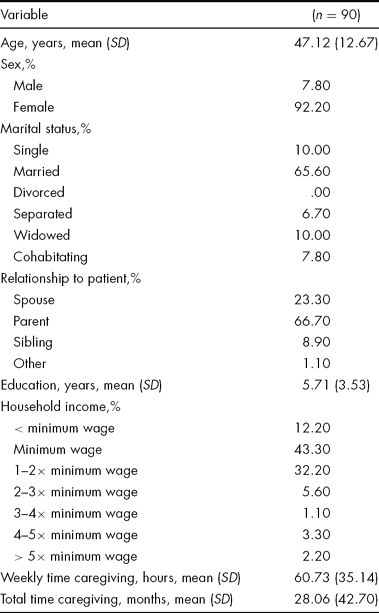
Ninety family caregivers of individuals with TBI were recruited from the Hospital Civil Fray Antonio Alcalde in Guadalajara, Mexico (females = 92.2%; age range 18 to 76 years). All participants actively provided daily care for the individual with TBI and had familiarity with the client's social and medical status. Inclusion criteria for family caregivers were that participants: (a) were the primary caregiver of an individual with TBI; (b) had been providing care to the client for a minimum of 3 months; and (c) had no history of physical, mental, or neurological problems. Participant demographic information is summarised in Table 1.
Demographics of Participants

Note. SD = standard deviation.
Measures
Caregivers responded to demographic questions regarding: gender, age, marital status, occupation, years of education, relationship to the person with TBI and time spent in providing care. They also completed the TBI Impairment Questionnaire (TBI-IQ; this study) and the Family Needs Assessment Tool (FNAT; Rivera et al., in press).
TBI Impairment Questionnaire
TBI-related impairments were measured by using a 33-item questionnaire developed by the researchers for this study, and modelled after the five themes of TBI impairments determined by Marsh and colleagues (Reference Marsh, Kersel, Havill and Sleigh2002). The five themes entailed cognitive, emotional, behavioural, physical and social dysfunctions as a result of a TBI. Participants were asked to identify the presence of these impairments in the person with TBI by answering ‘yes (0)’ or ‘no (1)’. They were then asked to rate the amount of their own stress related to each endorsed impairment using a 4-point Likert scale (1 = no estres, 2 = poco estres, 3 = bastante estres, and 4 = mucho estres [1 = no stress, 2 = little stress, 3 = some stress, and 4 = great stress]). Scores for each domain were created by summing the number of ‘yes’ answers or participants’ responses to the stress items. The internal consistency reliability coefficient (Cronbach's alpha) for the TBI-IQ with the study sample was .85.
Family Needs Assessment Tool
The FNAT (Rivera et al., in press) assesses family needs reported by caregivers of individuals with neurological conditions. The original version was a 27-item measure developed based on information from three previous questionnaires that have been used to evaluate family needs of individuals with neurotrauma (Junque, Bruma, & Mataro, Reference Junque, Bruma and Mataro1997; Kreutzer, Serio et al., Reference Kreutzer, Serio and Bergquist1994; Sato, Ricks, & Watkins, Reference Sato, Ricks and Watkins1996). A more recent factor analysis (Rivera et al., in press) identified five factors using 14 items of the FNAT: household needs (e.g. help with chores, preparing meals), informational needs (e.g. information about the person with TBI from professionals and other TBI caregivers), financial needs (e.g. more money to cover basic expenses), health needs (e.g. regular exercise, feeling good about one's physical health), and social support needs (e.g. help from one's church and community). These 14 items were used in the current study. Items were measured on a 5-point Likert scale (1 = strongly disagree to 5 = strongly agree). Sample items included: ‘I can exercise regularly’ and ‘I need help preparing meals.’ The internal consistency reliability coefficient (Cronbach's alpha) for the FNAT with the study sample was .68.
Procedure
This project was reviewed and approved by the institutional review board (IRB) at Hospital Civil Fray Antonio Alcalde. Caregivers of individuals with TBI were recruited from the same hospital. Participants were informed about the nature and purposes of this research study, their questions were answered, and signed informed consent was obtained. Caregivers completed a 30–45 minute interview with a psychologist, including the above instruments. For those caregivers who were not able to travel to the hospital due to caring obligations, home visits were made by the psychologist to conduct interviews.
Data Analysis
To explore the extent to which TBI impairments and related caregiver stress were associated with family needs in Mexico, two canonical correlation analyses were conducted which examined the pattern of relationships: (a) between the five types of TBI impairments (cognitive, behavioural, emotional, physical and social impairments) and the five categories of family needs (household, informational, financial, health and social support needs); and (b) between caregiver stress associated with specific TBI impairments and family needs.
A canonical correlation is a common analysis used in caregiver brain injury research (Perrin, Heesacker, Uthe, & Rittman, Reference Perrin, Heesacker, Uthe and Rittman2010) and extracts roots of shared variance from two sets of variables and then correlates those roots to determine the magnitude of the holistic relationship between the two variable sets. It is appropriate for the present study of the relationships between two sets of independent variables (TBI impairments and related caregiver stress) and one set of dependent variables (family needs). Its unique strength, as compared to the traditional Pearson r, is that a canonical correlation is derived from two latent roots of shared variance (one root from each variable set) and helps identify the overall strongest pattern of connections among the two variable sets. Thereby, the analysis also transcends the family-wise error that would occur from running dozens of correlations between all variables in both variable sets.
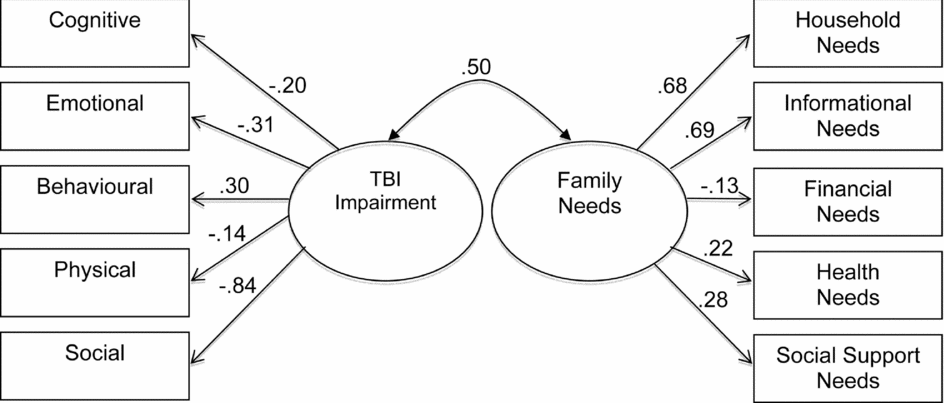
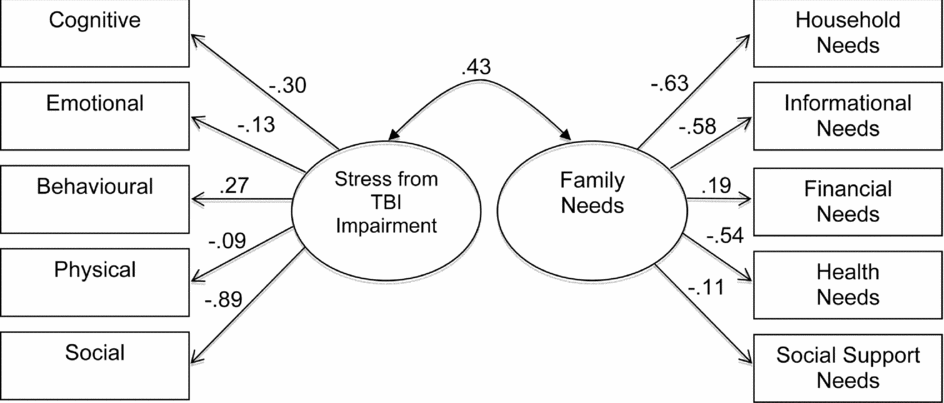
A single canonical correlation analysis produces a number of canonical correlations equal to the number of variables in the smallest variable set (in this case five variables). Each canonical correlation generated in a single analysis is comprised of shared variance unique from the variance in the other canonical correlations in that analysis. As a rule of thumb, the first canonical correlation is always the largest in magnitude, with each subsequent canonical correlation decreasing in magnitude as well as in statistical significance. In the current study, however, only the first canonical correlation in each of the two overall analyses will be reported and interpreted, as successive canonical correlations in a single analysis are often unreliable. Figures 1 and 2 illustrate the conceptual basis for and results of the first canonical correlation in each of the two analyses. The canonical variates of shared variance within a single variable set (shown in circles) are derivations of the two sets of variables (shown in boxes). Standardised canonical loadings within each variable set are included in the figures in order to identify the strongest pattern of connections among individual indices of these larger constructs. Finally, two correlation matrices of all variables from the current study were computed, one for the impairment variables and one for the caregiver stress variables.
Canonical correlation conceptual model and coefficients for TBI impairment domains and family needs
Canonical correlation conceptual model and coefficients for caregiver stress related to TBI impairment domains and family needs
Results
Presence of TBI Impairments
The first canonical correlation analysis examined which domains of TBI impairment (cognitive, behavioural, emotional, physical and social) were most linked with family needs (household, informational, health, financial and social support). In this analysis, the first canonical correlation was statistically significant [r = .50, λ = .53, χ2 (25) = 53.44, p = .001], a large-sized effect (Cohen, Reference Cohen1988). Standardised canonical coefficients were calculated to compare the relative contributions of the individual variables within each variable set to the overall canonical correlation. The standardised canonical coefficients for the TBI impairment variables indicated that the highest loading was for social impairments (−.84), and it was the only impairment variable above the conventional cutoff of .40. For the family needs variables, informational needs (.69) and household needs (.68) were above the .40 cutoff. This pattern of shared variance suggests that when the person with TBI had greater social impairments, their caregivers reported higher levels of household and informational needs (Figure 1).
Stress Related to TBI Impairments
The second canonical correlation analysis examined whether the stress that caregivers experienced relating to specific domains of TBI impairment was linked to their reported family needs. Again, a canonical correlation analysis was performed using the same family needs variables (household, informational, financial, health and social support), but with the substitution of the caregiver stress associated with domains of TBI impairment (cognitive, behavioral, emotional, physical and social).
The first canonical correlation was statistically significant [r = .43, λ = .59, χ2 (25) = 44.64, p = .009], a medium-to-large-sized effect (Cohen, Reference Cohen1988). Again, standardised canonical coefficients were calculated to compare the contributions of the individual variables to the overall canonical correlation. The standardised canonical coefficients for caregiver stress related to TBI impairments showed that only stress associated with social impairments (−.89) was above the conventional cutoff of .40. For the family needs variables, household needs (−.63), informational needs (−.58), and health needs (−.54) were above the .40 cutoff. This pattern of shared variance is similar to the results from the previous canonical correlation and suggests that caregivers had higher levels of household, informational and health needs when they reported stress due to the social impairments of the person with TBI (Figure 2).
Correlation Matrices
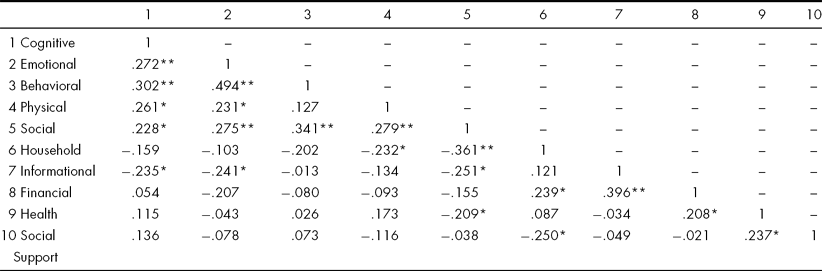
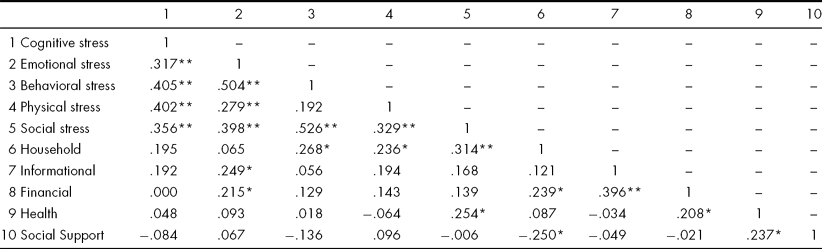
Two correlation matrices were calculated that explored the bivariate correlations among TBI impairments and family needs variables (see Table 2), as well as among caregiver stress related to TBI impairments and family needs variables (see Table 3).
Correlation Matrix for TBI Impairment Domains and Family Needs
Note. *p < .05, **p < .01.
Correlation Matrix for Stress related to TBI Impairment Domains and Family Needs
Note. *p < .05, **p < .01.
Only additional relationships to those uncovered in the canonical correlations will be reported here. In the first correlation matrix, higher physical impairments were associated with higher household needs (r = −.232, p < .05), and higher cognitive and emotional impairments were associated with higher informational needs (r = −.235, p < .05 and r = −.241, p < .05, respectively). In the second matrix, caregiver stress related to physical and behavioural impairments was associated with higher household needs (r = .236, p < .05 and r = .268, p < .05, respectively), and caregiver stress related to emotional impairments was associated with higher informational and financial needs (r = .249, p < .05 and r = .215, p < .05, respectively).
Discussion
A growing body of literature indicates that caring for an individual with TBI can be challenging and place the caregiver under a great deal of stress and burden due to the extensive and chronic nature of TBI care. Previous research suggests that the strain of taking care of relatives with TBI leads to a reduction in quality of life and satisfaction with life, lower perceived health, and higher rates of psychiatric morbidity among caregivers (Livingston et al., Reference Livingston, Kennedy, Marwitz, Arango-Lasprilla, Rapport, Bushnik and Gary2010; McPherson, Pentland, & McNaughton, Reference McPherson, Pentland and McNaughton2000). Caregiver foundation theory proposed that providing emotional and instrumental support to TBI caregivers could improve caregivers’ mental health and quality of life which consequently strengthens the quality of informal care for their family members with TBI (Moules & Chandler, Reference Moules and Chandler1999). However, very few studies have examined family needs in the context of caregiving for an individual with TBI, and none have investigated the impact of TBI-related impairments on family needs in Latin America. Thus, this is the first study to examine the connections between family needs and TBI impairments as well as the associated stress among TBI caregivers in Latin America.
This study had two aims: (a) to examine the connections between five domains of TBI impairment (cognitive, emotional, physical, behavioural and social) and five types of family needs (household, informational, financial, health and social support) in a group of caregivers from Guadalajara, Mexico, and (b) to examine how caregivers’ stress related to each of these TBI impairments is associated with family needs. Two canonical correlations found that when individuals with TBI had greater social impairments, their caregivers reported higher levels of household and informational needs, and similarly, when caregivers experienced high stress due to the social impairments of the individual with TBI, caregivers also reported greater household, informational and health needs. In bivariate correlation matrices, physical impairments in individuals with TBI, as well as related caregiver stress, were associated with greater household needs. Additionally, emotional and cognitive impairments in individuals with TBI, and caregiver stress related to emotional impairments, were associated with greater informational needs. These results provide evidence that the severity of TBI impairments and the stress those impairments place on caregivers have very direct – and at times large – implications for caregivers’ family needs in Mexico, and likely in other global regions with similar resources for families affected by TBI. The findings are consistent with a previous study conducted by Degeneffe (Reference Degeneffe2009), which indicated that when adult sibling caregivers of persons with TBI perceived greater cognitive-behavioral impairments, and experienced higher levels of being deprived from valued family activities, they were more likely to have a lower number of met rehabilitation needs. The author further revealed that more use of effective coping behaviors and access to social support were associated with higher numbers of met rehabilitation needs.
TBI Social Impairments
By far, the most robust associations with family needs were social impairments in individuals with TBI and the related caregiver stress. It has been repeatedly demonstrated in the caregiver literature that social factors play a significant role in the well-being of an individual with TBI and family needs of the caregivers. Families who provide care for individuals with more social impairments following TBI tended to have higher needs for informational (e.g., desiring comprehensive and specialised information about the individual with TBI), household (e.g., helping with housework and preparing meals), and health resources (e.g., caregiver physical and mental health problems). The results of this study highlight the critical need for rehabilitation professionals to target social functioning as a primary impairment in treatment, as well as the stress it places on caregivers and the needs it likely creates within the family system.
One explanation for this pattern of findings is that the more impaired the social functioning of individuals with TBI, the more difficulties they may have accurately communicating their needs to caregivers and performing normal social activities in and outside of the family, and the more individualised assistance and support they may need from caregivers. This may create an undue caregiving burden, which reduces the time and effort that family members can devote to household chores and even to taking care of their own health. Reduced social functioning in individuals with TBI may also be a particularly challenging deficit for family members to understand, creating a family need for information about TBI. Rehabilitation professionals, therefore, would likely benefit from developing interventions that not only provide accurate information to family members about the effects of TBI on social functioning, but also that help individuals with TBI integrate into their communities and overall family. TBI-focused family systems-interventions that target multiple family dynamics and the ways in which family members interact with the person with TBI would likely benefit the overall family system.
Previous research has supported these interpretations and corroborated some of the findings in this study. Changes in behaviours and social functioning as expressed in poor social judgement, social isolation, dependence and reduced social competence are among the most common and debilitating consequences of TBI (Kendall & Terry, Reference Kendall and Terry1996; Levin, Reference Levin1995; Prigatano, Reference Prigatano1992). These changes in emotional functioning and social interaction are strongly associated with caregivers’ perceived stress and emotional difficulties (Ponsford, Olver, Ponsford, & Nelms, Reference Ponsford, Olver, Ponsford and Nelms2003; Anderson, Parmenter, & Mok, Reference Anderson, Parmenter and Mok2002; Wells, Dywan, & Dumas, Reference Wells, Dywan and Dumas2005). In particular, neurobehavioural disturbance (Kosciulek & Lustig, Reference Kosciulek and Lustig1998; Kreutzer, Gervasio, & Camplair, Reference Kreutzer, Gervasio and Camplair1994), a heavy burden of care (Brook, Reference Brooks1991), loss of social connections (Brook, Reference Brooks1991; Kreutzer, Serio, et al., Reference Kreutzer, Gervasio and Camplair1994), and disruption in patterns of relating within the family (Brook, Reference Brooks1991; Curtiss, Klemz, & Vanderploeg, Reference Curtiss, Klemz and Vanderploeg2000; Maitz & Sachs, Reference Maitz and Sachs1995) have all been shown to influence the experience of caregiving. For TBI caregivers, social and behavioural impairments are often a greater burden than physical impairments (Brooks, Campsie, Symington, Beattie, & McKinlay, Reference Brooks, Campsie, Symington, Beattie and McKinlay1986; Kinsella, Packer, & Olver, Reference Kinsella, Packer and Olver1991), even many years after injury (Koskinen, Reference Koskinen1998). The prevalence and impact of social and behavioural impairments post-TBI could be attributed to resulting personality changes, which can consequently affect social interactions and dynamics between the person with TBI and family members (Weddell & Leggett, Reference Weddell and Leggett2006). Longitudinal studies have even found that changes in social functioning in individuals with TBI are extremely distressing to caregivers as much as five years later (Ponsford & Schönberger, Reference Ponsford and Schönberger2010).
Cultural Considerations
Family caregivers often play a very important role in the rehabilitation of individuals with TBI (Turner et al., Reference Turner, Fleming, Cornwell, Worrall, Ownsworth, Haines and Chenoweth2007), and this is especially true in global regions with strong cultural values of familism and collectivism like Latin America (Dilworth-Anderson et al., Reference Dilworth-Anderson, Williams and Gibson2002; Marin & Marin, Reference Marin and Marin1991). For example, Latino caregivers have been shown to endorse strong feelings of loyalty and obligation to support nuclear and extended family members who are sick or who have disabilities (Delgado & Tennstedt, Reference Delgado and Tennstedt1997; Villarreal, Blozis, & Widaman, Reference Villarreal, Blozis and Widaman2005; Zsembik & Bonilla, Reference Zsembik and Bonilla2000). Perhaps because of such a high emphasis placed on family relationships in Latino cultures, social or emotional impairments in individuals with TBI could severely disrupt important family relationships and norms, producing high levels of need within the family system. Previous research has found that although TBI caregivers in Latin America endorse similar family needs as caregivers in other global regions, family needs in Latin America are more likely to be unmet (Arango-Lasprilla et al., Reference Arango-Lasprilla, Quijano, Aponte, Cuervo, Nicholls, Rogers and Kreutzer2010). This could be due in part to the longevity of stress endured from the breakdown of social relationships within the family. Also, social stigma may be higher for family members providing care for a person with TBI who has impaired social functioning which may increase caregiver and family needs because of the high cultural value placed on social and familial interactions in this region (Villarreal et al., Reference Villarreal, Blozis and Widaman2005).
Implications for Rehabilitation Practice
This study provides empirical evidence that specific TBI impairments are not only related to caregivers’ mental health, as has been shown in previous studies, but now also to family needs – something rehabilitation professionals are particularly well-suited to address. Indeed, the most important implication for rehabilitation practice of the current findings is that much good can be done by expanding the field's focus to include an emphasis on critical family needs that are most directly related to impairments in individuals with TBI. Especially when individuals with TBI have low social functioning, families and caregivers need informational, household and health resources. Leith and colleagues (Reference Leith, Phillips and Sample2004) recognised five main themes of needs that TBI caregivers noted as important: (a) an early, consistent and comprehensive service delivery system; (b) detailed information and education regarding the condition or status; (c) formal and informal advocacy; (d) resourcefulness and empowerment; and (e) human connectedness and social belonging. These needs map very directly onto those identified as important in the current study.
Rehabilitation professionals can work with individuals with TBI and their family caregivers to explore graded educational or training programmes that match with severity of injury, stamina and related fears for individuals with TBI in order to further improve social and behavioural functioning. It is important to create an enjoyable experience and establish an environment in which individuals with TBI feel comfortable and develop social support, both in and out of the family and community. Helping motivate people with TBI to engage in social activity is of utmost importance to break the cycle of low social functioning, which is related directly to family needs. In addition, caregivers play a critically important role in the lives of individuals with TBI, and therefore their family needs should be taken into account during treatment planning. Rehabilitation professionals can first assess the interactions and dynamics of individuals with TBI and their caregivers. Then, significant attention could be given to understand how caregivers cope with day-to-day caregiving stress and what type of needs and supports are important both inside and outside the home. It may prove helpful to explore and introduce a social support network in these activities in order to provide additional reinforcement and accountability. In addition, rehabilitation professionals can bring information and resources to families who provide an extensive array of affective and instrumental care, such as assistance with emotional well-being, medication monitoring and behavioural management.
Thus, having access to resources and support for day-to-day caregiving demands (e.g., household), having access to a knowledgeable individual who can provide specific information regarding the condition or status of the person with TBI (e.g., medical problem, course of treatment), and having access to professional advice so that the individual with TBI can receive the best care possible (Kreutzer, Serio et al., Reference Kreutzer, Serio and Bergquist1994) are important components of rehabilitation. Implications for attending to family household and informational needs may increase caregiver quality of life and also increase the quality of care they can provide.
More specifically regarding TBI rehabilitation in a Mexican population, there currently exist no inpatient or outpatient programmes for caregivers or families affected by TBI in Mexico or in Latin America more generally (Arango-Lasprilla et al., Reference Arango-Lasprilla, Quijano, Aponte, Cuervo, Nicholls, Rogers and Kreutzer2010). The current data suggest that Mexican TBI caregivers are in dire need of support groups in outpatient rehabilitation facilities, as well as community programmes, that help them learn to meet their informational, household and health needs, especially when patients have severe social, emotional and physical impairments. There currently are also no day or residential facilities where caregivers can place individuals with TBI while attempting to meet their own personal or family needs (Arango-Lasprilla et al., Reference Arango-Lasprilla, Quijano, Aponte, Cuervo, Nicholls, Rogers and Kreutzer2010), so associations for individuals with TBI and their family need to be formed in this region that educate not only family members about TBI but also local and national governments. Funding for programmes that provide governmental incentive payments to families affected by TBI to help pay expenses or that create transportation services to take individuals with TBI to hospitals for medical or rehabilitation appointments would also likely help to alleviate caregiver burden and target some of the family needs identified in this study.
Limitations and Future Research
There are several limitations associated with this study and as a result, potential topics for future research. First, the non-random convenience sample of participants recruited from a hospital setting in Guadalajara, Mexico may limit the generalisability of the findings to TBI caregivers with different cultural backgrounds outside Mexico, and even to caregivers living in other countries in Latin America. Second, since self-report measures were used in this study, they are susceptible to response bias. Future studies should use more objective, clinician-rated measures of TBI impairments, as caregivers may inaccurately perceive the impairments of the person with TBI to be severe and from that inaccurate vantage point, may be more likely to perceive their families to have greater needs. Researchers can assess the accuracy of caregivers’ ratings, and possibly use cognitive-behavioural techniques and informational interventions to correct caregivers’ inaccurate assumptions about the person with TBI, when relevant. Third and most significantly, the research design in this study was correlational and cross-sectional, so it was not possible to determine causal relationships. TBI impairments and related caregiver stress can cause higher family needs, but the opposite causal direction may also be true. The causal relationship between TBI impairments, related caregiver stress and family needs may be more powerfully assessed using longitudinal cross-lagged designs in future studies.
Conclusion
Given that TBI is one of the leading causes of death and disability around the world, more research is warranted to better understand the needs of families affected by TBI. This study provided empirical evidence that specific TBI impairments are predictive of family needs of TBI caregivers in Mexico. The results shed light on the effects of TBI impairments and its impact on caregivers’ need in a collectivistic and familial culture. This is particularly important in Latin America due to the high rates of TBI and cultural factors which inform the relationship between caregivers and individuals with TBI. Interventions geared towards assisting caregivers and individuals with TBI could have a specific focus on the social relations and behavioural changes important to this population.