Milk fat globules are surrounded and stabilized by a thin membrane called milk fat globule membrane (MFGM), which is derived from the apical plasma membrane of the secretory epithelial cells in the lactating mammary gland (Keenan & Dylewski, Reference Keenan, Dylewski and Fox1995). The MFGM is composed of phospholipids and glycolipids as well as glycoproteins, enzymes, triacylglycerols and other minor components (Fox & McSweeney, Reference Fox and McSweeney1998). MFGM has been shown to have good emulsification properties (Oehlmann et al. Reference Oehlmann, Duncan and Keenan1994; Roesch et al. Reference Roesch, Rincon and Corredig2004) and it has been used for the preparation of liposomes as potential vehicle for the delivery of bioactive ingredients in functional foods (Thompson & Singh, Reference Thompson and Singh2006). Moreover, MFGM is a promising source of unique ingredients. For instance, health benefits have been attributed to one class of phospholipid, sphingomyelin and its hydrolytic products ceramide and sphingosine: suppression of colon carcinogenesis in mice (Merrill et al. Reference Merrill, Schmelz, Wang, Dillehay, Rice, Meredity and Riley1997; Schmeltz, Reference Schmeltz2000), reduction of plasma cholesterol (Vesper et al. Reference Vesper, Schmeltz, Nikolova-Karakashian, Dillhay, Lynch and Merrill1999; Spitsberg, Reference Spitsberg2005), protection against bacterial infections (Vesper et al. Reference Vesper, Schmeltz, Nikolova-Karakashian, Dillhay, Lynch and Merrill1999), and positive effects on atopic dermatitis (Ohnishi et al. Reference Ohnishi, Okino, Ito and Imayama1999). Several biological properties are also associated to MFGM proteins (Corredig & Dalgleish, Reference Corredig and Dalgleish1997; Roesch et al. Reference Roesch, Rincon and Corredig2004; Spitsberg, Reference Spitsberg2005), such as bioactive polypeptides with antimicrobial activities (Schroten, Reference Schroten1998).
Buttermilk, a by-product of butter production, has often been used as a raw material for the production of phospholipids-enriched fractions. Recently, Britten et al. (Reference Britten, Lamothe and Robitaille2008) proposed a washing treatment for bovine cream to reduce protein content of buttermilk, the major challenge in phospholipids fractionation. This simple approach involved a dilution of cream with milk ultrafiltration (UF)-permeate followed by a second skimming. This allowed a significant increase in the phospholipids-to-protein ratio in bovine buttermilk and butter serum owing to a marked reduction of the casein content.
Comparative analyses of the lipid composition of bovine and caprine milk showed a greater phospholipids concentration in caprine milk that averaged 300–500 mg/l, compared with 120–350 mg/l in cow milk (Jenness, Reference Jenness1980; Jandal, Reference Jandal1996; Jensen, Reference Jensen2002; Haenlein, Reference Haenlein2004). This suggests that buttermilk from caprine milk may offer potential for the production of phospholipids concentrates. The purpose of this study was to compare the effect of cream washing treatment applied to both caprine and bovine creams in order to produce phospholipids-enriched fractions.
Materials and Methods
Cream washing
Bovine and caprine raw creams, containing 40 and 33% w/w of fat respectively, were purchased from Parmalat (St-Hyacinthe, Quebec, Canada) and Laiterie Tournevent (Drummondville, Quebec, Canada). Raw creams were batch-pasteurized (65°C for 30 min). According to Britten et al. (Reference Britten, Lamothe and Robitaille2008), a portion of the creams was diluted to 4% milk fat with deionised water, brought to a temperature of 60°C and separated with a pilot plant separator (Model 62181m-60, Alfa Laval, Uppsala, Sweden) to produce washed cream. Regular and washed creams were immediately refrigerated at 4°C for at least 24 h before churning.
Butter making
Regular and washed creams were churned at 5–7°C with a Model 200-T mixer (Hobart, Troy, OH). Butter granules were separated from buttermilk and pressed to remove excess moisture. Buttermilks were filtered through 2 layers of cheese cloth and frozen at −20°C until analysis. Butters were melted at 50°C and centrifuged at 1800 g (Rotor JS-7.5, Beckman Coulter Canada, Inc., Mississauga, Canada) for 5 min, butter oil was discarded and butter sera were stored at 4°C until analysis. The volumes of cream, buttermilk and butter sera were recorded during the process and percentage recovery for protein, lipids and phospholipids was calculated from volume balance and composition analyses. Percentage recovery is based on initial cream composition prior to washing treatment.
Analyses
Total solids were determined by the direct oven drying at 100°C for 5 hrs (AOAC, 2000). Total protein was determined by measuring the nitrogen content by the Kjeldahl method (AOAC, 2000) and applying a conversion factor of 6·38. NPN was determined on filtrates collected after protein precipitation in 12% TCA according to the method of Rowland (Reference Rowland1938). Protein concentrations were reported as true protein, obtained after subtracting NPN from total nitrogen.
Lipid content was determined after extraction using the Mojonnier method (IDF, 1987). Phospholipids composition was analysed by HPLC (Beckman Coulter Canada, Inc.) with an evaporative light-scattering detector (SEDEX 75, Sedere, France) essentially as described by Britten et al. (Reference Britten, Lamothe and Robitaille2008). Phospholipids were identified and quantified using calibration curves made with phosphatidylethanolamine, phosphatidylinositol, phosphatidylcholine, phosphatidylserine and sphingomyelin standards (Sigma-Aldrich, St Louis, MO).
SDS-PAGE separation of proteins in buttermilks and butter sera was conducted on a 10–15% polyacrylamide gel gradient as described previously (Britten et al. Reference Britten, Lamothe and Robitaille2008). Gels were scanned on a Model GS-690 Imaging Densitometer (Bio-Rad, Hercules, CA) and the images were analysed with Multi-analyst software, version 1.1 (Bio-Rad, Hercules, CA). No correction was made for different dye binding capacity of proteins.
Preparation of creams, buttermilks and butter sera was repeated three times. The compositional data for creams, buttermilks and butter sera were subjected to analysis of variance (SAS Institute, Inc., Cary, NC).
Results and Discussion
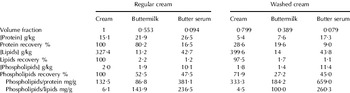
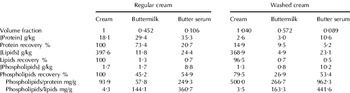
The effect of washing treatment on the composition of goat and cow cream is presented in Table 1 and 2 respectively. The washing treatment significantly reduced (P<0·05) protein concentration by 64 and 86%, in caprine and bovine cream, respectively. The washing treatment achieved here for bovine cream was more efficient at removal of contaminant proteins than previously obtained (Britten et al. Reference Britten, Lamothe and Robitaille2008), essentially because water instead of UF-permeate was used for washing. By considering the washing dilution factor in the aqueous phase of the cream and the protein content in regular and washed cream, one can calculate the protein fraction that is bound to fat. From this calculation, 7% of protein in cow cream and 32% of protein in goat cream is bound to fat droplets. This result suggests that the amount of protein adsorbed to fat droplets is much higher for goat cream (~10 mg/g fat) than for cow cream (~4 mg/g fat).
Protein, lipids and phospholipids distribution in buttermaking process from caprine cream

Protein, lipids and phospholipids distribution in buttermaking process from bovine cream

Washing treatment also induced significant loss of total phospholipids in the resulting caprine (Table 1) and bovine (Table 2) washed creams. Phospholipids removed with the skim fraction during the washing treatment come mainly from membrane fragment material and small fat droplets initially present in cream serum (Anderson & Brooker, Reference Anderson and Brooker1975). Phospholipids recovery in washed caprine and bovine cream, were respectively 71·9 and 79·5%. The higher proportion of phospholipids lost into water phase during the second skimming could be related to the smaller average size of goat milk fat globules (2·57–3·25 μm) compared with cow milk (3·00–4·50 μm) (Elagamy, Reference Elagamy2003). Smaller droplets, having a higher surface-to-volume ratio are richer in phospholipids and are more likely to be lost in the second skim during washing treatment. Protein removal being more important than phospholipids losses, the washing treatment resulted in significant increases of 5·3 and 2·5 times in the phospholipids-to-protein ratio (P<0·05) in the washed caprine (Table 1) and bovine (Table 2) creams respectively.
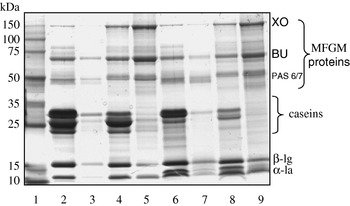
Buttermilk of bovine origin has often been used as a raw material for the production of phospholipids-enriched fractions. As washed bovine and caprine creams were partially depleted in protein they constituted interesting starting material. Regular and washed creams were churned to produce butter and buttermilk. As expected, protein content in buttermilk from goat (Table 1) and cow (Table 2) cream was significantly reduced by the washing treatment. Protein loss was mainly attributed to a decline in the casein content as illustrated by the comparative protein profile of buttermilks obtained by SDS-PAGE electrophoresis (Fig. 1). An important decrease in the intensity of the bands associated with caseins was observed in buttermilk obtained from cow cream (Lane 3 vs. lane 2) and goat cream (Lane 5 vs. lane 4). The relative proportion of MFGM protein was increased by washing treatment. According to Mather (Reference Mather2000), the main MFGM proteins were identified as xantine oxydase (MW=150 kDa), butyrophilin (MW=66 kDa) and PAS 6/7 (MW=43–59 kDa). Based on the densitometry analysis of the gels, MFGM protein represented 49% of total protein in washed bovine buttermilk (Fig. 1; lane 3) and 68% in washed caprine buttermilk (Fig. 1; lane 5). This result supports previous suggestion regarding the higher concentration of MFGM protein in caprine cream compared with bovine cream. The whey protein-to-casein ratios in washed bovine and caprine buttermilks were 0·61 and 0·80 respectively. These values are much higher than the natural ratio found in milk (about 20–25%) and result from the adsorption of whey proteins onto fat droplets during pasteurization (Ye et al. Reference Ye, Singh, Taylor and Anema2004).
SDS-PAGE profile of high molecular weight standard (1), regular cow buttermilk (2), washed cow buttermilk (3), regular caprine buttermilk (4) washed caprine buttermilk (5), regular cow butter serum (6), washed cow butter serum (7), regular caprine butter serum (8) and washed caprine butter serum (9). Samples were analyzed for the same volume. XO, Xanthine oxydase; BU, Butyrophilin; β-lg, β-lactoglobulin; α-la, α-lactalbumin.

The phospholipids-to-protein ratio in caprine and bovine buttermilk was significantly increased and reached 184 and 267 mg/g protein (Table 1 and 2) following washing treatment with water. For comparison purpose, cream washing with milk UF-permeate before churning increased the phospholipids-to-protein ratio in cow buttermilk from 53 to 172 mg/g (Britten et al. Reference Britten, Lamothe and Robitaille2008). On a dry basis, washing treatment increased the phospholipids from 17·8 g/kg to 69·0 g/kg in bovine buttermilk, and from 22·4 g/kg to 62·9 g/kg in caprine buttermilk. The phospholipids-to-lipid ratio in caprine buttermilk was lowered by the washing process (Table 1), suggesting increased fat contamination. Churning conditions should therefore be optimized in order to produce butter with minimal fat losses in buttermilk. In fact several factors affect the efficiency of the churning process as measured by the percentage of fat in buttermilk, such as turning rate of churn, fat content of the cream, average fat globule size and churning temperature (Walstra et al. Reference Walstra, Wouters and Geurts2006).
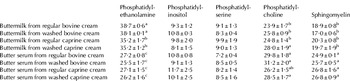
The phospholipids profile of regular and washed buttermilks of both origins (Table 3) was similar, except for phosphatidylethanolamine, which was slightly higher in bovine buttermilk, and for the proportion of phosphatidylcholine in washed caprine buttermilks (P<0·05), whereas the proportions of all other phospholipids classes remained relatively constant (P>0·1). The sphingomyelin content was between 170–200 g/kg total phospholipids which is similar to the values reported previously (Avalli & Contarini, Reference Avalli and Contarini2005; Rombaut et al. Reference Rombaut, Camp and Dewettinck2006).
Phospholipid composition (% of total phospholipids) of buttermilks and butter sera obtained form bovine and caprine creams

a,b,c Means in a same column followed by different letters are significantly different (P<0·05)
As suggested by Perennou (Reference Perennou1999), butter serum could be an excellent substrate for the preparation of phospholipids-enriched fractions. In a previous paper (Britten et al. Reference Britten, Lamothe and Robitaille2008), phospholipids over protein ratio in bovine butter serum was 1·8 times higher when made from washed cream and reached 473±3 mg/g. The ratio doubled in this study, reaching 962 mg/g (Table 2), mainly because the cream was washed with water instead of milk UF-permeate. On a dry basis, phospholipids represented 240 g/kg total solid. The phospholipids-to-protein ratio in butter serum from goat cream was about 30% lower than from cow cream (Table 1) and the phospholipids concentration on a dry basis was 180 g/kg. Despite the extensive reduction of casein and whey protein content, as visualized by the protein profile on SDS-PAGE (Fig. 1, lanes 6 and 9), high concentration of MFGM protein is responsible for lower phospholipids-to-protein ratio. Furthermore, we observed a lower phospholipids recovery in butter serum from caprine cream (Table 1) than from bovine cream (Table 2). As previously mentioned, fat losses during churning process, were more important for goat cream than for bovine cream and since these losses mainly consist of smaller fat droplets (rich in phospholipids), it contributes to reduce phospholipids concentration in butter serum.
Phospholipids composition of butter serum was similar in extracts of both origins and was not significantly affected by the washing treatment (P>0·05) (Table 3) which is consistent with previously reported results (Britten et al. Reference Britten, Lamothe and Robitaille2008). As previously reported by Rombaut et al. (Reference Rombaut, Camp and Dewettinck2006) and Britten et al. (Reference Britten, Lamothe and Robitaille2008), butter serum extracts were enriched in sphingomyelin when compared with buttermilks. Sphingomyelin concentration was more than 25% of total phospholipids in butter sera from both origins.
Conclusion
The application of a washing treatment to bovine and caprine creams before churning allowed the production of buttermilks with an increased phospholipids-to-protein ratio owing to a marked reduction of the casein content. This represents a great advantage for further phospholipids purification. Phospholipids content was significantly higher in caprine buttermilks than in bovine buttermilks, but phospholipids recovery was similar for both species after the treatment. Buttermilks obtained from goat cream contained higher concentration of MFGM protein compared with buttermilks for cow cream.
The cream washing treatment significantly reduced the casein content of butter sera of bovine and caprine origin. The treatment did not reduce phospholipids recovery in butter sera from either species. The higher content of phospholipids and the greater proportion of sphingomyelin compared with those in buttermilk make the bovine and caprine butter sera from washed creams excellent substrates for the production of phospholipids concentrates.
The results presented in this study point to the possibility of using the cream washing treatment prior to butter making to produce phospholipids-, and MFGM protein-enriched ingredients that could be used in various food systems as well as in nutraceutical products.