Introduction
Reduced motivation and goal-oriented behavior have long been considered key features of both psychosis (e.g. schizophrenia) and depression [e.g. major depressive disorder (MDD)]. Importantly, decreases in motivation impair functioning and significantly reduce quality of life (Beck et al. Reference Beck, Crain, Solberg, Unützer, Glasgow, Maciosek and Whitebird2011; Sarkar et al. Reference Sarkar, Hillner and Velligan2015). Current treatment options for depression and psychotic disorders are not sufficiently effective at reducing motivational impairments, in part due to the need to better understand the mechanisms that give rise to these symptoms. There are a number of frameworks available that could help identify potential mechanisms, including the animal literature on mechanisms that give rise to motivated behavior (Young et al. Reference Young, Zhou, Geyer and Swerdlow2010), as well as the Positive Valence System domain described as part of the Research Domain Criteria (RDoC) initiative developed by the National Institutes of Mental Health (Cuthbert & Insel Reference Cuthbert and Insel2013).
One important component in both of these frameworks is effort-cost decision-making (ECDM). ECDM refers to mental calculations that individuals perform to estimate the amount of work necessary to obtain an outcome. For example, a worker may estimate the subjective cost of working an extra hour to gain overtime pay. There are individual differences in effort cost estimates (e.g. some might find the extra hour of work worth the pay while others may not). Importantly, recent work has suggested that abnormal ECDM may be a contributor to motivational impairments in psychosis and depression. Research has shown that people with schizophrenia, schizoaffective, bipolar disorder, and MDD are less willing than healthy individuals to exert effort to obtain rewards on experimental tasks, and that this reduced willingness is related to motivational deficits (Yang et al. Reference Yang, Huang, Zhu, Wang, Cheung, Chan and Xie2014; Reddy et al. Reference Reddy, Horan, Barch, Buchanan, Dunayevich, Gold, Lyons, Marder, Treadway and Wynn2015; Hershenberg et al. Reference Hershenberg, Satterthwaite, Daldal, Katchmar, Moore, Kable and Wolf2016; Moran et al. Reference Moran, Culbreth and Barch2017). Taken together, these data suggest a common contributor to motivational impairments across psychosis and depression. However, it is not yet clear whether the psychological and neural mechanisms from which this seemingly similar ECDM deficit arises are shared across forms of psychopathology.
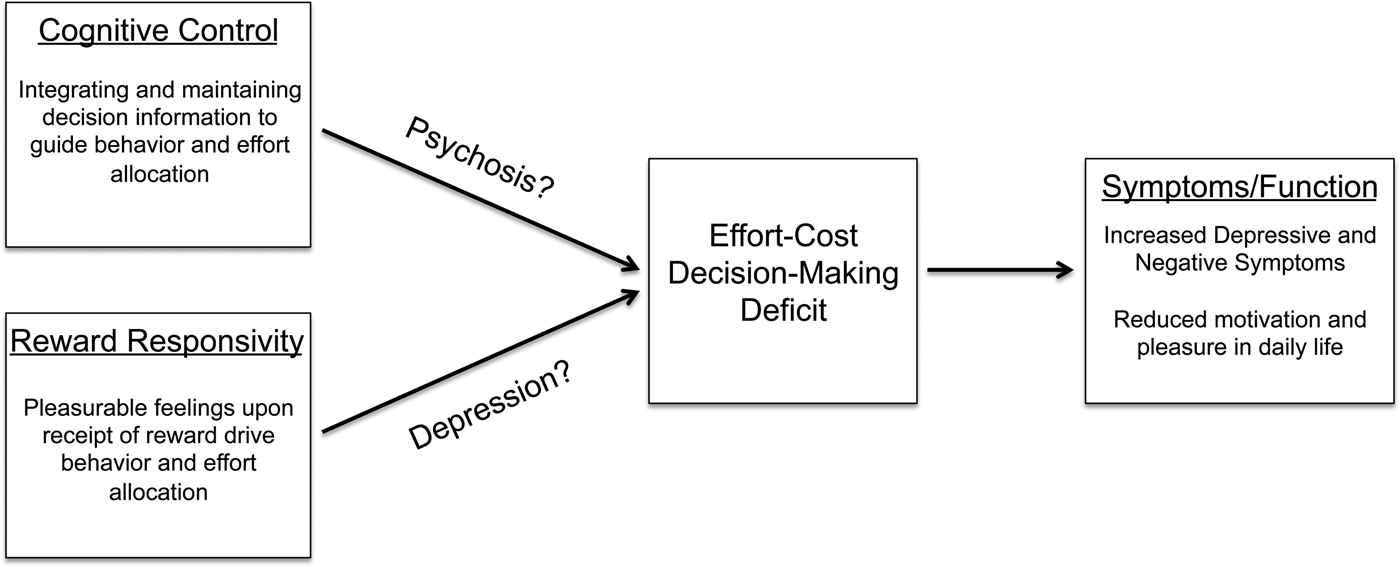
ECDM involves a number of component processes. Thus, ECDM impairments in psychosis and depression may arise from separable psychological and neural mechanisms (Fig. 1). The RDoC Positive Valence System and animal literature provide useful ideas as to potential dissociable mechanisms. For example, aberrant ECDM could arise from reduced reward responsivity, thought to be dependent on striatal function. In other words, individuals may be less willing to exert effort for an outcome that they may not experience as pleasurable. Alternatively, aberrant ECDM could arise from cognitive control impairments in the ability to use incentive information to effectively modulate effort allocation and decision-making processes, functions largely associated with the dorsolateral prefrontal cortex (DLPFC), anterior cingulate cortex (ACC), and striatal regions. Thus, even if rewards are experienced as pleasurable, if a person cannot maintain and use information about potential future rewards to guide behavior, they may not choose to exert effort to obtain a future reward.
Potential pathways to ECDM deficits and their implications.

The current review has several aims. First, we summarize the literature on ECDM in psychosis and depression, providing evidence for transdiagnostic impairment. Next, we provide evidence for the hypothesis that similar ECDM deficits might arise from disparate psychological and neural mechanisms. Specifically, we will argue that effort deficits in psychosis may more strongly be attributed to deficits in cognitive control and the neural correlates of cognitive control processes, while effort deficits in mood disorders may be more strongly attributed to reduced reward responsivity and the neural correlates of such processes. Finally, we discuss future directions and interpretative challenges to consider when examining ECDM transdiagnostically.
Effort-cost decision-making
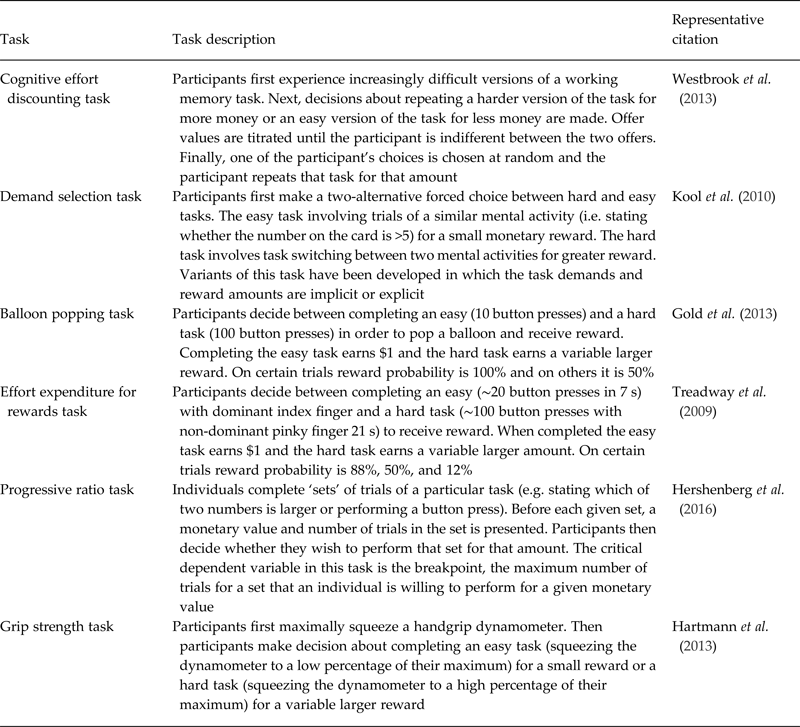
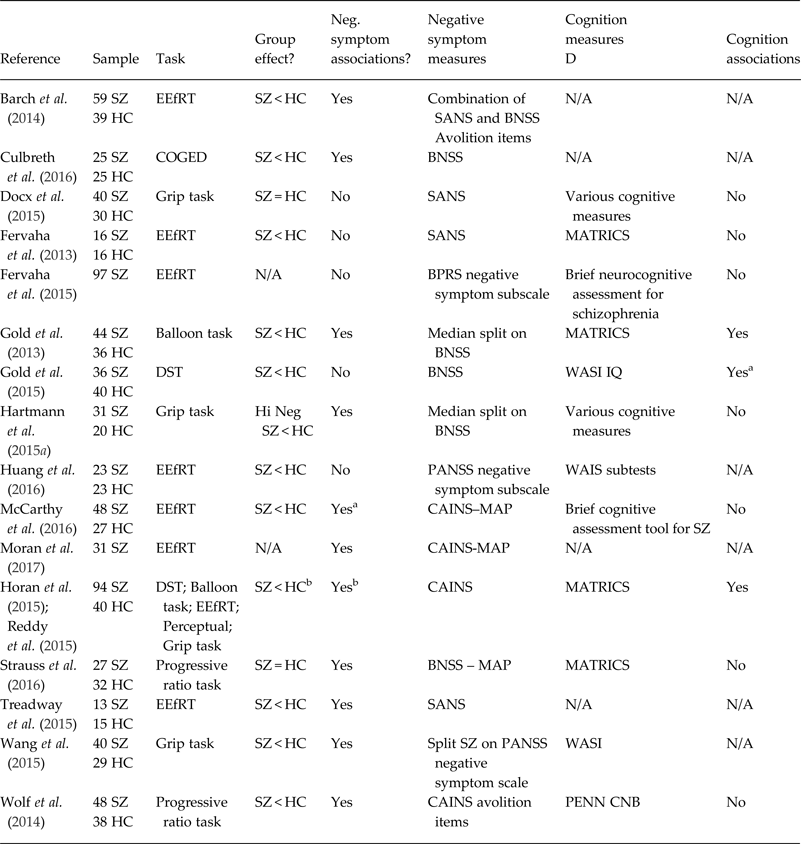
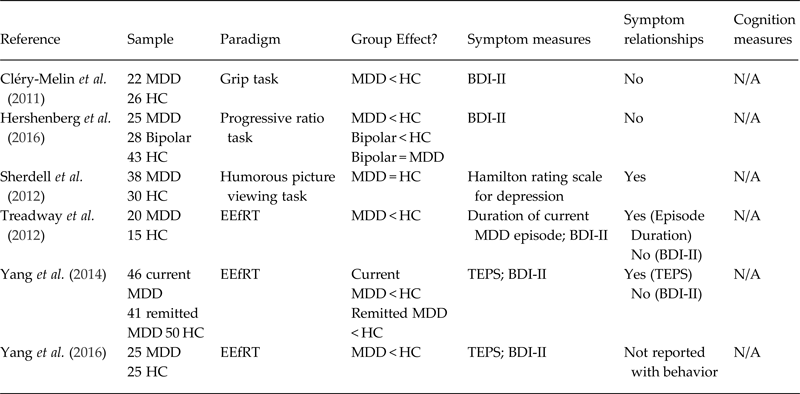
Table 1 provides a summary of paradigms for examining effort allocation in humans. Using these tasks researchers have shown that across psychosis and depression there is consistent evidence that patients are less willing to expend effort to obtain rewards compared with healthy controls (Tables 2 and 3). Below, we review these findings, separating studies by effort modality, either physical or cognitive. We focus on findings in psychosis or depression. Because of space limitations, we do not review animal models (Salamone et al. Reference Salamone, Correa, Farrar and Mingote2007) or human basic science models (Westbrook & Braver Reference Westbrook and Braver2016) of ECDM, which have strongly informed the clinical literature.
Summary of common ECDM paradigms

Summary of ECDM studies in schizophrenia patients

SZ, Schizophrenia; HC, healthy control; EEfRT, effort expenditure for rewards task; COGED, cognitive effort discounting task; DST, demand selection task; SANS, scale for the assessment of negative symptoms; CAINS, clinical assessment interview for negative symptoms; MAP, motivations and pleasure scale; BNSS, brief negative symptom scale; PANSS, positive and negative symptom scale; BPRS, brief psychiatric rating scale; WASI, Wechsler abbreviated scale of intelligence; MATRICS, measure and treatment research to improve cognition in schizophrenia; WAIS, Wechsler adult intelligence scale; PENN CNB, Pennsylvania computerized neurocognitive battery.
a Effect was present but in opposite direction.
b Significant group differences and individual difference relationship for some tasks,
Summary of ECDM studies in major depressive disorder

MDD, major depressive disorder; HC, healthy control; EEfRT, effort expenditure for rewards task; BDI-II, beck depression inventory 2nd edition; TEPS, temporal experience of pleasure scale.
Psychosis
Physical effort
The majority of studies examining effort in psychosis have used physical ECDM tasks. For example, studies have used button-pressing paradigms, during which individuals decide between performing an easy or hard button-pressing task for small or large reward. These studies have shown that individuals with schizophrenia choose to complete the hard task less than healthy controls as reward value and probability of reward receipt for the hard task increases (Fervaha et al. Reference Fervaha, Graff-Guerrero, Zakzanis, Foussias, Agid and Remington2013; Gold et al. Reference Gold, Strauss, Waltz, Robinson, Brown and Frank2013; Barch et al. Reference Barch, Treadway and Schoen2014; Reddy et al. Reference Reddy, Horan, Barch, Buchanan, Dunayevich, Gold, Lyons, Marder, Treadway and Wynn2015; Treadway et al. Reference Treadway, Peterman, Zald and Park2015; Huang et al. Reference Huang, Yang, Lan, Zhu, Liu, Wang, Cheung, Xie and Chan2016; McCarthy et al. Reference McCarthy, Treadway, Bennett and Blanchard2016). Further, many studies show individual difference relationships between effort and negative symptoms, such that high negative symptom patients show the least willingness to expend effort (Gold et al. Reference Gold, Strauss, Waltz, Robinson, Brown and Frank2013; Barch et al. Reference Barch, Treadway and Schoen2014; Horan et al. Reference Horan, Reddy, Barch, Buchanan, Dunayevich, Gold, Marder, Wynn, Young and Green2015; Treadway et al. Reference Treadway, Peterman, Zald and Park2015; Moran et al. Reference Moran, Culbreth and Barch2017) although several studies have failed to observe such symptom effects (Fervaha et al. Reference Fervaha, Graff-Guerrero, Zakzanis, Foussias, Agid and Remington2013, Reference Fervaha, Duncan, Foussias, Agid, Faulkner and Remington2015; Huang et al. Reference Huang, Yang, Lan, Zhu, Liu, Wang, Cheung, Xie and Chan2016). This inconsistency may be driven by method of assessment, with most of the positive results utilizing newly developed symptom measures (e.g. BNSS and CAINS) that better reflect current conceptualizations of negative symptoms (Kirkpatrick et al. Reference Kirkpatrick, Strauss, Nguyen, Fischer, Daniel, Cienfuegos and Marder2010; Horan et al. Reference Horan, Kring, Gur, Reise and Blanchard2011). Further, recent factor analyses have suggested that negative symptoms are composed of two separate factors, experiential and expressive (Strauss et al. Reference Strauss, Hong, Gold, Buchanan, McMahon, Keller, Fischer, Catalano, Culbreth and Carpenter2012) and there is some evidence that ECDM deficits correlate most robustly with experiential negative symptoms. Other studies have used grip strength paradigms, where individuals choose to squeeze a hand dynamometer to either a low or high degree of their maximum for small or large reward, and have reported reduced high degree choice in schizophrenia patients compared with controls (Hartmann et al. Reference Hartmann, Hager, Reimann, Chumbley, Kirschner, Seifritz, Tobler and Kaiser2015a ; Reddy et al. Reference Reddy, Horan, Barch, Buchanan, Dunayevich, Gold, Lyons, Marder, Treadway and Wynn2015; Wang et al. Reference Wang, Huang, Yang, Lui, Cheung and Chan2015), and similar correlations with negative symptoms (Hartmann et al. Reference Hartmann, Hager, Reimann, Chumbley, Kirschner, Seifritz, Tobler and Kaiser2015a ; Wang et al. Reference Wang, Huang, Yang, Lui, Cheung and Chan2015). However, one study did not find group differences or negative symptom relationships using a grip strength task (Docx et al. Reference Docx, de la Asuncion, Sabbe, Hoste, Baeten, Warnaerts and Morrens2015). Finally, one study used a progressive ratio task requiring participants to exert incrementally greater amounts of physical effort to obtain a monetary reward (Strauss et al. Reference Strauss, Whearty, Morra, Sullivan, Ossenfort and Frost2016). The critical-dependent measure in this task is breakpoint (i.e. the point at which the participant is no longer willing to exert effort to obtain reward) with larger breakpoint suggesting greater willingness to expend effort. They did not find group differences in breakpoint, but did report that breakpoint negatively correlated with negative symptoms (Strauss et al. Reference Strauss, Whearty, Morra, Sullivan, Ossenfort and Frost2016). Taken together, these findings suggest reduced physical effort allocation in psychotic pathology and that this deficit is most pronounced for high negative symptom patients.
One study has examined the neural mechanisms of physical ECDM in people with schizophrenia using a button-pressing task during neuroimaging (Huang et al. Reference Huang, Yang, Lan, Zhu, Liu, Wang, Cheung, Xie and Chan2016). Results suggested reduced activation of the medial frontal gyrus, posterior cingulate cortex, and ventral striatum during decision-making for patients compared with controls (Huang et al. Reference Huang, Yang, Lan, Zhu, Liu, Wang, Cheung, Xie and Chan2016). In a related study, Park and colleagues found greater activation in the caudate for patients compared with controls as a function of effort, but as their task did not involve a choice between hard and easy options their findings are difficult to generalize to the ECDM literature (Park et al. Reference Park, Lee, Kim, Kim and Koo2017).
Cognitive effort
Studies examining cognitive ECDM also provide evidence for decreased effort allocation in psychosis. For example, Wolf and colleague used a progressive ratio task requiring incrementally greater exertion of cognitive effort to obtain monetary reward (Wolf et al. Reference Wolf, Satterthwaite, Kantrowitz, Katchmar, Vandekar, Elliott and Ruparel2014). Schizophrenia patients showed lower breakpoints than healthy controls, and high negative symptom patients showed the lowest breakpoints. Similarly, our group used a cognitive effort-discounting paradigm where individuals decided between completing easy or hard versions of a cognitively demanding task for small or large reward (Culbreth et al. Reference Culbreth, Westbrook and Barch2016). Schizophrenia patients showed decreased willingness to perform hard versions for increased rewards compared with controls, and high negative symptom patients showed the least willingness to expend effort (Culbreth et al. Reference Culbreth, Westbrook and Barch2016). Finally, two studies have used variants of a demand-selection task to examine cognitive effort in schizophrenia (Gold et al. Reference Gold, Kool, Botvinick, Hubzin, August and Waltz2014; Reddy et al. Reference Reddy, Horan, Barch, Buchanan, Dunayevich, Gold, Lyons, Marder, Treadway and Wynn2015). In this task individuals choose between completing easy trials of a similar mental activity (i.e. stating whether a presented number is larger than 5) for a small reward or hard trials, which involve task switching between two mental activities for greater reward (Kool et al. Reference Kool, McGuire, Rosen and Botvinick2010). Reddy et al. (Reference Reddy, Horan, Barch, Buchanan, Dunayevich, Gold, Lyons, Marder, Treadway and Wynn2015) found that people with schizophrenia choose to perform hard trials less frequently than controls for high reward values, but they did not find a negative symptom effect. In contrast, one study did not find group differences using different variants of the demand selection task, but found evidence for difficulty in detecting the effort associated with various options in schizophrenia (Gold et al. Reference Gold, Kool, Botvinick, Hubzin, August and Waltz2014).
To date no study has directly examined the neural mechanisms of cognitive ECDM in psychosis. While indirect, Wolf and colleagues demonstrated that in schizophrenia patients, increased BOLD activation in ventral striatum and DLPFC during a reward processing task correlated with greater willingness to expend effort on a behavioral progressive ratio task (Wolf et al. Reference Wolf, Satterthwaite, Kantrowitz, Katchmar, Vandekar, Elliott and Ruparel2014). Such findings provide initial evidence for the role of striatal regions and cognitive control regions in effort deficits for those with schizophrenia, although more research is needed in this area.
Depression
Physical effort
Several studies suggest a physical ECDM deficit in depression. Studies using button-pressing paradigms have found consistent evidence for reduced willingness to expend effort in people with MDD compared with controls (Treadway et al. Reference Treadway, Bossaller, Shelton and Zald2012; Yang et al. Reference Yang, Huang, Zhu, Wang, Cheung, Chan and Xie2014, Reference Yang, Huang, Lan, Zhu, Liu, Wang, Cheung, Xie and Chan2016). Further, these studies observed that decreased trait levels of anticipatory pleasure (Yang et al. Reference Yang, Huang, Zhu, Wang, Cheung, Chan and Xie2014), increased duration of current depressive episode (Treadway et al. Reference Treadway, Bossaller, Shelton and Zald2012), and current compared with remitted depressive episode (Yang et al. Reference Yang, Huang, Zhu, Wang, Cheung, Chan and Xie2014) are associated with decreased effort expenditure. Similarly, a study using a grip-strength task showed that as reward increased MDD patients failed to increase effort expenditure (Cléry-Melin et al. Reference Cléry-Melin, Schmidt, Lafargue, Baup, Fossati and Pessiglione2011). Finally, Sherdell and colleagues using a novel paradigm with cartoon pictures as rewards, showed no diagnostic differences between MDD and healthy controls, but found increased effort allocation was related to increased levels of trait anticipatory pleasure in MDD patients (Sherdell et al. Reference Sherdell, Waugh and Gotlib2012).
One study has examined the neural mechanisms of physical ECDM in mood disorders. In this study, individuals with MDD and controls performed a button-pressing task during neuroimaging (Yang et al. Reference Yang, Huang, Lan, Zhu, Liu, Wang, Cheung, Xie and Chan2016). Results indicated that people with MDD showed reduced BOLD activation in the caudate and superior temporal gyrus as a function of reward probability compared with healthy controls, and reduced BOLD activation in the caudate as a function of reward magnitude. Rzepa and colleagues conducted a neuroimaging study where trials varied by effort (Rzepa et al. Reference Rzepa, Fisk and McCabe2017). Individuals at high risk for MDD, defined by scores of 27 or greater on the Mood and Feelings Questionnaire (Angold & Costello Reference Angold and Costello1987), showed blunted activation of the ACC and ventromedial prefrontal cortex on high effort compared with low effort trials. However, Park et al. did not find differences in BOLD activation during effort-based reinforcement-learning in MDD compared with healthy control subjects (Park et al. Reference Park, Lee, Kim, Kim and Koo2017). In both of these studies, there was no actual opportunity for participants to make a choice, and instead participants were given high/low effort trials. This may limit generalization of the results of these studies to the larger ECDM literature, which typically requires individuals to make an active choice as to whether or not to exert effort.
Cognitive effort
One study has examined cognitive ECDM in mood disorders. This study used a progressive ratio task and found that both individuals with MDD or bipolar disorder in a current depressive episode showed lower breakpoints than healthy controls, but they did not find correlations between breakpoint and symptoms (Hershenberg et al. Reference Hershenberg, Satterthwaite, Daldal, Katchmar, Moore, Kable and Wolf2016).
Summary
Behavioral evidence suggests that both individuals with depression and psychosis are characterized by a reduced willingness to expend cognitive and physical effort compared with healthy controls. While neuroimaging studies are rare, initial results suggest hypoactivation of the dorsal striatum during ECDM in mood pathology, and hypoactivation of the ventral striatum, cingulate cortex, and DLPFC in those with psychosis. This initial evidence of somewhat different neural correlates of impairments in ECDM across psychosis and depression raises the possibility that seemingly similar behavioral impairments may arise from different mechanistic pathways.
Mechanisms of ECDM
Studies suggest impaired ECDM in those with psychosis or depression. However, few studies have examined the psychological and neural mechanisms that could potentially contribute to impaired ECDM in these patient groups. Two potential mechanisms underlying ECDM deficits include reduced reward responsivity and impaired cognitive control. In the following sections, we discuss evidence for impairments in each mechanism in psychosis and depression, and ways that these mechanisms could contribute to impaired ECDM.
Reward responsivity
Reward responsivity is a critical aspect of ECDM. In short, if an individual does not like a particular reward they will be less likely to exert effort to obtain that reward. Further, the subjective cost of the effort necessary to obtain such rewards is likely to be increased if desire for the reward is low (Prévost et al. Reference Prévost, Pessiglione, Météreau, Cléry-Melin and Dreher2010). In the following section, we review the reward responsivity literature in psychosis and depression, and where relevant discuss associations between reward responsivity and ECDM.
Psychosis
A large literature has pointed to intact hedonic experience in schizophrenia (Kring & Moran Reference Kring and Moran2008; Strauss & Gold Reference Strauss and Gold2012). Specifically, whether in the laboratory or while performing pleasurable activities in daily life, individuals with schizophrenia self-report similar levels of pleasure compared with controls (Cohen & Minor Reference Cohen and Minor2010).
Using behavioral paradigms, several studies have shown intact reward responsivity in schizophrenia. Heerey and colleagues used a signal detection task where participants decide which of two variants of a briefly presented stimulus was presented (Pizzagalli et al. Reference Pizzagalli, Jahn and O'Shea2005; Heerey et al. Reference Heerey, Bell-Warren and Gold2008). Approximately 40% of correct responses receive reward feedback, but one of the two responses (‘RICH’) receives 3 times the amount of feedback as the alternative (‘LEAN’) response. People preferentially select the ‘RICH’ response across task blocks (response bias), but on debrief have no awareness of the response contingencies. They found that individuals with schizophrenia showed intact ‘bias’, an indicator of intact implicit reward responsivity, a finding that has recently been replicated in schizophrenia and schizoaffective disorder (Heerey et al. Reference Heerey, Bell-Warren and Gold2008; Barch et al. Reference Barch, Carter, Gold, Johnson, Kring, MacDonald, Pizzagalli, Ragland, Silverstein and Strauss2017).
Neuroimaging studies examining striatal response of schizophrenia patients to monetary reward receipt, a putative measure of reward responsivity, also show a consistent pattern of intact responses for both medicated and unmedicated patients (Abler et al. Reference Abler, Greenhouse, Ongur, Walter and Heckers2008; Schlagenhauf et al. Reference Schlagenhauf, Sterzer, Schmack, Ballmaier, Rapp, Wrase, Juckel, Gallinat and Heinz2009; Simon et al. Reference Simon, Biller, Walther, Roesch-Ely, Stippich, Weisbrod and Kaiser2010; Waltz et al. Reference Waltz, Schweitzer, Ross, Kurup, Salmeron, Rose, Gold and Stein2010; Dowd & Barch Reference Dowd and Barch2012; Nielsen et al. Reference Nielsen, Rostrup, Wulff, Bak, Lublin, Kapur and Glenthøj2012b ; Gilleen et al. Reference Gilleen, Shergill and Kapur2015). Further, electrophysiology studies have shown that the feedback negativity, an event-related potential component thought to index sensitivity to reward feedback, is intact in schizophrenia (Horan et al. Reference Horan, Foti, Hajcak, Wynn and Green2012; Llerena et al. Reference Llerena, Wynn, Hajcak, Green and Horan2016).
While no study to date has directly examined the contributions of reward responsivity to aberrant ECDM in psychosis, our group administered a questionnaire that asked participants to rate factors (e.g. reward amount) that might have influenced choice behavior (Culbreth et al. Reference Culbreth, Westbrook and Barch2016). Both negative symptoms and diagnostic group remained significant predictors of choice behavior when including, ‘To what degree were your choices based on the offer amount of each task’, as a covariate, suggesting that reward responsivity could not account for group and symptom effects. Converging evidence is also provided by Docx and colleagues who did not observe correlations between pleasure ratings of IAPS images and ECDM in schizophrenia (Docx et al. Reference Docx, de la Asuncion, Sabbe, Hoste, Baeten, Warnaerts and Morrens2015).
Depression
In contrast to psychosis, reduced reward responsivity is often considered a potential contributory mechanism for depressive symptoms (Alloy et al. Reference Alloy, Olino, Freed and Nusslock2016) and is a core tenet of prominent theories of affective experience in MDD (Rottenberg et al. Reference Rottenberg, Gross and Gotlib2005). Further, experimental studies have found that MDD patients self-report lower positive emotion during reward receipt compared with controls (Pizzagalli et al. Reference Pizzagalli, Holmes, Dillon, Goetz, Birk, Bogdan, Dougherty, Iosifescu, Rauch and Fava2009).
Behaviorally, studies have found that people with MDD display reduced reward bias, an indicator of reward responsivity (Henriques et al. Reference Henriques, Glowacki and Davidson1994; Henriques & Davidson, Reference Henriques and Davidson2000; Pizzagalli et al. Reference Pizzagalli, Iosifescu, Hallett, Ratner and Fava2008; Pechtel et al. Reference Pechtel, Dutra, Goetz and Pizzagalli2013; Vrieze et al. Reference Vrieze, Pizzagalli, Demyttenaere, Hompes, Sienaert, de Boer, Schmidt and Claes2013; Whitton et al. Reference Whitton, Kakani, Foti, Van't Veer, Haile, Crowley and Pizzagalli2016), and that reduced bias correlates with cross-sectional and longitudinal depressive symptoms (Vrieze et al. Reference Vrieze, Pizzagalli, Demyttenaere, Hompes, Sienaert, de Boer, Schmidt and Claes2013). Similar findings have also been found in children at risk for developing depression, with greater anhedonia correlating with lower reward bias (Luking et al. Reference Luking, Pagliaccio, Luby and Barch2015). Further, there is evidence for lower reward bias in remitted depression compared with healthy controls suggesting that reduced reward responsivity is consistent across clinical states of depression (Pechtel et al. Reference Pechtel, Dutra, Goetz and Pizzagalli2013; Whitton et al. Reference Whitton, Kakani, Foti, Van't Veer, Haile, Crowley and Pizzagalli2016). Several of these studies used the same paradigms that showed intact bias in people with psychosis.
Electrophysiology studies have consistently shown that the feedback negativity is blunted in those with MDD relative to healthy controls (Foti et al. Reference Foti, Carlson, Sauder and Proudfit2014; Liu et al. Reference Liu, Wang, Shang, Shen, Li, Cheung and Chan2014), and is most reduced for those with severe anhedonia (Liu et al. Reference Liu, Wang, Shang, Shen, Li, Cheung and Chan2014). Higher depressive symptoms in children also correlate with blunted feedback negativity (Bress et al. Reference Bress, Smith, Foti, Klein and Hajcak2012; Weinberg et al. Reference Weinberg, Liu, Hajcak and Shankman2015; Belden et al. Reference Belden, Irvin, Hajcak, Kappenman, Kelly, Karlow, Luby and Barch2016), and feedback negativity has been shown to predict the future onset of depressive episodes in adolescences (Bress & Hajcak, Reference Bress and Hajcak2013).
With regards to neuroimaging, People with MDD show decreased ventral striatum (Pizzagalli et al. Reference Pizzagalli, Holmes, Dillon, Goetz, Birk, Bogdan, Dougherty, Iosifescu, Rauch and Fava2009; Robinson et al. Reference Robinson, Cools, Carlisi, Sahakian and Drevets2012), dorsal striatum (Knutson et al. Reference Knutson, Bhanji, Cooney, Atlas and Gotlib2008; Forbes et al. Reference Forbes, Hariri, Martin, Silk, Moyles, Fisher, Brown, Ryan, Birmaher and Axelson2009; Zhang et al. Reference Zhang, Chang, Guo, Zhang and Wang2013), cingulate, insula, and orbital frontal cortex activation to receipt of rewards compared with healthy controls. A recent meta-analysis concluded that MDD was characterized by reduced activation in the striatum, as well as cingulate cortex (Zhang et al. Reference Zhang, Chang, Guo, Zhang and Wang2013). Decreased striatal response to reward receipt is also found in children and adolescents at increased risk for developing depression (Gotlib et al. Reference Gotlib, Hamilton, Cooney, Singh, Henry and Joormann2010; Sharp et al. Reference Sharp, Kim, Herman, Pane, Reuter and Strathearn2014; Luking et al. Reference Luking, Pagliaccio, Luby and Barch2015; Olino et al. Reference Olino, Silk, Osterritter and Forbes2015). Further, ventral striatal function has been shown to predict longitudinal increases in depressive symptoms in adolescents (Telzer et al. Reference Telzer, Fuligni, Lieberman and Galván2014).
Summary
Self-report, implicit-learning paradigms, electrophysiology studies, and functional neuroimaging data largely suggest that reward responsivity is intact in psychosis. However, data from similar modalities and methods suggests reduced reward responsivity in depression. As noted above, no study has directly tested the contributions of reward responsivity to aberrant ECDM in psychosis or depression. However, the work demonstrating intact reward responsivity in schizophrenia would suggest that it is an unlikely mechanism for aberrant ECDM in psychosis. In contrast, the work demonstrating impaired reward responsivity in MDD makes reward responsivity a potentially attractive contributory mechanism to impaired ECDM in depression.
Cognitive control
ECDM involves a number of functions that are highly reliant on cognitive control. Cognitive control has been defined as ‘the ability to regulate, coordinate, and sequence thoughts and actions in accordance with internally maintained behavioral goals’. (Braver, Reference Braver2012). For example, ECDM requires integrating decision information from different sources (e.g. availability of reward alternatives, likelihood of success) to derive and update the value of potentially rewarding outcomes. Further, ECDM requires generating and maintaining internal representations of potential outcomes, and using these to drive ongoing choice behavior, potentially in the face of distracting or conflicting information. Thus, disruption of cognitive control processes represents one potential contributory mechanism to impaired ECDM. In the following section we review the cognitive control literature in psychosis and depression, and where relevant discuss associations between cognitive deficits and ECDM.
Psychosis
Deficits in cognitive control have long been reported in psychosis (Barch & Sheffield, Reference Barch, Sheffield and Egner2017), with meta-analyses converging on a robust deficit (Szöke et al. Reference Szöke, Trandafir, Dupont, Méary, Schürhoff and Leboyer2008; Minzenberg et al. Reference Minzenberg, Laird, Thelen, Carter and Glahn2009) among individuals with chronic psychosis (Elvevag et al. Reference Elvevag, Duncan and McKenna2000; Cho et al. Reference Cho, Konecky and Carter2006; Chambon et al. Reference Chambon, Franck, Koechlin, Fakra, Ciuperca, Azorin and Farrer2008; Henderson et al. Reference Henderson, Poppe, Barch, Carter, Gold, Ragland, Silverstein, Strauss and MacDonald2012), first episode psychosis (Barch et al. Reference Barch, Carter, Braver, McDonald, Sabb, Noll and Cohen2001; Snitz et al. Reference Snitz, MacDonald, Cohen, Cho, Becker and Carter2005; Minzenberg et al. Reference Minzenberg, Firl, Yoon, Gomes, Reinking and Carter2010; Lesh et al. Reference Lesh, Westphal, Niendam, Yoon, Minzenberg, Ragland, Solomon and Carter2013), and those at risk for developing psychosis (e.g. Snitz et al. Reference Snitz, Macdonald and Carter2006). Meta-analyses have pointed to reduced activation in a network of brain regions in schizophrenia that have frequently been associated with cognitive control (Dosenbach et al. Reference Dosenbach, Fair, Miezin, Cohen, Wenger, Dosenbach, Fox, Snyder, Vincent, Raichle, Schlaggar and Petersen2007. Reference Dosenbach, Fair, Cohen, Schlaggar and Petersen2008), including bilateral anterior cingulate (Minzenberg et al. Reference Minzenberg, Laird, Thelen, Carter and Glahn2009; Alústiza et al. Reference Alústiza, Radua, Pla, Martin and Ortuño2017) and DLPFC (Minzenberg et al. Reference Minzenberg, Laird, Thelen, Carter and Glahn2009). This altered activity in cognitive control regions is present both at first episode (Barch et al. Reference Barch, Carter, Braver, McDonald, Sabb, Noll and Cohen2001; MacDonald et al. Reference MacDonald, Carter, Kerns, Ursu, Barch, Holmes, Stenger and Cohen2005; Snitz et al. Reference Snitz, MacDonald, Cohen, Cho, Becker and Carter2005) and chronic illness (MacDonald & Carter, Reference MacDonald and Carter2003; Yoon et al. Reference Yoon, Minzenberg, Ursu, Ryan Walter, Wendelken, Ragland and Carter2008; Barbalat et al. Reference Barbalat, Chambon, Franck, Koechlin and Farrer2009, Reference Barbalat, Chambon, Domenech, Ody, Koechlin, Franck and Farrer2011; Edwards et al. Reference Edwards, Barch and Braver2010; Poppe et al. Reference Poppe, Barch, Carter, Gold, Ragland, Silverstein and MacDonald2016), with some evidence for impairment in individuals at risk for psychosis (MacDonald et al. Reference MacDonald, Thermenos, Barch and Seidman2009). These deficits have also been to linked with negative symptoms (e.g. Nuechterlein et al. Reference Nuechterlein, Edell, Norris and Dawson1986; O'Leary et al. Reference O'Leary, Flaum, Kesler, Flashman, Arndt and Andreasen2000; Barch et al. Reference Barch, Carter and Cohen2003a , Reference Barch, Carter, MacDonald, Braver and Cohen b ; Henderson et al. Reference Henderson, Poppe, Barch, Carter, Gold, Ragland, Silverstein, Strauss and MacDonald2012), though not in all studies (Cohen et al. Reference Cohen, Barch, Carter and Servan-Schreiber1999; Harvey et al. Reference Harvey, Koren, Reichenberg and Bowie2006; Lesh et al. Reference Lesh, Westphal, Niendam, Yoon, Minzenberg, Ragland, Solomon and Carter2013).
No study to date has examined the specific relationship between cognitive control and ECDM in psychosis. Some studies have examined relationships with general cognitive ability, though results are mixed. Two studies have found that schizophrenia patients with lower scores on neuropsychological test batteries are less willing to exert effort (Gold et al. Reference Gold, Strauss, Waltz, Robinson, Brown and Frank2013; Horan et al. Reference Horan, Reddy, Barch, Buchanan, Dunayevich, Gold, Marder, Wynn, Young and Green2015). However, several studies have failed to find such relationships (Fervaha et al. Reference Fervaha, Graff-Guerrero, Zakzanis, Foussias, Agid and Remington2013, Reference Fervaha, Duncan, Foussias, Agid, Faulkner and Remington2015; Wolf et al. Reference Wolf, Satterthwaite, Kantrowitz, Katchmar, Vandekar, Elliott and Ruparel2014; Docx et al. Reference Docx, de la Asuncion, Sabbe, Hoste, Baeten, Warnaerts and Morrens2015; Hartmann et al. Reference Hartmann, Hager, Reimann, Chumbley, Kirschner, Seifritz, Tobler and Kaiser2015a ; McCarthy et al. Reference McCarthy, Treadway, Bennett and Blanchard2016; Strauss et al. Reference Strauss, Whearty, Morra, Sullivan, Ossenfort and Frost2016), and other studies did not collect measures of cognition in order to examine associations (Treadway et al. Reference Treadway, Bossaller, Shelton and Zald2012; Barch et al. Reference Barch, Treadway and Schoen2014; Wang et al. Reference Wang, Huang, Yang, Lui, Cheung and Chan2015; Culbreth et al. Reference Culbreth, Westbrook and Barch2016; Huang et al. Reference Huang, Yang, Lan, Zhu, Liu, Wang, Cheung, Xie and Chan2016). Thus, future research is needed to determine the relationship between cognition and effort allocation in those with psychosis. In particular, such work may benefit from using recent cutting-edge experimental measures of cognitive control and working memory to draw more focal links between effort expenditure and particular cognitive domains.
Depression
Evidence for cognitive control impairment in people with MDD is mixed (Paulus, Reference Paulus2015). Using a wide variety of tasks, behavioral studies have reported impaired cognitive control in people with MDD compared with healthy individuals and some relationships to symptoms (Mitterschiffthaler et al. Reference Mitterschiffthaler, Williams, Walsh, Cleare, Donaldson, Scott and Fu2008; De Lissnyder et al. Reference De Lissnyder, Koster, Everaert, Schacht, Van den Abeele and De Raedt2012; Demeyer et al. Reference Demeyer, Koster, De Lissnyder and De Raedt2012; Murphy et al. Reference Murphy, Michael and Sahakian2012; Vanderhasselt et al. Reference Vanderhasselt, De Raedt, Dillon, Dutra, Brooks and Pizzagalli2012; Foland-Ross et al. Reference Foland-Ross, Hamilton, Joormann, Berman, Jonides and Gotlib2013; Snyder, Reference Snyder2013; Yoon et al. Reference Yoon, LeMoult and Joormann2014), but others have reported no differences (Kaiser et al. Reference Kaiser, Unger, Kiefer, Markela, Mundt and Weisbrod2003; Holmes et al. Reference Holmes, MacDonald, Carter, Barch, Stenger and Cohen2005; Wagner et al. Reference Wagner, Sinsel, Sobanski, Köhler, Marinou, Mentzel, Sauer and Schlösser2006; Fales et al. Reference Fales, Barch, Rundle, Mintun, Snyder, Cohen, Mathews and Sheline2008; Holmes & Pizzagalli, Reference Holmes and Pizzagalli2008; Engels et al. Reference Engels, Heller, Spielberg, Warren, Sutton, Banich and Miller2010; Ladouceur et al. Reference Ladouceur, Slifka, Dahl, Birmaher, Axelson and Ryan2012; Ng et al. Reference Ng, Chan and Schlaghecken2012; Clawson et al. Reference Clawson, Clayson and Larson2013; Diler et al. Reference Diler, Pan, Segreti, Ladouceur, Forbes, Cela, Almeida, Birmaher, Axelson and Phillips2014; Saunders & Jentzsch, Reference Saunders and Jentzsch2014). Some behavioral evidences shows that cognitive control impairment in MDD may be more robust in the context of emotion (Wagner et al. Reference Wagner, Sinsel, Sobanski, Köhler, Marinou, Mentzel, Sauer and Schlösser2006; Peckham et al. Reference Peckham, McHugh and Otto2010; Joormann & Tanovic, Reference Joormann and Tanovic2015); however, several studies have failed to observe such effects (Engels et al. Reference Engels, Heller, Spielberg, Warren, Sutton, Banich and Miller2010; Saunders & Jentzsch, Reference Saunders and Jentzsch2014). These mixed findings may be due to variability in the age of the samples, examination of patients at different clinical states (e.g. including patients in remission), use of different tasks and outcome measures, and not accounting for more general cognitive deficits (e.g. processing speed impairments) (Snyder, Reference Snyder2013).
The neuroimaging literature also reveals mixed findings. Most consistently, several studies using the Stroop (Wagner et al. Reference Wagner, Sinsel, Sobanski, Köhler, Marinou, Mentzel, Sauer and Schlösser2006; Holmes & Pizzagalli, Reference Holmes and Pizzagalli2008) and emotional version of the Stroop (Mitterschiffthaler et al. Reference Mitterschiffthaler, Williams, Walsh, Cleare, Donaldson, Scott and Fu2008; Engels et al. Reference Engels, Heller, Spielberg, Warren, Sutton, Banich and Miller2010) have shown a hyperactivity of the ACC during conflict or disengagement trials for MDD patients compared with controls. However, one study using a Go/NoGo task did not find hyperactivity of the ACC in adolescents with unipolar depression (Diler et al. Reference Diler, Pan, Segreti, Ladouceur, Forbes, Cela, Almeida, Birmaher, Axelson and Phillips2014). Literature linking the DLPFC to cognitive control impairment in MDD has been mixed with some studies showing hypoactivation of DLPFC in depression (Fales et al. Reference Fales, Barch, Rundle, Mintun, Snyder, Cohen, Mathews and Sheline2008) while others show no significant differences.
Summary
Impairments in cognitive control and its neural correlates in the DLPFC and ACC are consistently reported in psychosis making them a potentially viable contributor to ECDM deficits. In mood pathology, the current literature is mixed regarding impairment in cognitive control. Thus, cognitive control impairments seem to be less of a strong candidate as a mechanistic contributor to ECDM deficits in mood pathology, though more direct tests of these hypotheses are needed.
Overall summary of mechanisms
Converging evidence suggests decreased effort expenditure in psychosis and depression. People with schizophrenia demonstrate largely similar reward responsivity compared with healthy controls, while evidence for reduced reward responsivity in MDD is well documented. In contrast, evidence for impaired cognitive control in people with psychosis is robust, while evidence for impaired cognitive control in mood pathology is mixed. While reward responsivity and cognitive control have not been directly examined in relationship to ECDM in either psychosis or depression, these data suggest the intriguing hypothesis that a similar effort deficit across psychotic and mood pathology may more strongly be attributed to different psychological mechanisms. Specifically, we hypothesize that in psychotic disorders, deficits in ECDM may largely reflect difficulties with cognitive control, and in particular the ability to integrate and maintain information about future rewards in a way that consistently guides ongoing behavior and effort allocation. In contrast, we hypothesize that in mood pathology, deficits in both psychological and neural responses to rewards reduce the attractiveness of potential outcomes, leading individuals to be less willing or likely to choose to allocate effort for those outcomes. While this hypothesis is based on the current literature, it should be noted that these predictions would be strengthened by additional research, particularly in the area of cognitive control and depression. Given recent evidence for emotional control impairments in depression it may also be the case that cognitive factors interact with emotional factors to contribute to ECDM impairment in the context of depression, but such predictions remain to be tested.
Of note, we did not discuss reward anticipation and its neural correlates as a separate potential mechanism in this review, though there is evidence for both behavioral and neural reward anticipation deficits in both psychosis (Heerey & Gold, Reference Heerey and Gold2007; Nielsen et al. Reference Nielsen, Rostrup, Wulff, Bak, Broberg, Lublin, Kapur and Glenthoj2012a , Reference Nielsen, Rostrup, Wulff, Bak, Lublin, Kapur and Glenthøj b ; Mote et al. Reference Mote, Minzenberg, Carter and Kring2014; Radua et al. Reference Radua, Schmidt, Borgwardt, Heinz, Schlagenhauf, McGuire and Fusar-Poli2015; Subramaniam et al. Reference Subramaniam, Hooker, Biagianti, Fisher, Nagarajan and Vinogradov2015) and depression (Shankman et al. Reference Shankman, Klein, Tenke and Bruder2007, Reference Shankman, Nelson, Sarapas, Robison-Andrew, Campbell, Altman, McGowan, Katz and Gorka2013; Nelson et al. Reference Nelson, McGowan, Sarapas, Robison-Andrew, Altman, Campbell, Gorka, Katz and Shankman2013, Reference Nelson, Shankman and Proudfit2014; Arrondo et al. Reference Arrondo, Segarra, Metastasio, Ziauddeen, Spencer, Reinders, Dudas, Robbins, Fletcher and Murray2015; Stringaris et al. Reference Stringaris, Vidal-Ribas Belil, Artiges, Lemaitre, Gollier-Briant, Wolke, Vulser, Miranda, Penttila, Struve, Fadai, Kappel, Grimmer, Goodman, Poustka, Conrod, Cattrell, Banaschewski, Bokde, Bromberg, Buchel, Flor, Frouin, Gallinat, Garavan, Gowland, Heinz, Ittermann, Nees, Papadopoulos, Paus, Smolka, Walter, Whelan, Martinot, Schumann, Paillere-Martinot and Consortium2015; Ubl et al. Reference Ubl, Kuehner, Kirsch, Ruttorf, Diener and Flor2015; Liu et al. Reference Liu, Sarapas and Shankman2016). We did not do so because we hypothesize that such deficits in reward anticipation might also reflect the outcome of impairments in reward responsivity and/or cognitive control. In other words, if someone does not find rewards pleasurable, they are likely to have reduced reward anticipation, as has been seen in depression. In contrast, if someone has difficulty using cognitive control mechanisms to represent and maintain reward information about future goals, one may expect deficits in reward anticipation, as have been seen in psychotic disorders.
Future directions
In the reminder of the review we discuss the types of data that may be particularly relevant in testing our hypotheses regarding mechanisms of ECDM in psychosis and depression. We close by discussing interpretative challenges to consider when conducting ECDM studies in psychopathology.
Analyses to understand why effort is reduced
Future studies will need to go beyond examining group differences in ECDM and begin to elucidate decision-making factors that contribute to aberrant ECDM. Specifically, it will be important to collect measures of ECDM and objective measures of reward responsivity/cognitive control in the same participants to observe whether effort performance is more closely related to cognitive control or reward responsivity, and whether these relationships differ as a function of pathology. Further, it may also be informative to obtain self-report from participants, following effort-based choice, regarding factors that could influence decision-making (e.g. perception of task performance). This will allow for better characterization of factors that might be relevant when considering ECDM in psychopathology.
Transdiagnostic samples
While there have been many studies examining ECDM in psychopathology few studies have taken a transdiagnostic approach [although see (Hershenberg et al. Reference Hershenberg, Satterthwaite, Daldal, Katchmar, Moore, Kable and Wolf2016; Park et al. Reference Park, Lee, Kim, Kim and Koo2017)]. The use of transdiagnostic samples is imperative to determining whether seemingly similar deficits arise from disparate mechanisms across disorders, and in determining differences in the relative magnitude of ECDM impairment between groups. Given the overlap between psychosis and depression in many patients (e.g. bipolar disorder with psychosis) future work is needed to examine how mechanisms such as reward responsivity and cognitive control may interact to give rise to ECDM impairments. Focusing on symptom dimensions, instead of diagnostic categories, and their contribution to ECDM impairment will be relevant to these questions.
Neuroimaging studies
The majority of ECDM research in psychopathology has been behavioral (although see Huang et al. Reference Huang, Yang, Lan, Zhu, Liu, Wang, Cheung, Xie and Chan2016; Yang et al. Reference Yang, Huang, Lan, Zhu, Liu, Wang, Cheung, Xie and Chan2016). Studies in the basic science literature have begun to generate a comprehensive picture of the associated neural processes of ECDM, including key biological components such as dopamine systems, the ventral striatum, and ACC. Disruption in a number of regions within this circuit could result in ECDM impairments. Future clinical work would benefit from exploring this circuit to examine the neural correlates of impaired ECDM, both within and across disorders. Importantly, neural activation is likely to represent multiple component processes of ECDM (e.g. estimation of reward value and effort associated with actions, decision-making processes, reward receipt, etc.). Imaging studies that attempt to separate such component processes, aided by careful jittering during ECDM trials, will be useful in specifying impairments on a component level, between and across disorders.
Changes across development of illness
Another direction for future work rests in understanding how effort impairments fluctuate over the course of illness. Most studies examining ECDM in depression or psychosis utilize large age ranges, which include individuals at various stages in their illness. It will be important for future research to more focally examine ECDM during particular phases of illness (e.g. those at-risk, first episode psychosis, chronic psychosis) in order to observe whether ECDM deficits fluctuate across the course of illness. Further, little work has focused on various clinical states (e.g. MDD or bipolar disorder in a depressive episode vs. in a remitted state) and future research will need to examine whether ECDM deficits vary by clinical state. Only one study regarding ECDM and clinical state has been conducted in depression, with remitted individuals displaying elevated effort allocation compared with those in a current episode (Yang et al. Reference Yang, Huang, Zhu, Wang, Cheung, Chan and Xie2014). Analysis of clinical states will also be of importance in bipolar disorder, where contributory mechanisms may vary as a function of clinical state. For example, reward hyporesponsivity may contribute to decreased effort allocation during depressive episodes. In contrast, hyper-responsivity may lead to exaggerated effort allocation during a manic episode. In summary, examining how EDCM processes vary across illness course, clinical state, and whether ECDM deficits might be predictors of illness development or progression will be a critical area for future research.
Interpretative challenges
Medications
Animal research has suggested that depletion of ventral striatal dopamine in mice results in reduced effort exertion (Salamone et al. Reference Salamone, Correa, Farrar and Mingote2007). Antipsychotic medications are proposed to reduce psychotic symptoms by blocking D2 receptors. Thus, antipsychotic medications perturb the system thought to underlie ECDM, confounding studies, in psychotic patients. While methods have been developed to account for different antipsychotic medications and dosages prescribed to patients (e.g. olanzapine equivalent dose) and such measures have been applied to ECDM studies with some informative findings (Gold et al. Reference Gold, Waltz and Frank2015), this is likely insufficient to fully characterize the role of anti-psychotics in ECDM. Further, an added interpretative challenge arises when performing transdiagnostic research across participants medicated with anti-psychotics and others not, as medication type is often confounded with form of psychopathology. Future work will require studies of unmedicated patients or those at-risk to aid our understanding of medication effects in ECDM impairments within and across disorders.
Controlling for performance/motor response
ECDM tasks typically involve choosing between easy and hard variants of a task. While the objective effort necessary to perform these variants increases from easy to hard variants, the subjective effort increase for participants may be related to confounding factors such as cognitive ability or motor function, which can differ between patients and controls. In order to make specific claims regarding impaired ECDM, researchers should control for performance and motor ability when examining group differences. For example, many researchers have subjects perform grip strength or button pressing tasks to a certain degree of their maximum (Treadway et al. Reference Treadway, Bossaller, Shelton and Zald2012; Barch et al. Reference Barch, Treadway and Schoen2014; Hartmann et al. Reference Hartmann, Kluge, Kalis, Mojzisch, Tobler and Kaiser2015b ). In cognitive effort tasks, cognitive ability may confound interpretation of effort deficits. While performance matching on cognitive tasks is a potential option, few researchers have attempted to experimentally control for such effects. If unable to experimentally control, it is our recommendation that researchers control for such factors in their statistical models (Culbreth et al. Reference Culbreth, Westbrook and Barch2016).
Interpreting results across ECDM studies
In addition to effort measures (e.g. button press, cognitive demands), ECDM tasks also vary in other potentially important factors of value-based decision-making (e.g. probability of reward receipt, reward amount), which need to be considered carefully when designing and interpreting experiments. For example, many ECDM paradigms include probabilistic reinforcement of successfully completed trials, while in other effort paradigms reward is deterministic. In paradigms with varying reward probability, the strongest patient-control differences are often found at the highest reward probability levels (Treadway et al. Reference Treadway, Bossaller, Shelton and Zald2012, Reference Treadway, Peterman, Zald and Park2015; Fervaha et al. Reference Fervaha, Graff-Guerrero, Zakzanis, Foussias, Agid and Remington2013; Gold et al. Reference Gold, Strauss, Waltz, Robinson, Brown and Frank2013; Barch et al. Reference Barch, Treadway and Schoen2014; Reddy et al. Reference Reddy, Horan, Barch, Buchanan, Dunayevich, Gold, Lyons, Marder, Treadway and Wynn2015; Wang et al. Reference Wang, Huang, Yang, Lui, Cheung and Chan2015; McCarthy et al. Reference McCarthy, Treadway, Bennett and Blanchard2016). Another factor to consider is the reward amount offered for both easy and hard tasks. Paradigms often offer variable reward amounts for the hard task and a fixed value for the easy task, and many studies find the largest patient-control differences at the highest reward values. However, studies vary widely in the differences between easy and hard offers. For example, Reddy and colleagues offered $0.10 for an easy task and between $0.20 and 0.40 for a hard task during a demand selection task, but offered $1 for an easy task or between $3 and 7 for a balloon popping task (Reddy et al. Reference Reddy, Horan, Barch, Buchanan, Dunayevich, Gold, Lyons, Marder, Treadway and Wynn2015). While significant group differences were found in both tasks, results must still be interpreted in light of highly variable reward values.
Conclusion
Converging evidence suggests aberrant ECDM in psychosis and depression. While there are many mechanisms that might contribute to such a deficit, in the current review we proposed two that may be particularly relevant, reward responsivity and cognitive control. People with schizophrenia demonstrate largely similar reward responsivity compared with healthy controls, while evidence for reduced reward responsivity in MDD is well documented. In contrast, evidence for impaired cognitive control in people with psychosis is robust, while evidence for impaired cognitive control in mood pathology is mixed. These data suggest an intriguing hypothesis that a seemingly similar behavioral ECDM deficit may arise from disparate mechanisms in psychosis and depression. However, transdiagnostic studies, neuroimaging designs, and studies examining the underlying mechanisms of ECDM are needed to fully test this hypothesis.
Declaration of Interest
Dr. Barch has consulted for Pfizer, Amgen, Roche, and Takeda, and has a contract to analyze imaging data for Pfizer. All other authors report no biomedical financial interests or potential conflicts of interest.