Introduction
Infectious disease is an issue for paramedics as they respond to emergency scenes in uncontrolled conditions before they are aware of the potential risks and may be exposed to many infectious diseases with subsequent health effects.Reference Thomas, O’Meara and Spelten 1 These exposures can range from major infectious disease outbreaks with high mortality rates to more common coughs and colds. The nature of their work has resulted in paramedicine being among the most dangerous occupations.Reference Speers 2 , Reference Maguire, Hunting, Guidotti and Smith 3
Infectious disease is defined as an illness that originates from a specific germ. These germs may be bacterial, viral, fungal, or parasitical.Reference Maguire, O’Meara, Brightwell, O’Neill and Fitzgerald 4 There are two forms of infectious disease: communicable and non-communicable. Communicable disease is the most common form of infectious disease encountered in the health care sector, being transmitted from one human to another.Reference Sanders, McKenna, Lewis and Quick 5 , Reference Checchi 6
Studies into infectious disease in health care mainly focus on infection prevention.Reference Macdonald 7 , Reference Dixon 8
However, education of infectious disease and the use of infection control systems does not ensure that health care practitioners comply with standard practices, and infections still regularly occur in the health care workplace.Reference West and Cohen 9 This complicates the control of infectious disease and has an adverse effect on the spread of infection.Reference Harris and Nicolai 10 , Reference Jackson, Lowton and Griffiths 11 A factor that complicates the issue of practitioner compliance with standard practices is the environment, with the unpredictable, uncontrolled, and suboptimal conditions encountered by paramedics, limiting the opportunity to apply adequate infection control procedures.Reference Larmer, Tillson, Scown, Grant and Exton 12 - Reference Linwood, Day, Fitzgerald and Oldenburg 14
The limited infectious disease research conducted in the field of paramedicine focuses on compliance with protective equipment use, attitudes and perceptions of paramedics, infectious diseases policy, and exposure rates to blood and body fluids.Reference Reed, Daya, Jui, Grellman, Gerber and Loveless 15 There is a lack of evidence that assesses the actual effect that infectious diseases have taken on the health of paramedics.Reference West and Cohen 9 , Reference Shaban, Creedy and Clark 16 - Reference Mackler, Wilkerson and Cinti 19
Report
The purpose of this scoping review was to determine what is known about the impact of infectious disease on the health of paramedics. A scoping review is a literature review that aims to provide an initial appraisal of the size, scope, and nature of the current research literature.Reference Smith, Morgans, Qureshi, Burkle and Archer 20 - Reference Kennedy, Kenny and O’Meara 22 Given the suspected lack of studies in this area, a scoping review was deemed more appropriate as it allows for the size, scope, and nature of the chosen field to be illustrated in a relatively short space of time without having to exclude articles based on their methods or study designs.Reference Smith, Morgans, Qureshi, Burkle and Archer 20 , Reference Tredea, McEwena, Kenny and O’Meara 23
The methodological framework set out by Arksey and O’Malley provides a clear, systematic approach to conducting a scoping review and was utilized here.Reference Smith, Morgans, Qureshi, Burkle and Archer 20 , Reference Grant and Booth 24 , Reference Kenny, Hyett, Sawtell, Dickson-Swift, Farmer and O’Meara 25 It consists of five key stages of the research process: (1) identifying the research question; (2) identifying relevant studies; (3) study selection; (4) data charting; and (5) collating, summarizing, and reporting the results.
Identifying the Research Question
For this scoping review, the following research question was developed: “What is known about the impact of infectious disease on the health of paramedics?” Impact was further specified into exposure to an infectious disease; the prevention and precaution strategies to reduce exposure and contraction; barriers to prevention; contraction of an infectious disease; and the physical, mental, and social effects of the disease on paramedics.
Identifying Relevant Studies
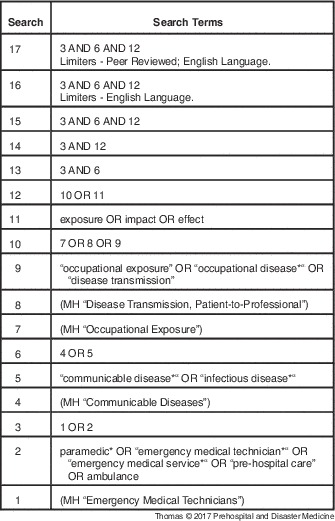
The strategy to identify articles was to search electronic databases and reference lists. Using the assistance of a consultant librarian, online searches were conducted using CINAHL (EBSCO Information Services; Ipswich, Massachusetts USA), Medline (US National Library of Medicine, National Institutes of Health; Bethesda, Maryland USA), Embase (Elsevier; Amsterdam, Netherlands), Proquest (Ann Arbor, Michigan USA), and Informit (Melbourne, Victoria, Australia) databases. The search was restricted to peer-reviewed, English language journals. No date range was selected in order to increase breadth of results, possibly at the expense of reviewing dated information. The search strategy for databases and search terms is presented in Table 1.
Search Strategy

Study Selection
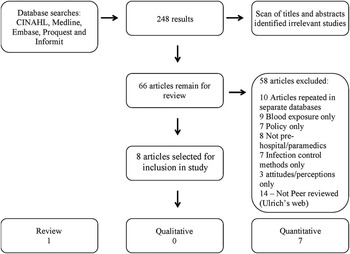
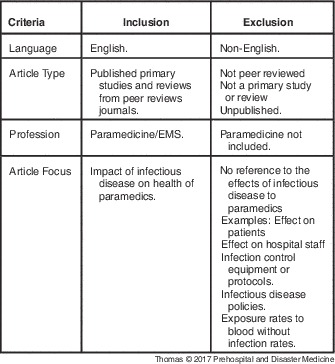
The initial search identified 248 papers, of which 182 were not relevant to the review (being related to in-hospital studies or not including paramedicine). A set of pre-determined inclusion and exclusion criteria were developed and applied to the results (Table 2). The inclusion criteria were published primary studies and reviews from peer-reviewed journals in English language studying the impact of infectious disease on the health of paramedics or emergency medical technicians (EMTs). The exclusion criteria were unpublished articles, articles from non-peer-reviewed journals, or not in the English language. The inclusion and exclusion criteria drove the process of elimination, which left 66 articles that were potentially relevant. Full texts of the articles were then obtained and reviewed for their contribution to understanding the effects of infectious disease on the health of paramedics. The final selection was refined to eight articles. The process of selection is illustrated in Figure 1.
Selection Strategy.

Inclusion and Exclusion Criteria

Abbreviation: EMS, Emergency Medical Services.
Data Charting
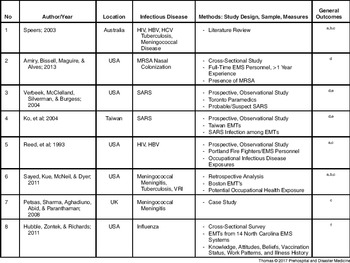
Studies that met the inclusion criteria and passed the study selection stage were then charted to synthesize and interpret the data (Tables 3 and 4).
Summary of Articles
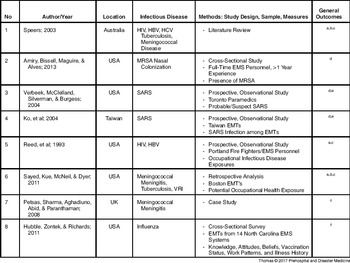
Abbreviations: EMS, Emergency Medical Services; EMT, emergency medical technician; HBV, hepatitis B virus; HCV, hepatitis C virus; HIV, human immunodeficiency virus; MRSA, methicillin-resistant staphylococcus aureus; SARS, severe acute respiratory syndrome; VRI, viral respiratory infection.
a High exposure rate to infectious disease.
b Exposures are decreasing.
c Low contraction rate of infectious disease.
d Paramedics’ risk of contracting a disease is greater than general population’s.
e Among first exposed to certain infectious diseases.
f High contraction rate of infectious disease.
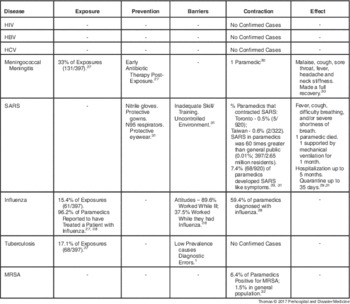
Impact of Infectious Diseases

Abbreviations: HBV, hepatitis B virus; HCV, hepatitis C virus; HIV, human immunodeficiency virus; MRSA, methicillin-resistant staphylococcus aureus; SARS, severe acute respiratory syndrome; VRI, viral respiratory infection.
Collating, Summarizing, and Reporting the Results
Two types of analysis have been completed: numerical and thematic. Numerical analysis assessed the “who, where, and how” of the reviewed articles. This sheds light on patterns in the research. The specific numerical variables used for data collection and analysis were authors, date, location of study, infectious disease studied, study design, sample, outcome measures, and general outcomes (Table 3).
Thematic analysis assessed the “what and why” of the reviewed articles based on the emerging themes (Table 4). Unlike a systematic review, there is no attempt to analyze the quality of the evidence reviewed.Reference Smith, Morgans, Qureshi, Burkle and Archer 20 , Reference O’Meara 26
Discussion
The result of the literature search identified eight articles for review: one literature review and seven quantitative studies (Figure 1). Seven of the articles were published between 2003 and 2013, with one other article published in 1993. The papers were predominately published in the US with the UK, Australia, and Taiwan contributing one each. The quantitative studies employed a variety of methods and study designs, including two cross-sectional studies, one retrospective analysis, one case study, and three prospective-observational studies.
The following elements were analyzed: exposure to an infectious disease; prevention and precautions; barriers to prevention; contraction of an infectious disease; and the health effect of the disease.
Exposure
Eight relevant infectious diseases were identified. Firstly, those that are spread by exposure to blood and other bodily fluids, such as the human immunodeficiency virus (HIV), the hepatitis B virus, and the hepatitis C virus.Reference Thomas, O’Meara and Spelten 1 , Reference Linwood, Day, Fitzgerald and Oldenburg 14 , Reference Anderson, Allen, Peckham and Goodwin 27 Diseases spread by the air-borne route are meningococcal meningitis, severe acute respiratory syndrome (SARS), influenza, and tuberculosis.Reference Thomas, O’Meara and Spelten 1 , Reference Anderson, Allen, Peckham and Goodwin 27 - Reference Petsas, Sharma, Aghadiuno, Abid and Paranthaman 31 The final disease identified was methicillin-resistant staphylococcus aureus (MRSA) that is spread via direct contact.Reference Verbeek, McClelland, Silverman and Burgess 32
Reed et alReference Linwood, Day, Fitzgerald and Oldenburg 14 and Sayed et alReference Anderson, Allen, Peckham and Goodwin 27 report on the exposure rates to infectious diseases generally. Both studies were conducted in the US in similar ambulance services; they showed a decrease from 4.4 exposures per 1,000 Emergency Medical Service (EMS) calls to 1.2 exposures per 1,000 EMS calls between 1993 and 2011. This decrease was attributed to ongoing education about infection prevention and improved personnel protective equipment (PPE) and infection control measures.
Sayed et al’sReference Anderson, Allen, Peckham and Goodwin 27 analysis of US EMTs reported meningococcal meningitis as the most common exposure type with 33% of all exposures (131/397). Tuberculosis was found to be the second most common exposure type with 17.1% of all exposures (68/397). Exposures to viral respiratory infections (VRIs), which included H1N1 influenza and influenza generally, were the third most common exposure type with 15.4% of total exposures (61/397). They found that while most infectious disease exposures were decreasing, the incidence of VRI exposures had a significant increase from 2008 to 2009. This was most likely due to the H1N1 outbreak in 2009. The potential for exposure to influenza is high with a survey of US EMTs showing that 96.2% of paramedics reported to have treated a patient with influenza.Reference Sayed, Kue, McNeil and Dyer 28 Exposure rates to HIV, hepatitis B, hepatitis C, SARS, and MRSA were not mentioned.
Prevention
Specific PPE utilized to prevent the exposure and contraction of infectious disease was mentioned only in Verbeek et al’sReference Petsas, Sharma, Aghadiuno, Abid and Paranthaman 31 study of the 2004 SARS pandemic. The equipment utilized were nitrile gloves, protective gowns, N95 respirators, and protective eyewear. Paramedics were advised to wear these for all patients with an acute febrile illness. A dedicated surveillance and quarantine program was utilized in Toronto (Ontario, Canada) to monitor paramedics and apply appropriate quarantine to avoid further exposures. Sayed et alReference Anderson, Allen, Peckham and Goodwin 27 report that antibiotic treatment was given prophylactically, post-meningococcal-meningitis exposure with 21 out of 23 paramedics requiring any treatment in their study being related to a meningococcal meningitis exposure. This early antibiotic treatment and subsequent close follow-up of exposed paramedics is the main attributing factor preventing more paramedics from developing meningococcal meningitis after being exposed.
Barriers
Inappropriate use of protective equipment is one barrier to prevention, with four out of five paramedics that developed probable SARS being exposed to patients before they were directed to wear PPE. A paramedic who developed probable SARS was wearing PPE, but had not been tested on fitting the respirator, and subsequently failed a fitting test at a later date.Reference Petsas, Sharma, Aghadiuno, Abid and Paranthaman 31 In Australia, the low prevalence of tuberculosis may cause diagnostic issues as the active disease is not often recognized early and the need for use of PPE is overlooked.Reference Thomas, O’Meara and Spelten 1 Paramedic attitudes, with almost all paramedics studied by Hubble et alReference Sayed, Kue, McNeil and Dyer 28 reported to have worked while suffering from an illness and more than one-third of these paramedics worked with influenza specifically.
Contraction
The two studies that observed HIV, hepatitis B, and hepatitis C reported zero confirmed cases. The most recent of these observed that no paramedics contracted tuberculosis in their study.Reference Linwood, Day, Fitzgerald and Oldenburg 14 , Reference Anderson, Allen, Peckham and Goodwin 27 The review by SpeersReference Thomas, O’Meara and Spelten 1 supports this low prevalence by reporting that acquiring these diseases is very rare, in health care and in paramedicine. A case study reported that one paramedic in the UK who did not have a significant exposure to respiratory secretions and was therefore not considered for antibiotic treatment developed meningococcal meningitis.Reference Ko, Chen and Ma 30
Studies conducted in Toronto and Taiwan during a SARS outbreak in 2003 reported very similar incidence rates of SARS infection among paramedics. The Toronto study found an incident rate of 0.5% (5/920) and the Taiwan study found a rate of 0.6% (2/322) amongst staff who developed probable SARS. The Taiwan study reported that probable SARS in EMTs is 60-times greater than the general public (0.01%; 397/2.65 million residents).Reference Hubble, Zontek and Richards 29 , Reference Petsas, Sharma, Aghadiuno, Abid and Paranthaman 31 A cross-sectional study conducted in a US ambulance service found a higher prevalence of MRSA nasal colonization in paramedics compared to the general population, with 6.4% of paramedics testing positive for MRSA compared to 1.5% of the general population.Reference Verbeek, McClelland, Silverman and Burgess 32 Hubble et alReference Sayed, Kue, McNeil and Dyer 28 found paramedics are at-risk of contracting and spreading influenza among co-workers, patients, and relatives with 59.4% of paramedics reporting to have been diagnosed with influenza and 89.6% presenting at work while ill.
Effect
The effects on paramedics’ physical health were reported for meningococcal meningitis and SARS. Studies on MRSA, influenza, tuberculosis, HIV, hepatitis C, and hepatitis B failed to report on this. A single paramedic was reported to have contracted meningococcal meningitis and suffered the physical symptoms of malaise, cough, sore throat, and fever, followed by headache and neck stiffness, was admitted to hospital and made a full recovery.Reference Ko, Chen and Ma 30 Out of all infectious diseases reported, SARS has had the most significant impact on health of paramedics. In the 2004 SARS pandemic, seven paramedics were diagnosed with probable SARS and one paramedic died as a result. The health effects of probable SARS were fever, cough, difficulty breathing, or severe shortness of breath. Hospitalization time of the paramedics in Toronto ranged between five to 19 days and quarantine after being discharged from hospital ranged between one to 35 days. In Taiwan, one paramedic died and another was hospitalized for five months. In Toronto, 7.4% (68/920) of paramedics developed SARS-like symptoms, which included fever, cough, muscle aches and pains, extreme fatigue, severe headache, and shortness of breath.Reference Hubble, Zontek and Richards 29 , Reference Petsas, Sharma, Aghadiuno, Abid and Paranthaman 31 No studies mention the mental or social wellbeing of paramedics.
In summary, studies into the effect of infectious disease on the health of paramedics are rare. This scoping review performed a comprehensive search of this area and identified eight relevant articles published within the past 22 years.
The studies show a decline in exposure rates to infectious diseases that has been attributed to increased education, improved PPE, and infection prevention strategies. Paramedics’ knowledge and attitudes towards infectious diseases as well as the uncontrolled environment they operate in can become barriers to disease prevention. These barriers increase the risk of paramedics being exposed to infectious diseases.
The incidence of paramedics actually contracting an infectious disease is rare for the majority of the studied diseases, with the exception of MRSA colonization, influenza, and SARS. Paramedics are among the first health care professionals exposed to these diseases and have been shown to be at greater risk of acquiring them compared to the general public, especially during infectious disease outbreaks.
The attitudes, values, and knowledge of paramedics in relation to infectious disease require further investigation. As almost all paramedics in one study reported they worked while they were ill and almost one-third of paramedics worked while they had influenza; paramedics are risking their own health and may unnecessarily spread infections to co-workers and patients.
Research conducted into the most common infectious diseases is limited. Besides influenza and MRSA, there is no research into the highly prevalent infections that appear less dangerous to paramedics’ health, such as viral upper respiratory infections and gastrointestinal infections. Research is required in this area to understand and reduce the risk of paramedics contracting and spreading these diseases to co-workers, family, and patients, which may have devastating effects on the health of elderly or immunocompromised individuals.Reference Amiry, Bissell, Maguire and Alves 33 , Reference Barrett 34
Currently, the exploration of the effects of infectious disease on the health of paramedics is incomplete. The World Health Organization (WHO; Geneva, Switzerland) defines health as “a state of complete physical, mental, and social well-being and not merely the absence of disease or infirmity.”Reference Monto 35 Only two diseases have had their effect on the physical health of paramedics described and no diseases have reported the mental and social health of paramedics who contract infectious diseases. Further research is required in order to understand the whole picture of the effect infectious disease has on paramedics’ health.
Limitations
Scoping reviews are designed to be an initial appraisal of the size, scope, and nature of the existing literature in a certain area; however, the methods used to complete a scoping review lack a critical appraisal. This is a deliberate action adopted based on the aims of a scoping review, yet it is described as a limitation in rigor and may limit the trustworthiness of the information gained from the reviewed literature.Reference Tredea, McEwena, Kenny and O’Meara 23 Including the expertise of a consultant librarian, the search terms utilized still may not encompass all search categories. With an attempt of being as far-reaching as possible, it is not practical to search every single database. These two factors create the potential to miss broad categories of research.Reference Kenny, Hyett, Sawtell, Dickson-Swift, Farmer and O’Meara 25
Conclusion
This scoping report assesses the extent of the peer-reviewed literature related to the impact of infectious disease on the health of paramedics. These findings indicate that exposure to infectious diseases is decreasing, except during pandemics, yet it remains significant. Prevention strategies are considered responsible for reducing amount of exposures, although paramedic knowledge and attitudes as well as the uncontrolled environment they work in are of concern. The effect on the physical health of paramedics is not well reported and the effect on mental and social health of paramedics is not reported at all.