


Introduction
Individual Cognitive Behavioural Therapy (CBT) is the first line psychological intervention recommended by National Institute of Clinical Excellence guidelines for those who experience psychosis (NICE, 2009). CBT aims to reduce distress, facilitate the development of coping strategies and improve quality of life (NICE, 2009). CBT for psychosis (CBTp) has been shown to be an effective treatment in reducing experiences of psychosis and improving functioning and mood (Wykes, Steel, Everitt and Tarrier, Reference Wykes, Steel, Everitt and Tarrier2008). However, a recent Cochrane review (Jones, Hacker, Coarmac, Meaden and Irving, Reference Jones, Hacker, Coarmac, Meaden and Irving2012) and meta-analysis (Lynch, Laws and McKenna Reference Lynch, Laws and McKenna2009) concluded that there was no direct benefit of CBTp over any other psychological intervention; these negative reviews have been criticized for being methodologically flawed (Hutton, Wood and Morrison, in press). The ongoing debate over the efficacy of CBTp highlights the need to continue to conduct research in this area.
There is still little known about the key change mechanisms in CBTp or about what specific aspects of CBTp are helpful to service users. In a recent Delphi study, (Morrison and Barratt, Reference Morrison and Barratt2010) trained CBT therapists were asked their opinions about the ingredients necessary for effective individual CBTp. Factors identified were broadly related to engagement, appropriate assessment, cognitive formulation, goal setting, homework and emotional issues. However, less is known about service users’ perspectives on their experiences of individual CBTp. Previous literature has identified that the priorities service users outline for recovery may be different to traditional views of recovery, and that patient preferences and valued outcomes are often different to those of professionals (Byrne, Davies and Morrison, Reference Byrne, Davies and Morrison2010). Service user led research highlights that recovery is not necessarily symptom focused, but rather an idiosyncratic process incorporating rebuilding self, rebuilding life, and hope for a better future (Pitt, Kilbride, Nothard, Welford and Morrison, Reference Pitt, Kilbride, Nothard, Welford and Morrison2007). Therefore, it is currently unclear which aspects of CBT are helpful to service users and whether CBTp meets their recovery needs.
Systematic reviews of qualitative literature are increasingly acknowledged as important in evaluating the efficacy of a therapeutic approach. Thomas and Harden (Reference Thomas and Harden2008) state that qualitative studies provide important perspectives and should be subject to the same rigour as quantitative studies to examine a specific evidence base. A previous systematic review of qualitative research on service users’ experiences of individual CBTp, group CBTp and relational therapy identified two superordinate themes: ingredients in the process of therapy (increased understanding of psychosis, coping strategies and considering alternative explanations, normalization); and What is the process of therapy? (attitude, power and self-concept, acceptance) (Berry and Hayward, Reference Berry and Hayward2011). However, NICE (2009) specifically recommends individual CBT, rather than group CBT or relational therapy, for clients who experience psychosis. It is therefore important to understand service users’ experiences of individual CBTp since change mechanisms may differ across therapeutic modalities. For example, in group therapy, most often it is peer support, meeting others with similar experiences and “not being the only one” that are identified as the most effective factors (Vindogradov and Yalom, Reference Vindogradov and Yalom1989). Moreover, in their paper, Berry and Hayward (Reference Berry and Hayward2011) acknowledge that the service user voice was “quiet and…somewhat dominated by professionals” (p.492). However, since the publication of their review, two additional service user led studies examining service user experiences of individual CBTp have been published (Byrne and Morrison, in press; Kilbride et al., Reference Kilbride, Byrne, Price, Wood, Barratt and Morrison2013). These recent publications are likely to have provided new perspectives in the current literature and further reinforce the need for a new review of the literature that incorporates recent service user led research.
Method
Design
A systematic review of the qualitative literature on CBTp was conducted using the “thematic synthesis” method as outlined by Thomas and Harden (Reference Thomas and Harden2008).
Study inclusion criteria
Qualitative studies were included if they were published in a peer reviewed journal. They had to examine service users’ experiences of individual cognitive behavioural therapy for psychosis (CBTp) through methods of interviews and focus groups. Studies had to explicitly state that participants had taken part in CBTp. Examination of service user experiences of CBTp had to be the primary aim of the study. A minimum of 50% of participants had to be services users; additional participants could be service providers, therapists, family members or carers. Participant-included studies had to meet either ICD-10 research criteria for a schizophrenia spectrum disorder or meet entry criteria for an Early Intervention or Detection Service in order to allow for diagnostic uncertainty in early phases of psychosis, and be aged at least 16 years old. Studies explicitly using participants with learning disabilities, primary substance misuse problems or with non-English speaking people were excluded.
Study extraction methodology
The literature search was conducted using two research databases (Psychinfo and Pubmed) in order to minimize the chance of missing relevant research. It has been noted that using only one search engine can often mean that 20–70% of relevant studies are missed (Dickersin, Scherer and Lefebvre, Reference Dickersin, Scherer and Lefebvre1994).
Three groups of search terms were used to search for relevant studies: cognitive behaviour therapy (CBT, CBTp, cognitive therapy); psychosis (schizophrenia, bipolar disorder, voices, delusions, hallucinations, schizoaffective); and qualitative methodology (interviews, focus groups). The quality of studies was assessed by examining how well each met criteria outlined by Aldersen (Reference Aldersen1995); examination of study aims, sufficiency of strategies used to establish reliability and validity, and the appropriateness of the study methodology.
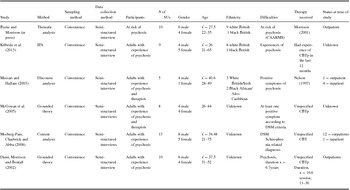
The search was conducted between January 2013 and April 2013. Authors LW and EB each conducted searches independently. Searches were repeated on a weekly basis to ensure that newly published research was not missed. The studies identified from searches were examined by the research team to ensure they met inclusion criteria, and a final list was then agreed upon. Six studies were extracted in total (See Table 1).
Studies extracted and included in analysis

*N of SU = Number of service users
Analysis
The complete results section of each paper was used as data for analysis and therefore included both quotations from participants in the constituent studies and authors’ interpretations of the data. Thematic synthesis was conducted in three stages with the aim of generating themes regarding service users’ experience of CBTp. The first stage, conducted by LW, involved free line-by-line coding of data from the six studies included in the review. Codes were extracted if they were considered to represent service user perspective of CBTp. Sixty-seven initial codes were developed. In the second stage, conducted by both LW and EB collaboratively, codes were translated across studies and related line-by-line codes were grouped together to construct descriptive themes. The third stage, again conducted by both LW and EB, involved the development of “analytical” themes by collapsing of the codes. Codes that were identified as exemplifying the same themes were merged. TM would act as a mediator if there was any disagreement. Final themes were then agreed upon (Thomas and Harden, Reference Thomas and Harden2008).
Results
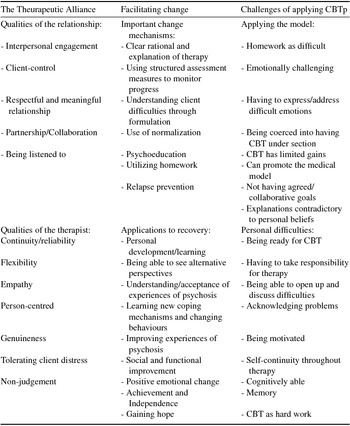
Three superordinate themes were identified from the qualitative data to describe service users’ experiences of CBTp: the “therapeutic alliance”, “facilitating change” and “challenges of applying CBTp”. Six sub-themes were also identified from the data. Table 2 outlines the superordinate themes and sub-themes and the rest of this section describes these themes with illustrative quotations from the primary literature.
Themes generated from the thematic synthesis

The therapeutic alliance
The superordinate theme of therapeutic alliance was apparent in five of the six studies included in the review, illustrating the importance placed on the therapeutic relationship in individual CBTp. Two sub-themes were identified: “qualities of the relationship” and “qualities of the therapist”.
Qualities of the relationship
Specific qualities were outlined as important in the development of a functional working relationship. This was endorsed by four of the six studies. The therapeutic relationship was considered a positive and important part of therapy.
Author: It is also important to emphasize that the picture of the experience of therapeutic contact that merged from clients’ descriptions was broadly extremely positive. (McGowan, Lavender and Garety, Reference McGowan, Lavender and Garety2005, p. 519)
It emphasized the importance of, for example, engagement, collaboration and equality:
Author: All participants, with the exception of c2, constructed therapy as a meeting of two equal human beings, a space where they were allowed to talk openly about their problems and “get things off their chest”. (Messari and Hallam, Reference Messari and Hallam2003, p.179)
Author: …and a flexible, collaborative approach to making practical arrangements for meeting. (Byrne and Morrison, in press, p.11)
The studies highlighted that the therapeutic relationship was even a change mechanism in itself and developed esteem and equality:
Participant: I’m not just a service user I’m someone on her level you know, really as a service user you get looked down on and you don't get considered at all, your feelings don't get considered at all when you’re ill, you know people tend to talk over you or at you, or at someone else for you, but people in [therapist’s] position, and people on her level and people such as you don't do that you know. (Kilbride et al., Reference Kilbride, Byrne, Price, Wood, Barratt and Morrison2013, p. 92)
Qualities of the therapist
Service users described key qualities or interpersonal abilities that a therapist needed to possess in order for therapy to be successful. This sub-theme was identified in data from five of the six studies included in the review. The importance of how a therapist draws upon their micro-skills to help the client feel comfortable and understood was reported:
Author: Staff members were most consistently characterized in terms of their informality, empathy, and professional understanding. (Byrne and Morrison, in press, p.9)
Therapist's genuineness was also outlined as an important quality that facilitated engagement:
Author: Clients constructed their therapist's genuine interest in their experience as respectful. (Messari, and Hallam, Reference Messari and Hallam2003, p.179)
The ability for therapists to tolerate service user distress was also seen as extremely important:
Participant: She didn’t, she wasn't really shocked or anything… it's nice to have someone who gets it, you know like [therapist], like when you, to not be shocked and to know why you’re saying it and just, to feel normal. (Byrne and Morrison, in press, p.11)
Facilitating change
All of the studies included in the review endorsed the view that individual CBTp was successful in facilitating change for people who experience psychosis. Two subthemes were identified: important “change mechanisms” and “applications to recovery”.
Important change mechanisms
This subtheme highlights the ingredients of CBTp necessary for therapeutic change. All six papers included in the review reported specific CBT change mechanisms. The mechanisms discussed fell within the four main stages of a therapeutic intervention (assessment, formulation, intervention, evaluation) and are clearly CBT specific.
Author: A number of CBT techniques were consistently highlighted by participants as the most useful, and these included evidence gathering and subsequent reappraisal of negative, unusual or paranoid beliefs (along with the reappraisal of potentially unhelpful safety behaviours such as social withdrawal). (Byrne and Morrison, in press, p.17)
The structured CBTp approach and monitoring change allowed service users to understand and monitor their experiences
Author: For a number of participants, filling out assessment measures enabled them to view their experience in a formalized structured context and this in turn enabled them to recognize progress. (Kilbride et al., Reference Kilbride, Byrne, Price, Wood, Barratt and Morrison2013, p.94)
The development and sharing of a formulation was an extremely important part of therapy for both client and the therapist as it facilitated understanding into the client's difficulties:
Therapist: The CF [Cognitive Formulation] process left me feeling more hopeful about therapy with this client. (Morberg Pain, Chadwick and Abba, Reference Morberg Pain, Chadwick and Abba2008, p.135)
Participant: … like maps of my mood and little things about different parts of your life and how they can fit together, he would just kind of draw little diagrams that to me they would make sense and I’d be like yeah yeah you’re right. (Kilbride et al., Reference Kilbride, Byrne, Price, Wood, Barratt and Morrison2013, p.94)
Intervention techniques such as homework and normalization were seen as essential tools that contributed to positive change in therapy:
Participant: It [homework] was to help me to conquer the problems, help mentally and physically. (Dunn, Morrison and Bentall, Reference Dunn, Morrison and Bentall2002, p.366)
Author: Therapy was seen as a slow process of making sense of his beliefs. He highlighted the value of discussions that normalized his experiences and explained his beliefs in terms of normal cognitive processes. (Messari, and Hallam, Reference Messari and Hallam2003, p.177)
Applications to recovery
CBTp was described by service users as an approach that can facilitate and assist with recovery from psychosis. CBTp was clearly illustrated to change the meaning of psychotic experiences for service users, which played a role in recovery:
Author: CBT was seen to offer opportunities to gain a “different perspective” on psychotic experiences and associated difficulties, and this was identified as an active element and as an important outcome. (Kilbride et al., Reference Kilbride, Byrne, Price, Wood, Barratt and Morrison2013, p.95)
CBTp was also identified as targeting idiosyncratic recovery factors such as social and functional recovery, providing understanding into experience of psychosis, and facilitating the development of coping strategies.
Author: Participants also frequently identified improved social functioning as a valued outcome of CBT involvement. In some cases this meant feeling more able to spend time with family and friends, while for others it meant feeling more able to go out into public spaces (including school, college, or work-places) when this had previously been extremely difficult. (Byrne and Morrison, in press, p.18)
Participant: A better understanding I think of what was actually occurring and how I can pull myself away from feeling bad when certain events occur. (Morberg Pain et al., Reference Morberg Pain, Chadwick and Abba2008, p.133)
In addition to developing understanding and coping strategies, an important part of service users’ recovery was acceptance of their difficulties. Acceptance seemed to allow the participant to move forward with their lives despite their difficulties:
Author: Acceptance as part of recovery was most clearly related to participants’ recognition that psychotic experiences or serious emotional difficulties could continue after therapy, though with less distressing and disabling effects. (Kilbride et al., Reference Kilbride, Byrne, Price, Wood, Barratt and Morrison2013, p.97)
Challenges of applying CBTp
This superordinate theme highlighted the difficulties in applying CBTp to the service user's presenting problems. It was endorsed by all six studies examined. It incorporates a number of difficulties pertaining to the model application and to client factors.
Applying the model
CBTp is demanding and studies describe how it can be quite difficult for service users to become socialized to the model. One study highlighted how CBTp does not fit the traditional societal perceptions of therapy which is why it is difficult for service users when they initially start therapy:
Author: Finding that therapy was more demanding than expected was often related to widely-held cultural understandings of psychological therapy, where clients are most often seen as passive recipients of therapists’ professional expertise, rather than as active partners within a more collaborative process. (Kilbride et al., Reference Kilbride, Byrne, Price, Wood, Barratt and Morrison2013, p.96)
This theme also outlined that aspects of the CBT model, especially formulations and homework, can be emotionally and cognitively challenging.
Participant: I just couldn't be bothered; sometimes I used to just leave it [homework]. I was scared to listen to it; if I put it off I always done it because what's the point in me coming to talk to him and not doing it. (Dunn et al., Reference Dunn, Morrison and Bentall2002, p.366)
A collaborative relationship often appeared missing when difficulties applying the CBTp model arose:
Participant: Couldn't see the relevance, I’m not sure why it was important, she just asked me to do it. (Dunn et al., Reference Dunn, Morrison and Bentall2002, p.366).
There was also an acknowledgement that therapy is more challenging when it is completed within an in-patient ward or under section. Service user may be completing therapy merely to satisfy the expectations of others’ or feel that they are in therapy under duress.
Participant: Yeah I hope it helps me to get discharged. It's part of the programme and I mean, a lot of patients here don't bother talking to their psychologist. (Messari and Hallam, Reference Messari and Hallam2003, p.176)
Personal difficulties
This sub-theme highlights that the client plays an important role in ensuring that therapy is a beneficial and effective process. The importance of being willing to engage in therapy, of having the cognitive ability to undertake therapy, and of being motivated to take charge was identified.
Participant: It always feels as though you know, “this is your time”, you know. “This is your allocated time” per week. Get on with it… a bit like a job and duty… he had a job but I have a job to myself… I have to, I have to utilize him. (Messari and Hallam, Reference Messari and Hallam2003, p.178)
Disclosing personal difficulties was extremely difficult for service users when undertaking CBTp and involved a huge effort and willingness to tolerate consequential emotional distress.
Participant: It was hard, it wasn't easy to go through things that had happened in the past. Erm… I got upset a lot, so it wasn't easy but… I knew it had to be done… just get past it. (Kilbride et al., Reference Kilbride, Byrne, Price, Wood, Barratt and Morrison2013, p.97)
Participant: There were times when I spoke to [therapist], you know, and it’s, you know, I was speaking about things from the past, and you know it brings it all back to you again, and there was times I left the session and you know my mood felt a bit low, but that's just because, you know bringing sh*t from the past, it's like a reminder. (Byrne and Morrison, in press, p.17)
Service users also highlighted the importance of overcoming these difficulties in order to progress within therapy.
Author: Almost all participants recognized the importance of [opening up] and discussions for their therapy to be effective. (Byrne and Morrison, in press, p.18)
Discussion
This study aimed to increase knowledge on service users’ experiences of CBTp by completing a thematic synthesis of the qualitative literature. Three overarching themes were identified: the therapeutic alliance; facilitating change; and challenges of applying CBTp. The original thematic synthesis conducted by Berry and Hayward (Reference Berry and Hayward2011) identified two overarching themes. The theme “the ingredients in the process of therapy” encompassed key therapeutic components such as normalization, developing an understanding of psychosis, finding alternative perspectives and developing coping mechanisms. The second theme “what is the process of therapy” identified key factors important for personal recovery: positive changes in attitude, developing power, acceptance and self-concept. Arguably, the theme identified in this analysis, “facilitating change (important mechanisms of change and applications to recovery)” overlaps with Berry and Hayward's two original themes. Therefore, two additional themes were identified giving further insight into the individual CBT process. As these themes pertain to interpersonal factors, it is likely that the inclusion of two service user papers had been highly influential.
The strong emphasis on the therapeutic alliance identified in the studies included in this review supports the vast literature that has examined the therapeutic relationship and highlighted its essential role in CBT generally and also within CBTp. Chadwick (Reference Chadwick2006) states that relationship building is extremely important in CBTp as it has different dimensions to a traditional therapeutic relationship and is “radically collaborative”. The specific ingredients identified in this study for an effective therapeutic relationship seem to support this and factors identified in Morrison and Barratt's (Reference Morrison and Barratt2010) Delphi study with CBT therapists. For example, developing a collaborative partnership, client control, continuity and therapist micro skills were all outlined as important. The emphasis on the therapeutic relationship may also indicate its importance in improving outcome in therapy. McCabe and Priebe (Reference McCabe and Priebe2004) have found that the therapeutic relationship independently predicts a better short and long-term outcome for service users. In addition, Dunn et al. (2006) found that a positive therapeutic relationship was significantly associated with completing therapeutic tasks e.g. completing homework, which facilitates an improvement in outcome. Therefore, clinicians should work to ensure that a positive therapeutic relationship is built based upon the outlined factors. It may be helpful to assess the therapeutic relationship on a regular basis, for example, using self-report measures such as the California Psychotherapy Alliance Scale (CALPAS, Gaston and Marmar, Reference Gaston and Marmar1991) in order to be able to respond to difficulties in this area. It will also be important to ensure that true collaboration is present throughout all aspects of CBTp, including selection of agenda items, setting of goals and negotiation of tasks between sessions. For instance, given the difficulties clients reported in completing homework, the latter may be aided by therapists negotiating (and completing) a homework task for themselves.
The theme of “facilitating change” highlighted specific mechanisms of therapy similar to that identified in the Morrison and Barratt (Reference Morrison and Barratt2010) Delphi study. They emphasized the importance of formulation, assessment and monitoring, homework, and change strategies. This suggests there is broad agreement between service users and clinicians on what works in therapy. The current review highlighted that service users appreciate a clear explanation and rationale of therapy, the assessment and monitoring of outcome in a structured manner, the development of an idiosyncratic formulation, homework, and the use of CBT specific change mechanisms. These findings support the use of well explained and clearly outlined applications of change mechanisms in CBTp, which should be utilized as often as appropriate. “Applications to recovery” was also a subordinate theme that indicated that CBTp can also meet the idiosyncratic recovery needs of service users who receive it as a therapeutic intervention. It is widely documented that service user recovery involves rebuilding self, rebuilding life and hope for a better future (Pitt et al., Reference Pitt, Kilbride, Nothard, Welford and Morrison2007), aspects of which are clearly captured in the application to recovery theme. For example, personal development/learning, social and functional improvement and gaining hope can clearly be likened to the themes found in Pitt et al.'s (Reference Pitt, Kilbride, Nothard, Welford and Morrison2007) paper.
Something that has been minimally explored are the obstacles that can get in the way of implementing effective CBTp. Little is known about service user perspectives on the difficulties of undertaking CBT for experiences of psychosis. This study identified such challenges as a major theme. It was highlighted that there a number of demands placed on the service user that are important for therapists to be aware of. Thus the therapist should ensure every effort is made to pace therapy appropriately, to have a clear rationale for therapy, and to develop a good therapeutic relationship. This is in accordance with previous research by Holmes, Rossiter and Jennison (Reference Holmes, Rossiter and Jennison2011) who has suggested the importance of adapting assessment and intervention materials to ensure they are more concrete and visual, plan for short sessions, labelling challenges to therapy, and collaboratively developing solutions and the importance of training and supervision. Morrison and colleagues have also previously highlighted the importance of being formulation focused and flexible in goal setting with clients who experience psychosis. (Morrison, Renton, Dunn, Williams and Bentall, Reference Morrison, Renton, Dunn, Williams and Bentall2003)
This review also makes clear that there are a number of client factors that influence the efficacy of CBTp. Client readiness and motivation for therapy were the two most dominant client factors identified in this review. It was reported that CBTp is unlikely to be effective if the client is unwilling to engage with therapy and do the associated work. However, this does not mean that CBTp is ineffective for specific clients, rather that readiness and motivation should be explored within therapy and attempts to overcome problems, where possible, should be made.
Strength of this review is that it incorporated two recent service user led papers, which undoubtedly led to the generation of themes relevant to service user perspectives. Thus, it gave service users a stronger voice within the analysis ensuring that the review was not dominated by professional views as has been previously highlighted as problematic (Berry and Hayward, Reference Berry and Hayward2011). Interestingly, the service user led papers contributed most to the superordinate theme of the obstacles of CBTp, which appears to highlight that service users may feel more able to talk about their difficulties with peers rather than a mental health professional.
A limitation of the review is the number of studies included in the thematic synthesis. Although Thomas and Harden (Reference Thomas and Harden2008) state that six to eight studies are expected for such a review, a larger number of studies may have provided further themes. Likewise, this highlights the lack of qualitative literature examining service users’ perspectives of therapy and that the evidence base needs to be expanded. Another limitation is the sampling strategies employed by most of the studies within the review, which recruited convenience samples until saturation rather than purposive samples to explore particular topics or emergent themes in more detail; thus, studies may have recruited a biased sample of participants who had a positive experience of CBTp. Further research should endeavour to recruit participants who have dropped out of CBT or who have not had a good clinical response in order to help explore whether there are any adverse effects associated with CBTp and to identify strategies that may help such people to engage in and benefit from CBTp in the future.
Declaration of interests
Professor Morrison was an author on three of the six papers reviewed in this study. To avoid contamination or bias of results, Professor Morrison did not partake in the thematic analysis of the studies reviewed.



Comments
No Comments have been published for this article.