INTRODUCTION
Aneurysmal subarachnoid hemorrhage (SAH) affects around 6 in 100,000 per year in the general population (Linn et al., 1996). The site of the aneurysm varies between individuals, with the three most common sites being the anterior communicating artery (ACoA) region, the posterior communicating artery (PCoA) region, and middle cerebral artery (MCA) bifurcation (Weir, 1998). Recent advances in the medical management of aneurysmal SAH have dramatically improved the number of functional survivors (Kassell et al., 1990). However, many of these survivors suffer poor neuropsychological outcome, which has a significant impact on their quality of life. In addition, SAH survivors often report psychosocial and emotional changes. These changes include lack of initiative, loss of interest, irritability, inexplicable hostility, difficulties with social situations, and a diminished capacity for planning and decision making (Hutter et al., 1995; Ljunggren et al., 1985; Ogden et al., 1994; Powell et al., 2002, 2004; Saveland et al., 1986).
Although these changes in personality and behavior are well recognized and have a significant impact on both survivors and their families, systematic investigations of their precise nature have been limited. There are several reasons for this finding. Although traditional neuropsychological tools are well suited to investigating the cognitive sequelae, the neutral nature of the stimuli limits their utility in assessing more affective aspects of behavior. Indeed, there have been reports of individuals sustaining brain injury with severe social and emotional difficulties who perform normally on a standard neuropsychological assessment, including measures of IQ, memory, and even executive functions (e.g., digit span, Wisconsin Card Sort Test; e.g., Eslinger & Damasio, 1985). As a result, studies investigating personality changes in SAH survivors have tended to rely on subjective measures such as behavioral rating scales or questionnaires (Hutter et al., 1995; Ljunggren et al., 1985; Ogden et al., 1994; Powell et al., 2002, 2004; Saveland et al., 1986).
Several computerized paradigms have been designed recently to measure and characterize the personality changes that are not well captured by standard neuropsychological assessment. The Iowa Gambling Task (Bechara et al., 1994) and the Cambridge Gamble Task (Rogers et al., 1999a) were developed to quantify deficits in everyday decision making commonly reported in patients with ventral prefrontal lesions due to a variety of etiologies (e.g., tumor resection, penetrating head injury, epilepsy). The Iowa Gambling Task requires subjects to learn the reward and punishment contingencies of four decks of cards. Ventral prefrontal cortex lesion patients persist in selecting high-win cards that also yield high penalties and are associated with long-term debt. The Cambridge Gamble Task was developed to assess risk-taking behavior during decision making, while minimizing demands on learning or working memory skills. The task aims to dissociate several different (potentially independent) difficulties in decision making, including altered sensitivity to reinforcement or punishment, impaired ability to process and use probabilistic information, or deficits in impulsivity. Mavaddat et al. (2000) previously reported increased risk-taking behavior on the Cambridge Gamble Task in survivors of aneurysmal SAH secondary to ACoA aneurysms.
Deficits in impulsivity, reward sensitivity, and decision making indexed by such computerized tasks are likely to reflect difficulties experienced in everyday life. For example, a failure to maximize reward and minimize punishment (or balance both reward and punishment) may lead to inappropriate financial, social, or work decisions or actions. Thus, these cognitive indices are likely to reflect psychosocial and personality changes after brain injury. The aim of the present study was to assess neurocognitive performance in these domains in patients with SAH secondary to MCA or PCoA aneurysms.
Attention has tended to focus on aneurysmal SAH secondary to ACoA aneurysms survivors for several reasons. Damage to the frontal lobes is a plausible effect of ischemia or infarction of cortical areas in the territory of the perforating branches of the ACoA (Alexander & Freedman, 1984; Damasio et al., 1985). This finding makes these patients particularly suitable for use in investigations focusing on the role of different areas of the frontal lobes in psychosocial and personality traits. In addition, historically ACoA survivors have been noted to show a triad of severe symptoms known as the “ACoA syndrome”: memory loss, confabulation, and altered personality (Alexander & Freedman, 1984; Damasio et al., 1985; Gade, 1982; Logue et al., 1968; Okawa et al., 1980; Vilkki, 1985). Although such dramatic changes occur less frequently with current therapeutic interventions, interest has continued to focus on this subgroup of survivors (Alexander & Freedman, 1984; Teissier du Cros & Lhermitte, 1984).
ACoA aneurysm rupture resulting in SAH only accounts for approximately 35% of aneurysmal SAH (Weir, 1998); thus, the psychosocial changes after SAH have not been systematically investigated in a substantial proportion of survivors. Some previous reports did not find differences in the pattern of cognitive deficits, rates of depression, or activities of daily living between MCA and PCoA survivors (Hutter et al., 1995; Ogden et al., 1994). Whereas these reports suggest MCA and PCoA survivors may suffer similar degrees of psychosocial difficulties and personality changes (Ljunggren et al., 1985), these changes have been quantified using indirect measures such as behavioral ratings or questionnaires.
This exploratory study aimed to investigate impulsivity, reward sensitivity and decision-making in survivors of SAH secondary to aneurysms in the MCA or PCoA using computerized tasks. Abnormalities in risk-taking behavior on the Cambridge Gamble Task could indicate several distinct processes: a lack of reflection on the available information, a tendency to make risky decisions regardless of the information available, and/or differential sensitivity to reward and punishment. Consequently, we have used several novel computerized tasks to further deconstruct the nature of any abnormalities.
METHODS
The data included in this study were collected in compliance with the regulations of our local institution and in accordance with the declaration of Helsinki (Cambridge Local Research Ethics Committee 99/119).
Patients and Comparison Participants
Twenty patients were recruited from a group of patients who had suffered from aneurysmal SAH (and associated surgery; 7 MCA; 13 PCoA) at least 12 months before participation (mean time since SAH = 68 months; range, 14–99 months). The severity of the SAH varied from World Federation of Neurological Surgeons (WFNS) grades 1–5, with a mean of 1.95. None of the patients suffered from additional complications after their SAH. SAH survivors were invited to take part in the study via letter. Twenty comparison volunteers were also recruited from the local community using posters and newspaper advertisements. Other than the illness episode associated with the index SAH, individuals (both patients and comparison volunteers) with a prior history of contact with neurological or psychiatric services were excluded.
Premorbid full-scale IQ was estimated using the National Adult Reading Test (NART; Nelson, 1982), and participants completed the Mini-Mental State Examination (Folstein et al., 1975) and the Beck Depression Inventory (Beck, 1970; Beck & Steer, 1987; Table 1). Caregivers of the participants were also asked to complete the Neuropsychiatric Inventory (Cummings et al., 1994) as a measure of psychosocial and personality change. In addition to the decision-making tasks described below, the participants also completed computerized tests of memory and attention (Pattern Recognition Memory, Spatial Recognition Memory and Rapid Visual Information Processing) taken from the Cambridge Neuropsychological Test Automated Battery (www.cantab.com).
Group characteristics [values given are mean (standard error mean)]

Decision-Making Tasks
All the computerized decision-making tasks were presented on an Advantech personal computer (Model PPC-120T-RT) using the touch-sensitive screen. The order of tasks and task conditions were counterbalanced across participants. Tasks were designed to minimize the effects of memory and attention load on performance by including visual cues, independent trials, and short task duration.
Cambridge Gamble Task
Participants guessed whether a token was hidden behind a red or blue box from a variable ratio of colored boxes. Then they “bet” on their decision being correct by choosing from a sequence of fixed percentages of their current total points. The possible bets progressed from smallest to largest in the “ascend” condition and the opposite in the “descend” condition. The chosen bet was added to or subtracted from their total points according to whether or not the prediction was correct (for task description, see Rogers et al., 1999a).
Three features of this task allowed for a detailed analysis of decision-making performance. The proportion of the total points bet indicates the participant's willingness to risk already-accumulated reinforcement to acquire further reward and rates confidence in their decision.
Comparison of betting behavior across ascend and descend conditions distinguishes between impulsive and risk-taking strategies (Cools et al., 2003). Impulsivity may result in early bets in both conditions (i.e., low bets in “ascend,” high in “descend”), due to failure to withhold responses to the presented bets, whereas larger bets across conditions could reflect risk taking.
The ratio of red to blue boxes varied across trials. As the favorability of the odds indicated the likelihood of a given response being reinforced, this aspect of the task allows for evaluation of sensitivity to probabilistic information, or “risk adjustment.”
Information Sampling Task
This task was designed to assess predecisional reflection as measured by information sampling rates (for task description, see Clark et al., 2006). Touching a box within a 5 × 5 grayed-out matrix immediately revealed one of two colors (Figure 1B). Subjects were instructed to open as many boxes as they wished before choosing which color was in the majority.

Mid-gray, represents red; black, represents blue. Typical displays from the computerized decision-making tasks. The ratio of red to blue boxes changed from trial to trial. A: Cambridge Gamble Task. B: Information Sampling Task. C: Bet choice screen from BlindWheel Task. D: Bet/Pass choice screen from BlindWheel Task. E: Reward trial from UpDown Task F: Lose condition trial from UpDown Task.
In the Fixed Win condition, the subject won or lost 100 points on each trial irrespective of the number of boxes opened. In the Decreasing Win condition, an incorrect response always lost 100 points, but the reward (250 points) for a correct response decreased by 10 points with every box opened.
Reflection was indexed by the average number of boxes opened. Error rates were also recorded, given that the principal feature of “reflection impulsivity” is the relationship between decision-making accuracy and the extent of information sampling (Evenden, 1999; see also Kagan, 1966). Few opened boxes on the Fixed Win condition could index impulsive behavior, as there is benefit and no penalty for opening more boxes.
BlindWheel Task
This task was designed to assess propensity for risk-taking behavior in ambiguous situations, where the probability of winning or losing is unspecified. The participant first chose what percentage of their total points to bet on the ball landing on a red segment of an unseen “roulette wheel” (Figure 1C). The roulette wheel with corresponding odds for that trial was then shown (Figure 1D). On most trials, participants were required to maintain their original bet and received feedback. On a subset of trials (16%, equally distributed between the eight ratio conditions), the participant could choose to “Pass” instead of “Bet,” resulting in no points being won or lost. Participants were encouraged to accumulate points and not to allow their score to fall to one point or the current block terminated and the next began (for further information, contact the authors).
Risk-taking behavior could be reflected by high bets (due to unknown odds at time of betting on all trials), as well as low rates of “Passing” on trials with unfavorable odds. In contrast, high rates of “Passing” on trials with favorable odds would reflect conservative behavior. Adjustment of “Pass” rates according to the odds reflects the participant's degree of risk adjustment.
UpDown Task
This task was designed to separate measures of reward-seeking behavior and punishment avoidant behavior, which are confounded in many other computerized decision-making tasks. In Win condition trials, the participant chose between a smaller fixed reward, or a chance reward where they could win either a higher number of points or zero points. Odds for the chance reward were represented by a color distribution (Figure 1E). After each choice, a message indicated the number of points won.
In the Lose condition trials, the participant chose between a smaller fixed loss, or a chance loss of a higher number of points versus no loss of points. The odds of losing points in the chance loss trial were represented by a color distribution (Figure 1F). After each choice, a message indicated the number of points lost.
Win and Lose condition trials were randomly intermixed and clearly distinguishable by color scheme and an indicating arrow. Participants started with points on each block of trials and were encouraged to accumulate points (for further information, contact the authors).
The amount of points at stake on chance options varied so that the difference between the larger chance win/loss versus the smaller fixed win/loss varied across trials. Appropriate risk adjustment during trials where the chance and fixed points were similar would predict increased choice of the fixed reward on win trials and increased choice of the chance option on loss trials. When a larger mismatch between the available chance and fixed points was available, choice of the chance option in win trials could index risk-seeking behavior, whereas choice of fixed option on the loss trials could index punishment avoidant behavior.
Data Analysis
All analyses were carried out using the Statistical Package for Social Sciences (SPSS V11.0.1, Chicago, IL), using analyses of variance (ANOVAs, with repeated measures where appropriate). Where significant interactions were found, post hoc t tests were carried out, with a Bonferroni correction for multiple comparisons. Interaction effects were also decomposed using a gradient analysis based on the analysis of Cambridge Gamble Task “risk adjustment” described by Deakin et al. (2004, page 592). Before analysis, proportion data were arcsine-transformed (Howell, 2002). However, data presented in text and figures are untransformed means. In those instances in which the assumption of homogeneity of covariance was violated, as assessed using the Mauchly sphericity test, the degrees of freedom against which the F term was tested were reduced by the value of the Greenhouse-Geisser ε (Howell, 2002). In the Cambridge Gamble and Information Sampling Task analyses, where condition (e.g., ascend/descend) and/or order of condition were found to have no significant effect, they were dropped from the ANOVA. Several statistical tests were used in the neuropsychological analysis and as such, significant results may capitalize on chance and the overall probability of a Type I error may exceed 5%. However, to lower the probability of capitalizing on chance, analyses were planned a priori and it is the pattern of results that are interpreted
RESULTS
Background
There were no significant differences between the two groups in terms of sex, age, NART, or MMSE. There was a trend toward a significant difference on the Beck Depression Inventory [F(1,38) = 3.051; p = .089]. The recruitment of more women than men to the patient group may be accounted for by their higher relative risk for SAH (Linn et al., 1996).
Results from the Neuropsychiatric Inventory revealed that at least 80% of SAH survivors reported neurobehavioral change. The most common difficulties included irritability, apathy, and depression.
Cambridge Gamble Task
Mean deliberation times varied significantly as a function of the ratio of the colored boxes [F(1.9,68.7) = 5.2; p = .009], with longer deliberation at less favorable odds. The percentage of trials where the more likely outcomes were chosen (henceforth “quality of decision making”) did not vary significantly as a function of the ratio of the colored boxes. There was a trend to a significant main effect of group on deliberation time [F(1,36) = 3.262; p = .079] but no group effect on quality of decision making. There was no significant interaction between participant group and ratio with deliberation time or quality of decision making.
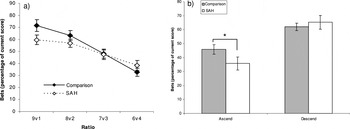
Risk adjustment analyses were restricted to trials where the more likely outcome was chosen. There was a main effect of ratio [F(1.5,52.9) = 81.465; p < .001], such that betting increased with the ratio of colored boxes (i.e., 9:1 > 6:4). There was a significant interaction between group and ratio [F(1.5,52.9) = 6.491; p = .007], such that the SAH showed less adjustment of their betting by the ratio of colored boxes (Figure 2a). This pattern was confirmed by a trend to significant differences in terms of risk adjustment [F(1,38) = 3.492; p = .070; risk adjustment = [2*(%bet at 9:1) + (%bet at 8:2) − (% bet at 7:3) − 2*(%bet at 6:4)] / average % bet; Deakin et al., 2004].

Cambridge Gamble Task. Risk adjustment: percentage of points risked to earn points as a function of (a) the ratio of the colored boxes and (b) condition (ascend/descend). Error bars represent ± 1 SEM (* indicates p < .05).
All participants placed larger bets in the descend than the ascend condition [F(1,36) = 67.3; p < .001]. Although there was no main effect of group, there was a significant group by condition interaction [F(1,36) = 5.719; p = .022]. Post hoc testing revealed that this finding was due to a significant difference in the ascend condition (t = 2.364; p = .024) and not the descend condition. The SAH group chose smaller (earlier) bets than the comparison group in the ascend condition (Figure 2b). There was no significant ratio by group by condition interaction, although this study may have limited power to detect such higher-order interactions, given the sample size.
Information Sampling Task
The total number of boxes opened [F(1,37) = 34.586; p < .001] and error rates varied significantly with condition [F(1,37) = 11.161; p = .002]. Participants opened fewer boxes and made more errors in the Decreasing Win condition (Supplementary Table 1). Neither of these effects varied significantly with group, nor were there main effects of group (boxes opened). In summary, we found no evidence that SAH differed in predecisional processing and/or reflection impulsivity.
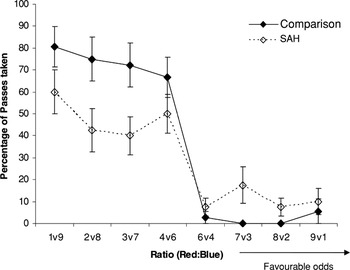
BlindWheel Task
There was no significant difference between the groups on the mean bet placed. The mean bet placed for the comparison group was 47.9% of current score and for the SAH group was 41.4%. The proportion of trials where participants withdrew their bet after seeing the odds varied with the ratio of segments [F(2.4,87.6) = 34.271; p < .001]. However, the SAH group withdrew fewer bets at favorable odds and retained more bets at unfavorable odds than the comparison group [ratio by group interaction; F(2.4,87.6) = 4.449; p = .010; Figure 3]. Corrected post hoc tests were nonsignificant at any individual ratio, but when the four unfavorable odds were collapsed together, the SAH group tended to pass less than controls [F(1,36) = 5.758; p = .022]. There was a trend toward a significant main effect of group [F(1,36) = 3.607; p = .066].

BlindWheel Task. Percentage of passes taken as a function of the ratio of the colored segments. Error bars represent ± 1 SEM.
UpDown Task
The proportion of fixed choices made varied significantly as a function of the odds in the chance option in win trials [F(2.163,82.187) = 25.989; p < .001] and loss trials [F(1.729,65.947) = 7.050; p < .001]. This finding did not vary between groups (odds by group interaction win trials).
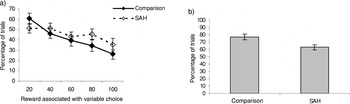
The proportion of fixed choices also varied as a function of the size of the win/loss in the chance option [win trials, F(3.597,136.704) = 14.965; p < .001; loss trials, F(3.433,130.455) = 8.600; p < .001]. This pattern showed significant variation between groups in win trials only [win by group interaction, F(3.597,136.704) = 2.914; p = .028]. This finding reflects the SAH group choosing the fixed win more often than the comparison group as the win associated with the chance option increased (Figure 4a). Using a risk adjustment analogous to Deakin et al. (2004), the reduced adjustment to reward in the SAH group was confirmed [F(1,40) = 5.186; p = .028]. There was no significant main effect of group in the win trials. However, on loss trials, the SAH group chose the fixed loss significantly less than the comparison group [F(1,38) = 7.579; p = .009, Figure 4b].

UpDown Task. a: WIN CONDITION Percentage of trials participants chose fixed win, as a function of reward size in variable choice. Error bars represent ± 1 SEM. b: LOSE CONDITION Percentage of trials participants chose fixed loss. Error bars represent ± 1 SEM.
This task does not show the framing effect in the comparison group found, for example, in Gonzalez et al. (2005). This finding is likely to be a reflection of the fact that, on some trials, the expected gains/losses on the two options were similar, whereas on others, the expected gains/losses on the two options were clearly unbalanced.
The mean deliberation times in the UpDown Task varied significantly as a function of the odds in the chance option of winning [F(1.947,73.970) = 11.057; p < .001] and losing [F(2.923,111.069) = 5.436; p = .002] and as a function of the chance option size of the win [F(3.094,117.568) = 3.807; p = .011] but not by the size of loss. This finding did not vary between groups. There was no significant main effect of group in win or loss conditions. In summary, both groups deliberated longer when the odds of winning or losing in the chance option were less favorable and when the size of the win was larger.
Other Variables
In light of the trend to a group difference between the SAH and the comparison group on the depression rating scale, and the possible effect of depression on reward sensitivity and overall motivation (Elliott et al., 1997), all the above statistical analyses were repeated, including the BDI scores as covariates. All the group differences noted in the original analyses (whether main effects or interactions) remained significant when the BDI scores were included (data not shown).
To determine whether the decision-making deficits described above could be linked to memory or attentional difficulties, correlations were carried out between the CANTAB measures and the following variables: risk adjustment in Cambridge Gamble Task (ascend and descend conditions), “passing” behavior in BlindWheel, and percentage of fixed win and loss choices in UpDown. These variables were selected because they represent the key abnormalities found in the SAH group. Correlations between these decision-making variables were also carried out to determine the relationship between the findings. All correlations were carried out within the SAH group only, and a Bonferroni correction was used to account for multiple comparisons. None of the correlations reached significance. There was no effect of task order or condition order on any measures in either group.
DISCUSSION
This study shows that survivors of aneurysmal SAH (secondary to aneurysm in the MCA or PCoA) have specific deficits in their decision-making abilities. The results suggest that the SAH group did not show the same adjustment in behavior as the comparison group with changing expectation of reward. Reduced sensitivity to probability was evident in the size of bet placed in the Cambridge Gamble Task (Figure 2). The results from the BlindWheel Task suggest that the SAH survivors took more risks at unfavorable odds (as they withdrew their bets less than the comparison group) and fewer risks at favorable odds (Figure 3).
One explanation of this pattern is that the SAH group had difficulty interpreting the probabilistic information encoded by the odds (both on the Cambridge Gamble and the BlindWheel Tasks). However, the results from the quality of decision-making results from the Cambridge Gamble Task suggest that interpretation of probabilistic information was broadly intact.
An alternative explanation of the risk adjustment deficits in the SAH group is abnormal sensitivity to reward and punishment. Consistent with this suggestion, in the UpDown Task, the SAH group showed increased risky behavior in loss trials and more conservative behavior than the comparison group on win trials. This pattern of behavior over these tasks suggests that the SAH group had reduced sensitivity to both reward and punishment. This finding is consistent with the caregivers' reports of apathy from the Neuropsychiatric Inventory.
Reduced cognitive flexibility may also underlie the performance of the SAH group. For example, on the Cambridge Gamble Task, the SAH group do not adapt their betting with the two conditions and with the ratio of boxes. On the BlindWheel, the pass option is only available on a proportion of trials, and the SAH group do not use it as often as the comparison group. However, the importance of such a pattern is unclear, as a lack of flexibility is not evident on the Information Sampling Task. Further work is required to clarify this situation.
The results from this study also show some evidence of impulsivity in the SAH group. On the Cambridge Gamble Task, the SAH group consistently placed earlier bets in the ascend conditions. This pattern may reflect deficits in response inhibition or delay aversion. However, it is not clear from these results whether this is a robust finding, as impulsivity was not found in the descend condition of the task. Future studies are required to determine the relative contributions of delay aversion and response inhibition in the impulsivity noted in the SAH group and the relationship to risk adjustment.
Previous studies of decision-making in SAH survivors have focused on SAH arising from aneurysms of the ACoA. Using the Cambridge Gamble Task, Mavaddat et al. (2000) found differences in risk-taking behavior in the ACoA group. However, in contrast to the current study, they found that the ACoA patients showed evidence of increased risk taking rather than impulsivity. These differences may be associated with differing patterns of neural damage following the SAH (see below). Future studies should further explore these differences, both in terms of decision-making behaviors and associated psychosocial patterns.
Neural Substrates of Abnormal Decision Making
Neuropsychological and functional imaging studies of decision making implicate a distributed neural circuit that includes ventromedial/orbitofrontal prefrontal cortex, amygdale, and the somatosensory cortex region (Bar-On et al., 2003; Bechara et al., 1994, 1999, 2000; Elliott et al., 2000; Rogers et al., 1999a,b, 2004). The ascending dopamine projection is also implicated in reward processing, reward certainty, and reward omission (Fiorillo et al., 2003; Frank et al., 2004).
The reduced sensitivity to reward and punishment as well as impulsivity noted in the SAH group, therefore, may be a consequence of abnormalities in a relatively distributed system. Determining the exact location of these abnormalities is challenging, as insertion of coils or clips often prohibits MRI scans. The SAH performance is unlikely to be simply attributable to lesions in the orbitofrontal cortex or amygdala as the pattern of deficits contrasts with individuals with frank lesions of these areas (Bechara et al., 1994, 1999; Rogers et al., 1999a). A more plausible suggestion is that SAH results in diffuse damage as a result of the neurotoxic effects of widespread subarachnoid blood (Ljunggren et al., 1985) or extreme increases in intracranial pressure (Smith, 1963), perhaps leading to disruption of the ascending monoamine pathways. Indeed, diffuse damage is consistent with the incidence of coma in the SAH group (data not shown). Similarities between the pattern of performance of the SAH survivors and head injury survivors further support this hypothesis (Salmond et al., 2005).
Alternatively, compromised blood supplies to the regions supported by the vessel with the aneurysm may lead to neuropathological changes. Potential affected regions following MCA aneurysm include the lateral aspects of the hemispheres, the basal ganglia and the posterior part of the anterior limb of the internal capsule, whereas the thalamus, hypothalamus, and posterior limb of the internal capsule might be affected following PCoA aneurysm (Weir, 1998). In light of recent interest in the role of the insula/somatosensory cortices in affective decision making (Bar-On et al., 2003), it is interesting to note that these areas may be vulnerable to damage, particularly after MCA aneurysms (Martin, 1996). Although anastomoses (networks of interconnected arteries) may limit the extent of the damage of tissue with compromised blood supplies (Martin, 1996), such damage (in addition to diffuse damage) might explain the differences between the ACoA SAH decision-making performance and that of the current cohort.
Limitations of Study
The sample of patients in this study may not be representative of all SAH survivors, particularly as the mean NART score was at the high end of the average range. The study required participants to comprehend simple instructions and cooperate with the testing session. However, in our experience, very few individuals are unable to meet these criteria, consistent with findings in other patient groups (Swainson et al., 2001). Indeed the mean MMSE score of approximately 28 was close to ceiling (30) and well above the dementing range of less than 24. It is possible that survivors with good outcome are less inclined to contribute to research, particularly if they have returned to work. Nevertheless, this study shows that, in the absence of global cognitive impairment, at least a subgroup of SAH survivors suffer impaired decision-making ability.
Future studies should investigate these decision-making deficits in the SAH survivors in a larger group. This strategy would increase the power of the analyses and, in particular, aid interpretation of significant interactions and correlations between task performances. In addition, it would be desirable to separate the survivors of SAH secondary to aneurysms in the MCA from survivors of SAH secondary to aneurysms in the PCoA. The use of individually checked MRI-compatible coils and clips in SAH surgery will permit the investigation of structural abnormalities associated with the decision-making deficits.
Finally, it is difficult to ascertain that the decision-making deficits found in this study represent changes relative to premorbid functioning. However, the results are consistent with reports from the patients' significant others of increased difficulties in social and emotional situations and reports of personality change following SAH (Hutter et al., 1995; Ljunggren et al., 1985; Ogden et al., 1994; Powell et al., 2002, 2004; Saveland et al., 1986).
ACKNOWLEDGMENTS
The authors thank the patients and volunteers who participated in this study and the staff at the Addenbrooke's Centre for Clinical Investigation. This work was supported by the Medical Research Council (Grant no. G9439390 ID 56883) and the Fund for Addenbrooke's and carried out within the MRC Centre for Behavioural and Clinical Neuroscience. The Cambridge Gamble Task and Information Sampling Task are licensed to Cambridge Cognition plc. B.J.S. is a consultant for Cambridge Cognition plc. We confirm that the information in this manuscript and the manuscript itself is new and original, that it is not currently under review by any other publication, and that it has never been published either electronically or in print.