In 1989, a long-time dairy farmer in Central Vermont named Peter Flint won awards for having the highest production herd of Jersey cows in the United States. And yet for Peter and his wife Bunny, this distinction was more of a wake-up call than a celebration. “We didn’t like that kind of notoriety, actually,” Peter Flint recalled in a 2012 interview. “It wasn’t us. It was a lot of stress.” Like many American dairy farmers at the end of the 1980s and early 1990s, Flint was burned out by the pressure he felt to continually increase milk production. “I felt like I didn’t like myself very much,” he said. “We were doing a lot of embryo work and feeding the cows eight times a day, starting at 3:30 in the morning. I said, ‘I don’t want to farm like this, for the sake of my cows.’” Flint believed his Jersey milk to be of superior quality, and he was determined to stop shipping to Agri-Mark, a Northeast milk cooperative. The couple decided to follow their dream of processing their own milk products, so they sold their milking cows and started an organic herd with 28 heifers in the fall of 1989. They bought used processing equipment and set up a small plant to make cheese and bottle milk in glass bottles under the name The Organic Cow of Vermont.
After several years of steady sales in local stores, they moved on to milk cartons. When these launched in 1994, sales took off rapidly. “It was like instantaneous,” Flint explained. Organic Cow entered a phase of growth not because of the move to cartons, but as a result of a recent event that would soon catapult organic dairy products into the mainstream: the U.S. Food and Drug Administration’s (FDA) approval of recombinant bovine somatotropin (rBST) for use in milk production. The highly publicized controversy over rBST laid the foundation for growing demand for organic dairy products, which, according to organic certification rules, came from cows not treated with rBST. In just a few years, organic dairy was transformed from a niche product available only in health food stores to a staple of conventional supermarkets and a “crossover” food for consumers previously unaccustomed to buying organic. Footnote 1
The success of these products created opportunities for dairy farmers struggling to make ends meet as the monthly conventional milk price, which is regulated by the US Department of Agriculture (USDA), became increasingly volatile in the 1990s. Organic processors paid farmers a contract price that was higher than conventional and consistent from month to month. What’s more, in the early years, the organic transition period was shorter and the guidelines less stringent than today. Organic production appealed specifically to farmers already using grazing as an integral part of their production system. Footnote 2
The success of organic dairy added momentum to the broader organic food market, which, following a series of institutional pronouncements of support and growing interest from the public, was growing at an annual rate of 20 percent or more. Footnote 3 Between 1994 and 1999, organic dairy itself took on a more mainstream identity as it became the fastest growing segment of the organic foods industry—with sales increasing more than 500 percent. Footnote 4 This critical time period is book-ended at the beginning by the first significant wave of dairy farm transitions, and at the end by the year of “peak” acquisitions of small organic brands. Footnote 5
Much has been written about the growth in demand for organic milk, the controversy over rBST, the emergence of a new organic consumer, and the success and takeover of organic brands in the 1990s. Footnote 6 There has been little attention, however, to the opportunities and challenges organic production brought to traditional US dairy regions in the mid-1990s and to the role farmers played in the development of organic dairy systems. Additionally, while there is a wide literature on farmers’ motivations to transition to organic, no study has looked at US dairy farmers, who have always faced a very particular set of circumstances and choices.
This article looks at the time period when organic milk progressed from a supermarket novelty to a billion-dollar industry and asks, how did American milk producers experience the growth of this new market? If the organic dairy industry was largely created by corporations in the 1990s, as some scholars have claimed, what role did farmers and small-scale processors play? Footnote 7 We anchor our research in the experiences of a group of Vermont dairymen and women who made the decision to transition and certify their farms at a time when the organic dairy industry was still in its infancy. Vermont is an appropriate study area because the state is economically dependent on the dairy industry—with 65 percent of agricultural sales coming from this single commodity and 60 percent of farmland devoted to dairying. Footnote 8 Dairy cows and farms are also central to Vermont’s landscape, vitality, history, and culture. Footnote 9 In the early 1990s, many of the farms that dot Vermont’s landscape were in a favorable position to transition to organic, thanks to their reliance on pasture and small size.
With The Organic Cow of Vermont, Peter and Bunny Flint built the first organic milk hauling and processing system in the Northeast United States. To keep up with demand for their products, the Flints started to buy milk from nearby farms. As the company grew, the founders attempted to create a kind of farmer-processor relationship that was different from what they had previously experienced as milk producers and that prioritized farmer livelihoods. Overwhelmed by its own success, Organic Cow eventually partnered with a conventional firm to achieve efficiencies in processing and distribution but was soon bought out by a larger corporate player.
The acquisition of Organic Cow was part of a pattern repeated often in the late 1990s, as agribusiness penetrated the most profitable parts of the organics industry, thanks to a regulatory environment that favored substituting inputs. This caused the organic sector to closely resemble its conventional counterpart, especially in the realms of marketing and distribution. Footnote 10 Observers like Michael Pollan have looked at the story of Organic Cow through the conventionalization lens and lamented that the company was absorbed into the “organic-industrial complex.” Footnote 11 Not only is this an oversimplification of what the Flints and their farmers achieved over the long term, it fails to account for organic dairy’s deep-rooted relationship with the conventional milk system.
This article will explore what the particularities of American dairying meant for the growth and conventionalization of the organic market in the 1990s. The very uniqueness of dairying, with its barriers to entry, capital intensiveness, commodity pricing mechanisms and high perishability, brings a different dimension to the debates surrounding the impact of organic systems on small-scale farms. In fact, organic dairy’s closeness to the conventional system it was born out of and its long history as a staple commodity complicate the traditional story of the evolution of the organic movement. By detailing the rise of Organic Cow and the establishment of the American organic dairy industry, this article provides lessons of interest to scholars of business history and American agriculture, as well as farmers, policymakers, and others interested in the development of alternative food systems.
We argue that the growth in demand for organic dairy products created unique opportunities for small-scale dairy farmers in New England, beyond just offering a livable wage. As we show, the Flints unrolled a farmer-processor model based on higher pay and mutual benefit. They took the opportunity provided by burgeoning demand for organic milk and found ways to share that boon with dairy families in their region. As farmers themselves, they were in tune to growing desires on the part of producers for a more profitable and sustainable way to farm. They were committed to growing their unusual brand and to maintaining the culture of small-scale dairy farming that was—and remains—so emblematic of Vermont. When they could not meet demand for their products from their herd alone, they actively recruited farmers they knew who were already using some organic methods. The farmer-processors behind Organic Cow and the farmers they worked with took ownership of the new organic dairy market and shaped the industry it was to become. By examining farmers’ reasons for transitioning to organic and the nature of their relationship with different processors, we shed light on the ways in which organic production transformed farmers’ roles within the commodity supply chain.
Our research draws on semistructured interviews with 16 farmers who shipped to Organic Cow at various stages between 1994 and 1999, and six “key informants,” including Peter and Bunny Flint. The other key informants are all informed observers who were involved in Vermont organic dairying in the 1990s. Our analysis is supported by numerous secondary sources, such as news articles and pieces from the business literature. This article is organized into three main sections: Part I covers developments in dairying and organic production leading up to the early 1990s; Part II explores Organic Cow’s early years and success, including farmer recruitment and motivations to transition to organic. Finally, Part III details the acquisition of Organic Cow and the choices of individual producers.
Part I: Transformations
Industrialization and Specialization of American Dairying
Starting in the 1940s, American agriculture underwent profound changes in productivity thanks to advances in crop genetics, livestock breeding, farm machinery, and petroleum-based chemical inputs. Footnote 12 As part of an industrial ideal that had established itself during the interwar period, agricultural leadership promoted widespread mechanization with the goal of transforming farming into a more efficient and businesslike operation modeled on modern factories. Footnote 13 Innovations such as the bulk tank affected dairy production specifically and contributed to making dairying a more specialized operation, with farmers who could not afford technological investments forced to leave the business. Footnote 14 The bulk tank, as well as other modern advances like electrification, on-farm refrigeration, mechanized feeding, veterinary drugs, and artificial insemination helped to ease the toil of daily farmwork and significantly increased dairy worker productivity. Footnote 15
As larger dairy farms began to move away from grazing in favor of confinement feeding, advances in fertilizer research, farm equipment, and plant genetics increased crop yields and lowered the cost of feeding grain to dairy cows. Footnote 16 The average cow’s production nearly tripled between 1950 and 1990 thanks to selective breeding and the development of silos, which greatly extended the milking season. Footnote 17 Herd health management was also transformed: farmers could buy antibiotics at their local drugstore as early as 1950, and later decades saw an upswing in antibiotic use as a way to control udder infections. Footnote 18
The federal milk marketing system helped to achieve a certain level of milk pricing stability while requiring that farmers follow specific production and cleanliness standards. Footnote 19 The USDA assured dairy farmers that they would be paid relatively high prices for their milk if they increased production and joined one of the large, consolidated cooperatives that had come to dominate the dairy market by the 1970s. Footnote 20 In the late 1980s, decreased federal support caused milk prices to become more responsive to changing market conditions, and more volatile. Footnote 21 Until that point, the relative stability of milk prices meant that farmers’ main concern was choosing a processing plant that offered a good price. Footnote 22 In the 1990s however, monthly fluctuations became so extreme that they meant the difference between farm profitability and bankruptcy. Footnote 23 In New England, many factors, such as debt and limited available land, prevented small dairy farms from growing in size to compete in this conventional milk market. Footnote 24
As a highly perishable product that is “harvested” daily, milk is unique among farm commodities in that it is picked up and hauled from farm to market every day of the year. Footnote 25 It is a “flow commodity” that must either be sold quickly as fluid milk or processed into storeable dairy products such as cheese, yogurt, butter, or powdered milk. Footnote 26 Most milk is picked up at the farm by a member-owned cooperative that serves as the marketing agent for farmer-members. Milk is then “shipped” to a processor or cooperative-owned dairy plant for processing, which covers pasteurization (heat treatment), bottling, and transformation into other products. In rare cases, dairy farmers invest in smaller-scale pasteurizers and bottling machines to brand and market milk products themselves. The milk production system thus places dairy farmers in a unique situation, far different from vegetable producers, who have fewer barriers to entry and greater flexibility in determining the best marketing outlets for their products. As price takers, dairy farmers—through their cooperatives—are limited in their ability to negotiate prices and cannot wait for a better price to come their way given milk’s perishability and the additional milk in the pipeline. With little negotiating power or leverage in contract deals, processors can chose from different cooperatives and producers, but not vice versa. Footnote 27
Evolution of the Organic Philosophy
The first science-based theories of organic agriculture were successfully applied in the 1930s and 40s in Western Europe. Footnote 28 From there, different schools of thought evolved, but all held as central the preservation of soil quality and fertility and the use of natural biological processes and manure to ensure plant health. Footnote 29 These novel ideas spread to North America thanks to the close relationships between organic advocates on both sides of the Atlantic. Footnote 30
The 1960s saw growing interest in organic farming as part of antiestablishment and environmental activism. A movement opposing synthetic chemicals of all kinds was growing, leading people to become interested in less processed, more wholesome foods. Footnote 31 In the 1970s, “organic” meant more than just producing vegetables without chemicals; it encompassed an idea of personal wholeness and a raised political consciousness. Footnote 32 Organic advocates saw their models of ecological agriculture as pathways for human survival in a world threatened by environmental crises and the perceived destructiveness of conventional agriculture. Footnote 33 At the same time, many observers outside the movement associated the word “organic” with health food fanaticism and hippie lifestyles. Footnote 34
Even when organic food began to draw attention from academics and government officials, it continued to be mostly ignored by mainstream agriculture. Footnote 35 The 1980s saw growing institutional validation for the movement: first, the USDA released a report citing many benefits to organic farming and calling for more research and education on the topic. Later, a now-famous United Nations report on sustainable development warned against ecological stress from increased agricultural productivity and called for greater use of organic methods in farming. Footnote 36
Early Organic Dairying
As early as the 1960s, there were instances of dairy and other commodity producers adopting organic practices on their farms because of strong misgivings about conventional farming. Footnote 37 The technological advances described previously often brought gains in production and efficiency but in some cases also led to external costs such as chronic herd health problems that shortened the productive lives of cows. While farmers saw their milk production increase, profitability often failed to keep pace. The early organic producers made the transition for practical rather than wholly ideological reasons, and very few were able to obtain any kind of price premium, though higher net income was sometimes achieved through lower operating costs and from eliminating costly chemical inputs. Footnote 38 In essence, these farmers were producing organically and selling conventionally. It is important to note that this was not a uniquely American phenomenon: there were concurrent cases of supply-side-only organic commodity producers in Europe as well. A 1981 study of organic farmers in England and Wales found that almost all organic meat and milk producers sold through conventional channels. Footnote 39 Even as late as 1999, a quarter of Belgium’s organic milk was sold conventionally. Footnote 40
Dairy farmers applying ecological or organic methods developed their own definitions of what organic meant. Footnote 41 Most often, organic dairying implied free access to outdoor grazing, the feeding of organic grain, the application of preventive and natural health remedies such as homeopathy, little or no use of synthetic and breeding hormones, and little or no use of antibiotics. Footnote 42 The 1980 USDA report on organic production found that organic livestock farmers “did not appear to ‘push’ their animals in the feeding programs. That is, they did not appear to strive for the highest possible rate of gain and to market the animals in the shortest possible time.” Footnote 43 Dairy and meat products were often overlooked by the organic counterculture movement and by the early certification standards that developed in the 1970s and 1980s, but animals were always considered an important component of an organic farming system. Footnote 44
In the 1980s, a handful of small-scale American milk producers invested in processing equipment so they could bring their organic products to niche markets like health food stores and farmers’ markets. Participating in processing operations was one way for farmers to increase their share of each dollar spent on their products. Footnote 45 Some of these on-farm processors were certified organic, and many were not. In the 1980s, organic certification standards in the United States were a patchwork of regional regulations applied with varying degrees of enforcement. Later, in the early 1990s, organic certifiers became more sophisticated as they took on the responsibility of preventing unfair competition in the marketplace. Footnote 46 Price premiums for organic products became the norm as a more formalized infrastructure and market for organic foods was established. Footnote 47 The price premium, rather than any kind of subsidy, has been the primary financial incentive for American producers to transition. Footnote 48
Part II: Early Years and Growth of Organic Cow
After years of research and public controversy, the FDA approved rBST for use in milk production in 1993. Footnote 49 Growth in demand for organic milk and dairy products is directly tied to this controversial decision. Footnote 50 Bovine somatotropin (BST) is a hormone that occurs naturally in cows. Recombinant bovine somatotropin (rBST) is an artificial version that increases the milk production of a cow when injected. Footnote 51 Despite government assurances that rBST posed no human health risk, a segment of consumers was wary of rBST’s impact on farmers, consumers, and milk cows. Footnote 52 Organic milk producers and alternative brands like Ben and Jerry’s sued for the right to market their products as rBST-free. Footnote 53
In the early 1990s, conventional dairy farmers throughout the Northeast were looking for ways to remain economically viable and still maintain their way of life. At the same time, even milk producers interested in organic methods had no incentive to become certified organic under the status quo. That was because the vast majority of dairy farmers sold to regional milk buyers and cooperatives, which were all conventional, and a farmer’s milk was mixed with milk from neighboring farms. Peter and Bunny Flint changed that equation by establishing the first alternative infrastructure for hauling and processing organic milk in the Northeast. They had realized early on that to stay ahead of growing demand, they needed more milk than what they alone could produce. In 1994 and 1995, word spread within the Vermont community of Jersey farmers that the Flints were looking to recruit producers and were offering a higher price than the federal milk order. Footnote 54
Organic Cow’s growing network of milk routes gave potential organic dairy farmers the marketing outlet they needed to justify becoming certified. One farmer speaks for many in saying, “We were certainly interested in [organic production] but we just didn’t feel able to take on processing and marketing our own product. So we always felt like when there was some market available, that’s when we would want to do it.” The organic milk hauling and distribution system that exists today, and which mirrors the conventional milk system in almost every aspect, started with Peter Flint’s first “milk truck,” which was nothing more than a bulk tank mounted on a trailer. Footnote 55
The dairy farmers who signed with Organic Cow found the organic transition relatively easy because they were pasture-based with average production levels, used minimal supplemental fertilizer, grew hay with little to no corn, and used antibiotics only rarely. Footnote 56 In other words, the farms best able to transition were already near-organic. It was a natural step for them to become certified and ship to the Flints, who were offering consistent above-market prices. Half of Vermont dairy farms have fewer than 70 cows, and about the same proportion commonly use grazing, which is a low-cost way to harvest forages. Footnote 57 Conventional dairy farms that already used pasture for at least half of the forage fed to cows—as is the case of many small Northeast farms—saw smaller increases in their production costs when transitioning, compared to dairies that did not rely on grazing. Footnote 58
There has been much academic interest in farmers’ reasons for transitioning to organic production. In terms of the broader organic market, research has shown that once price premiums became available, farmers have converted to organic production for both financial and nonfinancial reasons, and the interplay between the two may be difficult to deconstruct. Footnote 59 A concern for the environment and dissatisfaction with conventional have been shown to be important motivations. Footnote 60 There is some mixed evidence that philosophical concerns were more apparent in earlier converts, while financial motivations mattered more to later ones. Footnote 61 Even for those for whom finances were important, the goal was usually not income maximization, but rather farm survival. Footnote 62 A recurring theme is that organic farming is seen as a more challenging and exciting way to farm that allows producers to better achieve their full potential. Footnote 63 Only a few studies have looked at the motivations of dairy farmers specifically, and until now, none has examined the reasoning of American dairy producers. Footnote 64
Almost all of the farmers we spoke with had financial as well as philosophical motivations to transition. Footnote 65 Even those most committed to the organic philosophy fell along a financial-ideological spectrum. Some made clear that the price premium was the driver, while others insisted they had wanted to make changes for years and the extra income—while important—was not their primary motivation. When discussing financial motivations, most farmers stated that the appeal was not so much the premium but the contract price and the stability that came along with it. One farmer described how a range of factors affected her decision: “For one thing, being organic made sense for us—that it would be more sustainable for the land and for the animals. And then the fact that we could sign a contract and have a steady price.” Amid the growing volatility of conventional milk markets, this “steady price” was a tremendous benefit, as it allowed farmers to budget and plan with greater certainty. Only three farmers out of 16 reported transitioning for purely financial reasons or because it was the only way they could remain in business. The extra $3–5 per hundredweight—or 100 pounds—of milk was just the lifeline they needed to keep farming.
Philosophical reasons, including a belief in organic philosophy and a desire to “farm small” or farm differently, were reported just as often. “We liked what we read about, both the standards and the idea of organic dairying,” said one farmer who was new to organic methods. Beyond the attractive premiums and stable pricing, organic production offered a way for farm families to move away from an intensive mode of dairying. Footnote 66 Linked to this philosophy was a belief that the organic system would be a welcome challenge and would make dairying more exciting. One producer confided, “We just weren’t professionally satisfied shipping milk to the conventional market. I mean at a certain point, you’ve got to have a level of professional satisfaction to stay in an occupation.”
For the Flints, their interest in organic farming was what Bunny called a “creeping dawn”—they had been eating organic foods and gardening without chemical inputs for several years, and they saw it as a natural step to extend these practices to their work as dairy farmers. But beyond any philosophical considerations, organic farming was also a practical way out of a system that had taken its toll, a way to keep farming—just differently. Indeed, personal dissatisfaction with the conventional system was widespread, mainly as a result of what one farmer described as the “roller coaster ride of the dairy prices,” but also because of a perceived “cutthroat” nature of the conventional industry. One farmer, who served on conventional co-op boards, believed that “the farmer was just not going to get any kind of benefit out of it because these guys just undercut each other and by undercutting each other, all they did was pay their farmers less.”
As the debate over rBST raged on, some farmers quickly understood the resulting market potential of organic milk, and others were upset about the very existence of the new biotechnology. One farmer said he “didn’t want [his] milk going onto a truck that had BST milk on it.” This wariness on the part of farmers over rBST was not new. In the 1980s, Wisconsin dairy farmers “protested bitterly” when their local agricultural experiment station researched the technology, given the surplus of milk on the market at the time. Footnote 67
Organic Cow appealed to some farmers who were excited about the prospect of contributing to a local product. Milk had long been undifferentiated; now the colorful cartons from Vermont had found a customer base across the East Coast. One farmer explained, “Oftentimes when the milk leaves your farm, you never know where it goes. So I got very excited about the idea of selling my milk to a company where I could say, ‘I contributed to that product.’”
There are two important practical motivations to note. First, 12 out of 16 farms were already applying some organic methods, meaning they already had an understanding of what organic production would entail. Second, in 1994 and 1995, the transition to organic production was short (one month feeding organic grain if the land was already certifiable, whereas today that has jumped to one year). This very short transition process meant that becoming certified was a relatively low-risk decision that had the potential for high rewards. One farmer put it bluntly: “We were Agri-Mark members, and so we retained our membership in the co-op. If the [Organic Cow] truck didn’t show up, I could just pick up the phone and switch back at any time.” In addition, if Organic Cow did not send payment for the milk on the agreed date, usually within 30 days, the farmers could simply contact their old cooperative and likely have their milk picked up the next day.
The Flints greatly benefitted from growing consumer interest in organic milk, but perhaps equally key to their success was the presence of many small-scale dairy producers in their vicinity. As longtime milk producers themselves, they understood firsthand that organic price premiums could save New England farms from bankruptcy. “We were able to be competitive milking 30 or 40 cows,” said one early shipper. “There was no way a farm like mine could have made it any other way.” The Flints were open about their determination to not let their company “end up like conventional” and believed they were setting the standard for farmer pay price. Footnote 68
Success
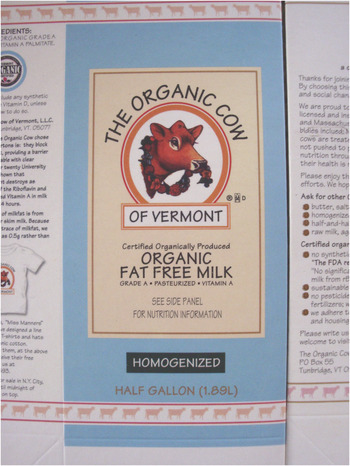
While Peter oversaw production and farmer contracts, Bunny forged relationships with retail buyers, and with the help of distributors, Organic Cow products began appearing in supermarkets as far away as Ohio and Florida. Organic Cow was one of the first organic brands to expand beyond the traditional outlets for organic products and appear in mainstream stores like Shaw’s and Hannaford. Footnote 69 Consumers used to a generic milk product were drawn to the pink, blue, and gingham-patterned cartons showing a Jersey cow wreathed with flowers alongside an invitation to visit the Tunbridge farm (Figure1). The taste of the milk was just as appealing; as one early shipper explained, “one of the selling points is just that it tasted really good.” By 1997, the $5 million business represented 9 percent of organic milk sales nationwide and dominated the East Coast organic milk market. Footnote 70 Organic Cow also supplied Stonyfield Farms with milk for an organic line of yogurts manufactured in neighboring New Hampshire. Footnote 71
Organic Cow milk carton. Photo by Olivia Saucier.

All the farmers we spoke with reported that their experience shipping to Organic Cow was a positive one, and there is broad agreement that the Flints played an essential role in developing the American organic milk market. Shippers reported feeling part of a close-knit environment, and a common feeling was that their relationship with the Flints was different from what they had previously experienced in the conventional market. “I really feel that with the Organic Cow, it was the beginning of the change of how processors and dairy farmers interacted,” one producer told us. She explains: “It was an eye-opener for a lot of the conventional farmers. Beforehand there really wasn’t a lot of dialogue between processors and farmers. The Organic Cow showed that they were more concerned about how the farmers were making it.” This feeling of belonging to an intimate group was especially strong in the early years (1994–1995), as the first shippers met in each other’s homes to talk through organic production challenges. The Flints also shared news of the business’ growth and direction. “I thought, as a producer for them, that they were really good about keeping us educated and keeping us in the loop and being really honest with us about pricing and contracts, so it was a real intimate business relationship,” said one farmer. Multiple producers mentioned how the couple kept their pledge to pay farmers first and cover the price of milk hauling.
While Organic Cow found success primarily in East Coast markets, two organic milk processors dominated the industry in the rest of the country: CROPP/Organic Valley and Horizon Dairy. While the two started out as partners—with Horizon producing its first product line from CROPP organic milk—they have come to represent two very different facets of the organics industry: CROPP is now the nation’s largest organic cooperative, controlled by farmer-members, and Horizon is a commercial division of WhiteWave, formerly a subsidiary of Dean Foods. Footnote 72
Partnership
Despite high levels of growth, Organic Cow faced challenges familiar to many entrepreneurial businesses trying to scale up. Starting a dairy-processing venture requires a completely different set of skills than those needed for running a dairy farm. Footnote 73 New on-farm processors must raise sufficient capital to overcome the barriers to entry in the dairy market and build a processing plant within an industry that frequently experiences oversupply. Footnote 74 A common financial challenge for start-up businesses is that they must fund the production and distribution of a product before receiving any revenue for that product. This circumstance requires substantial cash investment but also makes it difficult to provide collateral to obtain commercial loans to finance business growth.
By 1997, the Flints had tied up much of their personal assets to get the necessary credit to pay farmers and were in need of capital. Footnote 75 The company had operating losses caused by inefficient processing and packaging, competition from large organic dairies in the Western states, and problems with distribution. Footnote 76 To address these cash-flow and logistical challenges, they sold a 70 percent interest in the company to H.P Hood, the family-owned New England dairy processor. Footnote 77 The partnership, which was reported in the press as a joining of forces that would give Hood a “controlling interest” but keep Organic Cow as a separate company, gave the Flints access to operating and expansion capital, modern processing facilities, and a distribution network. Footnote 78 While the terms of the partnership were not disclosed to farmers at the time, the Flints continued to run the company much as before while benefiting from Hood’s infrastructure and expertise.
The alliance with Hood gave the Flints the leeway they needed to grow the company and honor their contracts with farmers. Partnering with a third-party or parent enterprise to take advantage of improved logistics, warehousing, and distribution is an efficient way for small-scale producers to scale up. Footnote 79 In the 1990s, “reformists” in the organic industry argued that the movement could have a greater impact by forging alliances with agribusiness. Rather than stick to a mantra of self-sufficiency, some in the alternative foods movement began collaborating with conventional partners to take advantage of the “informational and distributional networks” these latter actors had to offer. Footnote 80 At the same time, when expanding family-developed businesses forge partnerships, it often means giving up some control of the enterprise: when the Flints sold 70 percent of their company to Hood, they became minority owners.
From the first farmer meeting following the partnership announcement, Hood’s approach was hands off, letting Peter Flint manage farmer relations and raise the pay price from $18.50 to $21.00 per hundredweight with the goal of enticing more shippers to sign on. Footnote 81 One producer remembers walking out of the meeting in which the raise was announced: “Now that stunned me back then because if you could get a nickel out of a conventional operation, that was considered like a big deal. And we just walked out with $2.50. That’s like earth-shattering!” Farmers’ sense of support from the Flints was personal but also, importantly, financial. A supply contract with Organic Cow was more than a chance for a future in dairying; it returned a sense of worth to producers who had become accustomed to years of uneven milk checks, stress, and uncertainty.
Accessing Hood’s processing and distribution also meant substantial changes in the company’s operations. In May 1998, processing ceased at the Tunbridge plant and moved to Hood’s facilities in Massachusetts, closer to the lucrative Boston market, which resulted in the termination of ten of the company’s 16 employees. Footnote 82 By now Organic Cow had grown into a sizable hauling and distribution operation, buying milk from about 50 farms across the Northeast. Footnote 83
Part III: Acquisition and Repercussions
All the while, the continued growth in demand for organic dairy was not going unnoticed. Larger food processors had long been interested in entering the East Coast organic dairy market. In 1999, Horizon Dairy, the publicly owned corporation based in Colorado and affiliated with Suiza (later Dean Foods), bought 100 percent of the Organic Cow brand from Hood and the Flints, along with the rights to the company’s milk supply contracts. Press reports described the acquisition as a way for Organic Cow to manage its growth and save money on manufacturing, while Horizon vowed to maintain the current pay price and honor all farmer contracts. Footnote 84
The farmers we interviewed perceived the sale to Horizon in different ways—with some feeling angry and betrayed and others understanding the forces that led up to it. Most agreed, however, that the Flints were finding it increasingly difficult to manage their business. “We weren’t super upset to see the evolution because we could see Peter was struggling,” an early shipper told us. “He was probably better with farmer relations. We knew from the beginning that it wouldn’t stay a little mom-and-pop thing.” The Flints also bore all the financial risk, which is something many farmers understood. One farmer explained, “We weren’t the ones lying awake at night going, ‘Oh my God, where are we going to market this milk or what are we going to do with this bottler that isn’t working?’”
The business relationship between the Flints and the farmers felt like a partnership to many involved, with the farmers kept informed of most business decisions and made to feel like they were a key part of the company. In reality, there was never any legal partnership or shared responsibility. The farmers supplied milk and were paid. They neither invested in Organic Cow nor were they subject to cover potential financial losses, and they were only at risk for the milk that they had not received payment for. The social relationships and trust between the farmers and the Flints could not override the economic imperatives at hand; Hood’s investment in Organic Cow, while described publicly as a “partnership,” in reality handed over governance to a more powerful partner. Farmers were caught in this dynamic between maintaining Organic Cow’s core values and accepting outside influence and a new set of rules to be able to scale up and meet demand.
Choices
Within six months of the sale, another organic processor began operations in Vermont, mostly as a result of the efforts of one Organic Cow producer. CROPP/Organic Valley, the farmer-owned cooperative based in Wisconsin, had been waiting for an opportunity to expand in New England and so began a Vermont milk route in October 1999. Within three years, many of the earliest shippers to Organic Cow had left Horizon and joined CROPP, which now counts more than 130 members in the state of Vermont. Footnote 85
Horizon, Organic Valley, and Organic Cow all successfully marketed a product that had previously been undifferentiated. All three relied on the conventional milk production model to get their product to market, and all three shaped their marketing messages around the organic virtues and values behind their product. And yet there were also explicit differences between these processors, both in organizational structure and in their interactions with farmers.
Horizon was cofounded in 1991 by Mark Retzloff, a successful natural foods retailer based in Colorado. Footnote 86 While Retzloff did not have dairy farming experience, he understood the retail potential for organic dairy and was a strong believer in the environmental and health benefits of organic foods. Footnote 87 A growing infrastructure of natural food retailers like Wild Oats and Whole Foods served as early outlets for Horizon products. Footnote 88 Its first product line was an organic yogurt made from milk supplied by CROPP. When Horizon—caught up in the same post-rBST wave as Organic Cow—found that it could not meet growing demand for its products from CROPP milk alone, the company converted a large conventional dairy farm in Idaho to organic. Footnote 89 This farm was the first of a growing number of factory-scale organic dairy farms in the Western states. Footnote 90 In 1999, Horizon expanded internationally, acquiring UK-based Rachel’s Organics, a yogurt company founded by an entrepreneurial Welsh couple who, like the Flints, had recognized the market potential of organic dairy products early on. Footnote 91
Horizon’s sheer breadth and influence has gone so far as to obscure the contributions of smaller-scale processors like Organic Cow in some narratives of the rise of the organic dairy industry in the 1990s. In Nature’s Perfect Food, Dupuis describes how “a major part of the organic milk industry arose, fully grown” as a corporate creation. A 1998 profile of Horizon executives in the trade journal Dairy Field asserts that “Horizon literally created an industry through its organic dairy venture.” Footnote 92
In the United States, Horizon has received negative publicity for its corporate dairy farms and perceived violations of organic standards, but the company currently sources at least half of its American supply from family farms, including about 60 in Vermont. Footnote 93 Watchdog groups have reported that Horizon has pushed producers to accept lower pay prices, Footnote 94 but in reality the competition from CROPP/Organic Valley and other processors has kept Horizon’s pay price high. Footnote 95
The Cooperative Regions of Organic Producer Pools (CROPP) was founded as a produce cooperative in Wisconsin’s Coulee Region in 1988, but dairy immediately became the top sales category. Footnote 96 An important goal of the founding members of CROPP was to promote farm diversity and economic stability through stable pricing. Footnote 97 As with most dairy cooperatives, CROPP farmers finance the co-op, share its profits based on the volume of milk they supply, and govern the organization. In return, CROPP provides farmers with the services required to market their milk. Footnote 98 CROPP, and its brand name Organic Valley, is now the largest organic marketing cooperative in North America, with 1,834 farmer-members in 2014, including over 1,400 organic milk producers. Footnote 99 While a founding principle was to market products produced by members, in 2008 commentators drew attention to the fact that CROPP had quietly been purchasing milk from a nonmember Texas megafarm. Footnote 100 CROPP has also been criticized for supporting what some see as lax organic standards that benefit large-scale dairy operations. Footnote 101
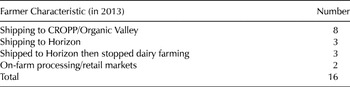
In the mid-1990s, Vermont organic dairy farmers had only one processor they could ship their milk to. By the year 2000, they had two options offering similar pay prices. Though neither option involved the Flints, for many producers, the decision to join CROPP was an easy one. Table 1 shows the actions taken by the producers we interviewed after the sale of Organic Cow to Horizon. These changes took place over two to three years, as binding contracts with Horizon ended.
Actions of farmers after sale of Organic Cow
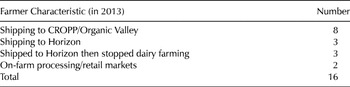
As of our interviewing period, eight farming couples had joined Organic Valley, three continue to ship to Horizon, three stopped dairy farming, and two started their own processing enterprise. Importantly, no producers went back to conventional milk production.
Farmers’ decision to join CROPP was often directly related to their experience with Organic Cow. One Organic Cow producer who did not want to resign with Horizon when his contract ended played a leading role in coordinating the first truckload of milk for CROPP. “I always felt like the farmers owned ‘The Cow’; like you just had that feeling,” he recounted. “And in reality, we didn’t. That’s the real appeal of Organic Valley. The farmers own that. Someone is not just going to sell it—sell you with contracts.” CROPP, as a farmer-owned cooperative, was perceived by some of the earlier shippers as being more in line with their values and as echoing their experience with Organic Cow, even though the co-op had no previous history in the state.
A negative perception of Horizon may have played a role in the decision to join CROPP. For one farmer this was key: “I had joined Organic Cow really loving the small company and the last thing I wanted to be a part of was the largest stock company in organic agriculture. It had no appeal to me whatsoever.” Amid the consolidation of the organic milk industry, farmers had some degree of choice and agency over how and where to sell their product, and ethical considerations and preferences affected those choices.
Farmers’ decisions over whether to resign with Horizon influenced their perception of the company. The eight farmers who left Horizon to join CROPP had mostly negative feelings and described attempts by Horizon to push them to sign amended contracts that offered a lower pay price. Key informant interviews supported this assertion. Another farmer who left Horizon likened her experience as “almost like being attached to the conventional markets again.” Nevertheless, the producers who have remained with Horizon report being satisfied. One Horizon farmer said the company field representative whom she had known for years was “very nice and helpful.” This illustrates how personal relationships, such as with field staff, may be more important to producers than philosophical considerations. As one farmer put it, “I just don’t see changing something that’s working. And Horizon’s working for me.” A sign of Horizon’s commitment to its milk producers is its response to the 2008–2010 economic recession. Both Horizon and CROPP instituted systems to limit milk production without terminating any farmer contracts, which was not the case of all organic processors. Footnote 102
Growth of the Business
The choice between staying small and scaling up has been faced time and again by many food brands, including, perhaps most famously, that other Vermont-based milk processor, Ben and Jerry’s. Ben Cohen and Jerry Greenfield had several things in common with Peter and Bunny Flint. Both entrepreneurial teams held a deep commitment to Vermont’s economy and “working landscape.” They sourced their milk locally, hired artists to design their logos, and adopted similar marketing techniques—that is, “marketing by the seat of their pants” due to a limited advertising budget. Footnote 103 They showcased their bold, colorful products and told stories to connect to customers. The Flints may not have had an explicit double bottom line in the same way as Cohen and Greenfield, who strived to maintain a social mission within a corporate model, but our interviews with them make clear they truly believed they had a duty to support small-scale farming.
Farmers’ experience shipping to Organic Cow changed the way these producers perceived themselves within the commodity supply chain. The idea that farmers were more involved—or had more ownership—than they actually did may have accounted, at least in part, for the shock many felt when the acquisition of Organic Cow was announced. For those most attached to “The Cow,” they sought out a business relationship in which they had some measure of countervailing economic power. Footnote 104 Some producers were galvanized by Horizon’s alleged aggressive treatment while others had philosophical objections to selling to a large conglomerate. Either way, their decisions were entirely based on personal experience. This kind of farmer agency is unusual in typical farmer-processor relationships, especially in the conventional milk system.
The sale of Organic Cow occurred during the year of “peak” acquisitions of organic brands by larger processors. Footnote 105 Corporations entered the organic sector by buying up smaller firms for two main reasons: they did not have the institutional knowledge related to organic processing, and there was a perception that consumers would be skeptical of organic product lines developed by multinational food corporations. Footnote 106 The term “conventionalization” was first introduced in 1997 to describe the process of agribusiness entering the organic sector and the way it changed the organic system to make it more like conventional. Footnote 107 The conventionalization of organics has led to large disparities of power and pressure on members of the supply chain to adopt industrial practices. Footnote 108 Indeed, what started as a movement for soil preservation and grew into a symbol of the counterculture and then a pathway to a sustainable future is now a $39 billion industry. Even as the nation’s largest food companies continue to acquire and unveil organic product lines, the original movement’s inherent values (those of sustainability and alternative living) continue to play an important role in brand marketing and identity. Footnote 109
The acquisition of Organic Cow was part of this conventionalization trend in that an independent brand became a subsidiary of a publicly traded entity known for sourcing milk from factory-scale farms. But the very nature of the dairy system makes the conventionalization analysis difficult. As this article shows, commercial organic dairying is a capital-intensive operation that has replicated the conventional commodity system from the start, with producers shipping their product for processing elsewhere. Footnote 110 Horizon itself has been described as a “conundrum”: the company was not founded by farmers and did not have its own network of small-scale milk suppliers, but it had also been present on the organic dairy scene since the early 1990s. Footnote 111 And while Horizon kept all Organic Cow farmer contracts in place, thereby supplementing the milk sourced from company farms and improving its image, allegations of attempts to decrease the pay price to farmers are reminiscent of conventional tactics.
From a contemporary farmer’s perspective, there are few practical differences between shipping to CROPP versus Horizon. The pay prices both processors offer are similar, and the milk pick-up and hauling process is the same. The difference between the two is a matter of organizational structure and in the proportion of milk sourced from independent farmers versus company-owned farms. Today, an organic milk producer’s choice between different marketing outlets is usually based on philosophy, relationships with field staff, and contracts with neighboring farms. Footnote 112 A 2009 study of New York organic dairy farmers found that the drivers of conventionalization were present, such as a cost-price squeeze and the sourcing of grain from faraway markets, but there was also evidence that organic milk producers were rejecting these pressures by going deeper into the organic model, embracing organic practices and looking for ways to localize their production. Footnote 113
A strong partnership between farmers and processors like the Flints was the basis for the organic dairy industry’s growth. Footnote 114 In 1993, there were only three certified organic dairy farms in Vermont. Footnote 115 Today there are more than 200, making up 23 percent of the state’s dairies. Footnote 116 In the years since the acquisition, organic dairying has been shown to be potentially more profitable than conventional in a Vermont farm-to-farm comparison, without factoring in the costs of transitioning. Footnote 117 A separate multiyear analysis of Vermont and Maine organic dairy farms showed more consistent profitability than their conventional counterparts. Footnote 118 Wisconsin organic dairy farmers reported being more satisfied with their quality of life, farm income levels, pay price received and herd health compared to conventional dairy producers. Footnote 119 Importantly, organic dairying has supported economic development in rural regions where dairy farms would otherwise have ceased to operate by providing an economically viable opportunity for small conventional dairies and relatively higher returns to labor for a given level of sales. Footnote 120
Conclusion
The story of the rise of organic dairying provides lessons on the development of organic markets for scholars, farmers, policymakers, marketers, consumers, and food system businesses. Organic dairy production experienced phenomenal growth in the 1990s, spurred by consumer wariness of rBST in conventional milk production. But a hitherto focus on the demand side has obscured the contributions of farmers and farmer-processors to the vast organic dairy system in the Northeast and beyond. Far from being the brainchild of natural foods executives, farmers and small-scale farmer-processors have led the emergence of a more sustainable form of dairying from the beginning. The Flints continued the movement started decades earlier by farmers who made changes to their production system but could find no separate organic marketing outlet for their milk. Organic Cow provided a stable income and reliable markets for shippers while at the same time responding to growing demand for more wholesome dairy foods. Before the company started buying milk in 1994, there simply were no other marketing outlets for Vermont milk producers who wanted to farm differently. The growth and success of organic milk provided the opportunity for a new kind of farmer-processor relationship in which Organic Cow, as a company, worked at the intersection of business and ethics, educating their shippers about their business dealings, paying what they saw as a fair pay price, and working to guarantee a future in small-scale dairying.
Organic Cow’s partnership with Hood helped alleviate the logistical challenges that arose, but that arrangement ultimately sealed the demise of the brand. And yet the earliest farmers to ship to “The Cow” were not satisfied with that story. The shift in understanding of the farmer-processor relationship that resulted from the Organic Cow experience was enough to create change. A rejection of conventional market tactics—symbolized by Horizon’s attempts to lower the pay-price—encouraged producers to seek out an alternative that was in the same spirit as Organic Cow but where ownership was real. This article speaks to the motivations of individual farmers to be more than just “input suppliers” and explores the farm-scale opportunities and challenges that came with the emergence of a commercial organic dairy sector.
Our research supports previous studies on the motivations of farmers to transition to organic production, in that the earliest Organic Cow farmers converted for both financial and philosophical reasons and to realize their personal and professional potential. Importantly, and unlike producers in other fields, Vermont dairy producers cited the price stability of organic as a major determinant in their decision. After several years of uncommonly volatile conventional milk prices, dairy farmers were attracted by the promise of consistent milk prices for every month of the contract.
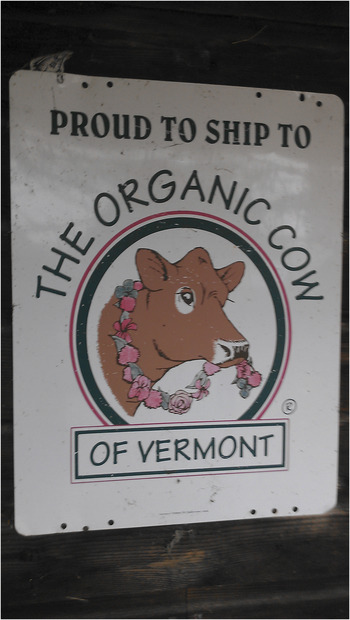
While the Organic Cow brand was eventually phased out, the company’s legacy lives on today in Vermont’s vibrant organic dairy community of more than 200 farms, including dozens that still have a sign outside the barn (Figure 2) that reads, “Proud to Ship to The Organic Cow of Vermont.”
Sign outside Vermont barn. Photo by Olivia Saucier.