In conversation with Natalie Bauer-Lechner during the summer of 1900, Gustav Mahler referred to his first four symphonies as ‘a perfectly self-contained tetralogy’.Footnote 1 Scholars have often recognized this grouping as a reflection of Mahler’s quotation of his own early song cycles in each of these works. According to Donald Mitchell, ‘If they are such [a tetralogy] – and perhaps “perfectly self-contained” is something of an exaggeration – it is surely because they all in various ways employ song, and more particularly Wunderhorn songs, or songs in the Wunderhorn manner (i.e. the Gesellen cycle), as a principal compositional technique.’Footnote 2 Constantin Floros’s short chapter ‘Fundamentals of “Tetralogy”’ in his Gustav Mahler: The Symphonies also acknowledges this shared self-quotation and the importance of Mahler’s use of the voice and the lied genre.Footnote 3 In addition to idiomatic similarities, Floros discusses aspects of ideology as a unifying element: all of Mahler’s symphonies share the project of expressing the composer’s world-view, seeking to answer personal, philosophical and religious questions. Floros writes, ‘The concept of “tetralogy”, of course, focuses more on the ideological connection between the four works. These are so close that they allow one symphony to appear as a continuation of another.’Footnote 4 The idea of a continued narrative across the four works might tempt us to look to Wagner as an inspiration for the grouping, given both his own characterization of the four Ring cycle operas as a tetralogy and Mahler’s enthusiasm for the operatic master. Yet Wagner’s finale, Götterdämmerung, differs quite significantly in tone from Mahler’s Fourth Symphony. Furthermore, the current explanations do not properly consider the characterization ‘perfectly self-contained’ – a formal distinction rather than one regarding content. Instead, ample evidence demonstrates that a more compelling understanding of Mahler’s ‘tetralogy’ should involve the tetralogies of ancient Greek Dionysian festivals, a specific formal construction that featured the performance of three serious tragedies and one concluding light-hearted satyr play.
While Mahler is likely to have learnt about the ancient world, including Dionysian festivals, as part of the neohumanist curriculum that became popular in Austrian schools beginning in the 1780s,Footnote 5 the composer’s interactions with the writing of Friedrich Nietzsche, especially The Birth of Tragedy Out of the Spirit of Music (Die Geburt der Tragödie aus dem Geiste der Musik) and Thus Spoke Zarathustra (Also sprach Zarathustra), are arguably a more important part of this reading of his early works. Nietzsche’s discussion of the dramatic tetralogy in The Birth of Tragedy gives considerable weight and crucial importance to the fourth, humorous work, and scholars have argued that the juxtaposition of tragic and comic was fundamental to Nietzsche’s own writings, including Thus Spoke Zarathustra and The Gay Science (Die fröhliche Wissenschaft). Similarly, joviality was clearly integral to the way in which the composer conceived the final quarter of his grouping. Nietzsche’s influence during this period is also evidenced by epistolary comments, trial titles for the Third Symphony and the composer’s setting of poetry from Thus Spoke Zarathustra. This article not only clarifies Mahler’s own comment about his early Wunderhorn symphonies, but also provides evidence for a more sophisticated and specific reading of Nietzsche’s philosophy than has been previously discussed. Getting to the root of Mahler’s ‘tetralogy’ characterization goes beyond the overt, but often unexplained, references to Nietzsche that the composer himself used, and demonstrates an engagement and agreement with the Nietzschean view of the redemptive effects of the musical arts.
The tragic trilogy
Mahler’s tetralogical characterization was made retrospectively, and was not the only description of the early symphonies that the composer gave. As a result, aligning his comments with this model is not entirely flawless: there is no evidence, for example, that he ever intended the works to be performed consecutively, as tetralogies were in ancient Greece (or as Wagner intended the Ring cycle – a different type of tetralogy – to be performed). Nonetheless, there is ample evidence for aligning Mahler’s self-proclaimed tetralogy with those of the ancient world, most importantly the overall formulation of three more serious works followed by a light-hearted drama – the satyr play – on a shared subject. The central purpose of this article is to offer a reading of the Fourth Symphony as a satyr play and thus to clarify Mahler’s tetralogical comment. However, in order to suggest that Mahler’s remark about his first four symphonies corresponds to this ancient tradition, the interpretation of the first three symphonies as tragedies first requires some discussion.
The performance of tragedy in ancient Greece was meant to reaffirm man’s connection to others through the shared experience of watching a drama, accompanied by music, in which a hero wrestles with basic conflicts of human existence. According to Aristotle’s Poetics, part of the social purpose of tragedy is catharsis. Although the proper definition of this term is heavily disputed, it may nonetheless be reduced here to the following: by viewing the tragic circumstances of a hero on stage, we empathize with the hero’s trial and are also purified by witnessing the hero’s fate. We experience the consequences of his actions through observation – very often inspired by common impulses – without suffering them ourselves.Footnote 6 Aristotle writes,
Tragedy, then, is an imitation of an action that is serious, complete, and of a certain magnitude; in language embellished with each kind of artistic ornament, the several kinds being found in separate parts of the play; in the form of action, not of narrative; through pity and fear effecting the proper purgation [catharsis] of these emotions.Footnote 7
The subject of a tragic drama would be easily accessible to members of the audience, the population of the city. The struggle of the protagonist would therefore need to be an essentially human one: heartbreak, loss, the cost of hubris, divided allegiances and so on. Not only would the audience be able to empathize with these types of emotional hardship, but it would also find the display therapeutic and educational as a result of viewing the consequences played out in the theatrical setting of the Dionysian festival.
While the programmes of the first two symphonies deal quite explicitly with tragic topics, that of the Third is more opaque. However, William McGrath has already done much of the work of interpreting the Third Symphony in tragic – and Nietzschean – terms. In his article ‘Mahler and the Vienna Nietzsche Society’, he connects in detail the content and intention of Mahler’s Third Symphony to the practices of ancient drama through Mahler’s membership in the Pernerstorfer Circle.Footnote 8 The circle consisted of students at the University of Vienna who read and discussed art, politics and literature, including the works of Nietzsche. Members of the circle even pledged their allegiance to the philosopher in a birthday letter in which they informed him of his role ‘as our luminous and transporting guide’.Footnote 9 This devotion leads McGrath to base his tragic reading of Mahler’s Third Symphony on the dual components of tragedy defined by Nietzsche: Dionysus’ frenzied intoxication and affirmation of man’s relationship to others through commiseration over life’s great struggles, and Apollo’s explanatory veil through which we must see the world in order to carry on living.Footnote 10
McGrath notes that, ‘Mahler created a Nietzschean framework to convey an idea of community that is expanded to embrace not only all of humanity but all levels of being in the world of nature,’ basing his analysis on the religious prototragedy Nietzsche describes in The Birth of Tragedy:
The prototragedy consisted of a chorus of Satyrs whose Bacchic celebration first drew the aesthetically participating audience into the chorus, and then projected its Apollonian vision of the god into the center of the celebration. The effect of this, according to Nietzsche, was to make the individual aware of himself as a part of all being (the assumption into the chorus) and then to allow him to transcend willing and find peace in reunion with the All (the Apollonian vision).Footnote 11
Correlating these two components with the two parts of Mahler’s Third Symphony, McGrath writes,
The symphony is divided into a long first movement which performs the role of the ancient Greek chorus by evoking the tremendous power of Dionysian emotion, and this is followed by an Apollonian vision in which movements two through six reveal how the hierarchy of being reflects the inner relationship between the underlying Dionysian unity and the particular forms in which life appears.Footnote 12
McGrath’s interpretation of the Third Symphony as tragic drama is then built on a structural model: the opening Satyr procession followed by the Apollonian revelations.
It should be noted that McGrath’s reading, and any other that interprets the Third as tragedy, might seem to overlook Mahler’s reported concern that the public would not understand the humour of the symphony.Footnote 13 However, these remarks frequently date from earlier incarnations of the work, which included a final movement entitled ‘Was mir das Kind erzählt’ (‘What the Child Tells Me’). This finale, the light-hearted Des Knaben Wunderhorn song ‘Das himmlische Leben’ (‘The Heavenly Life’), instead became the final movement of what is argued here to be the more humorous Fourth Symphony. What is perhaps more important is that Mahler’s friend and confidante Bauer-Lechner noted in her recollections of the composer that, ‘The content of all these works [the first three symphonies] is, in the main, profoundly tragic. Mahler himself said that anyone hearing them would be totally shattered.’Footnote 14
The First and Second Symphonies can be considered perhaps more concretely to be akin to ancient Greek tragedies, especially knowing that the composer had some education about the classical world. While the gradual accumulation of knowledge through the insight of the world’s creatures depicted in the Third Symphony mirrors tragedy’s ability to reveal lessons about existence to its audience, the programmes of the first two symphonies deal even more explicitly with topics of the tragic genre. Both symphonies concern a heartbroken lover – a semi-autobiographical character informed in part by Mahler’s unhappy love affair with the soprano Johanna Richter. Henry-Louis de La Grange summarizes a number of programmatic clues provided by Mahler about the First Symphony (which at this point included the original second movement, ‘Blumine’) that were reported in a review by Kornel Ábrányi printed in the journal Pester Lloyd in advance of the première in Budapest in 1888:
The first movement is described as ‘spring sounds’, the second as a ‘serenade’ evoking love’s rapture, the third as a ‘bridal procession expressing boundless joy and delight’, and the fourth as a funeral march inspired by the ‘Huntsman’s Funeral’, representing the burial of the symphonic hero’s illusions. The finale was ‘the victory of the hero who has been beaten to the ground, but who rises anew and triumphs because he has succeeded in creating his own inner world, which neither life nor death can take away from him […] in the course of this transformation, the memory of lost illusions, contained in all the previous themes, returns, as if the sun were suddenly emerging after a stormy night’.Footnote 15
Although the First Symphony’s initial title, ‘Titan’, has frequently been linked to the Jean Paul novel of the same title, which Mahler knew and admired, Bauer-Lechner recalled that Mahler meant only to depict ‘a powerfully heroic individual, his life and suffering, struggles, and defeat at the hands of fate’.Footnote 16 Bauer-Lechner’s account of Mahler’s own characterization of the work – which included ‘suffering’, ‘struggles’ and ‘defeat’ – reveals, despite a triumphant conclusion, the profoundly tragic elements of the composer’s narrative.
In the Second Symphony, the same hero continues to grapple with the tribulations of unrequited love. In a letter to the critic Max Marschalk in 1896, Mahler wrote, ‘I called the first movement “Todtenfeier”, and if you want to know, it is the hero of my D-major [First] Symphony whom I am bearing to the grave, and whose life I, from a lofty vantage point, reflect in a clear mirror.’Footnote 17 The first movement, originally written as a stand-alone symphonic poem, shares its title with Siegfried Lipiner’s translation of Adam Mickiewicz’s epic poem Dziady, which concerns the eastern European festival for wandering souls stuck in purgatory.Footnote 18 The composer’s handwritten programme of the symphony from December 1901 includes the following details. In addition to setting the scene of the hero’s funeral, the first movement asks, ‘What now? What is this life – and this death? Do we have an existence beyond it? Is all this only a confused dream, or do life and this death have a meaning? – And we must answer this question if we are to live on.’Footnote 19 The next three movements each provide a glimpse of the hero’s life. The second movement depicts ‘a happy moment from the life of his beloved departed one, and a sad recollection of his youth and lost innocence’, whereas the third presents the desperation and confusion that come about as a result of his unrequited love. In the fourth movement Mahler sets the Wunderhorn song ‘Urlicht’ (‘Primeval Light’), a meditation on existence and the afterlife. The finale begins with a ‘cry of desperation’ as we once again ponder the opening movement’s questions: ‘The end of all living things is at hand, the last judgment is announced and [all] the whole horror of that day or days has set in. – The earth trembles, graves burst open, the dead arise and step forth in [long] endless files.’ As we approach eternal judgment, ‘the “great summons” is heard; trumpets call from the Apocalypse’ before the soft and heavenly chorus of Klopstock’s ‘Auferstehung’, about which Mahler wrote the following:
There appears the glory of God! A wonderful gentle light permeates us to our very heart – all is quiet and blissful! – And behold: there is no judgment – There is no sinner, no righteous man – no great and no small – There is no punishment and no reward! An almighty feeling of love illumines us with blessed knowing and being!
The three tragedies of the Dionysian festival were often interrelated in some way. They presented the same characters or developments of the same story. In Mahler’s first two symphonies, the connection between the programmes of the two works is most conspicuously their treatment of the same hero. The connection between the content of the first two symphonies and that of the third is more rhetorical. In 1896, Mahler himself linked the Third Symphony to the first two, saying, ‘It’s the best and most mature of my works. With it I shall conclude my “Trilogie der Leidenschaft”’ – a term alternatively translated as ‘passion’ or ‘suffering’ which the composer used to bookend his first three symphonies.Footnote 20 This characterization could very possibly also be an allusion to Goethe’s Marienbad Elegy, a poem in the lament genre to which the author gave the same title.Footnote 21 The content of both works was inspired by unrequited love, with Goethe’s poem depicting his own devastating sadness. Should Mahler be referencing Goethe with this comment, he provides further evidence for a tragic reading of the first three symphonies. Alternatively, Peter Franklin explains his interpretation of the connection between the works, saying that the Third Symphony ‘was to celebrate the “happy life” that the Second had inaugurated after dispelling apocalyptic hours with its concluding choral hymn to the individual spirit’.Footnote 22
The Third Symphony’s ultimate aim is defined by the subtitle of the final movement: ‘Was mir die Liebe erzählt’ (‘What Love Tells Me’). The trajectory of the work gradually reveals a series of truths, culminating with that of love, the motivating force of the first two symphonies. Yet it is not simply romantic love that these works communicate; Mahler described the last movement of the Third Symphony by saying, ‘It is the last stage of differentiation: God! Or if you like, the Übermensch.’Footnote 23 Mahler’s somewhat strange characterization of the final movement reveals an understanding of the Übermensch and the concept of overcoming not as an ultimate position to be achieved at the expense of others, but as a divine project that brings one closer to God. In addition to being the aim of the Third Symphony, the idea of overcoming is also intrinsically linked to the finale of the Second Symphony, where, in the wake of heartbreak, the hero must overcome his grief and learn to rise again. In the finale of the First Symphony, the hero also triumphs over his disappointment by creating his own inner world, effecting a form of transcendence whereby the external causes of his pain can no longer prolong his suffering. In this way, all three early symphonies are not only about romantic love, but also about self-acceptance and self-promotion. By presenting his hero’s romantic disappointments, Mahler assures listeners that they are not alone in similar struggles, nor are they incapable of overcoming their hardships – a project similar to that of ancient Greek tragedy.
Objections to the comparison of these programmes with those of tragedy will probably hinge on the observation that they all seem in some way to have untragic conclusions. However, not all ancient Greek tragedies end tragically; in fact a number have something of a triumphant ending. Among these are Euripides’ Orestes and The Bacchae, the former ending with the intervention of a deus ex machina who puts all things right, while the latter culminates with the protagonist of the drama himself, Dionysus, securing his deserved recognition, albeit with gruesome consequences for members of his family. It is interesting to note here not only that the complete works of Euripides were among the few tomes of classical literature in Mahler’s library,Footnote 24 but also that according to Bauer-Lechner he was reading The Bacchae in the summer of 1899, a year before describing the first four symphonies as a ‘tetralogy’ and the year he began composing the Fourth.Footnote 25
Ancient tragedies might productively be viewed in terms of a conclusion that is often, in fact, victorious. The struggle through deception and the ultimate arrival at a positive outcome that is modelled by the narrative of Mahler’s First Symphony is mirrored in Sophocles’ Philoctetes. Footnote 26 In Aeschylus’ Eumenides, justice ultimately triumphs with the establishment of the judicial system. The victor of these works is not necessarily an individual human actor, but rather a particular ethos. It is the victory of a certain attitude towards the world and a consequent way of being that is also reflected in Mahler’s symphonies. Further examples include the conclusion of Sophocles’ Ajax, in which the final line reads, ‘There is nothing here that is not Zeus,’ a sentiment that might be posited as a corollary to the resurrection in the finale of the Second Symphony. Sophocles’ Oedipus at Colonus, the conclusion of which expresses a view of the world that is essentially tragic, may be the most illuminating: we suffer, we die, but in the end there is something triumphant about our existence.Footnote 27 Despite its name, what is more indicative of the genre of ancient tragedy is the use of the chorus to enhance the catharsis experienced by the drama’s viewers.
Mahler’s early symphonies, too, employ choruses in powerful ways. The use of voices appears in the finale of the Second Symphony, premièred in 1895 when the practice was still somewhat new, and continues in the fifth movement of the Third Symphony.Footnote 28 Mahler’s choruses function in similar ways to those of the ancient practice, frequently providing a commentary that complements the work’s narrative. In the Third Symphony, the chorus appears at a crucial moment in the penultimate movement, and provides observations of both mankind and his search for knowledge – the core of the symphony’s narrative according to Mahler’s programme. The chorus responds to the creed for earthly fulfilment in Zarathustra’s ‘Mitternachtslied’ (‘Midnight Song’) with a celebratory tale of its heavenly counterpart in the Wunderhorn song ‘Es sungen drei Engel’. It further unites mankind under the redemption of God’s love, despite doubts about our collective worth.Footnote 29 In the Second Symphony, the chorus similarly sings the ‘moral’ of the narrative – our individual and collective abilities to overcome, to ‘rise again’.
Numerous scholars have further observed Mahler’s use of instrumental choruses. Among them, McGrath identifies the presence of the ancient chorus in the opening movement of the Third Symphony. This instrumental choir performs the same function as the opening chorus, the parode, of the ancient genre, drawing the audience into the Dionysian, self-nullifying power of the performance.Footnote 30 Mark Evan Bonds interprets the finale of the First Symphony as a form of instrumental chorus, writing, ‘Although purely instrumental, the movement ends with a chorale-like theme whose character is decidedly vocal.’Footnote 31 Like ancient tragedies, Mahler’s early programmes utilize these choral moments to depict the nobility and the innate triumph of human suffering. Man certainly suffers in both the First and Second Symphonies – he even dies in the Second – but he ultimately triumphs. In Mahler’s works, mankind can overcome pain and find meaning in life.
Here Nietzsche appears again. The act of overcoming and creating our own meaning is in itself a Nietzschean trope. It is almost exactly the path of Zarathustra’s Übermensch, a correlation that might explain Mahler’s use of poetry from Thus Spoke Zarathustra in the Third Symphony. Even in his description of the marriage of Apollonian and Dionysian forces in the performance of Attic tragedy, Nietzsche acknowledges the triumphant effect of their combination. He writes,
The two antagonists were reconciled; the boundary lines to be observed henceforth by each were sharply defined, and there was to be a periodical exchange of gifts of esteem. At bottom, however, the chasm was not bridged over. But if we observe how, under the pressure of this treaty of peace, the Dionysian power revealed itself, we shall now recognize in the Dionysian orgies of the Greeks, as compared with the Babylonian Sacaea with their reversion of many to the tiger and the ape, the significance of festivals of world redemption and days of transfiguration.Footnote 32
Other details upon which a dramatic reading of the first three symphonies can be based – including the use of symphonic space, accompanying programmes, vocal parts and song quotations – have been discussed by other authors.Footnote 33 Yet when these elements are considered alongside the narratives of Mahler’s first three symphonies, a strong correlation with the tragic trilogy of Dionysian festivals appears: Mahler’s Trilogie der Leidenschaft employs tragic narratives or subject matter, and its music applies unique elements of drama that heighten the listener’s emotional response.
The satyr play
Dionysian festival performances concluded the presentation of three tragedies with a fourth, comic, drama called the satyr play. This four-part structure was most prevalent during the fifth century BC, with works of Aeschylus serving as examples.Footnote 34 The satyr play is of crucial importance to the interpretation of Mahler’s tetralogical comment as a reference to ancient dramas, as it is the final light-hearted drama that differentiates the ancient tetralogy from other tetralogies such as Wagner’s Ring cycle.
Whereas the differences between the Old Comedy (of Aristophanes) and the New Comedy (of Menander) are generally agreed upon, the distinctions between the comic, satyr drama and satire are still quite fraught, even among classicists. This is not least because much important primary literature, such as the second book of Aristotle’s Poetics (which is believed to have contained a discussion of satyr play as well as a number of examples of the genre), is lost.Footnote 35 Given this dearth of primary sources, it is perhaps unsurprising that the genre has generally received little scholarly attention.Footnote 36 According to classical scholarship on the elements of tetralogy, ‘Satyr-drama is often lost in the excitement over the more serious tragedies, and when it is considered, it is seen as a pleasant way to cheer up an emotionally drained audience.’Footnote 37 Mark Griffith, who has written comprehensively about the role of the satyr play, further notes that ‘the social function and aesthetic-emotional appeal of the Athenian fifth-century satyr plays have been of only marginal interest to most scholars of tragedy’ and that ‘the satyric component of the annual tragedy-competition has been downplayed’.Footnote 38
Nonetheless, some recent scholarship has attempted to identify and codify elements of satyr play. Given that these works were composed by tragedians and played a role in tragic competitions, they have frequently been discussed in relation to tragedies. Yet Carl A. Shaw’s 2014 Satyric Play argues that comedy and satyr play are more closely connected than satyr play and tragedy, emphasizing the comic elements of the satyr genre.Footnote 39 Griffith further explores a number of characteristics that define the satyr play and differentiate it from both tragedy and comedy, including tone, character relationships and the occasional infiltration of humour with moments of seriousness.Footnote 40 Scholars have observed that the tone of the satyr play is similar to that of fairy tales. These plays often take place ‘out in the wilds; amazing and delightful discoveries are made (a baby in a floating box, fire in a fennel-stalk, the first lyre made from a tortoise-shell, etc.)’.Footnote 41 Beyond the whimsical, satyr plays also invoke something akin to a moral. Rather than mere entertainment, the satyr play offers an underlying life lesson. Finally, character relationships take a unique form in the satyr genre. The interactions of the story are typically based on ‘two groups of characters, sharply distinct, yet incongruously and inextricably linked. Or we could say, in Aristotle’s terms, that a single “action” (praxis) or “story” (muthos) is “imitated” (enacted, represented) simultaneously by two different classes of performer, one “serious” (spoudaios), the other “low” (paulos) or “ridiculous” (geloios).’Footnote 42
Given that the satyr play is one part of a greater whole (the tetralogy), it often deals with the same or similar themes as the tragedies that precede it. These themes are serious, and the satyr play’s connection to the topics of tragedy results in moments of seriousness even within the final playful piece. The heroes of the satyr play are ‘often found delivering speeches of quite serious ethical and rhetorical content (unlike those of Old Comedy, where even morally and politically serious speeches always have to be spiced up with jokes, allusions, and some comic hyperbole)’.Footnote 43 The elements, then, that will be considered in my analysis of Mahler’s Fourth Symphony as indicative of the satyr genre are an overall comic tone with the presence of fantastical and mythical subject matter; a conclusion featuring something akin to a moral; moments of seriousness that interrupt the humorous; and the interactions of individuals or elements from distinct and opposite groups affecting a comic binary – low and high, prosaic and incredible, terrestrial and celestial.Footnote 44
Despite the absence of long-standing interest in the satyr play, a philosopher who placed a considerable weight on the role of the satyrs and their comic lack of pretensions also happens to be one in whom Mahler found himself interested. In The Birth of Tragedy Nietzsche writes,
Here, when the danger to his will is greatest, art approaches as a saving sorceress, expert at healing. She alone knows how to turn these nauseous thoughts about the horror or absurdity of existence into notions with which one can live: these are the sublime as the artistic taming of the horrible, and the comic as the artistic discharge of the nausea of absurdity. The satyr chorus of the dithyramb is the saving deed of Greek art.Footnote 45
According to Nietzsche, the combination of the tragic and humorous elements that appear in the tetralogy’s conclusion has the power of salvation that man desperately needs.Footnote 46 The essential nature of the human struggles presented in tragic drama casts a pall over our notion of existence, which can be viewed, at best, as absurd. Our response to the tragedy and pointlessness of life manifests as a kind of nausea that is cured only by looking at the same struggles from a comical perspective. It is only through this juxtaposition that we are inspired to keep living. A discussion with Bauer-Lechner about the Third Symphony further suggests that the importance of the role of humour to the philosopher had also imprinted on Mahler. Bemoaning a colleague’s misunderstanding of the juxtaposition of the seriousness of the fourth movement with the light-hearted nature of the fifth, Mahler said, ‘He didn’t understand (and, incidentally, only the fewest of the few can grasp such a thing) how the humour here has to aim at such heights of expression where all other means fall short.’Footnote 47
Mahler was introduced to Nietzsche’s writings by his university friends – as McGrath notes, members of the Pernerstorfer Circle.Footnote 48 This group included Victor Adler, Heinrich Friedjung, Richard von Kralik, Siegfried Lipiner and Engelbert Pernerstorfer, among others – men who would become important politicians and writers in the years from 1890 to 1915. Of Nietzsche’s works, it is certain that the group read The Birth of Tragedy and Untimely Meditations (Unzeitgemässe Betrachtungen), and the call for cultural community underlying Nietzsche’s discussion of the Greek dramatic tradition in The Birth of Tragedy resonated profoundly with the group’s members. Rudolf Ardelt, a biographer of Adler’s son Friedrich, reports that the group also read Thus Spoke Zarathustra,Footnote 49 and Mahler’s documentable interaction with the philosopher’s work is perhaps most obvious in his setting of the ‘Midnight Song’ from Thus Spoke Zarathustra in the middle of the Third Symphony.
Mahler’s use of text from Thus Spoke Zarathustra, a work that repeatedly celebrates laughter, connects him in yet another way with Nietzsche’s positive view of the role of humour. In addition to Nietzsche’s comments in The Birth of Tragedy about the importance of the satyr play in ancient drama, the regard Nietzsche held for the juxtaposition of tragic and comic can be seen in the philosopher’s own writing; it has been specifically suggested that the four parts of Thus Spoke Zarathustra bear a striking resemblance to the tetralogical structure established in ancient Greece. In 1973, Eugen Fink was the first to suggest this structural reading, and other scholars have followed.Footnote 50 Paul Loeb, who has been the most overt proponent of this reading, writes,
Nietzsche provides clues that his design of the entire Zarathustra was modeled from the start on a particular kind of Aeschylean tragedy; and also that his design of Part IV was modeled on the satyr play at the end of the tetralogy that parodied the thematically related material in the preceding trilogy.Footnote 51
Whether or not the structure of Thus Spoke Zarathustra is based on the tetralogies of ancient Greece, the emphasis Zarathustra places on laughter is undeniable. In Part IV, he tells his disciples about the qualities possessed by ‘higher men’. Even if these higher men cannot overcome themselves and become Übermenschen, the most important trait they can possess is a distrust towards everything, learning simply to laugh and dance.
Lift up your hearts, my brothers, high, higher! And do not forget your legs! Lift up your legs, too, you good dancers; and better yet, stand on your heads!
This crown of him who laughs, this rose-wreath crown, I myself have put on this crown, I myself have pronounced my laughter holy. Nobody else have I found strong enough for this today.
Zarathustra the dancer, Zarathustra the light, waves with his wings, ready for flight, waving at all birds, ready and heady, happily lightheaded; Zarathustra the soothsayer, Zarathustra the sooth-laugher, not impatient, not unconditional, one who loves leaps and side-leaps: I myself have put on this crown!
[…] This crown of him who laughs, this rose-wreath crown: to you, my brothers, I throw this crown. Laughter have I pronounced holy; you higher men, learn to laugh!Footnote 52
The centrality of laughter and comedy to Nietzsche’s philosophy in general has been commented on by several scholars. Vera Micznik has pointed out that sections of The Gay Science – a title Mahler once considered appropriating for his Third Symphony – also celebrated humour. The preface reads: ‘If we convalescents still need art, it is another kind of art – a mocking, light, fleeting, divinely untroubled, divinely artificial art that, like a pure flame, licks into unclouded skies […] what above all is needed for this: cheerfulness.’Footnote 53 In an essay entitled ‘Nietzschean Laughter’, Pete Gunter has suggested that the leitmotif of laughter is so prevalent and integral to the philosopher’s work ‘that with certain qualifications Nietzsche’s thought may be said to comprise not a tragic but a “comic” philosophy’.Footnote 54 Given these readings of Nietzsche and quotations from his work, it is no surprise that the philosopher put a unique emphasis on the light-hearted finale of ancient Greek tetralogies.Footnote 55
The ‘characteristic’ Fourth Symphony
The interpretation of Mahler’s 1900 grouping of his first four symphonies as an ancient tetralogy relies on correlating the Fourth Symphony with a satyr play, with its generally comic tone, its use of the fantastical and whimsical, its underlying moral and its distinctive interactions of opposing characters. There is much evidence for this reading, beginning with the fact that Mahler gave an early sketch of the Fourth Symphony the title ‘Humoreske’.Footnote 56 Derived originally from a term for literary sketches, ‘humoresque’ (or ‘Humoreske’) denoted works that were capricious and gave composers an opportunity to show liveliness and wit. Although Mahler eventually eliminated the symphony’s title, the final movement – a setting of ‘Das himmlische Leben’ towards which the entire symphony builds – maintains the humorous quality it originally suggested. Raymond Knapp has pointed out that the child’s vision of heavenly life relayed in ‘Das himmlische Leben’ includes the depiction of saints through ‘the activity of domesticating these rather scary religious figures, so that the child might laugh at what must normally be either taken seriously or even feared’.Footnote 57
Much of the literature about Mahler’s Fourth Symphony has emphasized the role of childhood and innocence, and this is not incongruous with the satyr play. Correlations between children and satyrs recur numerous times. According to Griffith, satyrs are ‘permanently childish’ and ‘impressionable, ineffectual, pleasure-seeking’ beings who attempt to ‘draw the audience down with them, to share a more childish fantasy of dependence, pretence, desire, irresponsible spectatorship, and instant gratification’.Footnote 58 This characterization may seem to bear a tone of judgment that is more negative than discussions of childhood in Mahler’s Fourth Symphony, but Griffith also notes that satyrs ‘are not present or perceived as the audience’s enemies, nor as the objects of strong disapproval or antipathy: rather, they are the audience’s friends, and in certain respects the projections and embodiments of some of its most childish and simple desires’.Footnote 59 Although the childlike elements discussed in Mahler’s Fourth are associated with innocence rather than immaturity, as the description of childishness in the satyr play suggests, the two types are not unrelated; the manifestation of one’s ‘most childish and simple desires’ is born from an innocence that demands those things we as adults come to see as unreasonable. Given the text of ‘Das himmlische Leben’ (see Table 1), the projection of childish desires – a child’s vision of heaven complete with the domestication of figures known to the adult world to be symbols of judgment and pain – is exactly what Mahler creates.
‘DAS HIMMLISCHE LEBEN’
| Wir geniessen die himmlischen Freuden, D’rum tun wir das Irdische meiden. Kein weltlich’ Getummel Hört man nicht im Himmel! Lebt Alles in sanftester Ruh’! |
We delight in heavenly joys, And therefore avoid the earthly. No worldly turmoil One does (not) hear in Heaven! Everything lives in the gentlest quiet! |
| Wir fuhren ein englisches Leben! Sind dennoch ganz lustig daneben! Wir tanzen und springen, Wir hüpfen und singen, Sankt Peter im Himmel sieht zu! |
We lead an angelic life! Are at the same time still quite merry! We dance and spring, We jump and sing, Saint Peter in Heaven looks on! |
| Johannes das Lämmlein auslasset! Der Metzger Herodes drauf passet! Wir führen ein geduldig’s, Unschuldig’s, geduldig’s, Ein liebliches Lämmlein zu Tod! |
John lets the little lamb out! Butcher Herod watches for it! We lead a patient, Innocent, patient, A dear little lamb to death! |
| Sankt Lucas den Ochsen tät schlachten, Ohn’ einig’s Bedenken und Achten, Der Wein kost’ kein Heller Im himmlischen Keller, Die Englein, die backen das Brot. |
Saint Luke would slaughter the ox, Without any doubts and qualms, Wine costs not a farthing In the heavenly cellar, Angels bake the bread. |
| Gut’ Kräuter von allerhand Arten, Die wachsen im himmlischen Garten! Gut’ Spargel, Fisolen Und was wir nur wollen! Ganze Schüsseln voll sind uns bereit! |
Good vegetables of all kinds, Grow in the heavenly garden! Good asparagus, beans And whatever we might wish! Completely full platters are ready for us! |
| Gut’ Äpfel, gut’ Birn’ und gut’ Trauben! Die Gärtner, die Alles erlauben! Willst Rehbock, willst Hasen, Auf offener Strassen Sie laufen herbei! |
Good apples, good pears and good grapes! The gardeners allow them all! If (you) want a deer, or a hare, In the open street They run here! |
| Sollt ein Festtag etwa kommen, Alle Fische gleich mir Freuden angeschwommen! Dort läuft schon Sankt Peter Mit Netz und mit Köder Zum himmlischen Weiher hinein. Sankt Martha die Köchin muß sein! |
Should a feast day arrive, All fish will joyfully come swimming! Already Saint Peter runs there With net and with bait Into the heavenly fishpond. Saint Martha must be the cook! |
| Kein Musik ist ja nicht auf Erden, Die unsrer verglichen kann werden. Elftausend Jungfrauen Zu tanzen sich trauen! Sankt Ursula selbst dazu lacht! |
No music exists on earth, That could be compared to ours. Eleven thousand maidens Venture to dance! Even Saint Ursula herself laughs! |
| Cäcilia mit ihren Verwandten Sind treffliche Hofmusikanten! Die englischen Stimmen Ermuntern die Sinnen! Daß Alles für Freuden erwacht. |
Cecilia with her relatives Are splendid court musicians! The angelic voices Enliven the senses! So that everything awakens for joy. |
Note: The English translation presented here is based on Knapp, Symphonic Metamorphoses, 18.
In response to the frequency of the ‘childhood’ reading of the Fourth Symphony, Knapp writes, ‘There would seem to be little room within this sentimentalized world for the symphony’s many contrasting and often contradictory elements, which therefore appear oddly dissonant, together serving as an example of Mahler’s eclectic mixing of perspectives in his symphonies.’Footnote 60 Knapp’s article goes on to offer a reading of childhood in the Fourth that is not so innocent and peaceful but rather filled with ambivalence and suffering, but it is his observation about mixed perspectives and contradictory elements that I wish to address. The Fourth Symphony makes great use – perhaps greater than any of Mahler’s preceding symphonies – of intersecting perspectives and the juxtaposition of inner and outer worlds, a style of humour that connects experiences that are normally independent of one another and is exemplified by writers Mahler admired deeply. According to Elisabeth Schmierer, ‘Humour [in the aesthetic manner of Jean Paul and E. T. A. Hoffmann] as a poetic category connects the terrestrial with the extraterrestial, the “small” world with the “infinite”, the lowly with the sublime; this comparison allows the recognition of the totality of the real world.’Footnote 61 In his discussion of Mahler’s particular interest in the work of Hoffmann, Donald Mitchell quotes a remarkable passage on Hoffmann’s style that appeared in The Times Literary Supplement on 21 May 1970:
[Hoffmann’s] vivid evocation of vanished historical periods; his original blend of art-criticism and storytelling; his startling transitions from immersion in horror to ironic contemplation; his mingling of the tragic and the ridiculous, the grotesque and the sublime, the fantastic and the real – all these make up a genuine and recognizable style which should assure him of a permanent place in the European pantheon. No one has depicted more successfully than he that narrow border between where the fantastic meets the everyday.Footnote 62
One might say that no composer has depicted more successfully than Mahler this ‘narrow border’, and this duality is remarkably similar to one of Griffith’s identified components of satyr play: the interaction between two unrelated, even opposing, characters.Footnote 63
The combination of contrasting characters in Mahler’s music is at the heart of Theodor Adorno’s monograph on the composer. Adorno notes that Mahler’s symphonies embody a duality between the subject and the object, writing that in Mahler’s music, ‘The subject is yoked into the world’s course without finding himself reflected in it or being able to change it.’Footnote 64 This sonic interaction between the perspective of the subject and a contrasting portrayal of the world around him – what Adorno calls the world’s course (Weltlauf), whether it be antagonistic, pleading or compromising – is uniquely articulated in Mahler’s works. Mahler’s music does not always portray a single narrative of events led by the actions of the hero. Instead, the composer often depicts a subject who feels disconnected from or at odds with the narrative surrounding him, which Mahler simultaneously relates. The sense of dichotomy is so typical of and prevalent in Mahler’s oeuvre that Adorno adumbrates a series of ‘characters’ – breakthrough (Durchbruch), suspension (Suspension) and fulfilment (Erfüllung) – solely attributable to his style that require the interaction of two distinct components, as in the humour of Hoffmann and the drama of satyr play.Footnote 65
Each of these characters involves the introduction of new and unexpected material and a consequent dialectic: an interaction of two different points of view. Although these Mahlerian characters appear throughout the composer’s works, Adorno referred to the Fourth as ‘the extreme example of the character symphony’.Footnote 66 Bonds has also noted that ‘the strategy of interruption and juxtaposition’ characterizes the Fourth Symphony in particular.Footnote 67 He further interprets the entire work as avoiding the grandness of the symphonic genre, writing, ‘For the first time in his avoiding output, Mahler abjures the idea of grand victory,’ and that the outcome is ‘antithetical to the symphony’s traditional aesthetic of monumentality’.Footnote 68 The following analysis outlines Mahler’s use of contrasting perspectives throughout the work and offers a musical basis for a reading of the Fourth Symphony as a satyr play.
Symphony no. 4 in G major
Movement I: Bedächtig, nicht eilen
More than Mahler’s earlier works, the Fourth Symphony employs Classical movement structures that provide a neat framework for contrast and the comic interaction of opposing sentiments. The first movement’s sense of comic duality is created primarily by two aspects: the competitive and conflicting interaction of the thematic actors – strings and winds – in the development; and the changing role of the Naturlaute from thematic complements to alien intrusions that disrupt and challenge the central melodic line. Mahler uses the structure of sonata form to take expository melodies that would normally be merely varied in the development and places them in contexts where they become legitimately incongruous and ill-fitted. The composer also employs several distinctive Naturlaute that, by alluding to life out of doors and in motion, contribute to the musical constructions of space that allow for impressions of being simultaneously within and without. These elements enable the composer to create a sense of dialogue between musical and extramusical worlds, a symphonic version of Hoffmann’s literary style.
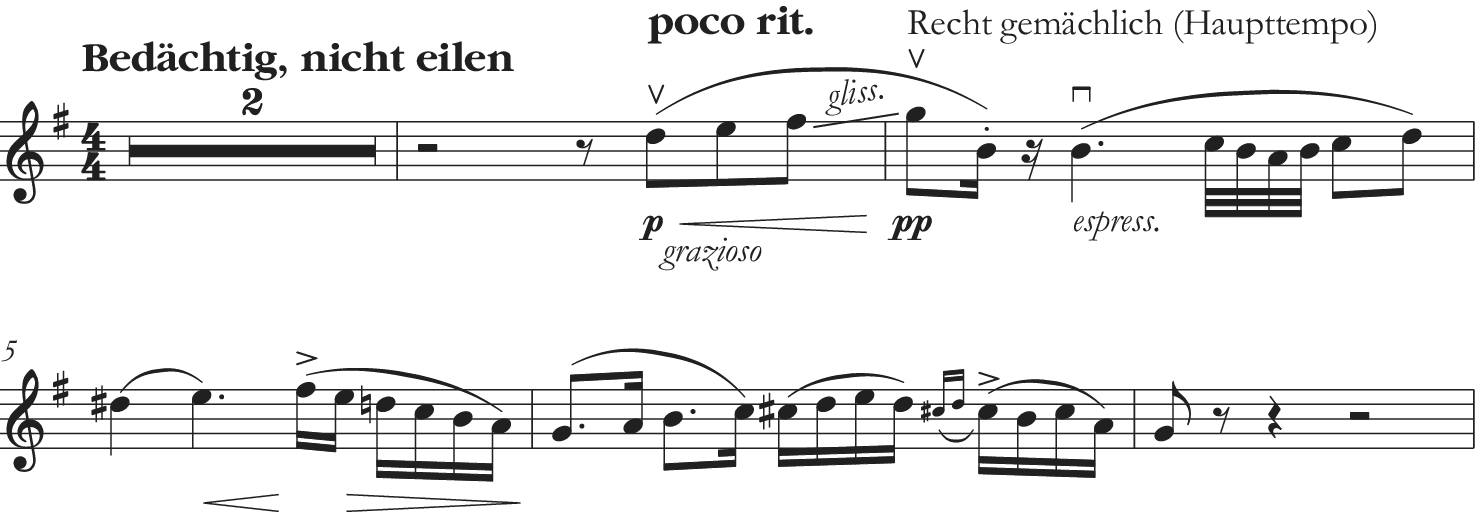
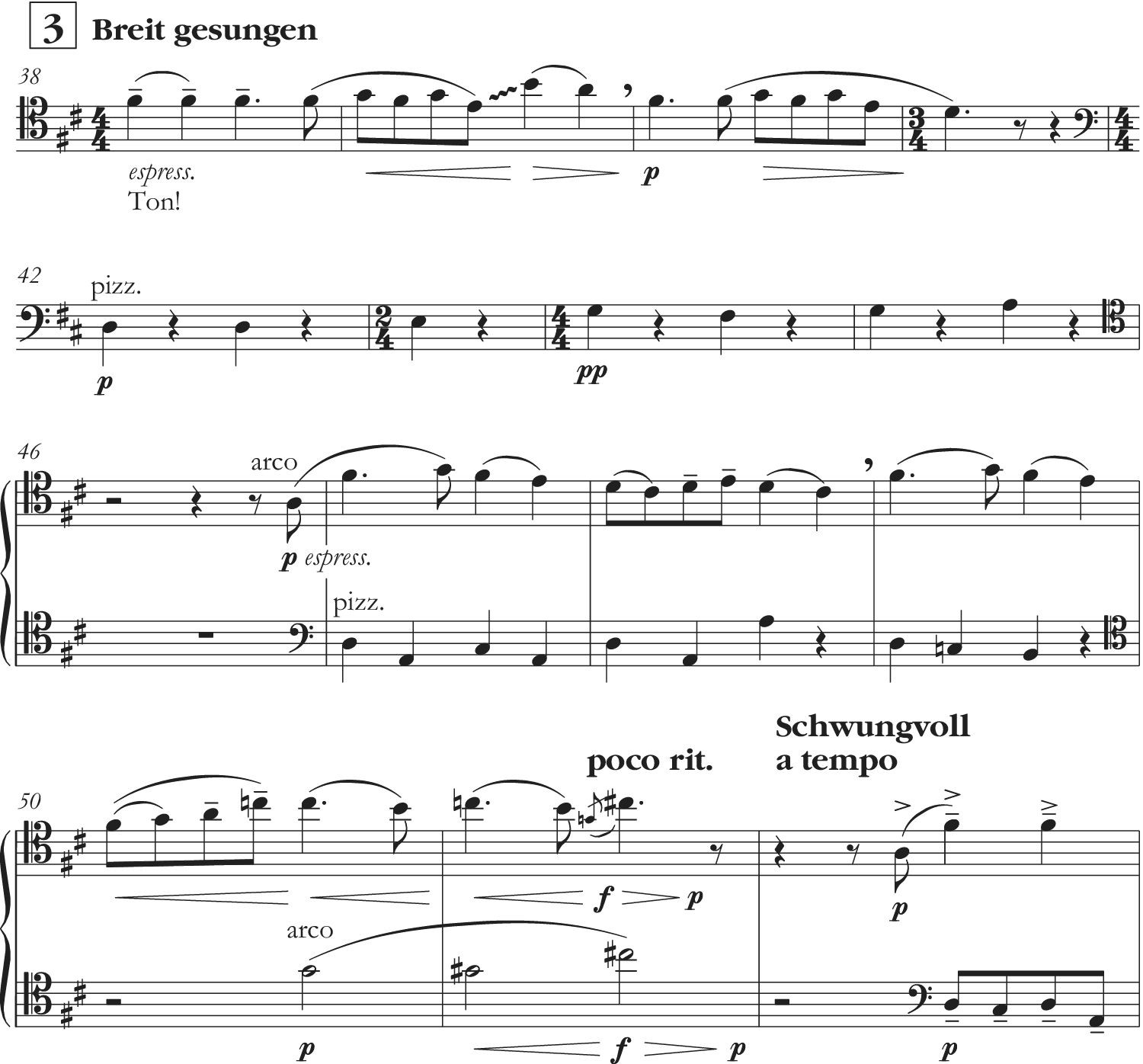
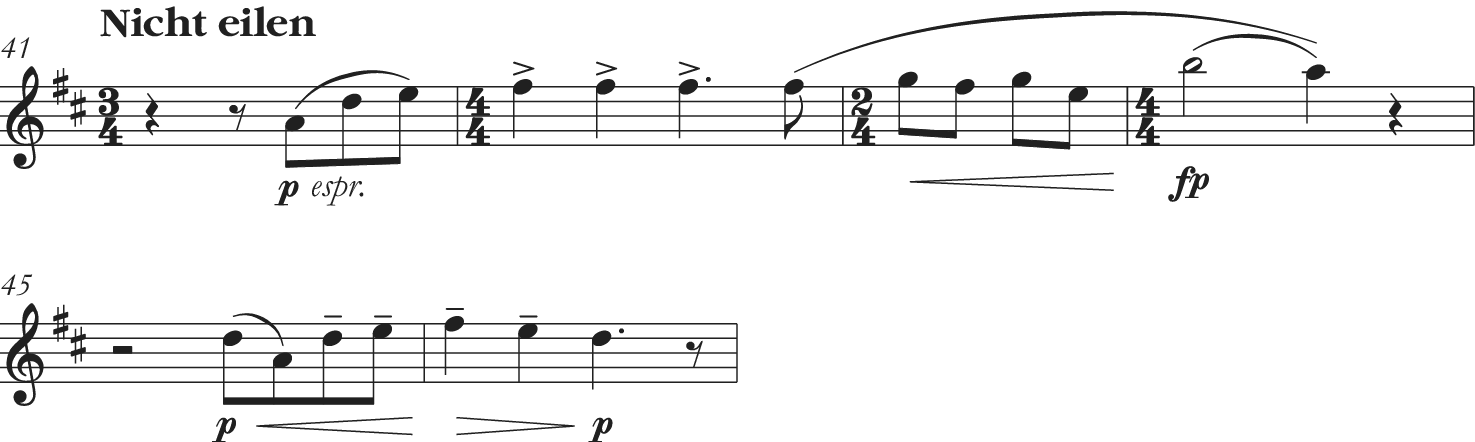
The primary-theme area of the first movement’s exposition begins with the sound of sleigh bells, which give way to a cheerful melody played by the first violins (see Example 1) and accompanied by complementary melodic fragments in the winds. The sleigh bells that introduce this opening passage, and each of their recurrences throughout the symphony, should be considered a form of Naturlaut, as the bells recall the image of sledding, a sense of being outside and experiencing nature. Their use operates in much the same way as hunting horns evoking the pastoral; they are man-made – even musical – sounds that nonetheless conjure a sense of the outdoors. The second thematic area begins at bar 38 and conventionally features a slower and more lyrical theme. The melody is played by the cello, again accompanied by the winds (see Examples 2 and 3).
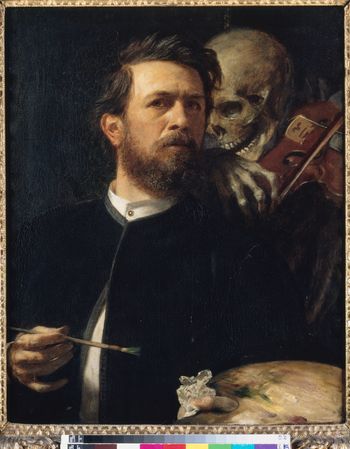
Arnold Böcklin (1827–1901), Self-Portrait with Death Playing the Fiddle. 1872. Oil on canvas, 75 x 61 cm. Inv. A I 633.
Photo: Joerg P. Anders. Location: Nationalgalerie, Berlin. Photo credit: bpk Bildagentur / Nationalgalerie, Berlin / Joerg P. Anders / ART RESOURCE, NY.

Mahler, Symphony no. 4, movement I, primary theme in violin I, bars 1–7.

Mahler, Symphony no. 4, movement I, secondary theme in cello, bars 38–52.

The development section, also introduced (at figure 8, bar 102) by sleigh bells, begins with a restatement of the primary theme. No longer in tune with its accompaniment, however, the opening melody, formerly cheerful, becomes dark and twisted. The brass emerges from the supporting role it played in the exposition and cuts across the symmetrical themes of the opening; the support the winds lent the strings in the exposition deteriorates and is replaced with the forceful entry of more prominent melodic figures. Throughout the development, the sleigh bells appear periodically, sprinkling the conflict between winds and strings with light-hearted irony. In contrast with their buoyant introduction of the exposition, they now appear taunting and satirical.
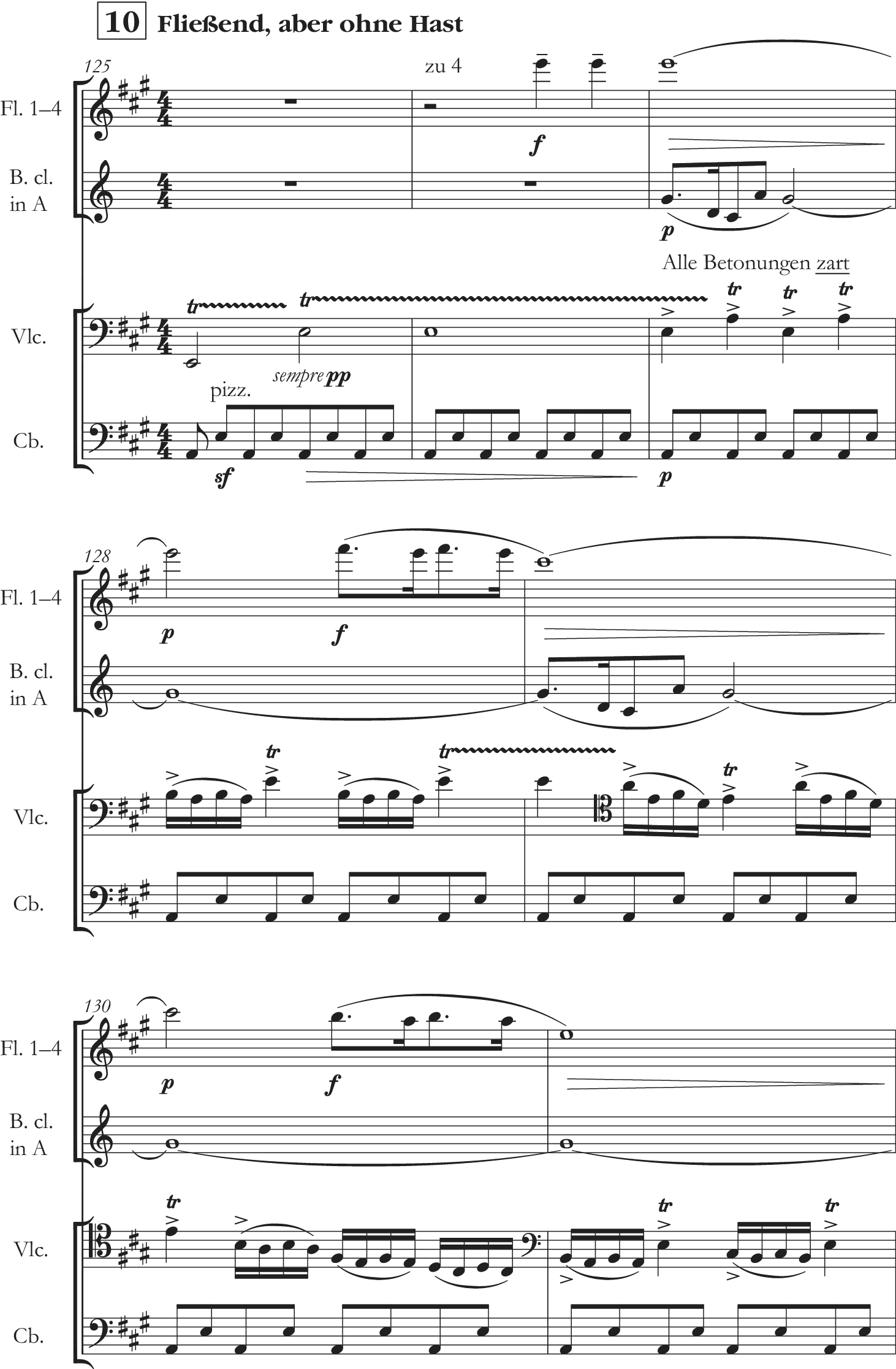
At figure 10, a new Naturlaut, an alpine cattle call in the flute, appears. Initially the call plays a role similar to that of the bells of the exposition, functioning as part of a new melody (see Example 4), yet as the clarinet begins to share the flute’s music at bar 147, a growing sense of disquiet appears in the form of chromatic runs in the strings. By bar 210, the cattle call finds itself straining to be heard over the battling brass and strings. While the horns and trumpets repeatedly punch out a marching melody in crotchets, the strings first try to respond with fortissimo chords. When they fail to impede the blasting brass, the cellos, violas and violins begin an assault via semiquaver runs and high-pitched tremolos. Ultimately, both forces gradually relinquish their grasp on the direction of the movement, fading from fortississimo to piano shortly before the recapitulation. The return of the opening cheerfulness, undermined by a sense of unease, is exemplary of the contradictory elements that are characteristic of satyr play and of humour in the style of Hoffmann and Jean Paul.
Mahler, Symphony no. 4, movement I, secondary theme in oboe, bars 41–6.

Mahler’s themes are not merely cultivated and varied in the development, they come into conflict with one another. The direction of the music becomes obscured and forward momentum is replaced by clashing perspectives. When the Naturlaute are a part of the melody, they evoke certain traditional relationships between music and landscape. However, when they are juxtaposed against the melodic line, they create a sense of being alternately within and without; by appearing to be in conflict with the melodic line, their allusions to the countryside place the melody distinctly apart from this formerly cohesive, pastoral landscape. The change in the music’s sense of space also creates another explicitly Hoffmannesque duality: the terrestrial and the extraterrestrial, serving as the basis for humorous interactions that portray the world in its entirety.
Movement II: In gemächlicher Bewegung
The second movement is a Scherzo and Trio, borrowing its structure from the form often used in the third movement of sonatas and symphonies.Footnote 69 Comically endowed by its literal translation (‘joke’), a Scherzo is faster and more playful than a Minuet, but still often paired with a contrasting Trio, which Mahler realizes in a more dignified tone. Although the Scherzo and Trio pairing is not uncommon in other Romantic works, Mahler’s music pointedly depicts the opposition between joke and stately dance. The Scherzo sections of the work feature a solo violin to be played in the style of a fiddle, lowering the tone of the ‘joke’ further through its instrumentation; stylistically at odds with this ‘folk’ character of the Scherzo, the Trio sections evoke aristocracy and hegemony thus reversing the traditional structure of the more elegant and bourgeois Minuet followed by the simpler Trio. Mahler’s approach to the dual dance movement creates a comical juxtaposition of high and low cultures both by enforcing their stereotypes and by inverting their conventions.
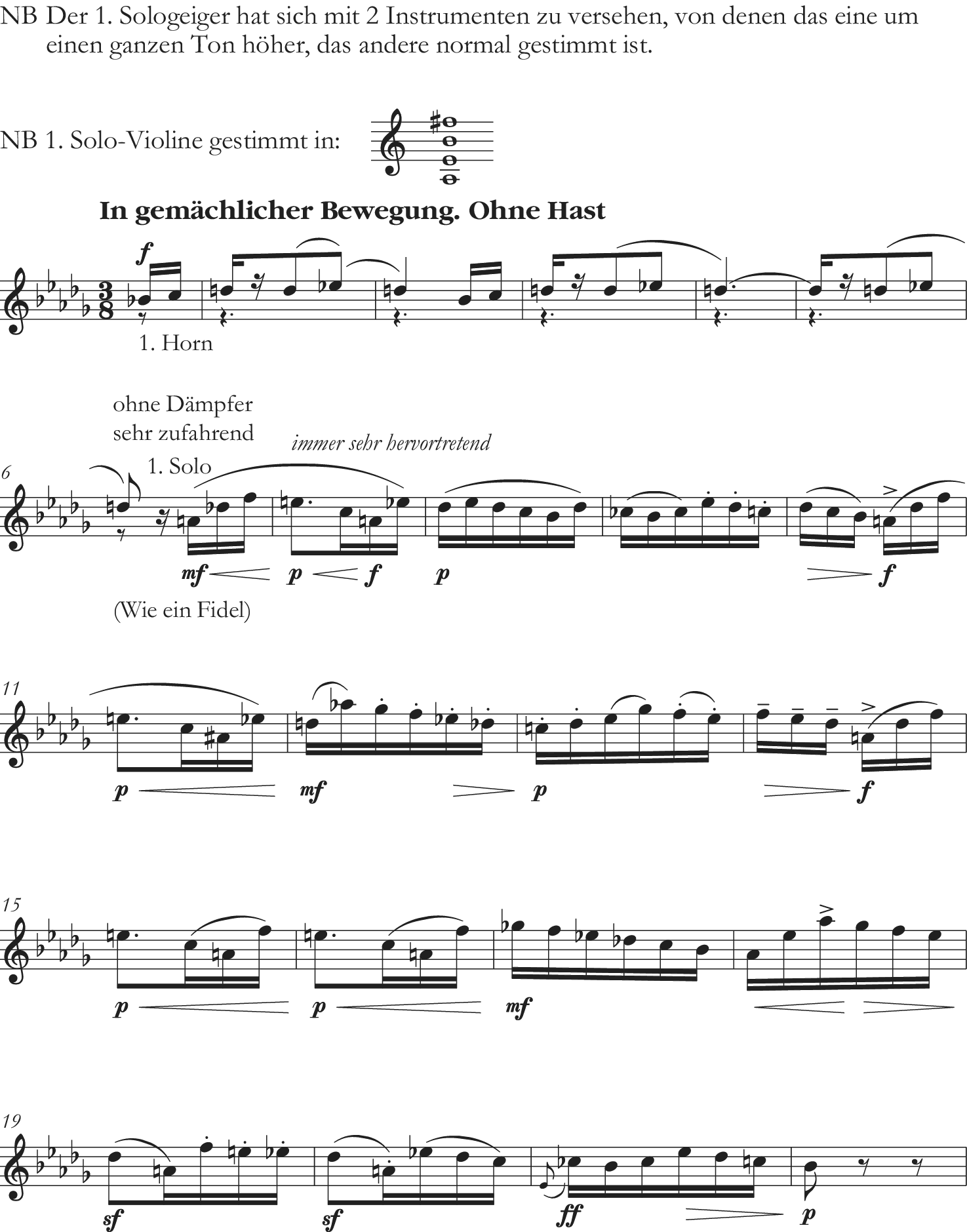
The Scherzo alternates with two instances of the Trio, creating an ABA1B1A2 structure.Footnote 70 While the Trio sections are largely cohesive and consonant, at times so swooning as to border on the parodic, the material of the recurring Scherzo features a disjunction that never manages to shake off its awkwardness; even the end of the movement seems simply to resign itself to its own division before flippantly concluding. One of the quirks of the Scherzo material is that it vacillates between parallel key areas: C major and C minor. Resorting to an overly simplified distinction between the two modes, this creates a see-saw between ‘happy’ and ‘sad’ that has promise for comedic effect. In addition to these shifting modes, the Scherzo’s soloist is a scordatura violin whose strings are each tuned a tone higher than concert pitch. The ‘mistuned’ fiddle first enters in bar 6 and although it picks up the ‘right’ rhythms and figures from the orchestral introduction, the repetition of diminished fourths and fifths creates the sense that the fiddler might be in the ‘wrong’ key, grasping at a half-forgotten tune (see Example 5).
Mahler, Symphony no. 4, movement I, alpine cattle call in flute, bars 125–31.

Regarding the movement’s peculiar fiddle, Mahler’s subtitle for this movement was originally ‘Freund Hein spielt zum Tanz auf; der Tod streicht recht absonderlich die Fiedel und geigt uns in den Himmel hinauf’ (‘Freund Hein strikes up the dance; Death bows the fiddle quite strangely and fiddles us up to heaven’).Footnote 71 In German folklore, Freund Hein is a skeletal figure of death, and the connection between Mahler’s subtitle and artworks depicting a dancing or grinning skeleton has been well documented: the conductor Willem Mengelberg made the note ‘Totentanz Holbein: Der Tod führt uns’ in his score of Mahler’s Fourth Symphony in reference to Holbein’s series of woodcuts called Bilder des Todes. Footnote 72 Alma Mahler reportedly told the musicologist Jack Diether that the composer was ‘under the spell of the self-portrait by Arnold Böcklin [1827–1901], in which Death fiddles into the painter’s ear while the latter is entranced’.Footnote 73 The figure of Freund Hein, as it is realized by Böcklin especially, possesses a jolly and humorous character in its own right (see Figure 1). ‘The diabolical cheerfulness of Böcklin’s Death,’ Knapp writes, ‘drawing like so much of his work on familiar topics of fantasy, combines with the suggestive intimacy of the word Freund attached to this character, and with the casual insolence of the phrase “Freund Hein spielt auf”, to convert death into something more playful than threatening.’Footnote 74 The connection between Mahler’s comment and a jocular portrayal of death suits the composer’s original conception of the work as a ‘Humoreske’.
Mahler, Symphony no. 4, movement II, solo violin, bars 1–22.

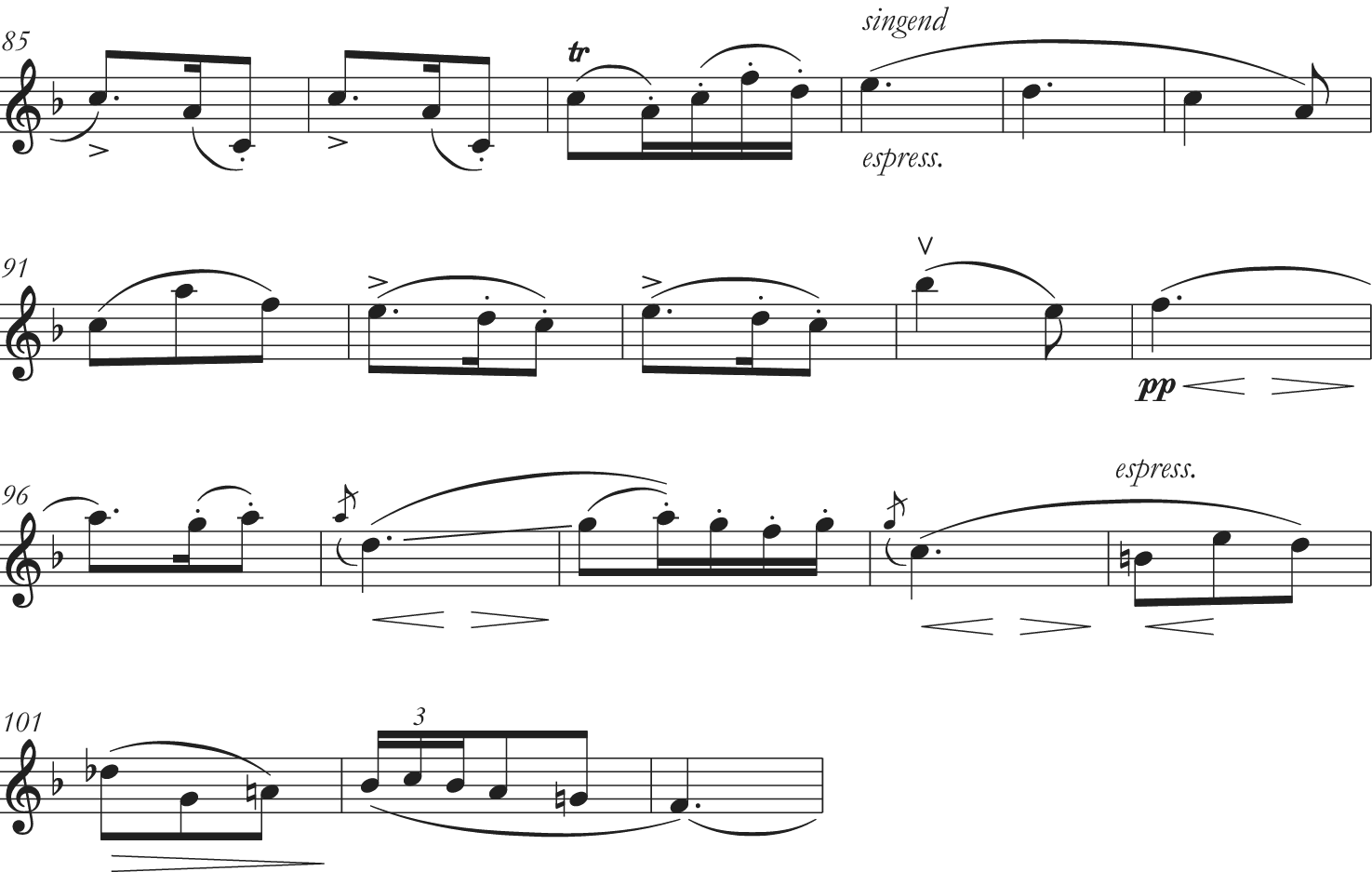
Mahler’s mistuned fiddle disappears during the Trio, the more formal and stately dance section of the movement, creating room for a different kind of violinist – one whose serenading melody might entertain aristocratic dancers at one of Vienna’s carnival season balls. The Trio has been generally considered by scholars as a Ländler,Footnote 75 a folk dance with its own rustic roots, but whose absorption into the classical repertory dates back to Haydn and Mozart.Footnote 76 Thus it creates a distinctly more refined contrast to the opening folk tune. In the Trio, the violin section plays an almost crooning melody (see Example 6), whose stark juxtaposition with the preceding solo fiddle is made explicit by the concert-master’s conventional switch between two different instruments.
Mahler, Symphony no. 4, movement II, violin I, bars 85–103.

The form of the movement, featuring two alternating sections, is itself exaggerated: the normal three-part Minuet and Trio (Minuet–Trio–Minuet) is expanded into five parts (Scherzo–Trio–Scherzo–Trio–Scherzo). Occasional examples of expanded Minuets (or Scherzos) and Trios do appear in the musical repertory before Mahler’s Fourth, but the repetition here emphasizes the absurdity of the relationship between the two sections.Footnote 77 The piece is not merely a Scherzo with an out-of-tune fiddle, broken up by a Trio that parrots the sentimentality of the Viennese waltz. The bizarre Scherzo is interrupted twice with the charming melodies of the Trio, accentuating the lowliness of the Scherzo’s soloist. Even the end of the movement – a half-hearted restatement of the opening material followed by a chipper conclusion – sounds as if it has embraced its own ridiculousness.
Movement III: Ruhevoll (poco adagio)
The most important differentiation between comedies and satyr plays in the ancient world was subject matter: satyr plays tended to deal with the same serious material present in the preceding tragedies, but from a light-hearted perspective. Unlike outright comedies, these works bore a connection to the weighty contents of tragedies, dealing with the same essentially human struggles. The satyr play also contained moments of seriousness amid its humour, an element missing from comedy. Regarding the only complete extant satyr play, Euripides’ The Cyclops, O. B. Hardison, Jr, and Leon Golden write that it ‘combines serious moments with the grotesque drunkenness of Polyphemus’.Footnote 78 Like the satyr play genre, the Fourth Symphony is also not purely comedic, but presents moments of serious contemplation that reach their apex in the symphony’s third movement. Mahler himself described the slow movement thus: ‘A divinely serene, yet profoundly sad melody runs through it, that can only have you laughing and crying at the same time.’Footnote 79
The third movement, tranquil and beautiful, lacks much of the humour that has been discussed in the first two movements. And the text of the following final movement’s song addresses a child’s vision of heaven, a theme for serious (rather than comic) contemplation. This transcendental movement fits nicely against the reading of the work as a satyr play by reminding the listener of the serious and moving subject matter with which the work ultimately deals. The third movement’s slow and celestial opening theme in particular evokes not only earnestness but also the romantic, which can be heard in the swooning strings. At figure 2, the melody is taken over by the oboe and a change in harmony evokes a more melancholic tone. Both the movement’s themes therefore hark back to the subject of the earlier symphonies: life, death and eternal love.
Not to abandon the character of the symphony (or the satyr play) entirely, there remain some elements of humour in the third movement. It consists of a double set of theme and variations, a movement type most closely associated with Haydn, who used the same structure in many of his symphonies: nos. 53, 70, 63, 82, 90 and 103 all utilize the double variation form.Footnote 80 In these symphonies, the form almost always appears as the second movement of the work, where Mahler has placed his Scherzo and Trio. Otherwise, Mahler’s theme and variations follow closely in their internal form the model established by Haydn.Footnote 81 Although the reverse ordering is not particularly marked by the late nineteenth century, Mahler’s double variation movement and its use of Haydn’s model allows for a reading of the order as a play on form worthy of the prankster Papa Haydn himself.Footnote 82 Mahler’s adherence to Haydn’s model in one way (the use of a very particular form associated with the establishment of the symphonic structure) and his deviation from convention in another (the reverse ordering of the middle movements) is a playful reinterpretation of tradition. Although formal deviation is not always indicative of humour, its presence in Mahler’s ‘Humoreske’ symphony alongside fidelity to convention in all other ways appears as something of a musical joke; perhaps the score has fallen to the floor and in recovering the pages the performers have put the movements in the wrong order.
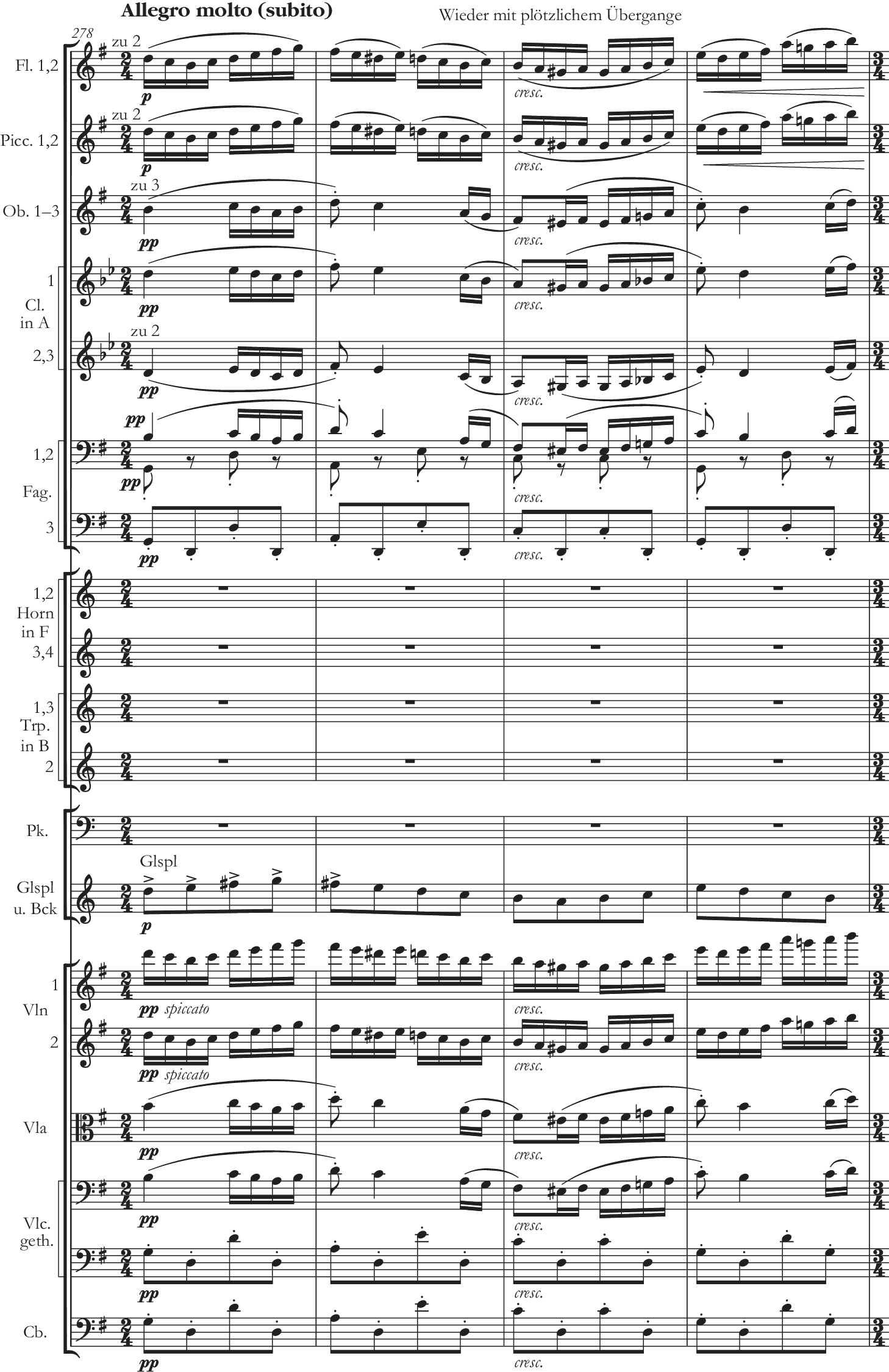
More significant than the issue of conventional ordering, the movement also contains a single, striking moment of juxtaposition between seriousness and humour. As the serenity builds towards a kind of intensity between figures 10 and 11, the musical character begins to run away with itself (see Example 7). High winds and strings both break into semiquaver runs while the composer instructs the players to play Allegro molto (subito) […] Wieder mit plötzlichem Übergange. The suddenly increased speed and abrupt transitions give the aural impression of a cartoon sequence in which the protagonist’s feet have escaped his control just in time to hurtle into something explosive. Ten bars later, however, the movement returns to its overall composure.
Mahler, Symphony no. 4, movement III, bars 278–86.


Movement IV: ‘Das himmlische Leben’
The final movement of the Fourth Symphony is an almost unaltered presentation of the song ‘Das himmlische Leben’ from Des Knaben Wunderhorn, composed in 1892, years before the rest of the symphony. Fragments of the finale’s music can be found in each of the preceding movements, as Mahler told the conductor Georg Goehler: ‘Each of the first three movements is thematically most closely and significantly related to the last.’Footnote 83 James Zychowicz concludes that, ‘Through it Mahler is able to reveal the song gradually, leading to it through increasingly […] explicit fragments. Allowing the song thus to pervade the work, he is able to strengthen the function of “Das himmlische Leben” as the goal and source of the Symphony.’Footnote 84 While such a teleological reading of the finale as the ‘goal’ of the symphony is somewhat problematic, this thematic unity emphasizes the importance of the final movement’s song to the work as a whole.
Given the underlying presence of the song throughout the entire work, the text itself deserves further examination. Regarding the song’s text, Knapp writes,
The joke of casting Herod as butcher is surely not above the heads of most children, nor is St Peter’s eager reversion to his former profession of fisherman (‘Dort läuft schon Sankt Peter / Mit Netz und mit Köder / Zum himmlischen Weiher hinein’). Even if the irony of St Luke slaughtering his ox for food, or of St Ursula being provoked to laughter, is above the heads of most children (and, today, most adults), the spirit of fun that infects the whole, with its absurdist modeling of dreamlike irrationality, makes the ethos of these references, if not their specific referential content, accessible to all.Footnote 85
For Knapp, the ‘spirit of fun’ concerns the traditional portrayal of each saint mentioned in the text of ‘Das himmlische Leben’, taking what is normally a serious subject and allowing it a comical bent. For example, John the Baptist is frequently portrayed with a lamb, a symbol of Christ. For John to let out his lamb not only suggests that even a highly revered saint is capable of losing track of his valuables, but also allows the listener to see such a figure as fallible (a frequent condition for humour). Portraying Herod as a butcher (of animals) lends a light-hearted slant to the biblical tale of the Massacre of the Innocents, Herod’s attempt to prevent Christ from growing to adulthood. The depiction of St Ursula laughing while 11,000 maidens dance reverses the fate of the martyr who was slain by the Huns along with the 11,000 virgins who accompanied her on a pilgrimage to Rome – the victims of terrible violence are instead joyous and gay.
Bonds interprets these juxtapositions as emphasizing violence and therefore to some extent as macabre;Footnote 86 however, I find Knapp’s overall reading of the poem as playful and domesticating more compelling. Furthermore, Mahler’s own comments about the text seem to relay a playful rather than a grisly interpretation; according to Bauer-Lechner, Mahler spoke enthusiastically about the poem, saying, ‘What mischief is combined with the deepest mysticism! It is everything turned on its head.’Footnote 87As such, it contains a dialogue between contrasting moods. The song alternates between on the one hand lively and soaring melodies and on the other dark and frenzied episodes accompanied by the sleigh bells of the symphony’s opening without an obvious correlation to what is occurring in the text.Footnote 88 Bonds suggests that these alternations between joyous and sinister are indicative of an ambivalence towards the finale’s depiction of utopia, ‘in which the comforting and terrifying coexist’, a result of there being ‘no true synthesis [of the themes]’.Footnote 89 However, a kind of synthesis of the themes lies in the very coexistence of the comforting and the terrifying. It is yet another appearance of the tragicomic juxtaposition that, according to Nietzsche, provides the inspiration to pursue a human existence. As Bonds himself notes, ‘Every account of the Fourth emanating from Mahler or his immediate circle (Bauer-Lechner, [Bruno] Walter) consistently emphasizes the contrast of light and shadow, calmness and panic, laughter and tears’,Footnote 90 and Nietzsche’s characterization of the life-affirming results of observing ancient tetralogies explains why Mahler might consider and refer to his own works as ‘a perfectly self-contained tetralogy’.
Discussions of irony
In fin-de-siècle Vienna, an appreciation of the juxtaposition of contrasting sentiments was common. Jean Paul and his brand of satire experienced a renaissance in the 1880s. Mahler’s contemporaries, including Hermann Bahr (a friend of the composer), Hugo von Hoffmannsthal and Arthur Schnitzler, were considered part of the Junge Wien literary movement, which was characterized by ‘humour, keen irony and astute satire’.Footnote 91 It might be suggested, then, that the juxtaposition of light and serious in the overall structure of Mahler’s tetralogy be read as irony. Mahler’s music has been repeatedly considered in ironic terms and the composer himself used ‘ironic’ and ‘eironeia’ to describe the third movement of the First Symphony in a letter to Max Marschalk.Footnote 92 However, the large-scale juxtaposition of tragic and comic does not quite fit the definitions of irony that have previously been used to describe Mahler’s music.
Zoltan Roman’s essay ‘Connotative Irony in Mahler’s Todtenmarsch’ explores the third movement of the First Symphony, as does Floros’s ‘Tragische Ironie und Ambivalenz bei Mahler’.Footnote 93 Both authors draw on a view of irony that uses humour to subvert seriousness, while the juxtaposition of the sombre and the light-hearted throughout Mahler’s first four symphonies serves a purpose entirely different from that of subversion. Rather, the heartbreak and overcoming of the hero of Mahler’s first two symphonies should be taken with complete seriousness, not least because they have been discussed in the context of Mahler’s own biographical experiences. Furthermore, the ultimately light-hearted Fourth Symphony does not undermine the messages of the first three symphonies, but complements their profound meditations on existence and human experience with the childlike joy that can also be found in life.
Julian Johnson discusses the irony of Mahler’s music in terms of the combination of two contrasting emotions, in particular the artificial and the genuine.Footnote 94 Two distinctions arise here as well. First, many of the juxtapositions considered humorous or ironic in Mahler’s works are not necessarily between tragedy and comedy, as I am suggesting is the case in the broad view of Mahler’s tetralogy; for example, neither the juxtaposition of solemn and shrill nor that of refined and grotesque presents a tragicomic binary. The second difference between the tragicomic juxtaposition discussed here and the conflicting voices of Mahler’s musical irony has to do with the resulting effect. Irony, when executed correctly, might induce eye-rolling, snickering or outright laughter. For this reason, moments of irony are often read as comic. However, what I argue Mahler was seeking with his tragicomic juxtaposition was something else entirely: a feeling of redemption and restored faith in the human condition achieved by relieving the despair associated with the struggles of existence with those beautiful moments of wit and comic banter that inspire us despite life’s difficulties. This was also the aim of the ancient tetralogy’s satyr play finale. What Nietzsche valued in satyr play and the proximity of tragic and comic more generally was not what we associate with the response to irony (a dismissal of the serious), but rather inspiration to face the truth of life’s struggles through the complement of humour.
In his perceptive study of Mahler’s symphonies the critic Paul Bekker wrote, ‘The Fourth Symphony is a closing work. It is so in three ways: in relation to musical form, in relation to poetic and intellectual substance, and in relation to the world-view of the creative artist.’Footnote 95 Mahler, of course, indicated something similar when he referred to the completion of the Fourth Symphony as part of his creation of ‘a perfectly self-contained tetralogy’. Bekker further determines that with the Fourth Symphony’s last line of poetry – ‘So that everything awakens for joy’Footnote 96 – ‘Mahler had come to the end of the world […] He had found in his longing, his urge to believe, his deep metaphysical need, the way to the hereafter. He had discovered what could be achieved in this way: the blissful certainty of inalienable strength, of divine love, of heavenly glory.’Footnote 97 The revelatory awakening for joy and its relation to the artist’s world-view that Bekker describes as the character of Mahler’s ‘closing work’ is not unlike the reaffirmation of life and inspiration to revel in existence that Nietzsche attributes to the tragicomic juxtaposition of ancient Greek tetralogies.Footnote 98
The study of the role of tragicomic juxtaposition and its Nietzschean roots in Mahler’s work begins with the composer’s comment about creating ‘a perfectly self-contained tetralogy’. I do not suggest that Mahler set out at the start of his First Symphony in 1887 to write a tetralogy based on the dramas of ancient Dionysian festivals. Instead, I believe that Mahler looked at his nearly completed work in 1900, when he spoke to Bauer-Lechner about the grouping, and saw in the first four symphonies a reflection of the ancient Greek practice. The composer’s comment, coupled with an appreciation of the redeeming power of the juxtaposition of tragic and comic emphasized and modelled by Nietzsche, whom Mahler had read and reread by this time, connects the structure and substance of his first four symphonies to a particular tradition of ancient Greek drama.
Consideration of Mahler’s educational background, his literary interests, the musical characteristics of the Fourth Symphony and the effects he wished his music to create as evidenced through his own comments about his work reveal an undeniable reflection of the ancient model, as well as the crucial role of Nietzsche as a mediator of these ideas. Mahler’s interest in Nietzsche has long posed an interesting scholarly puzzle, cropping up in discussions of Mahler’s Third Symphony especially. Instead of merely acknowledging the composer’s explicit references to Nietzschean ideas (references whose meaning is often unclear), connecting Mahler’s ‘tetralogy’ to its probable source of inspiration demonstrates a level of engagement, and agreement, with Nietzsche’s writings of which the composer has not hitherto been thought capable.