Introduction
This article draws from research on performance and stylization in order to explore the stylized projection of the voice of the Black preacher in the public domain. Coupland (Reference Coupland2001:345) defines stylization as ‘the knowing deployment of culturally familiar styles and identities that are marked as deviating from those predictably associated with the current speaking context’. While a number of scholars have described the linguistic features used in a range of Black preaching traditions (Holt Reference Holt and Kochman1972; Smitherman Reference Smitherman1977, Reference Smitherman2000; Mitchell Reference Mitchell1979; Gumperz Reference Gumperz1982; Spencer Reference Spencer1987; Pitts Reference Pitts1993; Rickford & Rickford Reference Rickford and Rickford2000; Green Reference Green2002; among others), few studies explore the uses of Black sacred styles in secular domains, particularly in those contexts where performers invite reflection on, and possibly critique of, these linguistic forms and the social personas that they may be associated with. In fact, given the prevalence of depictions of the Black preacher as a stock character in American comedic traditions, stylizations of Black preachers demand greater analytic attention.
With this in mind, I seek to illustrate the ‘moving parts’ involved in the construction of the voice of the Black preacher in the performances of African American comedian Richard Pryor with the ultimate goal of discovering what these linguistic features help the performer to accomplish in interaction. Important questions that I ask include: What linguistic features surface in the construction of the voice of the Black preacher? What are the mechanisms by which the performer signals how we, as audience members, should interpret these features? Finally, what impact do these choices have on performer-audience interactions? Answers to these questions lend support for the notion that linguistic stylizations disrupt our associations between language, identity, and ‘authentic’ contexts of use, inviting listeners to reflect on and/or redefine the links that they make between linguistic forms and the social personas that these features may have come to represent.
Black sacred traditions and sociolinguistic research
To date, a great deal of work has been done documenting the features of a range of Black preaching traditions, illustrating the social significance of the role of the preacher in African American communities. W. E. B. Du Bois in his pivotal work, The souls of Black folk (Reference Du Bois1903/1904), observes that the Black preacher holds a critical position as mediator between the sacred and secular in churches that are important sites of social organization in Black communities. As a number of scholars have noted, Black preachers, who move easily between formal, sacred styles and informal, secular styles during their sermons, draw heavily from elements of the Black verbal tradition to strengthen their messages. One aspect of this tradition, tonal semantics, has been described by a number of authors and includes such features as sustained intonation and melody, rhythm, a gravelly tone, variations in rate of delivery, stammering, and hesitations, among others (Holt Reference Holt and Kochman1972; Smitherman Reference Smitherman1977, Reference Smitherman2000; Mitchell Reference Mitchell1979; Gumperz Reference Gumperz1982; Spencer Reference Spencer1987; Pitts Reference Pitts1993; Rickford & Rickford Reference Rickford and Rickford2000; Green Reference Green2002). Furthermore, African American Vernacular English (AAVE) has also been acknowledged as an important tool for preachers to make their messages more down-to-earth and accessible (Gumperz Reference Gumperz1982; Pitts Reference Pitts1993). Overall, Black preachers have been found to draw from both segmental features (including phonology, morphology, and syntax) as well as suprasegmental features (including volume and pitch) of African American English in order to make their messages meaningful to congregations.
While this work describing the linguistic features utilized in Black preaching traditions is invaluable, very little attention has been paid to the ways that the voices and speaking styles of Black religious leaders have been utilized in contexts outside their ‘normal’ domains of use. As Britt (Reference Britt2011) and Cole & Pellicer (Reference Cole and Pellicer2012) have shown, however, public figures in secular contexts have been found to strategically draw from features of Black preaching traditions in their political messages. For example, Britt (Reference Britt2011) found that Black politicians utilized style shifting to cloak themselves with the authority and respect associated with Black preaching styles as they presented controversial political and social messages. These style shifts also created shifts in the interactional framework of the event, leading to more dynamic interactions between the audience members and public speakers. In addition, Cole & Pellicer (Reference Cole and Pellicer2012) explored audience uptake in response to Hillary Clinton's incorporation of features of Black preaching traditions in her political speeches, including the use of syntactic parallelism and biblical passages. While the live audience engaged with Clinton in an interactive manner common in Black church settings, a number of viewers had mixed responses to her linguistic choices, some even viewing these uses of Black preaching as a form of ‘pandering’ to Black audiences (Cole & Pellicer Reference Cole and Pellicer2012:463). Despite the range of audience reactions to these linguistic choices, studies like these suggest that even when decontextualized from their normal contexts of use, Black preaching styles can have powerful impacts on speaker-audience interactions.
Furthermore, Black preachers themselves have been depicted as stock characters in a number of secular domains since the early 1900s. For example, Weisenfeld (Reference Weisenfeld2007) describes the ways that director Oscar Micheaux, through silent films like Within our gates (Reference Micheaux1920) and Body and soul (Reference Micheaux1925), visually portrayed Black clergy as energetic and lively, yet with deep moral corruption. In the same time period, Black comedian Bert Williams recorded the Elder Eatmore sermons including Elder Eatmore's sermon on throwing stones (Reference Williams1919a) and Elder Eatmore's sermon on generosity (Reference Williams1919b). According to Forbes (Reference Forbes2008), these monologues presented audience members with the image of a preacher whose attempts to extort money from his congregation revealed his own moral shortcomings. Reed (Reference Reed2001) also finds that Black religious life was an important source of humor and a target of critique from Black recording artists between the 1910s and 1960s. Comedic depictions of Black preachers continue well into the present including the Reverend Leroy character from The Flip Wilson show in the 1970s, Reverend Ed Cash from the television show In living color in the 1990s, and Reverend Uncle Ruckus from the cartoon series The boondocks in the early 2000s among many, many others. The extensive use of this character type suggests that Black religious leaders and their speaking styles have been woven into the American imagination, presenting audiences with enduring, albeit exaggerated, social and linguistic images of this important social persona. While Britt (Reference Britt2011) and Cole & Pellicer (Reference Cole and Pellicer2012) demonstrate that Black preaching styles can be used to reframe the current speaking context, stylized constructions of the voice of the Black preacher are of added interest given the fact that these instances of highly reflexive language use may help to establish and/or transform public perceptions of these ways of speaking and the public image of Black religious leaders.
Stylization and performance
Given the number of images of Black preachers that have been projected in the public sphere, the lack of in-depth sociolinguistic study of these character voicings is surprising, especially considering the growing importance of issues of stylization and performance in sociolinguistic research. As Coupland (Reference Coupland2001:346) points out, sociolinguists have traditionally examined linguistic variation from the perspective of ‘authentic’ usages of vernacular linguistic forms by members of speech communities in their natural settings. Researchers of performance have revealed, however, that speakers who are seen to be ‘performing’ or ‘putting on’ the voices of others also seem to draw from the same ideological and linguistic resources as ‘everyday’ language users (Coupland Reference Coupland1985, Reference Coupland2001; Shilling-Estes Reference Shilling-Estes1998; Jaffe Reference Jaffe2000; Chun Reference Chun2004; Carmichael Reference Carmichael2013). In addition, linguistic variations used in performance can contest the status quo and challenge the ‘natural’ relationship between language forms, speech communities, and an individual speaker's identity projections (Woolard Reference Woolard1987; Coupland Reference Coupland2001).
In fact, research on stylization and performance can give us powerful insights into the dynamic nature of language use. First, it is well established that performance draws heightened attention to language and ‘puts the act of speaking on display’ (Bauman & Briggs Reference Bauman and Briggs1990:73). As Coupland (Reference Coupland2001:350) illustrates, stylized utterances help to create a break between the performer and the immediate speaking context, evoking other situations and times in which these linguistic forms are typically used while helping the performer to ‘embed’ a new layer or participation framework into the current speaking context. In the context of public performance, this new participation framework often involves the performer drawing the audiences into the ‘fictive, otherworldly realm’ of the character that they are stylizing (Rampton Reference Rampton2009:160).
Furthermore, Coupland (Reference Coupland2001:349) argues that stylizations can serve as a type of subterfuge in that performers can play with the ambiguity between whether the character voice (and perhaps its connected stances and beliefs) ‘belongs’ to the performer, someone else, or both. In other words a stylized utterance ‘dislocates a speaker from the persona he or she voices, and from the pragmatic implications of what is said’ (Coupland Reference Coupland2001:366). In terms of their linguistic features, stylized utterances draw the audience's explicit attention to the linguistic features that performers use to project recognizable social personas. These linguistic features are often ‘emphatic and hyperbolic’, allowing performers to ‘emphasize dissonant social meanings’ (Coupland Reference Coupland2001:350).
Turning to the role of stylizations in stand-up comedy, these types of dislocations and hyperbolic presentations can be quite useful given the types of social commentary that comedians may be making. As Mintz (Reference Mintz1985) illustrates, stand up comedy is a form of public ritual that gives performers unusual license to draw our attention to potentially sensitive issues of social concern. In this process, comedians often construct what Mintz terms negative exemplars that are meant to be distorted, exaggerated representations of social personas and socially unacceptable behavior (Mintz Reference Mintz1985:74). Like Coupland, Mintz finds that these character constructions often involve a type of ‘creative distortion’ whereby tools including exaggeration, stylization, and incongruity (among others) help the performer construct their critique (Mintz Reference Mintz1985:79). Furthermore, through their performances, comedians may also seek to flatten out the vast differences between their audience members, leading them in ‘a celebration of a community of shared culture, of homogeneous understanding and expectation’ (Mintz Reference Mintz1985:74). This comes with the underlying assumption that in order to be a successful performer, ‘the comedian must establish for the audience that the group is homogeneous, a community, if the laughter is to come easily’ (Mintz Reference Mintz1985:78). In essence, the performer strategically highlights underlying shared cultural (and linguistic) understandings in order to make their humor ‘work’. Overall, these studies suggest that while performers may draw from recognizable linguistic repertoires, they may also distort and/or greatly simplify these repertoires in their performances. Most importantly, these deployments (and reconfigurations) of speaking styles often occur with the explicit purpose of drawing our attention to a set of linguistic forms and/or social practices that are the object of critique. At the same time, the bracketing of these stylizations in ways that separate them from the performer's own voice and personal stance may protect performers from the backlash that such depictions may invite. In other words, the performer may be showing us, rather than simply telling us in their own words, the social ills of the characters that they are constructing.
With these points in mind, I explore the relationship between the linguistic stylizations of the voice of the Black preacher and what I call the story world of Richard Pryor's performances. This story world includes stretches of talk that have been ‘bracketed off’ from the broader speaking context, giving the audience a new framework in which to interpret his character's linguistic and social behaviors. I argue that metalinguistic commentary, the features of Black preaching styles and dialect features used, and incongruities in the story world content all come together to key Pryor's characters as certain social types with specific social (and linguistic) attributes and a specific world view. Furthermore, while the linguistic features used to construct the characters may already come preloaded with a range of social meanings, through the performance itself the performer may reinforce, distort, and create new associations between these speaking styles and character types. Finally, in the performances presented in this study, audience members interact with Pryor in a way that both reaffirms the success of his stylizations while at the same time signaling alignment. Here, shouts of “take your time”, “all right”, “yes”, “preach”, and “for sho” indicate that audience members ratify his more street-wise projections of the Black preacher.
Data collection
The data for this article comes from four audio tracks and one video recording of comedy bits performed by Richard Pryor. The primary analysis focuses on the track ‘Black preachers’ from the album Craps (after hours) (Reference Pryor1971), the track ‘Our text for today’ from the album …Is it something I said? (Reference Pryor1975), and the bit ‘Black preachers’ performed live before a predominantly Black audience on Soul train Footnote 1 airing on June 21, 1975. These three segments were chosen because they retell the same story about a preacher who meets God while walking down the street. The similarities in the content of the story allow us to narrow our focus and consider the ways that Pryor uses language to construct one particular type of preacher as opposed to the broad range of preachers including the more flashy, charlatan, or street hustling preachers that he has performed in his movies, television shows, and in other contexts throughout his career. Data from the track ‘Religion’, which also appeared on the album Craps (after hours) and the track ‘Shortage of White people’, which appeared on the album …Is it something I said?, were also included to facilitate comparisons between what I call Pryor's preaching voice and other speaking styles in his performances. Each segment was transcribed using elements of a conversation analysis (CA) transcription method that is useful in highlighting the stylistic features of preaching styles including stress, vowel lengthening, and volume. A description of the transcription conventions used in this analysis appears in the appendix.
Born in 1940 in Peoria, Illinois (McPherson Reference McPherson1975), Richard Pryor was chosen for this analysis because he has been widely recognized for his ability to draw from everyday language use to produce believable, heartfelt characters. For example, on April 27, 1975, James McPherson of The New York Times wrote:
He seldom throws out one-liners… Instead, he enters into his people and allows whatever is comic in them, whatever is human, to evolve out of what they say and how they look into a total scene. It is part of Richard Pryor's genius that, through selective use of facial expressions, gestures, emphases in speech and movements, he can create a scene that is comic and at the same time recognizable as profoundly human. (McPherson Reference McPherson1975:242)
In describing Pryor's masterful approach to what he calls ‘character-heavy’ stand-up comedy, Watkins (Reference Watkins1994) notes that, starting with his album Craps (after hours), released in 1971 and performed for a predominantly Black audience, and continuing with in his album …Is it something I said?, which was released in 1975, Pryor did not shy away from depicting everyday struggles faced by African Americans. In fact, Pryor's movement towards projecting more believable depictions of Black life, combined with his intellectual critique of social inequality, establishes him as an important forefather of African American folk humor. According to Watkins:
He was the first African-American stand-up comedian to speak candidly and successfully to integrated audiences the way Black people joked among themselves when most critical of America. (Watkins Reference Watkins1994:562)
It is Pryor's penchant for constructing believable characters and his increasing mainstream acceptance that makes him an important site of analysis of the projection of the stylized voice of the Black preacher into the public sphere.
Analysis
Pryor's voices
Pryor's preaching voice is foregrounded against the backdrop of other voices/speaking styles that he deploys in the three performances. The most salient voice that occurs alongside his preaching voice is what I call his stage voice. Functioning similarly to the abstract of a narrative (Labov Reference Labov1972a), Pryor uses this stage voice to talk directly to audience members in order to provide them with the gist of the upcoming joke and the context for the interpretation of what will follow. For example, the majority of excerpts (1) and (2) below are spoken using the stage voice, which contrasts with other voices that have been bolded for emphasis.
-
(1) From ‘Our text for today’ (…Is it something I said?)
1 RP: Black church you get a ↑sho:w with [wɪt] your [jə] money see,
2 Aud: ((laughter – 1.5 seconds))
3 RP: ↑White church all they ↑do is (0.1) > Jesus was wonderful
4 bye < ((said with a nasal quality))
5 Aud: ((light laughter – 2.0 seconds))
6 RP: °Black church they get down.°
-
(2) From ‘Black preachers’ (Soul train)
1 RP: I [ɑ] want to do a thing cause tomorrow most [moʊs]
2 people be goin to church. (0.4) and I [ɑ] wanted to um (0.2)
3 uh Black church is a lot different than when you go to White
4 church, .hhh (0.5) because uh usually in a White church they
5 have strange music. .hhh
6 Aud: ((light laughter – 1 second))
7 RP: I mean you go in there right you hear m-
8 ((sings five notes)) [((looks over shoulder))
9 Aud: [X- X-
10 Aud: [whooo
11 Aud: [((light laughter))
12 RP: you don't know if Dracula is gon jump out on you or
13 not you [know.
14 Aud: [((light laughter))
15 Aud: [X- X- X-
16 RP: ((smiling face)) but (0.2) ↑Black preachers know
17 God personally right know when you go to church
18 they [deɪ] go. .hhh ((leans head back, makes serious face))
19 YOU KNO::W, (0.3)
20 Aud: [((light laughter))]
21 Aud: [ X- X- X- ]
22 RP: I [ɑ] ↑FIRST [fɝ:s] MET GO:Dh. [gɑdʰ] ((talking out of
23 one side of his mouth))
24 Aud: ((light laughter – 1.6 seconds))
25 RP: IN NINETEE:N AND TWENTY [twʌnɪ] NI::NE. [nɑ̤n̥]
The stage voice in these excerpts helps focus the content of the joke and gives a sketch of the characters that Pryor is preparing to perform. For example, using the stage voice, Pryor describes White churches as strange and weird (excerpt (2), lines 4–5) and Black churches as being showy, almost like a paid performance (excerpt (1), lines 1 and 6), but more in touch with God (excerpt (2), lines 16–17).
It is important to note here that I make a distinction between the stage voice and what can be considered Pryor's ‘everyday’ speaking style. Given the staged nature of these performances, it is clear that the language of the stage voice is not the casual, unmonitored speech typically associated with off-stage speaking styles (Labov Reference Labov1972b). Using this stage voice as a baseline, however, we are able to observe the ‘moving parts’ of the phonology, syntax, morphology, and general style shifts used in Pryor's character voicings.
With this in mind, Pryor often uses in-breath, pauses, tempo changes, and raised volume, as well as physical cues such as leaning back or changes in facial expression, to mark shifts between the stage voice and the other voices in these performances. For example, in the bolded text in excerpt (1), lines 3 and 4, we hear the voice of a speaker from a White church who is constructed using a high-pitched, nasal voice. This ‘White church voice’ involves a faster rate of speech, limited pitch variation, and relatively limited content (i.e. “Jesus was wonderful” and “bye”). A brief pause marks the transition into this White church voice. In line 18 of excerpt (2), an in-breath and shift in body position mark a transition to the much louder voice of the preacher that begins in the bolded text of line 19.
These shifts (i.e. pauses, physical orientation, and volume) are the first of many layers of semiotic cues that Pryor uses to foreground the voices that he is constructing. In particular, the stage voice is important because Pryor uses it to make explicit metalinguistic commentaries about the social and cultural meanings of the voices and the speaking styles that he presents to the audience. As we see in the next sections, Black churches (and Black preachers) are not strange or scary, but deeply familiar for Pryor. In addition, the performative nature of the preacher's style (i.e. “Black church they get down”) and the social significance of Black preaching (i.e. “Black preachers know God personally”) are clearly established. Finally, Pryor's metalinguistic commentary also points to the homogenizing nature of comedic performance. Here, rather than specifying the specific style or denomination of preacher that he is targeting, Pryor flattens out the range of diversity of Black preachers and preaching traditions that exist in African American communities, putting them into one monolithic group.
Grammatical and phonological contrasts
While Black preachers and Black churches have been collectively described as more performative, showy, less scary, and more intimate with God than White churches, syntactic, morphological, and phonological cues provide additional layers of information that may help socially locate (and perhaps add more nuance to) Pryor's preacher. It is important to note, however, that the linguistic features cited below may have a range of associations for different audience members. As Johnstone (Reference Johnstone2011:658) points out, broadcast comedic performances create ‘multiple possibilities for the interpretation of unexpected linguistic forms’. In this section, I highlight a number of possible associations that might be made with the linguistic features highlighted by Pryor based on evidence from previous sociolinguistic research.
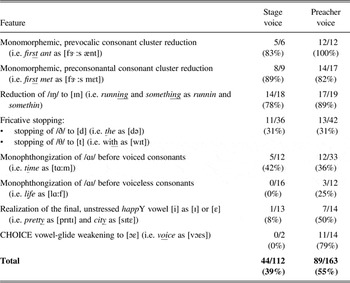
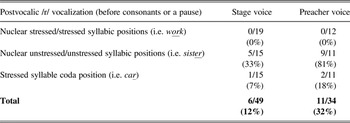
In order to make more robust comparisons between Pryor's stage voice and preaching voice, the comparisons below also include data from the track ‘Religion’ from the album Craps (after hours) and from the track ‘Shortage of White people’ from the album …Is it something I said?. As a result, the analysis in this section and data in Tables 1 and 2 below present comparisons based on a total of 459 words that were spoken in the stage voice and a total of 455 words spoken in the preaching voice.
Phonological features of the stage voice and preaching voice.

Postvocalic /r/ vocalization in the stage and preaching voice.

First, while elements of AAVE syntax and morphology (Rickford & Rickford Reference Rickford and Rickford2000; Green Reference Green2002; Wolfram & Thomas Reference Wolfram and Thomas2002; Wolfram Reference Wolfram and Schneider2008) appear in both Pryor's stage voice and his preaching voice, these features are quite rare. In all of the tracks examined, Pryor's stage voice used two instances of negative concord (i.e. “I ain't seen no White folks no more” and “You can't get no nut doin no yoga”), one instance of invariant be that expresses the future or hypothetical (i.e. “tomorrow most people be going to church”), and one instance of habitual be (i.e. “church be having…”). His preaching voice also uses one instance of habitual be (i.e. “he be getting down”), one instance of unstressed been (i.e. “ever since that day I been able to heal”), one instance of ain't for haven't (i.e. “I ain't messed with you”), two instances of third person singular -s absence (i.e. “Then he shift on your ass” and “Where it say…”), and one instance of redundant use of the plural -s marker (i.e. “That's two peoples”).
In addition, in Table 1 and Table 2 below I present a number of phonological features that appear in Pryor's stage voice and preaching voice that have also been associated with AAVE, Southern White Vernacular English (SWVE), and other nonmainstream varieties of American English. These charts include the number of tokens of each feature, the number of contexts, and percentages for each feature as they appear in the stage and preaching voices.
In terms of similarities, both the stage voice and the preaching voice have relatively high rates of features shared with a number of nonstandard varieties of English including consonant cluster reduction and reduction of /ɪŋ/ to [ɪn], and moderate rates of fricative stopping of /ð/ to [d] and /θ/ to [t]. Although consonant cluster reduction is common in most varieties of English, it appears more frequently in African American Vernacular English, particularly when the word following the cluster begins with a vowel (Bailey & Thomas Reference Bailey, Thomas, Mufwene, Rickford, Bailey and Baugh1998; Thomas Reference Thomas2007). Both the stage voice and preaching voice feature high rates of consonant cluster reduction.Footnote 2 While fricative stopping also appears in many nonstandard varieties of English and while rates may vary across African American communities, substitutions of both /θ/ and /ð/ have been closely associated with speakers from lower social classes, and substitutions of /θ/ have been associated with speakers who have less contact with Whites and with speakers who are male (Thomas Reference Thomas2007:455). In addition, Johnstone (Reference Johnstone2011:665–66) has pointed out that reduction of /ɪŋ/ to [ɪn] can potentially sound working-class to American audience members. Combined with the syntactic and morphological features described above, features such as consonant-cluster reduction, reduction of /ɪŋ/ to [ɪn], and fricative stopping of /ð/ to [d] and /θ/ to [t] have the possibility of helping to socially locate both voices as African American and perhaps working class. In essence, working-class, Black speech can be said to operate as a type of baseline against which other, contrasting features can be measured.
In terms of contrasts, Pryor's preaching voice is generally less r-ful than his stage voice, particularly in unstressed syllabic positions. R-lessness is a feature shared by both SWVE and AAVE speakers and may also be a marker of informality and lower social class (Thomas Reference Thomas2007:453). Furthermore, while monophthongization/glide weakening of the diphthong /ɑɪ/ is shared in AAVE and SWVE, African Americans are less likely to weaken this glide before voiceless consonants (Thomas Reference Thomas2007:460). Both the stage and preaching voice show evidence of glide weakening of /ɑɪ/. Glide weakening of /ɑɪ/ before voiceless consonants, however, is restricted solely to his preaching voice, particularly in the lines immediately following a switch from the stage voice into the preaching voice (see line 22 of excerpt (2) above and line 3 of excerpt (3) below). Similarly, realization of unstressed happY vowel [i] as [ɪ] (or as a more exaggerated [ε]) and CHOICE vowel-glide weakening appear almost exclusively in the preaching voice.
The realization of the happY vowel [i] as [ɪ] is an older form of English that has been retained in the speech of older African Americans (Thomas Reference Thomas2007:459). In addition, while a number of these features can be found in pockets throughout the United States, a number of factors point to Pryor's characterization of his preacher as stereotypically Southern. For example, /ɑɪ/ monophthongization is often stereotypically associated with the South (Thomas Reference Thomas and Schneider2008:100) and glide weakening of this diphthong before voiceless consonants appears in working-class speech in portions of the South (Thomas Reference Thomas and Schneider2008:100). Furthermore, CHOICE vowel-glide weakening is also geographically restricted to the South and occurs in both Southern White and African American speech (Thomas Reference Thomas2007:461), particularly in speakers born before 1960 (Thomas Reference Thomas and Schneider2008:101). While the utilization of features like glide weakening of /ɑɪ/ before voiceless consonants may reflect a type of linguistic misrealization (Gibson & Bell Reference Gibson and Bell2010; Bell & Gibson Reference Bell and Gibson2011) given that Pryor explicitly mentions the Blackness of his character in excerpts (1) and (2) above, it is possible that this feature may serve indirectly as a marker of the Southernness of his preacher's voice rather than race.
In fact, it seems quite reasonable that Pryor would utilize a speaking style that stereotypically locates the preacher as Southern. As Smitherman (Reference Smitherman2000:212) points out, the sacred style of Black preachers has its home in the rural South. Furthermore, as Southern Blacks migrated to Northern cities, their style of worship and their tendency to organize into smaller, storefront congregations led to them being derided by Northern Blacks and Whites alike. As Reed points out:
Black clergy of mainstream denominations considered them an embarrassment and a hindrance to racial progress. Although many Southern Baptist and Holiness/Pentecostal groups left the storefront to establish permanent and thriving congregations, they retained, not only their charismatic worship style, but also the stigma of their peculiarity and their humble beginnings. To those outside of these traditions, such enthusiastic worship was not only bizarre, but was actually humorous and fit to be the butt of many a joke not unlike those found in the minstrel tradition. (Reed Reference Reed2001:30)
With these stereotypes and responses to Southern religious practice in mind, it would make sense that Pryor might pepper his preacher's talk with features that are stereotypically or geographically linked to the South.
In the aggregate, working-class Black speech seems to serve as a baseline pointing to the intentional marking of his preacher as older and potentially Southern. As we see in the next sections, however, when we consider these phonological and stylistic features in context, it seems that Pryor may be making additional strategic contrasts between moments where stereotypically Southern and/or exaggerated speaking styles are either highlighted or de-emphasized in the story world of the performance.
Stylistic features
Pryor's preaching voice is constructed using a subset of features found in various Black preaching traditions including manipulations of voice quality, talk-singing, elevated language, and vernacular speech as well as genres of speech that are specific to church encounters including scripture reading and testimony-giving. For example, excerpt (3) from the track ‘Our text for today’ (which immediately follows excerpt (1) in the recording) illustrates elevated language, manipulation of voice quality, and scripture reading.
-
(3) From ‘Our text for today’ (…Is it something I said?)
1 RP: °Black church they get down° (1.0) our text [tεks] for toda::y. [tədε]
2 Aud: ((light laughter -2.3 seconds))
3 RP: conce:rns, (0.4) ((clears throat)) (1.1) life [lɑf] (0.1) in
4 the [də] beginnin. (0.6) as it MANifests [mænɪfεs] itself,
5 Aud: ((light laughter - 1.5 seconds))
6 RP: through [θu] the eTERNAL complextities.
7 Aud: ((light laughter – 1.2 seconds))
8 RP: of (.) renunci↑ation:.
9 Aud: ((light laughter – 0.7 seconds))
10 RP: as o↑po↓osed, [əpoʊz] (0.2) to (0.2) juxtaposition (0.4)
11 of the inferior [ɪnfɪriə] mi:nd. [mɑ̤n̥d̥]
12 Aud: ((light laughter – 5.9 seconds))
13 RP: uh let us turn our text[tεks]. (1.6) to: uh.
14 Aud: ((light laughter – 2.9 seconds))
15 RP: ((mumbles to self))
16 Aud: ((light laughter – 2.3 seconds))
17 RP: let us turn our text [tεks] to the BOOK of
18 ↑WONDER. [wʌndə̤]
In lines 1–11, Pryor plays with the high talk or exaggerated language of the Black verbal tradition whereby speakers ‘talk with uncommon words and rarely used expressions’ (Smitherman Reference Smitherman2000:217). Here, words like manifests, renunciation, and juxtaposition complicate his sermon. Pryor further exaggerates the word complexity by adding an additional consonant (i.e. as ‘complextities’) and he dramatically contours his intonation to emphasize the word opposed. Interestingly, the exaggerated language used here does not contribute much meaning to the content of his sermon. Pryor also manipulates his voice quality by adding a breathy quality to the vowel and devoicing the final consonants of the word mind in line 11. He then shifts to a scripture reading in line 13.
Pryor also uses talk-singing in his Soul train performance of the skit ‘Black preachers’. In lines 1, 8, 9, 14, 18, and 19 of excerpt (4) (which follows excerpt (2) in the recording), Pryor's preacher talk-sings using raised volume and raised pitch as well as lengthening and a singing quality on vowels in words like walking in line 19.
-
(4) From ‘Black preachers’ (Soul train)
1 RP: I [ɑ] WAS ↑WALKIN ↑DO::WN THE STREET. [stritʰ]
2 ((talk-singing, from side of mouth))
3 Aud: [((light laughter))
4 Aud: [alright
5 Aud: [yeah
6 Aud: [ ((shouts)) ]
7 Aud: [ ((5 seconds of heavy applause)) ]
8 RP: ((talking from side of mouth)) I SAID I WAS WALKIN
9 [DO::WN THE STREET. [stritʰ]
10 Aud: [well
11 Aud: [yeah
12 Aud: [ ((shouts)) ]
13 Aud: [((3.8 seconds heavy applause))]
14 RP: I WAS NOT RUNNIN.
15 Aud: [yeah
16 Aud: [X- X- X- X- x-x- ]
17 Aud: [ ((shouts)) ]
18 RP: I WAS ((leans back, closes eyes, and opens mouth wide))
19 RP: ↑W[A:::::::LKIN ((hums a few notes))
20 Aud: [((4.8 seconds of heavy applause))]
21 Aud: [ ((shouts, a whistle is blown)) ]
22 Aud: [ ((laughter)) ]
Pryor's preacher builds additional drama into the sermon through the addition of heavy aspiration on the final sound of words like street in lines 1 and 9. As described earlier, Pryor's use of talk-singing may be a reflection of the comedic tendency to target more exuberant and dramatic speaking styles of Black preachers for the sake of humor (Reed Reference Reed2001).
Finally, Pryor's preachers provide testimony about their encounters with God in each of the performances. For example, in excerpt (5) below, Pryor's preacher tells the audience/congregation about God calling out to him from an alley.
-
(5) From ‘Black preachers’ (Craps (after hours))
1 RP: AND I ↑HEARD THIS ↑VOICE[vɔεs] CALL UNTO ME:, [mi̤]
2 (0.5) and the VOICE [vɔεs] had POWer and
3 majesty. [mædʒəstɪ]
4 Aud: ((laughter – 1.0 second))
5 RP: and the voice [vɔεs] said pst. (0.3)
6 Aud: ((laughter – 0.2 seconds))
7 RP: and I [ɑ] ↑walked up to the voice [vɔεs] and I [ɑ] said
8 what. [wʌtʰ] (0.2)
9 Aud: ((laughter – 1.0 second))
10 RP: and the VOICE [vɔεs] got mag↑NIficent and HOLY and
11 reSOUNded. [rɪzaʊndɪdə̤] (0.7) and the voice [vɔεs] said
12 °give me some of that [dæt] sandwich.°
13 Aud: ((loud laughter – 4.0 seconds))
Through this first-hand testimony we discover that God speaks directly to the preacher, exemplifying his personal relationship and ratifying his status as a spiritual leader. Pryor's preacher also continues with elements of Black preaching styles, thereby adding drama to the content of this sermon, through the increased pitch, stress, and volume in lines 1 and 2, the stress and increased volume placed on words like voice, magnificent, holy, and resounded in lines 10 and 11, and the addition of schwa at the end of the word resounded. Breathy voice and aspiration also appear on words like me, what, and resounded in lines 1, 8, and 11, adding to the suspense of the story. This exaggerated performance contrasts with the quiet, almost whispered, voice of God in line 12.
The exaggerated stylistic features of these excerpts may connect to a broader pattern of social critique of the Black preacher in the public domain. As described earlier, previous constructions of the voice of the preacher in mainstream contexts have called attention to the deleterious effects of exaggerated preaching styles on preacher-community relations. For example, Oscar Micheaux' silent film Body and soul (Reference Micheaux1925) presented an energetic visual depiction of the preacher's sermon and serves as a critique of more emotive styles of preaching. Weisenfeld (Reference Weisenfeld2007) argues that Micheaux's work reminds audiences that:
the overly emotional approach to worship in some Black churches makes Black congregations more susceptible to manipulation by unscrupulous clergy. He proposes, instead, a sedate, rational religiosity grounded in knowledge of the Bible as key to the uplift of African American communities. (Weisenfeld Reference Weisenfeld2007:134)
In fact, for more than a hundred years, religious leaders, scholars, filmmakers, musicians, comedians, and community members have all weighed in on Black religious practices, the use of more dynamic and energetic elements of Black preaching styles, and even the moral fiber of the church and its leaders. For example, in 1878 Bishop Daniel A. Payne, a prominent Black clergyman and educator, commented on the singing and clapping that he observed at a Black Baltimore church as being ‘disgusting’ and those who favored these more exuberant styles of worship as ‘ignorant masses’ (Mitchell Reference Mitchell1979:81–82). Furthermore, as Blake (Reference Blake2010) points out, African Americans have long been ambivalent about more animated preaching styles such as whooping, a style of preaching that involves a combination of talk-singing, gasping, shrieking, shouting. Some members of the African American community consider styles like this to be ‘crass’ or ‘minstrelsy’ while others find it to be an important art form with connections to West African verbal traditions. More importantly, Blake points out that preachers who rely heavily on styles like whooping may face critique for delivering sermons that have the form and flair but no spiritual content.
Overall, the use of exaggerated stylistic features, particularly in contexts where there is an absence of substantial spiritual content, may point to Pryor's participation in a critique of the preacher who is all show but has no substance, a critique that might be widely recognizable to his African American audiences.
Story world incongruities
Through the story world of the preacher, Pryor also creates interesting contrasts between the content and the expectations set up by the styles that he is using. For example, excerpt (6) below, which immediately follows excerpt (3) in the track ‘Our text for today’, is surprising because of its purely secular content. Here, Pryor's preacher draws directly from the lyrics of the popular Stevie Wonder song, ‘Living for the city’, in lines 5–24 below.
-
(6) From ‘Our text for today’ (…Is it something I said?)
1 RP: let us turn our text [tεks] to the BOOK OF
2 ↑WONDER. [wʌndə̤]
3 Aud: ((light laughter – 2.2 seconds))
4 RP: ((smacks)) (0.1) where it ↑SA:Y? (0.8) ((smacks))
5 (0.8) A ↑BOY. [bɔε]
6 Aud: ((light laughter – 1.4 seconds))
7 RP: was ↑BO:RN. (0.8) in ↑HARD [hɑd] time
8 missi↑SIppi:. [mɪs.sɪpε̤]
9 Aud: [X- X- X- X- ]
10 Aud: [ ((loud laughter – 2.7 seconds)) ]
11 RP: sur↑ROUNded [səraʊndɪdʰ] (0.8) by FOUR [foʊ] wa:lls,
12 (0.3) that were not pretty. [prɪthɪ̤]
13 Aud: [ ((laughter - 2.4 seconds))
14 Aud: [X- X-
15 RP: his PArents. (0.2) that's two peoples.
16 Aud: ((laughter – 1.9 seconds))
17 RP: GIVE THEM [dɪm] LO:VE and affection. [əfεkʃʌ̤n̥] (0.8)
18 >just to keep em stro:ng,< .hh >movin in the [də] right
19 direction.<
20 Aud: ((laughter – 2.4 seconds))
21 RP: GIvin [gɪbm] JUST [dʒʌs] enOUGH,(1.4) I said JUST [dʒʌs]
22 enOUGH,
23 Aud: ((light laughter – 1.0 second))
24 RP: for the [də] city:. [sɪthε̤]
25 Aud: [ ((heavy applause – 6.3 seconds))]
26 Aud: [ ((loud laughter, whistles)) ]
This excerpt is interesting because Pryor continues with the sacred packaging of this secular content through the use of pitch and volume to emphasize important points of this ‘scripture’ in lines 5, 7, 8, and 11, particularly on words like boy, born, hard, Mississippi, and surrounded. He uses breathy voice to accentuate and add drama to the ends of phrases on words like Mississippi, pretty, affection, and city in lines 8, 12, 17, and 24, a more exaggerated pronunciation of the final vowel [ε] on Mississippi and city in lines 8 and 24, and the careful articulation and aspiration of the [t] in pretty and city (rather than an expected flap) in lines 12 and 24.
While it is not completely unheard of for preachers to draw from secular content to make their messages accessible to their audiences, what is notable in this excerpt is the preacher never brings the congregation back to a clear canonical Biblical text nor does he connect the text of the ‘Book of Wonder’ to a deeper Christian message. In essence, he is a preacher that has the form with little substance. Audience members respond to the incongruity between the form and content of this excerpt through their loud laughter, applause, and whistles in lines 25 and 26.
At this point, excerpts (3) through (6) seem to follow earlier comedic traditions that target exuberant, Southern-sounding preaching styles as sites of critique. Pryor adds a bit of nuance, however, when he provides us with a fuller understanding of his preacher in the excerpts below. For example, in lines 6 through 12 of excerpt (7) below (which immediately follows excerpt (5) in the track ‘Black preachers’), the preacher's encounter with God takes an interesting turn, giving audiences a view of his more witty, street-wise nature.
-
(7) From ‘Black preachers’ (Craps (after hours))
1 RP: well ever since that day I [ɑ] been able to
2 hea:l. [hi̤l̤]
3 Aud: ((laughter - 1.0 seconds))
4 RP: cause I [ɑ] didn't get up off the [də] sandwich. [sæmɪtʃ]
5 Aud: ((laughter – 0.7 seconds))
6 RP: see if you God make your [jə] ↑own god damned [dæm]
7 sandwich. [sæmɪtʃ]
8 Aud: ((laughter -0.7 seconds))
9 Aud: [X- X- X- X- X- X-
10 RP: [I ain't messed [mεs] with [wɪt] ↑you don't mess with ↑me.
11 Aud: ((laughter – 1.5 seconds))
12 RP: it's ↑rough out here God,
Here, the preacher, who one might expect to be a model of charity and compassion, acts in very real, street-wise terms. Interestingly, as he describes his rationale for denying God a piece of his sandwich, his speech is punctuated with vernacular phonology and syntax including the use of consonant cluster reduction on words like messed, interdental fricative stopping on words like with, postvocalic /r/ vocalization on words like your, and the use of ain't. Like the preacher who uses vernacular speech to make their sermons more down-to-earth, Pryor's preacher is indeed speaking in the voice of the people. This vernacular speech, however, is not used to profess lofty religious ideals, but instead is used to express a very practical view of the world. In line 12 of excerpt (7), Pryor's preacher further emphasizes an every-man-for-himself philosophy (i.e. “it's rough out here God”) when he rejects God's request. In all, this excerpt helps present God and the preacher as individuals struggling with the realities of hunger and poverty. What is also notable is that the more salient phonological elements that may have helped to color this preacher as Southern-sounding earlier in the track in excerpt (5) (i.e. CHOICE vowel-glide weakening, realization of unstressed happY vowel [i] as [ɪ], and glide weakening of /ɑɪ/ before voiceless consonants) are absent from this segment. In addition, dramatic elements of Black preaching styles, including breathy voice, talk-singing, and high talk are also missing from this segment. Thus, while Pryor may have added Southern-sounding, exaggerated speech to introduce us to this preacher, the Southern, exaggerated qualities of his speech are deemphasized when the preacher takes the turn towards being more witty and street-wise.
Pryor's preacher also makes a dramatic reversal in excerpt (8) below. In the lines preceding this excerpt, the preacher gives testimony about how he has encountered God while walking down the street. Yet, this preacher again shows his street-wise nature by rethinking the original proposition that this voice is indeed that of God (line 5) as opposed to that of “a couple bad brothers” in an alley (lines 11 and 12). In line 22 the preacher even reverses the original assumption that he had even heard the voice of God at all.
-
(8) From ‘Black preachers’ (Soul train)
1 RP: HOWEVER [hɑʊεvə], (0.3) I DID NOT VENTURE DOWN
2 THAT DARK alley way [weɪ̤].
3 Aud: [take your time take your time
4 Aud: [alright
5 RP: for it might not have ↑BEEN (.) the voice [vɔεs] of God.
6 Aud: [X- X- X- X- X- X- ]
7 Aud: [ ((light laughter – 2.4 seconds)) ]
8 Aud: [all right
9 Aud: [yes
10 Aud: [preach
11 RP: but a couple BAD BROTHERS [brʌðəz] with a
12 ↑BASEball [bat.
13 Aud: [yeah
14 Aud: [X- X- X- X- ]
15 [ ((light laughter - 1.6 seconds)) ]
16 [ ((shouts)) ]
17 RP: God don't know, (0.3)
18 Aud: yeah
19 (0.5)
20 RP: And I DON'T KNOW ↑EITHER. [iðə] (0.2)
21 Aud: ((shouts and laughter – 0.8 seconds))
22 RP: HE WASN'T [wʌdn] TALKIN, (0.3)
23 Aud: for sho
24 RP: and I WASN'T [wʌdn] WALKIN.
Like the previous examples, this sermon climax is punctuated with features that might be associated with working class and African American speech including postvocalic /r/ vocalization (i.e. on words like however and brothers), reduction of /ɪŋ/ to [ɪn] in words like talking and walking, and stopping of the fricative /s/ before the nasal in the word wasn't. While one instance of CHOICE vowel-glide weakening appears in line 5, breathy voice, talk-singing, and high talk are absent from this stretch of talk.
Audience-performer interaction
As Pryor's performances unfold, audience members respond in interesting ways to the stylistic choices that he is making. For example, audience members provide laughter tokens in response to the exaggerations and incongruities in the preacher's style and story world. For example, in excerpts (3), (5), (6), and (7), audience members respond to the incongruities primarily through laughter and applause.
When Pryor's preacher expresses a worldview that contrasts sharply with what might be considered fundamental religious belief, however, audience members respond with “take your time”, “all right”, “yes/yeah”, “preach”, and “for sho” in lines 3, 4, 8, 9, 10, 13, 18, and 23 of excerpt (8). Utterances like these are very common in preacher-congregation interactions in church where congregants show support for the preacher's message. In addition, where Southern, exaggerated speaking styles are de-emphasized, Pryor's preacher is most articulate about the idea that spiritual blessings such as being able to heal (see excerpt (7)), come not through attending to the voice of God, but through self-preservation. Furthermore, God's existence is even questioned altogether in excerpt (8). Surprisingly, audience members are most vocal in their support when Pryor's preacher makes this most dramatic claim about God's existence.
Discussion
Returning to the broader issues of stylization and performance that frame this analysis, it is clear that Pryor draws on often hyperbolic and exaggerated features of the Black preaching traditions, including talk-singing, high talk, the insertion of additional consonants in words, and breathy voice quality, among others. As Coupland (Reference Coupland2001) pointed out, these exaggerated features may help to cue dissonance between the preacher's expected spiritual depth and the reality of his ‘empty’ sermons. Furthermore, the use of features that may socially locate the preacher as Southern seem to coincide with moments where Pryor's preacher is the most laughable. These patterns in Pryor's performances seem to point to the continuation of previous comedic traditions that target Southern-inflected, highly energetic preaching styles for ridicule, particularly among African American churchgoers. Pryor, however, then flips his stylization on its head as he shifts to a version of the preacher that is more witty and street-wise, often in contexts where Southern-oriented, exaggerated features of the preacher's voice are de-emphasized in favor of ways of speaking that may point to a working-class identity. This second vision of the preacher evokes strong tokens of alignment in the form of shouts and applause from audience. In fact one could argue that this second vision of the preacher speaks best to the heart and soul of his audience members. Notably, these stretches of working-class speech, whose features overlap considerably with Pryor's stage voice, may in fact blur the line between Pryor's ‘own’ personal stance and that of the preacher that he is constructing. As described earlier in this article, when Pryor de-emphasizes the Southern-inflected speech, he seems to engage in a type of subterfuge where the distinction between his own voice and the witty preacher's voice is unclear.
Turning to the broader implications of this subterfuge, it is clear that Pryor's stylizations reflect ongoing changes in the relationship between Black preachers, the Black church, and the Black community. In this case, Pryor was born during a time period in which African Americans increasingly challenged the status quo and the role of authority figures both inside and outside the community (Benjamin Reference Benjamin2007). This shift in focus may be reflected in the ways that Pryor pushes the linguistic and social boundaries of his characters in his performances. Furthermore, the performances examined in this study were released at a time in Pryor's career when he was decidedly more radical and irreverent than earlier in his career. As Watkins points out:
With his return from self-imposed exile in 1971, it was apparent that a new, rejuvenated Richard Pryor had surfaced. He prowled the stage effortlessly, shifting chameleon-like from one vivid characterization to another. The nod toward middle-class approval that had constrained his art in mainstream venues had vanished. (Watkins Reference Watkins2002:295)
Watkins (Reference Watkins2002:297) describes Pryor's ‘Our text for today’ skit as having a ‘more earthbound and skeptical view of religion’. In fact, Pryor is quite explicit about his negative assessment of religion in his track ‘Religion’ from the album Craps (after hours) where he says, “religion fucked a lotta people up”. Pryor and his contemporaries were also quite skillful at lampooning the preacher, so much so that Clarence Page writes in 1978 for the Chicago Tribune:
The Black church is taking a beating these days—all in good humor of course. Flip Wilson, Richard Pryor, and just about every other Black comic with access to the movies or television has a fictitious clergyman character who comes off as a fast-talking, money-hustling, slick-headed, woman-chasing, jive-turkey preacher. (Page Reference Page1978:H31)
This social and historical context suggests that Pryor's stylizations may be a part of an ongoing movement to draw attention to, and critique, Black religious traditions in the public domain. Here, Pryor utilizes exaggeration and hyperbole to draw our attention to what he depicts as less desirable features of the preaching persona, while blending his own voice into what is presented as a more favorable image of the witty, street-wise preacher.
Conclusions
Mass mediated performances like the ones explored in this study are of particular interest primarily because they may serve as a conduit for the projection of (and possibly revision of) recognizable social personas in the public sphere. I have argued in this article that the story world in which the stylizations are embedded along with the metalinguistic commentary given by the performer are key in helping the performer to reinforce and/or establish indexical associations between the character type and the linguistic features used to construct this character. It is also clear that audience members are active participants in this process whose contributions must be taken into consideration by analysts. While Pryor's depictions are generally well received by the live audience, there is always the risk that audience members may reject a performer's stylizations outright through booing and heckling. Despite this risk, this first level of live audience/performer interaction may in fact help valorize the performer's stylizations in what Bauman (Reference Bauman2011) considers a collective co-construction of the performance. Thus, in the case of a successful performance, the performer and audience members together may work to lay the groundwork for broader social ratification of the linguistic stylizations and affiliated social personas that are being projected in into the public sphere.
Furthermore, while the focus of this article has not been on the ideological implications of these stylizations, it is clear from previous research that comedy can be seen as an important site of ideological work (Woolard Reference Woolard1987; Shilling-Estes Reference Shilling-Estes1998; Jaffe Reference Jaffe2000; Chun Reference Chun2004; Carmichael Reference Carmichael2013). As Chun (Reference Chun2004) has illustrated, Korean American comedian Margaret Cho draws from a racialized system of subordination and ‘othering’ in her use of mock Asian (i.e. stereotyped representations of speakers of accented English). While I have not addressed the full ideological implications of Pryor's stylizations here, the initial humor in Pryor's performances seems to draw from the ideological and discursive landscape that subordinates and treats as disorderly the speech (and social persona) of Southern-sounding, showy Black preachers. At the same time, Pryor's own identity as an African American may help legitimate his stylizations (and therefore critique) of the voice of the Black preacher. In other words, his performances seem to take the form of the self-deprecating ethnic humor described by Chun. As scholars move forward in exploring the stylizations of the voice of the Black preacher in the public sphere, important questions remain including to what degree performers’ stylizations participate in the subordination of stigmatized varieties and what boundaries (if any) exist between social critique and mockery in these types of public performances.
Overall, the associations described in this study are necessarily tentative and, as Johnstone (Reference Johnstone2011) points out, it is critical to find out directly from audience members themselves the types of associations that they might make with the linguistic features mobilized by performers through focus groups and surveys. Nevertheless, through the analysis presented in this article, I hope to have provided a clear articulation of which linguistic features are mobilized in the construction of the voice of the Black preacher and the ways that these stylizations have been received by live audience members. Given Pryor's status as a comedic legend who is heavily emulated by later generations of performers (Chun Reference Chun2004), this analysis sets the stage for further studies that explore the range of depictions of the voice of the Black preacher as well as the potential uptake and evolution of elements of Pryor's stylizations in the public sphere.
Appendix: Transcription conventions
The conversation analysis transcription conventions used in this article are adapted from the systems developed by Sacks, Schegloff, & Jefferson (Reference Sacks, Schegloff and Jefferson1974) and utilized by Atkinson & Heritage (Reference Atkinson and Heritage1984).
- (0.0)
-
durations of pauses or breaks in the stream of speech in tenths of seconds
- (.)
-
‘micro-pause’ or a pause shorter than one tenth of a second
- (())
-
characterizations of stretches of talk, vocalizations, and speaker/audience behavior
- > <
-
faster speaking rate than surrounding talk
- ° °
-
lower volume than surrounding talk
- ?
-
rising pitch at the end of phrase
- .
-
falling pitch at the end of phrase
- ,
-
low tone rising towards the middle of the speaker's pitch range, indicating that the phrase is not complete
- CAP
-
speech delivered loudly relative to the surrounding talk
- underline
-
syllables delivered with stress or emphasis
- :
-
lengthening or drawing out of the preceding sound
- ↑
-
dramatic upward pitch movement
- ↓
-
dramatic downward pitch movement
- X-
-
single, loud clap
- x-
-
single, softer clap
- [
-
the point where the overlap begins
- ]
-
the point where the overlap ends
- .h
-
inbreath