Does innovation proceed from the top down or the bottom up? This is a crucial question for those interested in the sources of economic growth and especially for those concerned with policies and institutions to promote innovation. It is a question at the heart of the debate about ‘innovation systems’: the national – and maybe increasingly international – set of institutions that channel, and that may or may not encourage, innovation (Nelson, Reference Nelson1993). One way to approach the problem is to consider innovation historically and at a micro level. This paper argues that the institutions crucial to innovation are decision rights, the rights to determine how assets and capabilities will be deployed in any situation not explicitly spelled out in contract. Especially if it takes place in a systemic, non-modular way, innovation may require unified decision rights, implying integrated control of complementary stages of production, in order to overcome the dynamic transaction costs of change. But the processes of subdivision, differentiation, and learning – the processes of fission, forking, and fine tuning – may also require changes in decision rights in order to overcome dynamic transaction costs. In the latter case, those changes in rights come about through spinoffs, a differentiating institutional change that is essentially the flip-side of vertical integration.
In what follows, I develop this argument both in the abstract and through an examination of some kindred ideas in the history of thought about innovation. I then illustrate the argument with a case study of three generations of an American family of inventor-entrepreneurs in electricity and electronics.
Modularity and decision rights
An architecture describes the parts of a system, the roles of those parts in the system, and the nature of the connections among the parts (Baldwin and Clark, Reference Baldwin and Clark2000: 77). Loosely and somewhat imprecisely, we can describe an architecture as modular if the interactions among the components of the system remain relatively localized (in a well-defined sense).Footnote 1 By contrast, a non-modular system would be one in which changes in one component would have effects – potentially unforeseen and complex effects – on many other components, including ones that are distant (in a well-defined sense). In a modular system, interactions are encapsulated within modules; the inner workings of the modules, which may themselves be complex and non-modular, are hidden and sequestered (Langlois, Reference Langlois2002), and the modules communicate with one another only through lean and formal interfaces, passing information and materials to one another at what Carliss Baldwin (Reference Baldwin2008) calls thin crossing points.
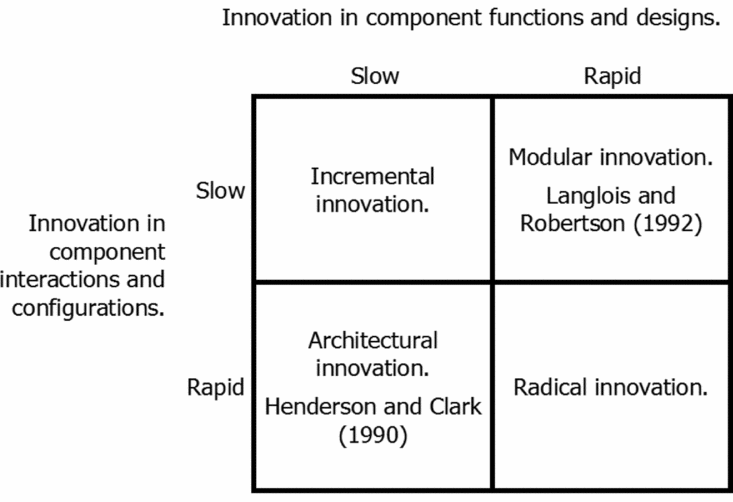
What has this to do with adjustment and recombination? Henderson and Clark (Reference Henderson and Clark1990) expanded the traditional categories of radical versus incremental innovation to include two new possibilities: architectural innovation and modular innovation. (See Figure 1.) Architectural innovation means keeping the modules unchanged while varying the way the modules are connected together. A paradigm of this would be Lego© bricks, which can be assembled into an infinite number of complex shapes. Modular innovation means keeping the architecture constant while varying the content of the modules. A paradigm of this would be a post-war component stereo system, in which one could constantly swap out amplifiers, pre-amps, speakers, and turntables for improved versions without changing the architecture fundamentally.
Types of innovation

This has implications for transaction costs, and thus for the institutional form that innovation assumes. In their (relatively) extreme forms, both architectural and modular innovations lend themselves to inexpensive recombination. This is because, in their extreme (modular) forms, architectural innovation and modular innovation are both kinds of autonomous innovation. When interfaces are standardized, it is easy to rearrange the pieces and even to incorporate pieces from far-away and unlikely sources.Footnote 2 Notice that this is recombination not in the sense of analogy but in the sense of swapping components in an out – it is recombination the way DNA does it.
As we move away from the extreme lower left and the extreme upper right of the figure, recombination starts to incur increasing costs of adjustment. In the lower right of the figure, the system becomes less modular; it isn't even clear whether there are distinct modules at all, and every part may interact with every other part. When recombination occurs in a non-modular way, often through analogy, it leaves in its wake a series of problems needing simultaneous solutions. This is arguably what happens in cases of major systemic innovations. To put it another way, systemic change creates a complex set of complementarities among the components: change in one part of the system will necessitate simultaneous changes in (perhaps many) other parts of the system (Langlois and Robertson, Reference Langlois and Robertson1995; Teece, Reference Teece1986).
Interdependencies – complementarities – are a source of what I call dynamic transaction costs (Langlois, Reference Langlois1992). Transaction costs are normally thought of in comparative-static terms as a horse race between alternative organizational forms in equilibrium, holding all other things equal. In historical time, however, the world is constantly changing – disequilibrium by anyone's definition – and all other things are not equal. For example, markets (and, more fundamentally, market-supporting institutions) may take time to develop in response to a large systemic innovation, and internal organization may thus prove superior in the short run because it can redeploy capabilities more speedily, not because it has any static transaction-cost advantages. I will suggest in this paper that the opposite can be true as well: sometimes it may be internal organization that is slow to respond to innovative possibilities, and spinning off into the market might be the best way to evade dynamic transaction costs. In either case, I argue, problems of complementarity can be overcome most cheaply when change is overseen by a single entrepreneur (or perhaps a very small group of like-minded entrepreneurs) who have unified control of all or most of the interdependencies involved.
At least since Frank Knight (Reference Knight1921), organizational economists have recognized that contracting can never be complete. Because of (perhaps radical) uncertainty and information costs, which are endemic in situations of systemic change, economic agents cannot foresee all future contingencies and thus cannot write contracts in enough detail to account for all contingencies. As a result, there must be a residual right of control, the right to decide what to do in situations not covered by the contractFootnote 3 (Hansmann, Reference Hansmann1996; Hart, Reference Hart1989). This takes us to the heart of the question of incentives to invent. If decision rights are in many hands, or are in the wrong hands, organizing a system of complementary innovations will imply costly persuasion, bargaining, and maybe hold-up. As the case study will illustrate, we should thus expect innovation to be most effective when agents have a structure of decision rights that matches the structure of the innovation.
Adam Smith on innovation
Perhaps because we live in the age of the internet and social networks, or perhaps because we live in the age of recombinant DNA, everyone seems agreed that innovation is all about recombination. Unanimity on this point extends from growth theory (Weitzman, Reference Weitzman1998) to economic history (Mokyr, Reference Mokyr2002) to technology management (Fleming, Reference Fleming2001). As author Matt Ridley put it in a much-viewed TED talk and elsewhere, innovation is about ideas having sex. In fact, however, this is an old idea, clearly articulated at least as early as Adam Smith, and upheld since then by writers as diverse as Clarence Ayres, Arthur Koestler and Joseph Schumpeter. Smith also pointed to mechanisms of innovation in addition to recombination, mechanisms that I will call subdivision (along with the related process of differentiation) and fine tuning.
‘The greatest improvement in the productive powers of labour, and the greater part of the skill, dexterity, and judgment with which it is any where directed, or applied, seem to have been the effects of the division of labour’ (Smith, Reference Smith1976, I.i.1). These are the very first words of Book I of The Wealth of Nations. Contrary to the teachings of the mercantilist writers – Smith essentially coined that term – the wealth of nations consists in productivity, and the division of labour is the key to increasing productivity. It is not that pre-existing differences in productivity make trade desirable; it is that trade is one way of increasing the extent of the market, and an increased extent of the market calls forth a process of learning-by-doing.
How does it work?
This great increase of the quantity of work which, in consequence of the division of labour, the same number of people are capable of performing, is owing to three different circumstances; first to the increase of dexterity in every particular workman; second, to the saving of the time which is commonly lost in passing from one species of work to another; and lastly, to the invention of a great number of machines which facilitate and abridge labour, and enable one man to do the work of many. (Smith, Reference Smith1976, I.i.5)
Putting aside the second reason, which is just a story about economies of scale, we have what seem to be two distinct benefits of the division of labour, increasing dexterity and technological invention. These two forms of learning-by-doing may be more similar than at first seems: they are both rooted in expertise.
Smith conceives of dexterity as the acquisition and continual improvement of tacit skills. It is fine tuning, not obviously recombination. With a narrow focus on simplified tasks, a worker is forced to repeat over and over the same set of operations; and more repetition means more skill, even phenomenal skill.Footnote 4 In the case of a line worker, that translates into more operations performed per unit time. This kind of learning-by-doing seems naturally limited by human physiology, however, and most economists would call it just human capital acquisition, not innovation. But Smith's point is that every new subdivision of tasks re-catalyses this process of fine tuning, implying that the process of subdivision itself enhances productivity: it is a kind of innovation.
Mechanical invention for Smith is also a form of learning-by-doing, albeit one involving perhaps a more conscious or explicit cognition. In becoming narrowly focused and knowledgeable about a specialty, the operative comes to understand the process intimately and is able to perceive ways of simplifying it. Smith also believes that the operative will have an incentive to invent: the utterly apocryphal boy who devised a closed-loop feedback mechanism for steam engines did so in order to free up time to play with his friends (Smith, Reference Smith1976, I.i.8). Obviously, the issues of incentive are more complex, and not merely because Smith is assuming that innovation is autonomous (Teece, Reference Teece1986), that is, that the innovation is all under the control of the operative, who does not have to coordinate with other stages of production. Moreover, the innovation is skill enhancing, not skill displacing, so it potentially benefits the operative to increase his or her productivity. Smith also assumes that the returns to invention flow to the operative who invents, in the form of increased leisure at the very least. This is probably in part because Smith tended to think of the division of labour as generating separate new ‘peculiar trades’ or ‘occupations’, which would be coordinated through markets. Incentives for invention by subdivided labour within the boundaries of firms may be quite different.
As Michael Polanyi (Reference Polanyi1958: 51) recognized, the acquisition of tacit knowledge requires not just repetition but also emulating a master. Even learning-by-doing narrowly understood implies the addition of new knowledge, not just the reorganization of existing knowledge. But this is not ‘recombinant’ in the sense most people mean. Smith was well aware of the power of recombination, however, and he was also well aware that not all innovation is autonomous: sometimes innovation is systemic (Teece, Reference Teece1986). Sometimes it requires simultaneous change in and coordination across multiple stages of production.
All the improvements in machinery, however, have by no means been the inventions of those who had occasion to use the machines. Many improvements have been made by the ingenuity of the makers of the machines, when to make them became the business of a peculiar trade; and some by that of those who are called philosophers or men of speculation, whose trade it is not to do any thing, but to observe every thing; and who, upon that account, are often capable of combining together the powers of the most distant and dissimilar objects. In the progress of society, philosophy or speculation becomes, like every other employment, the principal or sole trade and occupation of a particular class of citizens. Like every other employment too, it is subdivided into a great number of different branches, each of which affords occupation to a peculiar tribe or class of philosophers; and this subdivision of employment in philosophy, as well as in every other business, improves dexterity, and saves time. Each individual becomes more expert in his own peculiar branch, more work is done upon the whole, and the quantity of science is considerably increased by it. (Smith, Reference Smith1976, I.i.9)
Scientific knowledge is a good like any other, and it can be produced more efficiently by specialization and narrow expertise. Prescient as this account is, does innovation really come from the industrialized production of knowledge? Because, again, Smith tended to think about the division of labour as coordinated by spontaneous forces, his picture of expert innovation sounds more like the institutions of Paul David's ‘open science’ (David, Reference David2004) than like a corporate R&D lab. Moreover, when invention becomes its own specialty, the division of labour applies to systemic as well as to autonomous innovation. Like the shop-floor autonomous inventor, the professional inventor is able to frame the problem of technological change cognitively, in this case seeing the problem comprehensively, and, by combining together the powers of the most distant and dissimilar objects, is able to solve that problem through recombination.
This Smithian thread was taken up in the 1960s and 1970s by Nathan Rosenberg. In an unjustly neglected paper with Edward Ames (Reference Ames and Rosenberg1965), he generalized Smith's account of the division of labour. Ames and Rosenberg noticed that Smith considered only the specialization (or not) of workers, never that of machines.Footnote 5 For Smith, the problem is that tools are already specialized, but workers initially are not, meaning that one worker uses many different tools. There are therefore efficiencies to be claimed from specializing workers to the same degree as the tools, which may then lead to further specialization of both workers and tools. When workers become more specialized and tasks more routine and simplified, the skills of those workers become deeper along one dimension; but their set of skills becomes narrower. Writers from Smith himself to Marglin (Reference Marglin1974) have thus feared extreme deskilling as the end point of the process.Footnote 6 What they failed to appreciate, and what Ames and Rosenberg noticed, is that tools may also change their degree of specialization: they can become less specialized. Instead of performing one narrow operation, tools – or, now, machines – can start performing many different operations. However dexterous a human operative can become, a machine can potentially become far more dexterous. The despecialization of machines is clearly a recombination in some sense, but this sort of mechanization generates increasing returns because it spreads over more and more units the skills effectively programmed into the machine (Langlois, Reference Langlois, Dow and Earl1999).
This means that deskilling – cognitive narrowing in humans – is not in fact the ultimate result of specializing and simplifying tasks. The very processes that lead to efficient specialization of labour – simplification, subdivision, and clear articulation – also make it easier to mechanize tasks, since machines have a comparative advantage in the simple and routineFootnote 7 (Simon, Reference Simon, Anshen and Bach1960). The end result is broader skill for both machines and humans. In many if not most cases, mechanization involves not just a replacement of the human operative with a mechanical version performing the same operations, but rather the complete redesign of the production process. The human telephone operator of the early twentieth century was not replaced by an android that could insert plugs into jacks more quickly but by electromechanical switching equipment that connected calls in a completely different way. The new technology required users to learn new skills like dialling a phone and looking up phone numbers. It also crowded humans out of the routine activity of call switching into the less-routine activity of designing and maintaining electromechanical switches. Although the decreased specialization of machines displaces the existing skills of routine workers, this process simultaneously creates new (and cognitively more complex) specialties for humans, specialties in which those humans acquire skills through learning-by-doing (Bessen, Reference Bessen2015).
Complementarity
Perhaps the most significant way in which Rosenberg developed the Smithian tradition is in seeing innovation as fundamentally about both learning-by-doing and problem solving. For Rosenberg:
[Most] mechanical productive processes throw off signals of a sort which are both compelling and fairly obvious; indeed, these processes when sufficiently complex and inter-dependent, involve an almost compulsive formulation of problems. These problems capture a large proportion of the time and energies of those engaged in a search for improved techniques. (Reference Rosenberg1969: 4)
Rosenberg was writing in reaction to the formal representation of the production function, which makes a sharp distinction between technological change (a shift of the curve) and factor substitution (a movement along the curve). If factor substitution requires a significant movement along the curve, asked Rosenberg, can we really believe that the relevant techniques are ‘known’? Moreover, the formal literature at the time argued that, in equilibrium, technological change should never be biased in any direction, since firms will have the same incentive to reduce costs along one margin as along any other.Footnote 8 But the incentives look very different if we see production in terms not of a choice of known ‘techniques’, but of a chain of complementary activities. Innovation then becomes a cognitive process of finding and solving problems. Identify the problems – the bottlenecks in the system – and you have identified the inducement mechanisms and focusing devices that drive technological change:
Before the productivity-increasing benefits of any single breakthrough can be realized, many other accommodations need to be made. The expansion of a productive activity runs into a series of new constraints or bottlenecks. As one bottleneck is overcome, others eventually assert themselves and need to be expanded. (Rosenberg, Reference Rosenberg1972, p. 21)
The technology historian Thomas Hughes (Reference Hughes1983), who thought along very similar lines, called these bottleneck problems reverse salients.
Of course, Rosenberg was not the only one to think of technological change in terms of complementarity in production. But this point of view was arguably typical of what I think of as the Stanford School of the economic history of technology. The work of Paul David is about complementarities, and not only in the case of the typewriter keyboard. David (Reference David1990) famously argued that the adoption of electricity in American manufacturing after the invention of electric generation technology was slowed by the need to adapt complementary investments, especially the design of factories. David and Gavin Wright (Reference David and Wright1997) argued that America's success in mining came not so much from its resource endowment as from a network of complementary knowledge, technology and institutions. And Tim Bresnahan and Shane Greenstein (Reference Bresnahan and Greenstein1996) suggested that the personal computer required complementary ‘co-invention’ by users before it made a significant impact on productivity.
Problem solving in a chain of complementary activities. Is this recombination? Or is it mostly adjustment – fine tuning? Especially in the case of systemic change, innovation typically operates through a process of analogy, which is one manifestation of recombination. In the early automobile industry, the American conception of a horseless carriage competed with, and was quickly supplanted by, the French conception of a road locomotive. Henry Ford and his associates figured out how to make the latter work on unpaved roads and, more importantly, how to make such vehicles cheaply using the moving assembly line, borrowed by analogy from the disassembly lines in slaughterhouses (Ford and Crowther, Reference Ford and Crowther1922: 81). Yet – and this is Rosenberg's point – much of the hard work of innovation came not in imagining the recombinations themselves but in working out all the many difficult problems that inevitably crop up when one tries to combine together the powers of objects that are distant and dissimilar. Much of innovation is adjustment and fine tuning, even if, again, some of this problem solving may also take advantage of ideas and practices from other realms.
Differentiation
Before there was a Stanford School there was an Austrian School. Beginning in 1871 with founder Carl Menger (Reference Menger, Dingwall and Hoselitz1950), the Austrians saw the economy, both production and consumption, in terms of complementary activities and assets.Footnote 9 No one reflected this idea more clearly than Ludwig Lachmann. ‘All human action, unless prompted by ingrained habit of mind or guided by routine, is problem solving’, he wrote (Lachmann, Reference Lachmann1986: 49). For an entrepreneur, problem solving means managing assets in a chain of complementarity:
Complementarity is of the essence of capital use. But the heterogeneous capital resources do not lend themselves to combination in any arbitrary fashion. For any given number of them only certain modes of complementarity are technically possible, and only a few of these are economically significant. It is among the latter that the entrepreneur has to find the ‘optimum combination.’ The ‘best’ mode of complementarity is thus not a ‘datum.’ It is in no way ‘given’ to the entrepreneur who, on the contrary, as a rule has to spend a good deal of time and effort in finding out what it is. Even where he succeeds quickly he will not enjoy his achievement for long, as sooner or later circumstances will begin to change again. (Lachmann, Reference Lachmann1978: 3, original emphasis)
Lachmann distinguished between plan complementarity, the complementarity of the capital combinations of the firm, and structural complementarity, the complementarity of capital resources belonging to different firms trading with each other (Lachmann, Reference Lachmann1986: 63–4).
Rosenberg emphasized salience and commonality along the chain of complements, which leads multiple entrepreneurs and inventors to offer alternative solutions to what were basically the same set of problems. By contrast, Lachmann emphasized distinctiveness and idiosyncrasy, which leads entrepreneurs not only to offer alternative solutions but also to envision alternative problems. In the chain of complementarity, process innovation and product innovation are often hard to distinguish, and attacking one kind of problem often yields the solution to a different, and unexpected, problem.
It is easy to find examples in which the solution to a production problem led to a new product. In 1969, Ted Hoff and his team at Intel were trying to find an economical way to make electronic-calculator circuits for a Japanese client. Producing the necessary hard-wired logic chips would have been too expensive, so they hit upon the idea of a general-purpose logic chip that could be programmed with software (Noyce and Hoff, Reference Noyce and Hoff1981). That became the microprocessor. But Lachmann actually emphasized the opposite pathway. When entrepreneurs vary their products, in an effort to differentiate them from the products of competitors and thus earn rents, they inevitably generate unforeseen problems, which lead in turn to technological improvements, including process innovations. Indeed, for Lachmann, it is product differentiation that drives learning-by-doing, ‘the continuous improvement in productivity as engineers and workers come to learn more about what may be done with a given technology’.
In the view that is currently in fashion this phenomenon must be regarded as a ‘gradual shift in the production function’, a form of ‘disembodied’ technical progress that requires no new capital investment. In our view, by contrast, our phenomenon is primarily a manifestation of dynamic product differentiation. Once a new machine has been introduced, different people will use it in different ways in order to produce different products, or different varieties of the same product, which have to compete with each other for the same customers. It is the divergence of interpretations of the range of potentialities of the new machine that here lends shape and direction to the market process (Lachmann, Reference Lachmann1986: 57).
Recombination is certainly one way of differentiating products and processes. For example, in the 1970s, the noted automotive designer Hal Sperlich had toyed with the concept of a ‘crossover’ vehicle that would have characteristics of both a station wagon and a van. The idea went nowhere at Ford, and Sperling was eventually fired by Henry Ford II. But when former Ford executive Lee Iacocca took over Chrysler, he brought Sperling on board, where Sperling was able to take advantage of the front-wheel-drive K-Car platform to create the minivan (Levin, Reference Levin1995: 82–3).
Differentiation is a mechanism distinct from recombination, and it has potentially different organizational implications. By differentiation I mean not only changing the actual or perceived characteristics of the product – classic product differentiation in the literature of industrial organization – but also changing the technological and organizational procedures for making the product, as well as potentially subdividing the product, process, or organization into subunits. As the late Steven Klepper (Reference Klepper2016) makes clear, the process of differentiation is most often a matter of vertical and horizontal disintegration through spinoffs. Looking at examples that included automobiles, tyres, lasers, and semiconductors, Klepper found that what appear to be industrial clusters result not from geography but from differentiation.
Interestingly, the phenomenon of spinoffs seems to be driven by the same sorts of dynamic transaction costs as vertical integration. Morris Silver (Reference Silver1984) argued that, contrary to the narrative of slippery knowledge dominant in mainstream theory, innovators often discover that that they can't actually persuade others in the chain of complementary activities – those who hold the decision rights – of the value of their ideas. As a result, they must resort to vertical integration as a second-best alternative. Klepper (Reference Klepper2016: 79) tells a similar story about spinoffs. Innovators within an organization do not spin off a new firm in order to steal intellectual property. Quite the opposite: they typically form new firms because they can't persuade others in the chain of complementarity – others who hold the decision rights – that their ideas for (differentiating) changes in processes, products, or management are valuable. To acquire the necessary decision rights, they must set out on their own.
A tale of three Spragues
This all may sound rather abstract. To make it more concrete, consider the multi-generational story of the Sprague family of entrepreneur/inventors in electricity and electronics. This history not only illustrates alternative pathways for innovation but also provides a window into the history of American industry from the late 19th to the late 20th centuries. The story of Frank Julian Sprague (1857–1934) and Sprague Electric Railway and Motor Car Company illustrates systemic recombinant innovation and the importance of unified decision rights; the story of Robert C. Sprague (1900–91) and Sprague Electric illustrates modular or autonomous innovation as well as the mid-century model of corporate R&D; and the story of Peter J. Sprague (born 1939) and National Semiconductor illustrates the phenomenon of spinoffs and the disintegration (and then reintegration) of decision rights.
When he was eight years old in 1866, Frank Julian Sprague and his brother were sent to live with relatives in North Adams, Massachusetts when their mother died and their father disappeared to seek his fortune in California.Footnote 10 After high school, Sprague travelled to Springfield to sit for what he thought was the exam for West Point; it turned out to be the exam for Annapolis, where Sprague enrolled. Along with West Point, Annapolis in this period was one of the top schools for science and engineering education, and Sprague became obsessed with electricity, a passion he indulged while on shipboard duty, where he sketched ideas for inventions. He began making contacts within the electromechanical community, and was lucky to find himself moored at the Newport Torpedo Station, which was a hotbed of electrical innovation under Moses Farmer, the resident ‘electrician’. But the Mecca of invention was Menlo Park, and Sprague eventually resigned his commission to go to work for Edison.
This was the age of the dynamo – the electric generator. By spinning magnets within coils of wire to produce an electric field, a dynamo converts mechanical energy into electricity. But the process is reversible. Applying electric current to the same basic apparatus generates mechanical energy – the electric motor. This was Frank Sprague's real interest, and he eventually persuaded Edison to let him work on it. Sprague's singular idea was essentially to create a closed-loop feedback system that would keep an electric motor operating at a constant speed even as the attached load varied. This was the ideal solution for electric traction. Worried about priority and recognition, Sprague set out on his own, and, with the help of venture capital, started the Sprague Electric Railway and Motor Car Company. (It is striking to a modern how similar the world of electrical invention in the late 19th century was to that of Silicon Valley, with venture capital, start-ups, and spinoffs. Sprague was essentially a spinoff from Edison.)
The main chance was clear to everyone, and many people were working on it: intra-urban railways. At the time, public transportation consisted mostly of horse-drawn coaches, which were messy, slow and costly to operate.Footnote 11 The arrival of central electric power suggested a recombinant innovation: electric motors coupled with elements of steam railroads to pull the coaches. But the hard part was getting all the elements of that recombination to work and ironing out the kinks: the recombination presented a complex set of bottleneck problems and reverse salients. Initial efforts took the analogy literally. Edison's Menlo Park laboratory created a test system in which a locomotive, complete with cow catcher, simply swapped a repurposed dynamo for the steam boiler and pulled carriages behind it. As Sprague would eventually figure out, the system needed a complete redesign.
In 1887, a group of entrepreneurs visiting Richmond, Virginia noticed that the city had but one short horse-drawn tram line. They saw a profit opportunity. Having heard of Sprague from some tests he had run in New York, they approached with the offer of a fixed-price contract to build an entire electric transit system from the ground up, including central power plant, 40 cars and 80 motors. Sprague jumped at the chance without even visiting Richmond. Given a tight deadline (which in the end had to be extended), Sprague and his team rushed to solve myriad technical problems, most of them unexpected. He had to scale up the Sprague self-regulating motor significantly to deal with gradients as high as 10 per cent.Footnote 12 He had to figure out how to get power to the motors, settling on an overhead system. In the end, Sprague created a wholly new and modern system design in which the motors, suspended beneath the carriage in line with the wheels, were in the coaches themselves not in a separate locomotive – in effect a simplifying innovation that hid complexity within reorganized modules:
Like every pioneering innovator, Sprague met considerable resistance. Some came from fellow engineers who labeled his proposals as impractical, unscientific, and contrary to good engineering practice. Resistance also came from the owners and managers of the street and elevated railways because they were reluctant to alter traditional methods of operation. It is significant that Sprague did not make his pioneer installations in existing street railways or in the New York elevated lines. He succeeded in breaking the wall of resistance by securing a foothold in a new firm or one with new management. (Passer, Reference Passer and Miller1952: 235–6)
The Richmond system was a success, and Sprague's business took off. So did the electrification of mass transit, one of the most rapidly accepted innovations in history. It created ‘streetcar suburbs’, and altered the economic geography of the city long before the automobile. The rapid growth of electric traction, and of electromechanical technology generally, created tremendous economies of scale and scope, and by 1889 Sprague was induced to surrender his company to Edison General Electric, which had been formed that year under the auspices of Drexel, Morgan & Co. to unify and professionalize Edison's enterprises. In 1892, EGE merged with Thomson–Houston (which had absorbed Sprague's principal competitor) to form General Electric. Sprague went on to invent control systems for elevators and urban rail, leading to two more companies, the first sold to Otis Elevator in 1898 and the second, the Sprague Electric Company, to General Electric (again), this time in 1902.
Frank Sprague's son Robert C. Sprague took after his father: he attended Annapolis and took up electrical tinkering at sea.Footnote 13 Frank Sprague's era was that of the dynamo; Robert's was that of the vacuum tube and the radio. In some ways the radio evolved from the dynamo, in that Guglielmo Marconi's transmitters were electromechanical devices that spewed high-frequency electromagnetic energy; the invention of the diode and triode tubes allowed much cleaner reception and eventually transmission. Radio was initially a substitute for the telegraph where wires were impractical, notably at sea. This made it a military technology, and for the duration of World War I the government nationalized American Marconi, the British company that dominated radio early on in the US. After the war, the Navy wanted to retain control, but Congress compromised and created a ‘national champion’ – Radio Corporation of America – to take over the assets and personnel of American Marconi as well as assets and radio-related patents from GE, AT&T, Westinghouse and other companies. As audio modulation of radio waves became practicable, commercial radio – free broadcast bundled with advertising – was born, and the radio, like the electric railway, became one of the most rapidly adopted innovations in history, faster even than the personal computer. Like the personal computer, the radio benefited from a thick network of hobbyists; and like the personal computer, the radio was a relatively modular technology in which a fairly standard set of discrete components could be combined cheaply, implying low economies of scale in assembly (Langlois, Reference Langlois, Dosi and Galambos2013).
While still on active duty in 1925, Robert Sprague came up with an idea for a tone control for the radio in the form of a switchable bank of capacitors. He and his wife Florence started producing them out of their kitchen in Quincy, Massachusetts. Sales were disappointing. But Robert's brother Julian pointed out that the capacitors in the tone control were themselves small and well designed. These sold well, and Sprague Specialties (eventually to be renamed Sprague Electric, the name of Frank's third company) formed in 1926. Attempts to outsource production of the capacitors ‘didn't work out as planned’ (Sprague, Reference Sprague1958: 11), so the family had to set up their own assembly operations. By 1929, they needed space, and essentially by accident ended up in Frank's old home town of North Adams, where they bought a disused textile mill.
Sprague Electric was not a managerial multi-divisional enterprise of the sort that Alfred Chandler held out as characteristic of American industry. Closely held until the very end and always functionally organized, Sprague came closer to what Chandler (Reference Chandler1990) called personal capitalism.Footnote 14 Yet in many other respects Sprague epitomized the American manufacturing firm of the mid-20th century. The company initially focused on capacitors, a discrete ‘passive’ component essential to all electronic systems of the era. Sprague was highly vertically integrated, making not only capacitors but also its own fabrication machinery. This was largely because the company's strategy focused on quality and rapid generational innovation rather than price. Sprague established an R&D laboratory in North Adams to stay one step ahead in capacitor technology, which usually meant inventing production equipment as well. This was the classic mid-century model of innovation driven by in-house R&D, successful in this case because highly focused. Such innovation certainly involved applying science, what Joel Mokyr (Reference Mokyr2002) calls ‘propositional’ knowledge. Discovering new materials and processes for making capacitors also certainly involved some kind of recombinant knowledge, and fabrication is a complex process with bottlenecks and reverse salients. Yet in the large – from the perspective of electronic systems – this was fundamentally fine tuning of a modular component: figuring out how to produce capacitors at a progressively lower cost with increasingly superior specifications.
Alexander Field (Reference Field2012) has argued that the 1930s were the decade of highest US productivity growth in the 20th century. Perhaps the Sprague experience illustrates why: Sprague responded to the Depression by hiring a management-consultant firm to redesign factory processes and compensation schemes, and it pared expenses while temporarily halting R&D. Unsurprisingly, World War II was a bonanza for the company. By the end of the war, sales had increased eightfold and employment more than doubled. The war also propelled Sprague into products beyond capacitors. (They even teamed up with a local shoe firm to make gas masks.) Business declined when the war ended, but quickly picked up again as the Cold War and new technologies like FM radio demanded components. The New Deal Wagner Act forbade company unions, and Sprague's workers required a second try before creating a union that, although independent of the national labour organizations, was deemed kosher by the feds. Despite some unrest before the war and again in 1946 (when the repressed inflation of the war burst into view), labour relations at Sprague were calm throughout the post-war years, and the firm provided an array of mid-century-style paternalistic benefits.
The birth of the transistor in the early 1950s was not initially a disruptive innovation, since transistors simply substituted for vacuum tubes in circuits that still required many discrete passive components. Like other electronics firms, however, Sprague hoped to get involved in the transistor revolution, and it was one of the firms that bought rights (inexpensively) from Bell Labs. It is one of the central facts of the history of the semiconductor industry in the 20th century, however, that the electronics firms that were most successful in the vacuum tube era could not translate that success into the era of the transistor (Langlois and Steinmueller, Reference Langlois, Steinmueller, Mowery and Nelson1999). Sprague was no exception. The company set up a semiconductor production division in Worcester, Massachusetts. But, although company scientists did make some important contributions to the technology, the semiconductor strategy was unfocused and drew resources away from the cash-cow passives businesses.
By the 1970s, the world was changing for most traditional American firms. Foreign competition, which had been almost non-existent right after the destruction of World War II, began to resume in earnest. The Vietnam War inflation garbled price signals and would soon precipitate the collapse of the Bretton Woods system, increasing international flows of capital and goods. In a set-piece repeated throughout American industry, the Sprague workers, who had finally affiliated with the AFL-CIO a few years earlier, responded to inflation by staging a major strike in 1970 in the midst of a recession (Seider, Reference Seider2014). Sales plummeted, and, like other American firms, Sprague accelerated the process of moving labour-intensive activities to the South and overseas. North Adams collapsed into decline. At the same time, many American firms were flush with what Michael Jensen (Reference Jensen1986) dubbed free cash flow, the rents of America's temporary post-war dominance. These firms cast about for things to spend their money on, creating the conglomerate era of unrelated diversification. Sprague was an appealing target. After a near-miss with a merger to a similarly sized firm, the company was gobbled up first by General Cable in 1977 and then by Penn Central in 1981. When inflation subsided and foreign competition intensified, conglomerates were forced to get rid of unrelated units. Penn Central spun Sprague off in 1987; and, amid mounting losses, the company was finally pieced out completely by 1991. The former textile mill in North Adams that was once Sprague's main plant is now the Massachusetts Museum of Contemporary Art.
Why were the traditional electronics firms unsuccessful in semiconductors? Essentially because the model of product and process innovation through corporate R&D was the wrong model. Once the transistor effect had been demonstrated at Bell Labs, the crucial reverse salient was production: how to fabricate the devices cheaply and reliably. It was a classic learning-by-doing problem. And it turned out that highly specialized start-ups were best equipped to solve it.
William Shockley, one of the inventors of the transistor, decided to leave Bell Labs and set up shop on the San Francisco Peninsula where he had grown up. Shockley was a great recruiter of personnel but a terrible manager and by all accounts an unstable personality. When he decided to turn away from the problems of production in an attempt to invent new devices, his best staff members revolted. The ‘traitorous eight’, as they were famously called, secured venture capital from Long Island investor Sherman Fairchild and set out on their own. One of the eight, Jean Hoerni, figured out a way to create transistors by sequential deposition – the planar process – and his colleague Robert Noyce extended the idea to fabricate multiple transistors on a single substrate – the integrated circuit. In many ways the planar process was a recombinant innovation. Hoerni's breakthrough came because, as an inveterate contrarian, he went against the conventional wisdom and tried leaving an oxide layer on top of the wafer. He discovered that the oxide was in fact a terrific insulator; and by combining this insight with several diffusion processes already well known at Fairchild, he created a new and vastly superior way to fabricate transistors (Lécuyer, Reference Lécuyer2006: 150–2).
The problems involved were arguably a more complex version of the kinds of problems Sprague had had to solve in fabricating capacitors. But not only did Noyce and company make the crucial breakthroughs, they were also highly focused on price and performance, not product innovation, and they were unencumbered by the baggage of capabilities and investments in other technologies. Rather than engaging in traditional corporate R&D seeking new knowledge, spinoffs like Fairchild and Intel followed what Noyce called the principle of ‘minimum information’ – do research only when you run into a roadblock and have no other choice (Moore and Davis, Reference Moore, Davis, Bresnahan and Gambardella2004: 20). Thus what started as a recombinant innovation proved successful as a trajectory for fine tuning. Under production manager Charlie Sporck, Fairchild began mass-producing semiconductors using the planar process, employing the same kind of learning-curve pricing that Henry Ford had once used with the Model T (Lécuyer, Reference Lécuyer2006: 200–7).
But Sherman Fairchild had a buyout option. This he speedily exercised in 1959, turning the successful start-up into the West Coast division of his Fairchild Camera and Instrument Company. The change in ownership structure – in decision rights – immediately led to conflict. Not owners, and without stock options, the engineers were no longer being rewarded. Perhaps more importantly, they felt that the new owners did not understand what it took to be successful in the semiconductor business. Referring to the company's distant Long Island headquarters, Charlie Sporck recalled that ‘the Syosset folks were using large profits generated by semiconductor operations to fund acquisitions that didn't make a lot of sense. There was a growing friction between the division's management and the Fairchild corporate management’ (Sporck, Reference Sporck2001: 139). Soon, Fairchild staff were defecting in droves to create their own start-ups, fuelled by venture capital. Far more than agglomeration economies, it was these spinoffs that created Silicon Valley (Klepper, Reference Klepper2016, Moore and Davis, Reference Moore, Davis, Bresnahan and Gambardella2004).
When Julian Sprague died young in 1960, his son Peter was left with a small inheritance. An adventurer and entrepreneur by inclination, Peter was not an engineer like his uncle and cousin but had studied political science at Yale and MIT and economics at Columbia. While working in New York in 1964, he invested in a small, near-bankrupt firm called National Semiconductor that was operating out of a former hat factory in Danbury, Connecticut. By 1966 he had taken the company public on the cheap and was chairman of the board.Footnote 15 For the third generation, a Sprague was head of an electronics firm by age 27. Charlie Sporck soon came calling with a group of defectors from Fairchild, looking for a company that would give them the decision freedom they had lacked. ‘I proposed a plan’, wrote Sporck in his memoirs, ‘wherein I would bring some competent people from Fairchild with me, and we wanted complete decision making authority, along with a free rein to turn the company around’ (Sporck, Reference Sporck2001, p. 211). Overcoming initial misgivings, Sprague cleared the way by firing some of the existing staff, and the board installed Sporck as CEO, giving him carte blanche. And stock. This arrangement was an early template of the Silicon Valley firm (Lécuyer, Reference Lécuyer2006: 259–61).
Sporck immediately cut employment in Danbury and moved the company's centre of gravity to the Peninsula. National became a cost leader in the production of semiconductors through tight operational controls, outsourcing final assembly to the Far East. By 1975, the company was a ‘super-mass-production manufacturer’ – the largest producer in California and the second largest (after Texas Instruments) in the US (Lécuyer, Reference Lécuyer2006, pp. 291–2). In 1987, National acquired what was left of Fairchild, eventually selling it off again in pieces at a profit, though by that time National was losing its cost advantage to Asian competitors and had begun focusing on its niche of linear rather than digital semiconductors (Sporck, Reference Sporck2001). In 2011, National itself was acquired by Texas Instruments for $6.5 billion.
Perspective
Yes, innovation often involves recombination. That was true of the electric railway, of capacitors, of the planar process. But these recombinations – the contours of which were often ‘in the air’ – all threw up arrays of complementary problems that had to be solved from the bottom up. Especially when innovation is non-modular, recombination requires fine tuning and problem solving to be successful. And sometimes it is the bottom-up process of problem solving that shows the way for new recombinations.
In a non-modular environment, problem solving along the chain of complements requires the synoptic vision that Adam Smith described. It also requires unified decision rights, often implying vertical integration or at least a synoptic design stage with wide rights of control. Innovation also occurs through differentiation – fissioning and forking away from established ways of doing things. This kind of innovation also requires cohesive decision rights, achieved by spinning off a new ownership structure. Vertical integration and spinoffs are the two faces of the problem of dynamic transaction costs.
Acknowledgements
I would like to thank David Harper, Geoff Hodgson, Deirdre McCloskey, and four anonymous referees for helpful suggestions. I also benefited from the comments of participants at the symposium on Innovation and Creative Production: ‘Innovation from the bottom-up’, 2 December 2016, New York University, and at the WINIR Symposium on the Legacy of Ludwig Lachmann, 11–13 April 2017, Johannesburg. Remaining inadequacies and errors are my own.