Introduction
Population ageing is widely regarded as one of the main challenges facing European countries today. Low fertility and the increase in life expectancy have led to an irreversible and continuous increase in the absolute and relative numbers of very old and dependent people. According to United Nations 2005–base projections, 10 per cent (38 millions) of the (the former 15 country) European Union population will be aged 80 or more years by 2050. Residential and community care for frail older people has been developed to a variable extent among European countries, but nowhere can formal care services meet the entire demand for care. To face this critical situation, governments have implemented various policies to promote informal care. But before shifting the care ‘burden’ to the family, a fundamental question has to be addressed: is today's family able and willing to take up this responsibility? Intergenerational solidarity is still very strong (Dooghe Reference Dooghe1992; Ogg and Renaut Reference Ogg and Renaut2006). In most cases, the family, and especially women, remain the main carers for older adults (Jenson and Jacobzone Reference Jenson and Jacobzone2000). Nevertheless, intergenerational solidarity has changed: more and more women wish to be financially independent and to have careers.Footnote 1 The result is that caring activities are increasingly viewed as an additional or competing role.
A better knowledge of the factors that facilitate or hamper the combination of the work and care roles at different stages of a woman's life will help decision makers manage the labour force and social security funds. Many researchers have studied the effect of elder care on women's work characteristics. The presented analysis is original in four ways: it draws on European data while most studies have referred to the United States; it uses a longitudinal approach to examine the long-term effect of care; it studies the effect at different life stages; and it tests whether it is the care per se or the intensity of the care that influences the work participation of European women.
Literature review and research hypotheses
Research on the care-work relationship has used many and diverse theoretical frameworks, study populations and data, and considered many different aspects of care and work. Labour market studies, for instance, have been interested in the effect of care on employment participation and characteristics (Dentinger and Clarkberg Reference Dentinger and Clarkberg2002; Crespo Reference Crespo2006). Psychologists have focused on the ‘stress’ or ‘strain’ experienced by women with the dual and ‘competing’ roles of worker and carer (Dautzenberg et al. Reference Dautzenberg, Diederiks, Philipsen, Stevens, Tan and Vernooij-Dassen2000; Rozario, Morrow-Howell and Hinterlong Reference Rozario, Morrow-Howell and Hinterlong2004; Sarasa Reference Sarasa2005a). Econometricians, often taking the allocation of time as the theoretical framework (Becker Reference Becker1965), have tried to measure the opportunity costs of care (e.g. Carmichael and Charles Reference Carmichael and Charles1998), and to correct for the potential endogeneity of care in the working hours function (Johnson and Lo Sasso Reference Johnson and Lo Sasso2000; Spiess and Schneider Reference Spiess and Schneider2003; Heitmueller and Michaud Reference Heitmueller and Michaud2006). Finally, social gerontologists have tried to assess the effect of working status on the probability of providing informal care to an older relative (Stone and Short Reference Stone and Short1990; Boaz Reference Boaz1996).
The cross-sectional and longitudinal studies of the effect of caring on the probability of reducing working hours or ceasing to work were first reviewed. Most studies have restricted the study population to women, because it is well known that they are more likely to become carers. Some studies have focused on those aged 50 or more years, the age group with the highest probability of having a dependent parent. Dautzenberg et al. (Reference Dautzenberg, Diederiks, Philipsen, Stevens, Tan and Vernooij-Dassen2000) carried out a telephone survey in four Dutch municipalities among women aged 42–56 years. Inspired by role theory, they tested various hypotheses on the relationship between work and care. One concerned the impact of caring on the adjustment of working time. No evidence was found that the caring activity led to a change. Similar results were found in the United States (US) using data from the 1988–89 National Survey of Families and Households (NSFH) (Wolf and Soldo Reference Wolf and Soldo1994). When analysing married women with one or more living parent aged 65 or more years, no evidence was found that being a carer of a parent reduced either the propensity to be employed or the conditional hours of work.
Carmichael and Charles (Reference Carmichael and Charles1998) studied the influence of informal care responsibilities on the labour supply of women. Using a representative sample from the 1985 General Household Survey (GHS) of Great Britain of women aged 21–59 years, they examined the relative importance of the income, respite and substitution effects of caring on employment participation. Their findings supported the hypothesis that the combined effect of income and respite care prevailed over the substitution effect: women who were carers did not have a lower rate of participation in employment. They may even be more ‘attached’ to their work because it provides them with a break from the caring responsibilities. Women carers did, however, work fewer hours and they received lower incomes than non-carers. Carmichael and Charles suggested that there was a threshold effect, in that the negative effect of caring on earnings was not unconditional but occurred only when the care was intensive (defined as 20 or more hours per week). Crespo (Reference Crespo2006) also found that providing intensive care had a negative effect on middle-aged women's paid-work. She used data from the first wave in 2004 of the Survey of Health, Ageing and Retirement in Europe (SHARE), which allowed comparison of the effects in northern and southern Europe. Interestingly, a significant negative effect was found in both regions. If the propensity for being a carer is higher in southern Europe, once the role is adopted, the effect on work participation is present everywhere.
This first group of studies provides evidence that being a carer does not lead women to reduce hours of paid work, but that providing intensive care is associated with the reduction or even cessation of work. The main limitation of these studies is that cross-sectional data cannot detect delayed or lagged effects: only short-term responses to being a carer are captured. It is reasonable to think that the decision to cease working will in many cases not be taken immediately a care episode begins. Most probably, the decision comes later, when the working-and-caring woman becomes aware that she can no longer manage the two roles. Longitudinal data are needed to capture such delayed or lagged effects.
The earliest longitudinal analyses of the effect of informal care were carried out in the US by Pavalko and Artis (Reference Pavalko and Artis1997) using the 1984 and 1987 waves of the National Longitudinal Survey of Mature Women (aged 50–64 years). They found that women who started to care were more likely than non-carers to reduce their working time or even to cease work. Johnson and Lo Sasso (Reference Johnson and Lo Sasso2000) reached the same conclusion using the first three waves (1992, 1994 and 1996) of the Health and Retirement Study. Retrospective data have also been analysed in the US and Europe. Henz (Reference Henz2004) investigated the reported effect of caring episodes on working patterns using the work and care life stories collected by the 1994–95 Family and Working Life Survey. She was particularly interested in the timing of the first caring episode and its implications for the trajectory of employment. She highlighted the diversity of caring experience and confirmed that women, especially those near the end of their working lives, were more likely to become carers. Some of the workers who became carers did report changes in their working hours and some stopped work. Such responses were more frequent among those in routine or semi-routine jobs, but unfortunately variations by age group were not reported. Dentinger and Clarkberg (Reference Dentinger and Clarkberg2002) used retrospective data for people aged 50–72 years from the 1994–95 Cornell Retirement and Wellbeing Study to investigate whether providing care, and its characteristics including intensity, led people to retire earlier. The results showed that the effect of caring was, as expected, stronger for women and that it varied with the characteristics of the provided care.
Spiess and Schneider (Reference Spiess and Schneider2003) used data from the 1994 and 1996 waves of the European Community Household Panel (ECHP) to explore the relationship between changes in caring hours and in working hours among women aged 45–59 years who were in paid work at one or both waves. The results showed that starting to care or increasing caring hours raised the probability of a reduction in working time, particularly in southern Europe and Ireland. Viitanen (Reference Viitanen2005) worked on a larger sample of women aged 20–59 years from all ECHP waves (1994–2001). She tested the effect of caring (regardless of intensity) on the probability of ceasing work for each country separately. In most cases, the effect of informal care was statistically insignificant, which may have been a consequence of the few women carers in some country samples or because of the simple definition of care (viz. caring or not). As Carmichael and Charles (Reference Carmichael and Charles1998) noted, it seems that the effect of caring depends on its intensity.
These longitudinal analyses have shown that even when the delayed effect of care is considered, it is still important to take into account its intensity. Some of the studies found that the effect of care differs according to the women's stage of life but did not consider that element in the explanatory analyses or models. Age is often entered as a continuous variable, but this does not reliably capture life stage. This paper takes as its starting point two of the key lessons of previous research: the importance of using longitudinal data to study the delayed effect of caring, and the importance of examining care intensity. The presented analysis also adds the original feature of using a life stage approach. Because the experiences of work and family life change over time, we may expect that the experience of caring and its consequences will vary by age group and life stage.
This paper examines the effect of caring on the probability of women ceasing work using 1994–2001 ECHP data. The ‘global’ effect of caring was tested first, and then the effect of providing intensive care (i.e. at least two hours a day). The analysis was carried out on the entire sample of working women, and then on each age group separately. The age groups were constituted to represent specific life stages. The youngest age group was therefore defined as aged 20–29 years (when women enter the labour market and start child bearing). The next group was aged 31–49 years, taken to be middle-aged women in a relatively stable period of their lives, with children growing up and a career progressing. The oldest age group (of female workers) was defined as those aged 50 or more years. Many women of this age have frail parents who require their help. If the parents' need for care increases, early retirement may be more appealing for women at this life stage than a change in work commitment.
The research questions
On the basis of previous work and current understanding, two hypotheses were formulated:
H1: Being a carer per se does not affect employment participation, but providing intensive care does have a significant effect on the probability of ceasing paid-work.
H2: The direction of the intensive care effect depends on the women's life stage and on their relative attachment to their work. We expect a positive effect for older women, who are less attached to the labour market, being near the end of their working life. A negative effect is more likely to occur among younger women (who keep working because it provides them with a break from caring and their earnings enable them to pay for professional care to share the responsibility).
Data and methods
The European Community Household Panel data
The ECHP was a large longitudinal survey that was funded by the European Union and conducted from 1994 to 2001. The standard questionnaire had several modules that dealt with individual characteristics, household composition, income and expenditure, education, and employment (working status and its characteristics). The response rate at the first wave was 71 per cent across all countries, and ranged from 40 per cent in Luxembourg to 90 per cent in Italy and Greece (Eurostat 1996). In the social relations module, questions were asked about caring activities at the time of interview (e.g. whether the respondent provided informal care, hours-a-week spent in care, and if the care recipient was a co-habitant).
Study sample
To be included in the analysis sample, a woman had to have participated in the ECHP since the first wave (1994) and to have been in work at the second wave (1995). Among the 66,195 women in the first wave, 6,705 were excluded because they subsequently left the panel, 34,821 because they were not working in 1995, and 77 because their working status was missing. The final sample comprised 24,592 European women working in 1995.Footnote 2 The analyses were carried out on this pooled sample. Comparisons with official figures and with other data assessed whether the study sample was representative of working women and, more particularly, the caring sub-sample. The proportion of women who were working in the ECHP of 1995 was similar to that reported in the official statistics of each country. As there are no comparable national statistics on carers, the attributes of women carers who worked (as compared to those not working) were identified from the research literature. Barnes and Given (Reference Barnes and Given1995), among others, have shown that working carers tend to be younger and more highly educated than non-working carers. This pattern was verified by the ECHP data: the median age of non-working carers was 56 years as against 45 years for working carers. Forty-nine per cent of the first group had completed secondary school, against 28 per cent of the second. Overall, non-working women were more likely to be a carer (9% against 6%) and to provide intensive care (6.3% against 3.2%). It was concluded that the ECHP samples were broadly representative of each national population, and no evidence was found of a selective bias in the sub-sample of working women.Footnote 3
The selectivity or bias of the sample attrition was also investigated.Footnote 4 The initial sample of 24,592 women reduced by 5.7 per cent during the first year, and attrition continued thereafter at a lower level. The absolute number of women leaving the panel was almost stable over time, and 62 per cent of the sample remained until the end.Footnote 5 A comparison between the attritor and non-attritor members of the sample showed that the percentage of the non-attritors who ceased work was nearly twice that of the attritors (34% against 18%) (table not shown). Given that the distribution of the personal characteristics differed little between the two sub-groups, it is reasonable to believe that selective attrition is not an issue.
Discrete-time event history analysis
Discrete-time event history analysis was chosen as the main analytical approach for two reasons. First, if one assumes that the decision to leave work was not immediate and was influenced by the individual's earlier circumstances, then a longitudinal approach was required. Secondly, being a carer of an older adult (the main independent variable) was not necessarily a constant. Event-history analysis allows predictors to change through time. The event of interest is the first transition out of work between 1995 and 2001, an unrepeatable event.Footnote 6 Later events were not considered in the analysis. The beginning of the study period was then a time when none of the sample had experienced the study event, and was taken as the time of the interview in 1995. The first events that occurred during 1995–96 were recorded by the 1996 interview. Providing that a ‘person period’ file is created, the data analysis for discrete-time event history analysis with a dichotomous dependent variable can use binary logistic regression.Footnote 7 The structure of the file allows dealing with time-varying variables and interpreting the results in terms of hazard rates.
Measures
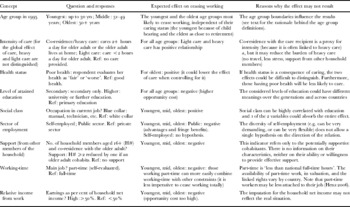
The operational definitions of the dependent and independent variables are summarised in Table 1. According to the literature, the recommended control variables for hazard rate models are the woman's health status, education, social class, activity sector, support,Footnote 8 working time and relative income from work.Footnote 9 The questions on care intensity were administered only to the respondents who stated that they were caring for older adults at the time of interview.Footnote 10 It should be noted that this question concerns only ‘unpaid’ caring activities, even though in some of the study countries allowances for carers were paid to compensate for the caring costs. In the event-history analysis, time was also included as a predictor. Both linear and quadratic terms were included in the logistic regression.Footnote 11
Operationalisation of the analysed variables and expected relations

Note: Ref: Reference category.
All the predictors except life stage could vary through time. The time-varying predictors were lagged one year, on the assumption that the woman's working status at the end of a given period is associated with the values of the predictors during the preceding wave/year. The rationale was that the characteristics of employment (e.g. full-time or not, blue collar, activity sector) are state-dependent: they will by definition be missing when a woman ceases working. Lagged-specification was therefore needed to include those characteristics in the analysis. Most variables had very few missing values (generally close to one per cent) except for having ‘part-time’ work (15% missing at Wave 1). To avoid deleting observations with missing values, information from previous waves was used to impute the values of the independent variables. This correction allowed analyses on a larger and less ‘selected’ sample even if imputation may lead to under-estimation of change over time. Observations with missing values on the dependent variables were deleted.
The descriptive results
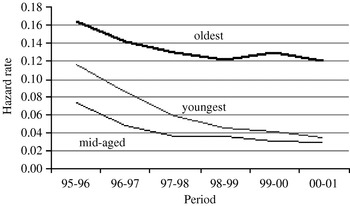
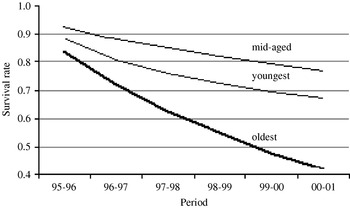
From 1995 to 2001, 28 per cent of the sample made the transition out of employment but the percentage varied by age group (28% for the youngest, 20% for the middle-aged and 50% for the oldest). Life tables were computed separately for each age group to see if the hazard rate of ceasing work differed from one group to another. Figure 1 shows that the hazard rate had the same general shape for the three age groups: beginning high and afterwards decreasing slowly, and that the oldest age group had the highest rate in each period and the lowest gradient of decline. The youngest age group had the steepest curve: the hazard rate decreased threefold between 1995–96 (0.12) and 2000–01 (0.04).
Hazard rate of ceasing work by age group and time. Source: ECHP 1994–2001.

Survival function for ceasing work by age group and time. Source: ECHP 1994–2001.

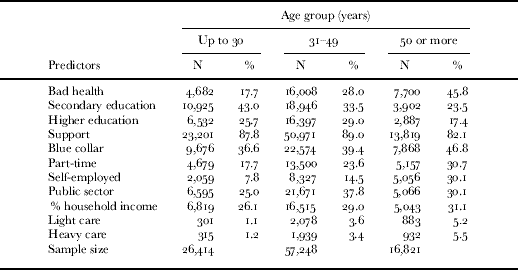
Table 2 shows that the personal characteristics of each age group differed considerably. For instance, 46 per cent of the oldest age group (over all waves) evaluated their health status negatively during the last year, compared to 18 per cent for the youngest and 28 per cent for the middle-aged.Footnote 12 For the oldest age group, in 30 per cent of the person-periods the respondent was self-employed during the previous year (compared to 14.5% for the middle-aged and 7.8% for the youngest group). Working part-time was also more frequent for the oldest group (30.7% against 23.6% for the middle-aged and 17.7% of the youngest). As expected, the proportion of those who were carers was highest in the oldest group (10.7% against 2.3% for the youngest and 7% for the middle aged). In each age group, one-half of the carers provided intensive care.
Distribution of the personal characteristics by age groups
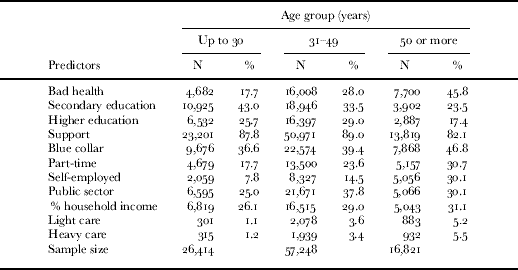
Source: European Community Household Panel (ECHP), Waves 1994–2001.
The explanatory results
The first model was an event-history analysis for the entire sample (controlling for age group) that tested the first hypothesis. Afterwards, separate models were fitted for each age group to test the second hypothesis.Footnote 13
The effect of caring depends on care intensity
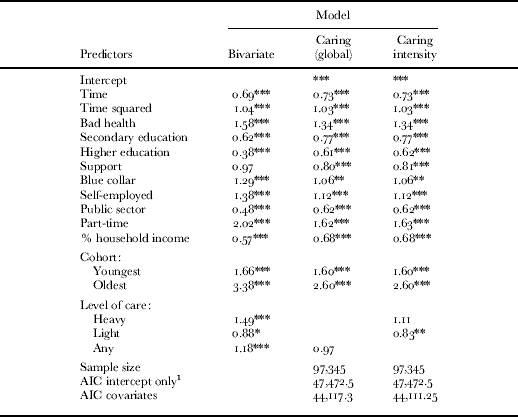
Bivariate analyses showed that all the predictors except the support variable were significantly associated with the probability of ceasing work (Table 3). Women in the oldest group were more than three times as likely to cease working during the following year as the middle aged (odds=3.38). Higher-educated women were 40 per cent more likely to cease working over the next year than those having only a primary school diploma. Working part-time rather than full-time doubled the odds of ceasing work during the following year (odds=2.02), while working in the public sector rather than the private sector decreased the probability of ceasing work (odds=0.45). Of all the variables, age group was the most influential. Comparing the bivariate and multivariate analyses, all the variables that produced significant bivariate associations remained significant in the multivariate models (separately of care intensity and of the fact of being a carer). These results contrast with previous findings that have found that the fact of being a carer is not significant when personal characteristics are controlled.
Hazard rate models for ceasing work (effect of caring characteristics for the entire sample)
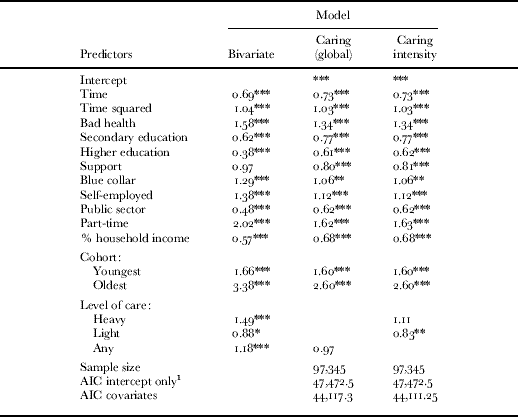
Notes: The sample size refers to the number of observations (person-periods) used for the analysis (after exclusion of the observations with missing values on at least one of the predictors). The first columns present the result of the bivariate analyses (gross odds). The next columns show, for each caring characteristic, the result of the ‘full control’ model (including all the independent variables). 1. The Akaike's Information Criterion (AIC) statistic compares the fit of nested models (Akaike Reference Akaike1974).
Significance levels: *** p<0.01, ** p<0.05, * p<0.1.
Source: European Community Household Panel 1994–2001 (see text).
When heavy care and light care were distinguished, a significant effect was found in the multivariate analysis. Providing light care had a negative effect: working women who provided light care were less likely to cease working during the following year than those who were not caring for older adults. A possible explanation is that these women were more attached to their jobs, either because they needed the money to pay for complementary formal care (an income effect), or because working provided a break from caring. Cross-tabulations (not displayed) show that these women tended to be higher educated and to have a white-collar job. The opposite was true for working women who provided heavy care. These women also had worse health status (38% against 28%). Providing heavy care was not significant in the multivariate analysis, probably because its effect varied from one age group to another.
The effect of care intensity depends on the life stage
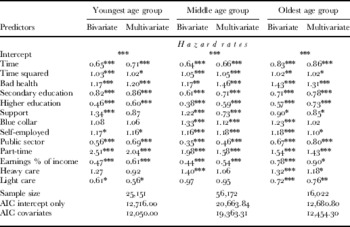
Caring for older adults was relatively uncommon among women in the youngest age group (up to 30 years). In this group, as in the entire sample, the effect of providing light care was negative (gross odds=0.61): in the multivariate model, when controlling for personal characteristics, the odds of ceasing work during the next year were 56 per cent of the odds among those not providing care for older adults (Table 4). This negative effect was stronger than in the bivariate analysis. Among the other variables introduced in the model, there was a high positive effect of working part-time: all other things being equal, the odds of ceasing work were almost twice (odds=2.04) those of full-time workers. Other characteristics of particular importance for this group were: being higher educated, with the odds of ceasing care 40 per cent lower that those with lower education; and having only secondary school education also had a negative effect, but the effect was smaller. Working in the public sector reduced the odds of ceasing work by around 30 per cent. Women contributing at least 50 per cent of the household net income were about 40 per cent less likely than others to give up work.
Hazard rate models for ceasing work (effect of caring intensity by age groups)

Significance levels: *** p<0.01, ** p<0.05, * p<0.1.
Source: European Community Household Panel 1994–2001.
Among middle-aged working women (aged 31–49 years), the bivariate analysis showed that providing heavy care was associated with an increase of 40 per cent in the odds of ceasing work compared to those who did not care for older adults. The multivariate model demonstrated that, controlling for personal characteristics, care intensity did not influence the probability of ceasing work, but that all the control variables were significant. Among this age group, only personal characteristics predicted exit from work during the following year. The most influential predictors were the same as among the youngest age group: working part-time (positive effect), working in the public sector, large contribution to household income, and having had secondary and higher education (negative effect). Among this age group, however, poor health also had quite an important effect, being associated with a 46 per cent increase in the odds of ceasing work during the following year, all other things being equal.
Among the oldest age group (aged 50+ years), as mentioned, ceasing work is a ‘normal’ and expected event, and interest in the effect of caring is on whether it explains the timing of the exit or encourages ‘early retirement’. It is therefore of interest that both light care and heavy care had a significant effect in the multivariate models in the expected direction. All other things being equal, when compared to women who did not care for older adults, those providing light care were less likely to cease working during the following year (odds=0.76), while those providing heavy care were more likely to do so (odds=1.18).
Discussion
This paper has examined the influence of caring on the working status of European women. The ECHP dataset (1994–2001) was used to trace the effects of care intensity on the probability of ceasing work at different life stages (as represented by three age groups). The first hypothesis was that it is not the fact of being a carer that affects the probability of ceasing work but the intensity of the care. Analysis of the entire sample showed that, once controlling for personal characteristics, the effect of being a carer lost significance, but when care intensity was considered, providing light care did significantly decrease the likelihood of ceasing work. The non-significance of being a carer has been reported by previous studies (Wolf and Soldo Reference Wolf and Soldo1994; Dautzenberg et al. Reference Dautzenberg, Diederiks, Philipsen, Stevens, Tan and Vernooij-Dassen2000), as has the significant effect of care intensity (Carmichael and Charles Reference Carmichael and Charles1998; Crespo Reference Crespo2006). The new and surprising result is that it was less intensive care that had a significant and negative effect on work exit, not intensive care. This negative effect could be explained by the respite effect of work (Carmichael and Charles Reference Carmichael and Charles1998), but given the large effect of age group, it would be premature to apply this interpretation to the entire sample. It is possible that the respite effect applies only to a specific age group.
The second part of the study focused on the associations for each age group. As opportunities for and attachment to work vary over the lifetime, it is likely that the effect of care on employment also varies by life stage. Some previous descriptive results have supported this proposition, but the only tests of life-stage hypotheses have focused on the caring experience of ‘mature’ working women (Pavalko and Artis Reference Pavalko and Artis1997; Dentinger and Clarkberg Reference Dentinger and Clarkberg2002). It was hypothesised that the effect of care intensity varies by age group, and was expected that the respite effect would be strongest for the youngest group, and the substitution effect strongest for the oldest. As for the middle-aged group, the effect of care was expected to be weaker because, at this life stage, commitment to work is usually high and stable.
The second hypothesis on the differential effect of care intensity by age group was partly supported. The analyses confirmed that the middle-aged group was not affected by the caring activity whatever its intensity. Also, the positive effect of intensive care for the oldest group was supported, in line with the previous studies of mature women. Alongside, a negative effect of providing non-intensive care was found for the youngest and the oldest age groups (and observed for the entire sample). This result is interesting for two reasons, because the effect applied at the two ends of the working life, and because most of the studies on the effect of care intensity have examined the effect of intensive care, either by treating this variable as continuous or by imposing a minimum threshold (as of hours) for the caring activity (Carmichael and Charles Reference Carmichael and Charles1998). By considering the effect of both non-intensive and intensive care, the analyses have revealed a respite effect particular to non-intensive care. Further research is needed to validate this effect. The ECHP contains information on care activity and is the only extant dataset that allows us to study the care provided to older people over time in European countries, but it does not provide as much detailed information on older people and intergenerational relationships as some specialised surveys. The absence of clear criteria for identifying the carer and of information on the availability of other sources of care may have influenced the results.
Conclusions and policy implications
By highlighting the importance of a carer's life stage, and in showing that caring is not necessarily incompatible with paid work, the reported analyses have made an original contribution to the study of the relationship between care and work. It has also been shown that when the care activity becomes too demanding, over time some women cease paid work. The analyses have shown that those in the oldest age group were more at risk of becoming carers, of providing intensive care, and of ceasing work when they became carers. The results have clear policy implications. The macroeconomic consensus is that to respond to population ageing, we should keep workers at the workplace longer. The absolute and relative numbers of workers aged 50 or more years is increasing, but a substantial proportion is likely to care for a relative at this life stage. To avoid more early retirements as a consequence of heavy care responsibilities, it is important to develop formal services (e.g. day care and community care) to reduce the intensity of informal care and to allow carers to continue to work (Chappell and Blandford Reference Chappell and Blandford1991). Further research is needed to identify other care characteristics, such as duration, the kind of care provided, and the relationship between the carer and the cared-for person, which may affect the capacity of the working carer to maintain their double commitment.Footnote 14
Acknowledgments
I would like to thank my supervisor Jaak Billiet (a sociologist at Katholieke Universiteit Leuven) and Bruno Schoumaker (a demographer at Université Catholique de Louvain) for their advice. I also thank the anonymous reviewers for their detailed and very useful comments. The analysis of the ECHP data was conducted during a placement with the Centre d'Études, de Populations, de Pauvreté et de Politiques Socio-économiques and International Networks for Studies in Technology, Environment, Alternatives, Development (CEPS/INSTEAD) of the International Masters in Social Policy Analysis (IMPALLA) programme in Leuven and Luxembourg.